Growing up, nobody told you there was an alternative. Monogamy wasn’t presented as one option among many. It was the only option. The default. The path you followed without question. But defaults work great for the people they were designed for. For everyone else, they leave a quiet question hanging in the air: Is this really the only way to love?
Polyamory is the practice of having multiple romantic relationships at the same time, with the knowledge and consent of everyone involved. The word comes from the Greek “poly” (many) and the Latin “amor” (love). This isn’t about rejecting commitment. It’s about expanding what commitment can look like. This guide covers what polyamory actually is, where it fits in the world of ethical non-monogamy, how it works day to day, and how to know if it might be right for you.
What Polyamory Actually Is (and What It Definitely Isn’t)
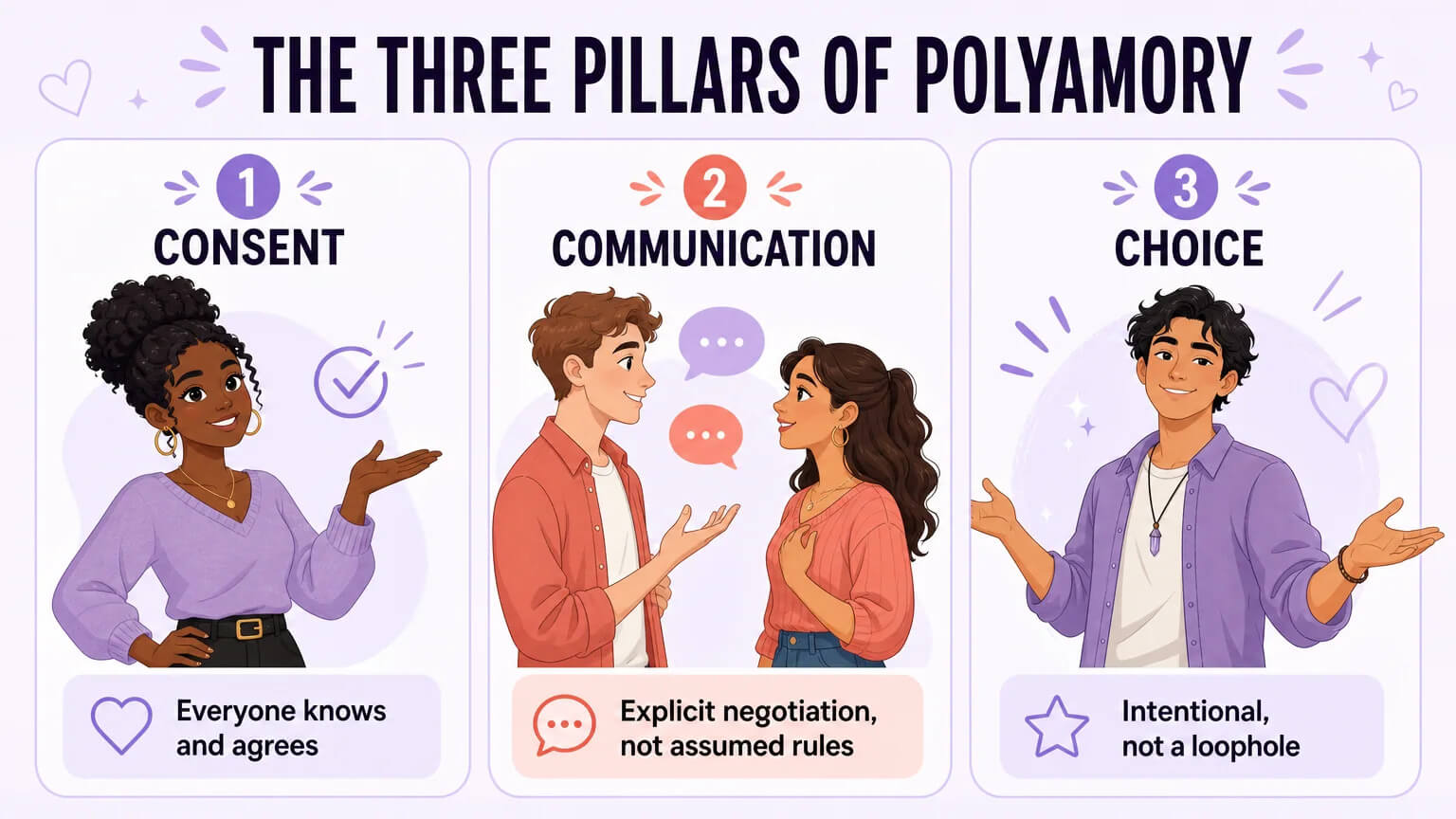
Polyamory gets caricatured constantly in pop culture. Strip away the noise, and it rests on three pillars.
Consent. Everyone involved knows about and agrees to the arrangement. This is what separates polyamory from cheating. Cheating is breaking a mutual agreement. Polyamory builds different agreements, then honors them.
Communication. Polyamory runs on explicit negotiation, not assumed rules. Agreements are discussed openly, boundaries are named clearly, feelings are shared regularly. In many monogamous relationships, the “rules” are never actually spoken. Polyamory demands that they be.
Choice. Polyamory is intentional. It’s not a loophole, a phase, or a backup plan for a struggling relationship. It’s a deliberate way of structuring your relationships to reflect who you are.
Now, what polyamory is not:
It’s not cheating. If someone is lying to their partner about seeing other people, that’s cheating, regardless of what label they use.
It’s not polygamy. Polygamy is a marriage structure involving one man with multiple wives, often within a religious context and with inherent power imbalances. Polyamory is a relationship choice across any gender configuration, and it explicitly rejects coercion. You can jump to this guide to learn more about the differences between polyamory and polygamy if you want >>
It’s not just a sex thing. Sexual connection can be part of it. So can romantic connection. So can both. So can neither. The point is emotional honesty about what you want and what you offer.
As one writer put it: polyamory means you don’t subscribe to the belief that love must be exclusive to be meaningful. You can have a favorite book and still read others. Love isn’t a finite resource. It’s a practice.
Where Polyamory Fits on the ENM Spectrum
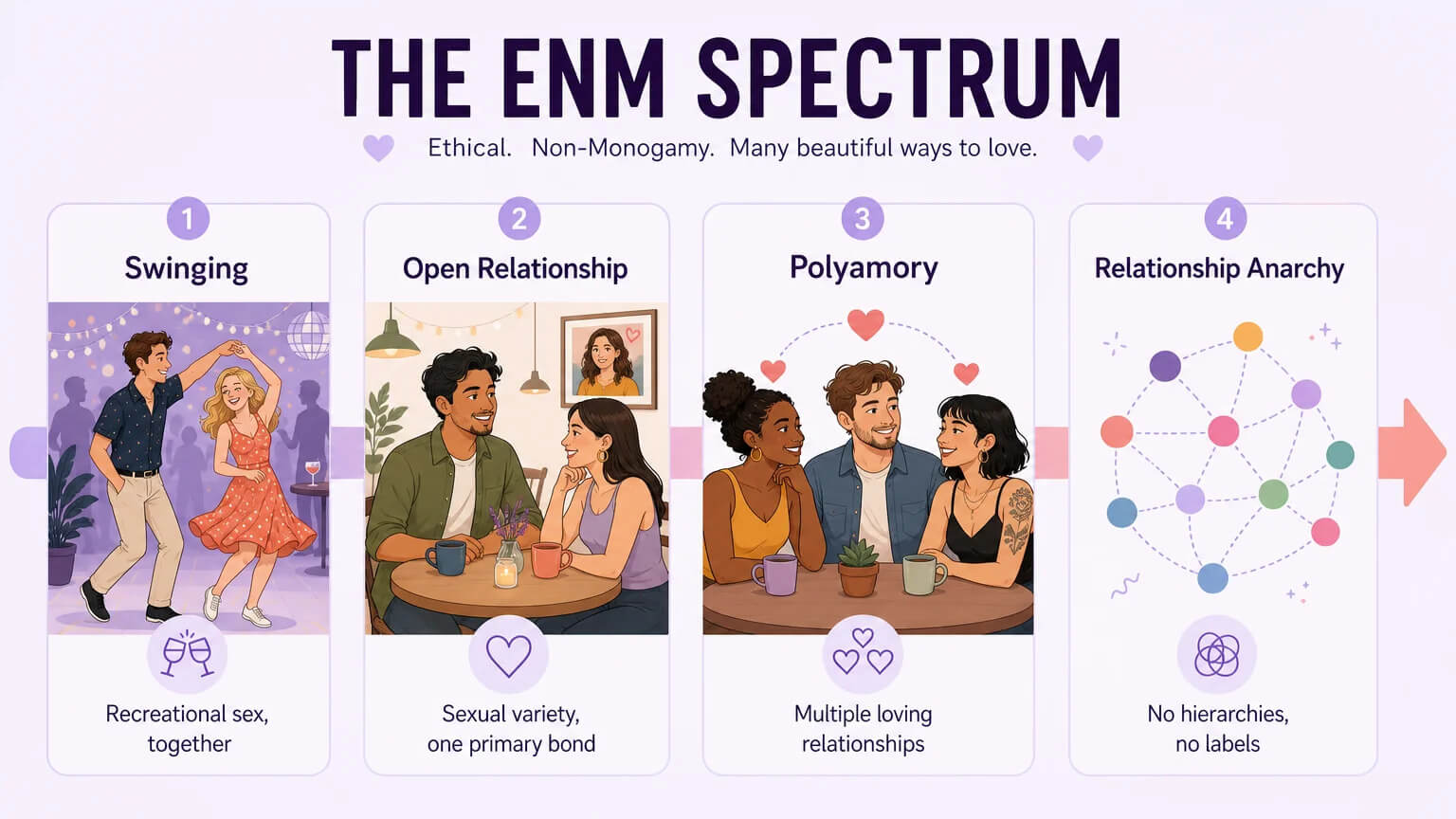
Ethical non-monogamy, or ENM, is the big tent. Polyamory is one specific room inside it. ENM runs on a spectrum, not a clean set of categories. (Want to dive into how they differ from each other? check this guide >>)
Swinging sits at one end. It centers on recreational sex with other couples or singles, usually done together, with emotional attachment avoided outside the primary partnership. It’s the shared experience for two people who are already solid.
Open relationships sit a step further in. Partners can date or have sex with others independently, but the original couple remains the central emotional unit. The focus is on sexual variety, with some dating and emotional connection permitted depending on the agreement.
Polyamory shifts the focus from sex to love. The defining feature isn’t physical variety. It’s the openness to multiple loving, committed relationships. You’re building real emotional connections with more than one person, with everyone’s full knowledge and consent.
Relationship anarchy sits at the far end. It rejects hierarchies and labels. Every connection is what it is, without any relationship being more important than another by default.
There’s a saying in ENM circles: “Swingers have sex, polyamorous people talk.” It’s reductive, but it captures the distinction. Swinging is about shared physical experiences. Polyamory is about emotional depth across multiple relationships.
For 3Fun readers, this matters because many people start at the casual end. They explore threesomes or swinging and discover they want more. They want to actually know the person. Build something. That pull toward emotional connection isn’t a sign you’re doing it wrong. It slides naturally toward the polyamory end of the spectrum.
The Many Shapes of Polyamory
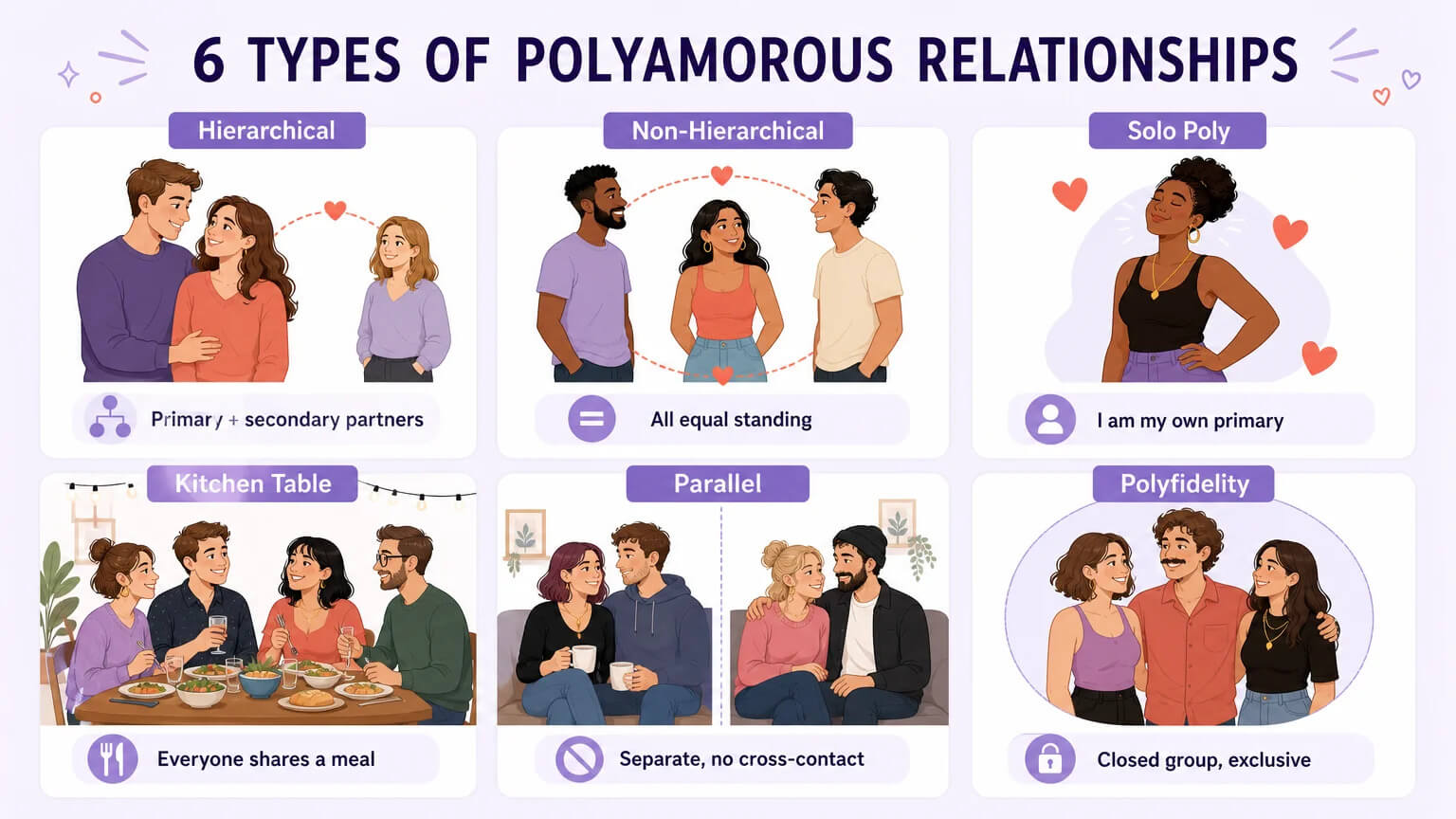
Polyamory is less like a single floor plan and more like a custom build. The structure bends to fit the people.
Hierarchical polyamory is the most common starting point for couples opening up. One relationship is primary. Others are secondary and work around that central partnership. Primary partners may hold veto power over new connections.
Non-hierarchical polyamory takes more negotiation. No partner is prioritized. All relationships have equal standing. Some people find this more authentic to their values.
Solo polyamory means “I am my own primary partner.” Solo poly people maintain multiple relationships while living independently. They don’t seek cohabitation, marriage, or shared finances.
Kitchen table polyamory is the family style. Partners and metamours develop genuine bonds. Everyone is comfortable enough to share a meal together.
Parallel polyamory runs the other way. Partners know about each other but don’t interact. The relationships stay distinct.
Polyfidelity is a closed group of three or more people who are exclusive to each other. Nobody dates outside the group.
Triads, vees, and quads describe structural shapes. A triad (sometimes called a throuple) is three people all dating each other. A vee is one person dating two people who aren’t involved with each other. A quad involves four people in various configurations.
None of these is more legitimate than another. The right structure is the one where everyone feels safe, respected, and fulfilled. And if you would like to research more about polyamory spectrum, you can jump to this detailed guide >>
Polyamory by the Numbers
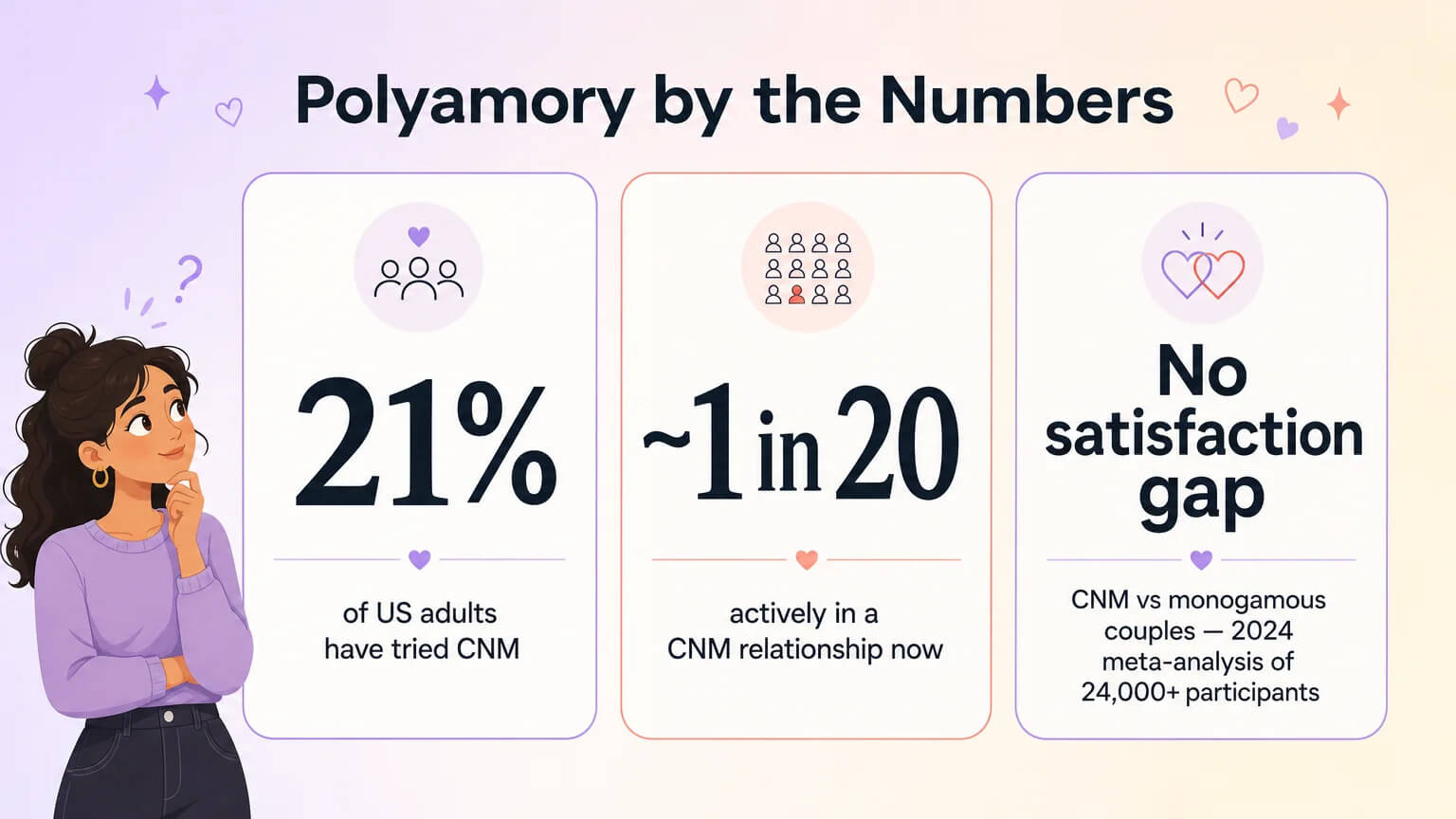
Polyamory isn’t fringe. It’s more common than most people realize.
An estimated 21% of American adults have engaged in consensual non-monogamy at some point. That’s one in five. Right now, about four to five percent of the population is actively in a CNM relationship.
The numbers skew younger. A major 2025 Belgian study found that 22.3% of adults aged 18 to 25 had been in a polyamorous relationship in the past year alone.
Research challenges the assumption that monogamy is inherently more satisfying. A 2024 meta-analysis of 35 studies with more than 24,000 participants found no significant differences in relationship satisfaction or sexual satisfaction between non-monogamous and monogamous people.
The stereotype of polyamorists as “young, wealthy, White liberals” doesn’t hold up. A 2024 study of over 3,500 polyamorous people found diversity across age, income, race, and political affiliation.
Academic interest has exploded: 12 articles on polyamory between 2000 and 2009, compared to 90 between 2020 and mid-2023 alone.
About one in four polyamorous individuals has experienced discrimination. Social stigma is real, and it’s one of the hardest external challenges people in these relationships face.
The Emotional Reality No One Talks About
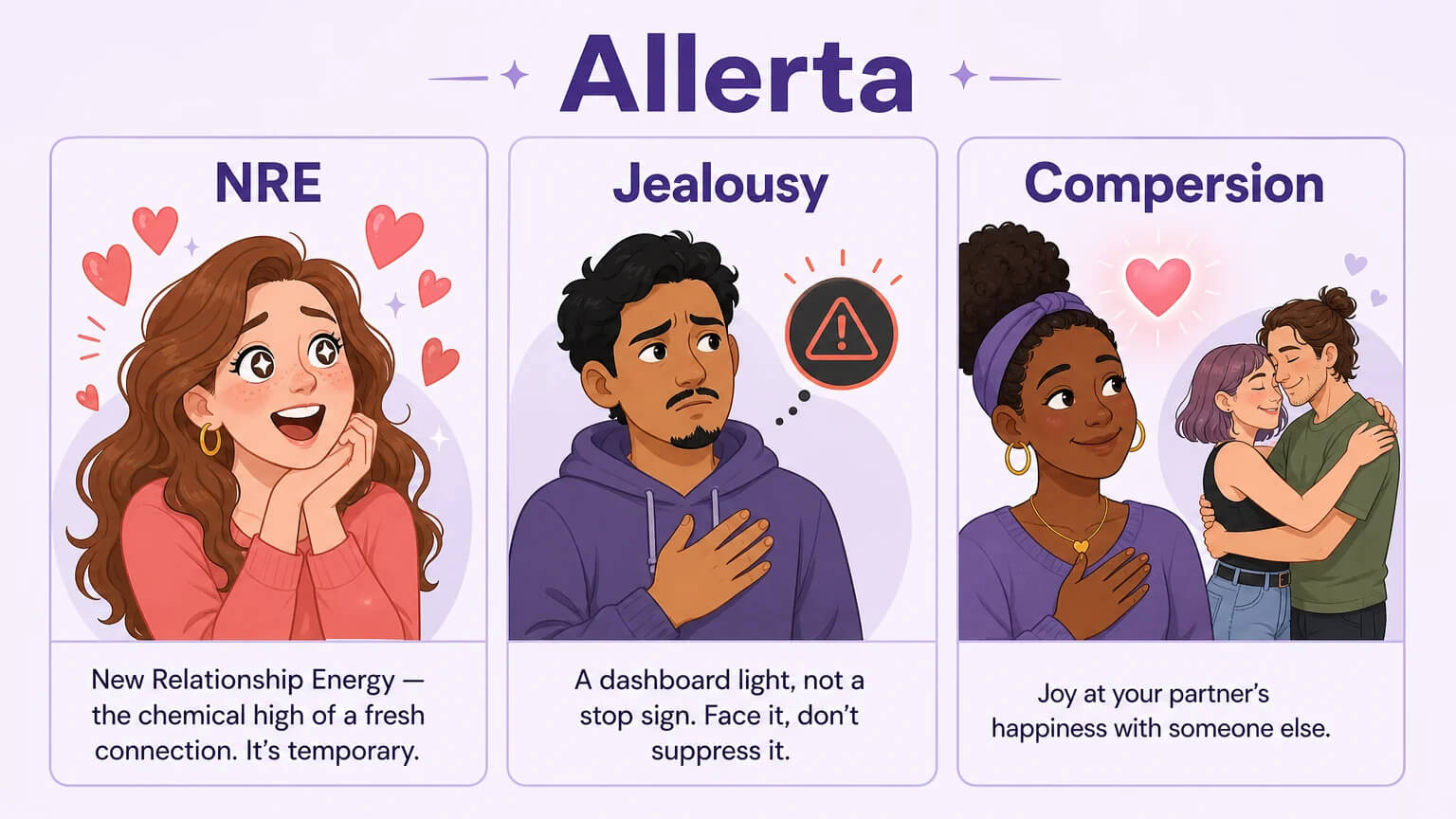
Every beginner encounters three emotional forces nobody warns them about. Understanding them before you start is the difference between thriving and crashing.
New Relationship Energy (NRE). The chemical high of a fresh connection. It hits hard. It can convince you someone is your soulmate after three dates. It can make you neglect a long-term partner who doesn’t deserve that. The universal advice from people who’ve been through it: slow down. Start with friendship before escalation. Don’t make life-altering decisions while high on NRE. It’s temporary. The real test is what happens after the high fades.
Jealousy. It doesn’t vanish. Research confirms jealousy arises in polyamorous relationships at similar rates to monogamous ones. The difference is how you treat it. Polyamory doesn’t teach you not to feel jealous. It teaches you to face it. To ask: “Where is this coming from? What need isn’t being met?” Jealousy is a dashboard light, not a stop sign. The problem isn’t the feeling. It’s the behavior that follows if you ignore it.
Compersion. This one surprises people. It’s the opposite of jealousy: the feeling of joy when your partner experiences joy with someone else. “I love to watch his face light up when she calls,” one polyamorous person describes it, “because I know how much he cares about her. Every relationship is unique, and nobody can replace me, because they are not me.”
Researcher Marie Thouin distinguishes between two types. Attitudinal compersion is a general sense of support for your partner’s other relationships. Embodied compersion is the genuine burst of excitement. The first is what matters for healthy relationships. The second is a bonus.
You don’t need compersion to be good at polyamory. You can be neutral about your partner’s other partners. You can be a little uncomfortable sometimes. None of that means you’re failing. As one therapist put it: “You can have great sex without an orgasm, and you can have a great non-monogamous life without compersion.”
How Poly People Actually Make It Work
The biggest practical challenge in polyamory is scheduling. Not jealousy.
“It can get very, very hectic at times,” one polyamorous person told the BBC. “When you’ve got three or four on the go, it’s logistics most of the time.”
Behind every successful polycule is a ruthlessly organized calendar. The community standard is Google Calendar, color coded per partner, with non-negotiable time blocks for each relationship. Protected solo time is mandatory to prevent burnout. Buffer time between engagements accounts for travel, emotional transitions, and spontaneous needs. Some poly people use time-budgeting triage: assessing how much time and energy each relationship needs per week, then allocating accordingly. Not equally.
The “maybe” date is quietly toxic in polyamory. It communicates “I’ll find time for you unless something better comes up.” Treating scheduled time with any partner as a firm obligation is one of the highest-leverage practices.
Holidays add complexity. Competing traditions, multiplied gift costs, family introductions. Solutions include Secret Santa arrangements, spending caps, and honest talk about which partner attends which family gathering. The single most useful practice is emotional stakes mapping: making transparent which events matter most to which partner before the calendar fills up.
Communication cadence matters as much as calendar discipline. Regular check-ins, dedicated scheduling channels, explicit response time agreements. These prevent the slow erosion of trust when someone is left waiting.
Polyamory runs on communication infrastructure. The romance is built on top of the logistics, not instead of them.
Is Polyamory Who You Are, or Something You Do?
This is one of the most personal questions in polyamory, and the community doesn’t agree on the answer.
Some people experience polyamory as an orientation. They struggled in monogamous relationships their entire lives, feeling like something was wrong with them, before discovering polyamory and having everything click into place. They call themselves “obligate poly” the way someone might describe themselves as gay: not a preference, but a fundamental part of who they are.
Others experience polyamory as a choice. A practice. A set of skills they developed. They could be happy in monogamy, but they choose polyamory because it aligns with their values and desires.
There’s a third category: ambiamory. Some people are genuinely happy in either structure. They don’t have a strong preference. The quality of the relationship matters more than the configuration.
Researcher Meg Barker found that polyamorous people fluidly draw on both framings depending on context. They use the identity frame (“I was born this way”) to push back against pressure to change. They use the choice frame (“I choose this consciously”) to present themselves as responsible and intentional. Both are valid.
Legally, the distinction matters. An orientation can’t get you fired in some jurisdictions. A lifestyle can. That’s a real vulnerability.
But practically: you don’t need to solve the identity question to explore the practice. You need to be honest with yourself and with everyone involved. If you want to understand the full range of reasons people choose polyamory — from evolutionary biology to attachment science — read our deep dive on why people are polyamorous.
Polyamory Is an Amplifier, Not a Fixer
Polyamory doesn’t fix a struggling relationship. It exposes it. Every crack that was there before becomes more visible when more people are involved.
“Relationship broken, add more people” almost never works. If a partnership has trust issues, communication breakdowns, or mismatched desires, adding other people won’t resolve them. It amplifies them. It’s also deeply unfair to the new people brought into an unstable situation.
For relationships that are already solid, polyamory can be extraordinary.
It removes autopilot. In a monogamous long-term relationship, it’s easy to coast. The structure itself keeps you together. In polyamory, you choose each other again and again. That repeated conscious choice keeps the relationship alive in a way that comfort and routine never can.
As one couple described it: “This journey made us more committed. Not the commitment of obligation or default, but the commitment of choice.”
Try this: if the idea of your partner being happy with someone else fills you with genuine warmth, even alongside some nervousness, you might have the foundation. If it fills you with dread and you’re only considering polyamory to keep them from leaving, pause. Polyamory will not save a relationship that’s already in trouble. It will only make the trouble more obvious.
Is Polyamory Right for You? A Place to Start
There’s no quiz that tells you whether you’re polyamorous. But there are questions worth sitting with, honestly and alone, before you bring them to anyone else.
What does your ideal relationship life look like in five or ten years? Does it include loving more than one person, or does one partner feel like the right fit?
How do you actually feel when you imagine your partner connecting deeply with someone else? Not how you think you should feel. How you actually feel.
What’s drawing you toward polyamory? Is it curiosity about a specific person? A sense that monogamy has never quite fit? Or is it a way to avoid ending a relationship that’s already struggling?
How much time and emotional energy do you genuinely have? Half-stepping isn’t an option. If you’re stretched thin already, adding more relationships won’t fix that.
Are you willing to be uncomfortable? Polyamory involves sitting with feelings you’ve been taught to avoid and moving through them anyway. That’s not a bug. It’s part of the practice.
If you’re already in a relationship and want to bring this up, the approach matters. “Could you read this article and tell me what you think?” works better than “I want to see other people.” Make it shared learning, not a demand. Give your partner time. Weeks or months, if they need it. They haven’t had the same time to process that you have.
You don’t need to have answers today. The fact that you’re asking the questions at all is worth something.
FAQ
Can a polyamorous person date a monogamous person?
Yes. These are called mono-poly relationships. They can work, but they require exceptional communication and clear agreements. The key factor is that the monogamous partner genuinely wants the arrangement, not merely tolerates it. If they’re saying yes to avoid losing you, resentment will build over time. Regular check-ins about how both partners are feeling are essential.
Do poly couples get jealous?
Yes. Jealousy doesn’t disappear in polyamory. What changes is how it’s handled. Polyamorous people tend to face jealousy openly, investigate its roots, and communicate about it rather than suppressing it or lashing out.
What’s a metamour?
Your partner’s other partner. You’re not romantically involved with them, but the quality of that relationship affects your partner’s life and therefore yours. In kitchen table poly, you might be close friends. In parallel poly, you might never meet. Here is the full guide: what is a metamour?
Is polyamory legal?
Dating multiple people is legal. Marrying multiple people (polygamy) is not, in most countries. Polyamorous relationships exist in a legal gray area with few protections for housing, employment, or child custody. Somerville, Massachusetts became the first U.S. city to legally recognize multi-partner domestic partnerships in 2020, changing its definition of a relationship from “formed by two people” to “formed by persons.” For more information, check this guide: is polyamory legal?
What’s the difference between polyamory and an open relationship?
Open relationships typically focus on sexual variety while keeping one primary romantic bond. Polyamory is about multiple loving relationships. The emotional connection is the point. An open relationship expands who you can sleep with; polyamory expands who you can love. Check this guide to find more details >>
Can you cheat in a polyamorous relationship?
Absolutely. Cheating is breaking agreements. Polyamory has agreements, just different ones. Lying, hiding connections, violating boundaries, and breaking promises of honesty are all cheating, regardless of relationship structure.
What resources should I read to learn more?
Start with “The Ethical Slut” by Dossie Easton and Janet Hardy, and “Polyamory for Dummies” by Jaime M. Grant. The Multiamory podcast covers communication and logistics. Reddit’s r/polyamory community offers real-time discussion from thousands of practicing polyamorous people.
How do I find polyamorous community?
Local poly meetups and discussion groups exist in most major cities. Dating apps like 3Fun are explicitly ENM-friendly. Online communities on Reddit, Discord, and Facebook fill the gaps when in-person options are limited. Look for spaces where ENM is normalized, not just tolerated.