
Six people around a farmhouse table on a Sunday morning. Pancakes, coffee, a toddler in a high chair, someone’s cooking bacon. They laugh easily. They know how everyone takes their eggs.
That is the image that gives kitchen table polyamory its name. It is warm, inviting, and curated to within an inch of its life.
The version you do not see is the conversation three of them had the night before about why one metamour feels left out of group decisions. Or the text thread about whether the new person someone is seeing is ready to meet everyone yet.
If you are a couple researching polyamorous relationship, you have probably felt pressure to name your “style” before you have even had the first real conversation. This article will not sell you on kitchen table polyamory. It is a map. What KTP actually looks like in practice, where it sits among your options, what real couples experience when they try it, and how to decide whether it fits your dynamic. You will finish knowing whether KTP is worth pursuing, how to start if it is, and what to do if it is not working.
What Is Kitchen Table Polyamory?
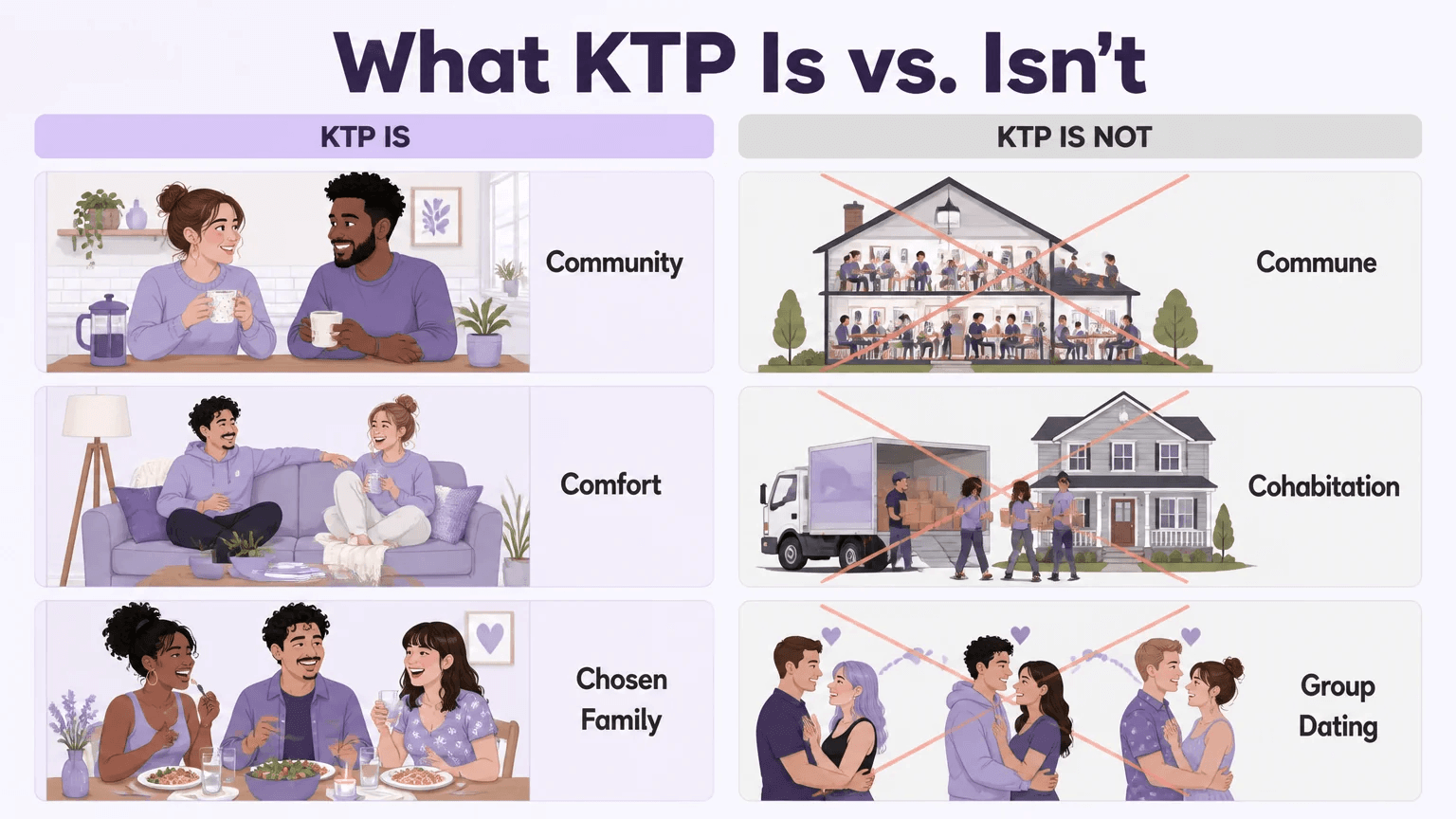
The name is literal. Kitchen table polyamory describes a dynamic where everyone in the polycule is comfortable enough to gather around a kitchen table and share a meal together. The aspiration is community, not proximity. The image is family dinner, not a summit meeting.
Under that image is a specific relationship architecture. In KTP, metamours (your partner’s other partners) develop close-friend or sibling-like relationships built on emotional safety, mutual respect, and reliability. These are chosen-family bonds that run parallel to the romantic relationships in the polycule, not in place of them. Metamours might text independently, grab coffee without the hinge partner present, or show up for each other’s birthdays. The connection is its own thing.
KTP is not a commune. It is not group dating. It does not demand cohabitation, shared finances, or romantic involvement between metamours. It describes a comfort level, not a living arrangement.
The philosophical engine is compersion: feeling joy that your partner experiences pleasure from someone else. Compersion is central to the KTP ideal, but it is not mandatory. Some people feel it naturally. Others build it slowly, over months of small positive experiences. And some never feel it at all, which is valid and does not disqualify you from healthy non-monogamy. You can practice KTP without compersion the way you can run a marathon without enjoying every mile. The structure holds either way.
The boundary that matters most: KTP cannot be forced. Friendships between metamours must develop organically. Pressuring someone into “best buddy” dynamics is coercive, not connective. Metamours decide their own relationship. The hinge partner does not dictate it.
In plain terms: kitchen table polyamory is a style of consensual non-monogamy where metamours choose to build genuine family-like connections, rather than existing as separate lives the hinge partner toggles between. The key word is choose. Nobody gets assigned a seat at this table.
The Polyamory Spectrum: Where Kitchen Table Fits
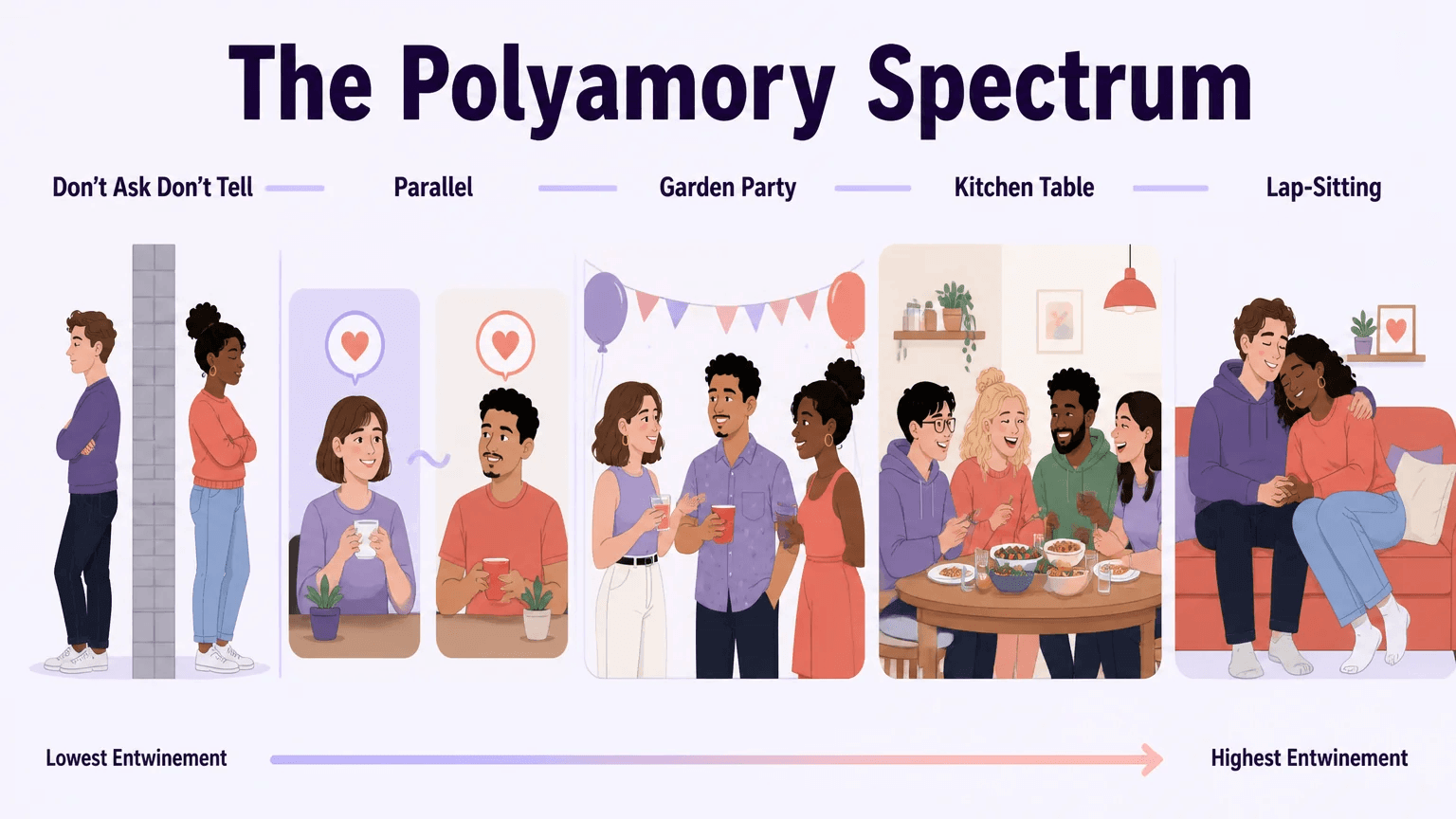
KTP is not the most poly option, and it is not the only one. Knowing the full menu reduces the pressure to pick correctly on the first try.
The spectrum runs from lowest to highest entwinement. At the far end sits Don’t Ask Don’t Tell (DADT), where partners actively avoid knowing or discussing each other’s outside relationships. One step up is parallel polyamory, where all partners are aware each other exists but have minimal to no interaction. Then comes garden party polyamory, where metamours are cordial at group events but do not have deep independent friendships. Kitchen table polyamory occupies the medium-to-high entwinement space. At the very top is lap-sitting polyamory, which includes cohabitation and romantic or sexual relationships between metamours.
A distinction that gets muddied constantly: parallel polyamory is not DADT. In parallel, everyone knows about everyone else. They simply do not share meals, group chats, or deep emotional bonds. Conflating the two makes parallel seem more extreme than it is, and it pushes people toward KTP who might thrive in parallel.
Garden party polyamory deserves more attention than it gets. Metamours are friendly at birthdays, parties, and mutual friends’ gatherings. They are glad each other exists and can make small talk. They do not share daily meals, group threads, or deep emotional bonds. For couples where one partner wants more connection than parallel offers but full KTP feels like too much, garden party is a calibrated middle path.
And something most guides skip: you can mix styles. KTP with one partner and parallel with another is entirely valid. Your polycule does not need a single uniform structure. Different dynamics call for different architectures, and honoring those differences is a sign of relational intelligence, not inconsistency.
The Real Benefits of Kitchen Table Polyamory
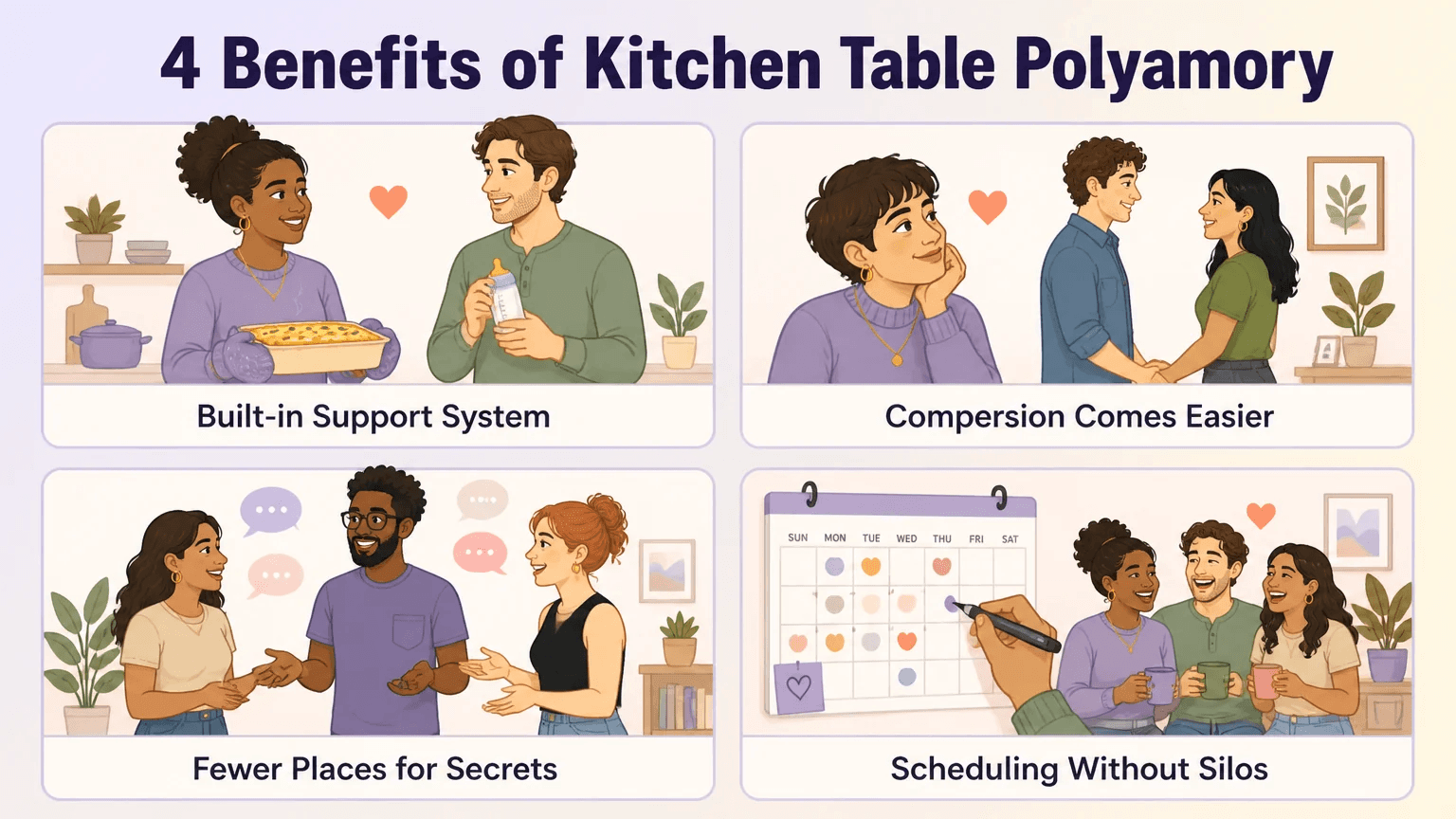
These are not promises. They are possibilities, each one requiring work to realize.
The biggest one is the built-in support system. A couple together 18 years and open for 9 built a KTP dynamic where metamours babysit each other’s kids, bring groceries, and coordinate during pregnancy. They are looking at buying a multifamily home together. During the wife’s pregnancy, the husband’s partner brought home-baked treats and shared hand-me-down newborn supplies. More hands mean more care, and the care is tangible.
Compersion comes easier when you genuinely like your metamour. It is simpler to feel joy about your partner’s other relationships when you have a real positive connection with the other person. Abstract compersion becomes concrete when you are genuinely glad your metamour brought your partner soup when they were sick.
Then there is transparency. An open-communication structure reduces opportunities for deception and builds trust across the entire polycule. Fewer places for secrets to hide means fewer secrets to discover.
And scheduling stops feeling like triage. Shared calendars and coordinated group time reduce the logistical friction that strict world-separation creates. In parallel polyamory, the hinge partner must divide time between completely separate worlds. KTP allows everyone to gather in one room, share a calendar, and plan together. Holidays, birthdays, and weekends do not require a spreadsheet and a negotiation.
One couple who made it work put it plainly: “We come home to each other with more empathy and patience than I think we’d have otherwise.”
The Honest Challenges No One Talks About
This section is the credibility of the entire article. If KTP were as frictionless as the Instagram version suggests, everyone would do it.
Forced friendship breeds resentment. This is the most commonly cited expert warning across every source. Mandated bonding between metamours is coercive. If someone only wants parallel, that boundary must be respected. You cannot schedule chemistry, and you cannot negotiate someone into wanting a friendship they do not want.
Jealousy does not disappear. Charlize, a practicing KTP partner, admits jealousy surfaces regularly. She deals with it through direct communication and reassurance. KTP manages jealousy through tools. It does not eliminate it through structure. Expecting otherwise sets everyone up for failure.
For people with histories of enmeshment or poor boundaries, KTP’s high-integration model can feel triggering rather than healing. If you grew up in an environment where boundaries were not respected, being asked to fold your romantic life into a close-knit group may activate old survival patterns. The emotional labor of managing multiple close relationships is significant, and not everyone has the capacity.
Blurred privacy creates compound stress. Individual relationship issues ripple through the entire polycule. Your conflict with one partner becomes stress for people who did not sign up for it. The proximity that makes KTP warm also makes it porous.
Couple’s privilege goes unaddressed too often. When long-term couples leave their inherent privilege unacknowledged, it marginalizes newer partners and creates invisible hierarchies. The couple that opened together did not stop being a unit, and that unit carries weight.
Getting close to metamours to “keep an eye on things” is not KTP. It is control disguised as community. If your interest in your partner’s other partners is primarily surveillance, the architecture is not the problem.
Is KTP Right for You? A Couple’s Self-Assessment
There are no wrong answers here. Only useful information.
Start with four questions. Be honest with yourself on each one.
What is your social battery? Does social interaction drain or energize you? If you need solitude to recharge, KTP’s constant availability may exhaust you.
What is your history with boundaries and enmeshment? If high integration feels safe rather than threatening, KTP may fit. If closeness reads as danger, it probably will not.
Do you actually vibe with your metamour or metamours? Is there genuine chemistry or just obligation?
What does the hinge partner actually want? Is one person driving the KTP vision alone while the other nods along?
The desire must come from you. KTP cannot be coerced or adopted as a compromise to keep a partner happy. If you are considering KTP primarily to avoid conflict or prove you are “evolved,” the foundation is unstable. A structure built on fear of losing your partner will crack under the first real stress test.
No style is more evolved than another. The belief that KTP is superior to parallel polyamory is a harmful myth that creates in-group pressure. The right structure is the one where everyone involved feels respected and heard.
You can do KTP with one partner and parallel with another. This is not failure or inconsistency. It is honoring different dynamics with different people.
Three signs KTP might be right for you: you feel genuine warmth toward your partner’s partners, not just tolerance; you have the emotional bandwidth for multiple close relationships without depleting yourself; and integration feels like freedom rather than obligation. Three signs it might not be: you are doing it to prove something; you dread group gatherings and feel relief when they are canceled; or your partner wants it significantly more than you do and you are considering it to avoid conflict.
Your First 90 Days: A Roadmap for Couples
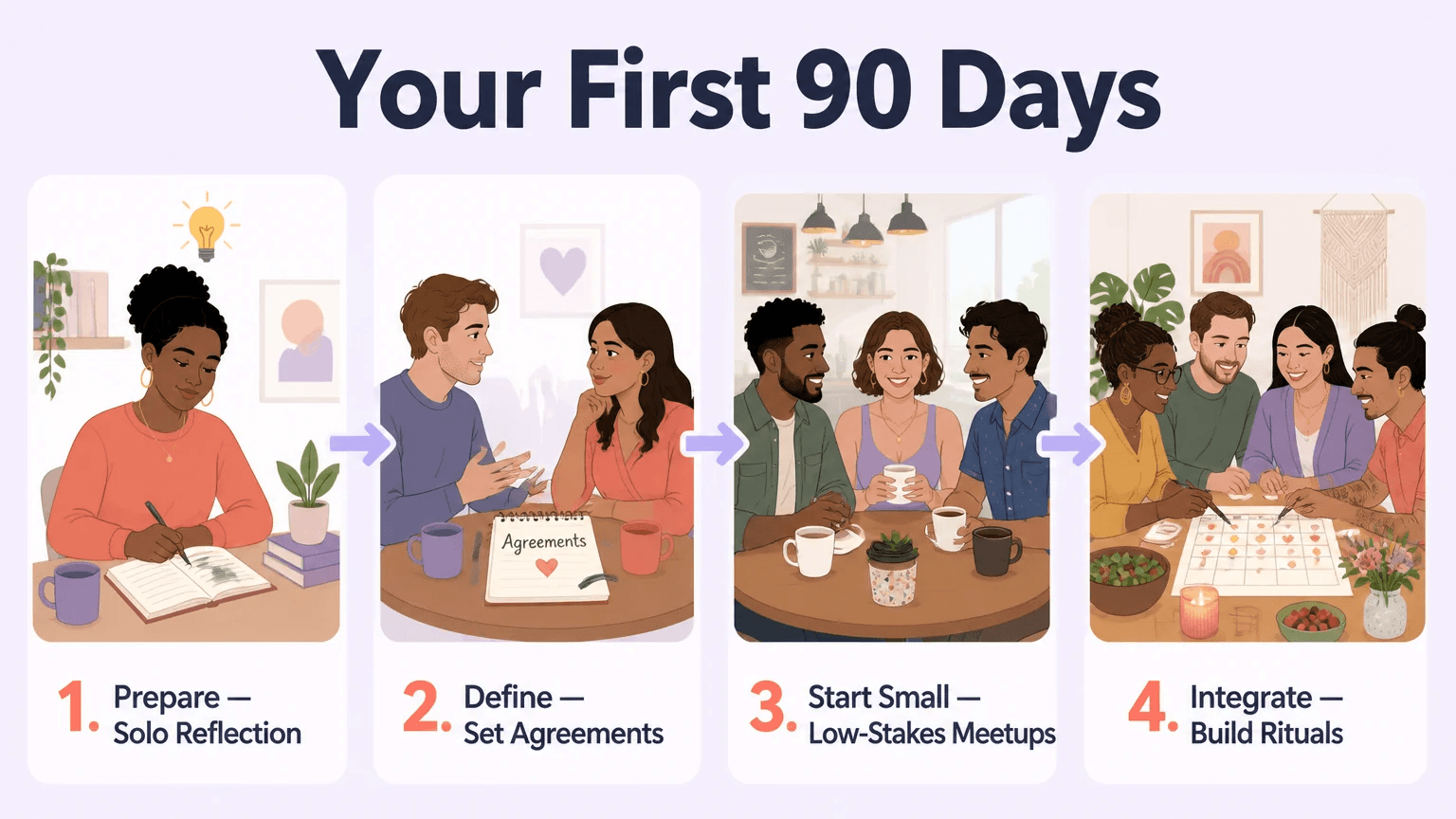
Knowing what KTP is does not tell you how to start. Here is a playbook organized into four phases. Every step is reversible.
Spend the first two weeks preparing independently. Each partner reflects and researches on their own before discussing together. Learn the vocabulary: metamour, polycule, compersion, NRE (new relationship energy), hinge partner, fluid bonding. Read “Opening Up” by Tristan Taormino. Assess your communication readiness honestly. Can you sit with discomfort without shutting down? Can you name what you need without blaming?
The next two weeks are for defining boundaries together. Use agreements, not rules. Rules are rigid and one-sided (“You must never…”). Agreements are flexible and collaborative (“We agree to check in before changing safer sex protocols”). Cover physical boundaries, emotional depth, time and availability, communication protocols, existing commitments, and public presentation. Each partner journals separately on what kind of KTP appeals to them before coming together for the conversation. Use I-statements. Share hopes and fears without blame. Propose one small reversible first step.
For the following month, start small. Low-stakes experiences in sequence: a 30-to-60-minute coffee meet-and-greet in a neutral setting. Then a group outing with a built-in activity like game night, a farmers market, or trivia. Then a shared calendar trial for one month.
The 180-Day Rule applies throughout: for the first six months of a new relationship, make no major life decisions under NRE influence. Brain chemistry during NRE (dopamine, oxytocin, serotonin shifts) impairs judgment in ways similar to intoxication. Treat big decisions like Monopoly money during this window. Hinge partners must actively counterbalance by scheduling dedicated time with existing partners.
In the final month, create regular check-in rituals. Weekly or monthly touchpoints to share what is working, review agreements, discuss jealousy, and celebrate compersion moments. When introducing a new partner, communicate early, ask what each existing partner needs to feel secure, use neutral settings, and never force bonding timelines. The polycule grows at the speed of its slowest member.
When Kitchen Table Needs to Scale Back
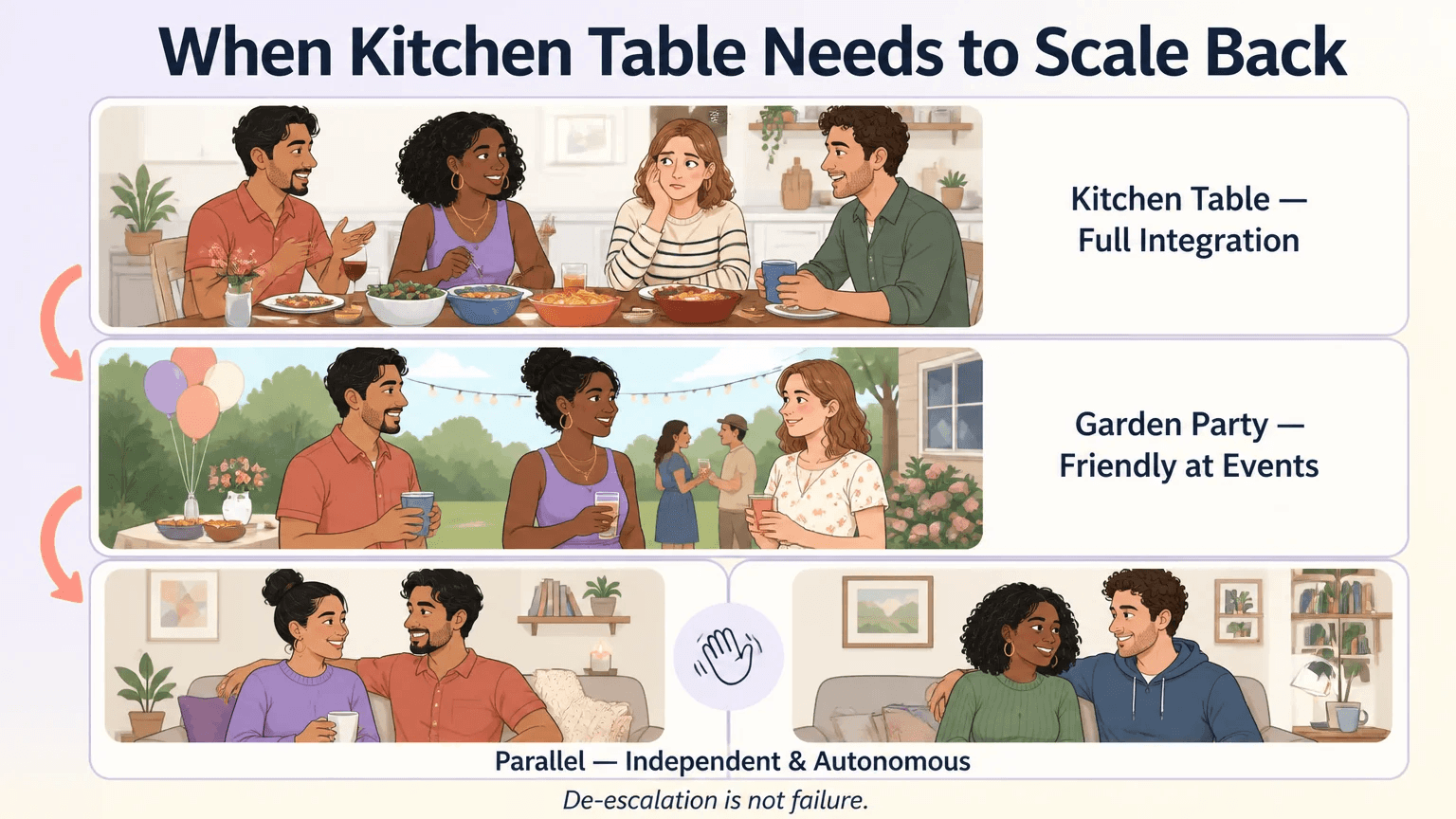
What if you try KTP and it does not work?
You adjust. De-escalation is a mature relationship skill, not a sign that non-monogamy failed. Shifting from KTP to garden party or parallel is an act of care. You are protecting the relationships by adjusting the architecture, not abandoning them.
One woman shared that witnessing her husband give affection to another woman was too painful. “Compersion never came for me.” After difficult emotional processing, she discovered she is happier with parallel polyamory: not meeting metamours, not hearing details. She describes the shift as liberating emotionally. This is not a cautionary tale. It is a success story about self-knowledge.
Garden party polyamory offers a calibrated middle ground when full KTP feels like too much but parallel feels too disconnected. Cordial at group events, glad each other exists, but no daily meals, no group threads, no deep emotional bonds required.
The hinge partner’s role in de-escalation is to facilitate rather than force. When metamours want different styles, the hinge must hold the tension without pressuring anyone into alignment. KTP is a spectrum, not a destination. You can start parallel and drift toward KTP over time, or start KTP and drift toward garden party. The direction matters less than the consent.
If you need to say it out loud, here is a script. To your partner: “I am realizing that the level of integration is costing me more than it is giving me right now. I need to shift toward something more parallel for a while. This is not a rejection of anyone. It is me taking care of my capacity so I can keep showing up.” To your metamour: “I value you and I am glad you are in my partner’s life. I need to take a step back from our friendship for a bit. This is about my own bandwidth, not about anything you have done.”
Real Stories from the Kitchen Table
Theory is useful. Narrative is what makes it real.
A couple together 18 years, open for 9, built a KTP dynamic that looks more like an extended family than a dating arrangement. The wife’s partner of five years is married with a toddler. They babysit for each other, bring groceries, help with chores, and are looking at buying a multifamily home together. During the wife’s pregnancy, the husband’s partner brought home-baked treats and shared hand-me-down newborn supplies. This is KTP as mutual aid. It can scale all the way to shared domestic life if that is what everyone wants.
Charlize, 50, and Matt, 44, have a simple ritual. If one of them brings someone home, they all have breakfast together the next morning. Charlize is friends with one of Matt’s partners in New Zealand. One agreement: condoms with new partners, STI testing required before that changes. KTP does not require a commune. Sometimes it is just pancakes and honesty. The architecture lives in daily rituals, not grand declarations.
Jessie Rushing started parallel. Her local partner wanted to meet his metamour. Three people, drinks at a bar, then a Valentine’s dinner together. Everything communicated in advance, no pressure, organic connection. She realized she no longer preferred parallel. Where you start does not determine where you end up. KTP can be something you drift into, not a decision you make once and lock in forever.
These are three different configurations. None is the “right” one. Your kitchen table will look like your people, not anyone else’s.
FAQ
What exactly is kitchen table polyamory?
A style of polyamory where everyone in the polycule is comfortable sharing meals and has friendly, family-like relationships. Metamours interact regularly rather than existing in separate worlds. The name comes from the literal image of gathering around a kitchen table. KTP is medium-to-high entwinement on the polyamory spectrum.
How is KTP different from parallel polyamory?
KTP means metamours interact regularly with close, chosen-family relationships (medium-to-high entwinement). Parallel polyamory means relationships run side by side with minimal to no interaction between metamours (low entwinement). Garden party polyamory sits in between, with cordial group-event friendliness but no deep independent bonds. You can mix styles across different relationships in your polycule.
Is KTP better or more “evolved” than parallel polyamory?
No. Neither style is inherently better. The healthiest structure honors everyone’s capacity, comfort, and consent. The belief that KTP is superior creates in-group pressure that pushes people into dynamics that do not serve them. The right structure is the one where everyone feels respected.
What if I feel jealous seeing my partner with someone else?
Jealousy is normal and does not mean KTP is failing. Manage it through direct communication, reassurance from partners, and emotional regulation tools. If compersion never arrives and witnessing affection remains painful, parallel polyamory may be a better fit. That outcome is valid, not a failure, and many people report feeling liberated by making that shift.
What is the 180-Day Rule?
For the first six months of a new relationship, do not make major life decisions under NRE influence. Brain chemistry changes during new relationship energy (dopamine, oxytocin, serotonin) can impair judgment in ways similar to intoxication. Treat big decisions as provisional during this window.
Does KTP mean everyone lives together or is sexually involved?
No. KTP means metamours are comfortable and friendly, not that they cohabitate or are romantically involved with each other. The highest-entwinement form, lap-sitting polyamory, involves cohabitation and romantic or sexual metamour relationships. That is a separate category beyond standard KTP.