You are scrolling a dating app. One profile says “ENM / open relationship” and the next says “polyamorous / partnered.” You swipe right on both, then pause. Are those the same thing? If they are not, which one are you even looking for?
If you have wondered whether open relationships and polyamory are different labels for the same thing, you are not alone. Couples therapy sessions, awkward first dates, and late-night group-chat debates circle this question.
The short answer: they are not the same thing, and choosing between them is not a vocabulary exercise. It determines what your relationships look like day to day, how you handle emotions, and whether your arrangement survives its first stress test.
Most articles define open relationships in one section and polyamory in another, leaving you to connect the dots. We compare them head to head across the dimensions that matter: emotional involvement, structure, agreements, jealousy, daily life, and which personality fits which model.
By the end, you will not just know the difference. You will know which path matches how you actually love. The difference starts with what the words actually mean.
What Each Model Actually Means (Beyond the Dictionary)
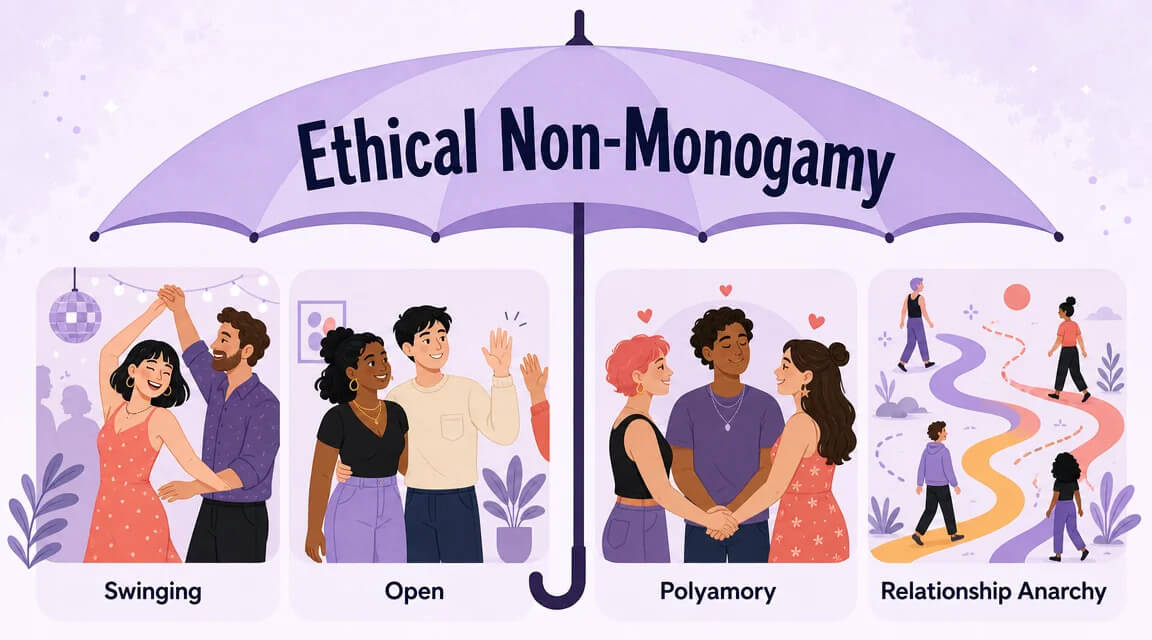
Ashera DeRosa, a licensed marriage and family therapist, gives the cleanest working definition: an open relationship means one primary couple exploring physical intimacy with others, typically keeping emotional exclusivity. Polyamory means forming deep emotional and physical relationships with multiple partners. That single sentence contains the entire roadmap.
Both models live under the ethical non-monogamy (ENM) umbrella, alongside swinging (recreational, often couple-to-couple), relationship anarchy (no hierarchies, no prescribed structures), and other configurations. Dr. Liz Powell describes swinging as recreational sex, polyamory as multiple loving relationships, and open relationships as the space between: sexually open with a primary partnership anchoring everything.
The word “polyamory” itself holds the distinction. Coined in the early 1990s by Morning Glory Zell-Ravenheart, it combines Greek “poly” (many) with Latin “amor” (love). It means many loves, not many bodies. That etymology is your memory anchor for the entire article.
Here is something most discussions leave out: these are overlapping spectrums, not rigid categories. An open relationship where someone catches feelings is not a “failed” open relationship. It is a relationship evolving toward polyamory. A polyamorous configuration where one connection stays casual and primarily sexual is not “not really poly.”
The gray zone, known in the community as the messy middle, is where most couples actually live. “No catching feelings” agreements are fragile because emotions do not follow agreements. Sex with someone you genuinely like releases dopamine and oxytocin. Your brain does not read your relationship contract before firing those circuits.
This blurring is not a bug. It is the terrain. The thing to hold onto from this section: open relationships protect the primary emotional bond by keeping outside connections casual. Polyamory expands the emotional bond to include multiple people. Everything else flows from this difference.
1. Sex vs Love: Where Each Model Draws the Emotional Line
Here is the agreement that launches a thousand therapy sessions: no catching feelings. It sounds reasonable on paper. In practice, it asks human beings to override their neurochemistry with willpower. Biology usually wins.
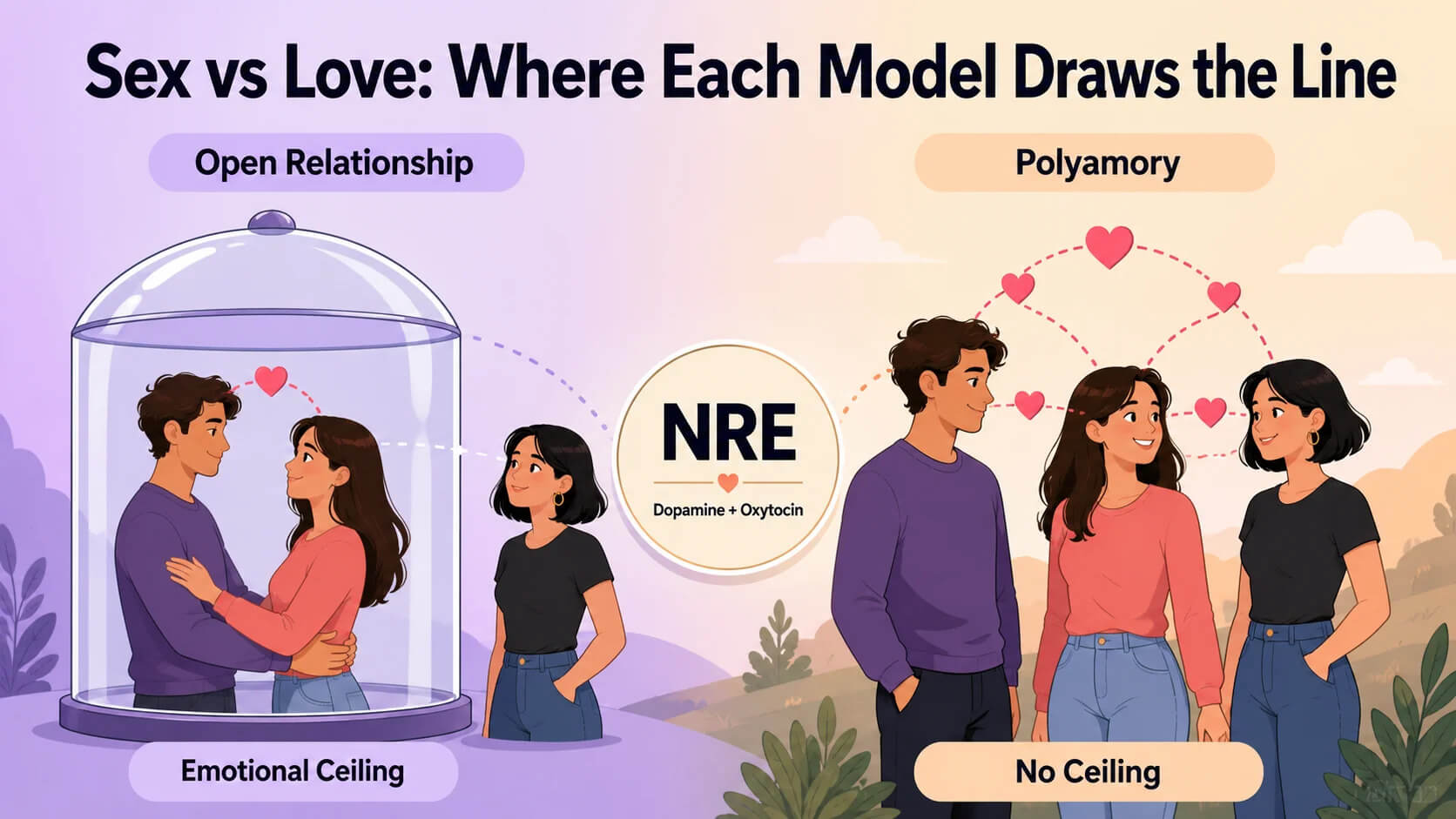
Open relationships draw the emotional line at romantic exclusivity. Outside connections can be sexual, friendly, playful, and even genuinely caring. What they cannot be is romantic love that escalates toward life partnership: shared finances, cohabitation plans, “I love you” in the lifelong-partner sense. These connections have an emotional ceiling.
Polyamory removes that ceiling entirely. Every connection has permission to become a full romantic relationship: sleepovers, holidays, meeting family, building a future together. Different partners might fill different roles. One might be a nesting partner you live with, another a weekend companion, another a long-distance love. But none are artificially capped.
New Relationship Energy, or NRE, is the mechanism that makes the open-relationship emotional boundary so fragile. Coined by polyamorous author Zhahai Stewart in the 1980s, NRE describes the dopamine-oxytocin flood of a new connection. Stewart called it the “molecular binding energy” of human connection, comparing it to an addiction. When you have great sex with someone you genuinely like, NRE makes emotional attachment nearly inevitable.
This is not a character flaw. It is biochemistry. One polyamory.com user put it plainly: “When you find someone who is sexually compatible with you, it is unlikely that love-type feelings will not develop.” A 2024 dissertation from Pace University (Moskowitz, 288 participants) found that polyamory showed no significant difference from monogamy on relational variables, while open relationships had poorer outcomes. The likely explanation: the emotional boundary is harder to maintain than the polyamorous model where feelings are expected and welcomed.
Couples who plan for the messy middle fare better than couples who pretend it cannot happen to them. Ask yourself: do you want outside connections that stay in a designated lane, or do you want the freedom to let each connection become whatever it organically becomes? Your answer to that question shapes everything that follows.
2. Hierarchy and Structure: Primary Partners, Nesting, and the Relationship Ladder
In an open relationship, you know who you call from the emergency room at 2 a.m. In polyamory, you might call two people. And they both show up. That small difference ripples through every aspect of daily life.
Open relationships are hierarchical by design. A primary couple shares a home, finances, maybe kids, and major decisions. Outside connections occupy a designated secondary space. This is not a flaw. For many couples, it is the entire appeal: sexual adventure without restructuring the foundation.
Polyamory spans a wider structural spectrum. Hierarchical polyamory explicitly ranks primary and secondary partners; a nesting partner gets holidays, emergencies, and veto power. Non-hierarchical, or egalitarian, polyamory ranks no partner above another. Descriptive hierarchy still exists: the partner you live with gets more time by default, even without a “primary” label.
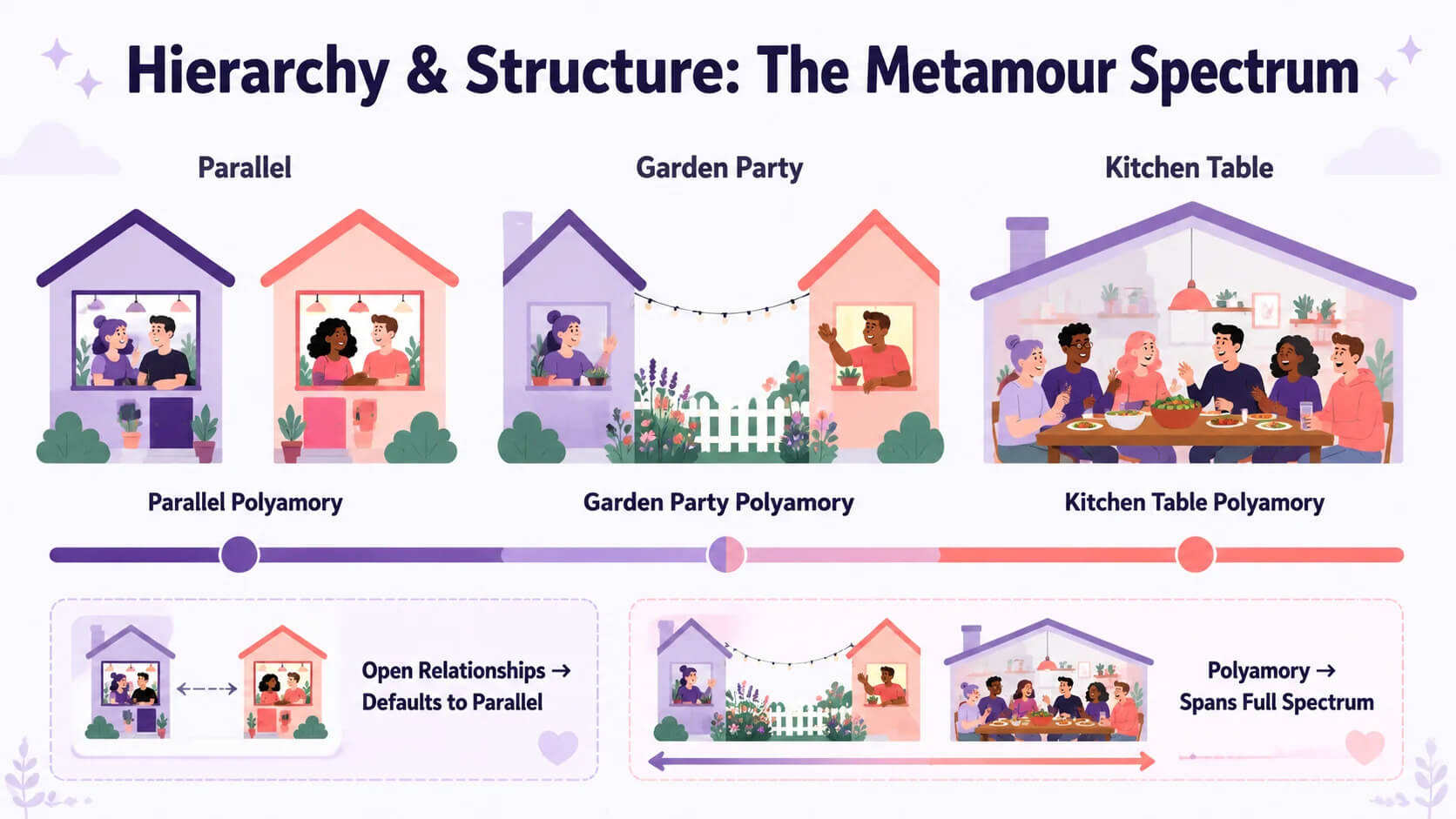
The KTP-to-parallel spectrum governs metamour contact (your partner’s other partners). Kitchen Table Polyamory means everyone shares meals, holidays, and group chats. Parallel Polyamory means zero metamour contact. Garden Party Polyamory splits the difference: amicable at events but not close friends.
Open relationships default to parallel. Outside partners rarely meet. Polyamory forces the metamour conversation because they share a partner’s time, bandwidth, and calendar. Whether you want to break bread with your partner’s other partner is a question you will need to answer.
Descriptive hierarchy means “we live together so we spend more time.” Prescriptive hierarchy means “this partner comes first by rule and can veto outside connections.” The difference is everything when negotiating your arrangement.
Picture two Saturdays. In an open relationship: Saturday night is a date with someone new, Sunday morning is sacred primary-partner brunch. In polyamory: Saturday is with partner A, Sunday you coordinate a group hang where partner A’s other partner brings pie. Neither is better. One of them probably made you wince. Pay attention to which one.
3. Rules and Boundaries: How Agreements Differ Between the Two Models
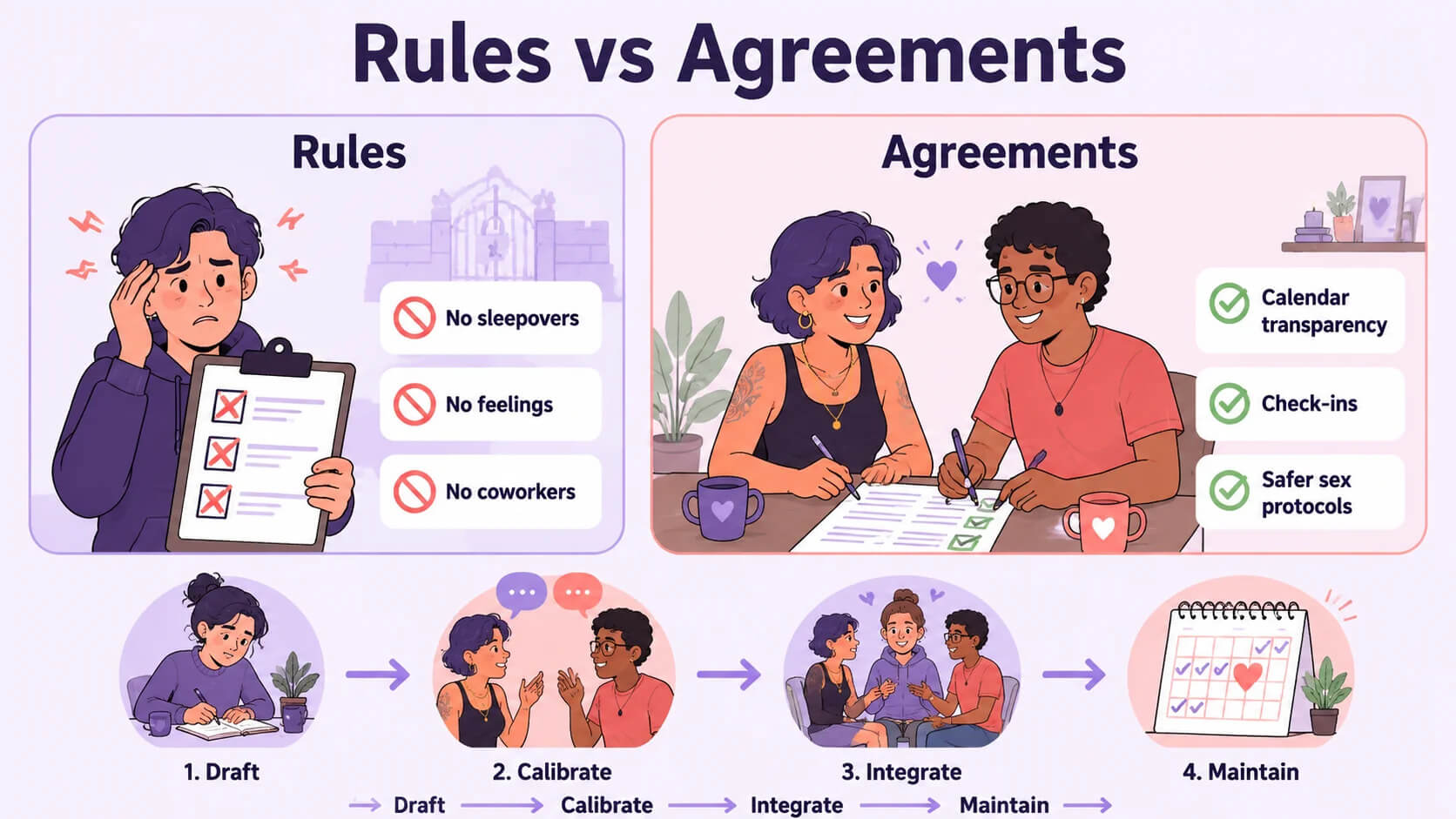
Most open relationship violations do not happen because someone is reckless. They happen because two people said yes to the same word and meant completely different things.
Open relationship agreements protect the primary bond: no sleepovers, no mutual friends or coworkers, always use protection, no romantic feelings, weekly primary date nights, disclose new partners within 24 hours, monthly check-ins. These frameworks are specific and enforceable. Their strength: clarity. Their weakness: they treat emotions as controllable and violations as binary. You either followed the agreement or you did not.
Polyamory agreements enable multiple loving connections: radical honesty about new connections, calendar transparency (a shared Google Calendar is nearly universal), safer-sex protocols with testing schedules, NRE management commitments (no canceling established plans for new connections), and recurring check-ins. These frameworks treat emotions as expected, scheduling as the real constraint, and agreements as living documents.
Dr. Tammy Nelson, a sex and relationship therapist, proposes a critical reframe: agreements over rules. Rules feel like restrictions imposed from above, breeding policing and resentment. Agreements feel like co-created frameworks, building partnership. The language shift changes the entire arrangement’s emotional texture.
If you are building agreements from scratch, use a staged protocol. Individual drafting: each person articulates non-negotiables and flexibilities separately, before discussing together. Mutual calibration: cross-reference and compromise using active listening. External integration: brief new partners on existing agreements before intimacy. Routine maintenance: monthly system reviews of what works and what does not.
A check-in sounds like this: “Review: I saw Alex twice. Appreciate: you handled that late-night text gracefully. Discuss: I feel disconnected from us this week. Agreements: our frequency understanding works, but I want to revisit overnights. Reconnect: Sunday brunch, just us, no phones.”
The agreement that always fails: no catching feelings. It is the most common starting point for open relationships and the most common break point. If you keep it, pair it with a protocol for when feelings develop. Because they will.
4. Jealousy: Different Triggers, Different Solutions
CNM practitioners show higher trust and lower destructive jealousy than monogamous individuals. A University of Michigan meta-analysis by Conley and colleagues, covering over 2,100 participants, confirmed it. Not because these people are less jealous by nature. Because their relationship structure forces them to get good at handling it.
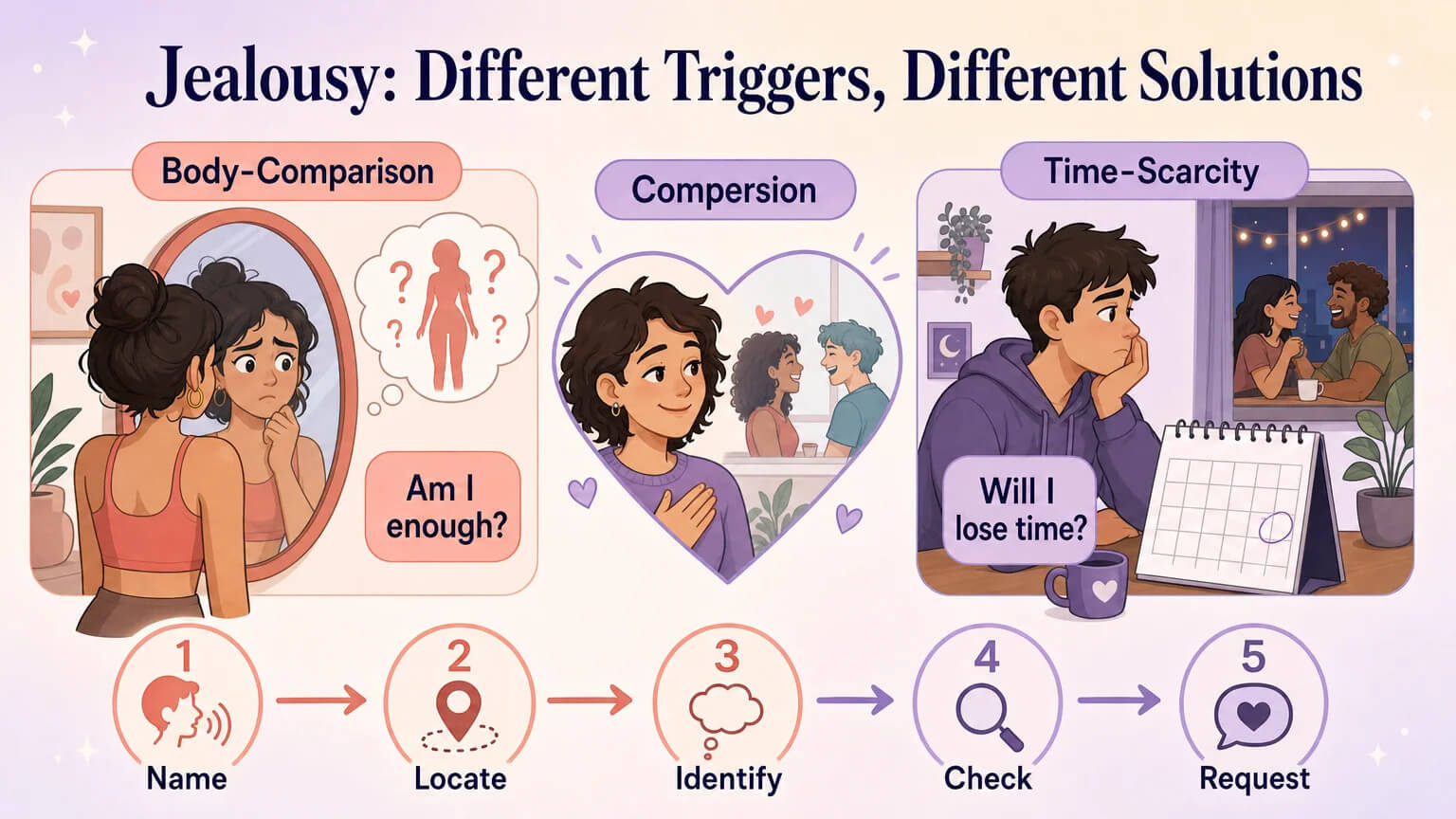
Jealousy has different flavors in each model, and the flavor determines the fix. In open relationships, jealousy asks: are they better in bed? More attractive? Will sex with them make my partner want me less? This is body-comparison jealousy, sharp and immediate. The fix: explicit reassurance about desire, agreements protecting your sexual bond, reconnection rituals after outside dates. No comparisons shared. A “heading home” text when the date wraps up. Sexual variety is not sexual replacement.
In polyamory, jealousy asks: do they love them more? Am I less special? Will I lose time and attention? This is time-scarcity jealousy, slower-burning but deeper. The fix: specific, scheduled quality time (“Tuesday night is ours,” not “we will find time”), verbal affirmation of what makes your connection irreplaceable, and the gradual practice of compersion.
Compersion is the experience of joy from your partner’s joy with others. It is a skill, not a trait. Start small: ask your partner to share one thing they enjoyed about a date, then notice the warmth when they smile telling the story. That is the beginning. It grows with practice, not forcing.
When jealousy hits: (1) Name it: “I am feeling jealous.” Naming reduces its power. (2) Locate it in your body: tight chest? stomach knot? (3) Identify the story underneath: “I am being replaced” is the story; facts may not support it. (4) Check the evidence: has your partner kept agreements? (5) Make a specific request: “Dedicated date night this week?” not “Make me feel better.”
Dossie Easton and Janet Hardy, authors of “The Ethical Slut”: “Jealousy is like grief, anger, or fear. Not pleasant, but manageable. The tools for managing it can be learned.” Your model does not determine whether you feel jealousy. It determines which tools you reach for and which story your jealousy tells.
5. A Week in Each Life: What These Models Actually Look Like Day to Day
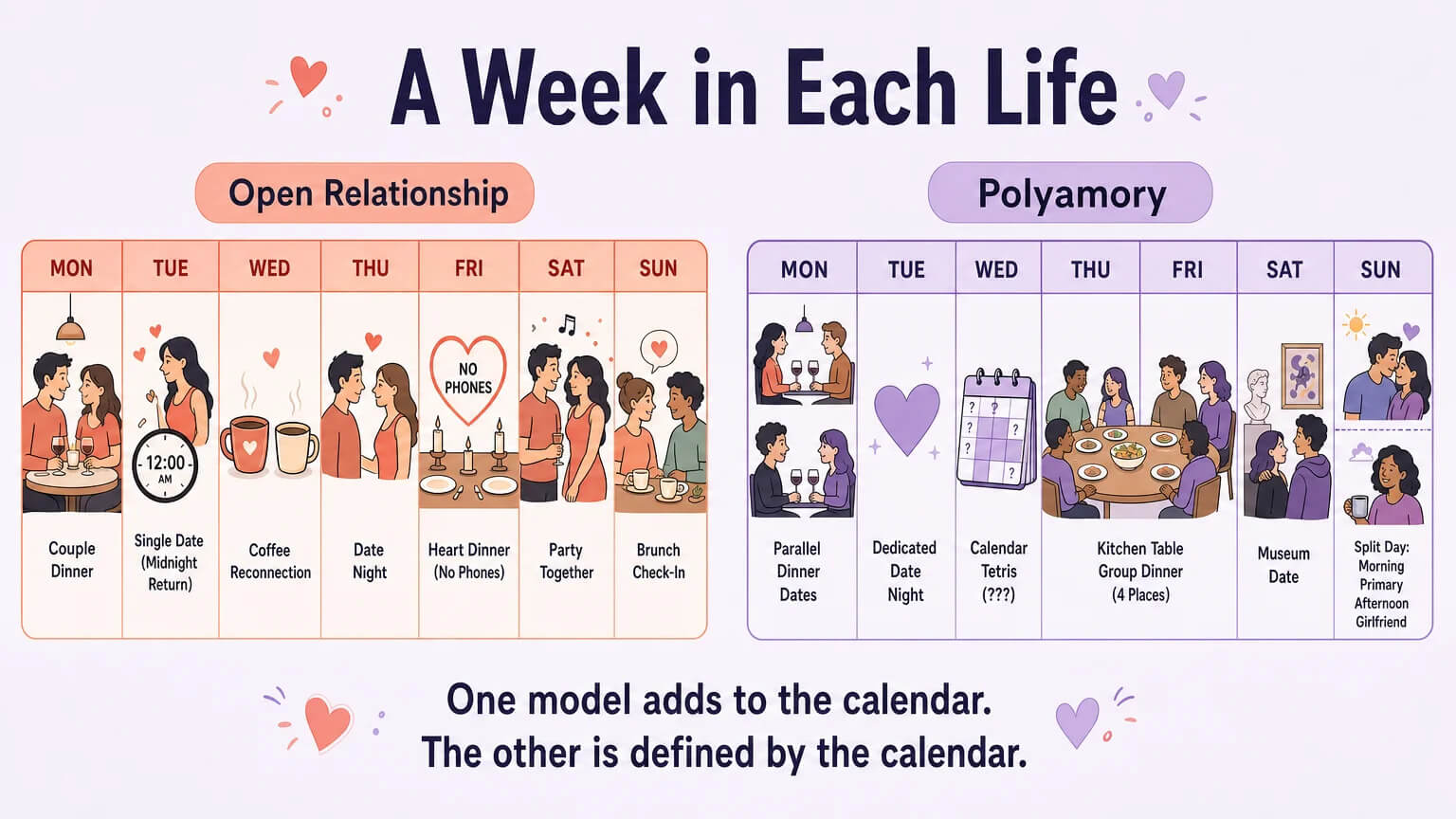
Theory is clean. Wednesday night when your partner is on a date and you are eating takeout alone for the third time this month is not.
An open relationship week: Monday, couple dinner. Tuesday, Partner A has a Feeld date: drinks, chemistry, home by midnight. Partner B gets a “heading home” text, feels a small pang and a larger sense of normalcy. Wednesday, reconnection ritual: morning coffee, casual debrief. Thursday, Partner B has a date. Friday, sacred date night, no phones. Saturday, a party together as a couple. Sunday, monthly check-in over brunch. Outside connections are experiences. They enhance the week without restructuring it.
A polyamorous week: Monday, Partner A has dinner with their girlfriend of six months; Partner B uses the evening for their weekly date. Wednesday, Partner A and their nesting partner have dedicated date night. Thursday, calendar Tetris: Partner A coordinates with their girlfriend; Partner B texts their comet partner visiting next month. Friday, kitchen table dinner: the nesting couple hosts Partner A’s girlfriend and her other partner. Metamour spaghetti night. Saturday, Partner B takes their other partner to a museum. Sunday, primary couple morning, then Partner A heads to their girlfriend’s. Outside connections are full relationships with their own rhythms and emotional gravity. The shared calendar is the household’s most important document.
Dating app profiles reveal the model. Open relationship: “ENM, partnered, dating separately. Here for fun, flirty connections.” Polyamory: “Solo poly, two committed partners, open to new connections that could become meaningful.” The language broadcasts the structure before the first message.
In both models, someone still has to take out the trash, walk the dog, and remember to buy milk. In open relationships, outside connections are a meaningful addition that fits around your shared life. In polyamory, outside connections are your shared life and must be integrated with chores, kids, careers, and sleep. One model adds to the calendar. The other is defined by the calendar.
Read both scenarios again. One probably felt exciting and the other felt exhausting. That is your answer. Do not talk yourself out of it.
6. Which One Is for You: A Personality-Based Guide to Choosing
A 2024 Polish study (Banaszkiewicz, 355 participants) found people in open relationships score higher on ambiguity tolerance than polyamorous people, but people who desire polyamory score higher than those who desire open. Wanting poly takes more comfort with uncertainty; doing open takes more adaptability.
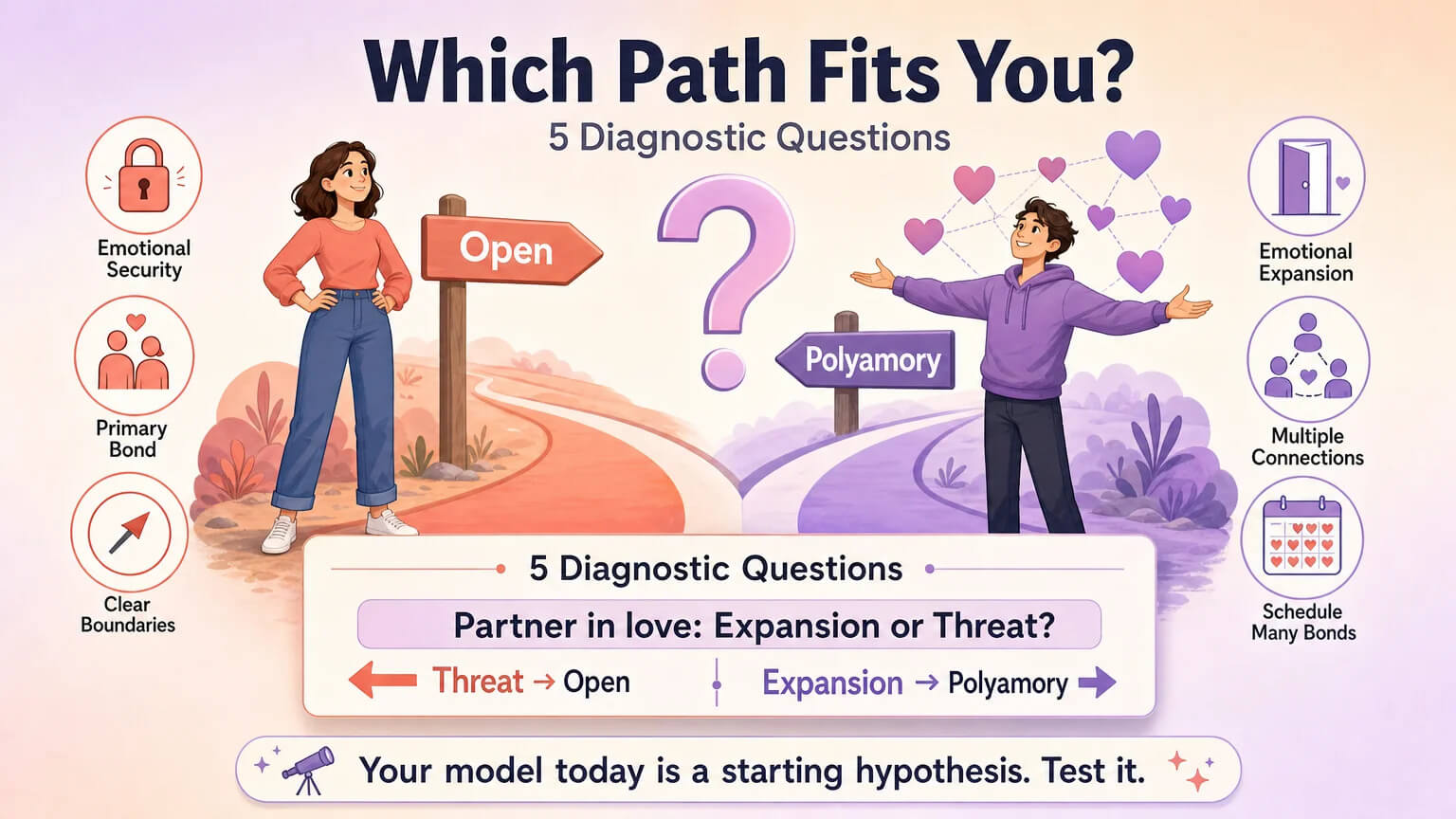
Five diagnostic questions. (1) Your partner falling in love with someone else: expansion or threat? Expansion = poly, threat = open. (2) Should outside connections fit existing containers or become whatever they become? Containers = open, freedom = poly. (3) How do you feel about calendar management? If coordinating three schedules exhausts you, polyamory may overwhelm. (4) Your actual goal: sexual variety = open, variety plus emotional expansion = poly. (5) Your bandwidth: polyamory demands a part-time job’s worth of communication and emotional processing.
Attachment style matters. Jessica Fern, author of “Polysecure,” found that secure attachers thrive in either model. Anxious attachers may find open relationships destabilizing because casual ambiguity triggers attachment alarms; they can do well in polyamory with clear communication and consistent reassurance.
The most common transition failure: one partner wants polyamory, the other only agreed to casual openness. It does not mean your relationship is doomed. Peter Holder recommends exploring what each person actually seeks: variety, connection, autonomy? “The label matters less than the underlying need.” Needs are often compatible even when preferred structures are not.
Valerie McDonnell, a sex therapist: “Opening a relationship is not a repair strategy.” The best time to open is when the relationship is already stable.
You can open sexually first and evolve toward polyamory later. You cannot easily take back emotional depth once multiple loving relationships are established. Starting open and iterating beats starting poly and discovering you hate it.
Most couples who succeed did not get the label right on day one. They communicated relentlessly and let their agreements evolve. Your model today is not a life sentence. It is a starting hypothesis. Test it, adjust it, and trust the structure that works for the two humans in it.
The Bottom Line
Open relationships and polyamory solve different problems. Pick the one that matches what you actually want.
Choose open if: you want sexual variety with one primary emotional anchor, clear boundaries, and outside connections that enhance your life without restructuring it. Choose polyamory if: you believe one person cannot meet all your emotional needs, you will do the labor of multiple loving relationships, and you feel expansion at your partner loving someone else.
If you are a couple: read the overview together and ask the five diagnostic questions. Where you agree is your starting point; where you disagree is your first conversation. If you are single: write your dating profile in the language of the model you want. The right words attract people seeking the same structure.
The label matters less than the honesty underneath it. The people who succeed are not the ones who picked perfectly on day one. They are the ones who kept talking.
FAQ
Can you transition from an open relationship to polyamory?
Yes, and many couples do. The transition works when both partners genuinely want it, not when one is pressured. If you started open with a “no feelings” agreement and someone caught feelings, slow down. Discuss what each person wants underneath the labels. A CNM-informed therapist can help. The messy middle is navigable with honesty.
How do I disclose my relationship status on a dating app?
Put it in your first line: “ENM, partnered, dating separately” or “Polyamorous, two committed partners, open to new connections.” Confirm before the first date: “Just making sure you caught my relationship status.” This filters out people who would not consent, saving everyone time. 3Fun app is built for this.
Is ENM the same as polyamory?
No. Ethical non-monogamy (ENM) is the umbrella term for all consensually non-monogamous styles, including open relationships, polyamory, swinging, and relationship anarchy. Polyamory is one type of ENM defined by multiple loving relationships. All polyamory is ENM. Not all ENM is polyamory.
What if my partner and I want different things?
This is common and does not mean your relationship is doomed. Slow down. Each person articulates what they actually seek: sexual variety, emotional connection, autonomy? Often the underlying needs are compatible even when preferred labels are not. Involve a CNM-informed therapist. Do not pressure, do not silently resent. If you cannot find alignment, that is hard information, but better than a coerced agreement that breeds resentment.