A 2025 meta-analysis landed a finding that should change how we talk about relationship satisfaction. After analyzing 35 studies, nearly 25,000 people across six countries, researchers found no meaningful difference in relationship or sexual satisfaction between monogamous and ethically non-monogamous relationships. The lead researcher called it evidence against the “monogamy superiority myth.” Around the same time, a national survey found 34% of Americans describe their ideal relationship as something other than completely monogamous.
If the structure does not predict happiness, what does? Communication. Trust. How well you hold boundaries. Your capacity to regulate your own emotions instead of making them your partner’s problem. These things matter more than whether you have one partner or several. And the specific type of polyamory you explore shapes how those skills actually work in practice. Get the structure right, and the skills have room to do their job. Get it wrong, and you spend more energy managing the container than the people inside it.
Below: 12 ways people build polyamorous relationships, organized by category so you can find the ones that sound like your team. No pressure. No prescriptions. Just a map.
1. Hierarchical Polyamory
If you and your partner are opening a long-term relationship, hierarchical polyamory is likely the first structure you will encounter. It preserves the shape of what you have already built.
In hierarchical polyamory, one primary partnership takes priority. This usually means cohabitation, shared finances, co-parenting, and greater decision-making power held together. Secondary and tertiary partners have less entanglement and fewer claims on time and resources.
Research by Flicker, Sancier-Barbosa, Moors, and Browne (2021) found that primary partners in hierarchical setups report satisfaction levels similar to people in non-hierarchical arrangements. The gap hits secondary and tertiary partners, who report lower satisfaction and higher attachment anxiety. The structure works for the primary couple. The ethical question is whether secondary partners are getting a fair deal.
The most common pitfall is couple privilege: the primary couple’s preferences automatically override secondary partners’ needs. Vetos exercised without secondary input. A secondary partner’s birthday getting rescheduled because the primary couple had a conflict. Partners treated as accessories rather than full humans with their own emotional worlds.
Best for: couples opening up gradually who want a clear safety framework while they learn. Watch out for: the quiet resentment that builds when secondary partners realize their needs will always come second.
2. Non-Hierarchical (Egalitarian) Polyamory
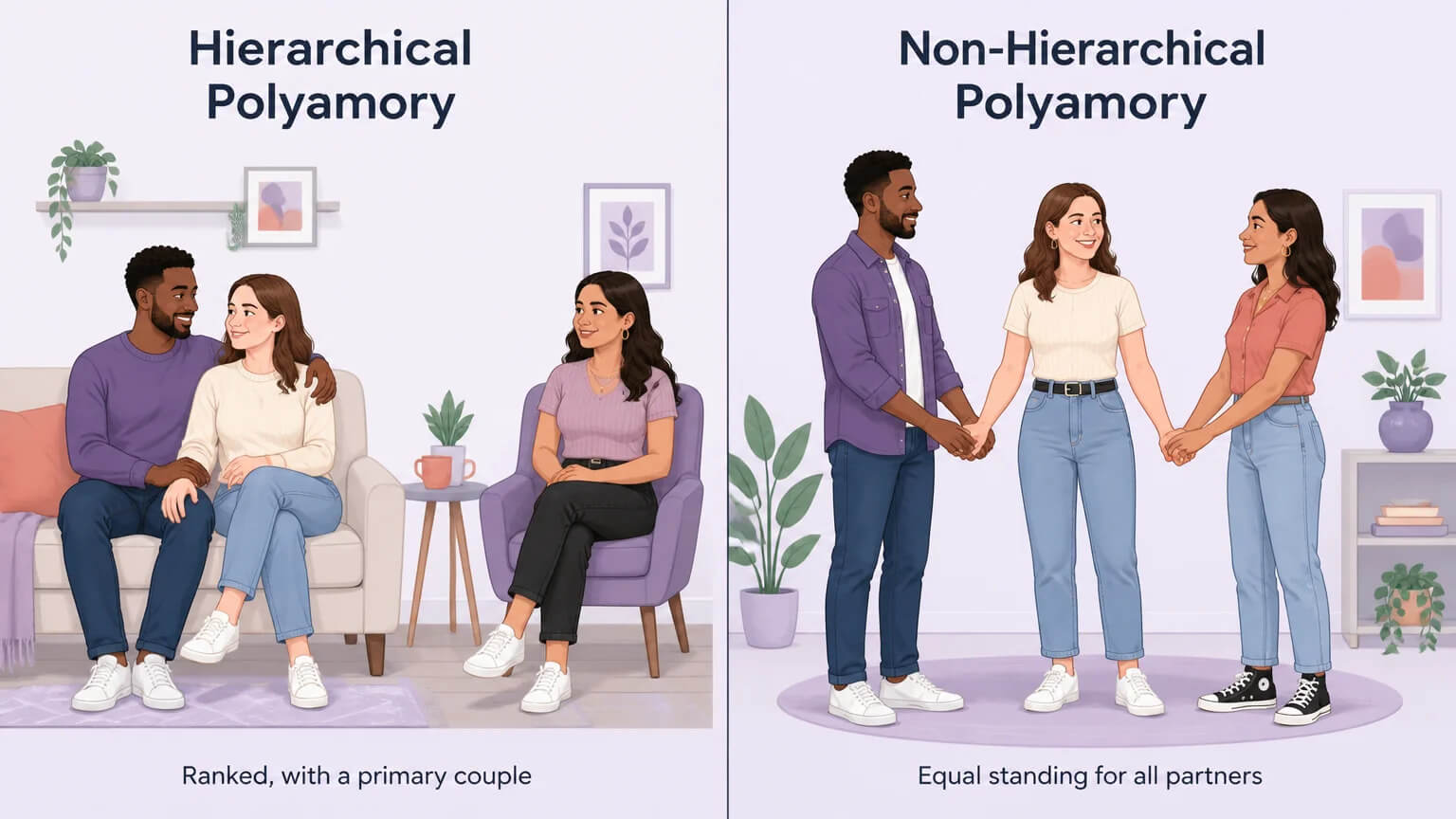
What if no partner automatically came first, ever? No preset rankings, no veto power, no one relationship that always wins when schedules collide?
Non-hierarchical, or egalitarian, polyamory means all partners have equal opportunity to negotiate their relationships. No one gets automatic priority by title. Decisions consider all partners equally.
Flicker et al. (2021) found that individuals in non-hierarchical configurations report higher relationship satisfaction and attachment security compared to those in hierarchical arrangements. Attachment security is more evenly distributed across partners, with fewer large gaps between who feels safe and who does not.
Balzarini et al. (2019) found that even among those who reject hierarchical labels, “pseudo-primary” and “pseudo-secondary” patterns emerge organically based on relationship length and cohabitation. You live with Partner A for five years. You will spend more time with them than Partner B of six months. That is not hierarchy; that is physics. The distinction: descriptive hierarchy (we live together, so we spend more time) versus prescriptive hierarchy (we must always come first by design). One is reality. The other is a choice.
The real work is distinguishing organic asymmetry from enforced ranking, and staying honest about which one is driving your decisions.
3. Nesting Partners and Anchor Partners
You live together. You split rent. You have a dog. Does that automatically make this person your “primary,” or does it just make them the person you happen to share a lease with?
A nesting partner is someone you cohabitate with. An anchor partner is someone deeply entangled in your life, emotionally, logistically, or both. These are not necessarily the same person. Neither term requires ranking above other partners.
This is where descriptive versus prescriptive hierarchy becomes practical. If you live with someone, you spend more time with them. That is descriptive, just math. But using cohabitation to override other partners’ needs is prescriptive: a choice, not an inevitability.
Sex therapist Valerie McDonald puts it simply: the quality of conversation matters more than the structure label. A nesting arrangement can be deeply egalitarian if both partners resist couple privilege. The real question is not “do we live together?” but “do we use living together as a trump card?”
The trap: letting cohabitation harden into unexamined defaults. The nesting partner who says “but we live together” to win every disagreement is practicing prescriptive hierarchy wearing descriptive clothing. Your shared home does not need a ranking system attached.
4. Solo Polyamory
Solo polyamory means not cohabiting with romantic partners, not merging finances, not riding the relationship escalator of marriage, shared property, and kids. Relationship coach Elizabeth Cunningham puts it plainly: “Solo polyamory is having yourself be the central partner in your life. Some solo polyamorous people even call it having a primary relationship with themselves.” Solo poly people maintain deep, committed, long-term relationships. They simply do not want to live together or merge lives logistically.
Cunningham warns that theory and practice diverge widely. Do not assume you know someone’s life because they identify as solo poly. Kind, honest communication about what you can and cannot offer is non-negotiable.
The hardest part is social illegibility. No default plus-one. Family asking “when are you going to settle down?” Partners who want escalation eventually realizing they are incompatible. Mel Cassidy, an original voice in the solo poly community, emphasizes this is not a transitional phase. Autonomy is the point, not the problem.
Best for: people who want deep, committed love without the logistical merger. Watch out for: partners who say they are fine with your autonomy but quietly hope you will change your mind.
5. Kitchen Table Polyamory (KTP)
You, your partner, your partner’s partner, and their partner all around the same dinner table, laughing, passing dishes, genuinely enjoying each other’s company. If that sounds like a dream, you might be KTP-inclined. If it sounds like a hostage situation, skip to section 6.
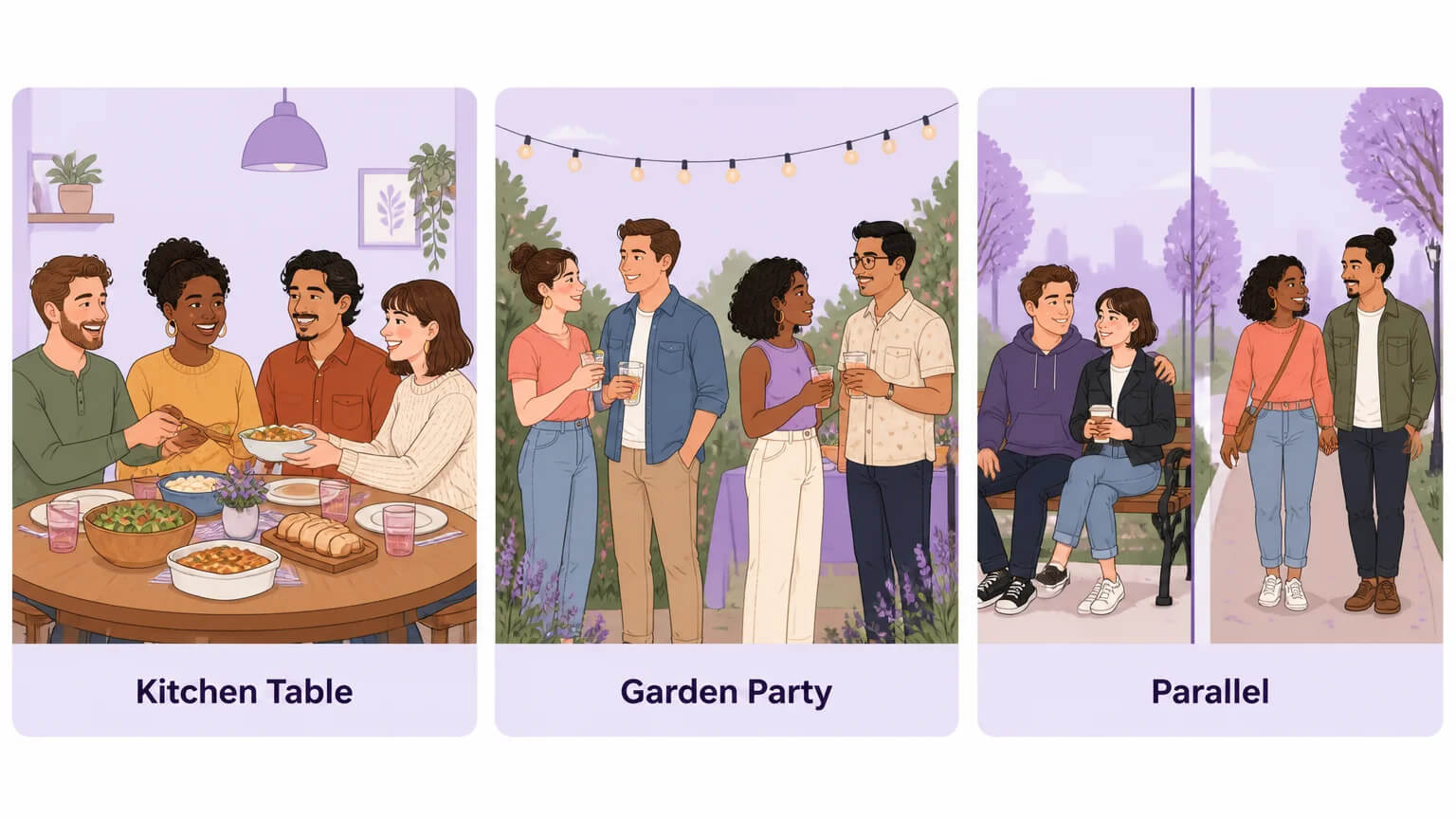
Kitchen Table Polyamory means all partners and metamours (your partner’s other partners) are comfortable gathering together socially. Shared holidays, group hangouts, sometimes collaborative decision-making. The kitchen table is both literal and not: this is the polycule as chosen family.
KTP creates built-in community. Someone to dog-sit. Someone to lean on during hard times. The hinge partner gets relief because metamours can communicate directly. When it works, it is warm, expansive, and lovely.
When it does not, the pressure to perform closeness becomes a second job. Cleveland Sex Therapy puts it directly: “When metamours don’t naturally click, KTP can feel forced, exhausting, and inauthentic.” Personal conflicts become everyone’s business. Constant exposure to a partner’s other relationships can amplify jealousy rather than reduce it.
KTP is an invitation, not an entrance exam. If it forms organically, wonderful. If it does not, that says nothing about your emotional maturity. Forced closeness is just as damaging as forced distance.
6. Parallel Polyamory
You do not have to be friends with your partner’s partners. You do not even have to meet them. Read that again.
Parallel polyamory means relationships run independently with minimal or no interaction between metamours, like train tracks that never intersect. The hinge partner is the sole conduit for communication and coordination.
This structure is ideal for introverts, people with limited social bandwidth, and anyone carrying boundary or enmeshment trauma. Cleveland Sex Therapy validates it as equally legitimate to KTP. It is not a sign someone “cannot handle” polyamory. It is a deliberate, often wise choice.
The tradeoff is hinge partner burnout. Every piece of information flows through one person. Poly.Land describes it plainly: “The hinge bears all communication and coordination burdens alone.” Scheduling becomes logistical Tetris. Holidays, birthdays, and emergencies become zero-sum negotiations. Without careful communication, Parallel can drift into a “don’t ask, don’t tell” feeling that breeds insecurity.
If you go Parallel, the hinge needs support systems that do not depend on either partner. Share enough to keep each person informed without oversharing. The structure protects autonomy; just make sure the person in the middle is not the only one holding the map.
7. Garden Party Polyamory
Not everyone gets a seat at the kitchen table. Some people get invited to the garden party. And that is exactly where they want to be.
Garden Party Polyamory sits in the middle ground between KTP and Parallel. Metamours are cordial, can attend larger group events together, and acknowledge each other warmly, but do not form close friendships or spend regular time together. Think good colleagues rather than best friends.
Find Poly describes it as a flexible middle path that avoids the extremes of forced closeness or total separation. It gives the hinge partner relief from being the only connection point, without demanding that metamours become friends.
The trap is ambiguity. Without clear expectations, one metamour may interpret garden party as “we are on our way to KTP” while another sees it as “this is as close as I want to get.” The mismatch breeds quiet resentment. The hinge may feel caught trying to please both sides.
Name it: “We are garden party. That means we are warm at events, but we are not doing weekly dinners.” Clarity turns garden party from an accidental collision of mismatched expectations into an intentional structure everyone can actually relax into.
8. Triad (Throuple)
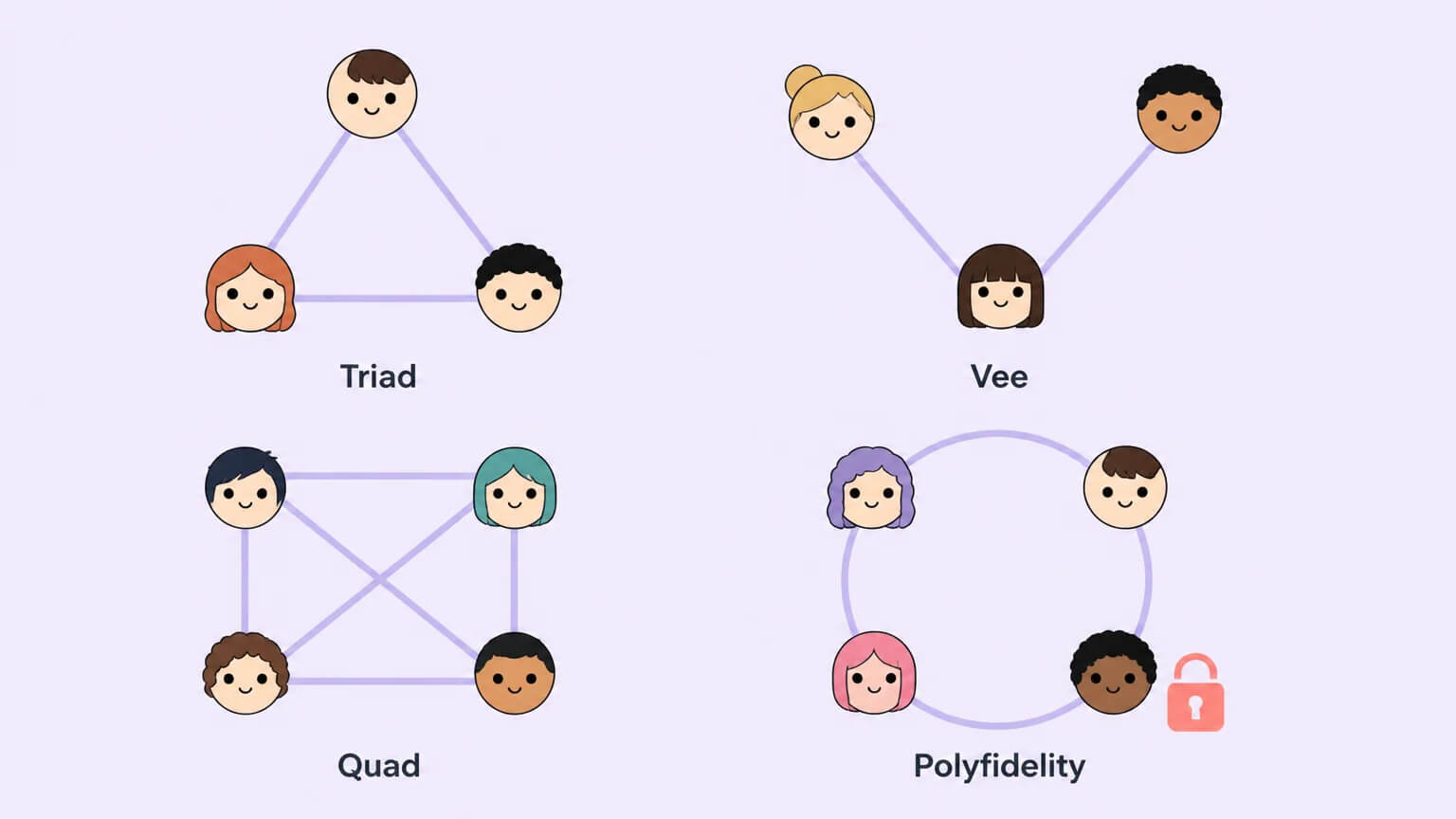
A triad (or throuple) is three people who are all romantically and sexually involved with each other. It is not a couple who found someone to spice up their sex life. The distinction matters more than most people realize.
In a triad, all three people are connected, unlike a Vee where only the hinge connects to both ends. Triads can be open or closed. They are the most fantasized-about poly structure, and the one most likely to implode when entered without intention.
For 3Fun readers, knowing the difference between a triad and a threesome matters. A threesome is an experience. A triad is a relationship structure involving rent, holidays, and whose mother you visit.
The research and community experience are consistent on this point: triads that form organically, where three people independently develop mutual feelings, tend to work. Triads that are recruited by an existing couple tend to fail. The added person faces asymmetrical power. The original couple has shared history, inside jokes, legal protections, and often an unspoken agreement to close ranks if things get hard.
Here is the test: if you would not show a prospective triad partner your couples’ texts about them, you are doing it wrong.
9. Vee (V)
You are dating two people. They know about each other. They are cordial, or maybe they have never met. You are the hinge in a Vee. And that is a role with its own playbook.
A Vee is one person (the hinge) dating two people (the “arms” of the V) who are not romantically or sexually involved with each other. It is a foundational structure; many more complex poly arrangements are built from overlapping Vees.
The hinge role is demanding. You are the emotional and logistical center of two separate relationships. If one metamour wants KTP and the other wants Parallel, the hinge gets caught in the middle. Cleveland Sex Therapy describes this as one of the most stressful structural conflicts: satisfying conflicting preferences without making anyone feel excluded.
The hinge can also accidentally distort rather than transmit. Oversharing creates a triangle where metamours learn about each other through the hinge’s edited reports rather than direct communication.
Best for: anyone dating two people who are not into each other, which describes most poly arrangements. The Vee is not a “lesser” structure; it is the backbone of the polycule. Watch out for: the hinge absorbing all the emotional labor without a support system of their own.
10. Quad
If a triad is three-dimensional chess, a quad is four-dimensional. The possibilities multiply fast, and so do the dynamics.
A quad is a four-person polyamorous relationship. Configurations range from a full quad (all four dating each other) to two overlapping couples or a connected chain. Quads can form intentionally or emerge organically: two couples become close, cross-connections develop, and suddenly you are planning four-person birthdays.
Unlike triads, where the power dynamic is usually couple-plus-one, quads often have more balance built in. But they also have more communication channels to maintain. With four people, you have six one-on-one relationships, four three-person dynamics, and one four-person dynamic. That is a network that takes real maintenance.
The complexity tax is real. Every decision involves more stakeholders. Scheduling is exponentially harder. A conflict between two people in the quad can ripple through all four. A quad that looks like a dream on paper can become a logistics nightmare in practice, especially if the structure formed quickly without each dyad building independent strength.
If you are exploring a quad, build the individual relationships first. Let each pair develop its own foundation, its own language, its own trust. The quad is only as stable as its weakest dyad.
11. Polyfidelity
Polyamory does not always mean an open door. Polyfidelity closes the circle, and keeps it closed.
Polyfidelity is a closed relationship involving three or more people who are exclusive with each other. Members do not date outside the group. Sometimes described as “group marriage,” it combines the multi-partner structure of polyamory with the exclusivity norm of monogamy.
Everyone inside has access to multiple loves, but the group’s boundaries are sealed. This offers emotional security and STI safety that more open structures do not, and looking like a traditional family unit can make it more socially legible.
The tradeoff is insularity. With closed boundaries, conflicts have nowhere to go. If two people in a polyfidelitous triad are fighting, the third person cannot seek outside support or connection without breaking the agreement. The closed structure can also create pressure to stay when someone wants to leave: leaving a triad means breaking up with two people simultaneously.
Best for: people who want the richness of multiple partners with the security of exclusivity, and who have strong conflict-resolution skills because there is no outside release valve. Watch out for: the insularity trap. Make sure everyone has outside friends even if they cannot have outside partners. The circle stays healthy when air can still get in.
12. Relationship Anarchy (RA)
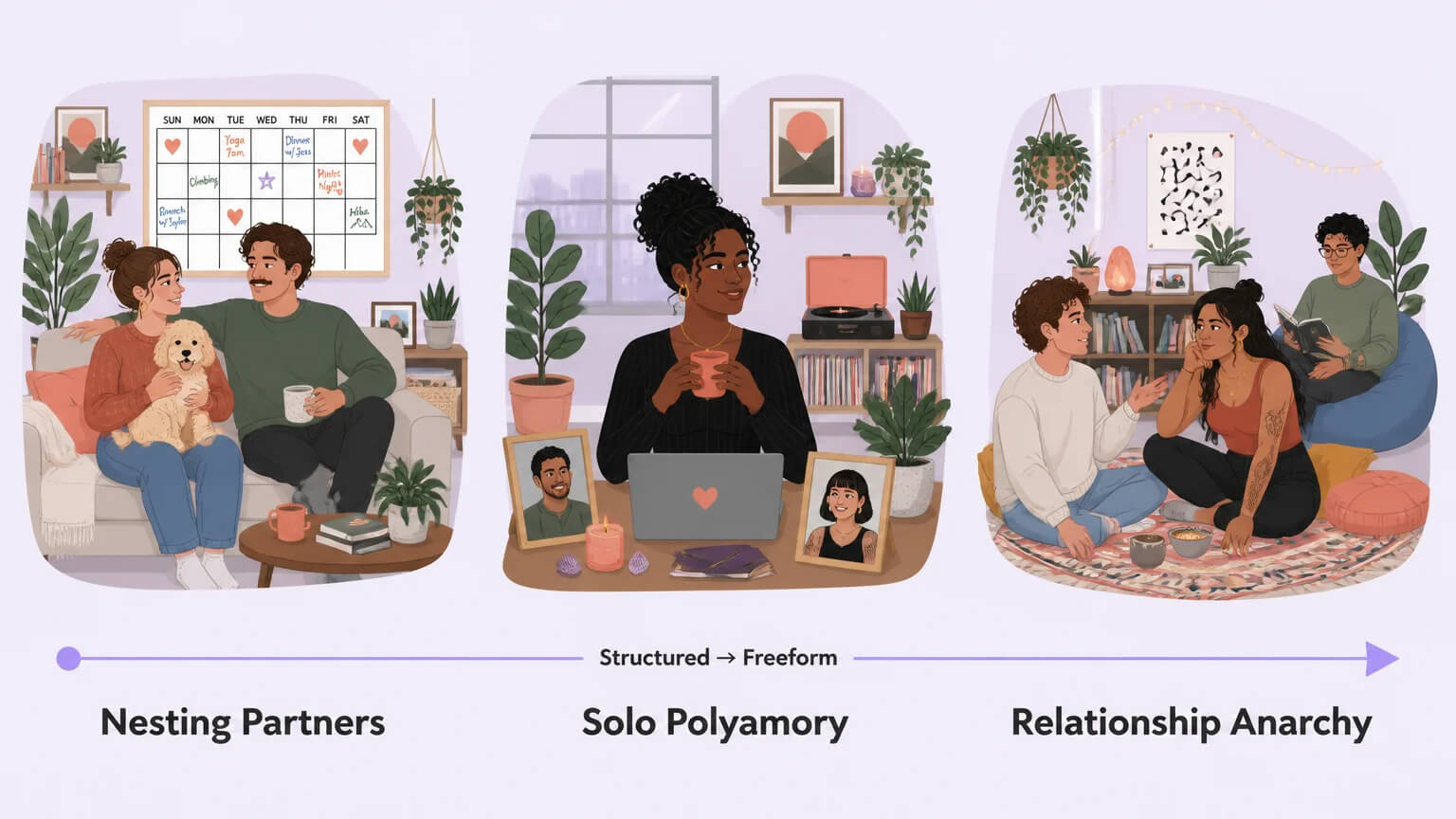
What if the boundary between “partner” and “friend” is a fiction, and treating it as real limits how deeply you can connect with everyone in your life?
Relationship Anarchy was coined by Andie Nordgren in a 2006 manifesto. It is a philosophical framework applied to all human connections, not just romance, that refuses to rank relationships by type. A close friend, a romantic partner, a cuddle buddy, a co-parent: all can be equally important, and none gets automatic priority based on category.
The Non-Monogamy Academy captures it well: RA “explicitly says the boundary between ‘partner’ and ‘non-partner’ is so gray that institutionalizing a distinction is meaningless.” This lets people step off imported relationship scripts. Every connection gets built from scratch.
The freedom comes with risk. Because RA rejects preset expectations, bad actors can use its language to avoid accountability: refusing to name commitments, dodging conversations about expectations, deploying poly terminology as a shield rather than a framework. RA requires more communication, not less. You are co-creating every relationship from scratch.
RA is liberating for people who want to design every connection on its own terms. But anyone who uses “relationship anarchy” to avoid defining what they can actually offer you is not practicing RA. They are practicing avoidance with better vocabulary.
FAQ
Which structure is best?
Research favors non-hierarchical for higher average satisfaction and attachment security (Flicker et al. 2021), but intentionality matters as much as the structure. The best structure is the one where all partners’ relationship goals are respected.
Can we start with one structure and evolve to another?
Yes, and this is common. Many couples start hierarchical as a safer on-ramp and evolve toward non-hierarchy. Others start Parallel and warm to Garden Party as metamours build trust. Be transparent with all partners about the possibility of evolution. Your structure today does not have to be your structure forever.
How do we handle jealousy?
Jealousy is universal. It is not a sign the structure is failing. Treat it as information: a signal about an unmet need or fear, not a shutdown switch. Trace it to its root, often anxious attachment or past experience. Name it, investigate it, and let it point toward what needs attention rather than what needs to stop.
What if one of us is monogamous-leaning?
Mono-poly is one of the hardest configurations but can work when the mono partner genuinely chooses it, not merely tolerates it. It succeeds best when a real asymmetry exists: sexual mismatch, disability, long-distance. If the mono partner is waiting for this to end, it will.