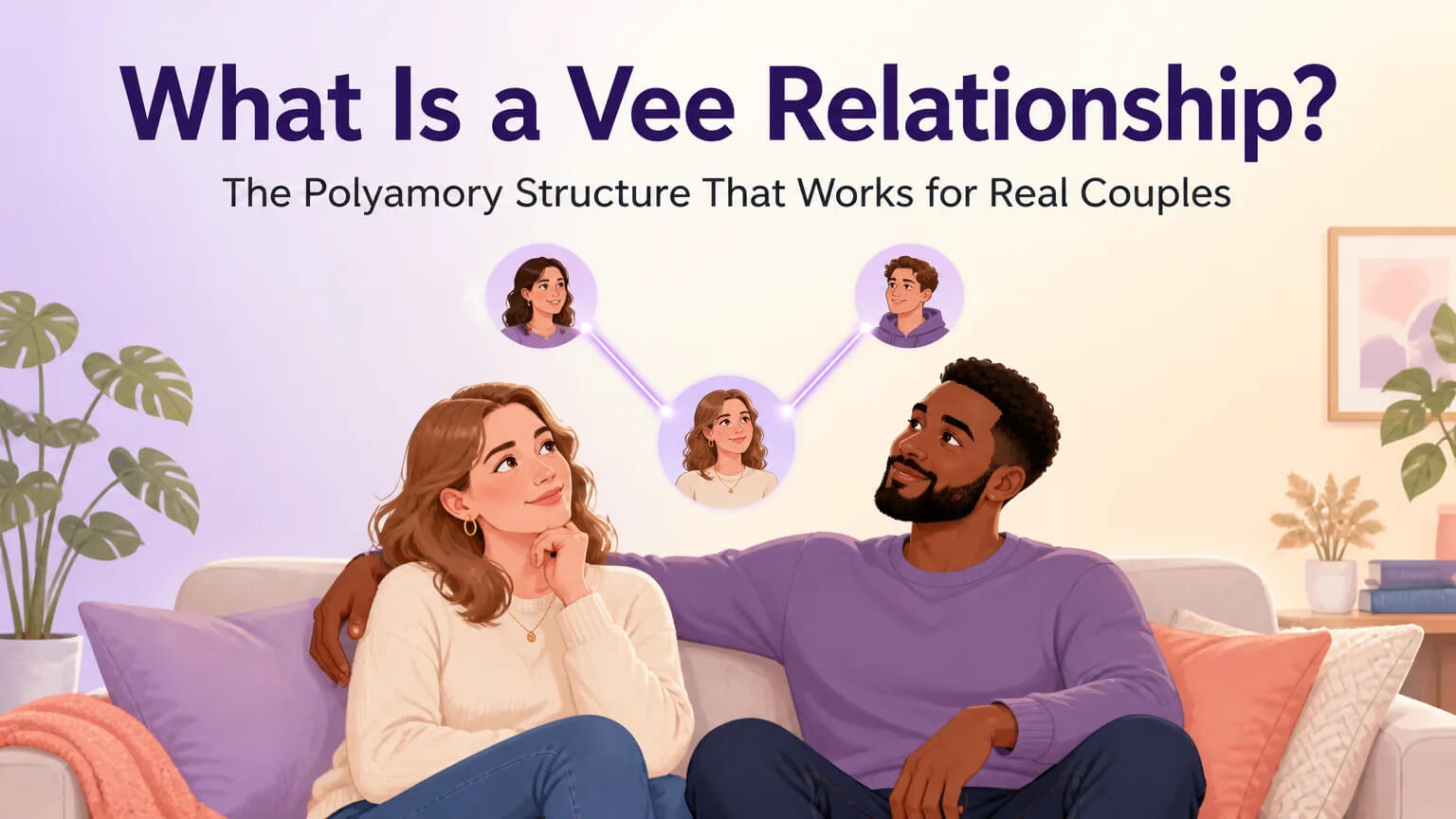
You and your partner have built something solid. You communicate well. You trust each other. And lately, you have been talking about something new. Not because anything is broken. Because your relationship feels strong enough to explore. That is not a crisis. That is relational abundance.
A vee polyamory structure is one person (the hinge, or pivot) romantically and sexually involved with two others who are not involved with each other. They are metamours. The shape is a V: hinge at the center, arms extending outward. What separates this from infidelity is informed, enthusiastic consent from everyone involved. Transparency is what makes it ethical.
This article covers what most online resources skip: what each role actually demands day to day, how metamours relate or agree not to, a working framework for jealousy from every angle, how real vees handle cohabitation and parenting, and a step-by-step guide for going from couple to vee.
Exploring a vee is not a referendum on your relationship. It is an expansion of something that already works.
Vee vs. Triad vs. Throuple: How to Tell These Polyamory Structures Apart
You have probably seen “throuple” in a headline or heard “triad” on a podcast and nodded along without knowing exactly how they differ. These terms get conflated constantly. The confusion has real consequences for how people approach opening up.
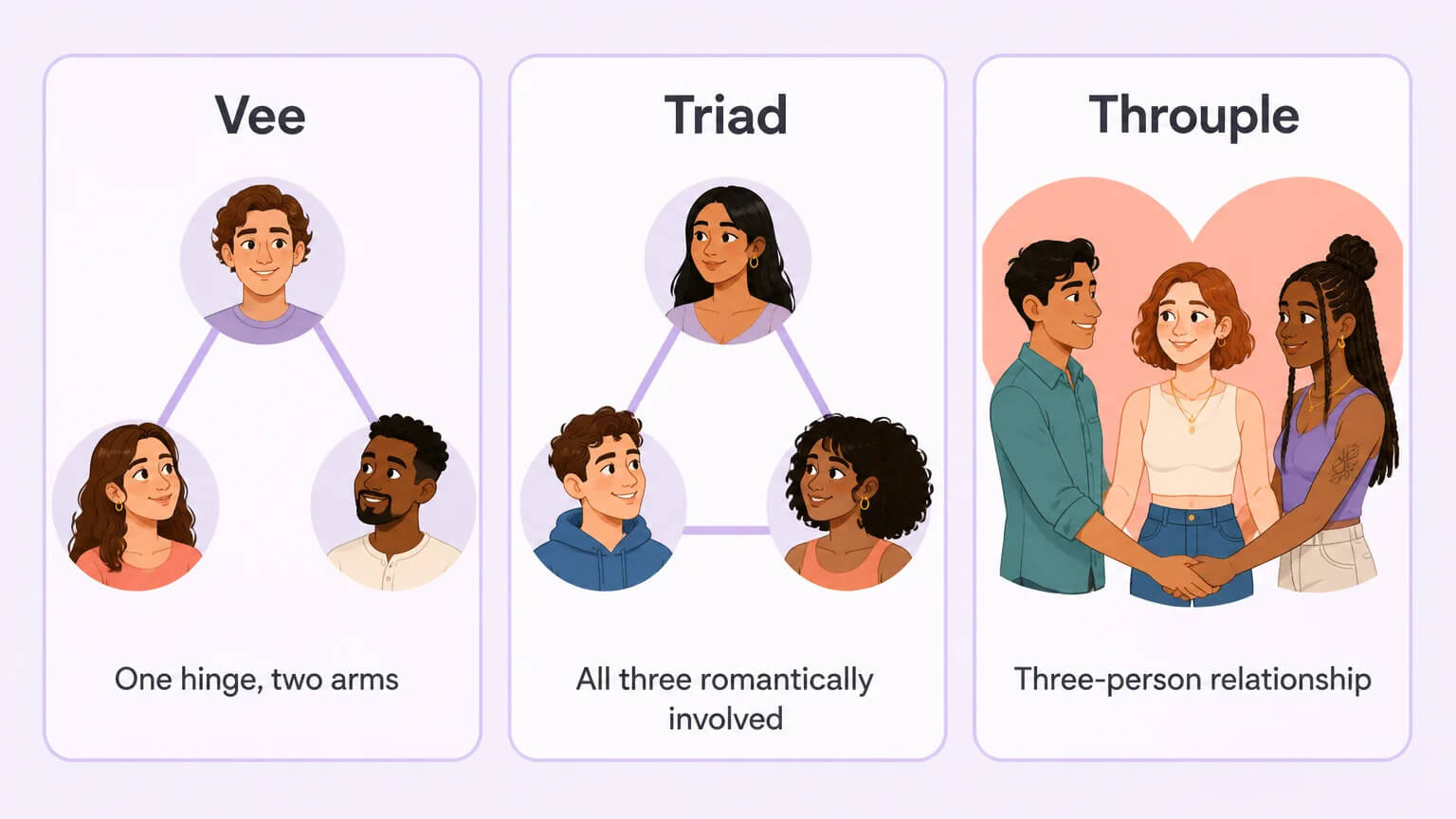
A vee is shaped like the letter V: one person at the center, connected to two people who are not connected to each other. A triad, or throuple, is a triangle. All three are romantically and sexually involved with each other. This is not semantics. It changes where jealousy lands, who carries the emotional labor, and what daily communication actually looks like.
Structures evolve. If the two metamours in a vee start dating, the vee becomes a triad. Some vees are open, meaning partners can date outside the three. Others are closed, or polyfidelitous. These are negotiated, not defaults. An open vee is not more evolved than a closed one.
In a vee, the hinge carries disproportionate weight as the sole connector between two relationships that do not touch. In a triad, emotional labor distributes more evenly, but the complexity of three interconnected relationships creates its own friction. Jealousy patterns differ. Privacy needs differ. A couple opening up to form a vee is doing something structurally different from a couple joining an existing triad.
Count the connection points. A vee has two: hinge to each arm. A triad has four: each person to every other, plus the group dynamic. That math is real. It is why vees tend to be the gentlest entry point into polyamory. Fewer moving parts. Simpler, which means more room to learn the skills before adding complexity.
The Hinge Partner Role: What It Actually Means Day to Day

Being the hinge sounds like the best deal in the arrangement. Two partners who both love you. Twice the attention. The reality is messier than that, and the hinge who walks in without understanding it is the hinge who burns out six months later.
The hinge is the emotional CEO. They manage scheduling across two separate relationships that do not touch. They are the communication relay, the emotional regulator, and often the conflict mediator. This asymmetry is built into the structure. It is not a sign that someone is doing it wrong.
Burnout does not arrive as a single event. It accumulates. Libido fades and sex starts to feel like obligation. Emotional responses go flat: canned answers, no real presence. Physical symptoms appear: headaches, digestion issues, insomnia. Resentment creeps in toward both partners, toward the whole arrangement, toward yourself for agreeing to it. Spot these markers early and you can correct. Miss them, and the structure collapses.
Prevention is learnable. Carve out off-duty hours where you are offline from both relationships, no exceptions. Set hard boundaries on emotional processing: “My emotional window closes at 10 PM on weeknights.” Give yourself 30 to 60 minutes between partner engagements to reset. Accept that 50/50 time splits are not real. Allocate your time based on who needs you most right now, and be transparent about it. Require your partners to develop their own coping skills and outside support. The hinge is not the sole emotional processor for two people.
As the kitchen table polyamory teacher puts it: the hinge is the conductor, not every instrument in the orchestra. The lazy hinge throws everyone together and hopes they mesh. That is the most common failure mode. Active, compassionate facilitation is the actual job. And yes, it can be learned.
Megan Bhatia, host of the Amory podcast and a practicing hinge, says it plainly: “You are going to unintentionally hurt your partner. Stretch the rubber band little by little; do not yank it too fast.” The goal is not perfection. The goal is showing up, repairing, and checking in.
Life as the Arm of a Vee: the Non-hinge Partner Experience

Almost everything published about vee relationships speaks to the hinge. But in every vee, two out of three people are the arms. They share the hinge but do not date each other. If that is you, or your partner, this section is yours.
The arm’s core experience is this: you share a partner’s time, attention, and emotional bandwidth with someone you may barely know. The comparison trap is real and it is constant. Differences in sexual frequency, time allocation, or emotional intimacy between the two arms can make you feel like the backup plan. This happens even when the hinge is doing everything right.
So how do you cope? Process low-level insecurity without routing every wobble to the hinge first. Maintain friendships, therapy, and hobbies outside the polycule. The hinge cannot be your only source of validation. Negotiate guaranteed minimum time: predictability is a form of security. Recognize that the feeling of scarcity is often internal, your own fears, not actual neglect. Build a direct channel with the metamour for logistics, even if you stay parallel otherwise.
Now the part nobody mentions. Being an arm comes with genuine gifts. Less emotional labor than the hinge. More autonomy. More personal time. Freedom to focus on your career, your friendships, your own growth without being the central support beam for the entire structure. The arm who builds a full life outside the vee is not failing at commitment. They are doing the role right.
One warning from people who learned it the hard way: be an arm because you want to. Not because it keeps a partner happy. Not for shared rent. Not for childcare help. Consent under duress is not consent. Your yes has to be your own.
Metamour Dynamics: From Kitchen Table to Parallel and Everything Between
Your metamour is the person who shares your partner. You did not choose them. You may not have much in common. And yet the health of your vee depends on how the two of you relate. Or agree not to relate.
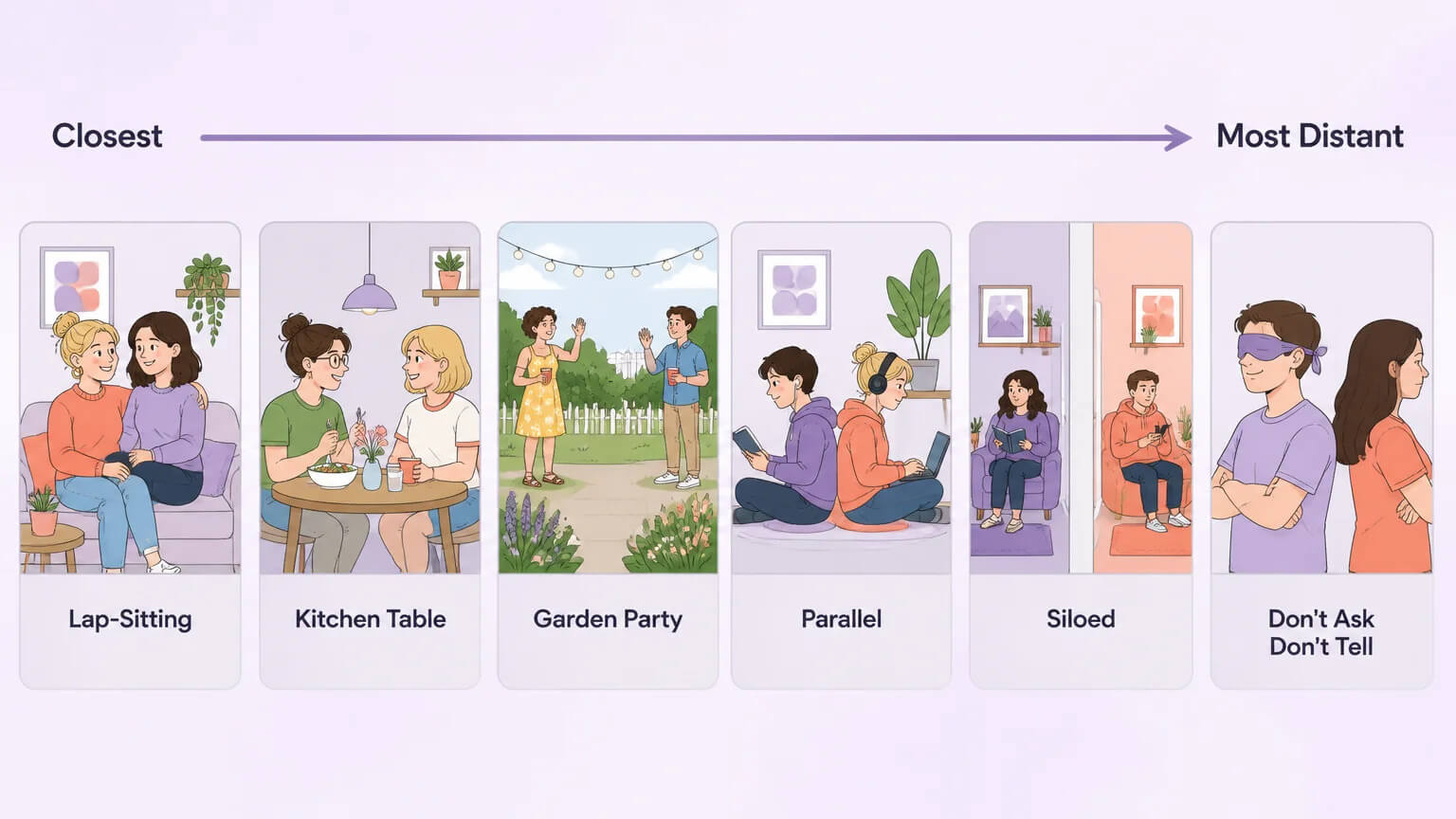
The metamour relationship lives on a spectrum. From closest to most distant: Lap-Sitting polyamory is an extremely close family unit. Kitchen Table means you are friendly, share meals, hang out comfortably. Garden Party means you are amicable at social events but do not keep regular contact. Parallel means minimal to no interaction. Siloed means completely separate lives. Don’t Ask Don’t Tell means you prefer not to know.
No style is better. No style is more evolved. What matters is that everyone involved actually consents to the level of interaction. Forced kitchen table polyamory is not more enlightened than parallel polyamory where both metamours happily coexist without ever talking. The right style is the one everyone can live with without pretending.
The hinge has to facilitate this, not just hope for the best. Throwing everyone in a room and crossing your fingers is the signature move of the lazy hinge, and the most reliable way to blow things up. The hinge controls what information passes between relationships. Complaining about one partner to the other contaminates the well. It is hard to undo.
What if one metamour wants kitchen table and the other wants parallel? The person wanting less contact sets the ceiling. You cannot force intimacy. You can always offer more openness later if trust builds. These relationships need room to breathe at their own speed.
Dr. Marie Thouin, a researcher on compersion, puts it this way: compersion grows when you see the metamour as human. Their awkwardness, their kindness, their normality. They stop being a mythical threat. You do not need to be best friends. But seeing them as a real person, not a symbol of what you might lose, is the foundation.
Jealousy in a Vee Relationship: Managing It From Every Angle

You are going to feel jealous. Your partner is going to feel jealous. The question is not whether it shows up. It is whether you have a plan for what to do when it does.
Jealousy is data, not a character flaw. It points to unmet needs, old wounds, or current insecurity. Eve Rickert and Franklin Veaux, who wrote the Polyamory and Jealousy guide, teach a straightforward skill: deconstruct the signal. Is it fear of abandonment? A dry spell in intimacy? Feeling like you are not enough? Name the specific need before you react. Then ask for a specific corrective and set a time to revisit it.
The hinge carries a unique version of this. You are managing two people’s jealousy at once. Partner A feels insecure. Partner B feels neglected because you spent the evening soothing Partner A. Now you are triangulated, and that can collapse the whole thing. Your job is not to eliminate jealousy. You cannot. Your job is to validate the feeling without becoming the sole processing unit for both partners’ emotions.
The arm’s jealousy hits differently. In a kitchen table setup, the triggers are immediate: you see your partner touch someone else’s hand, hear an inside joke, catch a look of adoration directed across the room. That is not irrational. That is your nervous system responding to input it cannot filter.
Ellecia Paine, a non-monogamous relationship coach, teaches the body-first approach: information is not integration. You can know your partner loves you and still feel sick when they leave for a date. Your body does not speak logic. It speaks sensation. Before you analyze the story in your head, regulate. Unclench your jaw. Exhale slowly. Drop your shoulders. Then do the cognitive work.
Keep a proof list. Saved texts, screenshots, kind words. Something concrete your nervous system can grab when it spirals. This is not sentimental. It is a regulation tool.
Compersion strengthens over time, like any muscle. It is not a purity test. Do not use it as a stick to beat yourself with. Feeling jealous does not mean you are failing. It means you are human. The goal is to feel what you feel and stay connected through it.
Real-world Vee Logistics: Cohabitation, Finances, Kids, and Holidays
On every polyamory forum, beneath the discussions about compersion and attachment theory, the real questions are quieter. Who sleeps where? How do we split the bills? What do we tell the kids? These questions decide whether a vee survives its first lease renewal.
Cohabitation patterns vary more than you would guess. Some rotate sleep schedules: Tuesday through Friday with one partner, Friday through Sunday with the other, Sunday night through Tuesday alone. Others give every adult their own bedroom. In one real vee, the married couple shares a bedroom while the non-married partner has their own room with an attached bath. The arrangement works because of emotional inclusion, not equal square footage. Private space is not a luxury. It is how this stays sustainable.
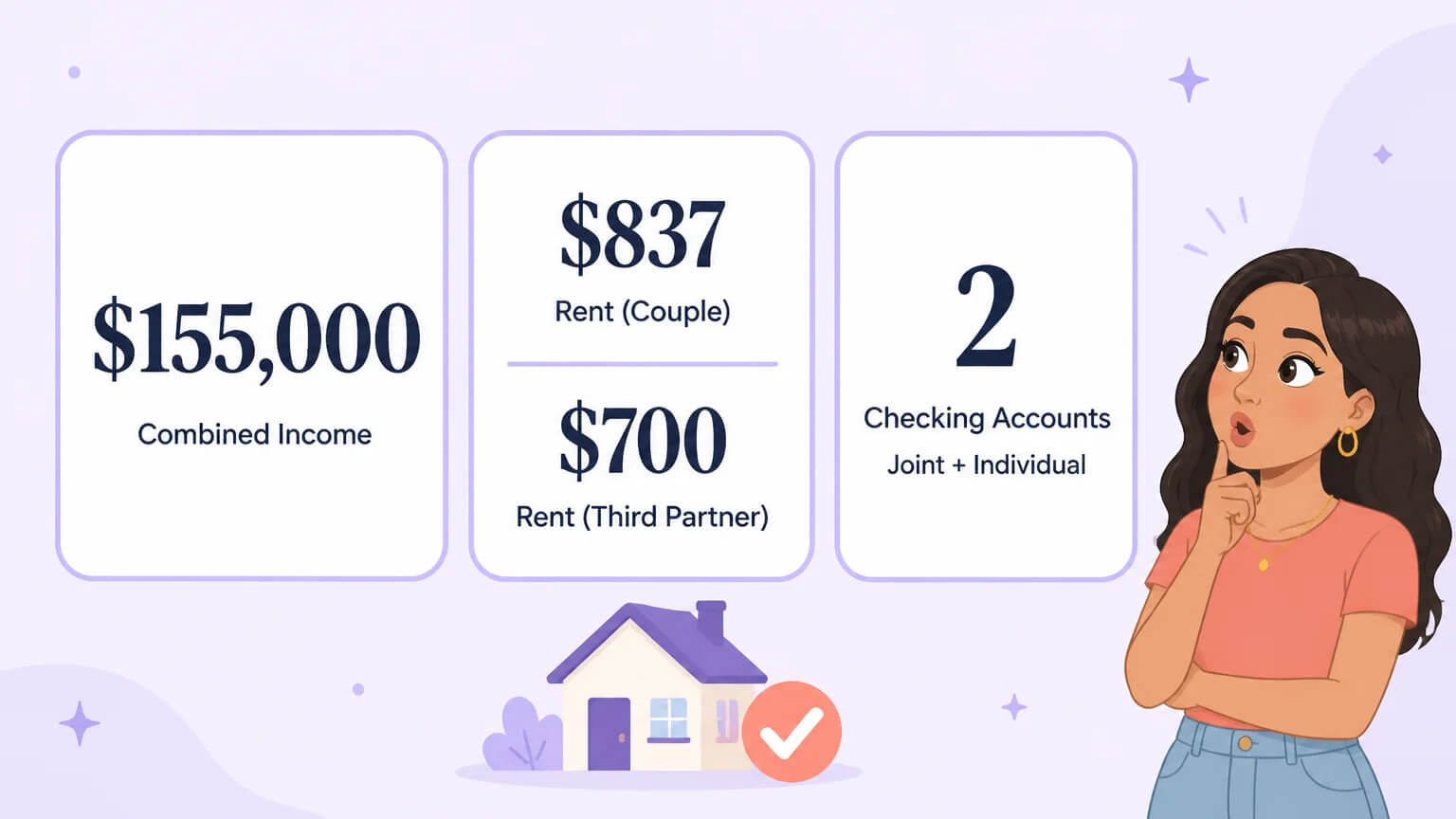
Finances need the same clarity. Jennifer Martin lives in a cohabiting MFM vee. The married couple pays $837 in rent. The third partner pays $700 plus utilities. Two checking accounts, one joint and one individual. Weekly family meetings cover chores, scheduling, and money. Their combined $155,000 income made homeownership possible. Laura Boyle, author of Monogamy? In This Economy?, offers a framing that cuts through the noise: treat partners and metamours like roommates first. Separate the logistics from the emotions. Dishes and bills are dishes and bills. Handle them like adults who share a lease.
The legal reality: in most of the US, only two legal guardians are allowed per child. Polyamorous families use power of attorney, living wills, and medical directives to give non-married partners legal standing. Know the limits before you hit them.
Introduce new partners to children slowly. Be honest in age-appropriate ways. Do not expect kids to keep secrets. They will not. They should not have to. One forum member’s seven-year-old outed the family to the in-laws. That is not a caution against polyamory. It is a warning against expecting a child to manage adult privacy. Weekly family meetings normalize the structure over time.
Holidays follow one principle: decide before the pressure is on, not during it. Some families alternate years. Some create new traditions that include everyone. There is no template. There is only the discipline of negotiating early.
Logistics are the container that holds the love. A vee with beautiful emotional dynamics and no plan for groceries will break faster than one with awkward dynamics and a solid cohabitation agreement.
How to Transition from Couple to Vee: A Practical Starting Guide
You have had the late-night conversations that start with What if and end with Are we crazy? You are not crazy. Thousands of couples have done this before you. The ones who did it well followed a recognizable pattern.
First, talk about polyamory as a concept, not a request. Do not lead with “I want a vee.” Lead with “I have been reading about polyamory and I am curious what you think.” The difference matters. The non-initiating partner needs room to explore the idea without feeling like a decision has already been made behind their back.
Second, educate together before you act separately. Read Polysecure together. Listen to the Multiamory podcast. Join a local polyamory discussion group. You want shared vocabulary and shared reference points so that when hard conversations come, you are working from the same map. Months of preparation is not excessive. It is the baseline.
Third, redefine what security means before you need it. In monogamy, security often lives in exclusivity: I am safe because I am the only one. In a vee, security has to live somewhere else: in consistent communication, emotional transparency, predictable scheduling, and a track record of showing up when you say you will. Name this shift explicitly. Do not wait for the first jealousy crisis to discover your partner’s definition of security was still anchored to exclusivity.
Fourth, normalize jealousy before it arrives. Do not promise you will not feel it. Agree on what you will do when it shows up: “I will tell you. I will not accuse. I will ask for what I need.” Build agreements together, not punitive restrictions. Flexible, revisited regularly, owned by both of you.
Fifth, introduce new connections one at a time. Let the structure stabilize around one new relationship before adding more. Couples who try to go from monogamous to a full polycule in three months end up back on the forums asking what went wrong.
Sixth, use the RADAR check-in method. Review what happened. Agree on what it means. Discuss what needs to change. Define the action. Reconnect as a couple. Schedule these weekly at first, then monthly as things settle.
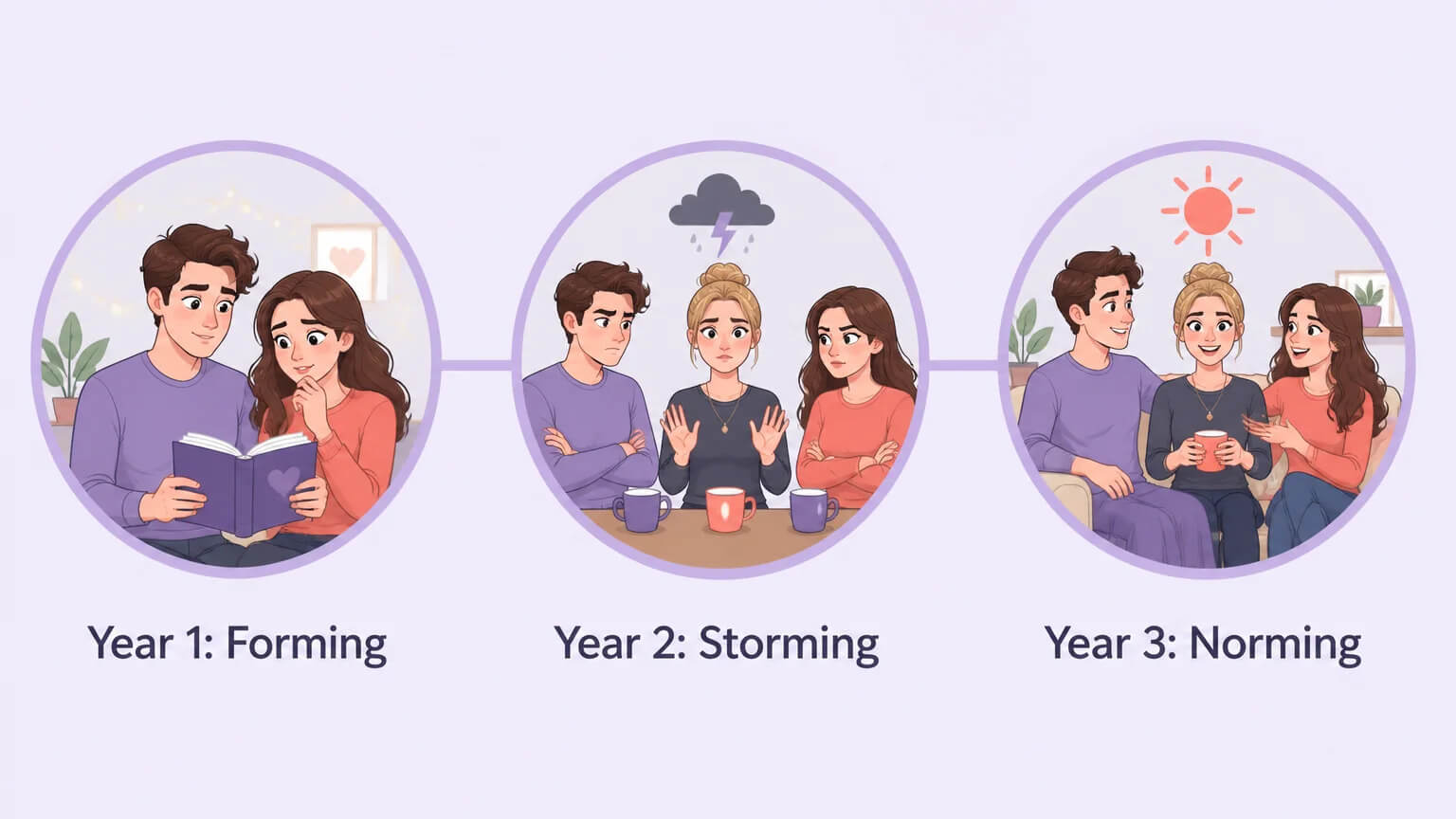
The realistic timeline from couples who have done it: first year forming, second year storming, third year norming. Major jealousy and conflict happen before things settle. That is not failure. That is the pattern. Knowing it ahead of time makes it survivable.
Vee Polyamory: Your Most Common Questions, Answered
What is the difference between a vee and a triad?
A vee has a hinge dating two people who do not date each other. A triad has all three romantically involved. If the metamours start dating, the vee becomes a triad.
Can a vee work if we are opening a previously monogamous relationship?
Yes, it is the most common entry point. But it takes months of shared education and a rock-solid foundation. Polyamory amplifies what is already there. It does not fix what is already cracked. Slow down.
What if one partner wants polyamory and the other does not?
Consent under duress (agreeing to avoid losing a partner) is not consent. A poly-knowledgeable therapist can help navigate the conversation. The non-initiating partner’s no is valid.
How do we actually handle jealousy?
Name the specific fear underneath: abandonment, neglect, inadequacy. Regulate your body before you analyze the story. Agree in advance on what reassurance looks like for each of you. Jealousy is data, not doom.
Should metamours be friends?
Not required. The spectrum runs from kitchen table (friendly) to parallel (minimal contact). The right level is whatever everyone actually wants. Forced friendship breeds resentment.
What is the biggest mistake new vees make?
Rushing. Going from monogamous to cohabiting vee should take at least a year. Other classics: the lazy hinge who abdicates facilitation, treating 50/50 time splits as the goal instead of needs-based equity, and using polyamory to rescue a struggling relationship.