2024 was the year throuples went mainstream. Luca Guadagnino’s Challengers put a tennis-court love triangle on every screen. Peacock launched Couple to Throuple, a reality series about couples adding a third. Bridgerton Season 3 delivered Benedict’s MMF triad. Dr. Justin Lehmiller at the Kinsey Institute tracked the surge, crediting it to the broader destigmatization of non-monogamy.
But media representation and real life are not the same thing. The question underneath the curiosity is simpler and more personal: what actually is a throuple, and could it ever work?
A throuple, short for “three-person couple,” is a consensual, committed romantic relationship among three people. It is not a one-time sexual encounter. That is a threesome. It is not casual dating. It is a lasting, intimate bond where all three people are emotionally invested in each other and in the relationship they share. Sex educator Alix Fox puts the distinction best: “A threesome is focused on love-making; a throuple is focused on being in love.”
Also called a triad or three-way relationship, a throuple can involve any mix of genders and orientations. Some are closed, with all three exclusive to each other. Some are open, with outside partners allowed. Some form when a couple adds a third. Others form when three people come together organically around the same time.
This guide covers what surface-level articles leave out: where the word came from, the four relationships hidden inside every triad, the types that exist, how daily life works (including sleeping arrangements), why throuples fail, and how to know if one is right for you.
Where Did the Word “Throuple” Come From?
“Throuple” is a portmanteau, a blend of “three” and “couple.” It literally means “three-couple.” The word sounds like it was coined by a BuzzFeed headline writer in 2022, but its history is stranger and longer than you would expect.
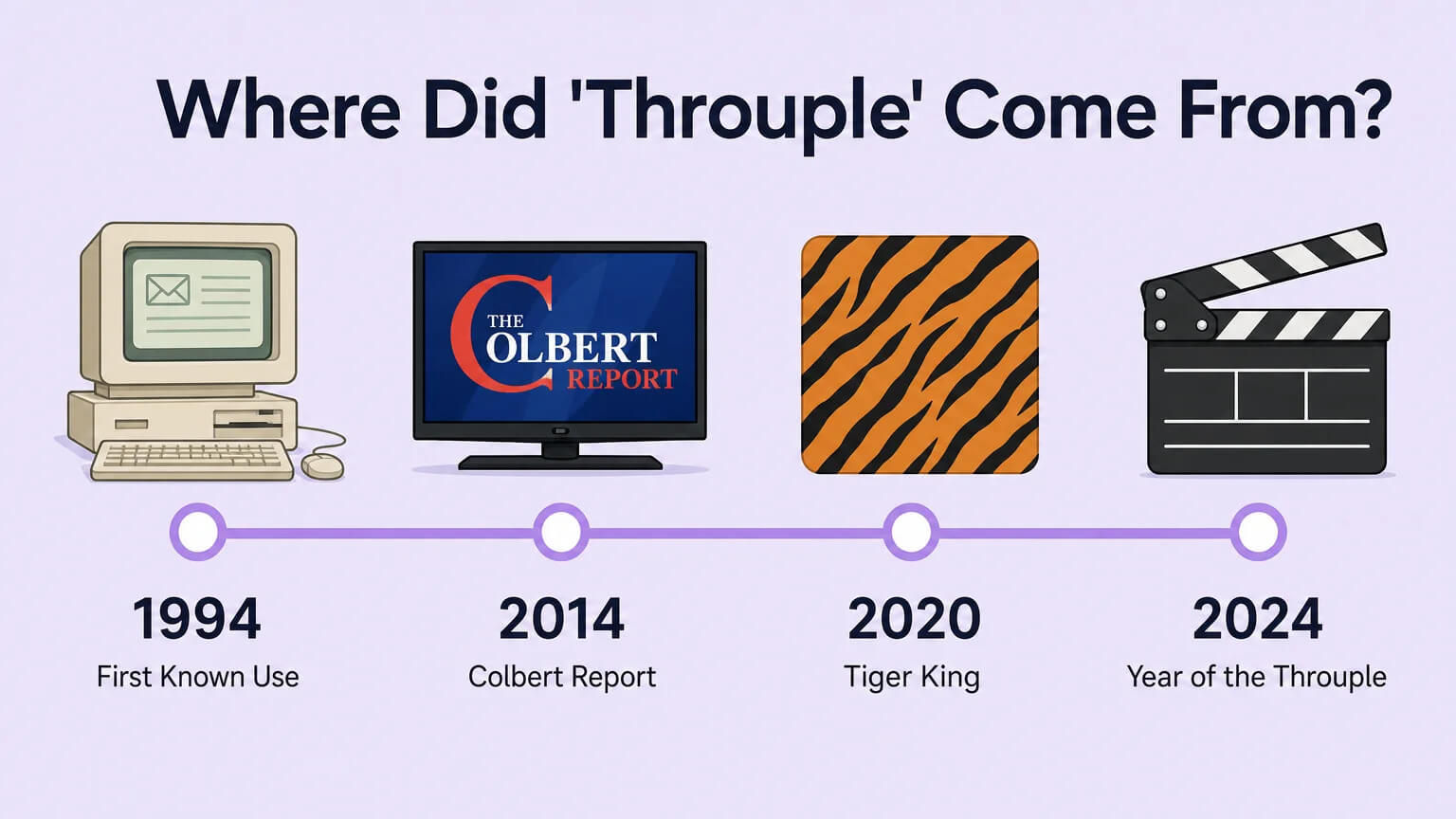
The earliest known written use of “throuple” dates to July 11, 1994, on a Unitarian Universalist email list running on the old Bitnet network, years before the web went mainstream. Someone was discussing polyamorous child-rearing and offhandedly wrote: “a couple (or in this case throuple or more).” The word was likely coined independently multiple times. It appeared again on Usenet in 1997, then in a novel in 2008, and reached mainstream print around 2012.
Then Stephen Colbert got hold of it. On The Colbert Report in 2014, he did a segment on polyamory that introduced “throuple” to a national audience. The real explosion came in 2020 with Netflix’s Tiger King. Joe Exotic, the big-cat zookeeper, was simultaneously married to two men, John Finlay and Travis Maldonado, in what the show explicitly called a throuple. The relationship was toxic: drugs, manipulation, domestic violence. But the term was lodged in the culture for good.
By 2024, outlets were calling it “the Year of the Throuple.” Luca Guadagnino’s Challengers turned a tennis love triangle into a cultural event. Peacock’s Couple to Throuple made it a reality-TV format. Bridgerton gave it the period-drama treatment. For a word that started on a Unitarian email list 30 years ago, “throuple” had arrived.
Why the history matters: The term did not come from academia or activism. It came from everyday people trying to describe their lives. That grassroots origin is worth remembering when the media framing gets overheated.
Throuple vs. Threesome vs. Polyamory: Clearing the Confusion
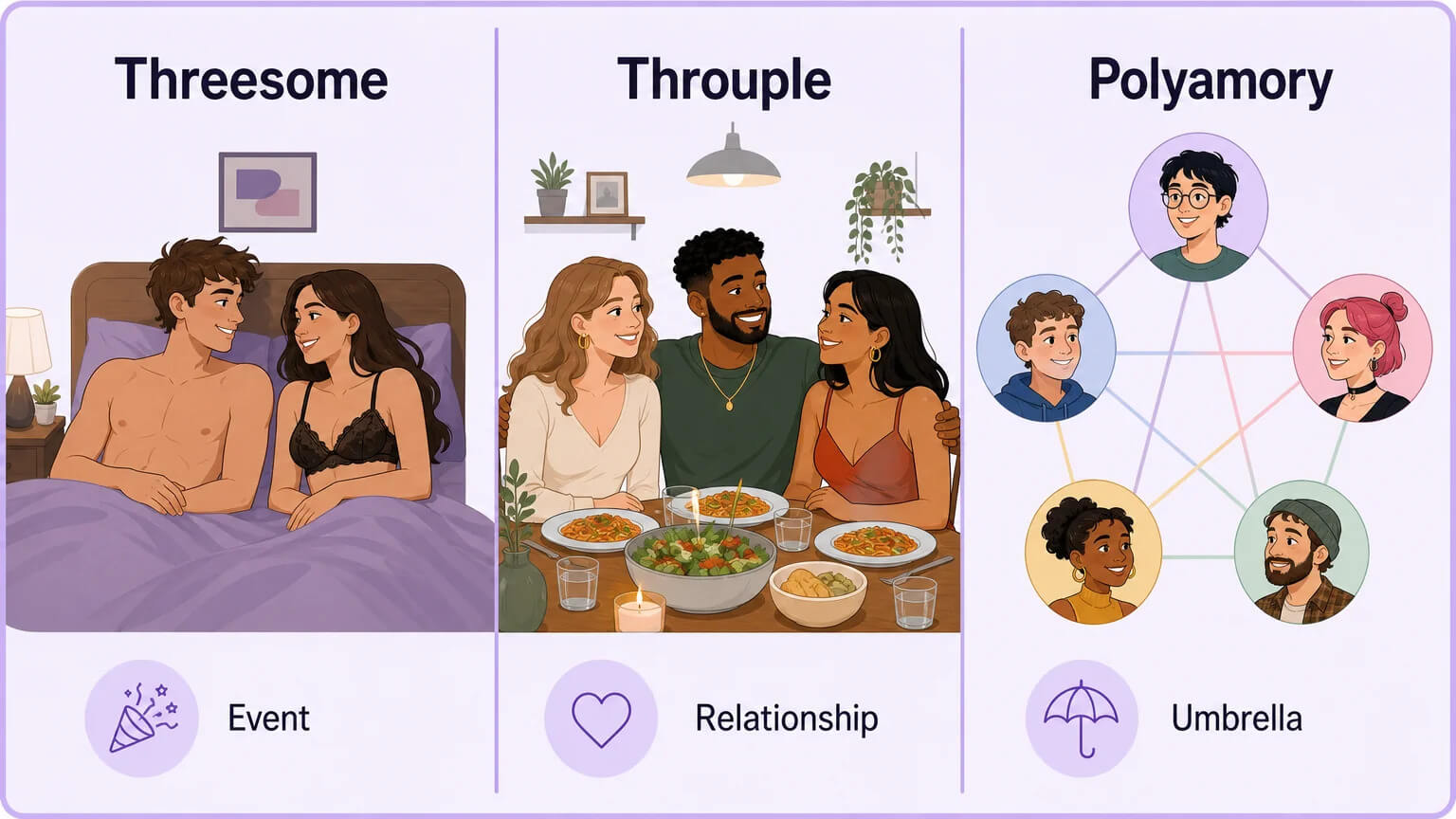
Most people use “throuple,” “threesome,” and “polyamory” interchangeably. They are not the same. Mixing them up creates real misunderstandings about what people want and what they are signing up for.
Throuple vs. Threesome: Emotion vs. Event
Sex educator Alix Fox draws the line cleanly: “A threesome is focused on love-making; a throuple is focused on being in love.”
A threesome is a sexual event. Three people have sex, typically once or occasionally. When it is over, everyone goes home. There is no shared Google Calendar, no “we need to talk about where this is going,” no meeting the parents.
A throuple is a relationship. It involves commitment, emotional investment, shared decisions, jealousy conversations, anniversary negotiations, and all the unglamorous logistics of building a life together. Just with three people instead of two.
The boundary test: If you cancel on them and they would be hurt emotionally, not just disappointed sexually, you might be in a throuple. If you cancel and the only loss is a fun evening, it is a threesome arrangement.
Throuple vs. Polyamory: Shape vs. Umbrella
Polyamory is the broad term for any consensual, ethical non-monogamous relationship involving more than two people. It is the umbrella.
A throuple, or triad, is one specific shape under that umbrella: three people in a relationship together. Other polyamory shapes include:
- V relationships: One person, the “hinge,” dates two people who are not dating each other.
- Quads: Four people in various interconnected configurations.
- Polycules: Larger networks of connected relationships, some romantic, some sexual, some platonic.
- Solo polyamory: Someone who maintains multiple independent relationships without nesting or hierarchy.
A throuple is one shape polyamory takes. It is common enough to have its own name, but it is far from the only configuration under that umbrella.
Throuple vs. Open Relationship: Structure vs. Permission
An open relationship typically means a couple that allows outside sexual partners without forming committed romantic bonds with those partners. A throuple is the opposite: the committed bond includes the third person. In open relationships, the third is outside the core. In a throuple, there is no outside.
The Four Relationships inside Every Triad (This is What Most People Miss)
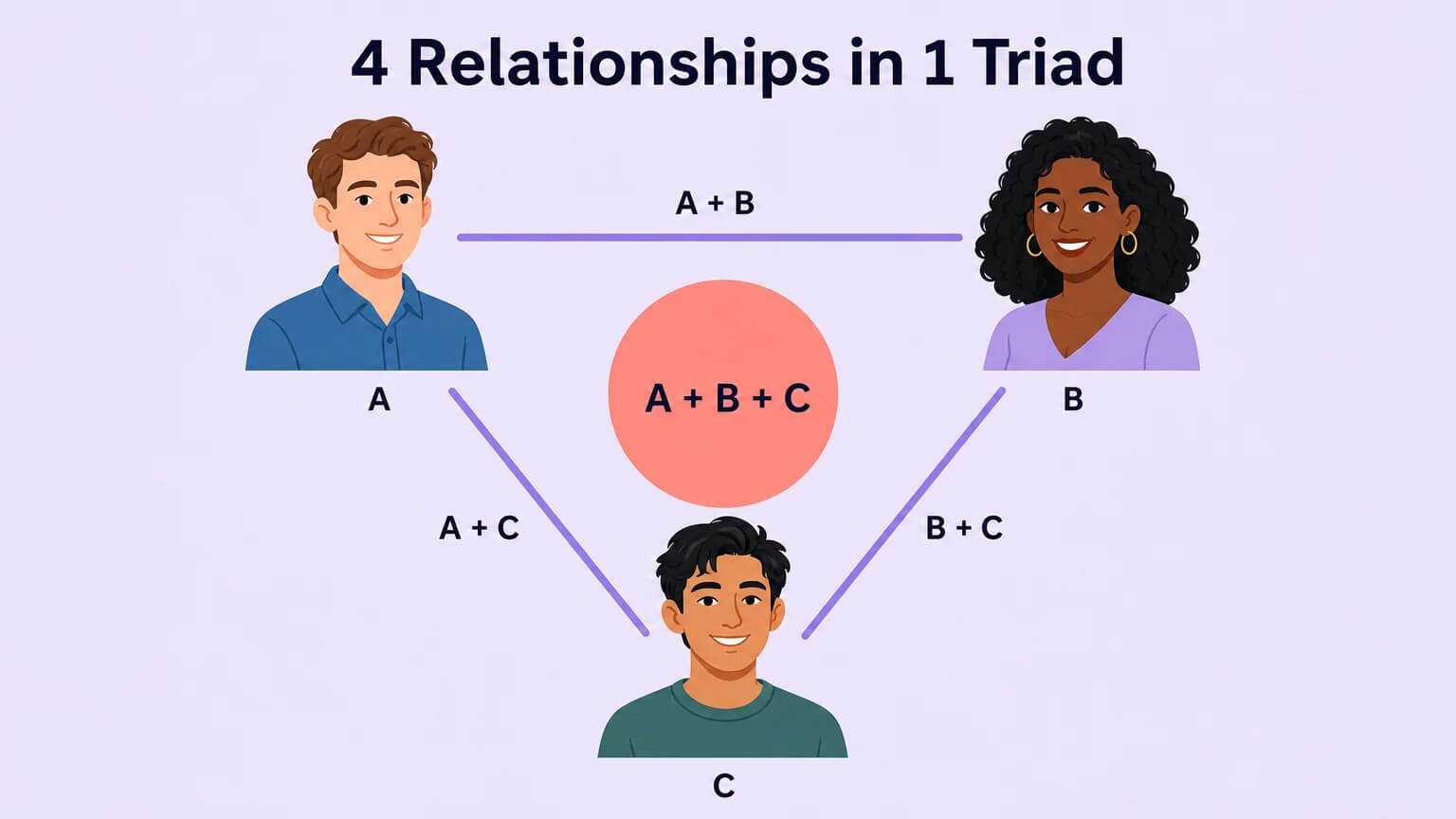
A throuple is not one relationship with three people in it. It is four relationships that all need to be maintained simultaneously:
- Person A + Person B
- Person B + Person C
- Person A + Person C
- A + B + C together, the group relationship
Ness, a member of a lesbian throuple interviewed by PinkNews in 2024, explains it from the inside: “We recognise four different relationships. Me and Katie are in a relationship, me and Kay are in a relationship, and Katie and Kay are also in a relationship, so that’s three. And then there’s the mutual relationship between the three of us.”
Melanie Moseley, another throuple member, told News24: “When you’re in a three-way relationship, you’re actually dealing with four different relationships. All of those need to be nurtured and taken care of.”
This is why “just communicate more” falls short. Four relationships means four sets of needs, four emotional landscapes, four channels of potential miscommunication. When Person A and Person B have a fight, it ripples into the B+C relationship, which affects the group dynamic, which changes how Person A feels about Person C.
Why This Framework Matters
- If one dyad is neglected, that pair drifts apart, and the person who feels least connected is often the one who leaves.
- If the group relationship is neglected, the triad becomes roommates rather than partners.
- If only two dyads are strong, the triad collapses into a V relationship or breaks apart.
Jessica Fern, author of Polysecure, frames it through attachment theory: each person in a triad has attachment needs with two other people plus a need to feel secure in the group identity. That is far more complex than monogamous attachment.
When you enter a throuple, you are not “dating two people.” You are managing four relationships. That is the real workload.
Not All Throuples Look the Same: Types, Shapes, and Configurations
There is no single throuple model. Throuples come in distinct configurations, and which one you choose, or fall into, changes everything about how the relationship functions.
Closed Triad (Polyfidelity)
All three people are exclusive to each other. No outside partners, sexually or romantically. This is the closest thing to a three-person marriage. Decisions are made as a unit.
Open Triad
The three are committed to each other but can have sexual or romantic connections outside the triad. Agreements about outside partners vary: some require disclosure, some require permission, some simply require safer-sex practices. The triad is home base, not a fence.
V Relationship (Hinge Dynamic)
One person, the “hinge,” is romantically involved with two people who are not romantically involved with each other. The two “arms” of the V might be friends, acquaintances, or never interact. This is the most common polyamorous configuration. A V has lower complexity than a triad; a triad has deeper interconnection.
Hierarchical vs. Non-hierarchical
In a hierarchical throuple, one relationship is designated as primary, typically an existing couple who added a third. The original bond takes priority in major decisions.
In a non-hierarchical throuple, all three relationships are treated as equal. Christopher, Robyn, and Amanda, a throuple interviewed in The Sun, describe it explicitly: “There’s no wife that matters more than the other. It’s an equal partnership.” Camp Throuple (Alana, Kevin, and Megan) recommends avoiding hierarchy entirely for the first six months: “Don’t break into pairs; maintain the triad dynamic.”
How Throuples Form
- Couple-to-throuple: A pre-existing couple adds a third, intentionally or organically. This path faces couple-privilege risks.
- Organic triad: Three people meet around the same time and choose to enter a relationship together. Fewer power imbalances, more ambiguity about what the relationship is.
- Accidental triad: A threesome or friendship evolves into a committed three-way relationship without anyone planning it.
How a Throuple Actually Works: Sleeping, Money, and Daily Logistics
Definitions and communication tips only take you so far. Here is what it looks like on the ground: how does a throuple actually share a life?
The Bed Question
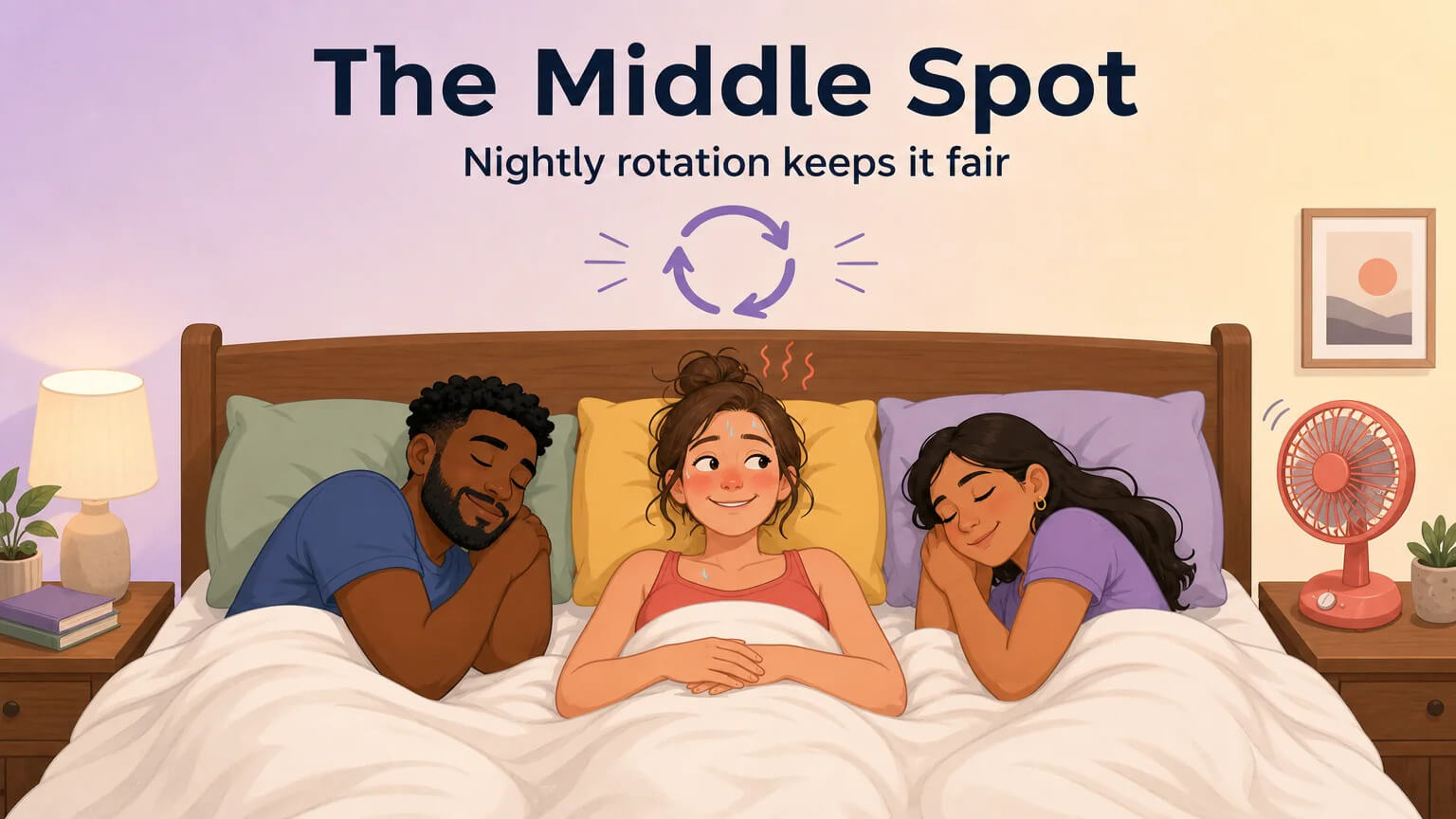
Most throuples sleep in the same bed, typically a king or California king with memory foam to reduce movement disruption. The real challenge is the middle spot.
The “Mac n’ Cheese method,” named by the Camp Throuple trio (Alana, Kevin, and Megan) after their initials (M-A-K), rotates who sleeps in the middle nightly. The middle is the worst position: it gets hot, bathroom access requires waking two people, and you are trapped between two body-heat radiators.
Practical solutions: cotton sheets only (no flannel), ceiling fans on high, individual pillows, long phone charger cords for the middle person, and a spare bed for nights when someone needs solitude or better sleep. Some throuples abandon the one-bed model entirely, using a flexible system where whoever needs the best sleep gets the most comfortable bed alone.
Money: Three Incomes, Three-way Splits
Throuples often split shared expenses three ways: rent, utilities, groceries. Three incomes covering shared costs leaves more individual disposable income.
But financial complexity gets complicated fast. Who is on the mortgage when only two people can legally sign? What happens to shared assets if one person leaves? Legal planning (wills, powers of attorney, co-parenting agreements, even LLCs for shared property) is not optional. The unmarried partner has zero automatic legal rights.
Time and Space: the Real Scarcity
Jessica Fern’s core insight applies here: “Love is infinite, but time isn’t.” Successful throuples schedule one-on-one time for each pair, group time for all three, solo time for each person, and maintain shared color-coded calendars. It sounds unromantic. The throuples that last call it essential.
When two people pair off, the third gets genuine solitude. Throuple members report this is actually more available than in a couple, where alone time is harder to come by.
The Built-in Mediator
When two people disagree, the third can mediate. In a couple, an argument has no natural circuit breaker. In a throuple, the third person can slow things down, offer perspective, and de-escalate, provided they stay neutral.
Why Throuples Fail (and How the Successful Ones Beat the Odds)

Here are the real failure patterns, from people who lived them, and what successful throuples did differently.
Failure Pattern 1: Couple Privilege
A person was in a successful throuple for two years. Then the other two decided to get married and “go traditional.” They changed the locks on the shared home, which all three had paid for, and kicked the third out. The third sued and won. The relationship was destroyed.
What successful throuples do: Deconstruct couple privilege from day one. No “original couple” veto power. No agreements that protect the pre-existing relationship at the third person’s expense.
Failure Pattern 2: Entering to Fix a Broken Relationship
A struggling couple adds a third to reignite the spark. The third becomes a bandage, then a scapegoat when the underlying issues resurface. Successful throuples enter from strength, not deficit. The third is wanted as a person, not a solution.
Failure Pattern 3: the Third Partner Becoming a Replacement
A couple invited a mutual friend in. After six months, the boyfriend and the new partner were doing everything alone together. They broke off the throuple to become a couple and are now engaged. The original girlfriend was replaced in her own relationship. Successful throuples maintain all four relationships intentionally and rebalance when one dyad accelerates.
Failure Pattern 4: the Closet and Broken Agreements
A third partner not ready to come out broke the safer-sex pact, went to a gay bathhouse, and brought back gonorrhea. The secret-keeping did more damage than the infection. Successful throuples only enter with partners ready to be honest, with themselves, each other, and the outside world.
Failure Pattern 5: Legal Invisibility
No U.S. jurisdiction allows three people to marry. The unmarried partner has no automatic inheritance rights, medical decision-making power, or custody protections. Successful throuples use proactive legal planning: third-parent adoption where allowed, wills, powers of attorney, co-parenting agreements. The California gay throuple of Jenkins, Mayfield, and Hodges spent over $120,000 to put three fathers on one birth certificate.
An 8-year parenting triad raising seven kids proves stability is possible. A throuple that ended only because a visa expired shows external circumstances, not internal dysfunction, can be the only cause. The through-line: treat jealousy as a signal to investigate, not suppress, and refuse to let one dyad dominate the others.
Is a Throuple Right for You? The Questions to Ask Before You Begin
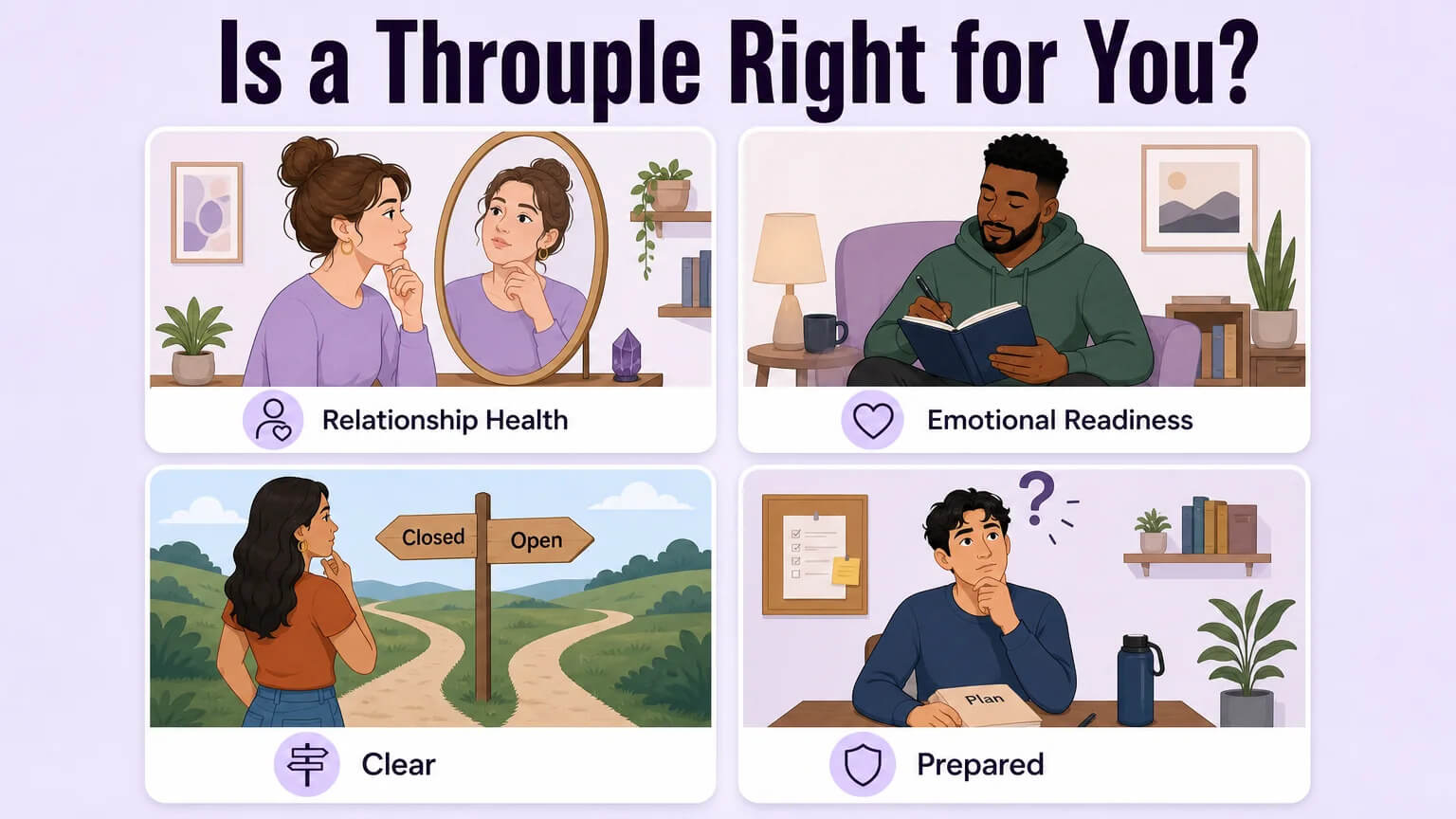
Before you open a throuple dating app or start “the conversation,” get honest about whether a throuple actually fits you.
Signs a Throuple is Probably not Right for You
- You want to fix a struggling relationship by adding a third person.
- Small triggers produce big reactions, and you cannot have hard conversations without shutting down or becoming defensive.
- You feel possessive rather than curious when your partner connects with someone else.
- You need to be your partner’s only source of emotional or sexual intimacy.
- One of you is closeted or ashamed about non-monogamy. Secrecy erodes from the inside.
Essential Questions to Answer Before Forming a Throuple
- Is the existing couple’s relationship genuinely stable? Adding a third amplifies cracks; it does not fill them.
- What happens if two people develop stronger feelings than with the third? Have a plan for addressing it without destroying anyone.
- How will we handle jealousy? “We will not get jealous” is not a plan. Acknowledge it will happen and agree on how to surface it.
- What are the sexual boundaries? Always together versus pairs allowed? Safer-sex agreements with outside partners?
- Is the throuple closed or open? Decide upfront and revisit regularly.
- How will we handle holidays, family, and public disclosure? Who comes to Thanksgiving? Whose workplace knows?
- How will finances work? What happens to shared assets if someone leaves?
- What happens if someone wants out? The exit plan is as important as the entry plan.
If You Are a Single Person Joining a Couple
You are in the more vulnerable position. The couple has history, shared finances, and an established dynamic. Ask whether they are willing to renegotiate everything, or expect you to “slot in.” Ask whether you will be a secret. Ask whether they have done the work to deconstruct their couple privilege.
If the couple cannot articulate what couple privilege means and what they are doing to counterbalance it, they have not done the work. Walk away.
The Core Truth
A throuple does not require less emotional maturity than monogamy. It requires significantly more. If you struggle with communication or emotional regulation in a two-person relationship, a three-person relationship will amplify those struggles, not solve them.
Building a Throuple That Lasts: Communication Frameworks, Boundaries, and the Agreements That Actually Matter
“Just communicate more” is the most common advice about throuples. It is also the most useless. These are the specific frameworks that therapists and successful throuples actually use. For the complete playbook — 10 therapist-backed agreements covering money, sleeping logistics, jealousy protocols, the third person’s bill of rights, and exit strategies with conversation scripts you can use tonight — read our full guide to throuple relationship rules.
Weekly Structured Check-ins
David Cooley’s Restorative Relationship Conversations model advocates structured dialogue within a “safe container.” The practical version: once a week, scheduled, non-negotiable. Appreciation first (what went well), challenges second (what felt hard), action items third (what changes). No alcohol, no phones. The check-in is the main event, not a prelude. This prevents both avoidance and ambush.
The Emotional-Distress Safe Word
Establish a word like “pineapple” or “pause” that anyone can say when a conversation becomes too activating. It means: “I need to stop right now. Not forever. But I am flooded and cannot continue productively.” This prevents someone shutting down while the other two keep pushing, a 2-vs-1 dynamic that breeds resentment.
Schedule Everything
Spontaneity is a luxury of couples. Throuples run on intentionality: scheduled one-on-one time for each dyad, group time for the triad, solo time for each person, and a shared color-coded calendar. It sounds unromantic. The throuples that last call it essential.
Boundary Creep: the Silent Threat
Martha Kauppi, author of Polyamory: A Clinical Toolkit for Therapists, warns that boundaries erode silently. “We only have sex all together” becomes “just kissing is fine” becomes someone feels betrayed, and no one explicitly broke an agreement, because the agreement crept.
The fix: Every month or two, revisit the initial agreements. Make changes explicit rather than discovering the drift after someone is hurt.
Deconstruct Monogamous Scripts
Jessica Fern’s core contribution: deconstruct the unconscious assumptions we inherit. Exclusivity equals love. Cohabitation equals commitment. One partner should meet all needs. In a throuple, every script must be examined and either consciously kept or consciously replaced. The people who succeed do this work explicitly. The ones who fail assume everyone shares the same unspoken scripts.
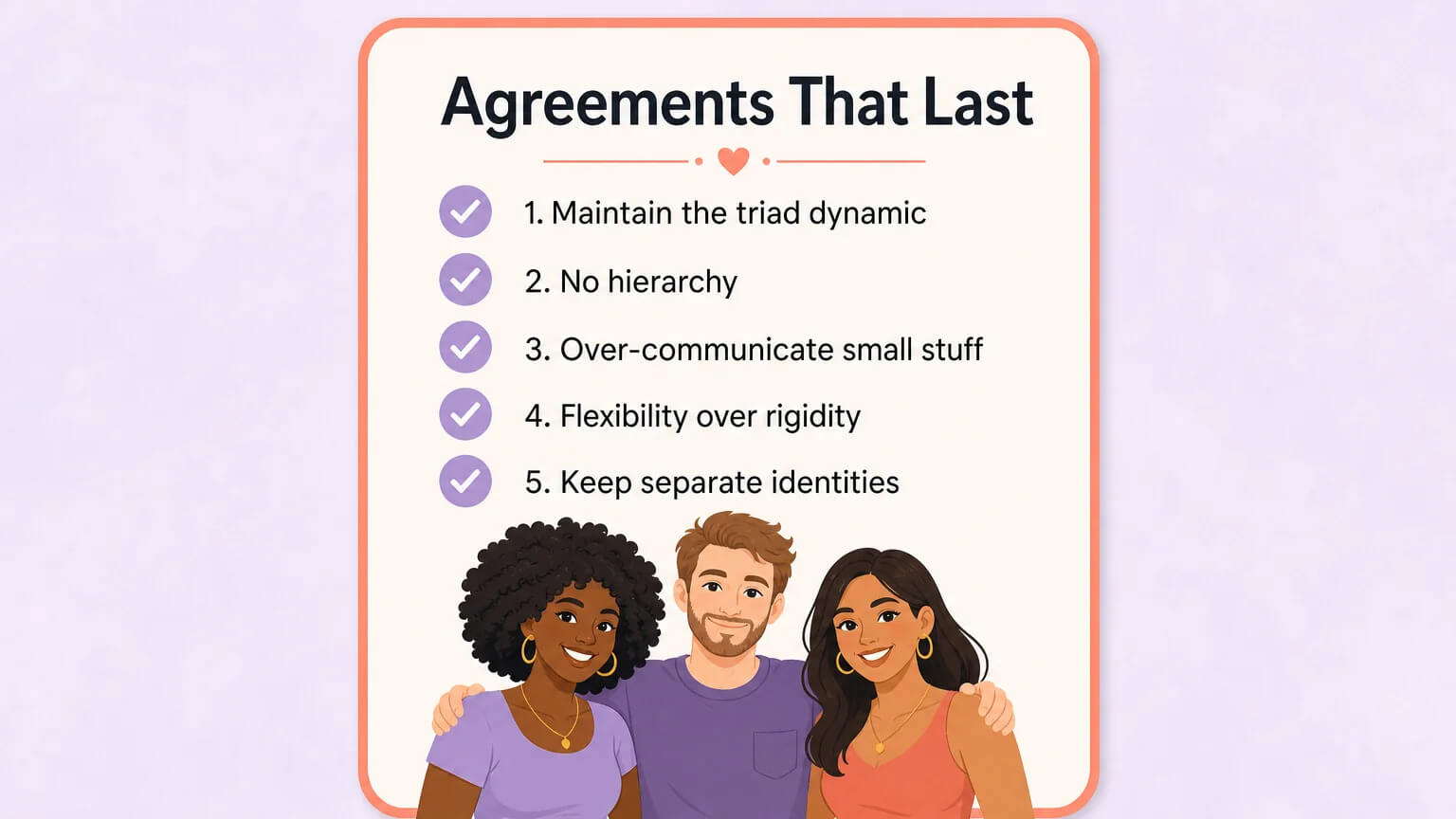
Agreements That Last
- First 6 months: maintain the triad dynamic. Do not break into pairs. Build the group identity first. (Camp Throuple)
- No hierarchy unless everyone explicitly agrees. (Christopher, Robyn, Amanda)
- Over-communicate the small stuff. Big fights start as small misunderstandings that were not surfaced.
- Flexibility over rigidity. What worked at month one may not work at year two. Review and revise.
- Maintain separate identities: separate dressers, personal nooks, individual hobbies. You cannot bring your full self to a relationship if you have lost track of who your full self is.
FAQ: Quick Answers to Common Throuple Questions
What is a throuple?
A throuple is a consensual, committed romantic relationship among three people, also called a triad. Unlike a threesome (a sexual event), a throuple involves shared emotional investment, commitment, and daily-life integration.
Is a throuple legal in the US?
You cannot legally marry as three people in any U.S. state. Some cities offer multi-partner domestic partnership benefits, and five states allow third-parent adoption. Proactive legal planning (wills, powers of attorney, co-parenting agreements) is essential for protecting unmarried partners.
What is the difference between a throuple and a threesome?
A threesome is a sexual encounter. A throuple is a committed romantic relationship. Sex educator Alix Fox: “A threesome is focused on love-making; a throuple is focused on being in love.” One is an event; the other is a life.
Are there any famous throuples?
Joe Exotic’s two-husband marriage on Tiger King (2020) is the most infamous. Bella Thorne dated Mod Sun and Tana Mongeau simultaneously. Frankie Grande was in a throuple with Daniel Sinasohn and Mike Pophis. Will Smith and Jada Pinkett Smith have described their dynamic with Sheree Zampino as a “kind of throuple.”
Do throuples sleep in the same bed?
Most do, in a king-size bed with a rotation system for the middle spot. Cotton sheets and fans are essential. Some keep a spare bed for nights when someone wants solitude.
What is the 3-3-3 rule of intimacy?
A guideline for maintaining balance: three hours of quality time together, three meaningful conversations, and three moments of physical affection per week.
How is a throuple different from an open relationship?
In an open relationship, a couple allows outside sexual partners without forming committed bonds. In a throuple, the committed bond includes the third person as an equal partner. Open relationships keep the third outside; throuples expand the core.
Can a throuple work long term?
Yes, but it requires more emotional intelligence and intentional planning than monogamy. Real examples include the 8-year parenting triad raising seven children and the California gay throuple with three fathers on one birth certificate.