Maybe you are in a relationship you value deeply and a quiet curiosity keeps surfacing. Maybe you are single and the default script does not fit. Either way, you landed here because something in you is asking whether there is another way, and you want to understand it before you name it out loud.
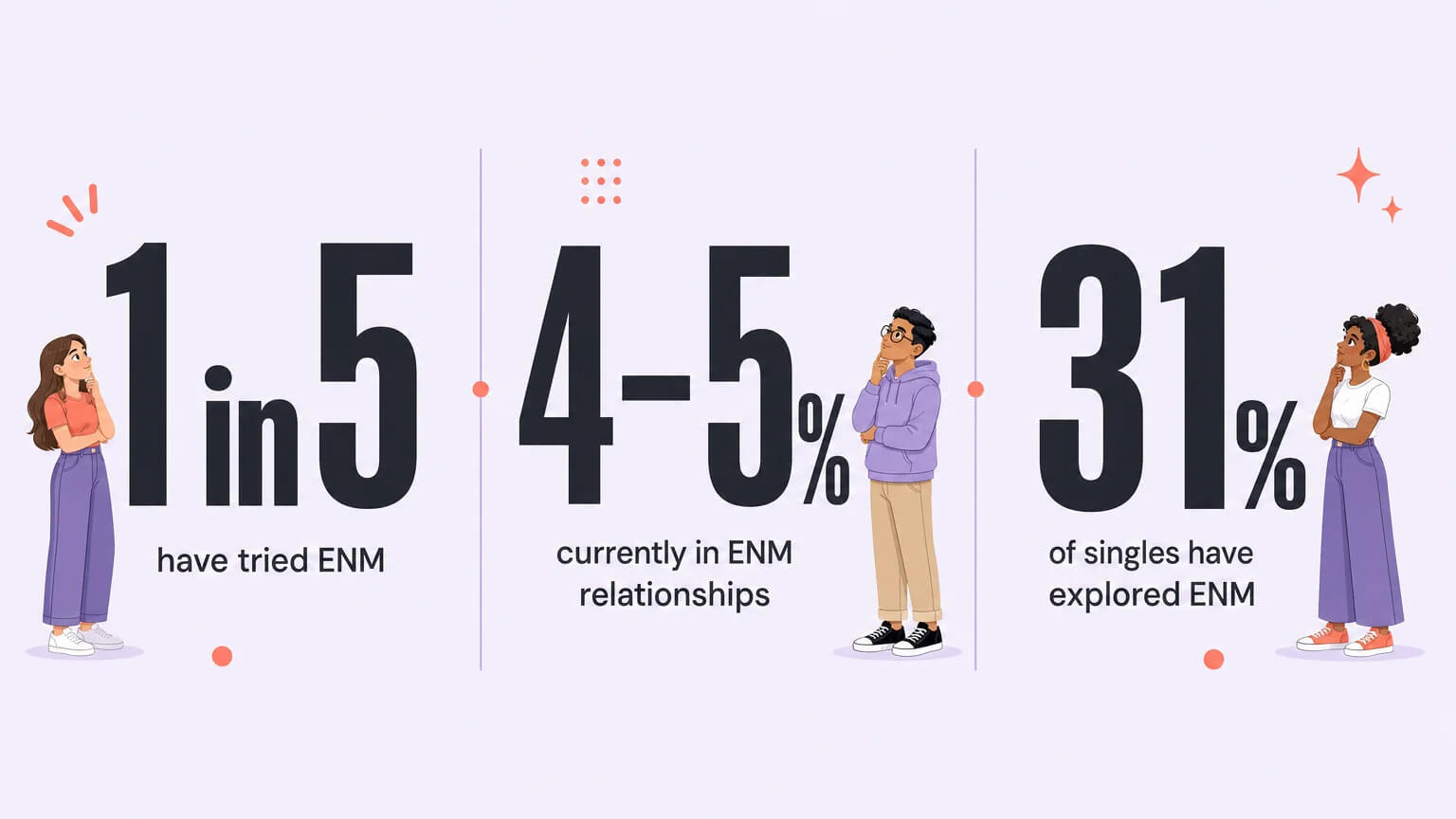
You are not alone. Roughly 4 to 5 percent of US adults are currently in an ethical non-monogamy relationship. One in five have explored some form of consensual non-monogamy in their lifetime. Among singles, nearly one in three. Google searches for this topic are up roughly 250 percent year over year. This is not fringe.
This guide is your starting point. Not a rulebook. Not a prescription. We will walk through what ethical non-monogamy actually means, the different ways people practice it, how to talk to your partner if you are in a couple, and how to navigate ENM as a single person. No judgment. No pressure. Just clarity.
Think of this less as permission and more as a map. An adventurous team deserves a good map. Desire does not require an apology.
What Ethical Non-Monogamy Actually Means
Roughly one in five American adults has engaged in some form of consensual non-monogamy. A 2025 Nature study put the past-year figure at 16.4 percent with a lifetime rate of 44.5 percent. Fifty-one percent of adults under 30 now approve of open marriage, per Pew Research. The conversation is already here.
So what does the term cover?
Ethical non-monogamy (ENM), also called consensual non-monogamy (CNM), is an umbrella term for any relationship arrangement where everyone knowingly and willingly agrees to romantic or sexual connections with more than one person. The key word is “knowingly.” Nothing happens in the dark.
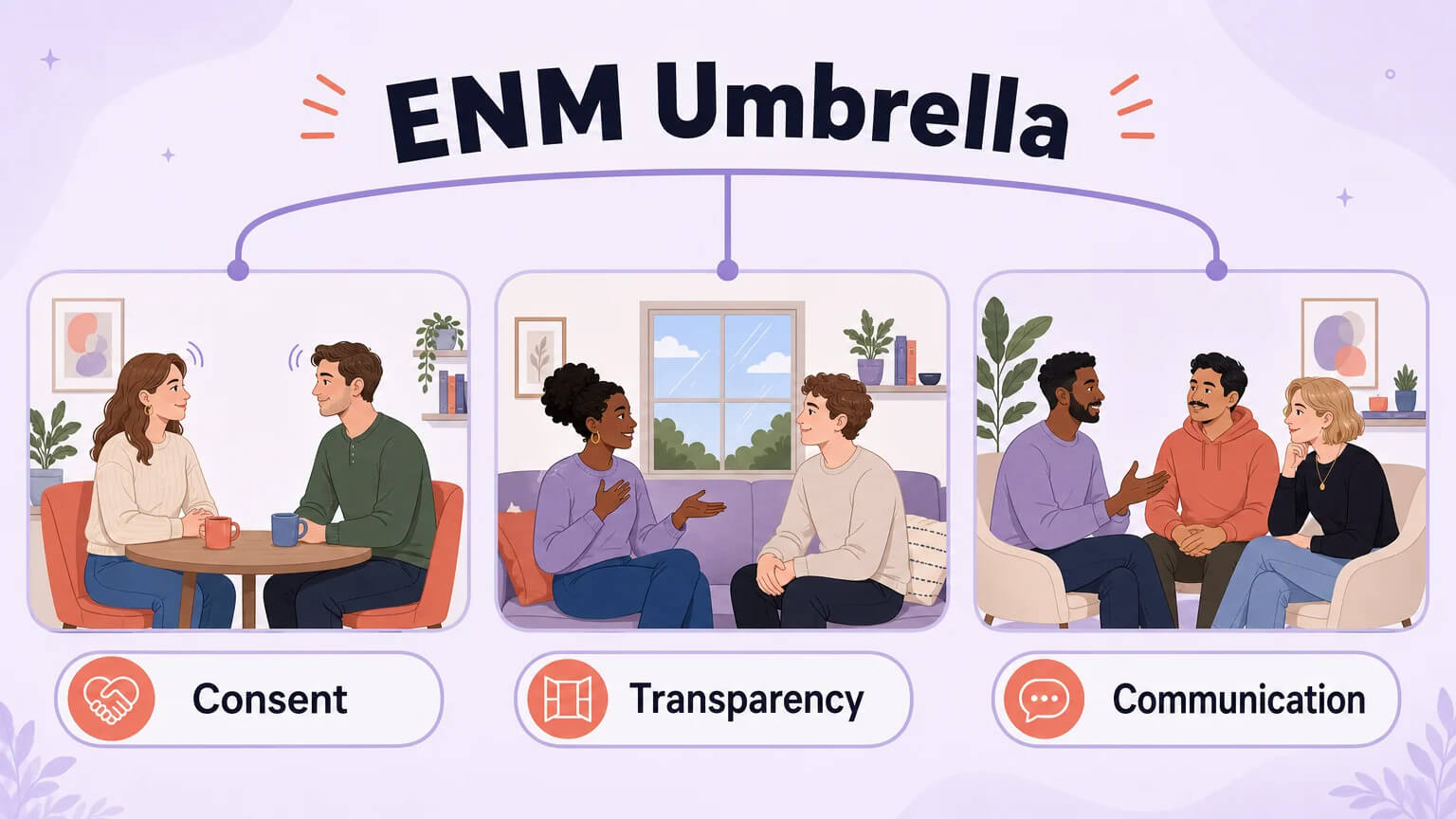
Three things make it work.
First, consent. It has to be informed, freely given, and revocable. Nobody is pressured, nobody is in the dark, and anyone can say “this is not working for me” at any point.
Second, transparency. No secrets. Partners know about each other’s existence. That does not mean every detail is shared, but everyone can see the shape of the arrangement they are in.
Third, ongoing communication. This is not a one-time conversation you check off a list. As non-monogamy coach Ellecia Paine puts it: “The negotiation is a living, breathing thing.”
ENM is the big tent. Polyamory, open relationships, swinging, monogamish, relationship anarchy: they all live under the same canvas. Each has its own norms, but they share the foundation of consent and transparency.
The word “ethical” is there to draw a clear line between consensual non-monogamy and infidelity. As Agnes, a psychiatric nurse and ENM practitioner, explains: “It’s essentially to separate us from the cheaters.” The label is not about moral superiority. It is about clarity.
Here is what ENM is not. It is not a fix for a struggling relationship. It is not a loophole for broken trust. And it is not proof you do not love your partner. A 2025 meta-analysis found relationship satisfaction in ENM partnerships is statistically equal to monogamous ones. The structure differs, but the health of the connection depends on the same things: communication, respect, and mutual care.
ENM Is Not Cheating: The Line That Changes Everything
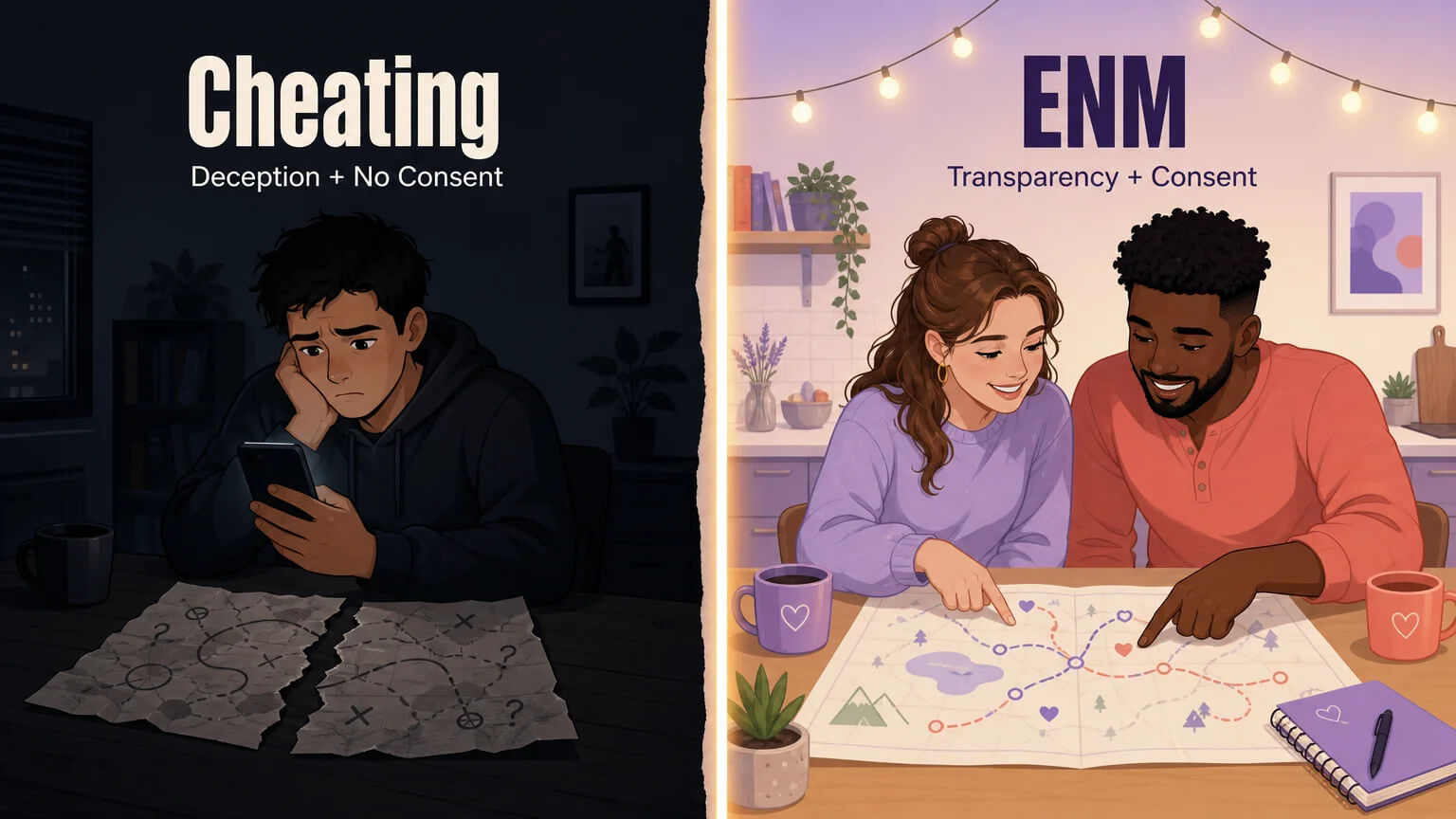
If your first question was “is not that just cheating with better branding,” you are not alone. It is the most common reflex, and it deserves a direct answer.
Cheating equals deception plus broken trust plus absent consent. ENM equals transparency plus informed consent plus ongoing communication. The difference is not the number of partners. It is whether everyone knows and agrees. One happens in the light, the other depends on darkness.
The distinction matters because cheating is still possible within ENM. The agreements differ from monogamous defaults, but they are just as real and just as breakable. Ruby Rare, a sex educator, puts it plainly: “When I have been betrayed within ENM relationships, it stung even more than in monogamous ones, because a line was still crossed.” ENM does not eliminate boundaries. It replaces default boundaries with ones you design together, which means violating them can hurt more, not less.
There is a practical side to this. People in ENM relationships tend to be more diligent about safer sex practices than people who cheat, precisely because the conversations happen openly. When you can talk about it, you can plan for it.
Then there is the “if you want other people, just break up” objection. It assumes love is a fixed pie: more for someone else means less for you. Dr. David Hague addressed this directly in his TEDx talk with a question that reframes the whole premise: “When you have a second child, do you have to divide your love? No, love can expand. Why is romantic love given a different category?”
This is not a permission slip to stray. It is a team deciding together what adventure looks like. ENM is built on agreements you write together. Cheating is a plan made in secret, with half the team not even aware they are on the journey.
The Types of Ethical Non-Monogamy: A Spectrum, Not a Checklist
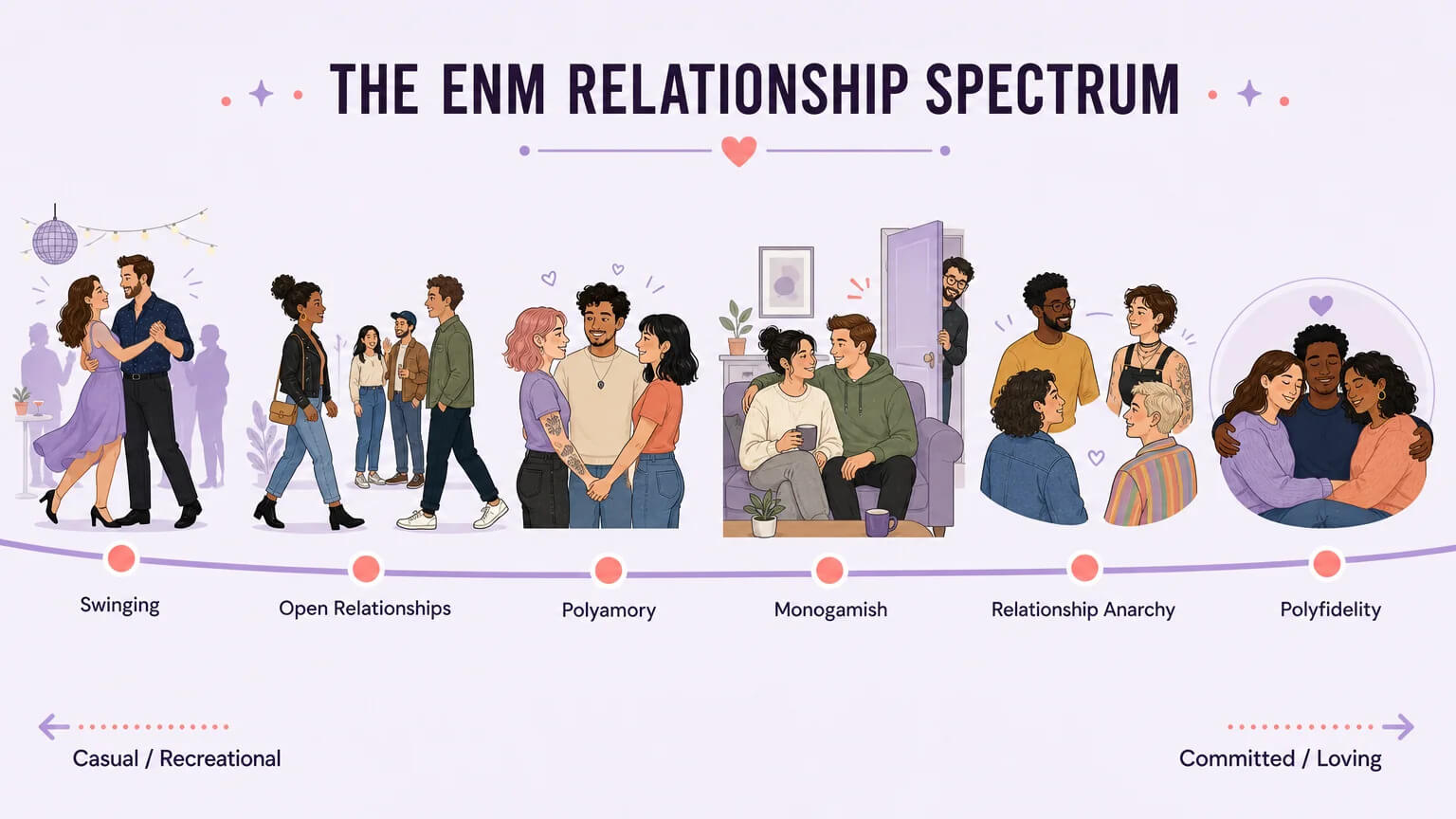
ENM lives on a spectrum. On one end, arrangements that are primarily sexual and recreational. On the other, arrangements built around multiple loving, committed partnerships. Most people fall somewhere in between, and most shift across the spectrum over time. The label you start with may not be the one you settle into.
Here are the six main approaches people take.
Swinging: Recreational sex, typically explored together as a couple, at parties, clubs, or events. The emotional connection stays with your partner while the adventure is shared. This is one of the most common entry points. For many couples, it is how they first test whether ENM feels right for them.
Open relationships: A primary couple allows outside sexual connections independently. Emotional exclusivity is typically maintained. This suits couples who want autonomy within a clear primary structure. Each person dates or hooks up on their own, but the romantic partnership stays central.
Polyamory: Multiple loving, romantic relationships. You date individually and form deep emotional bonds with more than one person. This works for people who want full relationships with multiple partners, each carrying real emotional weight. Polyamory is not about collecting experiences. It is about being open to love wherever it shows up.
Monogamish: Mostly monogamous with occasional exceptions. Coined by Dan Savage, this model suits couples who are fundamentally committed to each other but want room for the rare exception, often explored together. The emphasis is on “mostly.”
Relationship anarchy: No hierarchy, no preset categories. Each relationship is defined individually by the people in it, without default assumptions about which connection should matter more. Friendships, romantic partnerships, sexual connections: everything is negotiated from scratch. This approach appeals to people who reject the idea that a romantic partner should automatically outrank a close friend.
Polyfidelity: A closed group of three or more people who are exclusive to each other. Think of it as monogamy with more than two. This works for people who want multiple partners within a contained, committed structure. No one dates outside the group.
You do not need to pick a label today. The goal is finding what works for your specific relationships, with the specific people in them. That is the whole assignment.
ENM vs. Polyamory: Why the Distinction Matters
ENM is the umbrella. Polyamory is one thing under it. If you practice polyamory, you practice ENM. If you practice ENM, you might not practice polyamory. The arrow only goes one way.
The practical difference is straightforward. ENM without polyamory typically means sexual connections outside the primary relationship, with emotional exclusivity intact. Swinging and open relationships fall here. Polyamory means full romantic relationships with multiple people. Love, not just sex.
There is also an identity versus practice distinction worth understanding. You can be polyamorous as an identity even if you are dating one person or no one at all, the same way someone can be bisexual while in a monogamous relationship. Someone in an open relationship may never identify as poly. Both are valid, and neither cancels the other. The identity and the practice do not have to match for the label to fit.
Why this distinction matters in real life: imagine you tell your partner “I am interested in ENM” but what you mean is “I want multiple loving relationships.” They hear “I want us to swing together occasionally.” You are now headed for painful misalignment, not because either of you is wrong, but because the words were too broad to carry the meaning. Getting specific early saves months of confusion.
If you are not sure which describes you, focus less on the label and more on what you actually want. Do you want adventure with your partner as your anchor? Do you want to fall in love more than once? Do you want something you have not seen modeled anywhere yet? Answer those questions first. The vocabulary follows.
How to Talk to Your Partner About ENM

This conversation sets the tone for everything that follows. Done well, it opens a door. Done poorly, it feels like a threat before you finish the first sentence.
Dr. Alyssa Webb-McCune explains why it is so hard: “We see relationship threats as a physical threat. Your spouse saying ‘I want to talk about opening our relationship’ and a bear attacking you in the woods: same response in the brain and body.” Your partner’s racing heart is not dramatics. It is neurology.
Here is what helps.
Start with yourself first. Why are you curious? If a specific person is already on your mind, slow down. Opening for a particular person almost always ends badly. Focus on what you want your relationship to become, not who you want to date.
Choose the moment carefully. Calm, unhurried, sober. Not after a fight, not after a drink, not right before bed.
Open as an invitation, not an announcement. “I have been curious about something and I would love to talk about it with you” lands differently than “I have decided I want an open relationship.”
Lead with reassurance. “I care about you. I am committed to us. This is a curiosity, not a demand.” Say it plainly. Do not assume your partner knows.
Use “I” statements. Not “our relationship is missing something” or “you are not enough for me.” Try: “I have been thinking about what else adventure could look like for us.”
Talk feelings before logistics. What excites you? What scares you? Emotions first, schedules second.
Take pressure off the outcome. “We do not need to decide anything today. I just wanted to open the conversation.” Let it breathe.
What not to do: no ultimatums, no specific person already in mind, no convincing or persuading. Do not expect resolution in one conversation.
Jem and Daz Jones are a real example. She raised ENM after their marriage had lost its spark. He took it personally at first. They started attending swingers events as observers only. “We just agreed to go on a journey of discovery,” Jem explained. No agenda, just curiosity.
After this first conversation, educate together. Read Polysecure or The Ethical Slut. Find an ENM-affirming therapist. When your partner sees you doing the work alongside them, the conversation shifts from “what you want” to “what we are exploring.”
How to Practice Ethical Non-Monogamy: Agreements, Boundaries, and Check-Ins
Ellecia Paine has a line every beginner should hear: “If you think you will have one big talk about the agreements and then be done, that is really cute.” ENM is not a decision you make once. It is a practice you return to, week after week.
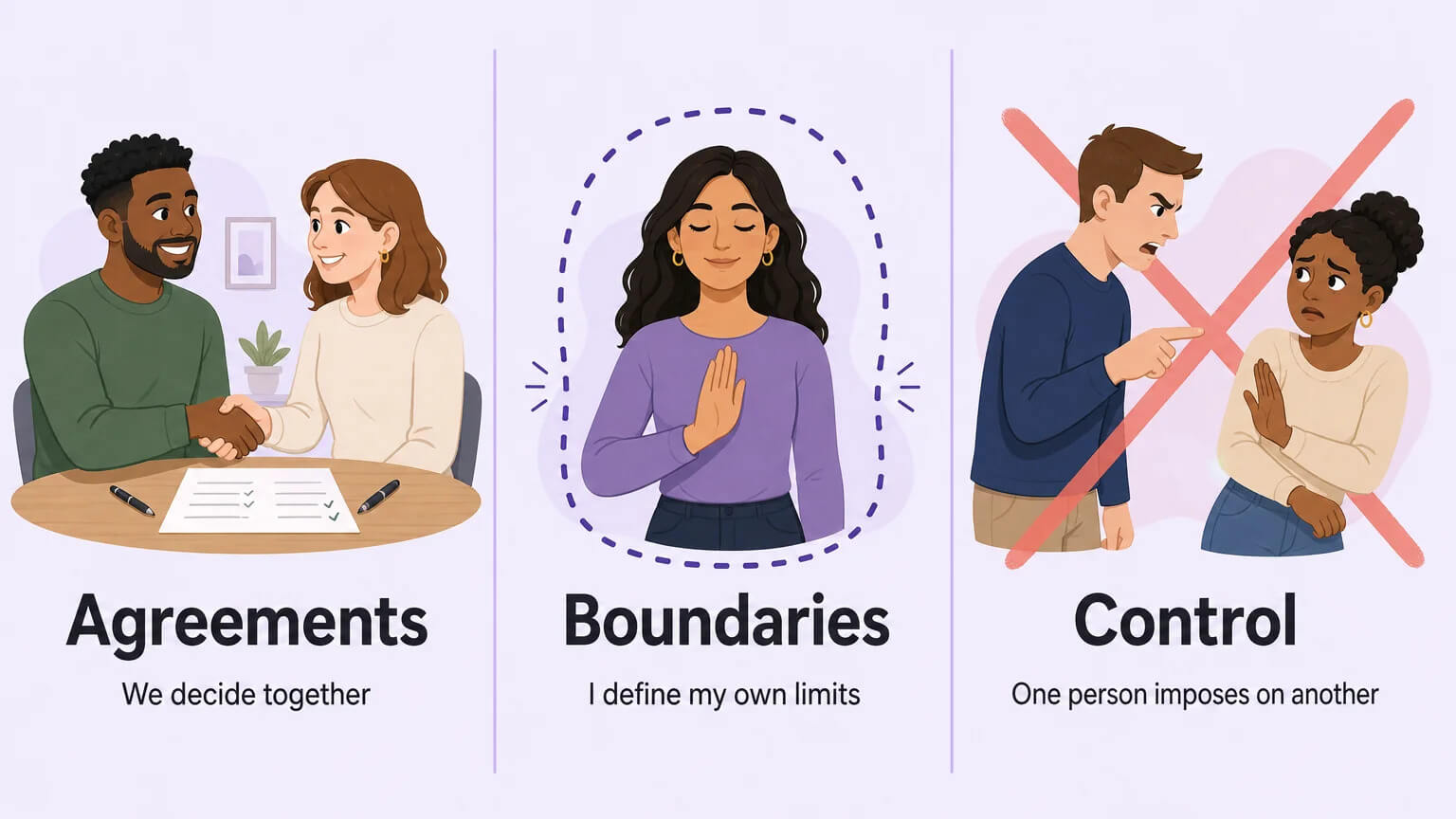
Start with the framework that makes practice possible. Three terms people often blur, but getting them straight matters.
Agreements are co-created. Both of you have buy-in because both of you helped shape them. And you can renegotiate as circumstances and feelings shift.
Boundaries are about your own actions, not someone else’s. “I will use protection with all partners” is a boundary. “You cannot see anyone else without my approval” is control wearing a boundary costume. Dr. Misty, a therapist who works with ENM clients, puts it this way: “The difference between a rule and a boundary lives in the body and power dynamic.”
People resent imposed frameworks. People trust agreements they helped build.
Six areas deserve clarity from the start. Sexual health: testing schedules, protection practices, disclosure of new partners. Emotional: what happens if deeper feelings develop, how you handle NRE (new relationship energy). Time and logistics: how many nights per week, how you communicate schedule changes. Disclosure: what you share with each other about outside connections, what stays private. Social boundaries: are you open about ENM with friends, family, coworkers? Veto power: be cautious here. Many experienced practitioners advise against unilateral veto; it creates insecurity rather than security.
Then there is the practice that keeps things from going sideways. Ellecia Paine recommends a weekly check-in.
Schedule it. Same time every week, non-negotiable, no phones. Start with appreciations: what went well this week, what did your partner do that you valued? Then discuss what is working and what is challenging, using I-statements. Review your agreements: does anything need updating? Finish with logistics for the week ahead.
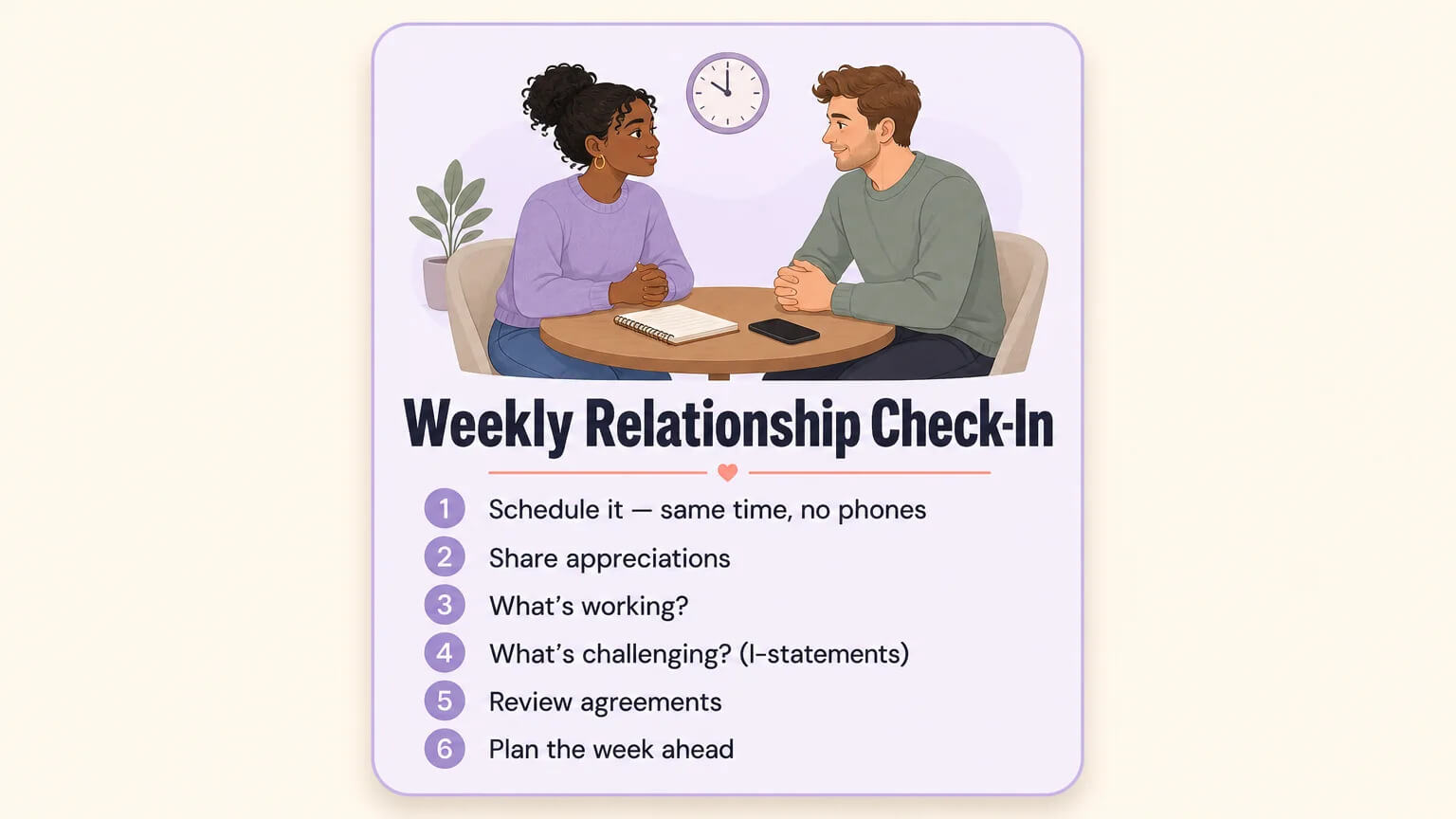
The shift here is real. Instead of reacting to problems as they flare up, you are building a rhythm that catches issues before they become emergencies.
A note on vocabulary as you build your own practice. Think “agreements” and “comfort zones,” not demands. Think “connections,” not casual encounters. And remember the foundational principle: if it is not an enthusiastic yes from everyone in the room, it is a hard no.
Mistakes Beginners Make in ENM (and How to Avoid Them)
These mistakes are common enough that experienced practitioners see them constantly. Reading through them before you start puts you ahead.
Opening up to fix a broken relationship. Maya Attia, an LMFT who works with non-monogamous clients, is blunt: “If you cannot navigate conflict with one partner, adding more people will create chaos, not healing.” ENM works best from abundance, not scarcity. Get the foundation solid first.
Rushing the slower partner. One of you is ready. The other needs time. Go at the slower partner’s pace, every time. The faster partner can wait.
Skipping emotional work for logistics. It is easier to talk about calendars than to talk about what it will feel like when your partner comes home from a date. Feelings first, logistics second.
The one-penis policy. A man in a heterosexual couple restricts his female partner to only dating other women. As Agnes puts it: “It is hugely sexist and misogynistic.” Examine the insecurity underneath rather than building an agreement designed to avoid it.
Treating jealousy as failure. Dr. Georgia Grace says it directly: “Jealousy does not mean you are any less good at being in an ENM relationship.” Maya Attia adds: “I do get jealous and question whether I am cut out for non-monogamy, but I tell myself that is learned behavior.” Jealousy is information, not a verdict.
Assuming you can predict how you will feel. Ellecia Paine again: “Human beings are terrible at guessing how we are going to feel in an imaginary scenario.” You think you will be fine with something on paper, then it happens and you are not fine. Start small. Process. Adjust. Repeat.
Underestimating time and emotional bandwidth. Ruby Rare: “I had no idea how much time I would spend on emotional admin.” Ellecia Paine calls it “a full-time job for your emotional life.” Go in with your eyes open.
One thread runs through every mistake: going faster than trust can hold. Slow down. Talk more than you think you need to.
FAQ: Your ENM Questions, Answered
Direct answers to the questions that bring most people here.
What exactly is ethical non-monogamy?
Ethical non-monogamy is an umbrella term for any relationship arrangement where everyone knowingly and willingly agrees to romantic or sexual connections with more than one person. The three pillars are consent, transparency, and ongoing communication. Polyamory, open relationships, swinging, and monogamish arrangements all fall under the ENM umbrella.
Is ENM just an excuse to cheat?
No. Cheating relies on deception and broken agreements. ENM relies on transparency and co-created agreements. The difference is not the number of partners. The difference is whether everyone knows and consents. Cheating is possible within ENM too, precisely because the agreements are real and breaking them carries weight.
How is swinging different from polyamory?
Swinging is primarily recreational and typically explored together as a couple, with emotional exclusivity maintained. Polyamory involves multiple loving, romantic relationships where emotional connection with more than one person is the point. Swinging is about shared adventure. Polyamory is about multiple relationships.
Do people in ENM relationships get jealous?
Yes, frequently. Jealousy is not proof that ENM is wrong for you. It is information worth investigating. Experienced practitioners treat jealousy as a signal rather than a stop sign. The question is not whether jealousy appears, but whether you have the tools and communication practices to work through it together.
Is ENM right for me?
There is no universal test, but some indicators help. You are curious enough to research rather than dismiss. You are willing to do emotional work, not just logistical planning. You can sit with discomfort without making it someone else’s problem. You value transparency even when it is hard. If these describe you, you are asking the right questions. The answer comes through conversation, reading, and time, not a quiz.
How do I navigate ENM as a single person?
Start by knowing what you want and being direct about it. Some ENM couples will treat you as an accessory to their relationship. The good ones will treat you as a whole person with your own needs, preferences, and boundaries. They are a guest in your playground, not a toy in your toybox. Vet carefully. Ask how long they have been practicing ENM. Ask what agreements they have in place. Trust your instincts when something feels off.
Can ENM work long-term?
Yes. Dan and Jennie have been married for over 30 years, and ENM has been part of their relationship for most of that time. Long-term relationships of any structure require ongoing effort. A 2025 meta-analysis confirmed that relationship satisfaction in ENM partnerships is statistically equal to monogamous ones. The structure differs. The work of showing up for each other is the same.
Still have questions? That is normal. This article is your starting point. The rest is conversation, reading, and time. No rush.
Ready to take the next step? We put together an honest guide to the best ENM dating apps that actually understand non-monogamy — real pricing, privacy features, and which app fits your situation.
No deadline. Just the next right step.