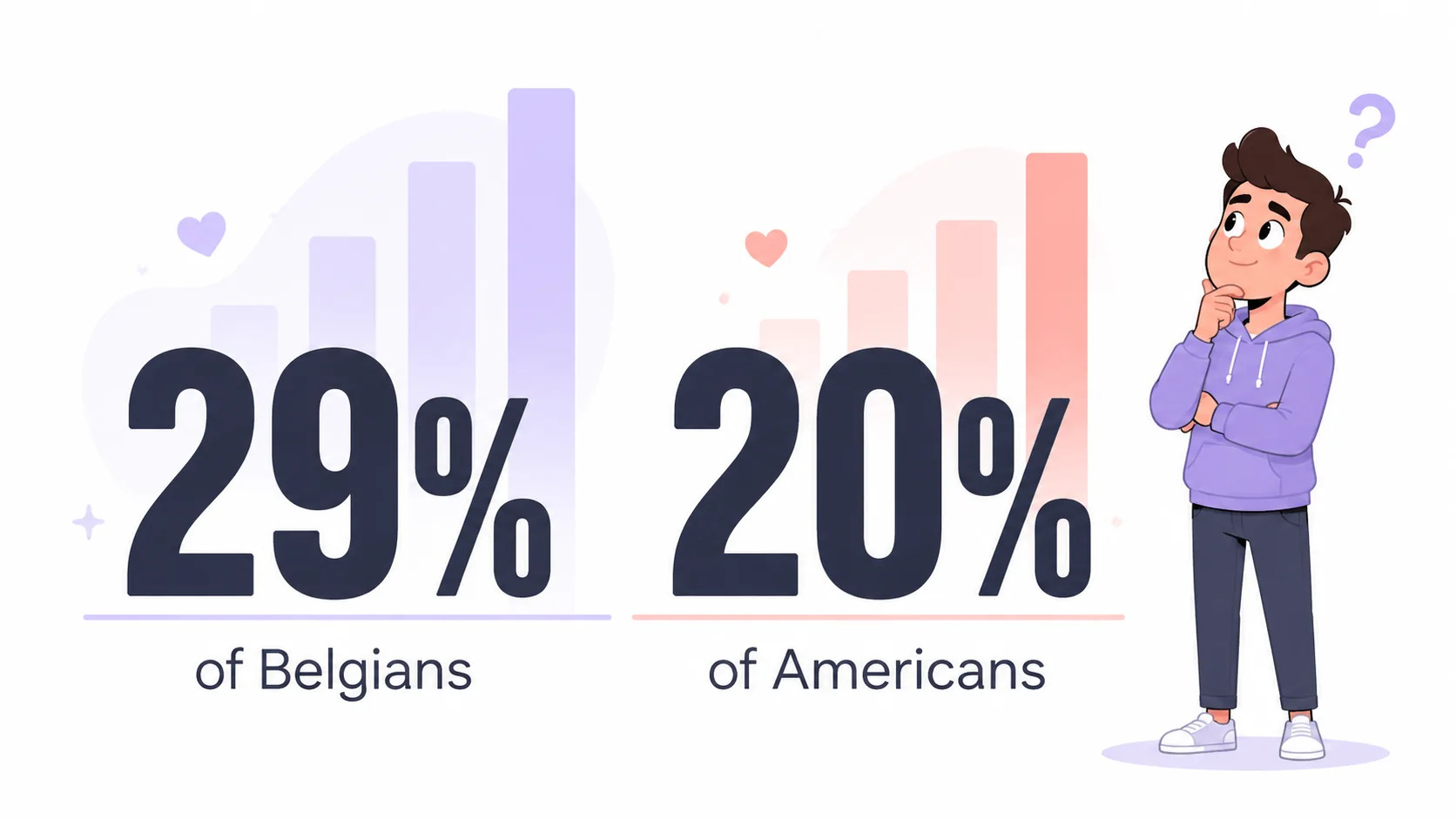
Almost one in three Belgians has been in a consensually non-monogamous relationship, according to a 2025 University of Antwerp study of nearly 2,700 adults. More than 20% of Americans have done the same. Those aren’t fringe numbers.
So what is an open relationship? In plain language, it’s a committed partnership where both people agree to have sexual or romantic connections outside the primary relationship. The word that matters most is “agree.” Without mutual consent, you have a breach of trust. With it, you have something built on transparency.
This guide covers what open relationships mean, how they differ from polyamory and swinging, the types that exist, the research behind them, and the practical side of navigating conversations, jealousy, social stigma, and closing one down. Think of this as a map for an adventurous team, not permission for a guilty couple.
What Does Open Relationship Mean? Defining the Core Terms
The phrase “open relationship” gets tossed around as a catch-all, but precision matters. If you and your partner are going to discuss this honestly, you both need to work from the same dictionary. The term itself entered modern usage through George and Nena O’Neill’s 1972 book “Open Marriage,” which introduced the idea that committed couples could negotiate outside connections without secrecy.
An open relationship is a form of ethical non-monogamy (ENM, but how they differ?), also called consensual non-monogamy (CNM), where two people in a committed partnership agree that outside sexual and romantic connections are permitted. The emphasis on “consensual” is everything. This is not infidelity dressed up in progressive language. Infidelity involves secrecy, broken promises, and a partner who did not agree to the terms. An open relationship operates on the opposite principle: full transparency and mutual authorization.
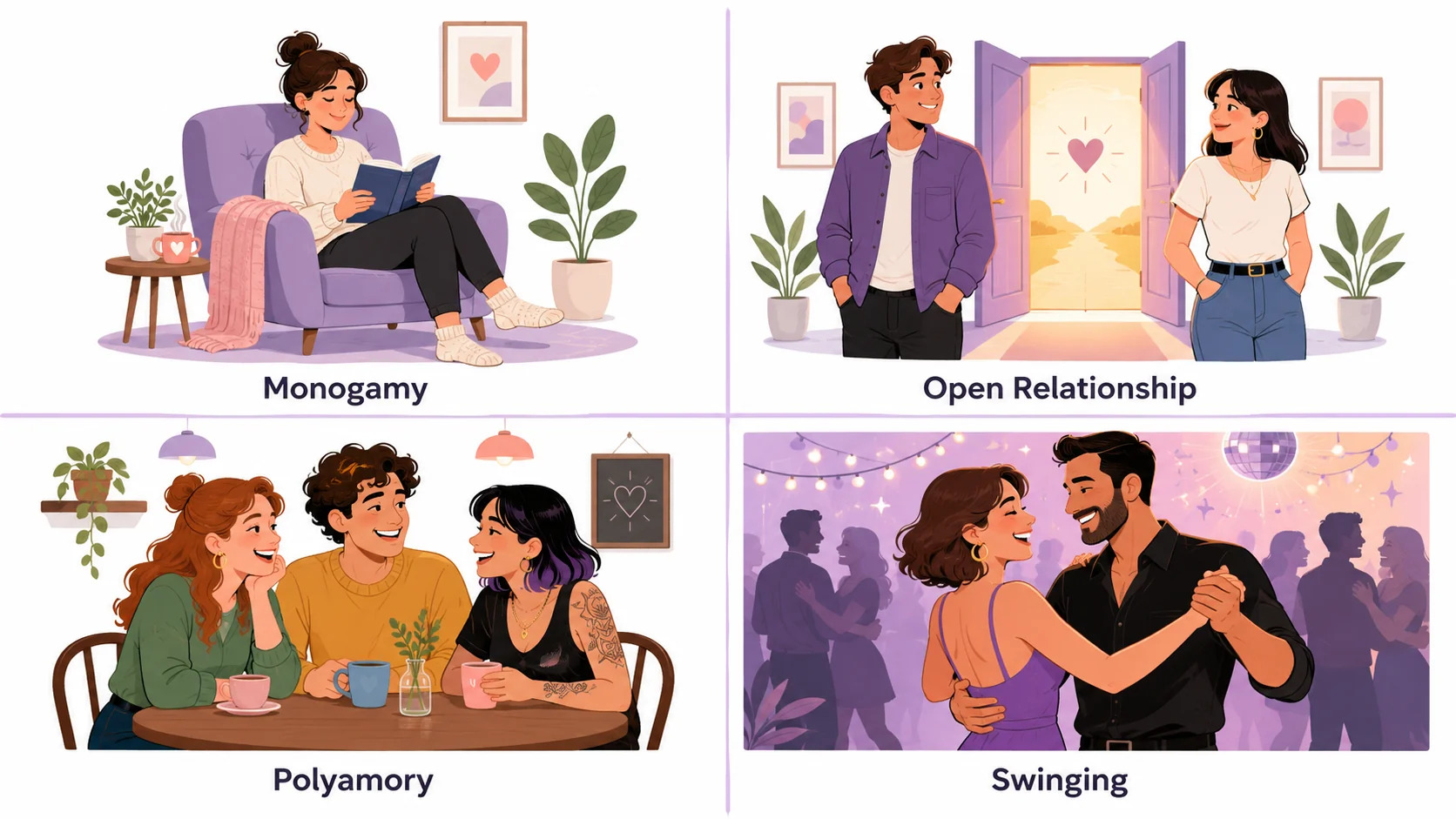
To understand what an open relationship actually looks like, it helps to see it next to the other models people confuse it with. The open relationship vs polyamory distinction is the most common point of confusion.
Monogamy is exclusivity by default. Two people agree that all romantic and sexual energy stays inside the relationship. This is the cultural default in most societies, but it’s a choice, not a biological mandate.
Polyamory means multiple loving, emotionally deep relationships pursued at the same time. Polyamory isn’t primarily about sex. It’s about the capacity and desire to build full romantic partnerships with more than one person, often without ranking them.
Swinging is recreational sex, typically engaged in as a couple, usually at parties, clubs, or arranged meetups. Emotional bonds aren’t the goal. Swinging is about shared adventure, not building additional relationships.
The simplest shorthand: an open relationship centers one primary couple who explore outside connections. Polyamory builds multiple full relationships without requiring a primary hierarchy. Swinging is couple-based recreational exploration. All three fall under the CNM umbrella, but they serve different emotional needs and carry different expectations. Knowing which one you’re actually talking about is step one.
Types of Open Relationships: From Don’t Ask Don’t Tell to Kitchen Table
Open relationships aren’t a monolith. They exist on a spectrum, and the version that works for you and your partner may look nothing like the version your neighbors have. Understanding the range helps you and your partner design something that fits your specific dynamic rather than squeezing into a mold that was never yours.
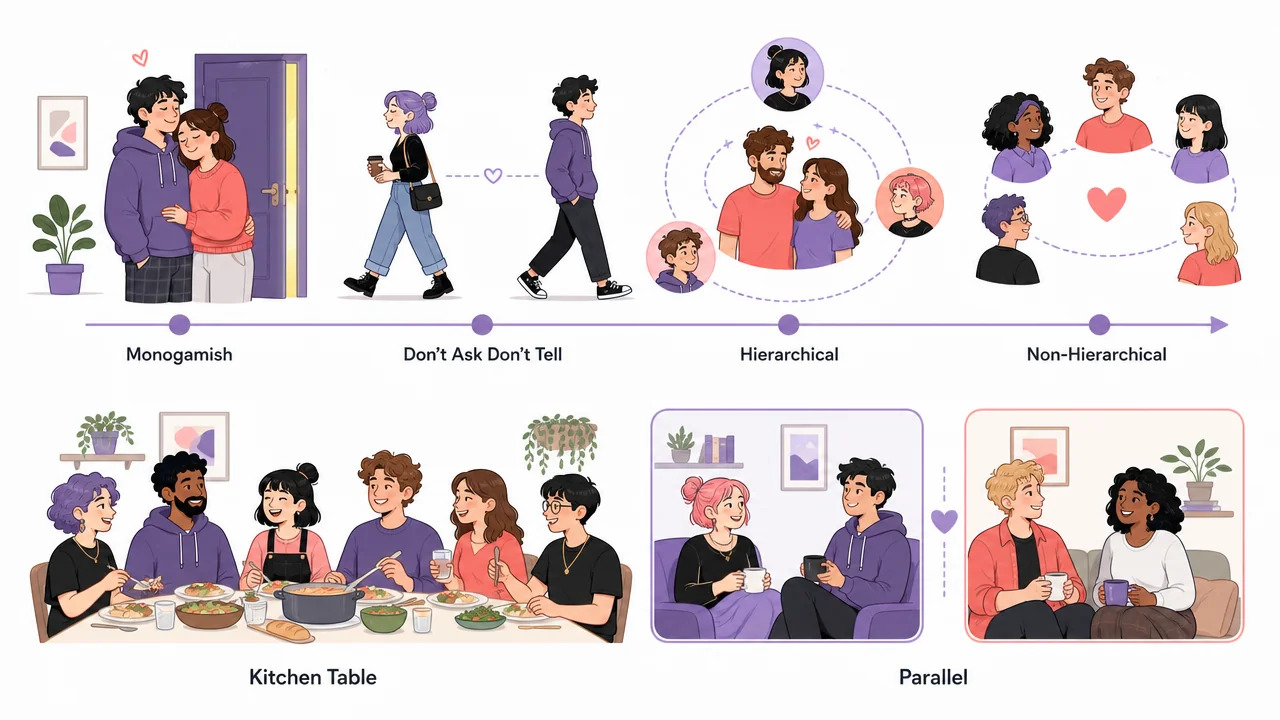
On the more contained end sits the “monogamish” model. Coined by columnist Dan Savage, this describes a relationship that’s mostly monogamous with rare, mutually agreed outside encounters. Think of a couple who is exclusive 360 days a year but leaves the door cracked for a specific situation: a work trip, a long-distance stretch, or a one-time opportunity both partners feel genuinely comfortable with. This isn’t a half-measure. For many couples, it’s the exact right calibration.
One step further is the Don’t Ask Don’t Tell (DADT) arrangement. Outside connections happen, but the details stay private. One partner doesn’t want to know when, where, or with whom. DADT works for some couples, but it demands a high tolerance for ambiguity. You’re trusting your partner without the reassurance of transparency, and that requires a specific kind of emotional wiring. The risk, which experienced practitioners flag regularly, is that withheld information can curdle into suspicion over time.
Many couples adopt a hierarchical structure. The primary partnership carries priority. Major life decisions (where you live, whether you have children, how finances work) center on the primary couple. Outside connections are real and respected, but they don’t get an equal vote in the big stuff. This is the most common structure for couples opening up from a monogamous foundation, because it preserves the central relationship as home base while creating space for exploration.
Non-hierarchical open relationships flip that script. No partner is formally ranked above another. Time, attention, and emotional investment flow based on need and desire rather than a predetermined pecking order. This approach demands strong communication skills because there’s no default tiebreaker when conflicts arise. Couples who thrive here often describe it as requiring a level of honesty that would have felt excessive in any previous relationship.
Couples also choose between different social styles. Kitchen table dynamics mean everyone involved (partners and their other partners, sometimes called metamours) is comfortable enough to share a meal together. The vibe is communal and transparent. Parallel dynamics, by contrast, keep outside connections entirely separate. You know your partner is seeing someone, but you never meet them, and that boundary is intentional, not hostile.
None of these types are destinations you arrive at and lock in forever. Couples often drift between styles over months and years. A monogamish phase might evolve into a more openly hierarchical chapter. A parallel arrangement might naturally warm into kitchen table comfort. The right type is simply the one you and your partner both genuinely, enthusiastically agree to. The only wrong type is one that one of you is silently enduring.
Why People Choose Open Relationships: Motivations and Attachment Styles
If open relationships sound like a lot of work (they are), the natural next question is: why would anyone sign up for this? The motivations are more varied and more ordinary than the stereotypes suggest.
Some reasons are relational. You and your partner might have mismatched libidos, and opening the relationship relieves pressure on both sides. One of you may be bisexual or pansexual and want to explore connections the other simply can’t provide. Long-distance stretches, career relocations, or differing social needs can make exclusivity feel less like commitment and more like a constraint neither of you asked for.
Other motivations are philosophical. Some people reject the idea that one human being can or should fulfill every single need for another. That’s not a failure of love; it’s a recognition that expecting one person to be your lover, co-parent, emotional confidant, intellectual equal, and sole source of physical intimacy for decades is a heavy ask. Choosing ethical non-monogamy from this perspective isn’t about lacking something. It’s about having enough security to share.
Then there are the personal reasons: self-discovery, sexual exploration, curiosity about kink, or the desire to grow emotionally by working through hard things. A Gleeden/IPSOS survey from mid-2025 found that 41 percent of urban Indians would be open to an open relationship if their partner suggested it, with 55% believing open relationships will become the dominant trend within a decade. The motivations cross cultures, continents, and age groups. Gen X respondents (ages 45 to 60) were the most experimental group in that survey.
Attachment science offers a useful lens here. Research by Amy C. Moors at Chapman University found that secure attachment predicts better outcomes in ENM relationships. People with a secure attachment style tend to handle the emotional demands of non-monogamy (communication, jealousy, negotiation) with greater ease. Anxiously attached individuals may struggle more with perceived threats to the bond. And here’s a nuanced finding from Moors’s research: avoidantly attached people often express interest in CNM as an idea, but they’re less likely to actually engage in it. The gap between abstract appeal and real-world participation is widest for avoidant attachment.
None of this means you need a perfect attachment profile before you and your partner can explore. It means self-awareness pays dividends. Understanding your attachment style before opening up helps you anticipate where your emotional friction points will be, and that foreknowledge makes them easier to navigate together.
Some couples arrive at open relationships proactively, drawn by philosophical alignment or shared curiosity. Others arrive reactively, after a period of distance or a tough conversation about unmet needs. Both starting points are real. What distinguishes a healthy open relationship from an unhealthy one isn’t how you got there. It’s whether both of you genuinely want to be there now.
What Research Reveals About Open Relationships
Quiet assumptions float through most conversations about relationships: monogamy is the scientifically validated gold standard, and everything else is a gamble. The data tells a more interesting story.
A 2020 longitudinal study followed consensually non-monogamous and monogamous couples over time. The finding: no significant difference in relationship satisfaction, psychological well-being, or overall happiness between the two groups. What predicted success wasn’t the relationship structure. It was communication quality, mutual consent, and emotional intelligence. Structure didn’t determine outcome. Skills did.
The prevalence numbers are striking. The 2025 University of Antwerp study found that 29 percent of nearly 2,700 Belgian adults had been in a CNM relationship at some point. In the United States, a 2017 study by Haupert and colleagues estimated that more than 20 percent of the population has engaged in some form of consensual non-monogamy. A Gleeden/IPSOS survey from mid-2025 found that 41 percent of urban Indians would be open to an open relationship if their partner suggested it, with 35 percent already in one. This isn’t a Western niche or a millennial fad. It’s a global shift in how people think about commitment.
The Antwerp study surfaced an interesting tension: roughly 66% of respondents still described themselves as monogamous, despite the high rates of non-monogamous experience. That gap between identity and behavior suggests many people are exploring without the language to name what they’re doing, or without feeling safe claiming the label. Age data reinforces the generational shift: 20 percent of 18-to-25-year-olds had a CNM experience in the past year, compared to only 5 percent of those 60 and older.
Research also points to several upsides when communication is strong: lower rates of jealousy-driven conflict, higher sexual satisfaction in some CNM cohorts, and the cultivation of compersion (the ability to feel joy in your partner’s joy with others). These aren’t automatic benefits. You and your partner earn them through the same skills that make any relationship thrive.
The bottom line from the research is simple. Science doesn’t say open relationships are better than monogamous ones. It firmly rejects the claim that they’re worse. The evidence supports something clearer than either extreme: relationship structure matters far less than the quality of communication, consent, and emotional presence within it.
10 Common Myths About Open Relationships, Debunked
Myths do real damage. They shape how people feel about their own desires before they ever speak them out loud. If you or your partner have hesitated to explore this topic, odds are good that one of the following beliefs is sitting in the background, unexamined. Time to pull them into the light.
Myth 1: Open relationships are just infidelity with a permission slip. Infidelity is defined by deception. Open relationships are defined by transparency. When both partners know, agree, and continuously communicate, the fundamental dynamic is the opposite of betrayal.
Myth 2: If you really loved your partner, you wouldn’t want anyone else. Love and desire aren’t a zero-sum game. Plenty of people experience deep, secure love for their primary partner and still feel attraction or connection to others. The desire for variety or exploration doesn’t diminish the love you have; it reflects the complexity of being human.
Myth 3: Open relationships never last. The 2020 longitudinal study found CNM couples report equal relationship satisfaction to monogamous couples. Longevity depends on communication, mutual consent, and emotional skill, not relationship structure.
Myth 4: Opening up always destroys the relationship. Opening a relationship that’s already struggling will accelerate the cracks. Opening a secure, communicative relationship from a place of mutual curiosity looks very different. The variable isn’t the decision to open. It’s the foundation it sits on.
Myth 5: Open relationships are all about sex. For some, yes. For many others, the draw is emotional expansion, community, self-discovery, or the freedom to form varied connections without secrecy. Reducing open relationships to sex is like reducing monogamy to exclusivity. It misses the point.
Myth 6: Only a certain type of person does this. The demographics say otherwise. The Antwerp study found age, education, and background weren’t reliable predictors. Non-heterosexual respondents were twice as likely to be in CNM arrangements, but the heterosexual majority was still substantially represented. In the United States, Oregon, Colorado, and Washington lead ENM-related search volume per capita, suggesting geography matters less than cultural climate.
Myth 7: Jealousy proves open relationships are unnatural. Jealousy is a human emotion, not a verdict on a relationship model. Monogamous couples experience jealousy too. The difference in CNM isn’t the presence of jealousy; it’s the expectation that you’ll learn to work with it rather than treat it as a stop sign.
Myth 8: You can’t raise a family in an open relationship. Thousands of CNM parents raise healthy, well-adjusted children. What matters for child development is stability, love, and attentive caregiving, not the number of adults in their parents’ romantic lives.
Myth 9: Open relationships are a new trend driven by the dating apps. Non-monogamous relationship structures predate Tinder by centuries. Indigenous cultures, early utopian communities, and historical free-love movements practiced forms of consensual non-monogamy long before apps entered the picture.
Myth 10: Opening up fixes a broken relationship. This is the most dangerous myth on the list. Dr. Sabrina Romanoff, a Harvard-trained clinical psychologist, has noted that open relationships fail for the same reason closed ones do: breakdowns in communication. If your foundation is cracked, adding more people doesn’t patch it. It multiplies the pressure points.
With the myths handled, the next layer is the practical one: how to actually navigate an open relationship, starting with the conversation most people find the hardest to begin.
How to Start the Conversation With Your Partner
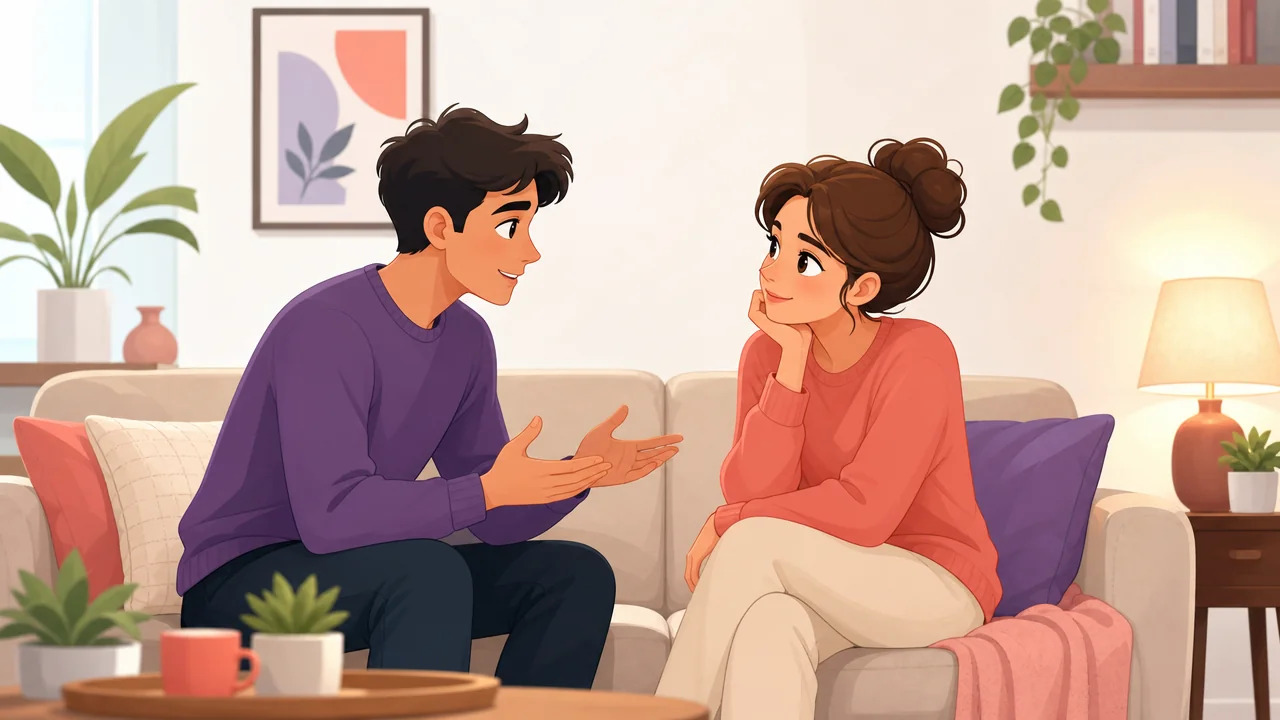
This is the moment most people stall. You’ve done the reading. You’ve sat with the idea. You’ve probably imagined a dozen different ways your partner might react, most of them bad. That anxiety is normal. It also doesn’t have to stop you.
Choose your timing with intention. A calm, private moment when neither of you is stressed or distracted is non-negotiable. Don’t bring this up during or right after sex, during an argument, or in a public place where your partner might feel exposed. The goal is to open a door, not to ambush someone through it.
Frame the conversation as sharing curiosity, not delivering a decision. You’re not standing at the front of the room with a presentation. You’re sitting beside your partner on the couch, saying something you’ve been thinking about, and inviting them to think about it with you. The difference in tone is everything.
Here’s one way to open:
“I’ve been reading about different relationship styles, and I’d love to hear your thoughts on open relationships. This isn’t something I’ve decided on. I just want to explore the idea together because you’re the person I process big things with.”
If your partner reacts defensively or with hurt, stay present. Don’t argue. Don’t defend. Listen. A response like this can help:
“I hear you. This isn’t about anything missing in us. I love what we have. I’m just curious about what other formats might look like, and I wanted to share that curiosity with you because you’re my person.”
If the conversation goes sideways, pump the brakes with care:
“Can we agree to just read about this together and check back in two weeks? No decisions, just learning.”
The first conversation is exactly that. A first. Not a closing argument. Not a demand. Expect an emotional reaction (shock, insecurity, curiosity, defensiveness, and yes, sometimes anger, in any order). Your job isn’t to persuade. Your job is to listen, to reassure, and to let your partner metabolize the idea at their own pace. A negative first reaction doesn’t mean the conversation is over forever. It means your partner is human, and this topic touches something deep.
And to help you through the first step,, i.e. how to ask for open relationship, we have prepared a detailed guide for you: How to Ask for an Open Relationship: Scripts, Prep, and What to Expect >>
Managing Jealousy in an Open Relationship: A Practical Framework
Name the elephant directly: jealousy is the number one fear people have about open relationships. It’s also the most misunderstood emotion in the entire conversation.
Jealousy isn’t proof that open relationships don’t work. It isn’t a character flaw. It isn’t a signal that you’re bad at this. Jealousy is a human emotion that shows up in monogamous and non-monogamous relationships alike. The difference in an open relationship is that you commit to working with it instead of letting it silently steer your decisions.
A helpful distinction: jealousy is the fear of losing something you have. Envy is wanting something someone else has. They’re different feelings with different roots, and lumping them together makes both harder to untangle.
The September 2025 Psychology Today framework for managing jealousy in CNM gives you and your partner a practical approach you can use starting today.
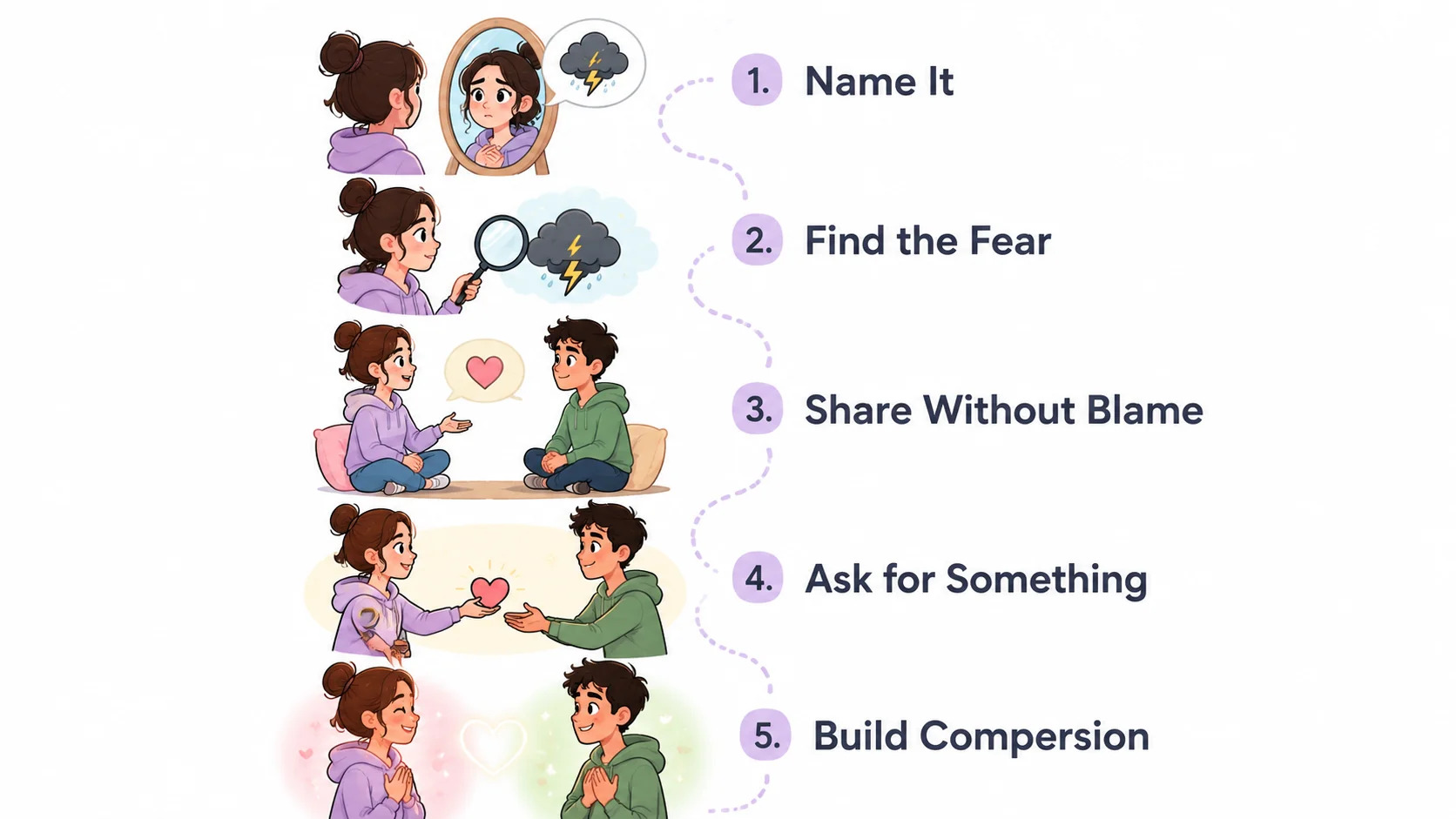
Step 1: Name it out loud without shame. Simply saying “I’m feeling jealous right now” begins to loosen its grip. Secrets and silence give jealousy power. Naming it takes that power back.
Step 2: Identify the specific fear underneath. Jealousy is almost always a cover for something more specific. Are you afraid of being abandoned? Of not being enough? Of losing your partner’s time and attention? Get granular. “I’m jealous” is the headline. “I’m afraid you’ll realize you prefer being with other people and leave me” is the story underneath, and that story can actually be addressed.
Step 3: Communicate the feeling without accusation. Use “I feel” statements that own your experience: “I felt scared when you stayed out later than we planned” lands differently than “You don’t care about our agreements.” Same concern, radically different impact.
Step 4: Ask for something specific. “Make me feel better” is vague and puts the burden on your partner to guess. “Could we spend Saturday morning just the two of us, no phones, like we used to?” is actionable and connecting.
Step 5: Build compersion over time. Compersion, the ability to feel genuine happiness in your partner’s joy with someone else, isn’t a switch you flip. It’s a muscle you build. Some research suggests about 53 percent of open relationship practitioners experience compersion. For the rest, it takes practice. Start small. Notice when your partner comes home energized. Let yourself feel glad that they’re glad, even if it sits alongside some discomfort. Both feelings can coexist.
Here’s what trips people up most, based on real stories from the CNM community: pretending jealousy isn’t there. Partners hide their discomfort to seem “good at being open.” They compare their outside experiences to their partner’s and spiral when the numbers don’t match. The antidote is radical honesty about feelings, not suppressing them. Managing jealousy together can deepen intimacy, because it forces the kind of direct, vulnerable communication that monogamous couples often avoid entirely.
Navigating Social Stigma When You Are in an Open Relationship
Your relationship might work beautifully behind closed doors. The challenge is what happens when those doors open and other people walk through with their opinions.
Social stigma around ethical non-monogamy is real. Research participants rate non-monogamous couples as worse on completely unrelated attributes, like paying taxes or flossing. The bias runs deep, and it’s often reflexive rather than reasoned. That doesn’t make it any easier to face.
A practical disclosure decision matrix helps you and your partner figure out who to tell. Think along two axes: how much does this person need to know, and how safe is it to tell them?
A close, open-minded friend ranks high on safety and may rank medium to high on necessity. Tell them if you want support. A conservative boss ranks low on both. Don’t tell them. A sibling you’re close to might rank high on necessity but varies wildly on safety depending on your family dynamics. Proceed carefully and on your own timeline. You don’t owe disclosure to anyone who would use it against you.
When you do decide to share, keep it simple:
“I’m sharing something personal because I trust you. My partner and I have an open relationship, which means we’ve agreed to have connections outside our relationship. This is working well for us, and I wanted you to hear it from me directly.”
Lead with confidence, not apology. You’re not confessing to something shameful. You’re sharing something true. If someone reacts negatively, you don’t owe them a debate. “It works for us, and we’re happy” is a complete sentence.
The emotional toll of staying closeted deserves a mention. Hiding a significant part of your life is exhausting. It creates a split between your internal reality and your external presentation, and that split wears on you over time. Finding community where you can be fully yourself isn’t optional. It’s essential. Online forums, local meetup groups, and lifestyle apps designed for ENM communities give you spaces where you don’t have to translate or justify your relationship to anyone.
Your relationship choices are yours whether or not everyone in your life understands them. The people who matter will adjust. The people who won’t adjust were never going to, and their discomfort isn’t your problem to solve.
How to End or Transition Out of an Open Relationship
Most articles about open relationships skip this section entirely. That’s a missed opportunity, because closing one down is one of the most searched topics in the space. Many open relationships close at some point. That’s not failure. That’s adaptation. Relationships shift across seasons of life, and the chapter you opened together three years ago may not fit who you both are today.
The first distinction: closing the relationship (returning to monogamy together) is different from ending the relationship entirely. Both paths are real, but they require different conversations. Closing should come from a place of mutual agreement, not a unilateral demand made under duress. If one of you is forcing the door shut while the other still has their hand on the handle, that’s not closure. That’s a power struggle with a different name.
A compassionate closure process looks like this.
First, initiate the conversation with the same communication skills you used to open the door. Lead with “I” statements. Share what’s shifted for you. Give your partner space to react without defending your position like it’s a courtroom argument.
Second, give existing outside partners compassionate notice. These are human beings who invested time and emotion in a dynamic you co-created. They deserve a direct, kind conversation, not a vanishing act. Acknowledge what you valued about the connection. Let them feel what they feel. Ghosting someone because the arrangement got complicated isn’t how adults treat each other.
Third, set a transition timeline that respects everyone’s feelings. A hard cutoff overnight is rarely kind or practical. Agree on a reasonable window for winding things down.
Fourth, rebuild the primary relationship through intentional reconnection. Schedule date nights. Consider a few sessions with a couples therapist to debrief honestly about what worked and what didn’t. This isn’t a post-mortem for something that failed; it’s a retrospective on a chapter you both lived through and learned from.
Fifth, grieve. Closing the relationship means losing a dynamic, a set of possibilities, perhaps specific people. You’re allowed to feel sad about that even if closing was the right decision. Sadness and certainty can coexist.
Here’s what matters: even if the open chapter ended, the communication skills, self-knowledge, and emotional intelligence you built during it stay with you. Some couples cycle between open and closed phases across decades of partnership, opening when life feels expansive, closing when life demands focus. Closing doesn’t have to be permanent, just as opening wasn’t. Your relationship belongs to you and your partner. You get to rewrite the terms whenever the old ones stop fitting.
Rules, Boundaries, and Agreements: Building the Foundation
The emotional work of an open relationship gets most of the attention. But underneath all of that sits an operational layer: the practical agreements that turn an idea into a functioning day-to-day arrangement. Without this layer, even the most emotionally intelligent couple will drift into confusion and resentment.
A useful distinction upfront: old-school rules are rigid, externally imposed, and often breed resentment. Boundaries are personal limits you set for yourself. Agreements are mutually negotiated terms both partners co-create. Healthy open relationships run on agreements and boundaries, not rules.
A rule says: “You cannot see anyone more than twice.” An agreement says: “We’ve agreed to check in after two dates with a new person before continuing.” The first controls your partner’s behavior. The second creates a shared moment of reflection. Same topic, completely different energy.
Most couples who do this well address at least eight areas in their agreement framework.
Sexual health and safer sex protocols. What protection methods do you both commit to using? How often will you get tested? What’s the disclosure expectation if something changes?
Time allocation. How many nights per week or month are available for outside connections? How do you protect dedicated time for just the two of you?
Emotional disclosure expectations. How much detail do you share about outside experiences? Some couples want the highlight reel. Others prefer knowing almost nothing. Get specific.
Veto power. Do either of you have the ability to ask the other to end a specific outside connection? Under what circumstances? If veto exists, how do you exercise it without it becoming a weapon?
Sleepovers and overnights. Are they on the table? How much notice is expected?
Public appearances and social media. Do outside partners appear in your social life? On your feeds? In photos? Define the visible perimeter.
Financial spending on outside connections. Dates, trips, gifts. What comes from shared accounts, and what stays separate?
Regular check-in cadence. Monthly? Quarterly? These aren’t emergency meetings. They’re scheduled maintenance conversations where you and your partner review how things are going, surface small frustrations before they become big ones, and adjust agreements that are no longer working.
Agreements aren’t a one-time contract. What made sense for you and your partner six months ago may feel restrictive or irrelevant today. That’s not a sign that something went wrong. It’s a sign that you’re paying attention. Schedule a recurring check-in, treat it as sacred, and approach it with curiosity rather than defensiveness.
The couples who thrive aren’t the ones with the tightest controls. They’re the ones with the clearest, most honest agreements, and the willingness to revisit them as real life unfolds.
Want to dive into more details about open relationship rules? You can check this detailed guide of ours.
Frequently Asked Questions About Open Relationships
What is the difference between an open relationship and polyamory?
An open relationship typically centers one primary couple who pursue outside sexual or romantic connections while maintaining their primary bond as the foundation. Polyamory involves multiple loving, emotionally committed relationships at the same time, often without ranking or prioritizing one partner over another. The distinction comes down to hierarchy and emotional structure, not just sexual exclusivity.
Do open relationships actually work long-term?
Yes. The 2020 longitudinal study found that CNM couples report relationship satisfaction equal to monogamous couples. Longevity depends on communication quality, mutual consent, and emotional skill, not relationship structure. Many open relationships span decades, and some couples cycle between open and closed phases across a long partnership.
How do I know if an open relationship is right for me?
Start by examining your motivation. Are you drawn from genuine curiosity and a sense of relational abundance, or are you hoping this will patch a crack in your current relationship? Talk honestly with your partner, consider your attachment style, and ask yourself whether you have the emotional bandwidth for the communication this requires. If the idea energizes rather than depletes you, that’s a useful signal. Check this guide to help you have an open relationship.
What are the most common boundaries in open relationships?
The big ones: safer sex protocols and testing frequency, time allocation between partners, emotional disclosure levels, whether sleepovers are permitted, public visibility and social media boundaries, financial spending on outside connections, and a regular check-in schedule. Every couple’s list looks different, and that’s the point. These are your agreements, not a template.
Can an open relationship fix a broken relationship?
No. This is the single most common and most damaging misconception about open relationships. Opening a struggling relationship amplifies its existing cracks rather than sealing them. The communication demands of CNM are higher, not lower, than monogamy. If your foundation is unstable, focus on repairing it first before adding more moving parts.
How do open relationships handle jealousy?
Jealousy gets handled through direct communication, not suppression. Name the feeling without shame, identify the specific fear underneath it, share it with your partner using “I feel” statements, and ask for a specific, actionable reassurance. Compersion, the practice of feeling joy in your partner’s joy, can be cultivated over time. Jealousy is feedback, not a verdict.
What does an open relationship mean for having children?
Open relationships and parenting work together in thousands of families. The research on child outcomes points to stability, attentive caregiving, and loving relationships as what matters, not the number of adults in romantic roles. Many CNM parents keep their relationship structure private from children until age-appropriate, navigating disclosure on a timeline that protects the family’s well-being.
How do I bring up the idea of an open relationship without hurting my partner?
Choose a calm, private moment. Frame it as sharing curiosity, not delivering a decision. Use exploratory language: “I’ve been reading about different relationship styles and would love to hear your thoughts.” Reassure them that this isn’t about anything missing in your connection. Expect an emotional reaction, prioritize listening over persuading, and treat the first conversation as exactly that: a first, not a final.