
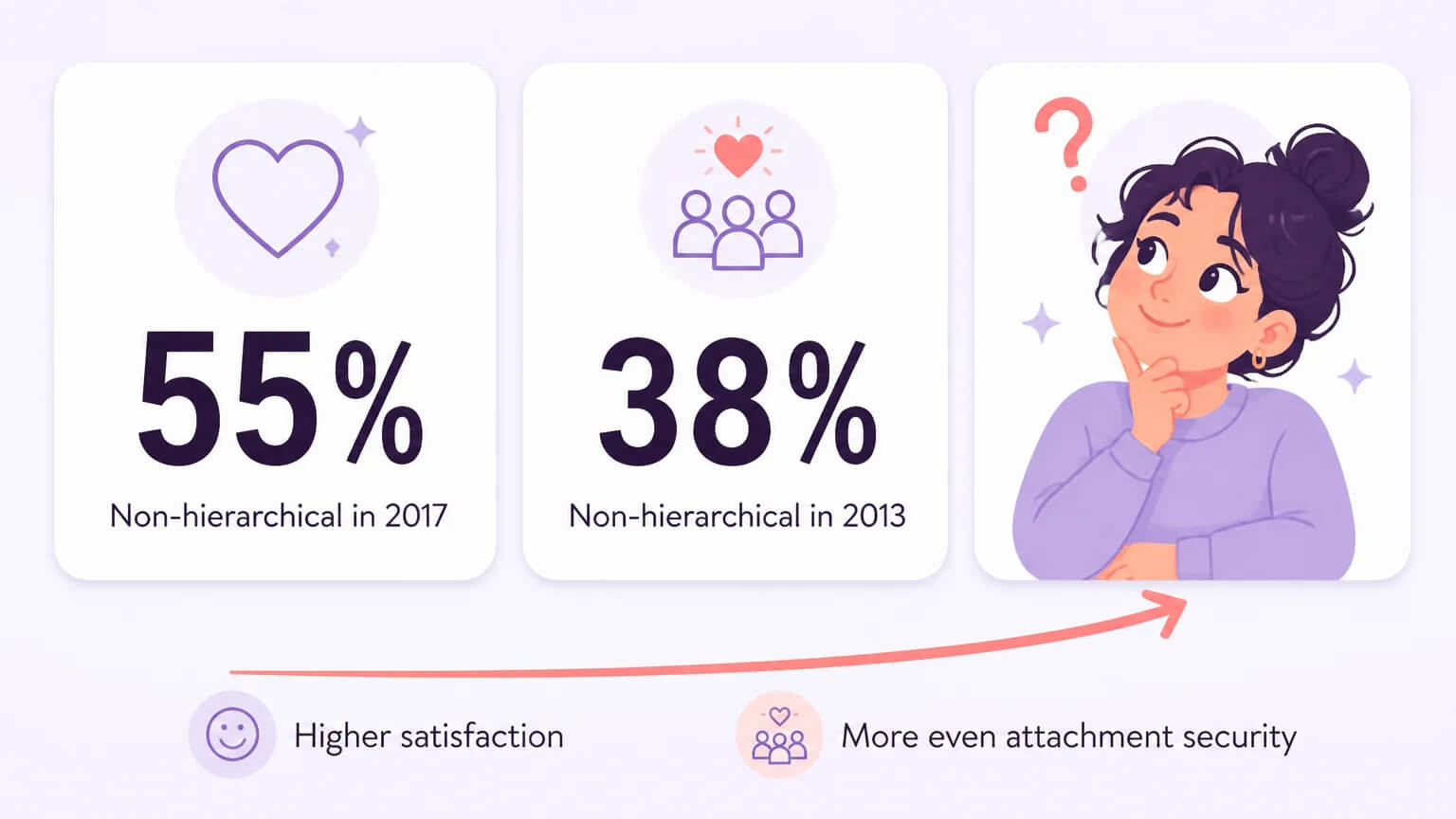
Fifty-five percent of polyamorous people now identify with non-hierarchical polyamory, up from 38% in 2013. That is the emerging majority, and it probably lines up with how you already want to love better than you realize.
Most people meet polyamory through a hierarchical lens: primary partners, secondary partners, veto power, couples opening up. Polyamory without ranking sounds confusing. Like something that cannot actually work.
Non-hierarchical polyamory points toward relationships where no one gets automatic priority. Someone can matter deeply without holding the title “most important.” A relationship can be deep, committed, and life-shaping without anyone wearing a badge that says “first.”
Here is what sits ahead: a clear definition, the myths that keep people stuck, what the research actually shows, how jealousy works without a safety net, navigating marriage and nesting, navigating breakups and de-escalation, the voices the mainstream conversation keeps skipping, and a practical guide for making the shift.
What would your relationships look like if no one got automatic first claim on your time, your decisions, or your future? This is a map. Use what fits.
What Non-Hierarchical Polyamory Actually Means
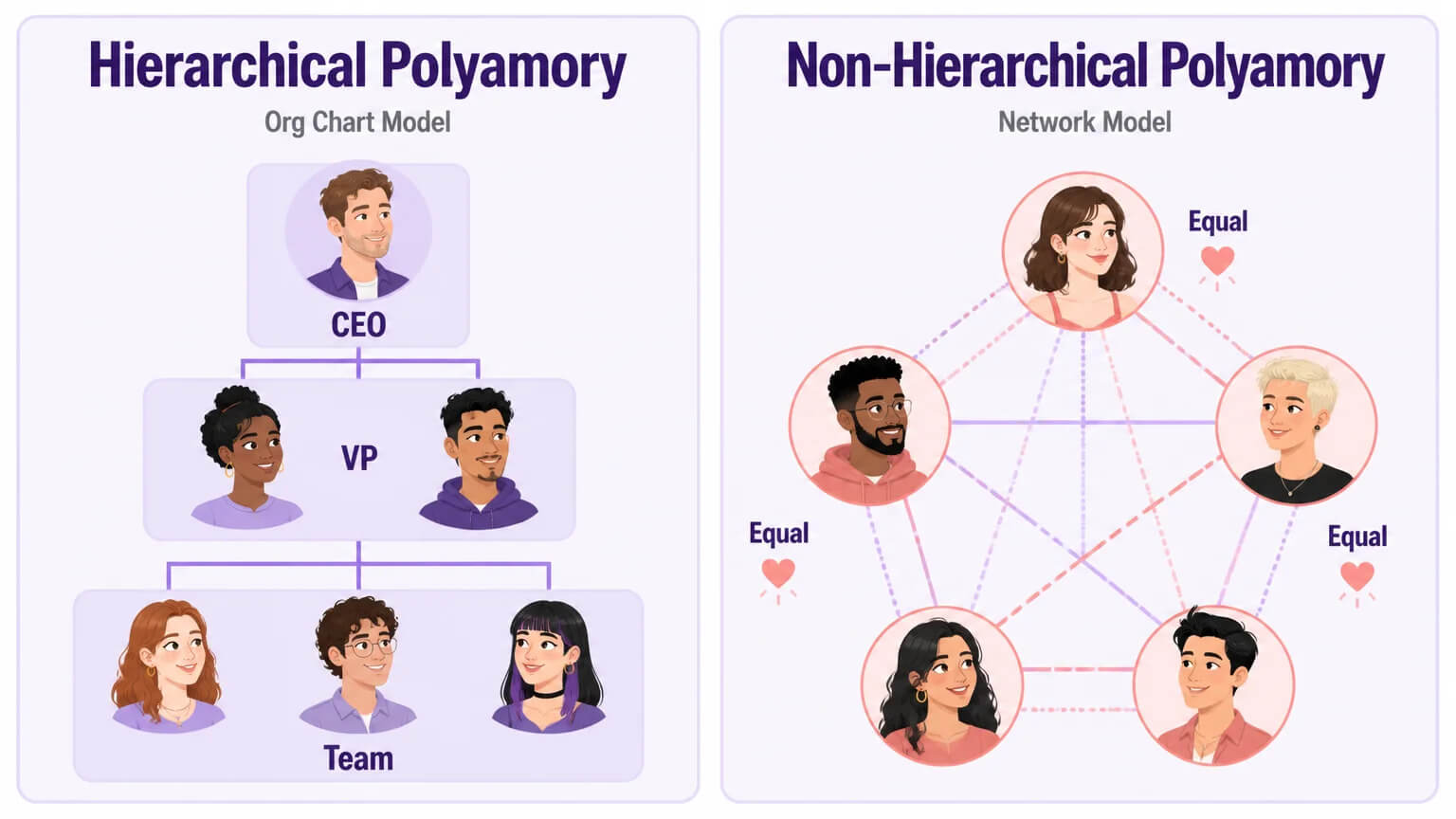
Non-hierarchical polyamory removes automatic preference, veto power, and the primary-secondary ranking system. One relationship does not dictate terms to others. No partner holds structural power over another’s connections just because they arrived first or share a lease.
The hierarchical model most people encounter first works differently. A “primary” partner gets priority in time, decision-making, and relationship milestones. “Secondary” partners operate within boundaries set by the primary dyad. This is the default. This is not the only option on the table.
The anchor point: non-hierarchical does not mean equal time, equal feelings, or identical relationships. It means no structural ranking. One partner might live with you and another might not. That is a practical reality, not a hierarchy. The difference lives in one question: do those arrangements come with automatic entitlement to your time and decisions, or are they logistical choices you revisit and renegotiate? Differences in time or emotional intensity are practical priorities. They are not structural power.
Take two partners. Alex lives with you and shares a mortgage. Jordan lives across town and sees you twice a week. In a hierarchical setup, Alex claims your weekends by default because “primary” means exactly that. In a non-hierarchical setup, Alex’s access to your time flows from shared agreements, not from a rank. Jordan can negotiate for the same weekend access. Alex does not win by default.
Hierarchical polyamory works like an org chart: CEO, VP, team. Non-hierarchical polyamory works like a network: nodes connected by different types and strengths of links, none holding default authority over the others.
In 2013, roughly 38% of polyamorous participants identified with non-hierarchical configurations. By 2017, that number hit 55%. This is the direction polyamory is moving.
Non-hierarchy demands a different way of thinking. To see why, you need to see the invisible script it rejects: the relationship escalator.
Stepping Off the Relationship Escalator
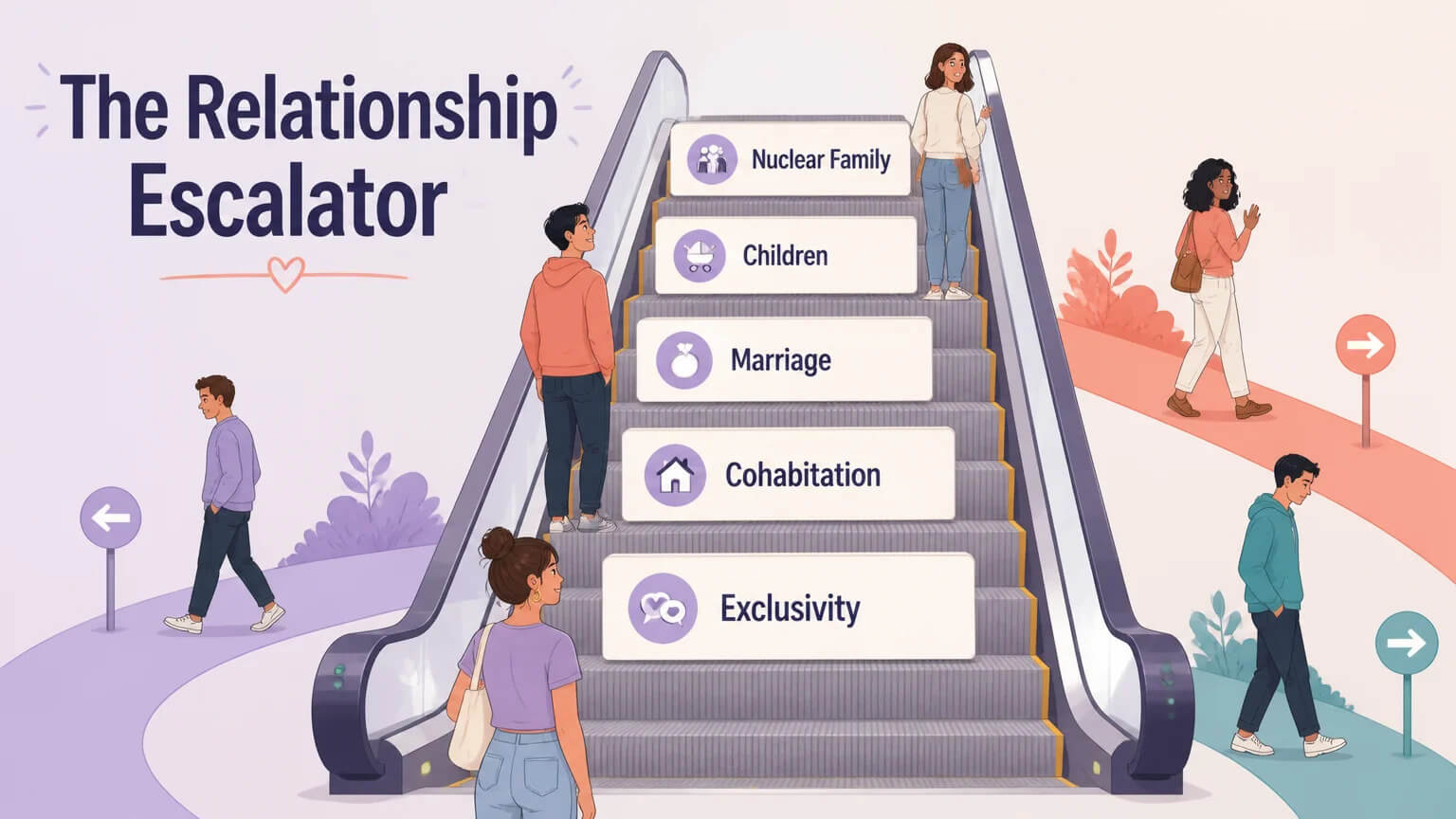
Amy Gahran, author of “Stepping Off the Relationship Escalator,” coined the term for a cultural script so baked-in that most people follow it without ever noticing: dating leads to exclusivity, exclusivity leads to cohabitation, cohabitation leads to marriage, marriage leads to kids, kids lead to death. Everyone calls each step progress. Staying at any step gets labeled stagnation.
The escalator has five clear stops: romantic and sexual exclusivity as the default, cohabitation as the milestone, marriage as the legitimizing institution, children as the natural next phase, and the nuclear family as the terminal goal. Every stop on that list is a social expectation. Zero of them are biological requirements.
In hierarchical polyamory, the escalator often still runs the show. The primary relationship follows the traditional path while secondary connections hit an implicit or explicit ceiling. A secondary partner might never meet the family, share a home, or get introduced as more than a friend. The cap is structural.
Non-hierarchy removes the cap. A relationship of six months might be as emotionally significant as one of six years. Depth is not assigned by role. Each connection finds its natural shape. Some include cohabitation. Some do not. Some include financial entanglement. Some do not. None of these variations signal that a relationship counts for less.
As Gahran notes, people in unconventional relationships talk about transitions, ebbs and flows, about as often as they mention breakups. Off the escalator, a relationship changing shape is not failure. It is the design. One couple might live together for three years, then shift to living apart while staying romantically connected. Two partners might share a mortgage with zero romantic entanglement between them. The escalator script has no language for these arrangements. That missing language is the whole point.
Non-hierarchical polyamory is one way to step off. It is not the only way, and people regularly confuse it with two related approaches.
Non-Hierarchical Poly vs. Relationship Anarchy vs. Solo Poly
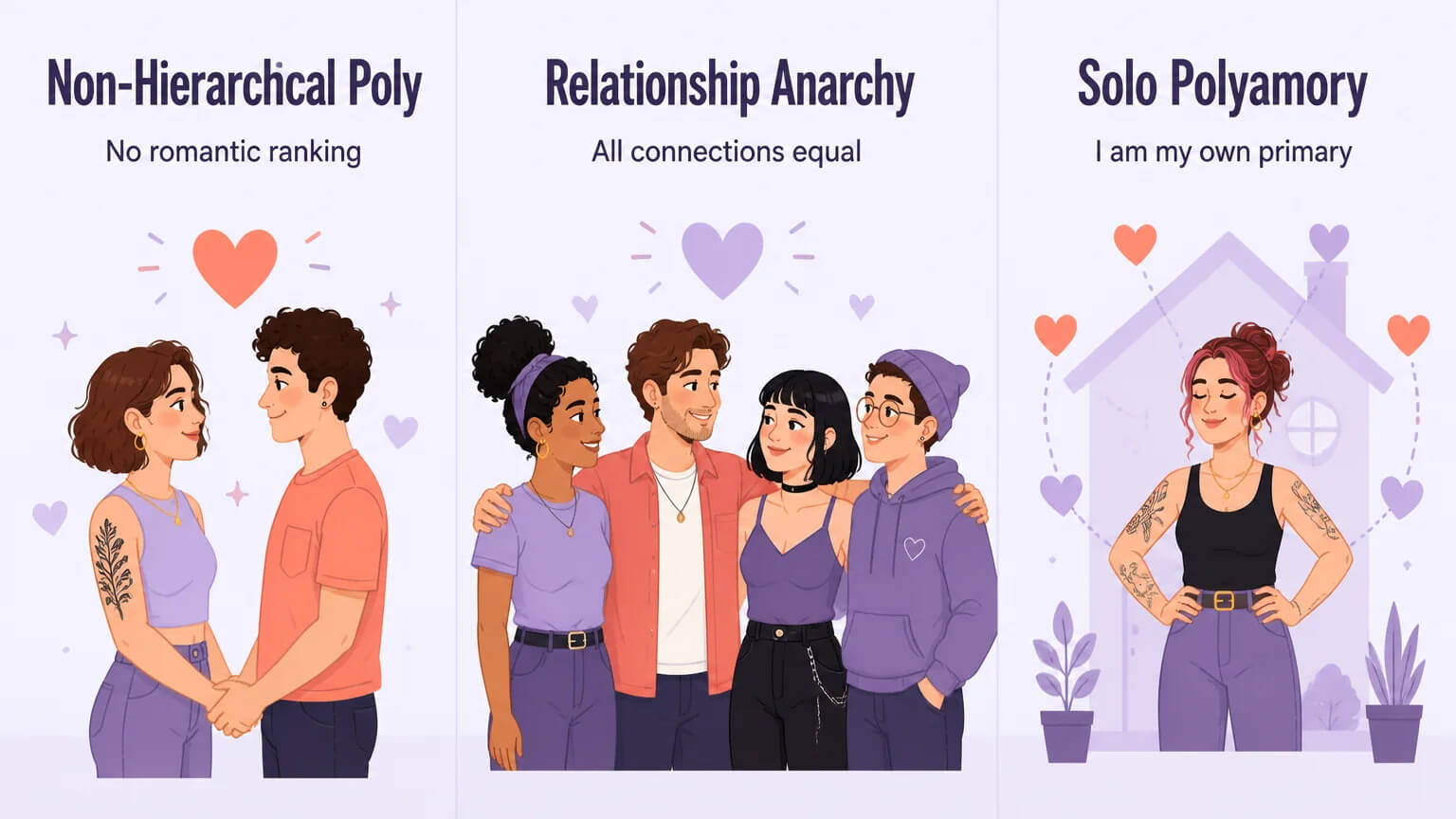
These three terms get tossed around like they mean the same thing. They do not. Understanding the differences keeps you out of the wrong conversation with the wrong expectations.
Non-hierarchical polyamory removes romantic and sexual ranking between partners. It still treats romantic relationships as a meaningful category. It grew out of polyamory specifically to fix the primary-secondary power imbalance. A non-hierarchical poly person might be married, nesting, or raising kids. This framework is about removing automatic entitlement. It is not about avoiding entanglement.
Relationship anarchy goes further. It challenges all hierarchies between relationships, including the assumption that romantic connections automatically outrank platonic ones. It applies anarchist political philosophy to human connections. A relationship anarchist might give a close friendship, a romantic partnership, and a queerplatonic relationship equal weight with no default ranking between them.
Solo polyamory is a different orientation. Someone who is solo poly maintains multiple relationships but chooses not to merge life infrastructure (finances, housing, legal entanglements) with any partner. They treat themselves as their own “primary.” Solo poly overlaps philosophically with non-hierarchical poly, but it differs in practice: solo poly is fundamentally about autonomy and non-merging. Non-hierarchical poly can absolutely include nesting, marriage, and shared finances.
In practice, many people blend elements of all three. Someone might practice non-hierarchical poly with a nesting partner while holding a relationship-anarchist approach to friendships. Someone else might identify as solo poly while maintaining a deeply committed non-cohabitating partnership. The labels count for less than the values underneath: autonomy, consent, transparency, and the rejection of structural ranking. But knowing the distinctions helps you say what you want clearly, and helps you spot when someone’s stated label does not match their lived practice.
Think of this as the quick-reference version. The one a friend gives you at a party so you do not walk into the wrong conversation.
The Myths That Keep People Stuck
These four myths keep coming up — in community conversations, late-night worries, and well-meaning advice that misses the mark.
“Non-hierarchy means everyone gets equal time.” The most common misunderstanding. Non-hierarchy is about removing structural ranking. It is not about making every relationship identical. One partner might live with you. Another might live across town. Those are practical realities. The question is whether those arrangements come with automatic claim on your Saturdays.
“True non-hierarchy is impossible.” This is the most active debate in the community. Skeptics argue that cohabitation, shared finances, marriage, and children inevitably create hierarchy. Anyone claiming non-hierarchy without acknowledging these realities is practicing “sneakiarchy”: hierarchy denied verbally but practiced structurally. As one widely circulated critique puts it: “Is your polyamory actually non-hierarchical, or do you just refuse to acknowledge and clearly communicate those hierarchies?”
Advocates counter that descriptive hierarchy (practical differences that exist) and prescriptive hierarchy (rules that enforce ranking) are fundamentally different. You can genuinely dismantle the latter. The therapist consensus: transparency about whatever hierarchy exists matters more than claiming pure egalitarianism.
“You cannot be married and non-hierarchical.” Marriage grants automatic structural privileges: legal recognition, tax benefits, social validation. But many practitioners reframe marriage as a legal convenience rather than a relationship ranking system. The question is not whether marriage creates advantages. It is whether you are honest about them and actively work to neutralize them.
“Non-hierarchy means no commitment.” Commitment in non-hierarchy is negotiated rather than assumed, which makes it more intentional. Nothing runs on autopilot. Every agreement, every ritual, every shared commitment exists because people chose it. The escalator did not carry them there.
These myths do not just confuse beginners. They can become weapons. “See, non-hierarchy is not even real” turns into a way to avoid examining your own relationship’s power structures. Do not let the perfect be the enemy of the intentional.
What the Research Actually Tells Us
The research is young, but it already points in a clear direction. Here is what the data says.
The cornerstone study comes from Flicker, Sancier-Barbosa, Moors, and Browne, published in 2021 in the Archives of Sexual Behavior. Three findings carry the most weight. First, individuals in hierarchical poly relationships reported lower overall satisfaction and attachment security compared to those in non-hierarchical relationships. Second, greater variability in attachment security existed between partners in hierarchical arrangements: primary partners felt secure; secondary and tertiary partners did not. Third, no significant differences in satisfaction and security were found between partners in non-hierarchical structures.
The variable that matters is not whether differences exist between partners. It is whether those differences are imposed structurally or emerge on their own. Differences that occur naturally, rather than in a predetermined hierarchical manner, relate to greater similarities in attachment security.
Jessica Fern, author of “Polysecure” and “Polywise,” extends attachment theory to polyamory: people can maintain secure attachment across multiple relationships, but it requires intentional communication, clear agreements, and recognizing that attachment needs are not a sign of “doing poly wrong.” Martha Kauppi, LMFT and author of “Polyamory: A Clinical Toolkit for Therapists,” frames the therapeutic question as “is this working, and if not, what needs to shift?” rather than “is this relationship structure valid?”
The honest limits: polyamory research is young, samples are small, and participants skew white and Western. The data is suggestive, not definitive. It is also the best data available, and it points in one direction: non-hierarchical structures produce more even outcomes across partners.
Research gives you the conditions that produce security. Structure does not tell you how to handle the feelings. The biggest one people worry about is jealousy.
Jealousy Without a Safety Net
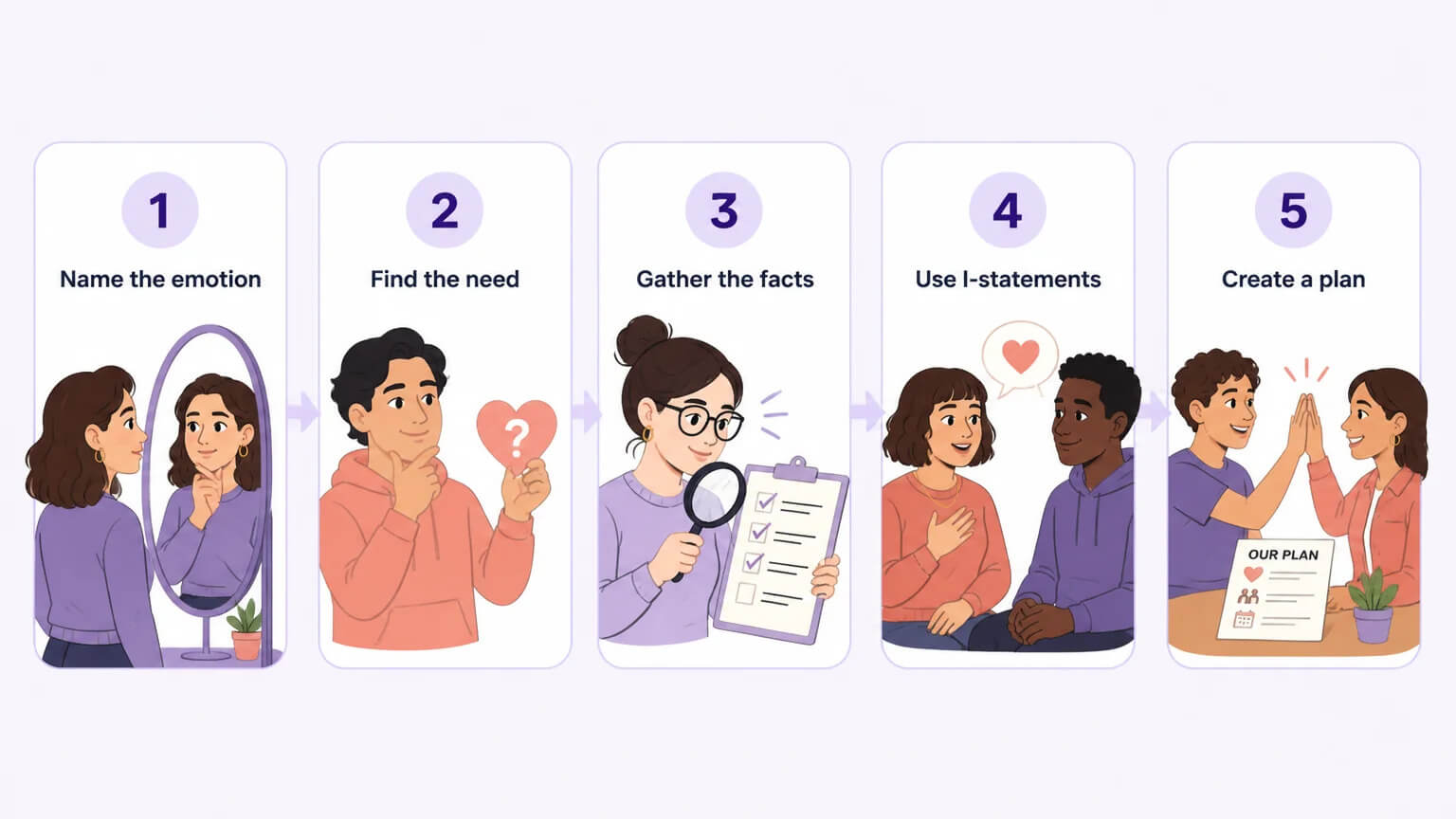
Kathy Labriola, author of “The Jealousy Workbook,” offers the metaphor that reframes the whole conversation: jealousy is not a stop sign. It is a dashboard light telling you where your emotional engine needs attention.
In hierarchical polyamory, the primary relationship provides a structural anchor. Even if a secondary connection ends or a new partner triggers insecurity, the “main” relationship stays protected by default. In non-hierarchical setups, every relationship stands on its own terms. There is no structural safety net and no default assumption about who comes first in a crisis. This can make jealousy feel more existentially threatening. It also means reassurance has to be built intentionally rather than assumed.
Consider Bri and Chen. When Bri’s new connection with Zed produced intense new relationship energy (NRE), Chen worried about losing closeness and being deprioritized. The resolution did not involve Bri ending things with Zed or Chen simply “getting over it.” Bri affirmed excitement about Zed while committing to maintain weekly deep connection time with Chen. They updated their agreements to define what counts as a priority date night and established a standing weekly ritual. The key insight: the solution was adding structure and predictability to the existing connection, not restricting the new one.
A five-step framework emerges from the community and therapist resources:
- Name the emotion concretely. Is it fear, sadness, anger, or a mix? Labeling reduces overwhelm.
- Identify the unmet need behind it. Safety? Predictability? Appreciation? Autonomy?
- Gather context data. What facts are you missing? Avoid filling gaps with worst-case narratives.
- Communicate using I-statements. Describe your experience without blame. Invite collaboration.
- Create a plan together. Small, testable adjustments (scheduling changes, boundary clarifications) that you revisit and refine.
NRE deserves its own mention. In non-hierarchical dynamics, no structural protection guards against being deprioritized when a partner is swept up in someone new. Practical countermeasures: scheduled check-ins, maintaining existing rituals even when excited about someone new, naming NRE openly rather than pretending it is not happening.
Jealousy in non-hierarchical poly does not prove the structure is failing. It proves you care about a connection enough to feel threatened when it shifts. The work is the same as any relationship. It is just more explicit.
Marriage, Nesting, and Kids: The Structural Reality Check
Structure does not equal security. That insight comes from one of the only practitioners writing publicly about being married and non-hierarchical.
Can you be married and non-hierarchical? Yes, but it takes active effort. Marriage grants automatic structural privileges: legal recognition, tax benefits, social validation, default inheritance, medical decision-making. Claiming non-hierarchy without addressing these is what critics call sneakiarchy. The practical test: no veto power, no automatic claim on each other’s time, transparent communication with all partners about what marriage means (and does not mean) in your specific dynamic. Many practitioners reframe marriage as a legal convenience. A tool for healthcare access, immigration status, or parental rights. Not a ranking system.
One married woman practicing non-hierarchical poly describes her setup: rotating use of master and guest bedrooms for sleepovers so no partner is structurally excluded, Google Calendar as the neutral scheduling infrastructure, being publicly out as poly to reduce secrecy-based hierarchy, zero veto power. The principle: marriage describes a legal arrangement. It does not cap other relationships.
The legal realities: third non-biological or non-married parents can be denied custody if the two legal parents separate or die. Solutions exist. Multi-parent legal recognition is available in California, Maine, Washington, Vermont, and Rhode Island. Advance healthcare directives can name all partners as decision-makers. Comprehensive estate planning (wills, trusts) and cohabitation agreements provide additional protection. Some families spend over $120,000 to privately contract the protections that marriage grants automatically to one partner.
On the practical side, Google Calendar with color-coding per partner is the community standard. TimeTree works for shared polycule scheduling. Your Significant Otter, a 2024 iOS app, supports polyamorous relationship journaling across multiple private spaces. No dedicated all-in-one polyamory management app exists yet.
When welcoming a new person into an existing network: share the network’s structure and agreements transparently from day one, create a welcome plan with introductions to existing partners if everyone consents, and schedule a check-in at two to four weeks. Integrity is a practice you show up for.
When Relationships End: Breakups and De-Escalation
Monogamous culture has breakup scripts. Non-hierarchical poly does not. That absence can feel disorienting, but it also means no assumption that a relationship must be all or nothing.
Amy Gahran’s research introduces Karen, who ended an eight-year partnership by transitioning to “nonsexual intimate friendship.” She treated this as a form of polyamory rather than a binary breakup. Everyone in the polycule accepted the friendship-relationship alongside other connections because the structure allowed relationships to change shape without being terminated. As Karen put it: “It has to be okay to end relationships without feeling that our support will be kicked out from under us.”
De-escalation is a valid shape-shift, not a consolation prize.
When a shift or full breakup is needed:
- Have the direct conversation. Do not let things drift. Avoid “Schrodinger relationships” that are practically over but linger without clarity.
- Define parameters for the new dynamic explicitly. Will you remain friends? With or without physical intimacy? How will you handle shared community events?
- Sit down with remaining partners to discuss what the shift means for those relationships. Address assumptions about newly available time or “promotion.”
- Manage community dynamics. Negotiate shared social spaces. Refrain from gossip unless abuse is involved.
- Seek support without triangulation. Lean on other partners if needed, but do not process about Partner A with Partner B in ways that create new conflicts.
When full breakups happen, the polycule feels it. Metamours may grieve too. No structural hierarchy means no default assumption about who “keeps” the community. Allow grief without pathologizing it. Negotiate shared social spaces explicitly. Keep processing with people outside the immediate network.
Off the escalator, a relationship that shifts from romantic partners to close friends is a different shape the same connection can take. Not a downgrade.
Beyond the White Default: Voices the Conversation Has Been Missing
The mainstream conversation about non-hierarchical polyamory has a demographic blind spot: most of the widely circulated writing comes from white Anglosphere authors. The conversation about relationship hierarchy through the lens of racial hierarchy has largely been missing.
Kevin A. Patterson, author of “Love’s Not Color Blind” (2018), makes the central argument: polyamory, however compassionate an alternative to monogamy, still operates within a racist society. When racism in poly spaces goes unacknowledged and unchecked (fetishization of people of color, exclusion by white partners, a mentality that treats BIPOC partners as experiences rather than people), polyamory stops being a more inclusive relationship style. White practitioners who reject relationship hierarchies still have work to do on the racial ones they carry.
Dr. Badiee, a therapist and professor of psychology at CSU, highlights that BIPOC individuals in polyamorous spaces navigate the compounding complexity of white supremacy alongside relationship structure. Decolonizing relationships means recognizing that Western polyamory discourse often carries colonial assumptions about what “enlightened” relationships look like. These assumptions can erase non-Western models of communal care and non-nuclear kinship.
Emerging voices are pushing forward: Giancarlo Simpson’s 2023 dissertation on Afro-Caribbean men’s polyamory experiences, active Black poly practitioners bringing real-time critiques and fresh perspectives to the conversation. These voices exist. They deserve to be part of the picture.
For non-BIPOC readers: read Patterson’s “Love’s Not Color Blind” and follow BIPOC poly educators. Examine your own dating patterns (who do you pursue, and why?). Do not ask BIPOC people in your community to educate you for free. Recognize that claiming non-hierarchy while benefiting from unexamined racial privilege is an incomplete project.
If your map of non-hierarchical polyamory only includes white voices, you are missing half the territory.
Making the Shift: From Hierarchy to Egalitarian
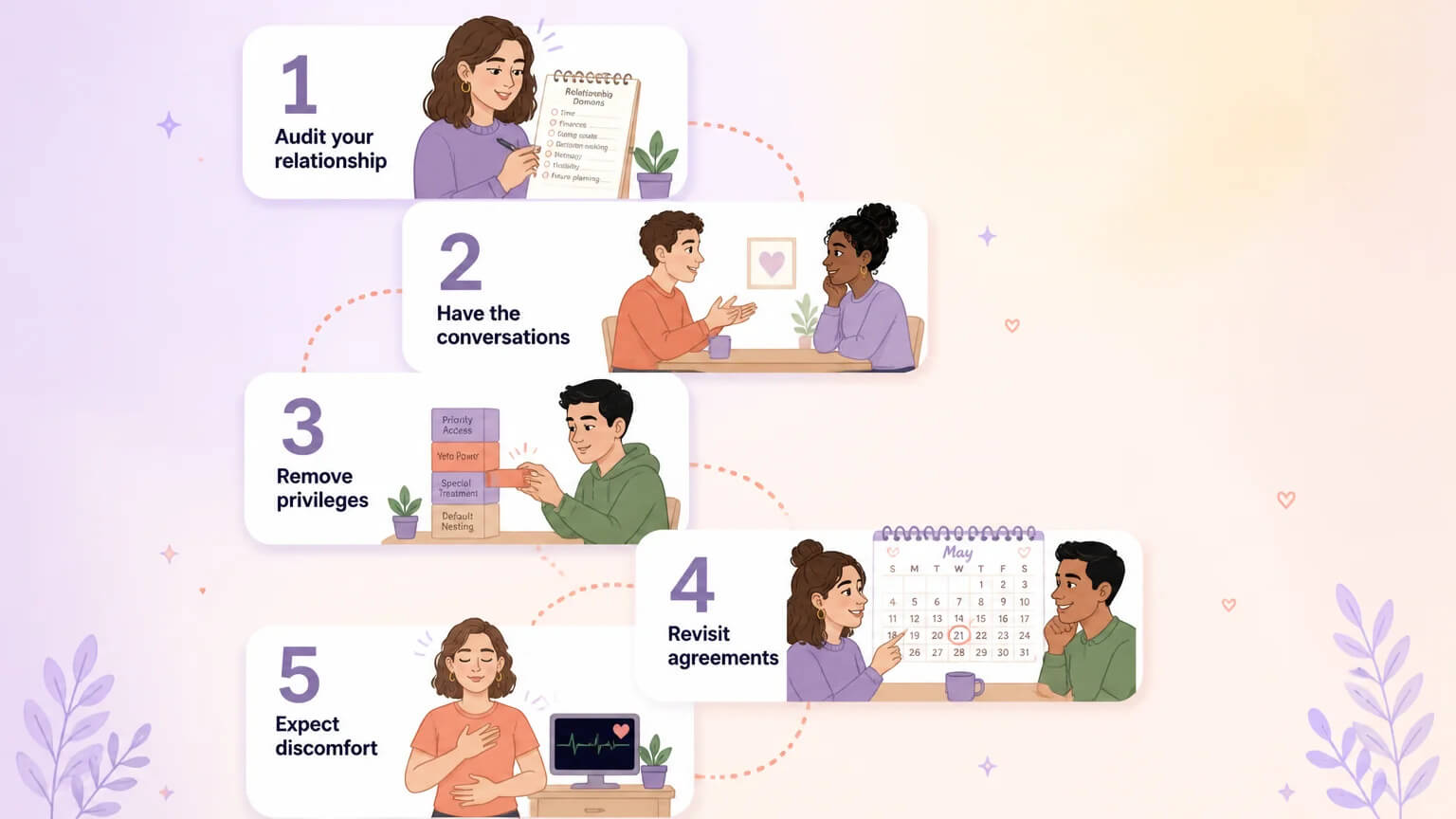
Most guides define non-hierarchical polyamory without telling you how to actually practice it. This section fills that gap.
Transition is genuinely hard. Existing partners may feel threatened as structural protections are removed. The person who has been “primary” has often built their identity and security around that role. Removing the label can trigger grief even when both people intellectually want the change. Expect discomfort. Do not pathologize it. The fear shows that the existing hierarchy was providing real emotional security, however unevenly distributed.
1. Audit your current relationship. Where does one partner get automatic priority? Map every domain: time allocation (who gets weekends by default?), financial entanglement (who has access to shared resources?), living arrangements (whose name is on the lease?), family building (who is assumed to be the co-parent?), being “out” (who gets introduced as the partner and who does not?), decision-making authority (who has veto power, explicit or implicit?). Write it down. Seeing it on paper makes implicit hierarchy explicit.
2. Have the explicit conversations, one area at a time. Do not renegotiate everything in one sitting. Start with the most visible structural privilege. Veto power is usually step one. Then time allocation. Then financial entanglement. Then living arrangements. Each conversation names what exists now, what each person is afraid of losing, and what the new agreement looks like.
3. Remove structural privileges one at a time. This is a process measured in months, not a switch flipped in a conversation. Removing veto power might happen in a day. Internalizing that you do not have default claim on your partner’s Friday nights might take six months of practice.
4. Revisit agreements regularly. Schedule monthly check-ins for the first six to twelve months. Three questions: What is working? What feels shaky? What needs adjusting? The goal is not a perfect agreement on the first try. It is a system that can learn.
5. Expect discomfort and do not panic. Feeling insecure during transition does not mean you are “failing at non-hierarchy.” It means your nervous system is adjusting to a new pattern. The antidote is not abandoning the project. It is adding predictability (scheduled time, clear commitments) while the old structural safety net is dismantled.
Success does not look like “zero hierarchy ever.” That is the purity trap. Success looks like transparency about whatever hierarchy still exists, intentionality about what you are keeping and why (one partner stays on your health insurance because it is practical, not because they are “primary”), and a system where all partners can name and negotiate their needs without fear of veto or retaliation.
FAQ
Can you be married and practice non-hierarchical polyamory?
Yes, but it takes active work. Marriage grants automatic legal and social privileges. Practicing non-hierarchy while married means removing veto power, not claiming automatic priority on each other’s time, and being transparent about what structural advantages exist. Many practitioners treat marriage as a legal convenience, not a ranking system.
What is the difference between non-hierarchical polyamory and relationship anarchy?
Non-hierarchical poly removes ranking between romantic and sexual partners but still centers romantic connections. Relationship anarchy rejects all hierarchies between relationships, including the idea that romantic connections should automatically outrank platonic ones. Many people blend elements of both.
Does non-hierarchical mean everyone gets equal time?
No. It means no structural ranking, not identical relationships. Practical differences in time spent are fine. The difference is that one partner does not automatically get weekends because they hold a “primary” title. Variations in time are practical choices, not entitlements.
How do you handle jealousy without a primary partner as an anchor?
Same core tools (self-regulation, I-statements, scheduled check-ins) but with more intentional reassurance because there is no structural safety net. Name the emotion, identify the unmet need, gather facts without spiraling, communicate collaboratively, and create a concrete plan you can test and adjust.
Is non-hierarchical polyamory actually possible, or is it a myth?
This is actively debated. Pure egalitarianism may be unreachable because cohabitation, shared finances, and children create structural differences. But prescriptive hierarchy (rules enforcing ranking, like veto power) can be genuinely dismantled. What matters is transparency about whatever hierarchy exists, not claiming impossible purity.
What tools help manage non-hierarchical poly logistics?
Google Calendar with color-coding per partner is the community standard. TimeTree works for shared polycule scheduling. Your Significant Otter (iOS, 2024) supports polyamorous relationship journaling across multiple private spaces. No dedicated all-in-one polyamory management app exists yet.