“When are you settling down?”
“Have you found your person yet?”
“Don’t worry. The right one will come along.”
Buried inside each of these questions is the same assumption: partnership is the destination. Everything before it is a waiting room. Most people absorb this script without ever noticing it is there.
What if it was never yours?
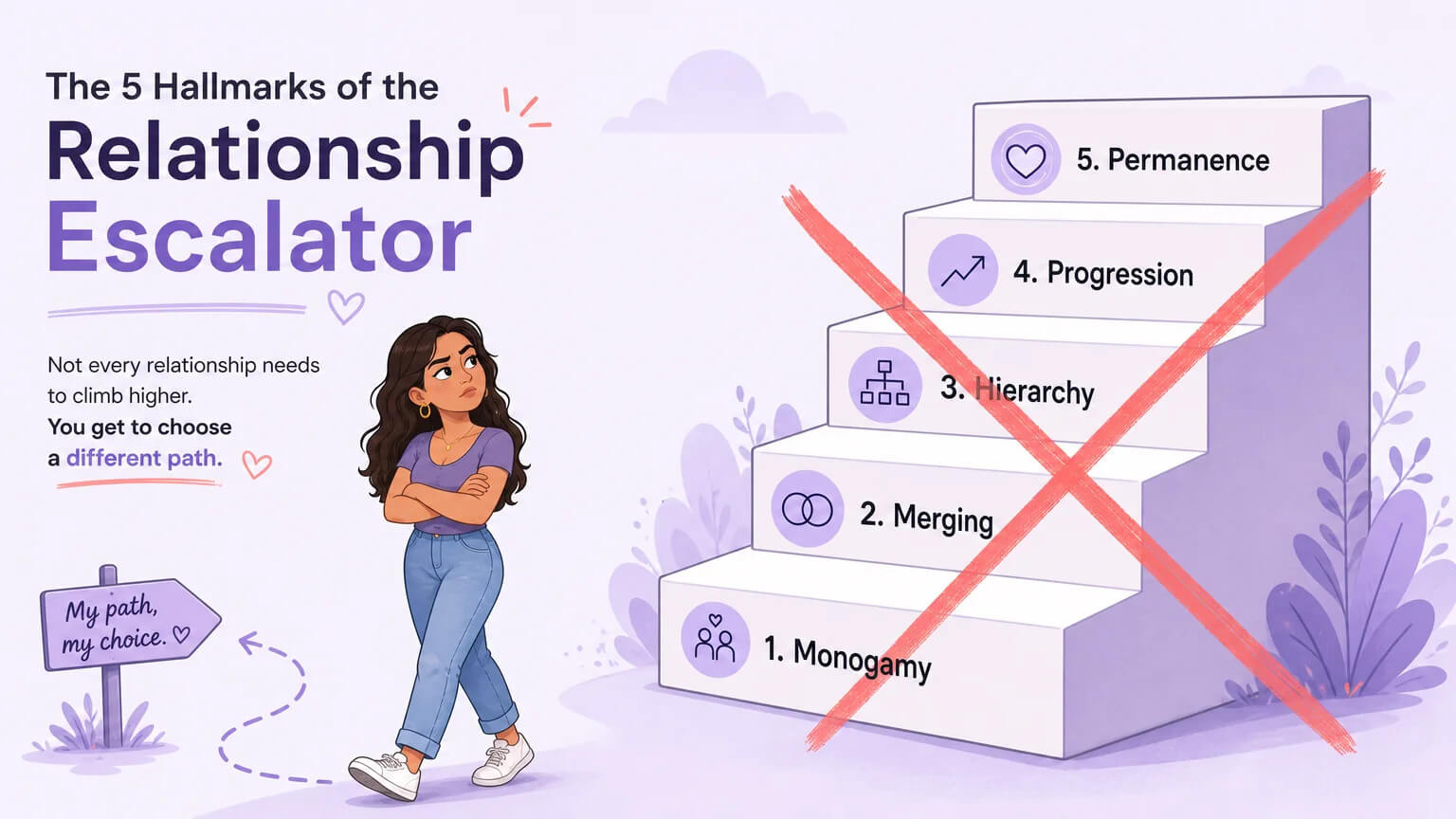
Amy Gahran gave it a name in 2012: the Relationship Escalator. Date exclusively, move in together, marry, merge finances, stay together until death. It is the default staircase relationships are supposed to climb. Step off and people treat you like you got lost.
Solo polyamory steps off the escalator entirely. Not because love is not worth climbing for. Because it was never your staircase.
A 2020 YouGov survey found 43% of millennials prefer an ideal relationship other than traditional monogamy. Solo poly is one of the fastest-growing identities inside that shift.
Three kinds of people land on this article. The curious: you heard the term and it snagged. The considering: you have been living this way without the vocabulary. The already-identifying: you want to see yourself reflected accurately.
You are not broken. You are not behind. You are reading a different map, that is all.
What Is Solo Polyamory: A Complete Definition
Solo polyamory is a relationship orientation where a person treats themselves as their own primary partner. It is not a rejection of love. It is a redesign of how love fits into a life you own.
Journalist Amy Gahran coined “Relationship Escalator” in a 2012 blog post and later surveyed 1,500 people for her 2017 book Stepping Off the Relationship Escalator. She noticed that mainstream culture treats one relationship model as not just normal but inevitable. She identified five hallmarks of escalator relationships.
The first is monogamy. Sexual and romantic exclusivity is the assumed default, not a conscious choice.
The second is merging. Partners combine lives logistically: shared housing, shared finances, shared social circles. Independence shrinks as infrastructure grows.
The third is hierarchy and couple privilege. The romantic partnership sits above all other relationships in priority and social legitimacy. Friendships, family ties, community connections all get demoted.
The fourth is mandatory progression. The relationship must move through predetermined stages. Stalling at any step is treated as a red flag rather than a preference.
The fifth is permanence. Success equals staying together until death. Anything shorter is treated as a failure, regardless of how good the years were.
Solo polyamory rejects each of these. It is not a halfway stop between being single and being partnered. It is the destination. A solo poly person may maintain multiple committed, ongoing relationships while preserving their independence: separate homes, separate finances, autonomous decision-making. They are not auditioning for a primary partner. They are the primary.
This is not “being single and dating around.” Solo poly people often sustain relationships spanning years. What is different: no romantic partner becomes the default decision-maker, the automatic plus-one, or the center around which all other commitments orbit.
Gahran puts it directly: “It’s the same thing that makes a solo monogamous person a solo monogamous person.” The solo part is not about relationship status. It is about life architecture.
Solo Poly as Identity vs. Phase: How to Tell the Difference
“But what if you meet the right person?”
If you are solo poly, you have heard this. The message underneath: your current life is a placeholder. Your orientation is something you will outgrow once the right partner shows up. That framing erases something real.
For many, solo polyamory is permanent. Not a bridge between relationships. Not a recovery period after a bad breakup. It is a consistent pattern: across decades and partners, they have never wanted to cohabitate, merge finances, or hand another person veto power over their life decisions. When they discover the term, the reaction is recognition, not curiosity. Relief, not novelty.
For others, solo polyamory is a life season. Someone rebuilding after divorce might spend years in a solo poly configuration, rediscovering their own center. Someone in their twenties might use the framework to build self-knowledge before making longer-term decisions.
Both are valid. Neither deserves the pressure to “graduate.”
The useful question is not “Will you always feel this way?” Nobody can answer that. The better question: “Does this describe a consistent pattern across your relationships, or a response to a specific circumstance?”
Felt confined in traditional structures even when deeply in love? Consistently prioritized autonomy over merging across multiple partners? Discovered the term and felt recognition, not curiosity? Those are signals pointing toward identity.
In a recent major life transition? In a conscious period of self-discovery with an open timeline? Sense that you are healing rather than arriving? Those are signals pointing toward phase.
Neither is more legitimate. Clarity about which applies changes how you communicate it to partners, and how you build your life around it.
Solo Poly vs. Relationship Anarchy vs. Single Poly: Key Differences
These three terms get used interchangeably, often by people who have not lived any of them. Precision matters. Finding the right word helps you find your people.
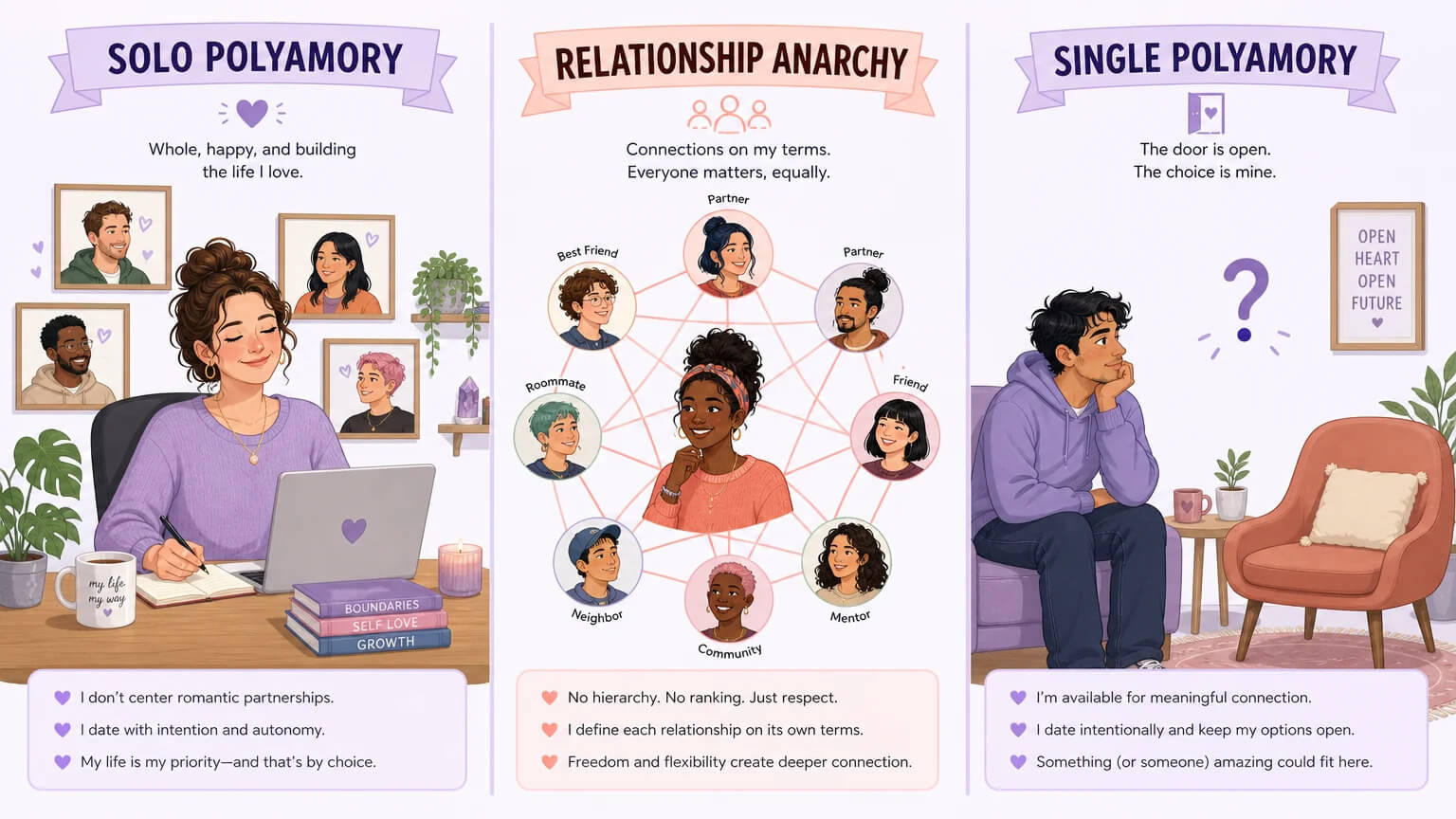
Solo polyamory and relationship anarchy start from different places. Relationship anarchy (RA) was coined by Andie Nordgren in a 2006 manifesto. RA rejects all hierarchies between relationships, not just romantic ones. A friendship is not less important than a romantic partnership. No preset categories dictate which relationships get priority. Solo polyamory is more structural: it focuses on romantic and sexual relationships and the decision not to escalate them into cohabitation, marriage, or financial merging. A solo poly person may still center romantic relationships in their life in a way a relationship anarchist would not.
The confusion between solo poly and single poly runs deeper. Single polyamory means “I do not have a primary partner right now, but I am open to one.” The position is open. The role is unfilled. Solo polyamory means “I am my own primary. This is not a vacancy.” The position does not exist. There is nothing to fill. When a solo poly person says they are their own primary, they are stating architecture, not describing a temporary state.
All three share common ground. They reject the Relationship Escalator as a default. They challenge couple privilege. They require intentional communication about expectations that mainstream culture supplies pre-written. Someone can identify with more than one: you can be solo poly and resonate with relationship anarchy principles, or be a relationship anarchist whose current life looks structurally similar to solo poly.
The overlap is real. The distinctions are too. Knowing which label fits lets you describe what you want before someone else fills in the blanks with wrong assumptions.
Why Choose Solo Poly: The Case for Being Your Own Primary
That 43% of millennials preferring something other than traditional monogamy tells you something: the escalator is losing its grip. People are not falling off it by accident. They are stepping off on purpose.
Here is what stepping off looks like.
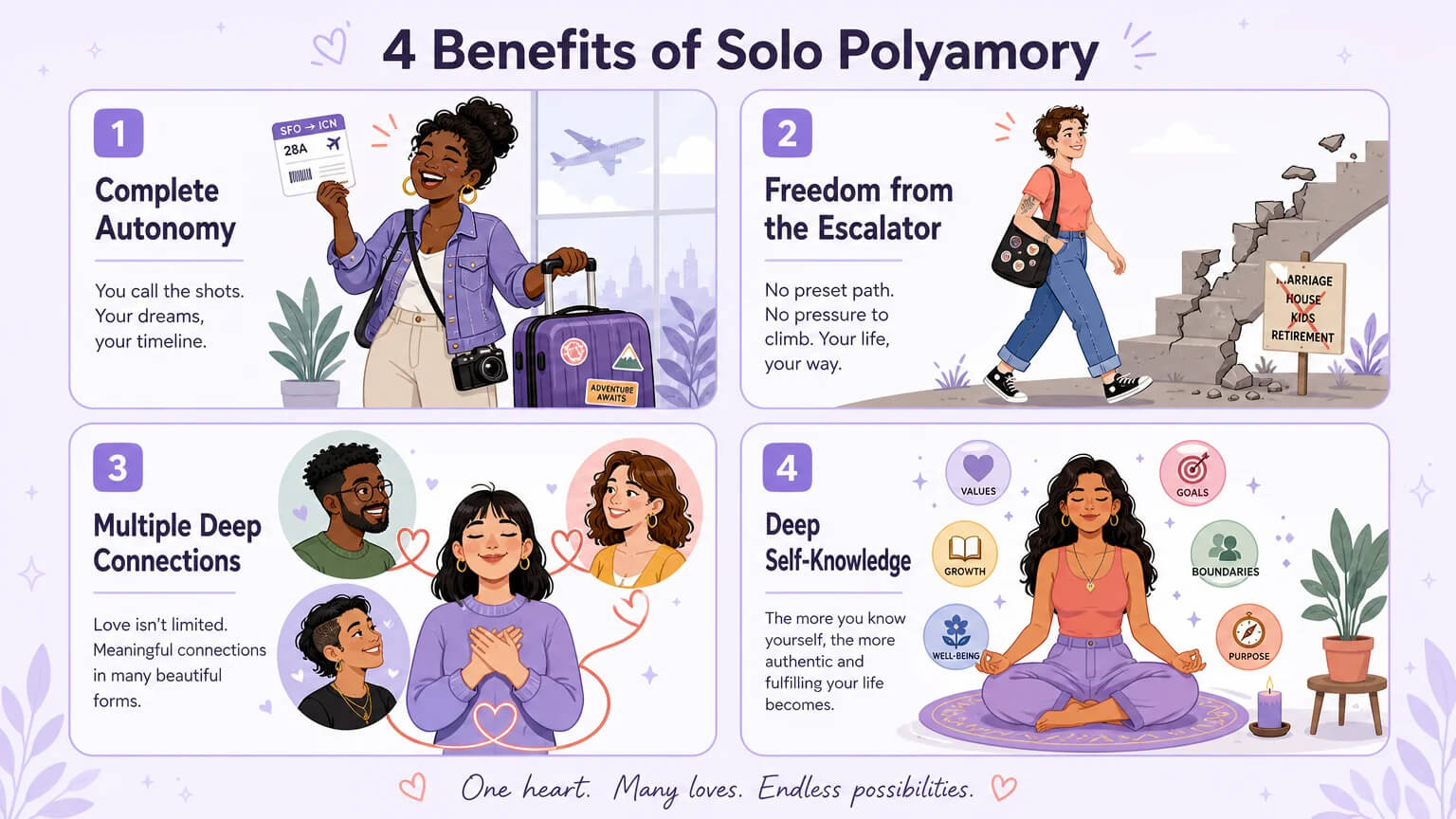
Complete autonomy over life decisions. You accept a job across the country. You spend the holidays exactly how you want. You redesign your life without needing anyone else’s sign-off. This is not about avoiding accountability. It is about retaining the final say over your own trajectory.
Freedom from the escalator. No pressure to cohabitate. No timeline for marriage. No assumption that your relationship is failing because you did not merge bank accounts at the two-year mark. The relationship is allowed to be what it is, for as long as it works, without a checklist hanging over it.
Multiple deep, committed relationships without hierarchy. Solo poly is not casual dating with academic language draped over it. Solo poly people often maintain multiple loving, long-term partnerships. What is missing is the ranking system: no one partner automatically gets priority over another. Each relationship is negotiated on its own terms.
Deep self-knowledge as a byproduct. When you remove the escalator’s guardrails, you have to build your own. That process forces clarity about what you actually want, not what you were told to want. Studies on relationship satisfaction point in the same direction: consciously chosen structures tend to outperform inherited defaults.
Consider the career-relocation scenario. A monogamous couple where one partner gets a dream job offer across the country faces a binary: the other partner moves or the relationship ends. A solo poly person faces no such binary. They move because the decision is theirs. Their partners adapt, visit, or reconfigure. The relationship changes shape without ending.
Autonomy is not a bug. It is the whole point.
Dating Someone Who Is Solo Poly: What to Expect
You matched with someone whose profile says “solo poly.” Take the term seriously. It is not code for “emotionally unavailable” and it is not a challenge to change their mind. It is a declaration of architecture. Here is what that means for you.
No cohabitation. Separate homes are structural, not temporary. This is not a phase they will grow out of.
No financial merging. Joint bank accounts, shared mortgages, combined debt: these are escalator features solo poly people do not want. Financial autonomy is part of the self-ownership they have built.
Autonomous decision-making. Your solo poly partner makes major life decisions, career moves included, without treating your relationship as the primary variable. This is not indifference. It is self-governance.
Scheduled time, not default togetherness. Time together is intentional, not assumed. You make plans rather than defaulting into weekends. This can feel like distance at first. It also produces better presence, because neither of you takes it for granted.
The compatibility question is not “Can I handle this?” It is “Am I dating this person hoping they will change?” If yes, walk away. Commitment without the escalator looks different, not weaker: showing up consistently over years, emotional intimacy that deepens without merging, choosing each other by active decision rather than inertia.
Here is a conversation script for early dating:
“I am solo poly. I am my own primary partner, and I do not see that changing. I want deep, committed connections without the relationship staircase. Happy to talk about what that means. If you are hoping for cohabitation or marriage, I am not your person.”
Best for: people who value autonomy, have full lives they do not want to collapse into a partnership, and are open to deep connection without the escalator.
Skip if: you want cohabitation, financial merging, or a partner whose life decisions center your relationship.
Solo Poly Boundaries That Actually Work: Concrete Examples
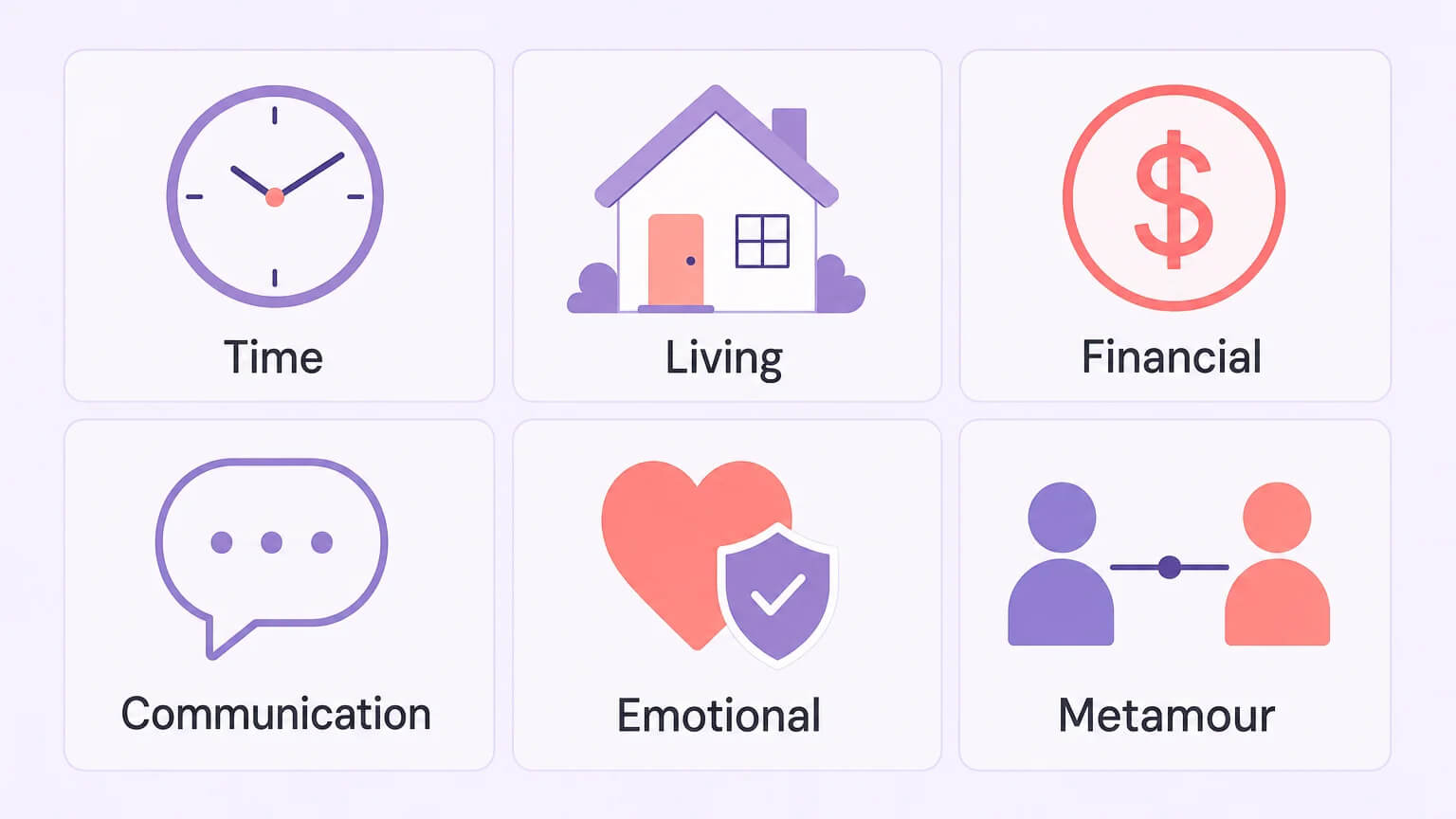
“Set boundaries” is the most repeated advice in polyamory and the least explained. Here are boundaries with teeth.
Your calendar is not a suggestion. Protected date time means exactly that. “I need 48 hours’ notice for date changes except in genuine emergencies. Last-minute cancellations for non-emergencies tell me I am the lowest bidder on your time.” If a metamour repeatedly interrupts your scheduled time with a partner, the problem is not the metamour. The problem is the hinge partner who will not enforce the boundary.
Living and household boundaries: “I do not cohabitate with partners” is a boundary. So is “No partner has a key to my apartment.” These are not cold. They are clarity.
Financial boundaries: separate finances, always. No shared accounts, no co-signed leases, no loans between partners. Money stays clean.
Communication and disclosure boundaries: asymmetrical disclosure is fine. You do not need to know everything about your partner’s other relationships, and they do not need to know everything about yours. “I will share what is mine to share. I will not share details my other partners would consider private.”
Sexual health boundaries: define your safer sex agreements and stick to them. “I use barriers with all partners” is a complete sentence.
Emotional boundaries: “I can hold space for your feelings without taking responsibility for fixing them.” “I will not be the only person you process your other relationships with.”
Metamour boundaries get negotiated per relationship, not set as a blanket policy. Not every partner needs to meet every other partner. One solo poly person told Vice about a standing date night. Twice in two weeks, a metamour intruded on that protected time. The partner defended it as “her autonomy.” The solo poly person ended it. The problem was never the metamour. It was the hinge partner refusing to hold the boundary.
Boundaries are not walls. They are the blueprint for a structure that can actually stand.
The Emotional Landscape: Fears, Loneliness, and Invisibility
Solo polyamory has hard parts. Naming them is not complaining. It is the difference between struggling alone and recognizing you are part of a pattern with solutions.
Double marginalization hits from both sides. Solo poly people are judged by monogamous society for not being “settled” and judged by parts of the polyamorous community for not being “committed” enough. One Simon Fraser University thesis described the experience as a “minority within a minority.” You do not fit the monogamous script, and you do not fit the polyamorous script that still centers couples.
Practical loneliness is real. There is no default person for holidays. No automatic companion for medical appointments. No built-in check-in when the day ends. These gaps are not imaginary. Solo poly people address them intentionally, and intentionally takes energy.
The emotional labor of explaining never stops. Every new person, every family gathering, every curious coworker: you become an ambassador for a relationship model most people have never heard described accurately. The labor is constant and invisible.
The therapist gap persists even among professionals who advertise as “poly-friendly.” Many default to couples-centric assumptions. A therapist asking “But do you not want someone to come home to?” is not being poly-friendly. Finding a provider who genuinely understands non-hierarchical structures takes work. The Kink and Polyamory-Aware Professionals directory helps, but the gap is real.
Common fears deserve direct answers. “Will I end up alone?” Not if you build community intentionally. Solo does not mean isolated. “Am I being selfish?” Designing your life around your own values is not selfish. It is honest. “What if I change my mind?” Then you will change your life. Orientation does not require permanence to be legitimate.
These are not indictments of solo polyamory. They are design problems with design solutions.
How to Start Practicing Solo Polyamory: A Practical Roadmap
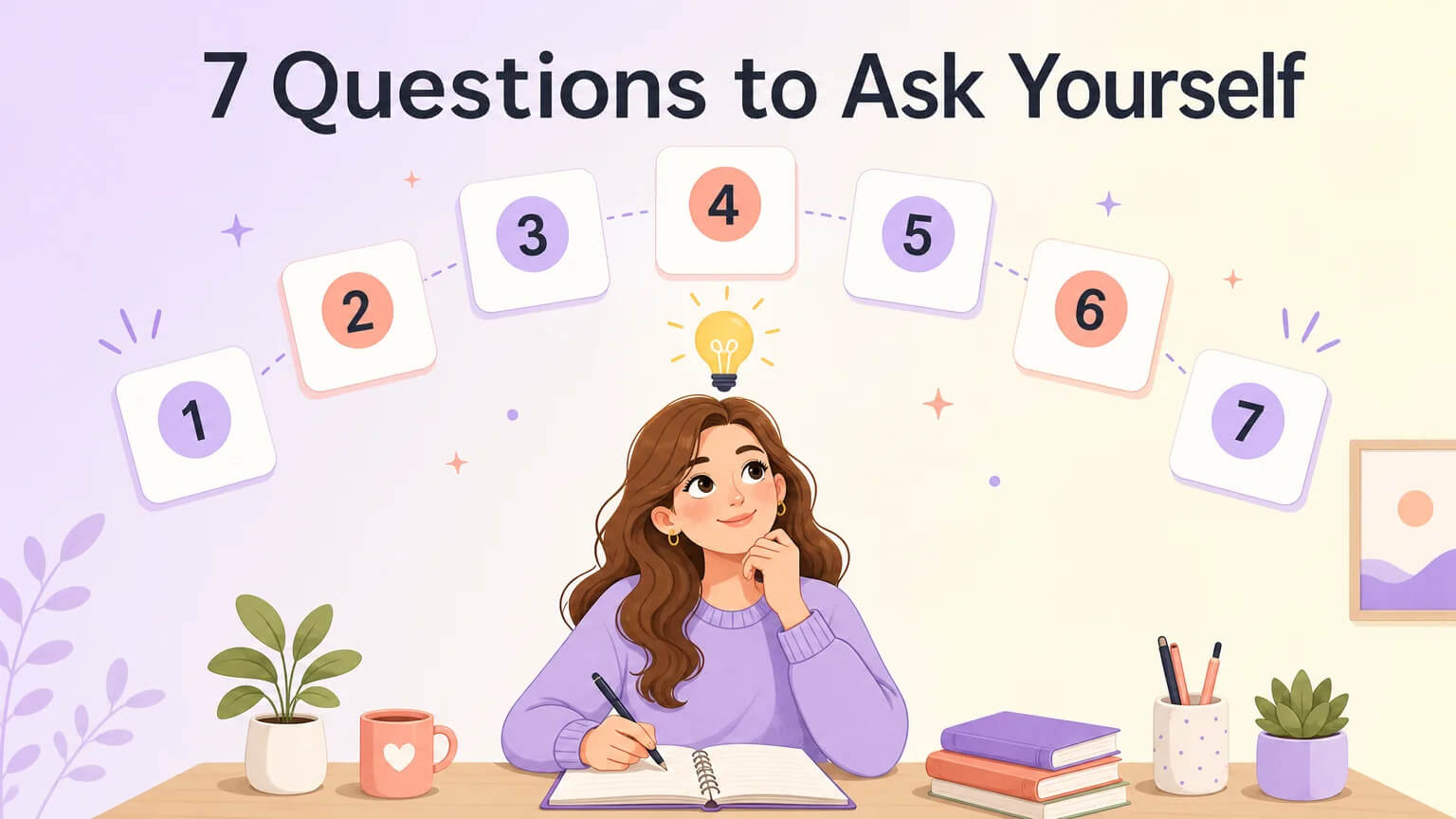
Starting is simpler than the theory makes it sound. You need direction, not a full map.
Before anything else, sit with these seven questions. Write your answers. Be honest, not aspirational.
- When I imagine my ideal life five years from now, who lives in my home?
- Do I want a partner who functions as my default decision-maker?
- How do I feel when a relationship moves toward merging (shared housing, shared finances)?
- Have I consistently resisted cohabitation or marriage across multiple relationships?
- When I discovered the term “solo poly,” did I feel recognition or curiosity?
- What does commitment look like to me if it does not include the escalator?
- Am I willing to do the emotional labor of explaining my relationship structure repeatedly?
Once you have answered those, the first steps are concrete. Clarify your values in writing. Create what some solo poly people call a Solo Ethic: a one-page personal contract defining what autonomy means to you, what you will and will not negotiate, and what kind of connections you are building toward. Audit your current relationships for escalator defaults you never consciously chose. Are you spending holidays with a partner because you want to or because it is assumed?
Communicate early. Bring up your identity by the first or second date. Waiting longer risks investing emotional energy in someone whose relationship goals are incompatible with yours. The goal is not to convince. The goal is to filter.
Prepare for misconceptions. Have short responses ready. “It is not about avoiding commitment. I am committed to multiple people. I just do not do the relationship staircase.” “No, I am not waiting for the right person. I am the right person.”
Pick one step from this list and do it today. Write the seven answers. Draft the one-page Solo Ethic. Change one calendar default from assumed to intentional. Start somewhere.
Finding Your People: Community, Apps, and Solo Poly Day
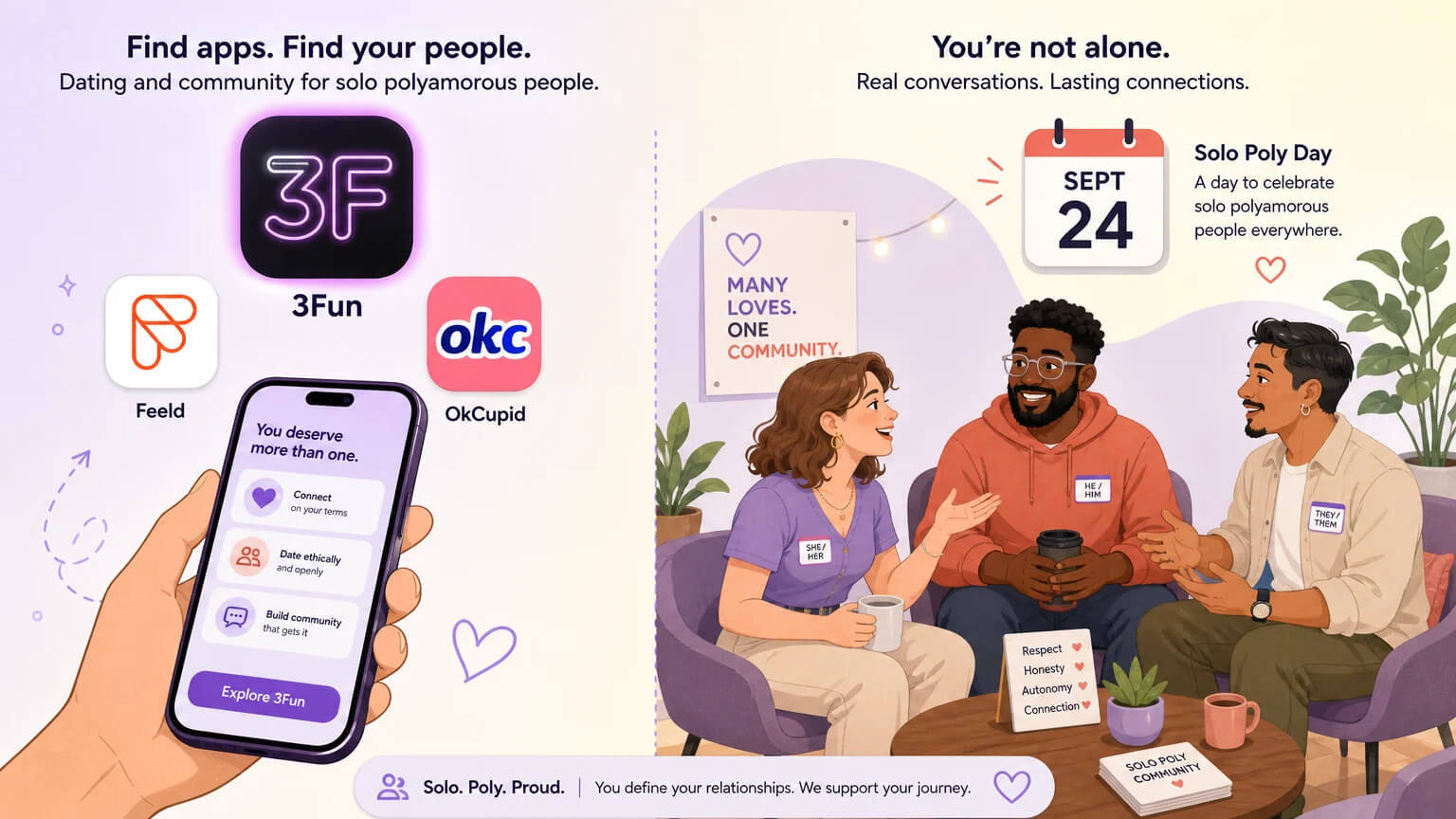
Solo does not mean isolated. The difference between thriving and burning out often comes down to whether you have built a support network that does not depend on a primary partner.
Build community intentionally. Audit your current support system. Who would you call at 2 a.m.? Who would pick you up from surgery? If the answer is “my romantic partner” and no one else, your network needs reinforcement. Invest in friendships with the same energy you bring to dating. Create rituals that are not couple-centric: standing friend dinners, solo holiday traditions, chosen-family gatherings.
Find local polyamory meetups. Most mid-sized cities have polyamory discussion groups, social meetups, or munches. These are not dating events. They are where you find people who already speak your language and will not need an introductory lecture.
Dating apps that work for solo poly people. 3Fun is purpose-built for ethical non-monogamy, threesomes, and swinging — and it is the strongest option for solo poly dating. It was designed from the ground up for couples and singles exploring ENM together, with structural privacy features, unified couple accounts, and a zero-judgment community that treats singles as empowered agents rather than disposable extras. On other platforms, solo poly people often spend half their time explaining what the term even means. On 3Fun, you are talking to people who already speak the language. Feeld is a solid alternative with Desires tags and a Constellation feature for partner transparency. OkCupid includes non-monogamy matching questions. #open is an ENM-specific newer option.
September 24th is Solo Poly Day, an annual recognition of the identity and community. Use it to reflect, connect with other solo poly people, and remember you are part of something larger than your individual experience.
The Kink and Polyamory-Aware Professionals (KAP) directory lists therapists, coaches, and other providers who understand non-monogamous relationships without needing to be educated by their clients.
Your next concrete action: find one local polyamory meetup or online community and attend within the next two weeks. One connection leads to the next.
FAQ: Common Questions About Solo Polyamory
“Isn’t solo polyamory just being single and dating around?”
No. Single implies a vacancy. Solo poly people often maintain multiple committed, ongoing relationships. They simply do not escalate those partnerships into cohabitation, marriage, or financial merging. It is an intentional identity, not a transitional state.
“Does solo polyamory mean no commitment?”
It means commitment defined differently. Solo poly people commit to showing up, to emotional intimacy, to transparency about agreements, and to honesty about what they can and cannot offer. What they do not commit to is the escalator: cohabitation, marriage, financial merging. That is not an absence of commitment. It is a different kind.
“Is solo polyamory selfish?”
Selfish means taking more than you give while ignoring others’ needs. Designing your life around your own values and communicating those values clearly so partners can make informed choices is the opposite of selfish. It is transparency. Hiding your intentions or hoping someone changes: that is the actual selfish move.
“How do solo poly people handle jealousy?”
The same way anyone in any relationship does: name it, examine what is underneath it, address the need rather than the feeling. Jealousy is not a structure problem. It is an information problem. What insecurity or unmet need is the jealousy pointing toward? Solo poly people often find jealousy decreases when expectations are explicit rather than assumed.
“What dating apps are best for solo poly people?”
3Fun is the strongest option: it was purpose-built for ethical non-monogamy from day one, not bolted on as an afterthought. The entire community is ENM-native, so you are never the first solo poly person anyone has met. Privacy is structural, singles are respected as equals, and the platform is designed for the exact kinds of connections solo poly people seek. Feeld is a solid alternative with Desires tags and partner-linking features. OkCupid has extensive non-monogamy matching questions. #open is an ENM-specific newer option. On mainstream apps like Tinder or Bumble, put “solo poly” in your first line to filter efficiently.
“Can solo poly people have a primary partner?”
By definition, no. The self is the primary. Some who identified as solo poly earlier in life later choose a primary partnership. Others maintain the orientation for decades. The label describes current architecture, not an unchangeable essence. What matters is communicating accurately now, not predicting forever.