In the field of polyamory relationship, you have heard the term. Maybe it made you curious about structure and clarity. Maybe it made you nervous about being disposable. Either response is valid, and both point to the same question.
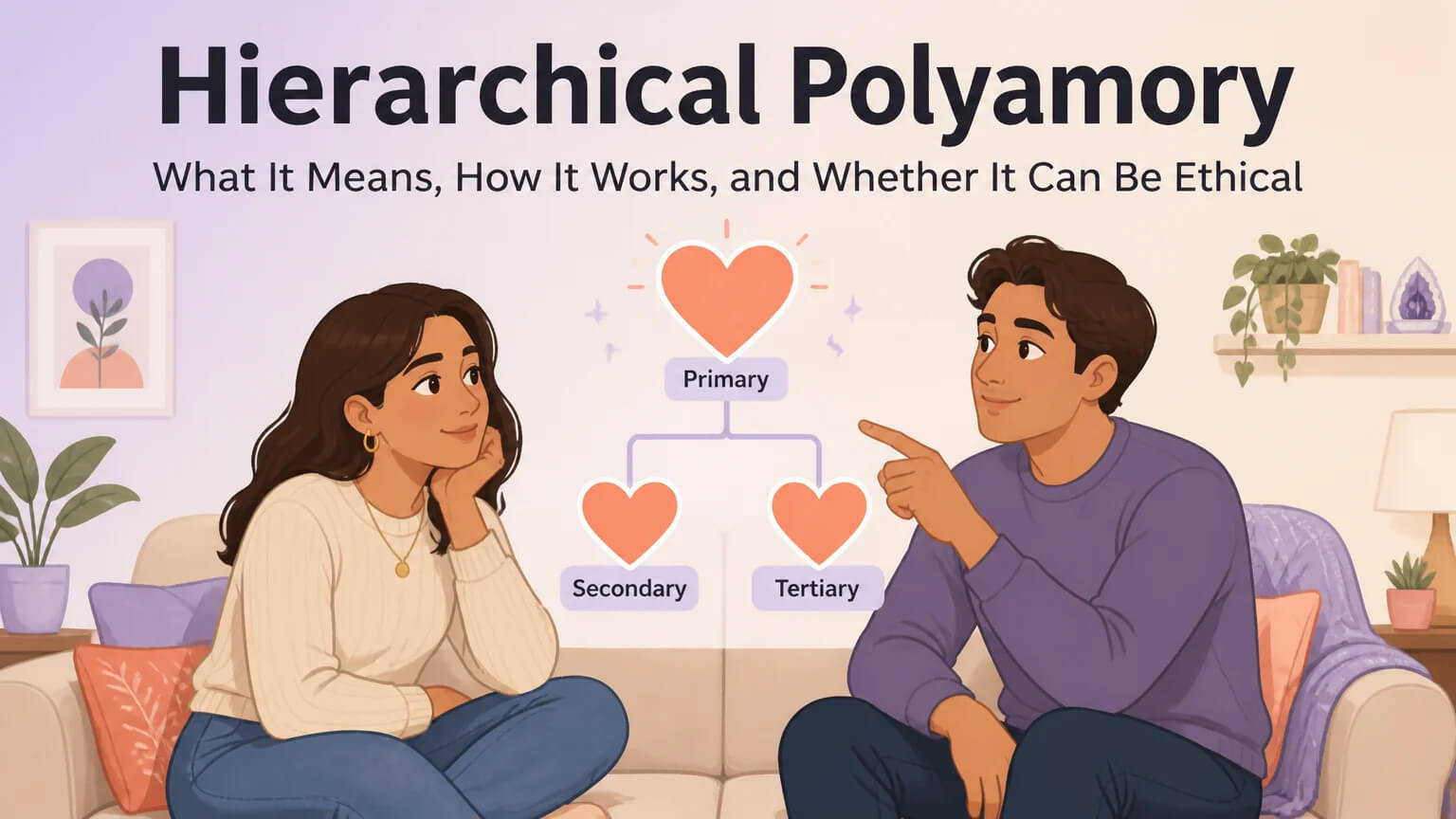
Hierarchical polyamory is one of polyamory relationship structures, where where partners are ranked by priority, typically described as primary, secondary, and tertiary. The primary partner is generally the person one lives with, shares finances with, or is married to, and receives the most time, energy, and commitment.
But that dictionary definition misses the tension. The polyamory community has been debating hierarchy for decades because the same word describes two radically different experiences: the security of knowing where you stand, and the dread of being told you never had a seat at the table.
The question is not whether hierarchy is bad. It is what kind of hierarchy.
This article walks through what the labels mean in practice, the prescriptive-versus-descriptive distinction that changes everything, the daily logistics of calendars and holidays, the empirical case for and against, and how to build a hierarchical dynamic that respects every person in it. Hierarchy can be ethical when it is transparent, consented to, and describes reality rather than dictating permanent second-class status. The work is in the difference.
What Hierarchical Polyamory Actually Means: Primary, Secondary, and the Spectrum Between
If you have ever been told “my wife comes first” after a conflict you did not see coming, you already know what implicit hierarchy feels like. The problem was not the prioritization. It was that nobody told you the terms before you were already invested.
At its simplest, hierarchical polyamory organizes relationships into tiers. Primary partners typically share the heavyweight commitments: finances, legal bonds like marriage, cohabitation, and priority in major life decisions. Secondary partners have committed, scheduled relationships without full life enmeshment. Tertiary partners are more casual, with lower time and emotional investment.
The labels themselves are not the problem. The problem is whether anyone consented to them.
Explicit hierarchy means every partner knows the structure upfront and agrees to it. You walk in understanding that your partner’s spouse gets the first call in a crisis, that holidays default to the nesting family, that certain escalations are off the table. As Agnes, the psychiatric nurse and therapist behind Wellbeing with Agnes, puts it: the distinction between explicit and implicit “essentially comes down to consent.”
Implicit hierarchy is the version nobody tells you about. There are no stated labels, no upfront conversation. You discover you are secondary only when a conflict hits: “I would love to spend the night, but my wife said no.” The prioritization was happening before you arrived, and you never agreed to it. Agnes calls this “a lot more insidious and unfortunately really quite common.”
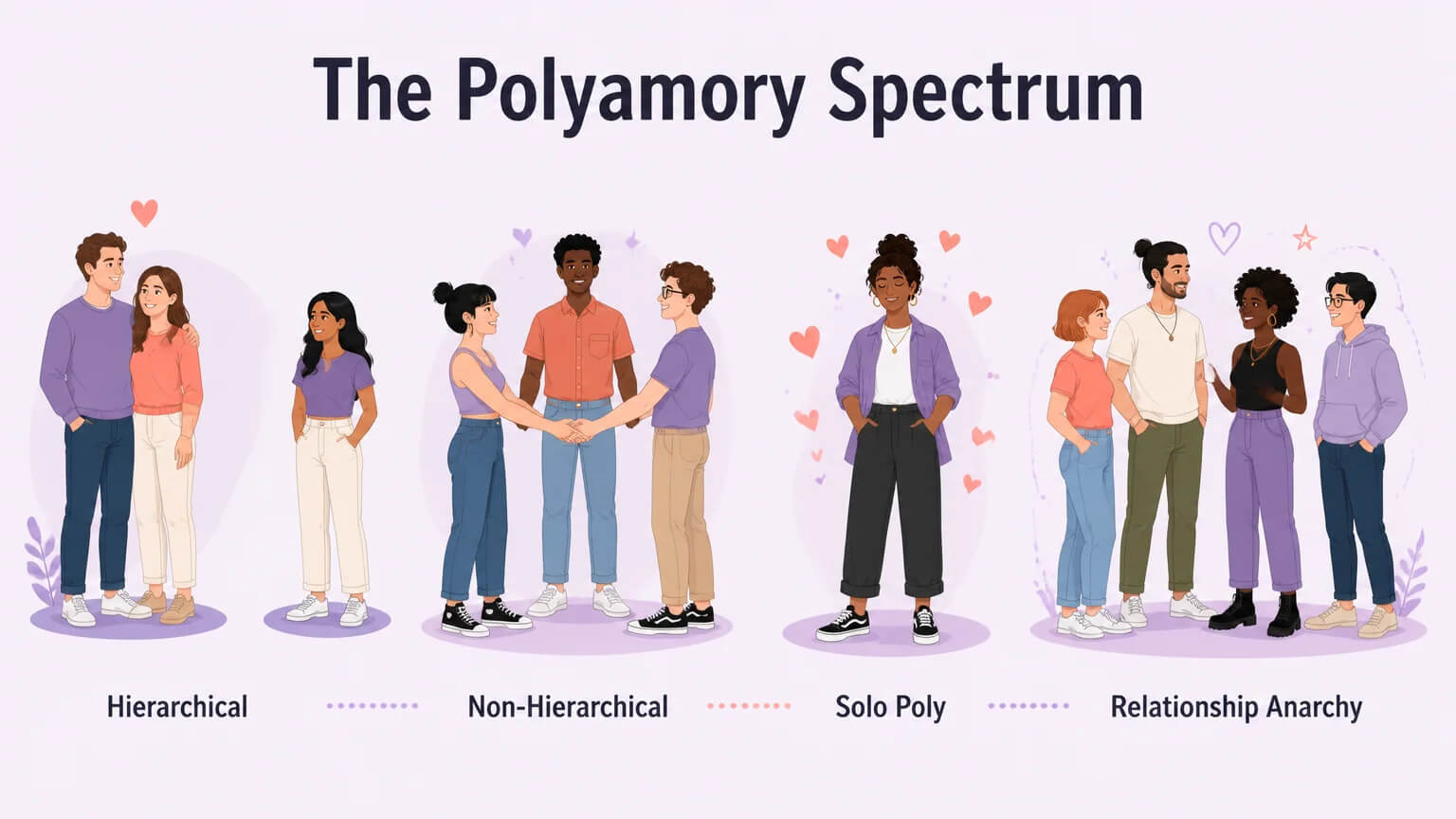
Non-hierarchical or egalitarian polyamory treats all romantic partners as equals, with no default prioritization and no partner holding decision-making power over relationships they are not in. Solo polyamory means living independently with no nesting partner and no hierarchy at all; the individual is their own primary. Relationship anarchy, a political philosophy coined by Andie Nordgren, rejects all prescribed relationship hierarchies and even the distinction between romantic and platonic connections. What matters is not where you land on this spectrum. It is whether everyone on the map knows the coordinates and consented to the route.
Prescriptive vs Descriptive Hierarchy: The Distinction That Changes Everything

Descriptive hierarchy is a mirror. It reflects what is already true about your commitments, time, and entanglement. Prescriptive hierarchy is a cage. It locks other relationships into permanent second-class status before they even begin.
Most people who say they practice hierarchy have never heard this distinction. And most people who claim to be non-hierarchical fail the test when their nesting partner gets uncomfortable.
Descriptive hierarchy honestly names naturally existing differences between relationships without structures enforcing those differences. A co-parenting spouse of ten years and a partner of six months have different levels of entanglement. That is not a moral failing. It is a fact.
Naming it is not controlling. It is being a reliable narrator of your own life. You are telling a new partner: here is what my life actually looks like, here are the commitments that exist, you get to decide if this works for you.
Prescriptive hierarchy imposes a glass ceiling. It uses agreements that permanently cap what other relationships can become, regardless of how they develop. A permanent arrangement where no other partner can ever meet the kids, attend a family holiday, or share a home, no matter how many years the relationship lasts. The ceiling is fixed. Growth hits it and stops.
The research backs this up. Flicker et al. (2021) found that predetermined, prescriptive hierarchy was associated with significantly poorer relationship outcomes. Naturally occurring differences caused far fewer problems.
Leanne Yau, the polyamory educator, points out that the semantic debate about labels is itself a distraction. What matters is what people are actually doing, not what they call it. One person says “we are hierarchical” and means “I have a mortgage and kids with this person, and that shapes my availability.” Another means “my wife decides whether your relationship continues to exist.”
Dr. Liz Powell, a licensed psychologist and author of Building Open Relationships, pushes the point further: marriage, kids, and cohabitation do not necessitate hierarchy. The assumption that they do is “born of mononormativity.” Kevin Patterson, a self-described relationship anarchist, is married, cohabiting, and raising kids with zero hierarchy. What makes something hierarchical is whether one partner gets agreement-making power over relationships they are not in. Full stop.
What Hierarchy Looks Like in Real Life: Schedules, Holidays, and Daily Rhythms
It is Wednesday at 6:45pm. Your nesting partner had a rough day and wants you home. Your secondary partner has been looking forward to this dinner all week. Who gets your evening, and more importantly, who decided that before this moment arrived?
Philosophy collapses into logistics the moment real calendars conflict. The couples who make hierarchy work are not the ones with the best intentions. They are the ones with the best spreadsheets.
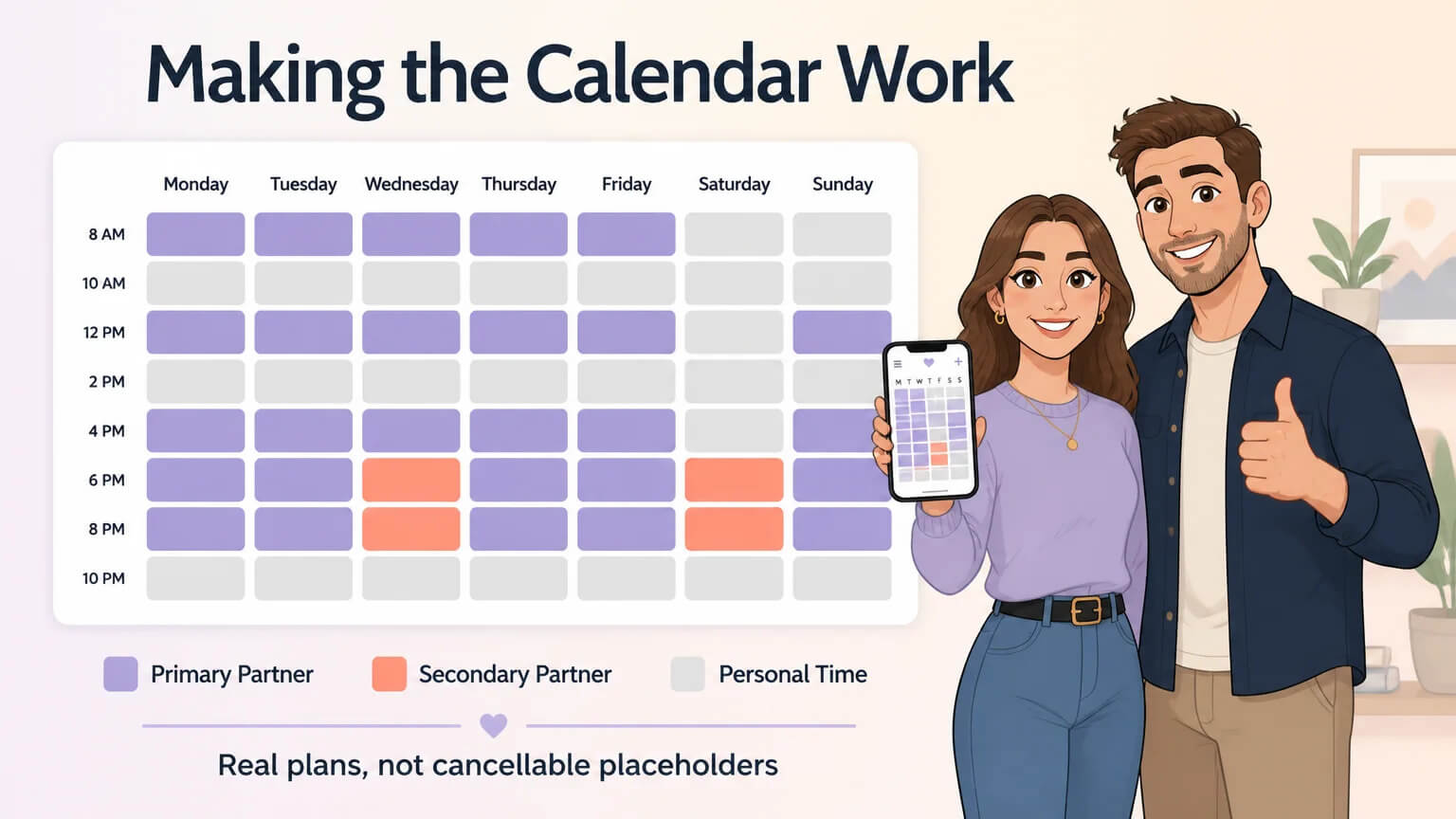
The most common weekly rhythm: weekdays with the primary or nesting partner for daily routines (waking up, breakfast, household tasks, childcare), and one dedicated evening per week reserved for a secondary partner. Some families schedule a secondary partner joining the primary household for dinner every other week. The standard tool is a shared digital calendar with color-coding by partner. These are real plans, not cancellable placeholders.
Holiday logistics are where hierarchy shows its seams. The typical pattern: the primary partner attends the major family gathering, and secondary partners get their own celebration on a different date. Some polycules stagger: Christmas Eve with one partner, Christmas morning with the nesting family, Boxing Day with another.
Canceled plans are the anti-pattern. When someone cancels on a secondary because the primary became available, the signal is unmistakable: you are a social convenience, not a committed partner. The agreement should be simple: if it is on the calendar, it is real. If it is not real, do not put it on the calendar.
Co-parenting structures add another layer. Main parents handle decisions and daily care. Co-parents (who may be secondary partners) take defined, lighter roles: playing, occasional school pickups, bedtime stories.
Two people, each with their own primary, can form a deeply meaningful secondary relationship with each other. Neither wants escalation. They already have mortgages, marriages, kids. Their time together is purely romance and connection, freed from life admin. Agnes describes this firsthand: “I have been able to so savor the time with that person because the time is really, really meaningful. We have only really met each other just purely as people, not in these other aspects of our life where we are sharing a huge amount of life admin together.”
A relationship does not need to be your whole life to be deeply real. The calendar should reflect that.
Why People Choose Hierarchy: Clarity, Security, and Honest Acknowledgment
If you have ever felt guilty for wanting structure, for wanting to know where you stand and what the boundaries are, this one is for you. Wanting clarity is not a moral failing; it is a sign of emotional intelligence.
Some people choose explicit hierarchy because the labels leave little to the imagination. Everyone knows the shape of the container they are entering. For people who prefer known structures over ambiguity, this reduces anxiety rather than creating it.
For a couple opening a previously monogamous relationship, having a defined framework provides significant stability. It makes non-monogamy more legible to the outside world: extended family, co-parents, the social circle that may need time to adjust. Hierarchy can be a bridge, not a permanent address.
Then there is honest acknowledgment of real-world commitments. A co-parent, co-homeowner, and legal spouse of fifteen years has different entanglement than a partner of six months. Pretending otherwise can be its own form of dishonesty. Descriptive hierarchy names what is already true. Naming it is not controlling. It is being a reliable narrator.
And then there is the simplest reason of all: secondary relationships, freed from shared bills, childcare logistics, and household negotiations, can be spaces of pure romance and connection. As Agnes puts it: you never text about toilet paper. You do not spend your time arguing about who forgot to book the plumber. It is about intimacy, presence, and actually enjoying each other. “A relationship does not have to be your whole life to still be a real, committed, deeply loving part of your life.”
Queer Family Life, a respected voice in the non-monogamy education space, puts it directly: “It is not the structure itself that determines health, but rather the practices and intentions of the individuals within it.” Compersion, regular check-ins, active listening, and a willingness to adjust agreements as relationships evolve are the actual indicators of whether a hierarchy works, not the labels on the door.
Wanting structure is not a failure of polyamorous enlightenment. It is an honest answer to a hard question: what do I actually have to give, and how do I give it without pretending?
Why People Reject Hierarchy: Power, Disposability, and the Veto Problem

Here is what the polyamory community has been arguing about for decades: hierarchy, when prescriptive, creates a dynamic where one couple’s security is purchased with a third person’s instability. And that instability has numbers behind it.
Flicker et al. (2021) found secondary and tertiary partners in hierarchical arrangements report significantly lower relationship satisfaction and attachment security than primary partners or those in non-hierarchical relationships. The cost of hierarchy falls almost entirely on the people with the least power to change it.
Dr. Liz Powell defines the core problem directly: hierarchy means “people in one relationship get a certain amount of power and say in relationships that they are not in, in a way that the people do not get in reverse.” This reduces the autonomy and agency of everyone in the secondary relationship, including the hinge partner themselves.
The veto is hierarchy’s sharpest edge. Franklin Veaux, co-author of More Than Two, lived the cautionary tale: his 18-year marriage to Celeste “never fully recovered” after she used a veto against his partner Elaine. Veaux and Rickert’s warning is direct: “Any time we choose to break our partner’s heart, the damage to our own relationship may be permanent.” It becomes, in their words, “a way to defend our own dysfunctions and entrench them.”
And then there is the hinge who plays helpless: “I would love to spend the night, but my wife said no.” Dr. Liz Powell calls this an abdication of responsibility. The hinge is choosing to comply, choosing one partner’s comfort over another’s autonomy. Framing it as powerlessness is dishonest.
Agnes names the trade at the core: “Sometimes hierarchy can be adopted so that the primary partners may have more security but it is security that has been taken away from this third party. That third party’s security has been sacrificed so that the primary relationship can be really firmed up.”
The community-level damage is real. As one polyamory community member put it: “This is the kind of behavior that makes people write ‘no poly’ on their dating profile because they are tired of getting treated like that.” These experiences do not just hurt the people directly involved. They make it harder for everyone practicing ethical non-monogamy to be taken seriously.
Add the gendered double standard on top: people frame a man’s veto as protective while dismissing a woman’s as jealousy or territoriality. The same behavior, filtered through different assumptions.
How to Practice Hierarchy Without the Harm: Agreements, Transparency, and the Secondary’s Bill of Rights

You have heard both sides. You understand the risks. This is where it gets real. The difference between a framework and a trap comes down to a few specifics.
The Secondary’s Bill of Rights, originally posted by Franklin Veaux around 2003, names six rights for non-primary partners: a voice in the relationship’s form, inclusion in decisions that affect them, the right to ask for compromise, relationships with people not with agreements, respected plans, and clear terms upfront. These are not nice-to-haves. They are the baseline.
Before entering any hierarchical dynamic, vet the person’s claims. Ask these questions. Not all at once on a first date, but early, and seriously. What does hierarchy mean to you specifically? If a conflict arises between me and your other partner, who gets prioritized and how is that decided? Does any third party have a say in our relationship? Does anyone have veto power? Are there caps on what our relationship can become? Is your hierarchy descriptive or prescriptive? And for anyone claiming to be non-hierarchical, the revealing question: what happens if your nesting partner becomes uncomfortable with me?
Observe behavior over time. People who cancel plans with you when their primary has a bad day are demonstrating hierarchy regardless of what they claim. As the viral observation put it: “Is your polyamory actually non-hierarchical, or do you just refuse to acknowledge and clearly communicate those hierarchies?”
The most attractive thing you can bring into the lifestyle is absolute clarity. If you are transitioning from prescriptive hierarchy toward something more egalitarian, the work starts with acknowledging what already exists. Identify which elements are descriptive versus prescriptive. Examine each prescriptive agreement and ask: what fear is this protecting, and can you address that fear without capping another relationship’s potential? Replace veto power with communication: the right to discuss concerns, not unilaterally end relationships. Give secondary partners a voice in decisions that affect them. Audit your calendar: is time with secondary partners real or cancellable? Recognize that the hinge is choosing to comply, and accept that non-hierarchical does not mean identical.
The work is not about being perfect. It is about being honest: with yourself, with your primary partner, and with every person who trusts you enough to enter your orbit.
FAQ
What is the difference between prescriptive and descriptive hierarchy?
Descriptive hierarchy honestly names existing differences in commitment, time, and entanglement between relationships without structures enforcing those differences. Prescriptive hierarchy imposes permanent caps on what other relationships can become. One reflects reality. The other enforces a glass ceiling. When vetting a potential partner, always ask which type they practice.
Can hierarchical polyamory be ethical?
When transparent and consented to by all parties, descriptive hierarchy can be ethical. Prescriptive hierarchy with permanent power differentials is structurally more problematic. The short answer: by the time you remove the elements that cause harm, the structure often stops resembling hierarchy at all.
Why would anyone want to be a secondary partner?
Some people have no desire for life enmeshment. Others already have nesting partners and do not need those commitments duplicated. Being secondary means your time together is purely romance and connection, free from shared bills and household negotiations. A relationship does not need to be your whole life to be deeply meaningful.
Is veto power ever acceptable?
Most experienced educators and the academic literature lean against it. Veto creates power imbalances, discourages communication, and often backfires on the primary relationship. Franklin Veaux’s marriage ended within two years of a veto. Frame it instead as the right to discuss concerns and request resolutions, not the right to unilaterally end someone else’s relationship.
Does marriage, having kids, or a mortgage automatically make a relationship hierarchical?
No. These create practical entanglements, but what makes something hierarchical is whether one partner gets agreement-making power over relationships they are not in. People practice non-hierarchical relationships with all three entanglement markers. Kevin Patterson, a relationship anarchist, is married, cohabiting, and raising kids with zero hierarchy.
How do I know if someone is actually non-hierarchical versus just saying they are?
Ask specific questions: what happens if their nesting partner becomes uncomfortable with you? Does anyone have veto power? Are there caps on what your relationship can become? Observe behavior over time. People who cancel plans when their primary has a bad day are demonstrating hierarchy regardless of what they claim.
What is the Secondary’s Bill of Rights?
Originally posted by Franklin Veaux around 2003, it names six rights for non-primary partners: a voice in the relationship’s form, inclusion in decisions that affect them, the right to ask for compromise, relationships with people not agreements, respected plans, and clear terms upfront. It later evolved into a broader non-hierarchical Relationship Bill of Rights in More Than Two (2014).
How does hierarchical polyamory differ from relationship anarchy?
Hierarchical polyamory ranks relationships with labels and preset prioritization. Relationship anarchy rejects all relationship hierarchies and societal norms about which connections should matter most. RA is a political philosophy coined by Andie Nordgren, not just a relationship preference. It can be practiced within monogamy; it is about philosophy, not partner count.