
You and your partner have explored. Maybe a threesome that felt different than you expected. Maybe a swinging scene where the conversation afterward outlasted the play itself. Whatever the spark, it left you with a question you were not quite ready to say out loud: What if this became something deeper?
The word you may have stumbled across is polyfidelity. Wanting to understand it does not make you confused or greedy or broken. It makes you curious about a quiet corner of consensual non-monogamy that does not get talked about enough.
Here is what it actually is, where it sits on the relationship spectrum, whether it might fit your team, and how to start the conversation without anyone feeling backed into it.
The Short Version: Polyfidelity in One Paragraph
Polyfidelity is a closed group relationship where three or more people are romantically and sexually exclusive to each other. The word itself is honest: poly (many) plus fidelity (faithfulness). Unlike open polyamory, where partners may date freely outside the group, polyfidelity draws a clear circle and says: everyone we love is already inside it. New members join only by unanimous consent, and in many groups, not at all. The most common forms are closed triads and closed quads. The term was coined by the Kerista Commune in the 1970s, making it older as a named concept than “polyamory” itself. A definition is useful, but the real test is simpler: does every person in the group genuinely want to be there? If the answer is not a clear yes from everyone, nothing else holds.
Where Polyfidelity Fits on the Relationship Spectrum
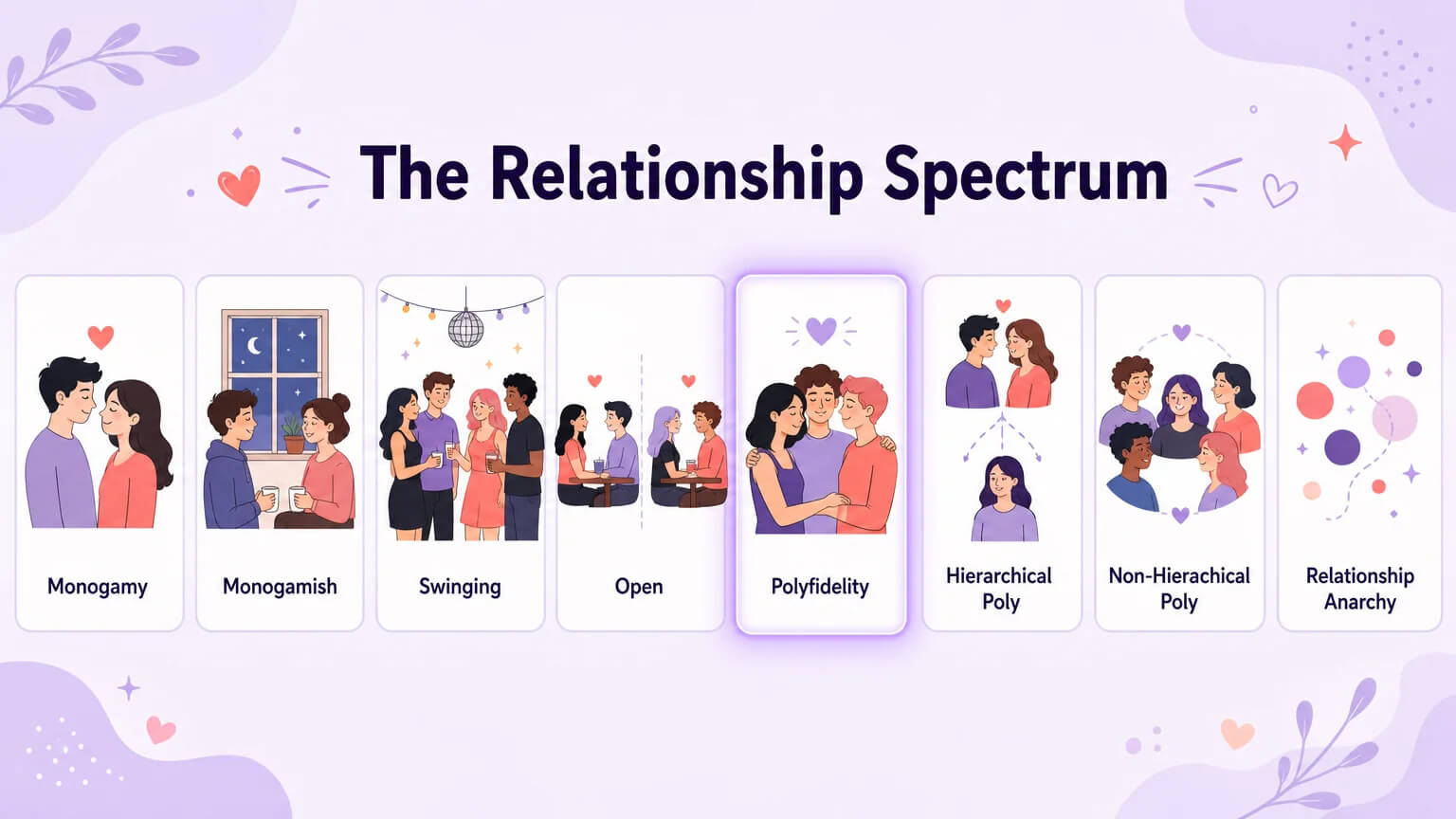
Nobody hands you a map when you step off the monogamy path. That is why polyfidelity can feel like a word without a neighborhood. But it has one, and understanding where it sits makes everything clearer.
There is a line from maximum exclusivity to maximum autonomy, and every relationship structure lands somewhere on it.
Monogamy sits on one end. Just past it is monogamish, where a couple keeps their primary bond but occasionally opens a narrow window. Then comes swinging, where the focus is recreational and partner-based. Open relationships let each person explore independently. At the midpoint, where emotional depth meets group exclusivity, sits polyfidelity.
Beyond it, you will find hierarchical polyamory (some relationships carry more weight), non-hierarchical polyamory (equal standing but open to new connections), solo polyamory (autonomy as anchor), and relationship anarchy (no preset relationship categories at all).
What makes polyfidelity distinct: it is the only structure on this spectrum that pairs multiple romantic partners with a closed boundary. You get the depth of polyamory and the security of exclusivity, just with more than two people.
For couples who have had threesomes and felt something beyond the physical, polyfidelity honors both impulses: the connection you have with each other, and the connection you discovered together with someone else.
The Different Shapes of Polyfidelity
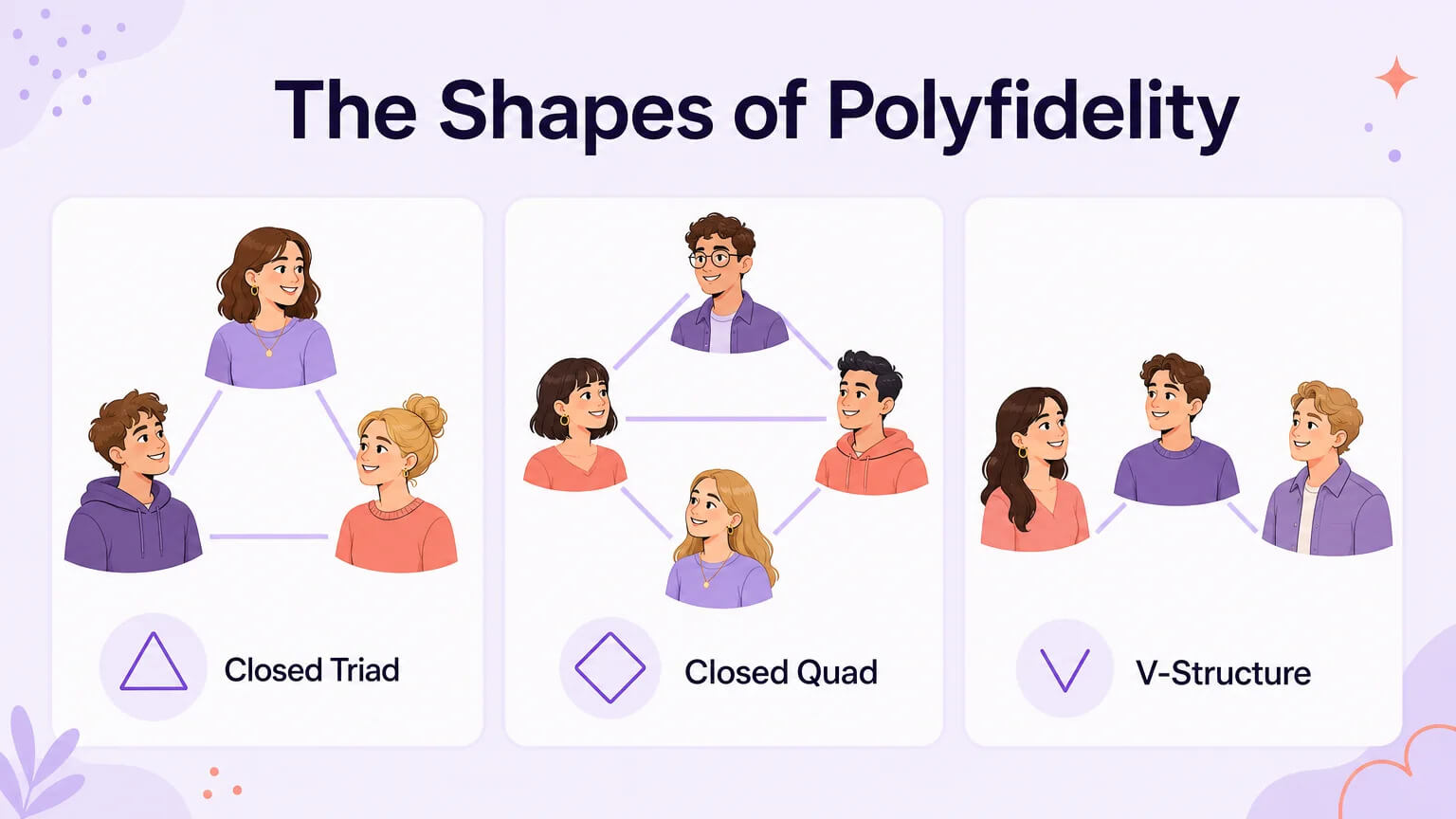
Polyfidelity is not a single blueprint. It bends around the people inside it.
The closed triad is the most common shape: three people, all romantically and sexually involved with each other. When it works, it is a triangle where every side carries equal weight. It involves four interaction configurations: all three together, and each of the three one-on-one pairings. All of them need tending.
A closed quad means four people in an exclusive group. Mathematically, that is six distinct dyadic bonds, any of which can be thriving or struggling at any moment. The maintenance is real. So is the reward.
A V-structure is simpler on paper: one hinge person dates two others who are not involved with each other. The two “arms” may be close friends, kitchen-table style, or mostly parallel. The arrangement works, but it asks a lot of the person in the middle.
Larger groups exist but are rare. Stability becomes harder as the group grows.
There is no correct shape. The right structure is the one every person enthusiastically agrees to, and the one that leaves room to renegotiate as people change, because people always do.
Why People Choose Polyfidelity
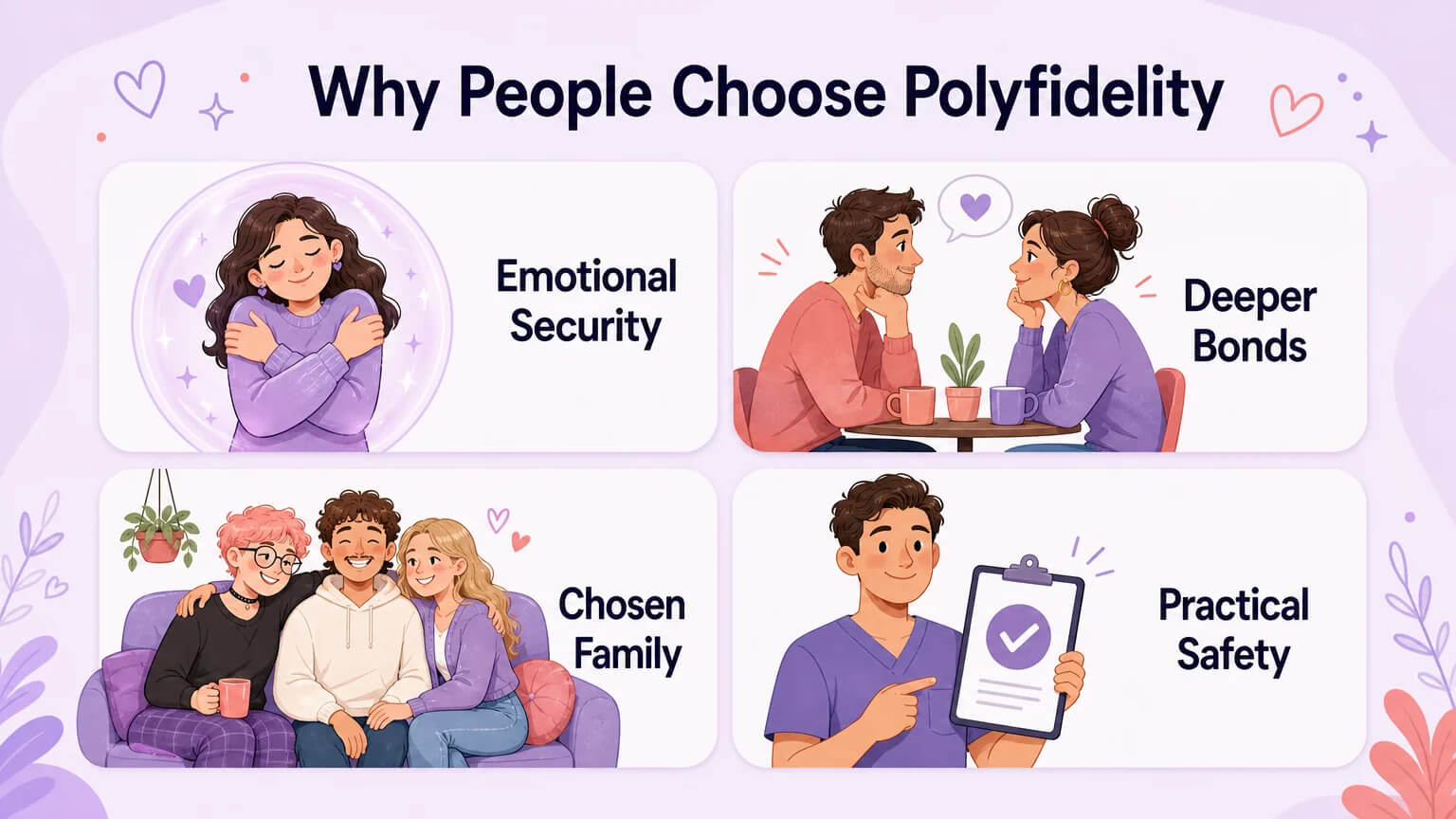
Nobody backs into polyfidelity by accident. It is too intentional.
First: emotional security. Open polyamory means your partner might form a new connection at any time. For some, that uncertainty is manageable. For others, it erodes the felt safety intimacy requires. A closed boundary removes the constant low-grade question of who else might enter.
Second: depth. Exclusivity lets everyone invest fully without the bandwidth drain of outside dating. When nobody is swiping, scheduling first dates, or managing new relationship energy with a stranger, the group’s attention stays on the people already in the room. Bonds deepen because they get more oxygen.
Third: chosen family. Many polyfidelitous groups describe themselves as intentional families first and romantic partnerships second. They raise children together, buy homes together, show up for each other’s parents’ funerals. The relationship serves a life. Ellecia Paine, a long-time voice in the ENM space, calls polyfidelity exactly that: intentional family.
Fourth: practical. Fluid bonding is safer inside a closed boundary. When everyone tests together and agrees to exclusivity, the risk calculus simplifies.
Polyfidelity is not about restricting freedom. It is about choosing depth inside a defined circle.
The Hard Parts Nobody Talks About

Every structure has its costs. Pretending polyfidelity does not is how people walk in blind.
The dating pool is tiny. Roughly one in twenty Americans practices some form of ENM, and polyfidelity is a subset of that. Finding one person you genuinely connect with is hard. Finding two or three who also connect with each other, and want the same closed container, takes patience measured in years.
Couple privilege is real. When an existing couple opens to a third, gravity pulls toward the original pair. The third can feel like an accessory, not an equal architect. Franklin Veaux, author of More Than Two, has written extensively on this dynamic. The antidote: a container where all three hold equal voting rights, equal standing, and equal room to be heard.
Jealousy does not disappear; it changes shape. In a closed triad, it sounds like “they have a better connection than we do” rather than “they might leave.” Raederle Phoenix frames jealousy as “resistance to loss.” A dashboard light, not a stop sign.
Breakups are geometrically harder. When one person leaves a triad, two relationships end, not one. Shared circles, leases, even parenting arrangements can fracture. The people left behind grieve both a partner and the shape of their lives.
None of this makes polyfidelity a bad idea. It rewards what any relationship rewards: honest communication and emotional clarity. The stakes are just higher, so the work has to match.
What Polyfidelity Feels Like for the Person Joining a Couple

Couples start with what they want. Here is the view from the other side of the table.
You meet a couple. Chemistry. Conversation. They want something real, closed, lasting. That sounds like what you want too.
But then the small things start. Decisions made between them before you are in the room. Your time together on their schedule, in their home, around their children. You are invited into their life but not into how it was built.
Red flags are not always dramatic. Agreements imposed without your input. One-on-one time restricted or forbidden. Being introduced as a “friend” at family gatherings years in. The absence of an exit plan: if the relationship dissolves, do you have any claim to the home, the shared finances, the life you helped build?
Green flags are just as clear: enthusiastic consent from every person. Equal say in every agreement. Space for individual connections, not just group dynamics. Being introduced as a partner, not a secret. A couple who says “we want to build something together” rather than “we want to add someone to what we already have.”
They are a guest in your playground, not a toy in your toybox. The difference is whether they get to help design the playground.
How to Start the Conversation
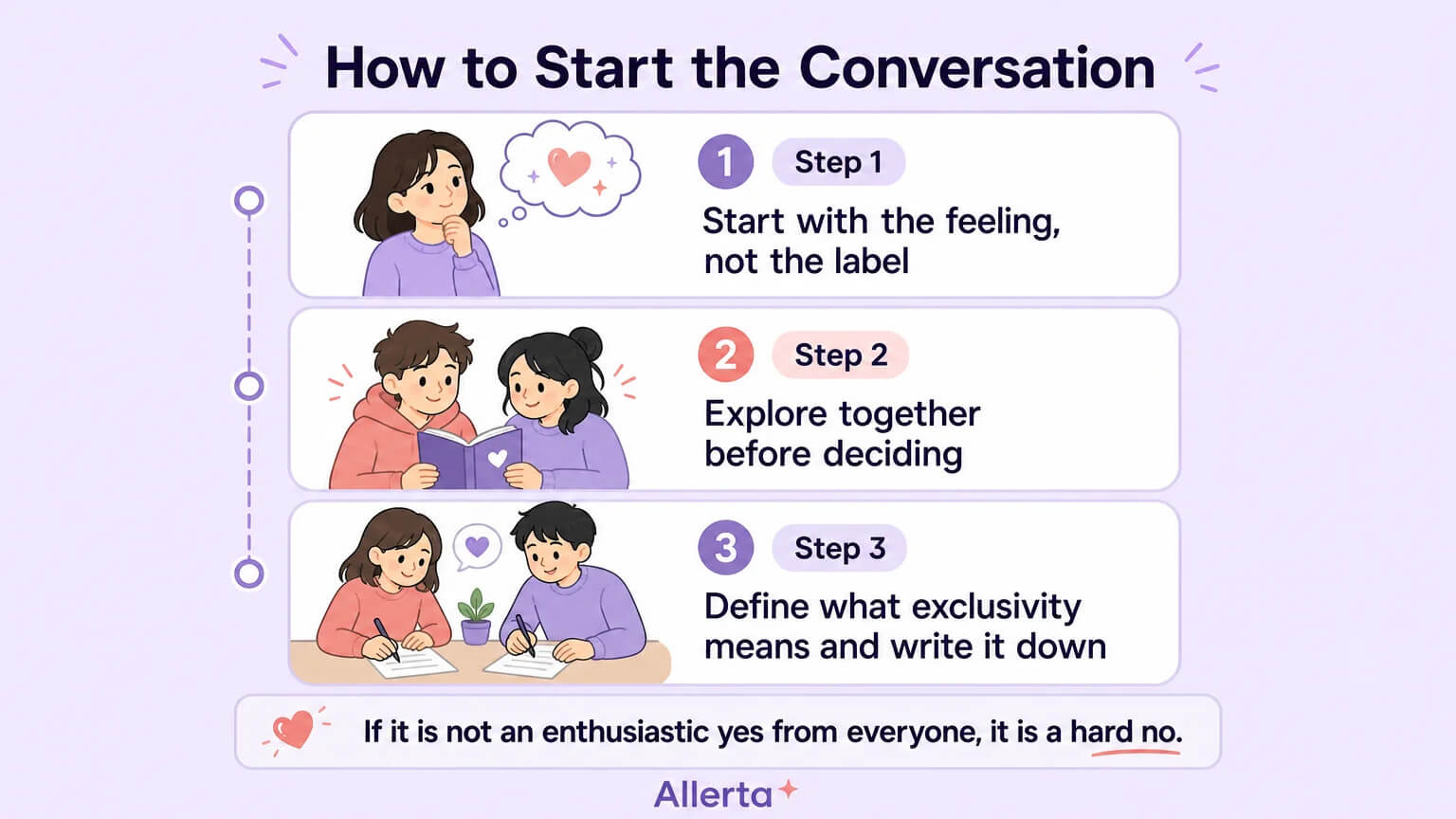
You do not need the perfect script. You need the right door to walk through.
Step one: do not lead with the label. No one warms up to “I think we should consider a closed polyfidelitous triad” over breakfast. Start with the feeling: “When we had that experience together, I felt something beyond the physical. Have you felt anything like that?” Let the conversation breathe before you name it.
Step two: explore together before deciding. Read the same articles. Listen to the same podcasts. Talk to people in closed dynamics if you know any. The goal is not to lock in a structure but to discover whether you are even looking at the same picture.
Step three: define what exclusivity means for your group and write it down. Is one-on-one time with each partner protected? What happens if someone develops feelings for an outsider? How do you handle it when one person’s comfort zone shifts?
The governing principle: if it is not an enthusiastic yes from everyone, it is a hard no.
The conversation might lead somewhere. It might not. Either outcome is valid. What matters is you had it.
FAQ
Is polyfidelity the same as polyamory?
Polyfidelity is polyamory, specifically the closed kind. All polyfidelity fits under the polyamory umbrella, but not all polyamory is polyfidelitous. The distinction: polyfidelity adds the commitment that no one seeks new partners outside the group without everyone’s agreement.
Can a polyfidelitous group add new members?
It depends entirely on the group’s agreement. Some groups are permanently closed by design. Others allow new members to join, but only through unanimous consent. If any person says no, the answer is no. There is no default setting, only what the group negotiates together.
What is the difference between polyfidelity and swinging?
Swinging is primarily recreational. Couples swap, play at parties, or explore group sex without the expectation of romantic attachment. Polyfidelity involves full emotional and romantic relationships within an exclusive group. They are different points on the same spectrum, not opposing philosophies. Some couples start in swinging and discover they want more. That path is valid.
How do you handle jealousy in a closed triad?
Name it, out loud, without shame. Jealousy in polyfidelity usually signals a fear of being left out or demoted within the group hierarchy. The practical fix: protect one-on-one time with each partner, offer explicit verbal reassurance, and revisit agreements together so everyone feels heard. Jealousy is not proof the arrangement is failing. It is proof someone needs attention.
Is polyfidelity legal?
You cannot legally marry more than one person in most countries, and polyfidelitous groups have no formal legal recognition. But people build lives together anyway. They share homes, co-parent, draft wills and powers of attorney, and create financial agreements that approximate the protections marriage would offer. The law has not caught up to how people actually love.