
You walk into your first polyamory meetup. Someone mentions their polycule’s weekly Sunday brunch with a shared Google Calendar and a group chat named “Kitchen Table Crew.” Another person talks about vacationing with their partner’s partner’s partner. Everyone seems to know everyone.
And you feel nothing. No desire to join the brunch. No interest in befriending your partner’s other partners. A small voice whispers: Does this mean I’m doing poly wrong?
It does not. That discomfort is not a red flag. It is a preference, and it has a name.
Parallel polyamory is the choice to keep your romantic relationships running alongside each other without forcing metamour friendships. In some poly communities, “parallel” gets treated like a dirty word. Something you settle for when you have not “graduated” to kitchen table dynamics. That framing is backwards. Poly educator Laura Boyle puts it plainly: any level of relationship entwinement can be healthy or not. The consent and respect inside the arrangement determine the health, not the structure itself.
We will walk through what parallel polyamory actually is, where it sits among the other metamour styles, what it looks like day to day, the agreements that keep it standing, the hinge partner’s job, the hard parts with honest fixes, and how to know if it fits your life.
Parallel Polyamory, Defined Simply
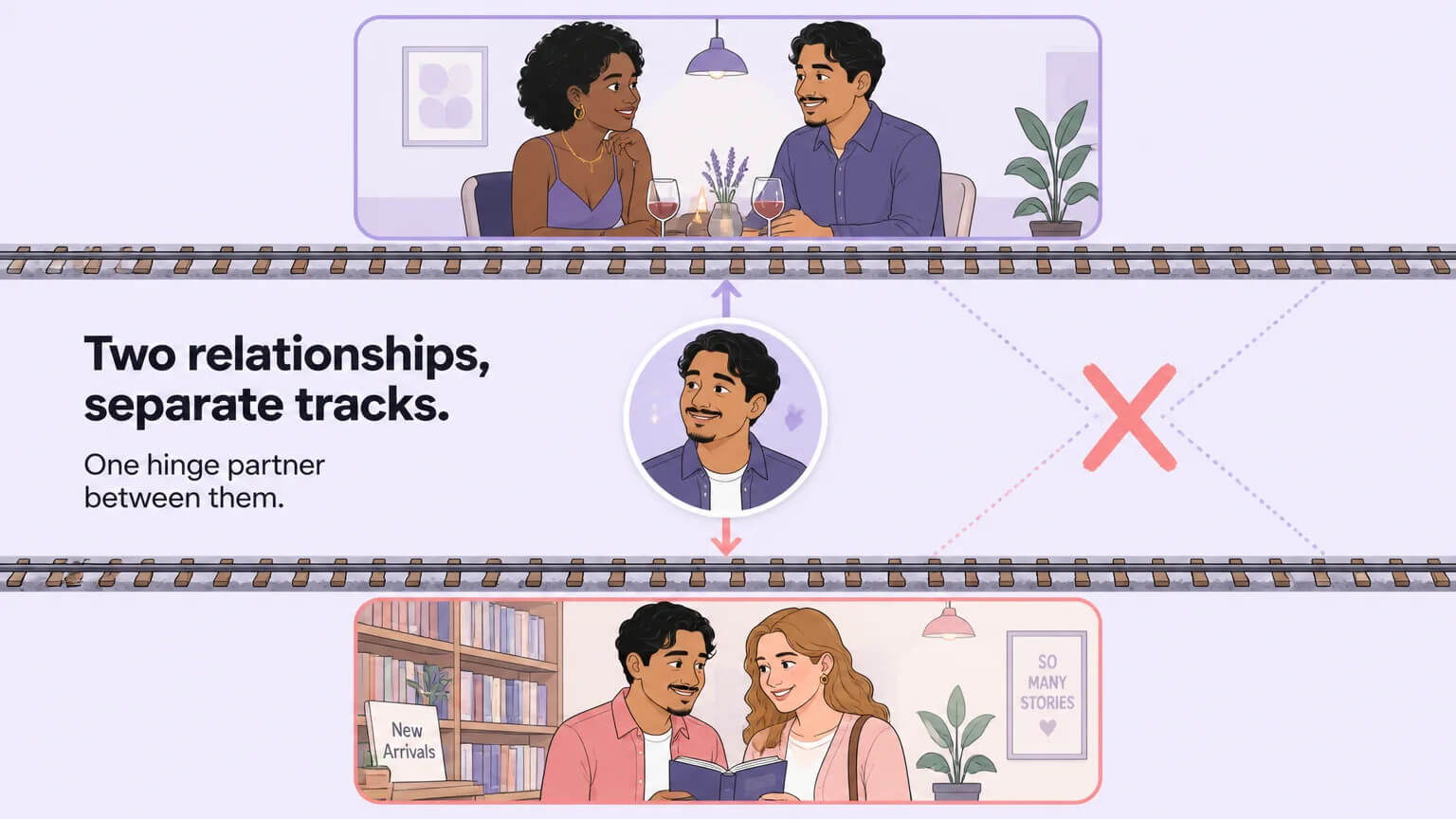
Think of parallel lines. They run alongside each other, independent, never forced to intersect. That is parallel polyamory: each relationship occupies its own track, and communication flows exclusively through the shared “hinge” partner, the person dating both people. There is no metamour group chat, no joint dinners, no expectation that your partner’s other partner becomes part of your social world.
First, the thing nearly everyone gets wrong. Parallel polyamory is not Don’t Ask, Don’t Tell. DADT means partners agree not to acknowledge other relationships exist. It runs on selective ignorance: if you do not hear about it, it cannot hurt you. Parallel poly runs on informed privacy. Everyone knows about the other relationships. They simply choose not to interact with metamours. The difference is structural. DADT avoids information to manage discomfort. Parallel manages interaction to protect autonomy. One runs on what you do not know. The other runs on what you choose not to do. DADT is secrecy. Parallel is structure.
A quick vocabulary lesson, since these terms show up everywhere. A “metamour” (Greek “met” for “with” + Latin “amor” for “love”) is your partner’s other partner. The “hinge” is the person dating both partners, the sole conduit for all communication and logistics. The most common parallel configuration is the “V” or “Vee”: one hinge plus two partners who are not involved with each other. Each arm of the V operates independently.
Parallel polyamory is not a default, a fallback, or “poly-lite.” It is a structure that honors autonomy and protects each relationship’s private space. It says: I can love you fully without merging every part of my relational world. That is not a compromise. It is a design principle.
Where Parallel Polyamory Sits on the Metamour Spectrum
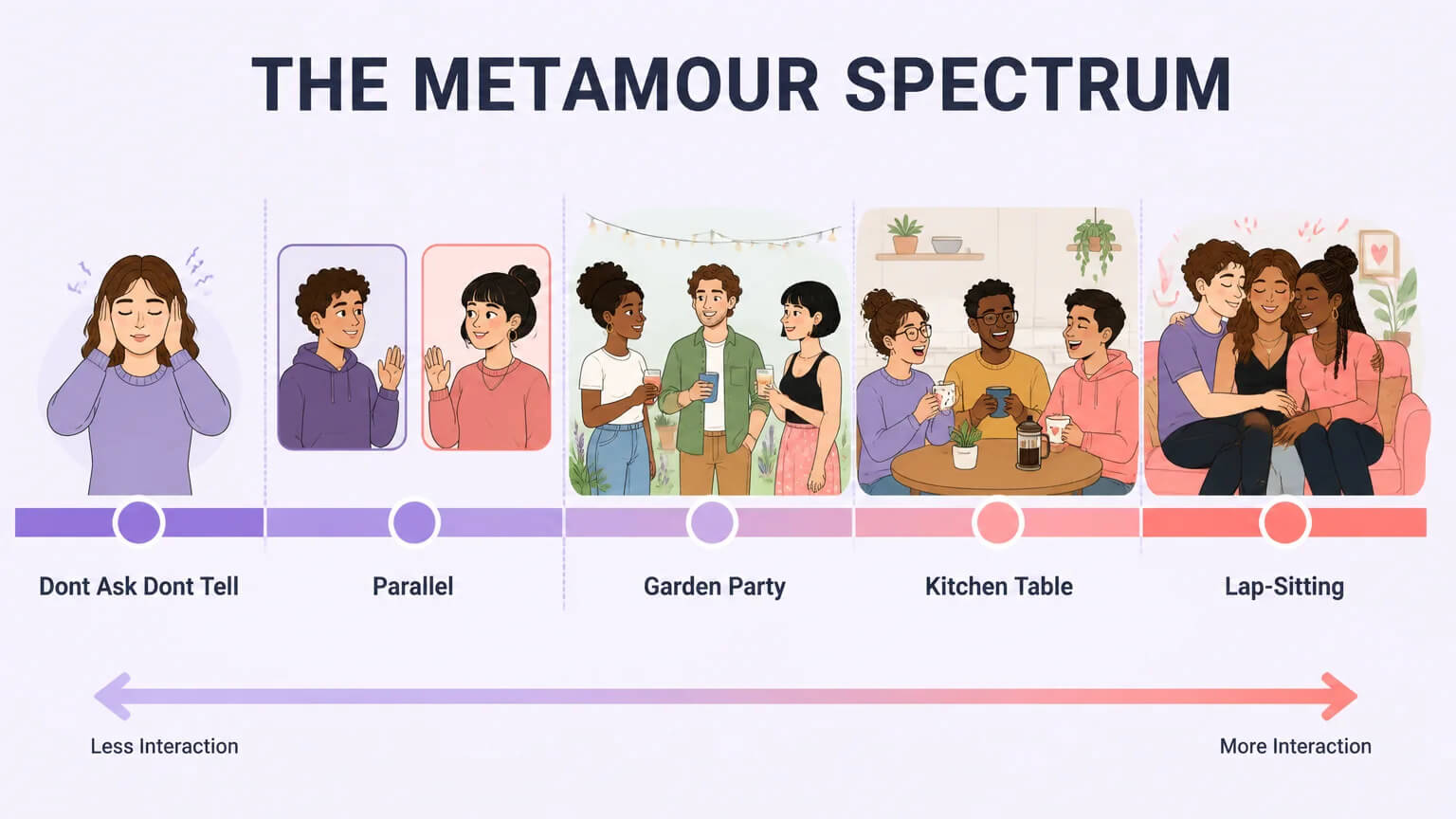
The polyamory world often talks as if there are two options: kitchen table or parallel. That is a false binary. The full spectrum, formalized by the Multiamory podcast and now widely cited across polyamory education, has five distinct positions.
At the far end sits Don’t Ask, Don’t Tell, where other relationships go unacknowledged. Next is parallel polyamory: everyone knows but metamours do not interact. Then garden party polyamory, the middle ground most explainers miss. Then kitchen table polyamory: metamours are friends who share meals and daily life. At the most entwined end, lap-sitting polyamory describes metamours who may be close friends, romantically involved, or cohabitating.
Garden party polyamory fills the space most people actually live in. It catches the folks who squirm at the “parallel” label but are nowhere near kitchen table. The Mona Show defines it concisely: metas are acquaintances who might attend the same garden party or birthday party for their shared partner without it being awkward. They make polite small talk. They do not forge independent friendships. It is the “friendly at his birthday dinner but we don’t text” arrangement.
Laura Boyle adds a wrinkle. Garden party serves people who dislike calling their relationships “parallel” because of community stigma but are not close enough to metamours to claim kitchen table. She also flags the term’s classist undertones: not everyone has a garden. The label matters less than the arrangement. Describe what you want. Do not get stuck defending a name.
The spectrum is a sliding scale, not locked boxes. Therapist Emily Martinez notes that metamour arrangements shift over time. Someone may start parallel, move toward garden party as comfort builds, or pull back from kitchen table to parallel when boundaries get crossed. No position on this spectrum outranks another. What matters is that everyone genuinely wants to be where they are.
How Parallel Polyamory Actually Works in Real Life
Here is what it actually looks like.
Sarah is a single mom. She dates parallel only. She does not mind hearing about metamours as part of a partner’s life, but she has no emotional bandwidth for metamour friendships. Her kids, her partners, and her existing friendships already consume every available resource. She only introduces partners to her children after several months of serious involvement. Sometimes this rubs a metamour the wrong way. She honors her own needs anyway. The structure protects what she has capacity for, not what anyone else wants from her.
Now picture the birthday dilemma. In parallel poly, celebrations are entirely separate. Partner A’s birthday with Partner B is a different event, possibly on a different day, from Partner A’s birthday with Partner C. No joint party, no shared cake, no group photo. The hinge plans double. This is not coldness. It is architecture: each dyad gets its own celebration, its own intimacy, its own protected space.
Cohabitating while parallel adds another layer. One household uses a whiteboard system on bedroom doors: red for do not disturb, green for open to company, with written notes like “Partner X will be in the living room 7 to 10 tonight.” Noise-cancelling headphones and separate bedrooms are practical infrastructure. Physical space boundaries support emotional ones.
Sometimes distance does the work for you. When metamours live in different cities, parallel poly happens organically. The challenge becomes whether the long-distance partner feels structurally secondary or excluded from the hinge’s day-to-day life. Intentional reassurance matters here more than in-person logistics.
Every one of these scenarios works because of the hinge. More on that in a minute.
For 3Fun readers: couples who swing or explore threesomes together can also practice parallel poly for separate romantic connections. The swinging dynamic and the poly dynamic operate on parallel tracks. They are different dimensions of exploration, and both deserve their own agreements.
Boundaries and Agreements That Make Parallel Poly Work
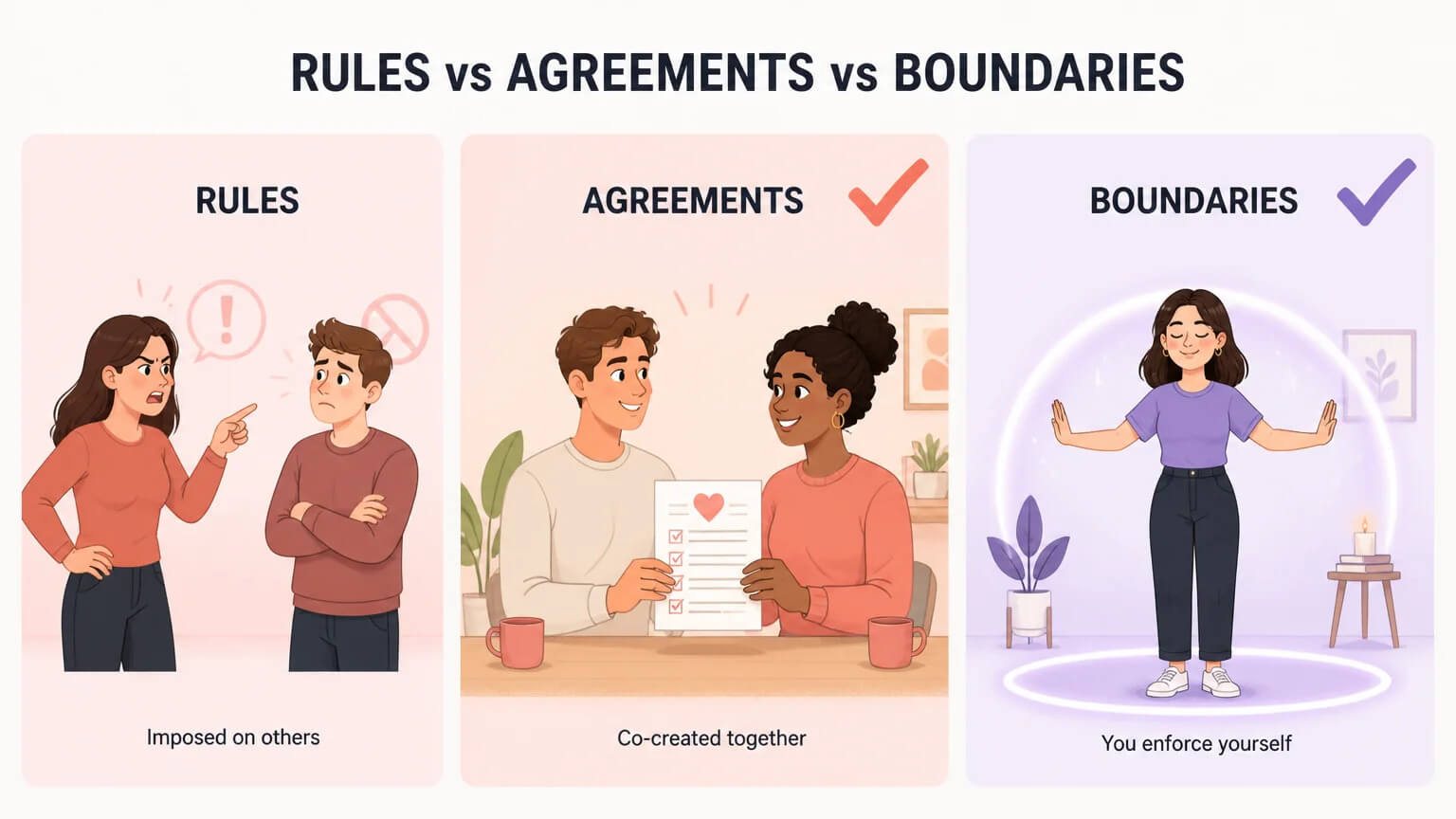
Parallel polyamory runs on clarity. Clarity requires a shared vocabulary, and the most useful conceptual framework is the distinction between boundaries, agreements, and rules.
Boundaries are personal limits you enforce yourself. “I only have barrier-free sex with my nesting partner” is a boundary. Agreements are co-created mutual understandings that remain flexible and renegotiable. Rules are imposed restrictions on someone else’s behavior, often rooted in distrust. Healthy parallel poly runs on boundaries and agreements. Talk to people who have done this for a decade and they will tell you: rules loosen as trust builds. The goal is moving toward agreements, not building a thicker rulebook.
Laura Boyle’s five boundary questions offer a practical self-assessment. What information are you okay with your partner sharing about you? How often are you comfortable interacting with your metamour? One-on-one? Small groups? Large groups? Your answers determine where you land on the spectrum, and they are morally neutral. Wrong answers do not exist. Only honest ones and dishonest ones.
Concrete parallel agreements often include pre-disclosure before dates with new sexual partners, STI testing schedules with shared results, fluid bonding reserved for nesting partners, household parameters around who can enter the shared home, advance notice of visitors, and weekly scheduled time slots. These are not restrictions. They are infrastructure.
One exception matters, even in strict parallel: exchange emergency contact information with metamours. If your shared hinge partner is in an accident, someone needs to reach you. This is a safety baseline, not a social obligation.
Starting the conversation can be the hardest part. A script helps. “I have learned that I feel most present in relationships when I keep them relatively separate. This is not about your other partner. I am glad they make you happy. It is about how I function best.” The “I” statement removes judgment. The acknowledgment of their happiness removes threat. The focus on your own architecture removes blame.
The Hinge Partner Who Holds It All Together
Poly educator Leanne Yau puts it plainly: “Parallel polyamory is valid AND, unfortunately, many hinges underestimate what it means to be the person in the middle managing the dynamic.”
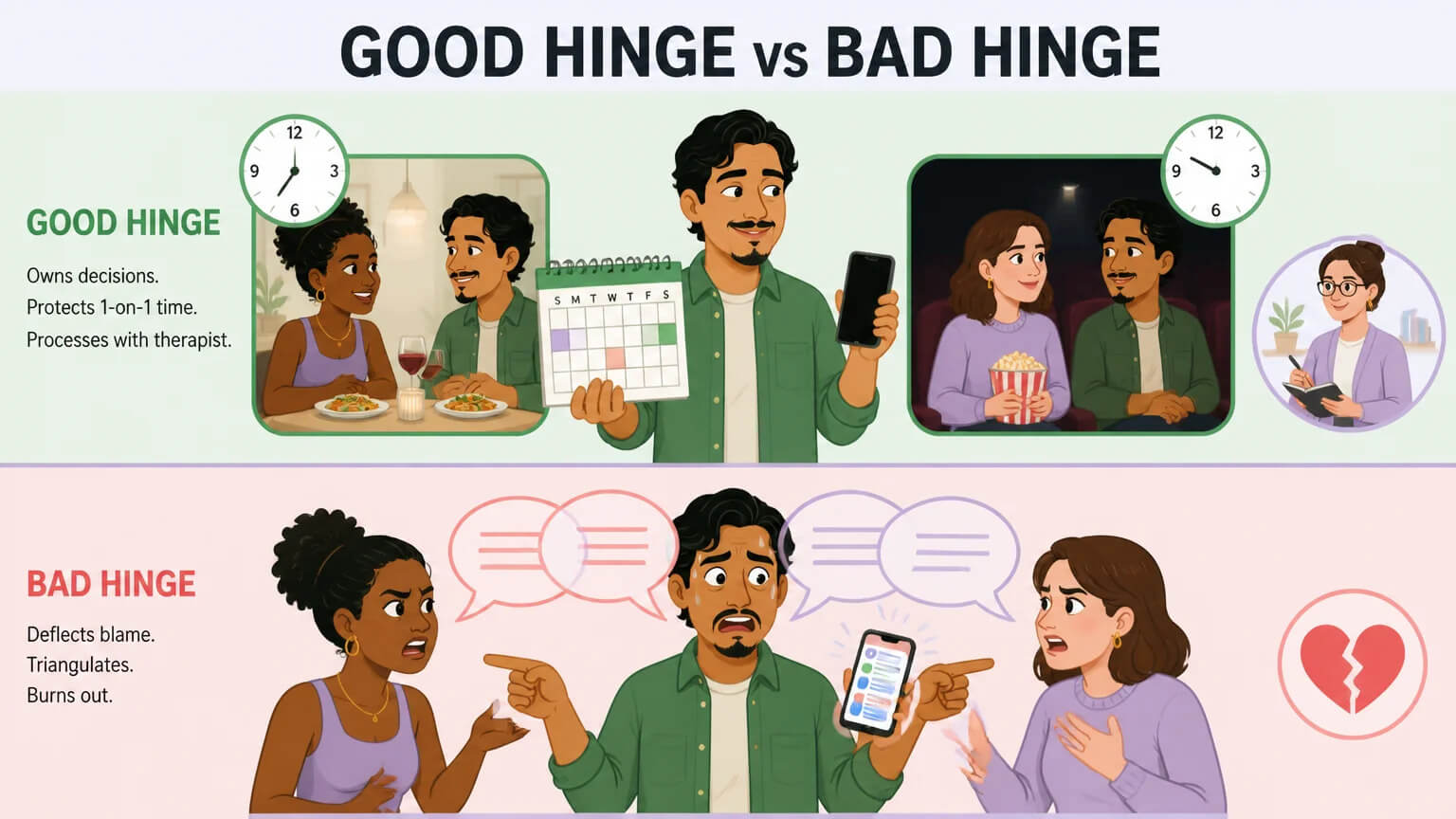
The hinge is the load-bearing element of parallel poly. They build and maintain both relational worlds. Messenger is only a fraction of the job. When the hinge works well, the structure feels effortless. When the hinge slips, the whole thing groans.
Good hinges own their scheduling. They say “I have made a commitment that evening” rather than “Partner B needs me.” They are the STI information vector, communicating risk changes across all relationships. They avoid triangulation. They never complain about Partner A to Partner B. They process relationship feelings with a therapist or a neutral friend. They create protected, phone-down, one-on-one time with each partner. They track commitments meticulously because, in parallel poly, they are the only person who sees the full picture.
Bad hinges deflect blame. They triangulate. They use one partner as an excuse for their own decisions. They fail to communicate STI risk changes. Laura Boyle describes a hinge who kept pushing his two metamours toward group sex with heavy hints neither wanted. Both metas went strictly parallel, then both left him. Manufacturing entwinement nobody asked for erodes the trust that made the structure possible.
Hinge burnout is real. Compartmentalization fatigue sets in when you constantly switch between separate relational worlds. Scheduling becomes logistical Tetris with no overlap possible. Pushing metamours together to lighten your load is not the fix. The fix is a calendar system used religiously, hinge feelings processed with a therapist, and the willingness to say the three words that save parallel structures: “I am at capacity.”
Three self-check questions for every hinge. Are you owning your decisions or deflecting them? Are you the only person who sees the full picture? Are you exhausted? If yes to all three, the structure needs reinforcement, not abandonment.
The Hard Parts and Honest Fixes
No relationship structure is frictionless. Parallel polyamory has its own pressure points. Here are four, each with a practical fix.
Scheduling Tetris. The hinge divides time between completely separate worlds. No group hang to ease the calendar crunch. No shared dinner that counts for both partners. Every hour goes to exactly one relationship. Fix: a color-coded Google Calendar with religious adherence, plus a weekly Sunday planning session where the week’s commitments lock in.
FOMO and exclusion. In kitchen table dynamics, you can casually join a group hang and feel included. Parallel poly offers no such shortcut. When your partner’s schedule fills with other connections, you cannot simply “hang out all together” to ease the feeling of being left out. Fix: scheduled reconnection rituals after dates, explicit reassurance requests, and naming the feeling without blaming the structure. “I felt left out when I could only see you for an hour this week” is honest. “Your other partner is stealing my time” is deflection.
Community stigma. In some poly spaces, parallel gets treated as less evolved. The Remodeled Love podcast titled an entire episode “Forcing Kitchen Table Polyamory (As A Means of Control).” Leanne Yau’s most-engaged post reminded people to “let your connections form organically and let your partners decide how close they want to be with each other, including not at all.” Fix: internal validation. No metamour arrangement is inherently superior. The people who judge your structure are not the people living inside it.
Style clash. Partner A wants kitchen table. You, the hinge, are dating Partner C who wants strict parallel. Therapist Tristan Byrnes identifies this as the most common clinical issue he sees. Fix: you can have kitchen table with one partner and parallel with another. Polyamory is not a one-size-fits-all contract. Different dynamics with different people is responsiveness, not inconsistency.
Every relationship structure has friction points. The question is whether the structure gives you enough to make the friction worth it.
Is Parallel Polyamory Right for Your Relationship?
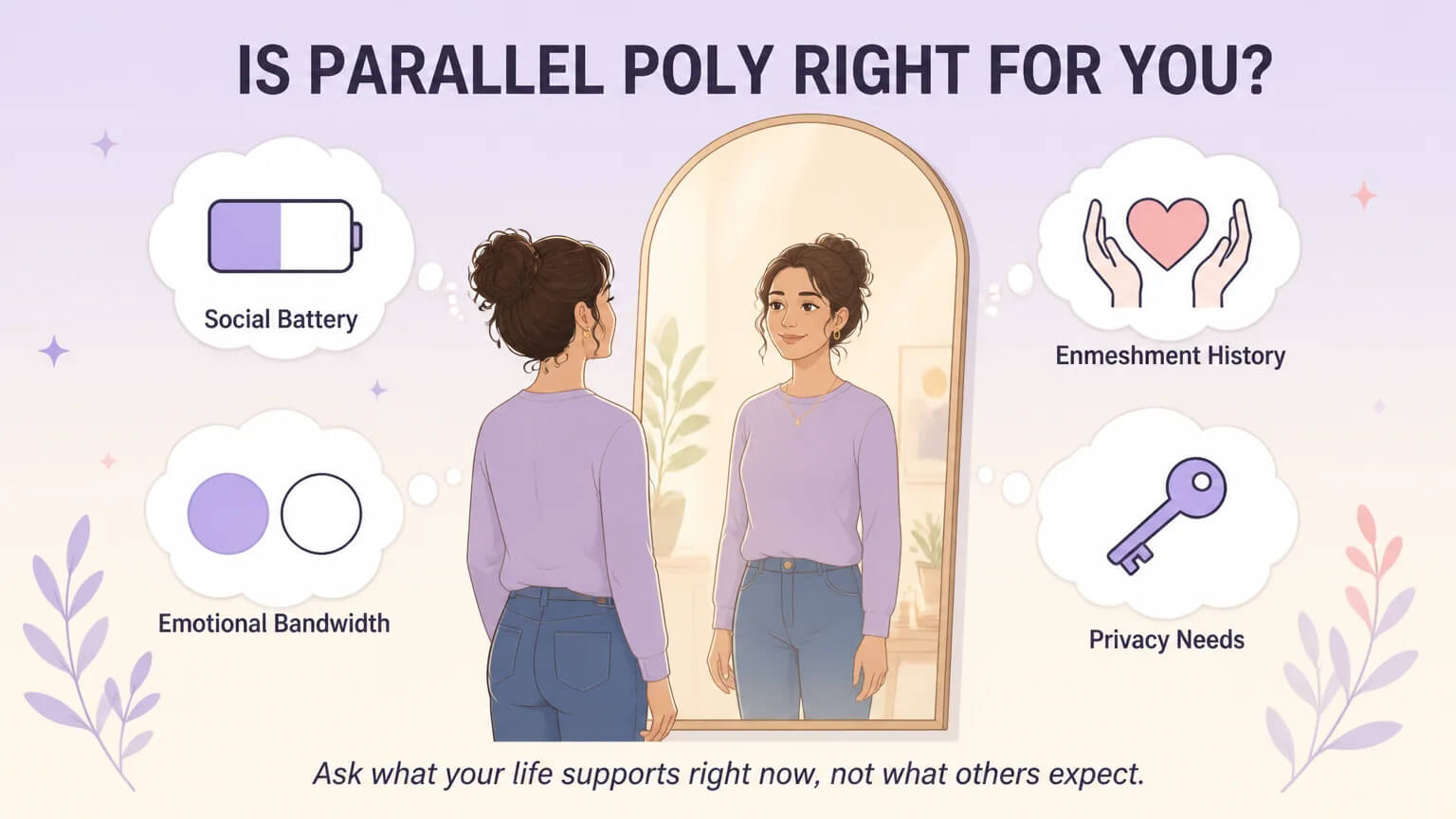
There is no personality type for parallel polyamory. The better question: what does your actual life support right now?
Therapist Tristan Byrnes offers a practical self-assessment. Check your social battery: if one-on-one time recharges you and group dynamics drain you, parallel may fit your wiring. Examine your history with enmeshment: trauma survivors may find kitchen table triggering and parallel safer, while people who have felt isolated may find the “instant family” of kitchen table healing. Assess natural chemistry with metamours: you cannot force friendship. If you have nothing in common with your partner’s other partner, parallel is healthier than performing closeness.
Check your emotional bandwidth. Single parents, demanding careers, and existing relationships already consume resources. Adding metamour friendships to a full plate is overextension. Evaluate your privacy needs. Some people thrive with dyadic intimacy. That is preference, not secrecy.
A clarification: solo polyamory and parallel polyamory are distinct concepts that often travel together. Solo poly is about life structure (you are your own primary, no cohabitation or merged finances). Parallel poly is about metamour interaction style. You can be solo poly with kitchen table dynamics, or nesting with parallel ones. They describe different dimensions of relationship design.
Your preferences can shift. You may start parallel and move toward garden party as comfort builds. You may pull back from kitchen table to parallel if boundaries get crossed. Regular reassessment is a strength, not inconsistency.
If you have read this far and parallel polyamory sounds like relief rather than compromise, that is your answer. Desire does not require an apology.
Tools and Systems for Smoother Parallel Dynamics
The right logistics reduce cognitive overhead. Less calendar Tetris means more energy for the people who matter. Here is the quick-reference toolkit.
Google Calendar is the universal default. Color-code per partner, use shared calendars with different visibility levels, and treat it like infrastructure. Free, no learning curve, works everywhere.
Weel Planner is the upgrade path. Purpose-built for polyamory, it features a two-ring calendar system: an inner ring for partners’ schedules and an outer ring for yours. Muting and privacy controls let you dim irrelevant events. iOS only. Queer-owned.
Notion suits documentation-heavy polycules. Community templates track relationship structures, boundary agreements per partner, sexual health logs, and breakup protocols. Comprehensive, though not automated.
Physical systems work for cohabitating households. A whiteboard on the bedroom door with red for do not disturb and green for open to company. Zero tech. Immediate visibility.
A weekly rhythm helps more than any single tool. Sunday calendar review. Pre-date check-in. Post-date reconnection ritual. Mid-week self-check. Monthly formal check-in to reassess whether the arrangement still works.
The principle: the tool matters less than the habit. The best calendar is the one everyone actually checks.
FAQ
Is parallel polyamory the same as Don’t Ask, Don’t Tell?
No. DADT means partners agree not to acknowledge other relationships at all. Parallel poly means everyone knows about them but chooses not to interact with metamours. DADT runs on secrecy. Parallel runs on informed privacy. Conflating them is the most common mistake people make.
Is parallel polyamory less healthy than kitchen table polyamory?
No. No metamour arrangement is inherently healthier than another. Health depends on whether everyone genuinely wants the arrangement and feels respected. A forced kitchen table is less healthy than a freely chosen parallel one.
What is the difference between parallel, garden party, and kitchen table?
They sit on a spectrum of metamour entwinement. Parallel: metamours do not interact. Garden party: metamours are friendly acquaintances who share special events and polite small talk, without independent friendships. Kitchen table: metamours are friends who share meals and daily life. Each is valid. None is the “final form.”
Can I have parallel poly with one partner and kitchen table with another?
Yes. Polyamory is not a one-size-fits-all contract. Mix styles across relationships based on individual compatibility and circumstances. The polycule does not need uniform style. Flexibility across dynamics is a feature, not a bug.
How do I tell a partner I want parallel poly without hurting their feelings?
Use “I” statements rooted in your own needs. “I feel most present in relationships when I keep them relatively separate. I am glad your other partner makes you happy. This is about how I function best.” The script affirms their happiness while stating your need.
Can parallel poly preferences change over time?
Yes. Metamour arrangements are not static. You may start parallel and shift toward garden party as comfort builds. You may pull back from kitchen table if boundaries get crossed. Regular check-ins keep the arrangement honest. Evolving preferences reflect what is actually working.