
You are scrolling a dating app profile, or your partner mentions someone new, and the word drops into conversation: metamour. You nod. You have no idea what it means. You are not alone. This word surfaces constantly in non-monogamous spaces but nobody hands you a manual.
A metamour is your partner’s other partner. Someone you are not dating, but who is connected to you through a shared romantic partner. In a polyamorous relationship where someone has a regular connection outside their primary relationship, that person is your metamour. The concept applies the moment someone you care about also cares about someone else, and that person enters your world whether you interact with them directly or not.
The word is not a diagnosis or a code for “your relationship is in trouble.” It is a tool for naming a dynamic that already exists so you can navigate it with intention instead of anxiety. Naming something reduces its power to confuse you. That is what metamour does: it gives shape to what was previously just a vague unease.
Great relationships do not outgrow adventure. They build a bigger container for it. Knowing what a metamour is, and how to relate to yours, is one of the walls of that container. The word comes with a history, an emotional terrain, and a set of practical questions nobody thinks to ask until they are standing in the middle of it.
Where the Word Metamour Comes From (and the Vocabulary That Goes With It)
“Metamour” sounds like it originated in a 2010s queer theory seminar. Its roots are older and simpler. The Greek prefix meta means “beyond” or “alongside.” Combine it with the French amour for love, and you get someone who exists alongside love. Not inside yours. Beside it. A metamour is literally a person who shares an orbit with you without being in a romantic relationship with you.
The word travels with a small cluster of other terms. You do not need to use any of them out loud. Having them in your back pocket means that when something feels confusing, you can name it, and naming it is the first step to navigating it.
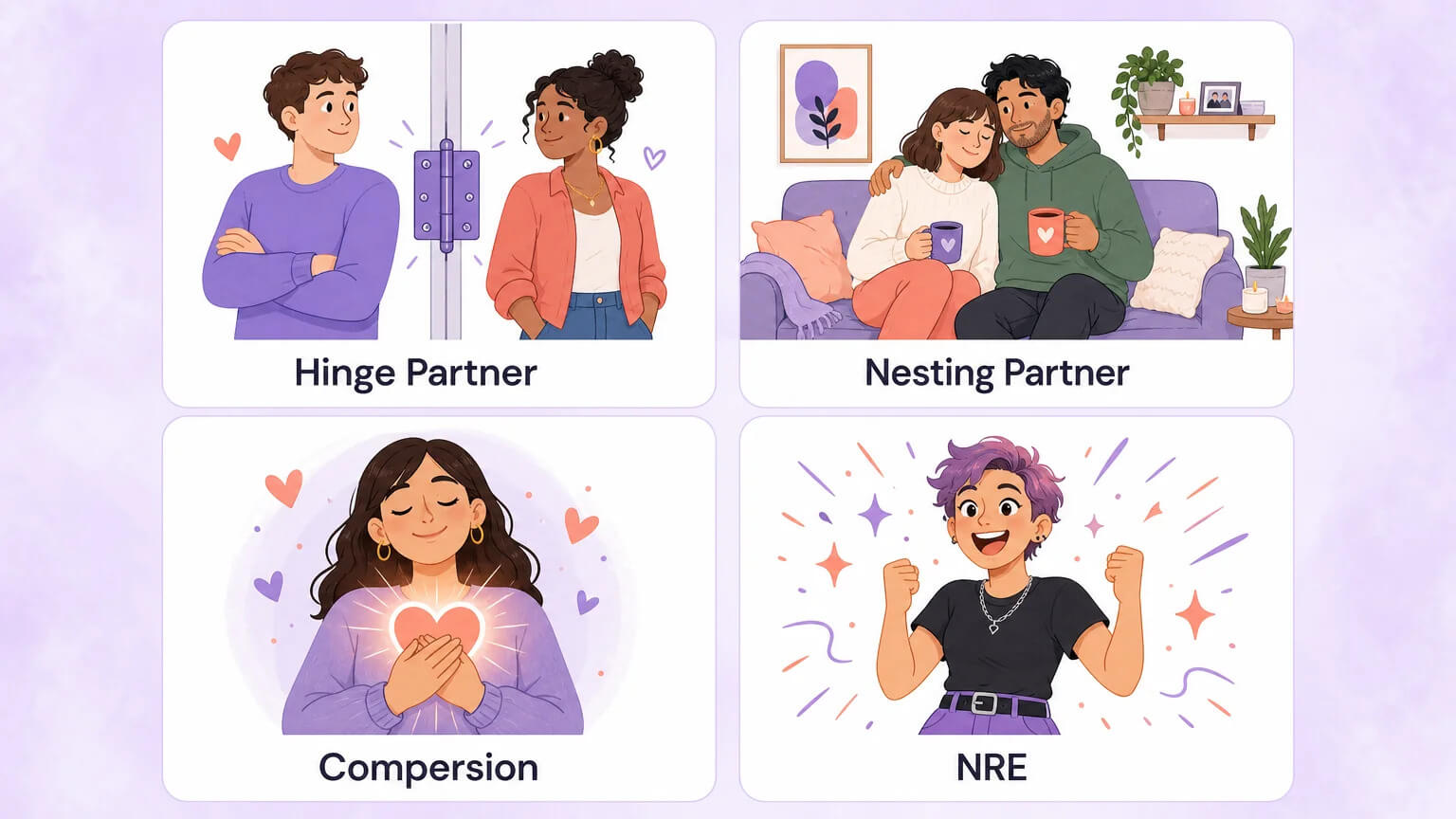
Hinge partner. The person in the middle, dating both you and your metamour. They are called a hinge for a reason: a door swings on its hinge, and how smoothly it moves depends on whether that hinge is aligned and well-maintained.
Nesting partner. Someone you live with and share domestic life alongside. A nesting partner is not necessarily a primary partner. The term describes logistics, not hierarchy.
Compersion. Feeling joy when your partner experiences joy with someone else. Marie Thouin, PhD, whose research focused specifically on compersion, found that it is a learnable skill, not an inborn trait. Some people arrive at it naturally. Most build it over time, the way you build any emotional capacity: through practice and a willingness to sit with discomfort long enough to understand what it is telling you.
NRE (New Relationship Energy). The dopamine-fueled excitement of a new connection. It can make your partner seem temporarily less available or unusually giddy. NRE is not a crisis. It is biochemistry with a timeline. Knowing the term helps you name the experience rather than personalize it.
The Three Ways People Navigate Metamour Connections (None of Them Are Wrong)
There is a quiet message in some non-monogamous circles: the truly “evolved” thing is to be friends with your metamour. If you are not braiding each other’s hair and co-hosting dinner parties, are you even doing it right?
Delete that message. It is pressure dressed up as enlightenment.
Metamour styles are not rungs on a ladder. They are options on a menu. None represents progress. None represents failure. They represent different people wanting different things at different times.
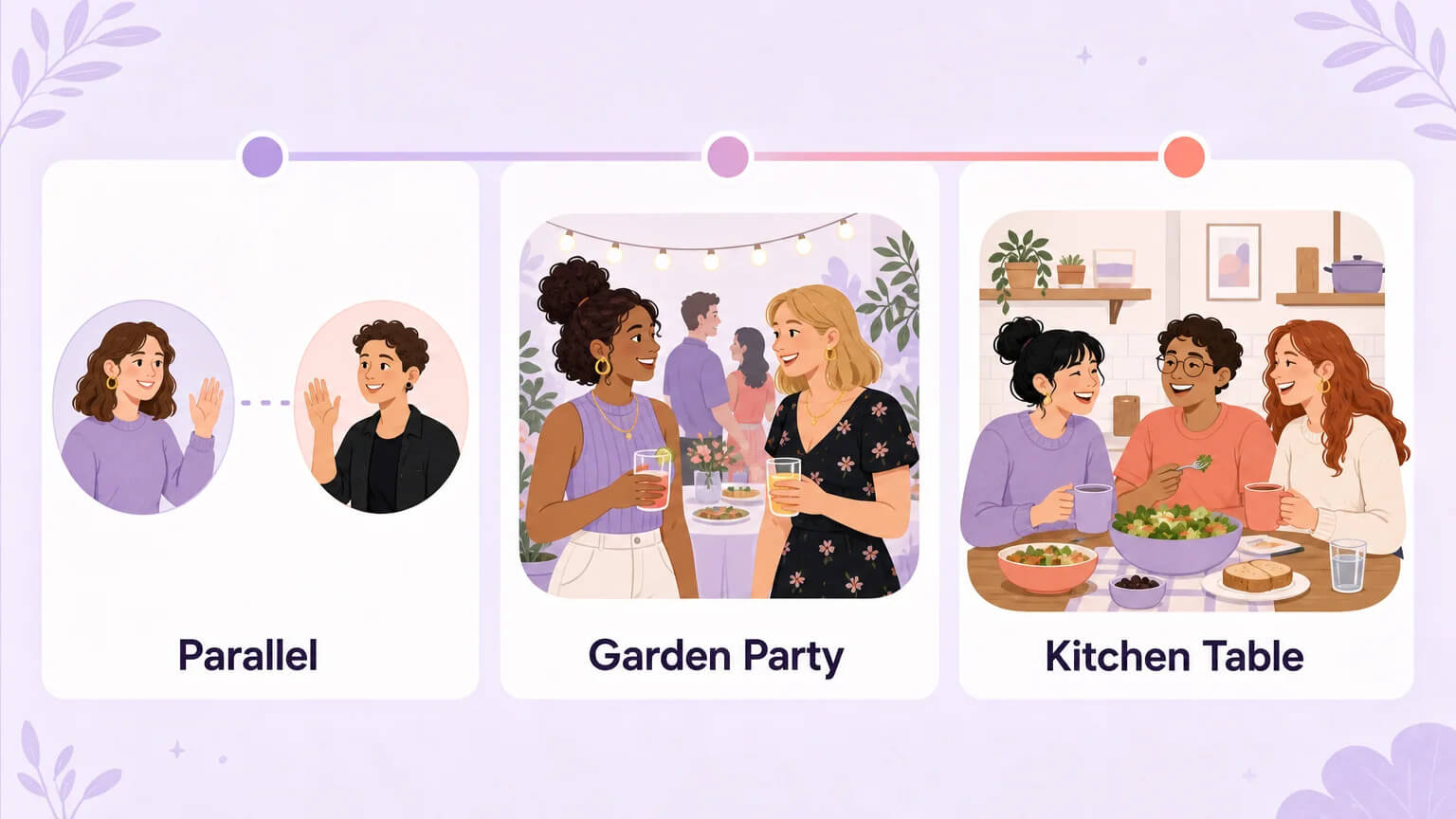
Parallel Polyamory. Separate orbits. Minimal interaction. You know your metamour exists. You might exchange polite hellos at drop-offs. You do not share meals, group chats, or emotional space. This is not avoidance. It is a deliberate, valid structure for people who prefer clear boundaries between relationships. For some, parallel is not a phase to grow out of. It is the permanent shape that keeps their relationships healthy.
Kitchen Table Polyamory (KTP). Friendly, close, maybe domestic. The name comes from the idea that everyone in the polycule can sit around the kitchen table comfortably. Think of the Resident V household model: a shared home where metamours coexist as chosen family. Dossie Easton described KTP as “making chicken soup if they get sick.” It is lovely when it works. It is not the standard you are failing to meet.
Garden Party Polyamory. Friendly at events, separate at home. The “work friends” energy of metamour connections. You can enjoy each other at a birthday party. You do not need to spend Saturday mornings together. For many people, it is the sweet spot.
You get to choose. You get to change your mind. The style that works with one metamour may not work with another. That is not inconsistency. It is discernment. Dr. Liz Powell puts it directly: sometimes you just dislike someone, and that is fine. Parallel is not a consolation prize. It is a legitimate choice.
Jealousy, Compersion, and What Metamour Relationships Actually Feel Like

Amanda Jepson, licensed therapist and AASECT-certified sex therapist, offers the cleanest reframe available: “Jealousy is not the enemy. It is a check engine light.” When your check engine light comes on, you do not smash the dashboard. You look under the hood.
Jealousy in a metamour dynamic is real and specific. It can look like watching your partner experience NRE with someone else and feeling the floor shift. It can look like seeing PDA you did not expect. It can look like the destabilizing stretch people call “poly hell,” that disorienting period when a partner’s new connection consumes their attention. These experiences are not evidence that you are bad at non-monogamy. They are evidence that you are human and paying attention.
On the other end is compersion: the warm, unexpected rush of happiness when your partner lights up about someone else. Marie Thouin’s research confirms it is learnable. It is not a personality trait you either have or lack. It is a capacity you cultivate slowly, through exposure and giving yourself permission to feel whatever you feel first.
Joli Hamilton, PhD, notes something critical: jealousy and compersion coexist. You can feel genuinely happy for your partner and genuinely wobbly about what their new metamour connection means for you. These emotions share a living room. The goal is not to evict jealousy so compersion can take over. The goal is to let them both sit on the couch.
There is also compersion pressure, the guilt of not being happy enough when your partner is thriving. It is quiet and corrosive. You are not failing if compersion does not arrive on schedule. Compersion is a bonus, not a grade. The only compulsory emotion in any relationship structure is respect.
The Hinge Partner’s Role: Why This Is Where Everything Lives or Dies
Joli Hamilton, PhD, names the dynamic directly: “I see a lot of people get angry about how their metamour is controlling [their partner] when really they have no clear agreements.” When tension flares between metamours, the hinge partner is almost always standing somewhere in the middle of it.
The hinge occupies a structural position with specific responsibilities. They are the information channel between two people not in a relationship with each other. They are the scheduler who makes time work across multiple calendars. They are the boundary-keeper who decides what stays private. They are the emotional translator who conveys needs and limits between relationships that touch but do not overlap.
Here is what capable hinging looks like.
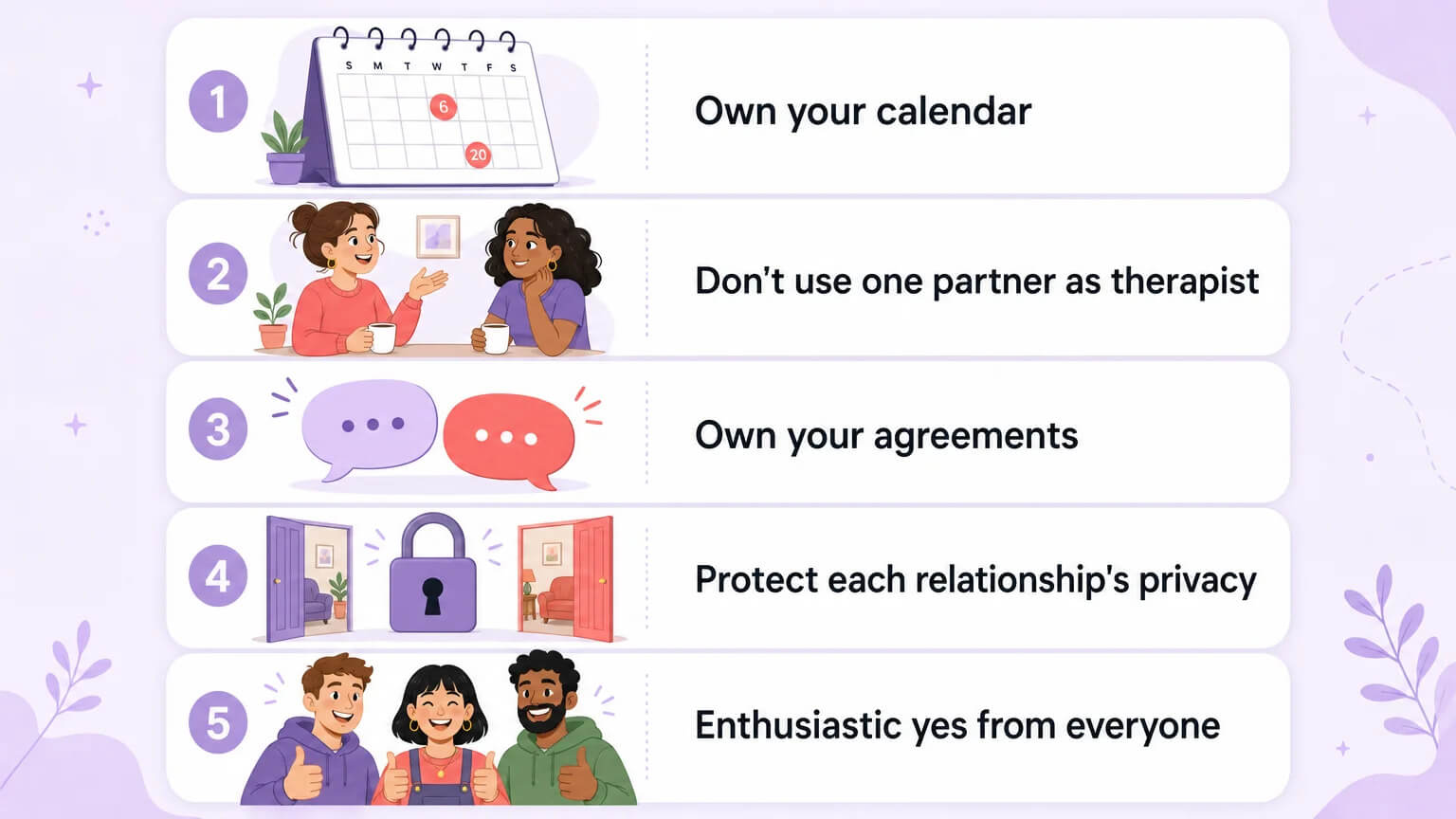
Own your calendar. If you are dating multiple people, your time management is your job. Do not make one partner negotiate availability with another. That is outsourcing emotional labor to people who did not sign up for it.
Do not use one partner as the other’s therapist. When you vent about your other relationship to a partner, you are leaking private emotional material into a container that cannot hold it safely. Get a friend, a therapist, a journal.
Communicate agreements clearly and own them. “I have an agreement that I check in before changing plans” is worlds apart from “my partner does not want me to change plans.” The first is accountability. The second is deflection with a side of blame.
Protect each relationship’s privacy. Your partner does not need access to your metamour’s emotional interior or private struggles. Intimacy is not a group project unless everyone explicitly consents.
If it is not an enthusiastic yes from everyone in the room, it is a hard no. The hinge’s job is to make sure no one is being dragged into a dynamic they did not choose, at a speed they are not ready for, on terms they never agreed to.
Meeting Your Metamour for the First Time: A Framework That Actually Works

Most first metamour meetings happen with zero planning. Someone shows up at someone’s apartment. There is wine and awkwardness and an unspoken question about whether this is supposed to feel normal.
There is a better way.
Before the meeting. Have a check-in with your hinge partner. What do you each hope for? What makes you nervous? What would make you feel safe? These answers are the foundation the meeting stands on.
Choose neutral ground. A coffee shop. A park bench. A walk through a neighborhood nobody lives in. Neutral territory levels the playing field and makes it easier for everyone to leave on their own terms.
Set a time limit. Forty-five minutes. Long enough for a real conversation. Short enough that nobody feels trapped. Agree on the endpoint beforehand.
Agree on PDA boundaries before you show up. The most common first-meeting derailment is unexpected physical affection. You expected coffee. Your partner and metamour arrive holding hands. Now you are processing jealousy mid-sip. Decide what feels okay before you walk through the door.
Have an exit phrase. Something simple and prearranged. “I think I need to head out soon” should mean exactly that, not “please decode whether I am actually upset.” It removes the pressure to perform emotional fine-tuning in real time.
The digital dimension. Group chats are not neutral territory. Ask before adding someone. Social media follows are not automatic. If you see your metamour on a dating app, that is normal. Swipe past and move on.
The goal is not friendship. It is not even liking each other. The goal is information. Who is this person? Can you coexist without constant friction? Everything beyond that is a bonus.
When Metamour Connections Get Complicated (and What You Can Actually Do)
Sometimes the vibe is off from the start. Sometimes things begin fine and degrade. This is navigable. Ashley Ayala, LMFT, puts it plainly: “There is no perfect blueprint for polyamory.” Every configuration is custom-built, and custom-built things need adjustment.
Here are the most common scenarios and what to do about them.
“I just do not like my metamour.” Dr. Liz Powell is direct: sometimes you just dislike someone, and that is okay. You do not need a reason that passes a courtroom standard of evidence. Go parallel. Keep interactions minimal. Guard your own headspace. A metamour you do not like is not a problem to solve. It is a boundary to maintain.
“My metamour refuses to meet me.” You cannot force a meeting, and trying makes things worse. Instead, assess whether your hinge partner is holding both relationships with care. Is your time respected? Are your agreements honored? If yes, a metamour who prefers distance is not a crisis. It is a preference.
“My metamour crossed a boundary.” Violations go through the hinge. Your partner addresses the behavior with their other partner directly. This is not your conversation. If your hinge refuses to intervene, the problem is not your metamour. The problem is your hinge.
“We are a couple opening up from monogamy.” You are building the airplane while flying it. The first metamour either of you has carries the weight of every insecurity you never faced before. That weight is not the metamour’s fault. It is the gravity of doing something new. Name it. Talk about it. Do not make your metamour responsible for it.
“We came from swinging.” Your toolbox just expanded. In swinging, the focus is shared experiences with clear boundaries around emotional attachment. When a connection becomes ongoing and feelings enter, the terrain shifts. What worked for one night may not work for a sustained metamour dynamic. That is not failure. It is a different job requiring different tools.
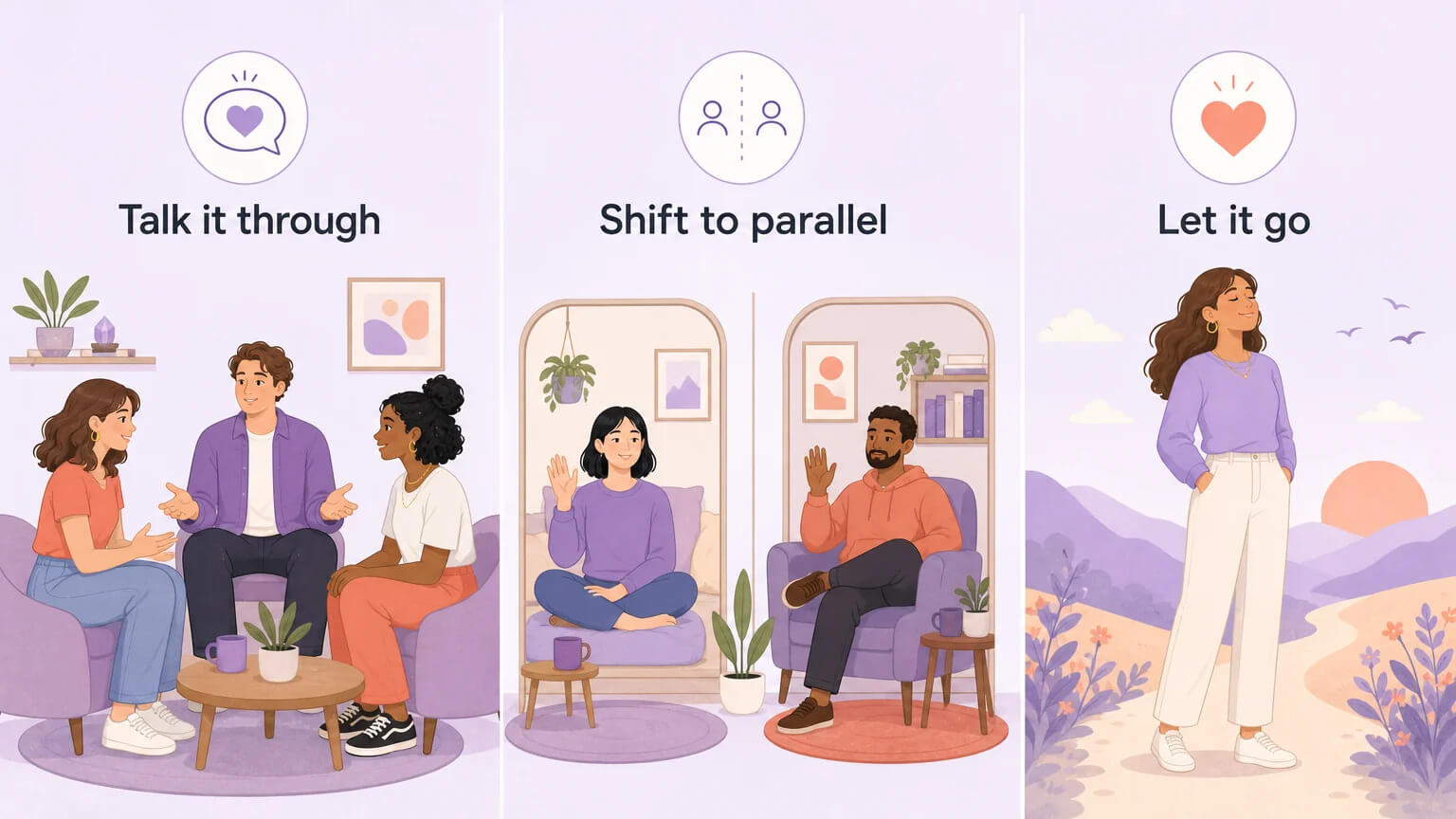
Three pathways: talk it through with your hinge. Shift to parallel and give each other space. Or accept that this configuration is not working and let it go. Walking away from a connection that hurts is not giving up. It is discernment.
FAQ
What is a metamour in simplest terms?
A metamour is your partner’s other partner. You are not dating them. They are connected to you through someone you both care about. If your girlfriend has a boyfriend, that boyfriend is your metamour.
Do I have to be friends with my metamour?
No. Parallel polyamory, where metamours have minimal or no interaction, is a completely valid structure. What matters is that everyone’s agreements are respected. Friendship with a metamour is optional.
What is the difference between parallel and kitchen table polyamory?
Parallel means separate orbits with minimal contact. Kitchen table means everyone shares space, meals, and conversation comfortably. Garden party sits between them: friendly at events, separate at home. None is more legitimate than the others.
I feel jealous of my partner’s other partner. Does that mean non-monogamy is not for me?
Jealousy is not a disqualification. It is a check engine light, signaling something worth looking at. Most people in non-monogamous relationships experience jealousy. What matters is whether you use it as information or let it drive decisions you have not thought through.
My metamour is causing problems. What do I do?
Talk to your hinge partner. Most metamour conflict is actually hinge partner conflict in disguise. Your partner is responsible for maintaining agreements and protecting both relationships. If your hinge is not holding that, the conversation you need is with them, not your metamour.
What should I expect at a first meeting?
Neutral ground. A time limit under an hour. Clear agreements about physical affection beforehand. An exit phrase everyone understands. The goal is not friendship. It is gathering information about whether you can coexist comfortably in the same relational ecosystem.
Can a metamour relationship change over time?
Yes, and it often does. A metamour you started out parallel with might become someone you genuinely enjoy. One you were close to might shift to more distance. Change is normal. The only constant is checking in that the current arrangement still works for everyone involved.
What is compersion and can I learn to feel it?
Compersion is feeling joy when your partner experiences joy with someone else. Marie Thouin’s research shows it is learnable, not innate. Some people feel it naturally. Most build it over time. It is a bonus, not a requirement, and its absence is not a failure.