You have heard the terms. ENM. Polyamory. Open relationship. Swinging. Maybe you nodded along in conversation while mentally filing them under “things I should probably Google.” Maybe someone you are seeing used a word you did not recognize and you are here trying to catch up.
Here is the thing most people do not realize until they have been reading about this for a while: ethical non-monogamy and polyamory are not opposites. They are not even in the same category. All polyamory is ENM, but most ENM is not polyamory. The word “versus” in the headline is a category error. Polyamory is one specific path on a much larger map, and conflating the two is the single most common beginner mistake in this space.
The question worth asking is not “which is better.” It is “where do I fall on this spectrum?”
What follows is every major type of ethical non-monogamy, from the most romantically invested to the most purely sexual, plus one philosophy that refuses the spectrum entirely. You will walk away with a framework for figuring out where you fit, a comparison table that maps the territory at a glance, and a list of mistakes beginners make so you can skip the hard lessons. Whether you are here out of curiosity or because someone used a term you did not recognize, you are in the right place.
The ENM Umbrella: What Ethical Non-Monogamy Actually Means
Ethical non-monogamy, often called consensual non-monogamy or CNM, is any relationship structure where all partners knowingly and willingly consent to multiple romantic or sexual connections. The word “ethical” is the load-bearing wall. It is what separates ENM from cheating.
As therapist Erin Alexander puts it: “Consensual non-monogamy is not cheating despite what some people believe because there is no dishonesty. There is transparency among all of the participants.” That distinction is the foundation. ENM is not a loophole. It is not cheating with a nicer name. It is a structure built on informed, voluntary consent from every person involved.
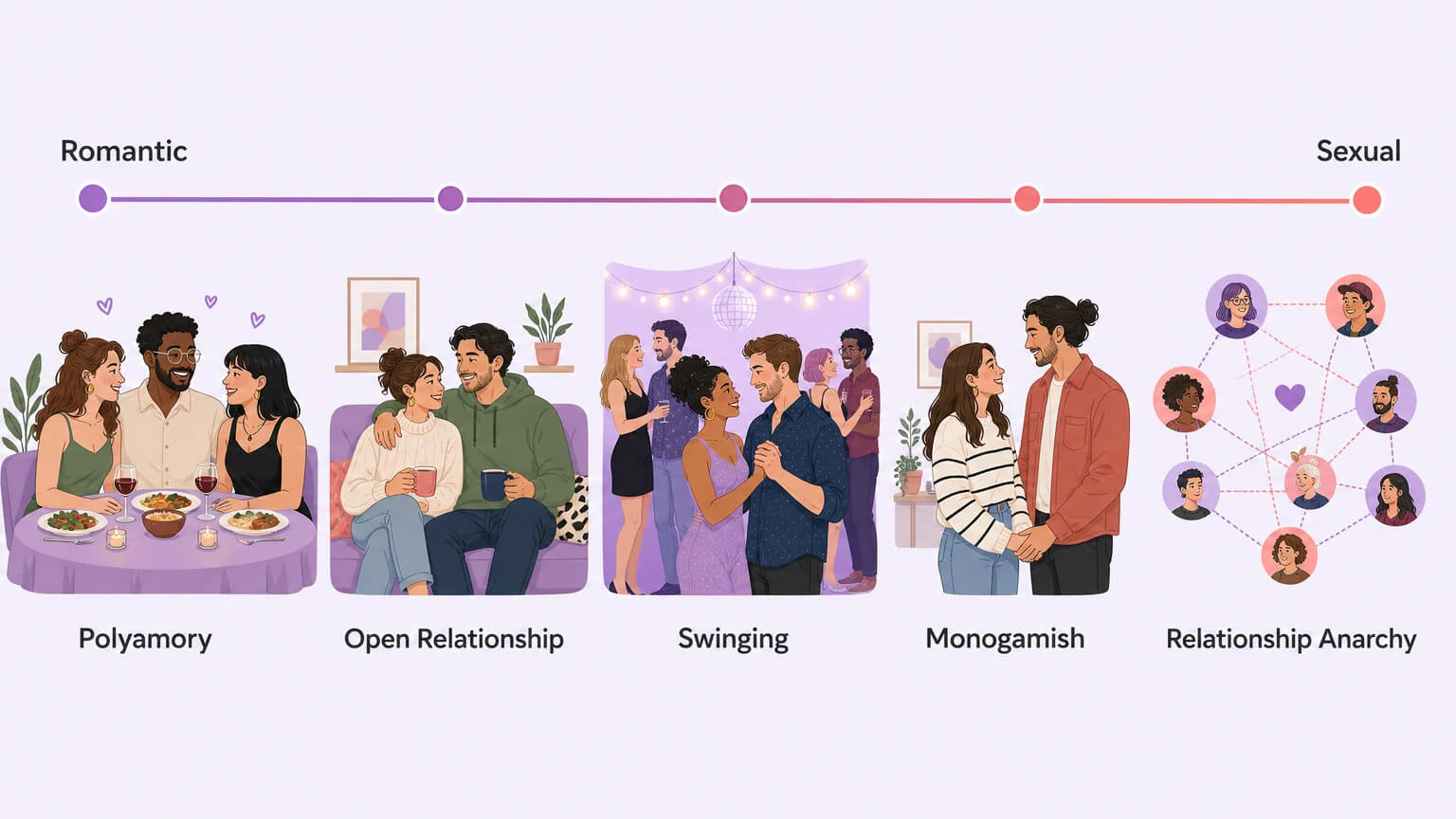
The clearest way to understand this territory is as a spectrum. At one end, relationship structures centered on romantic love with multiple partners. At the other, purely sexual exploration with emotional exclusivity preserved for a primary partnership. Most real-world ENM lands somewhere in between. Where you sit on that spectrum shapes how your relationships function.
Here is the full map:
| Relationship Type | Romantic Investment | Sexual Openness | Hierarchy | Best For |
|---|---|---|---|---|
| Polyamory | High | Variable | Variable | People who want multiple loving, committed partnerships |
| Open Relationship | Low (reserved for primary) | Medium-High | Yes (primary couple) | Couples wanting sexual variety while preserving emotional exclusivity |
| Swinging | Minimal | High (shared activity) | Yes (primary couple) | Couples exploring recreational sex together |
| Monogamish | Low (reserved for primary) | Low (negotiated exceptions) | Yes (primary couple) | Mostly monogamous couples with specific carve-outs |
| Relationship Anarchy | Varies by connection | Varies by connection | No (rejects hierarchy) | People who want to design each connection from scratch |
To put numbers on it: roughly 1 in 5 Americans have tried some form of CNM. About 4 to 5 percent are currently practicing. The figures are higher than most people assume, and they have been steadily rising. If you have ever worried that exploring non-monogamy makes you unusual, the data says otherwise. You are in a much larger crowd than you think.
Each type gets its own section below, ordered from most romantic investment to least, plus one philosophy that refuses to sit on any axis at all.
1. Polyamory: Multiple Loves, Multiple Commitments
If you have heard one term in the ENM conversation, it is probably polyamory. But polyamory is actually one of the least common forms of ENM. Dr. Zhana Vrangalova’s national survey found that only 5 to 7 percent of people chose polyamory as their ideal relationship type. Far more people want some form of open monogamy.
Polyamory is the form of ENM with the highest romantic and emotional investment across multiple partners. It is about love, not just sex. The practice involves multiple simultaneous, committed, loving relationships with the full knowledge and consent of everyone involved. It is the deep end of the romantic pool, and for the people it fits, it is not a compromise. It is the point.
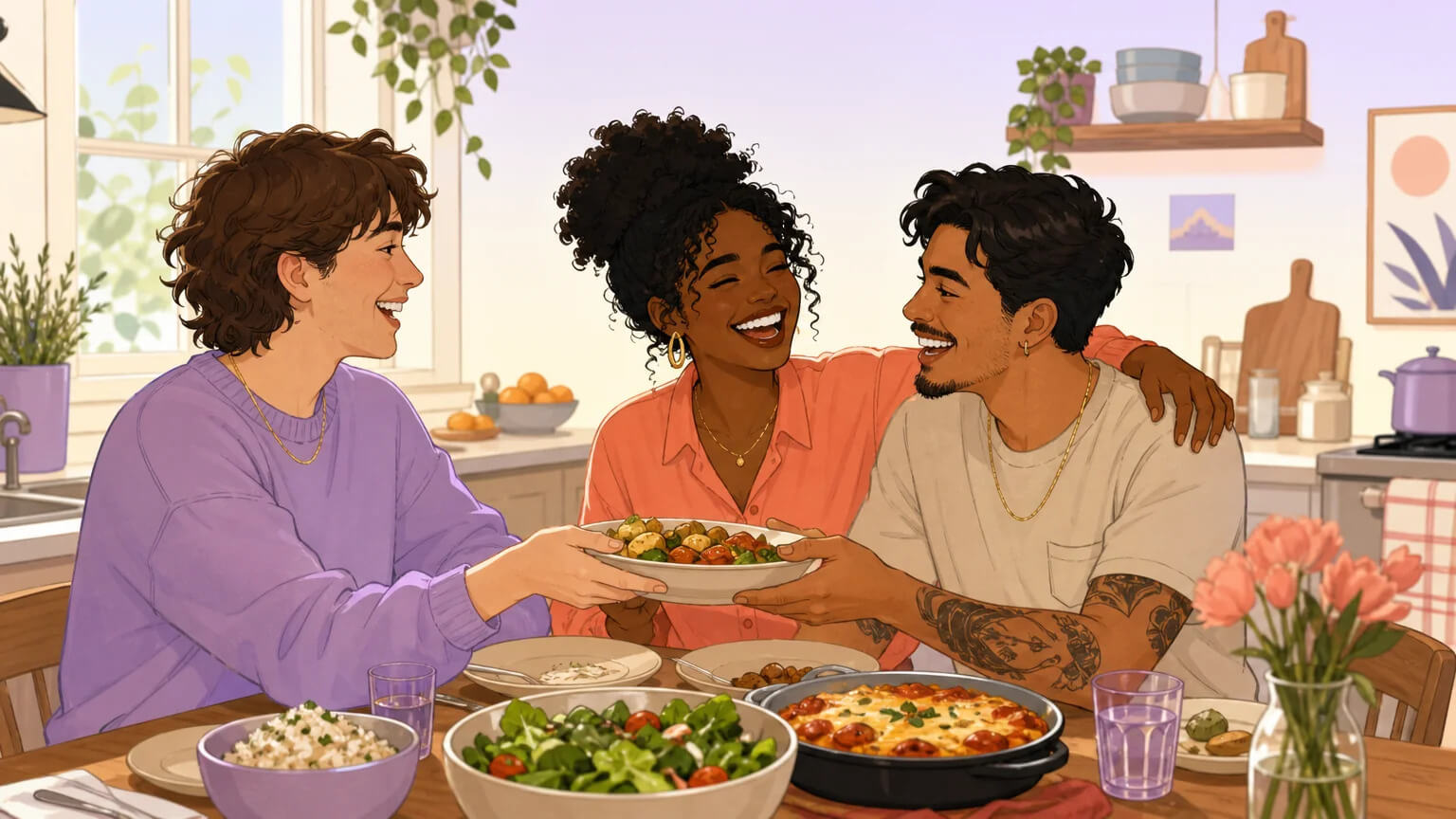
Polyamory has several internal variations. Kitchen-table polyamory describes a dynamic where metamours (your partner’s other partners) are friends who share meals and gatherings. Parallel polyamory means metamours know of each other but do not interact. Solo poly centers the self as the primary partner, with no nesting or cohabitation. Polyfidelity describes a closed group of three or more people exclusive to each other. The word “polyamory” is a doorway, not a room.
Jordan discovered polyamory after a monogamous relationship ended partly because they “could not stop developing feelings” for others. They now practice solo poly with a nesting partner they see several nights a week and a long-distance comet partner they see every few months. Their take: “I did not choose polyamory because monogamy was too hard. I chose it because it is how I am wired.”
Morgan’s polycule runs on a different model. They live with their spouse Robin. Robin’s girlfriend Jamie comes over for Sunday dinners. Morgan and Jamie have become genuine friends who grab coffee without Robin. Morgan’s boyfriend Chris joins the dinners too. There is a shared Google Calendar and a group chat for logistics. Morgan describes it simply: “We each have our own homes and lives. But we genuinely enjoy each other’s company, and when someone has a birthday, we all show up.”
Dr. Amy Moors’ research on more than 3,500 polyamorists upends the stereotype of the young, wealthy, white liberal. Polyamorists span age, income, race, and political affiliation. Notably, 7 percent report non-binary gender identities versus only 1 percent of monogamists. This is not a coastal elite phenomenon. It is a cross-demographic reality.
About 10.7 percent of people have tried polyamory. Roughly 16.8 percent desire it. Four to five percent are currently practicing. Polyamory demands the most emotional bandwidth of any ENM form. For the people it fits, that bandwidth is not a cost. It is the entire reason for doing it.
2. Open Relationships: Together, With Room to Explore

Sarah and Mike have been married eight years. They are solid but predictable. They agree to explore sexually with others while keeping their emotional commitment exclusive to each other. The very first thing they discover: they had never actually defined what “sex” means to each other. Does kissing count? Oral? The negotiation surfaced differences they had not discussed in nearly a decade of marriage.
An open relationship is a committed primary partnership where outside sexual connections are permitted but romantic love is reserved for the primary. This is the most common form of ENM. More people want open monogamy than polyamory, and the structure sounds simple: a couple decides together what is allowed, what is not, and under what conditions.
The catch is that “open” means something different to every couple. This is exactly why you cannot skip the definitions conversation. Non-monogamy coach Ellecia Paine warns: “Start by defining monogamy first. Do you even agree on what monogamy means? Then define what open means.”
Sarah and Mike landed on their version: no sleepovers, always protection, share basic details but not intimate specifics, and either partner can pause at any time without explanation. They started by going to a lifestyle club together just to observe. Their agreements evolved over months of trial and conversation.
The elephant in every open relationship is feelings. What happens if someone catches feelings? Feelings happen despite every intention. That is not a reason to never try. It is a reason to have a plan for when they show up. The skill is communication, not emotion suppression.
Paine puts it bluntly: “If you think you will have one big talk about the rules and then be done with it, that is really cute. The negotiation is a living breathing thing.”
A 2025 meta-analysis of 35 studies and nearly 25,000 participants is worth noting here: CNM couples report higher trust than monogamous ones, not lower. The explicit, ongoing communication that ENM demands builds trust that monogamous couples can coast without.
Open relationships are not polyamory-lite. They are their own architecture with their own logic. For couples who want variety without dividing romantic attention, they are exactly the right tool.
3. Swinging: Recreational, Together, No Strings Attached

If polyamory is about love and open relationships are about sex with guardrails, swinging is about sex as a shared activity. Think of it like salsa dancing or hiking, except the activity happens to involve other people.
Swinging describes couples who engage sexually with other couples or individuals, almost always together, with emotional attachment intentionally minimized. It is typically episodic: lifestyle clubs, parties, resort events. The couple is always the central unit, and the experience is something they do as a team.
Dave and Maria have been married fifteen years and swinging for five. They visit lifestyle clubs about once a month, vacation at a swinger resort once a year, and have a circle of friends in the community. Dave puts it plainly: “Swinging is something we do together. When we leave the club, it is just us.” They have zero interest in romantic relationships with others. Their agreement is simple: if either is not feeling it on a given night, they skip it. No pressure, no grudges.
Maria points out something worth underlining: “The communication skills we learned for swinging actually made our marriage better overall.” The 2025 meta-analysis backs her up. People in swinging relationships reported significantly higher sexual satisfaction than monogamous individuals. There is a reason these couples look happy at brunch.
Swinging is distinct from polyamory in one important way. Swingers may have regular play partners they are friendly with, but they are not building romantic partnerships. If polyamory is running a small restaurant with multiple regulars, swinging is going to a dinner party where everyone brought a dish.
Kayla Crane, a licensed therapist who works with ENM clients, emphasizes that clear agreements matter as much in swinging as in any other form. The difference is the container: swinging agreements are typically tighter, more specific, and designed to protect the emotional exclusivity of the primary bond.
Swinging is not a stepping stone to polyamory. It is not ENM with training wheels. For the couples it fits, it is the destination. And the research says they are having a very good time.
4. Monogamish: Mostly Monogamous, With Negotiated Exceptions
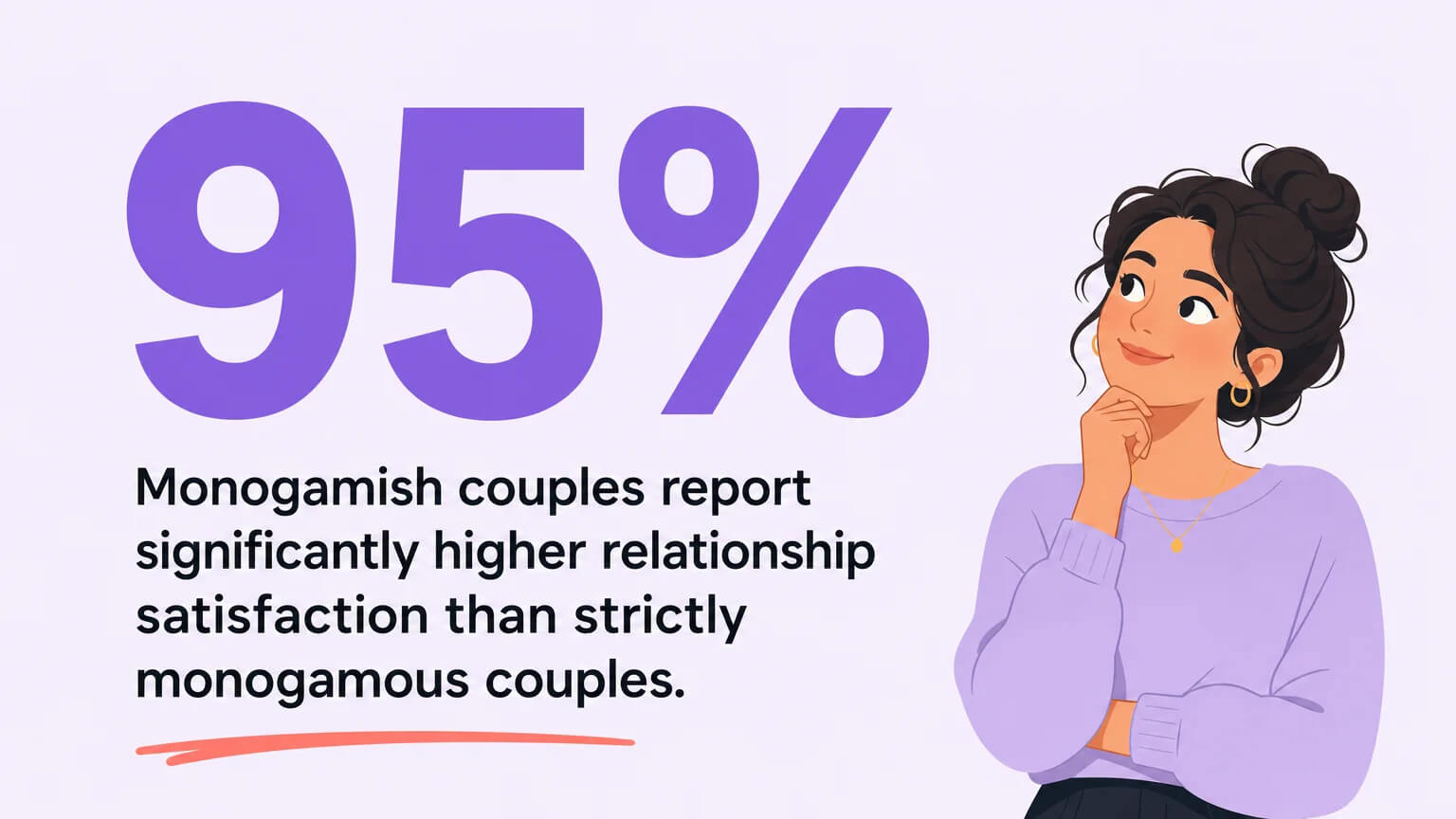
People in monogamish relationships reported being significantly happier than people in strictly monogamous ones. Not slightly. Significantly.
The term was coined by Dan Savage and describes couples who are approximately 95 percent monogamous with specific, negotiated carve-outs. Common forms include occasional threesomes, hall passes while traveling, or an “only play together” agreement at lifestyle events. The couple is fundamentally monogamous in identity and daily life. The exceptions are intentional and bounded.
Alex and Taylor live this model. They only engage with others when they are together. This looks like occasional threesomes or couple swaps at lifestyle events, never solo dating. All communication with play partners happens in group chats. Taylor explains: “We do not want separate lives. The whole point is doing something exciting together and then going home and talking about it for weeks.”
Therapist Erin Alexander puts it on a spectrum: “There are different levels of ENM, from couples agreeing to flirt in front of each other to full open relationships with specific rules. And every level is valid.”
Monogamish is the entry point for the largest number of people, far more than polyamory. It lets couples explore without adopting an entire new identity or relationship architecture. The container stays familiar. The edges get a little softer.
Monogamish is not ENM-lite. It is ENM, exactly what works for you. And for a lot of people, that is the only kind that makes sense.
5. Relationship Anarchy: No Script, No Hierarchy, No Defaults
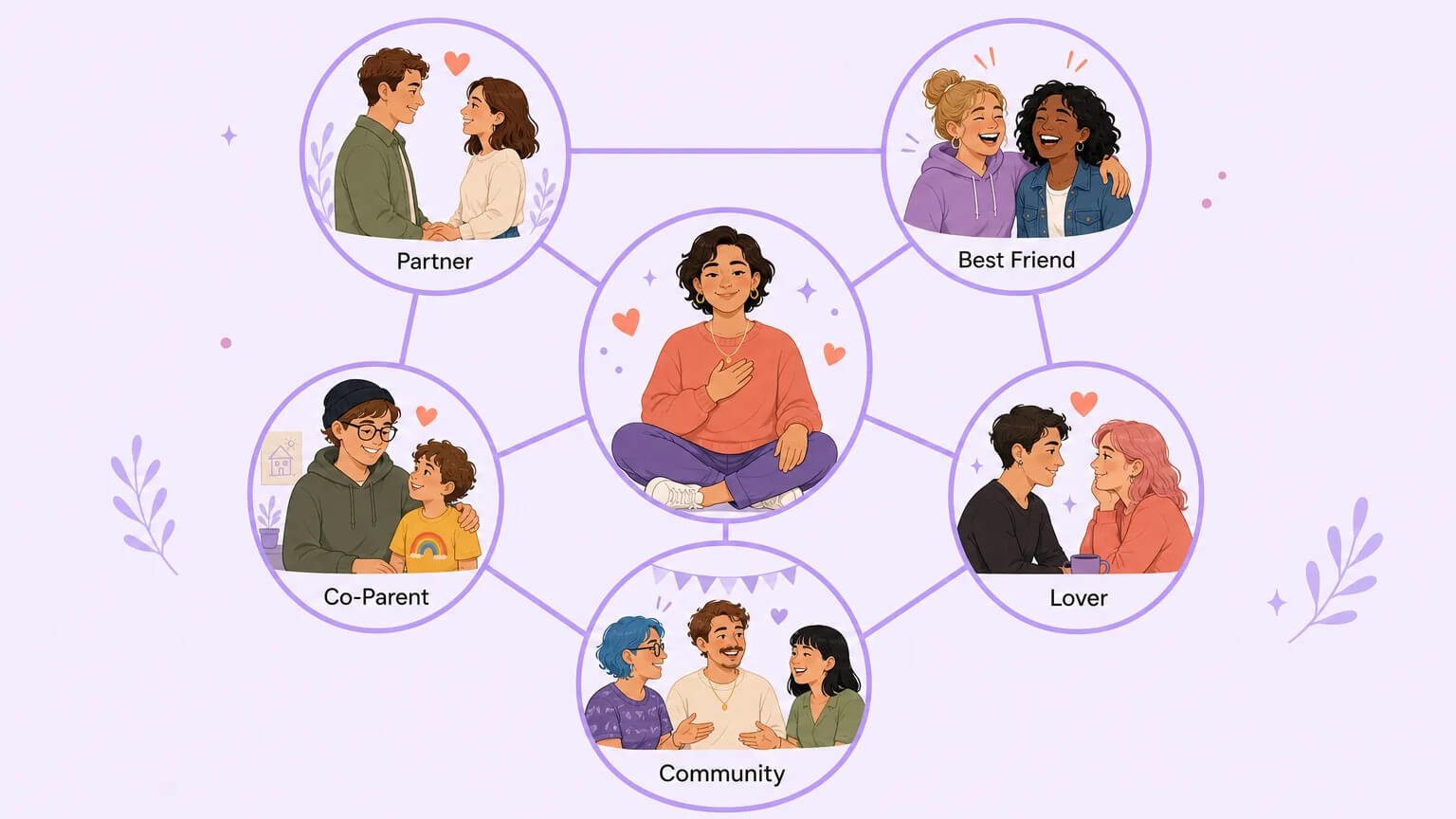
Everything above assumes you want a label for your relationship. But what if the whole idea of sorting relationships into types is the problem?
Relationship anarchy, coined by Swedish queer feminist Andie Nordgren in her 2006 manifesto “The Short Instructional Manifesto for Relationship Anarchy,” rejects all preset hierarchies. Romantic partners are not automatically more important than friends. No relationship inherits its shape from social defaults. Every connection is intentionally designed from scratch.
Dr. Liz Powell describes it this way: RA is about “moving away from rigid structures of what a partner is versus what a friend is, and instead having each connection find its own form.”
The counterintuitive part is that someone can be monogamous and still practice relationship anarchy. RA is a philosophy about how you approach all relationships, not a description of how many partners you have. It applies to friends, family, lovers, co-parents, and community connections equally.
Sam lives this philosophy. They co-parent a four-year-old with their best friend, a platonic arrangement they designed intentionally. They have a romantic partner they see weekly who lives separately. They maintain deep emotional friendships they value equally with romantic connections. No one relationship is assumed to be more important than another. Sam explains: “The question is not who is my most important person. It is what does this specific connection need and want to be.”
RA is frequently misunderstood as “polyamory without rules.” It is actually the opposite. It requires more communication, not less, because every commitment is custom-built rather than inherited from defaults. There is no script to fall back on. No “this is just how relationships work” to lean into. Every single agreement must be articulated and revisited.
This approach is not for everyone. By design, it refuses to be. But for people who have always felt that the default relationship escalator does not fit them, RA is the permission slip they never got.
6. How to Know Which Relationship Style Fits You
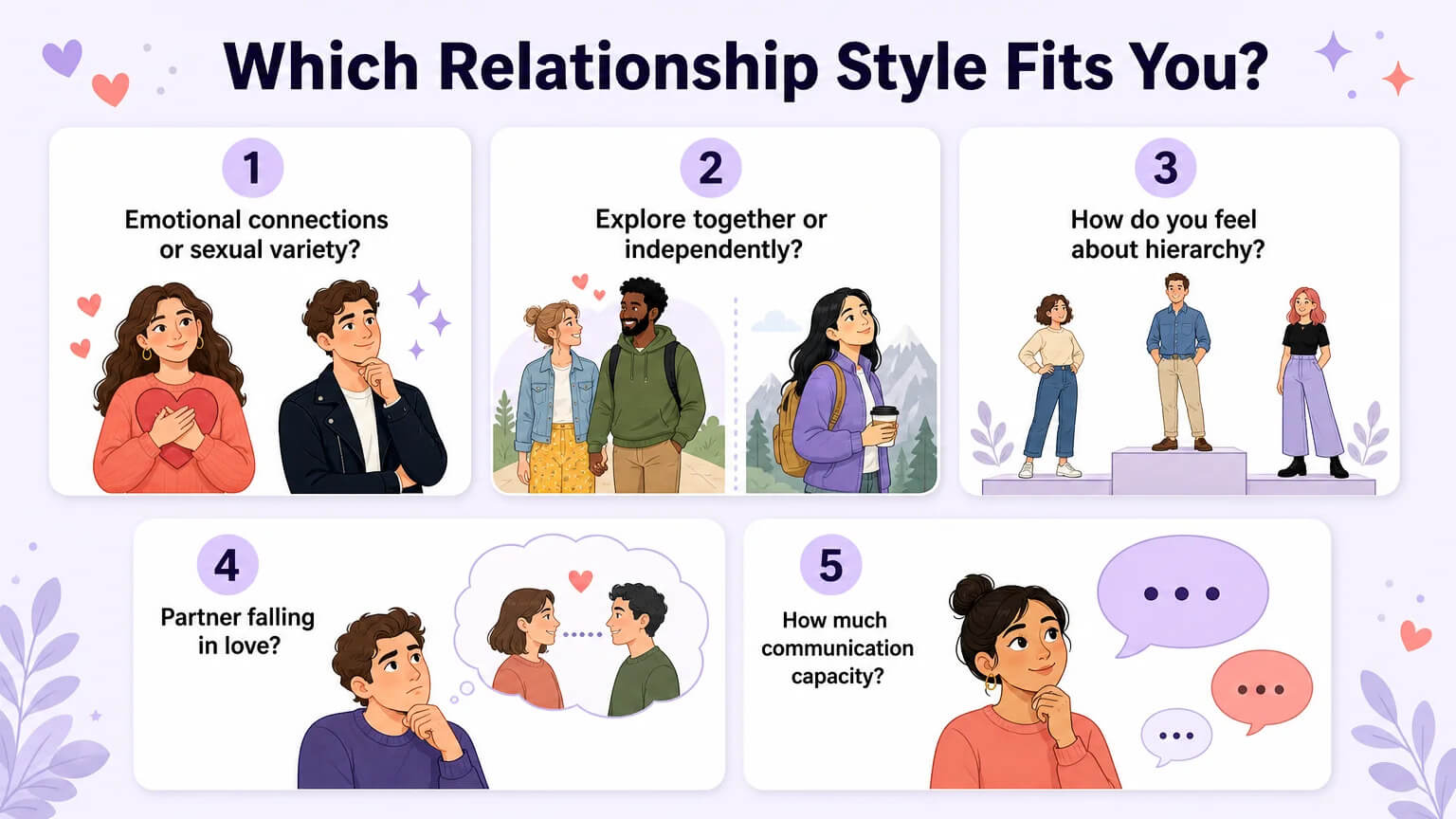
Reading about relationship types is one thing. Knowing which one might actually work for you, with your specific partner, your specific history, your specific emotional wiring, is something else.
Here are five questions to sit with. Not a BuzzFeed quiz. A self-assessment.
Do you want emotional and romantic connections with multiple people, or primarily sexual variety? If the former, look toward polyamory. If the latter, open relationships, swinging, or monogamish may be a better fit.
Do you want to explore together with a partner, or independently? Together points toward swinging or monogamish. Independently points toward polyamory or open relationships with solo dating.
How do you feel about hierarchy? Does having a primary partner feel secure or restrictive? If restrictive, relationship anarchy or solo poly may resonate.
Are you comfortable with your partner falling in love with someone else? If the thought feels threatening, you likely belong on the sexual-exploration side of the spectrum, not the romantic side. If it feels manageable or even positive, polyamory may be your territory.
How much communication capacity do you realistically have right now? Be honest. Polyamory demands the most. Monogamish demands the least. Your answer here is a constraint, not a moral judgment.
Therapist Martha Kauppi, who wrote the clinical textbook on CNM, describes the agreement-making process in stages: look within first, then communicate, get specific about what abstract terms mean, do not rush, and start with an experiment rather than a forever agreement. Her insight: broken agreements usually stem from a flawed process, not the wrong terms.
The thing to remember: you do not need to know the answer before you start. Exploring these questions with a partner honestly, over time, is the work. Most people who land in a satisfying ENM structure did not pick it from a menu. They arrived there through months of conversation.
Ellecia Paine offers the simplest starting point: define monogamy first. If you and your partner cannot agree on what monogamy means, you are not ready to define what ENM means. Get that foundation right, and everything else becomes easier to build.
7. Mistakes Beginners Make and How to Skip Them
Every experienced ENM practitioner has a list of things they wish someone had told them. Here is the list. Not to scare you. So you do not have to learn the hard way.
Opening up to fix a broken relationship. Therapists agree this is the most common and destructive beginner error. ENM amplifies existing dynamics. It does not repair them. Kayla Crane puts it plainly: “If you have trust issues, poor communication, or resentment, adding more people will make things worse.” Fix: get the existing relationship solid first.
Not defining terms before acting. Two people can use the same word and mean radically different things. “Open” to one partner might mean occasional threesomes. To the other, it might mean solo dating every weekend. Fix: Martha Kauppi’s process. Look within. Communicate. Get specific. Do not rush. Start with an experiment.
Treating “no catching feelings” as a workable policy. Feelings are not optional. They happen. The skill is what you do when they show up, not pretending you can ban them by agreement. Fix: have a plan for when feelings develop. What is the protocol? Who needs to know? What adjustments are available?
Underestimating the emotional labor. Ellecia Paine does not sugarcoat it: “Opening your relationship is not some magic portal to effortless freedom. It is a full-time job for your emotional life.” Fix: start slow, schedule regular check-ins using a framework like RADAR, and budget emotional bandwidth realistically.
Confusing boundaries with rules. Rules try to control others and breed resentment. Boundaries are about your own limits and needs. Dr. Keyanah Nurse draws a sharp distinction between being centered and being prioritized. Understanding which you truly want prevents painful mismatches. Fix: frame agreements around your own needs, not your partner’s restrictions.
One Guardian reader described ENM as “the best personal growth program I never signed up for” because it forced them to confront insecurities that monogamy had allowed them to avoid. The mistakes are not the failure. They are the curriculum.
The Bottom Line
The question was ethical non-monogamy versus polyamory. Here is what you now know: it was never a versus. Polyamory is one path on a much larger map.
The full spectrum is now clear: polyamory sits at the romantic-deep end with multiple committed loving relationships. Open relationships preserve a primary partnership while allowing outside sexual connections. Swinging treats recreational sex as a shared activity between committed partners. Monogamish keeps the container mostly closed with negotiated exceptions. And relationship anarchy rejects the entire taxonomy, designing each connection on its own terms.
A 2025 meta-analysis of 35 studies and nearly 25,000 participants found no significant difference in overall relationship satisfaction between monogamous and CNM people. Structure does not predict happiness. Communication, trust, and intentionality do. That finding runs through every section above. It is the thing to carry forward.
If you are just starting, the single best move is reading a book or listening to a podcast together for thirty days before making any changes. “The Ethical Slut” is the foundational text. “Polysecure” adds the attachment-theory lens. The Multiamory podcast offers evidence-based weekly guidance. And if you need professional support, the AASECT directory lists CNM-affirming therapists.
If you are ready to explore, apps like 3Fun and Feeld are built specifically for the ENM community, not retrofitted from monogamous dating. You will find people who already speak the language.
The goal is not to pick the right label. It is to build a relationship, or relationships, that actually fit the people inside them. Everything else is just vocabulary.
FAQ
Is not ENM just cheating with a nicer name?
No. The defining difference is informed, voluntary consent from every person involved. Cheating is deception and betrayal of agreements. ENM is transparency and mutually agreed-upon boundaries. As therapist Erin Alexander states: “Consensual non-monogamy is not cheating despite what some people believe because there is no dishonesty. There is transparency among all of the participants.”
What if my partner wants ENM and I do not?
Consent must be freely given. Agreeing because you are terrified of losing the relationship is not true consent. A CNM-affirming couples therapist can facilitate the conversation. In some cases, the relationship may be fundamentally incompatible. Recognizing that honestly is better than years of resentment from either agreeing under pressure or suppressing a core need.
Will not my partner just leave me for someone better?
People in monogamous relationships also leave their partners for someone else. ENM does not create that risk. It makes the conversation more honest. Many ENM practitioners report that the security of knowing their partner actively chooses them every day, rather than staying because of an agreement, actually increases trust.
What is the difference between an open relationship and polyamory?
Open relationships reserve romantic love for the primary partnership while allowing outside sexual connections. Polyamory involves multiple loving, committed romantic relationships simultaneously. The difference is whether emotional and romantic investment with outside partners is expected and encouraged.
What is the difference between swinging and polyamory?
Swinging is recreational and primarily sexual. Couples engage together, and emotional attachment is intentionally minimized. Polyamory involves ongoing romantic relationships with emotional depth and commitment. Swingers may have friendly regular play partners, but they are not building romantic partnerships.
Do I have to feel compersion, joy about my partner being with others?
No. Compersion is a goal and a practice, not a requirement. Most people do not feel it automatically. The intermediate step is neutrality: moving from “this feels terrible” to “I am not spiraling.” Ellecia Paine advises shooting for neutral first. Jealousy is normal and signals unmet needs. It is not a sign you are bad at ENM.
Which ENM style is right for me?
Self-assess: Do you want emotional connections with multiple people or primarily sexual variety? Do you want to explore together or independently? How do you feel about hierarchy? Is your partner falling in love with someone else threatening or manageable? Your answers point toward the style that fits. You do not need to know before you start. Exploring these questions is the work.
Is not ENM unstable? What about children?
Research does not support the claim that ENM is inherently less stable. The 2025 meta-analysis found no difference in commitment levels. What matters for children is relationship quality and stability of care, not the number of parents’ partners. Many polyamorous families raise children successfully.
Is ENM only for young, liberal, wealthy, white people?
No. This stereotype does not hold up against the data. The 2025 study of more than 3,500 polyamorists found diverse representation across age, income, race, and political affiliation. While media representation skews toward young coastal professionals, the reality is far broader. ENM communities include people of all ages, races, classes, and geographies.