In March 2022, a TikToker posted a video about a pineapple welcome mat at an Airbnb. Eleven million views later, a quiet community signal went mainstream. You have probably seen it too. On a cruise cabin door. Tucked into a dating app bio. In someone’s grocery cart. And you knew there was something happening just below the surface.
You were right.
The upside down pineapple meaning is simpler and more layered than the internet would have you believe. It is a recognized symbol within swinger communities. It is also a meme, a punchline, a piece of jewelry, and for people who have never been near a lifestyle club, a piece of tropical decor they now second-guess wearing in public.
What the mainstream coverage gets wrong is treating this symbol like a decoder ring, as if spotting a pineapple tells you everything about the people displaying it. It does not. The gap between what TikTok thinks the pineapple means and what actually happens inside the community is where the story lives.
This is written from inside the room, not from the hallway. It covers what the symbol means, where it came from, whether anyone actually uses it, how swinger culture differs from polyamory and open relationships, what happens when you accidentally signal, how TikTok broke a discreet code, the symbols beyond the pineapple, and the etiquette that keeps you from being the person nobody wants at the party.
What the Upside-Down Pineapple Actually Means
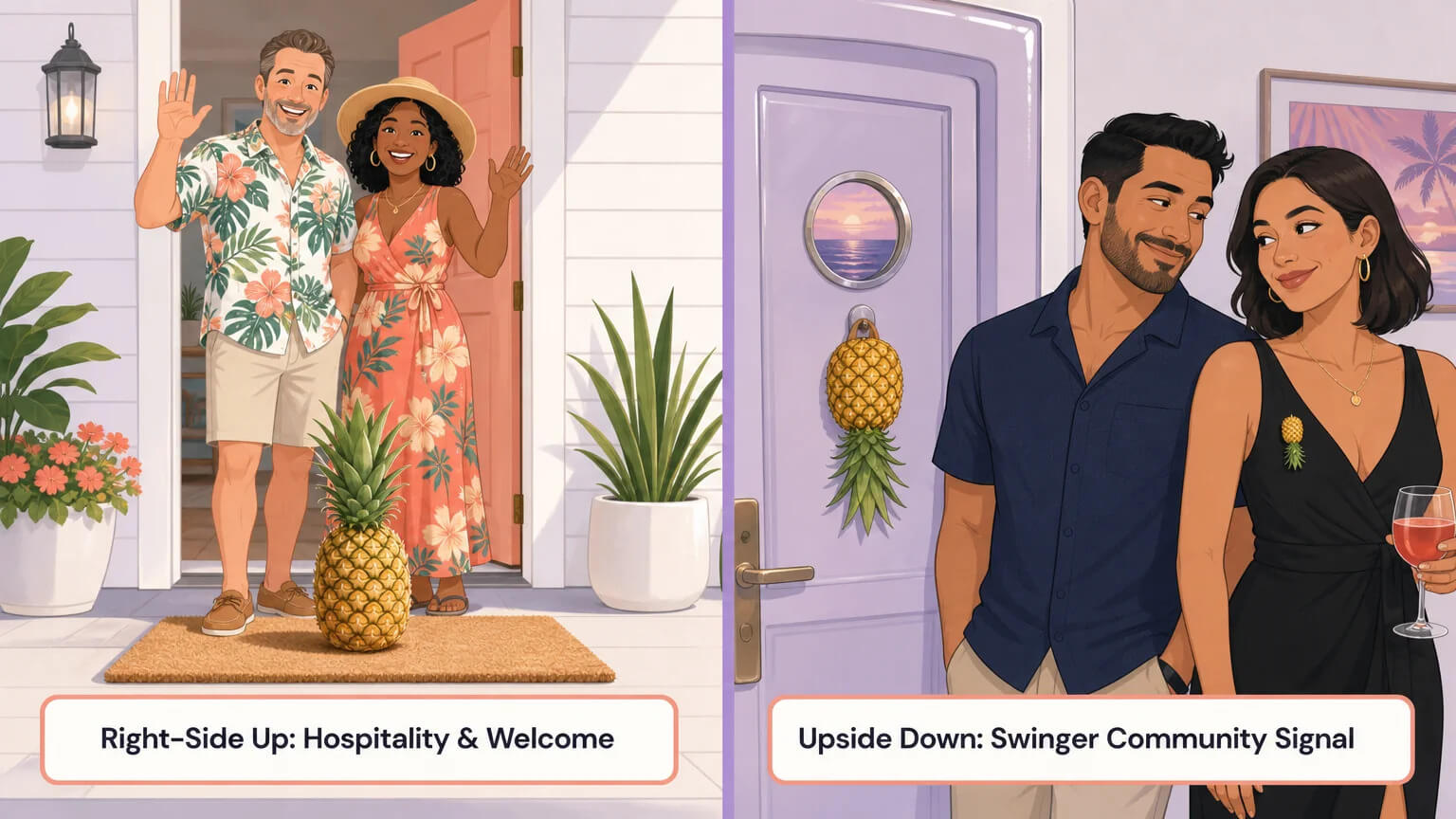
The core definition is straightforward: an upside-down pineapple is a recognized symbol within swinger communities that signals interest in partner swapping, group play, or identifying oneself as part of the lifestyle. The orientation matters. A right-side-up pineapple carries only the traditional meaning of hospitality and welcome, with zero swinger connotation. Turn it upside down, and the message shifts.
But the symbol did not emerge from nowhere. Its origin story starts long before anyone thought to put a piece of fruit on a cruise cabin door.
Pineapples have been a hospitality symbol for centuries, dating back to colonial-era decor when the fruit was so rare and expensive that displaying one signaled wealth and welcome. That association never faded. What changed was a specific community in Bridgemill, Georgia, who repurposed the symbol sometime before 2008 as a playful, deniable shorthand for a very different kind of welcome.
The earliest known online mention appeared on July 24, 2008, on the Import Atlanta car enthusiast messageboard. A user named Ran described a swinger community in Bridgemill that used pineapples as code. Five days later, a second mention appeared on the City Data forum referencing the same subdivision. That thread added a layer of local color: the community supposedly signaled each other not just with pineapples but by jingling their keys in the local Publix. One poster even claimed the community had been mentioned on an episode of Oprah, though they could not verify it.
The Urban Dictionary timeline adds another wrinkle. The first entry for “upside-down pineapple” appeared in 2006, but it described a type of oral sex, not swinging. The swinger definition did not appear on the platform until 2017. The meaning evolved.
That evolution is part of what made the symbol work. A pineapple on your door could mean you were a swinger. It could also mean you liked tropical decor. That ambiguity was the entire point. Until TikTok removed it.
Is It Real: What the Lifestyle Community Actually Says

Every mainstream article about the upside-down pineapple asks the same question: do swingers actually use this? Every one of them answers with speculation. So let’s hear from the people who would know.
“For us, the pineapple door magnet is more about folklore than fact.”
That is an anonymous lifestyle couple, married 13 years and together more than 16, speaking to cruise YouTuber Professor Melissa on an episode that has drawn over 101,000 views. They call themselves “lifestylers,” not swingers. And in all their years of lifestyle cruising, they have never seen an upside-down pineapple used authentically. They believe most pineapple displays on cruise ships are jokes by non-swingers who know the meme.
The actual way people connect looks nothing like door-knocking. Couples organize through private Facebook groups weeks before sailing. They talk, they plan, and they connect before ever boarding the ship. Bella and Jase of 4OURPLAY, who have been in the lifestyle for over a decade and built a business around lifestyle travel and education, use pineapple imagery openly in their merchandise. But their actual connections happen through organized group bookings, pre-cruise chat groups, and scheduled meetups. The pineapple is cultural branding, not operational signaling.
The community’s own framing is clear: direct, respectful conversation wins out over cryptic symbolism every single time. The etiquette around approaching others is real, structured, and unwavering. You never approach someone’s partner without both present and aware. Boundaries are set early. No means no. Anyone who is creepy gets walked away from.
The symbol is everywhere in pop culture. Its actual functional use is rare. And that is fine. The community has better tools, and it always did. These symbols are cultural shorthand, not contracts. The real connection happens through conversation, not code.
Swinging, Polyamory, and Open Relationships: The Differences That Matter
If you have ever scrolled through Feeld and felt like you needed a translator, you are not alone. The world of consensual non-monogamy contains distinct communities with different norms, vocabularies, and expectations. Conflating them leads people to the wrong apps, events, and conversations.
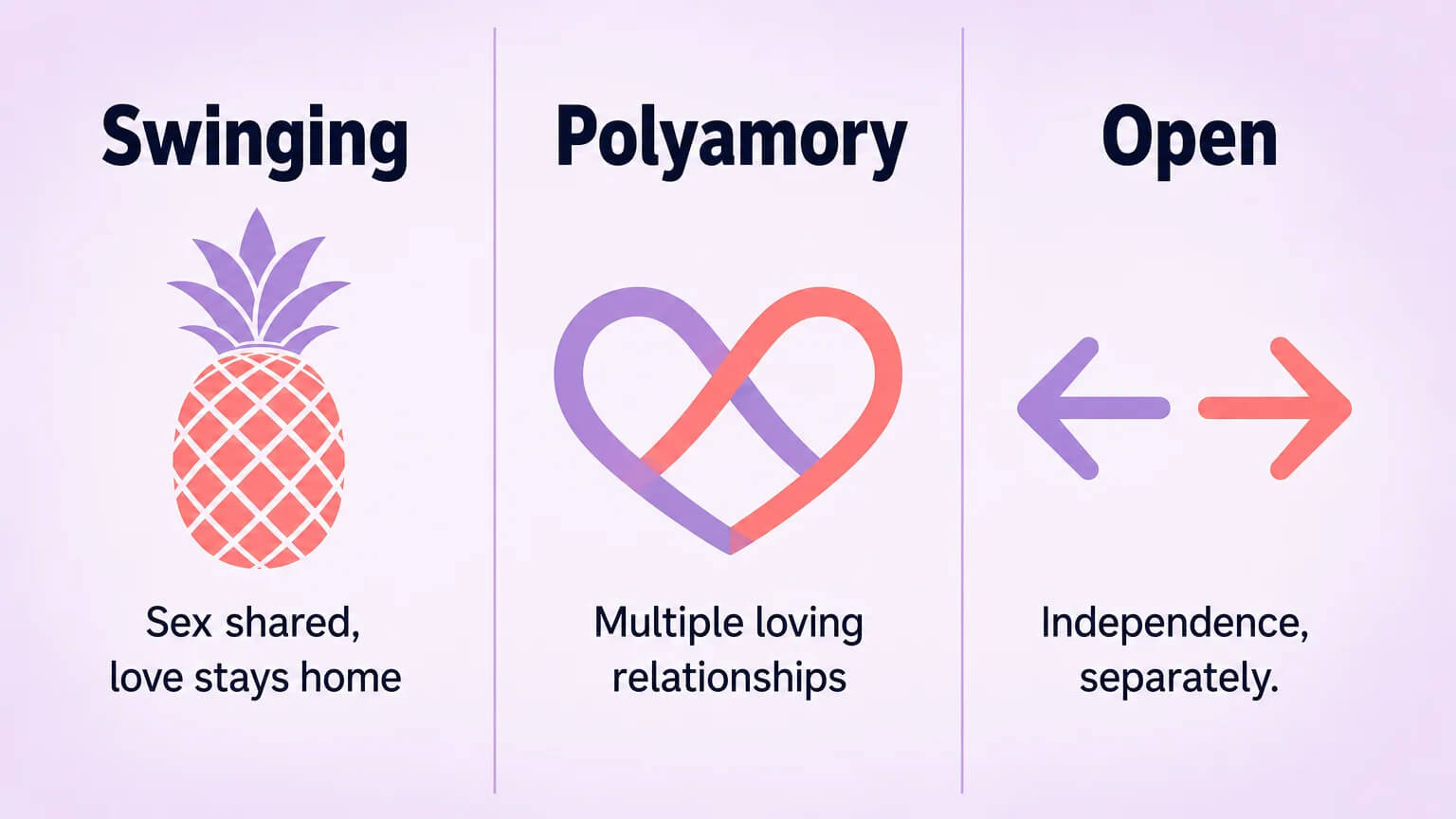
Swinging is couple-centric and sex-focused. The couple participates together at clubs, parties, cruises, and resorts. Emotional and romantic exclusivity with the primary partner is preserved. The pineapple symbol lives in this lane. Typical settings include lifestyle clubs, Bliss Cruise, Desire resorts, and dating platforms like SDC, Kasidie, and 3Fun.
Polyamory involves multiple loving, romantic relationships with emotional depth. Sex is optional and not the defining feature. The polyamory flag (blue, red, and black with a gold pi symbol) and the parrot or polycule symbols live here, not the pineapple. Typical settings include Feeld, OKCupid, polyamory meetups, and discussion groups.
Open relationships are romantically exclusive but sexually open. Partners date or have sex with others separately, not as a couple activity. This is individual exploration rather than a shared pursuit.
Why do these distinctions matter? A 2021 study published in the Archives of Sexual Behavior found that communication quality predicts relationship satisfaction across all consensual non-monogamy types. The model you choose matters less than how you communicate about it. Walking into a polyamory meetup expecting a swinger party, or vice versa, is the fastest way to create confusion and crossed signals. The vocabulary is not pedantry. It is the difference between finding your people and finding yourself in the wrong room.
If you are here because a pineapple caught your eye and made you curious, you are likely exploring the swinging lane. But knowing the full map lets you navigate intentionally rather than stumbling into a space that does not match what you actually want.
The Accidental Swinger: When You Do Not Know You Are Signaling
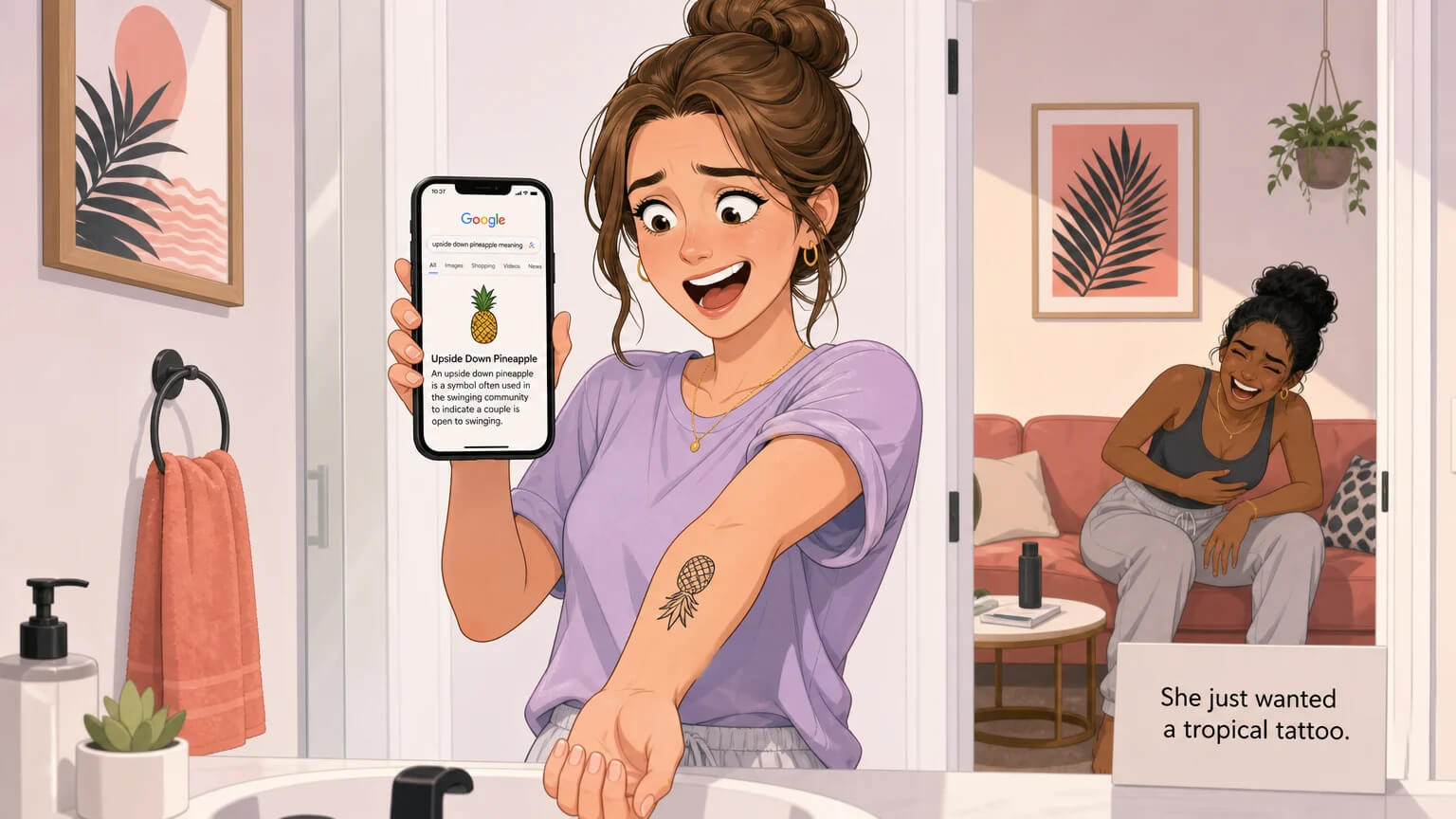
Brittany Lewin, from Queensland, Australia, got an upside-down pineapple tattoo on her forearm. She thought it was a “boss women” symbol. A friend texted to ask if she knew what she had permanently inked onto her body and suggested she Google it. Her viral TikTok showed her jokingly calling tattoo removal clinics. That is the permanent-consequence extreme of a surprisingly common phenomenon.
Ricky Bobby wore a yellow pineapple-covered shirt on a Carnival cruise and was repeatedly approached by strangers flirting with him. His embarrassed TikTok hit 18.7 million views as he filmed himself discarding the shirt. He had no idea the print was signaling anything.
Linda and her husband wore matching pineapple-patterned swimsuits on holiday because they thought the print was cute. They were confused why people were being “extra nice.” Her video reached 4.3 million views.
Cruise crew member Lucy Southerton once asked a couple wearing matching upside-down pineapple necklaces what the jewelry meant, expecting a sentimental story. They laughed and explained they were swingers and the necklaces were how other swingers identified them. She described it as an educational encounter.
A TikTok user’s mom tried to “correct” an upside-down pineapple sticker on a fellow cruiser’s door, innocently exposing the code to millions who had no idea what it meant.
None of them were signaling anything. The symbol did the signaling for them, without their consent.
The thread running through every story: context determines everything. A right-side-up pineapple is probably just tropical vibes. An upside-down one on a cruise ship door is probably a joke by someone who knows the meme. An upside-down one at a lifestyle resort is possibly genuine. A pineapple in someone’s kitchen wallpaper is almost certainly just decor.
These stories are genuinely funny. They also reveal something more serious: the code was designed to be discreet, and it is not anymore. If you are worried you have been accidentally signaling, a simple “I am not in the lifestyle, I just like pineapples” is sufficient. The community is trained to accept a graceful exit.
When a Secret Code Goes Mainstream: TikTok and the New Reality
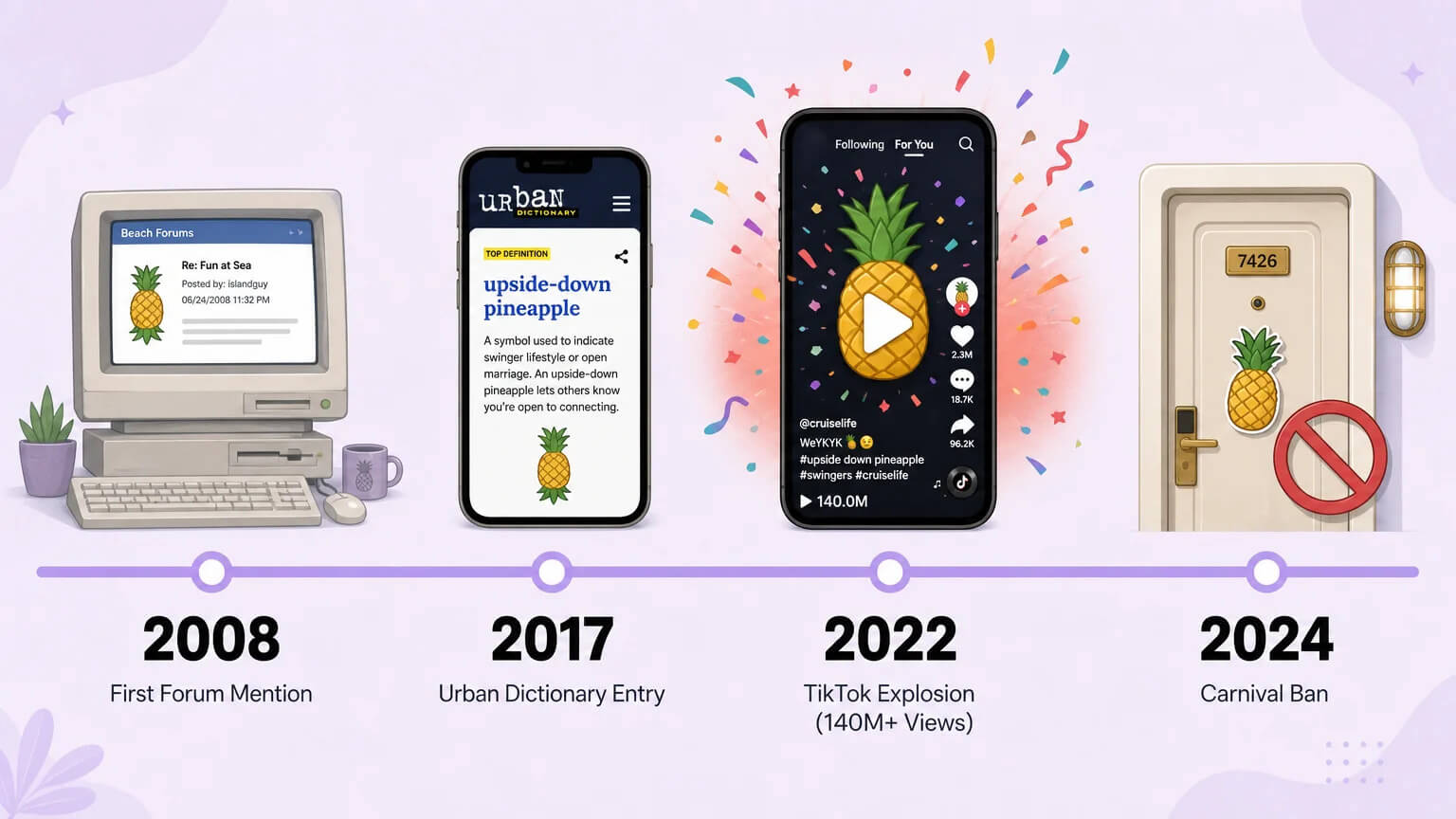
The pineapple was supposed to be a secret handshake. Then TikTok gave 140 million people the password.
The timeline is short enough to be jarring. Obscure forum mentions in 2008. Urban Dictionary codification in 2017. Then, on March 1, 2022, @webbnation22’s Airbnb doormat video exploded to 11 million views. Four months later, @mrmrsswing’s grocery cart video added another 6.8 million. The hashtag #UpsideDownPineapple rocketed past 140 million views. A quiet community signal had become a global punchline.
The institutional acknowledgment arrived in November 2024, when Carnival Cruise Line formally banned pineapple door decorations. Brand Ambassador John Heald announced the policy in a Facebook discussion. Crew will now remove pineapple items from any cabin door. Other major lines have not followed with formal bans but may remove decorations at their discretion.
The symbol also migrated in unexpected directions. In August 2024, TikToker Vivy Lin sparked a trend in Spain where singles flocked to Mercadona supermarkets between 7 and 8 p.m. carrying upside-down pineapples in their carts to signal they were looking to connect. Some stores hid their pineapples. The phenomenon was ironic and TikTok-driven rather than authentic, but it demonstrated how completely the symbol had detached from its community origins.
Community members express real concern about what this means. The symbol can no longer be assumed to be understood only by those inside the lifestyle. Prank misuse has become a problem. Trolls place pineapple stickers on random cabin doors, leading to mistaken assumptions. X user @SwirlingTheBowl, age 60, captured the generational shift perfectly: “I am today days old to discover that an upside down pineapple is a swinger symbol. I thought it stopped with keys in the key bowl.”
The community has not abandoned the pineapple. It has evolved into something between an inside joke, an ironic meme, and a still-functional, if less reliable, identifier. But the real adaptation happened elsewhere: the community moved toward private, direct methods of connection. Online groups, dedicated apps, club memberships. The symbol is now a conversation starter. It is not a contract anymore.
Beyond the Pineapple: The Full Landscape of Swinger Symbols and Where They Show Up
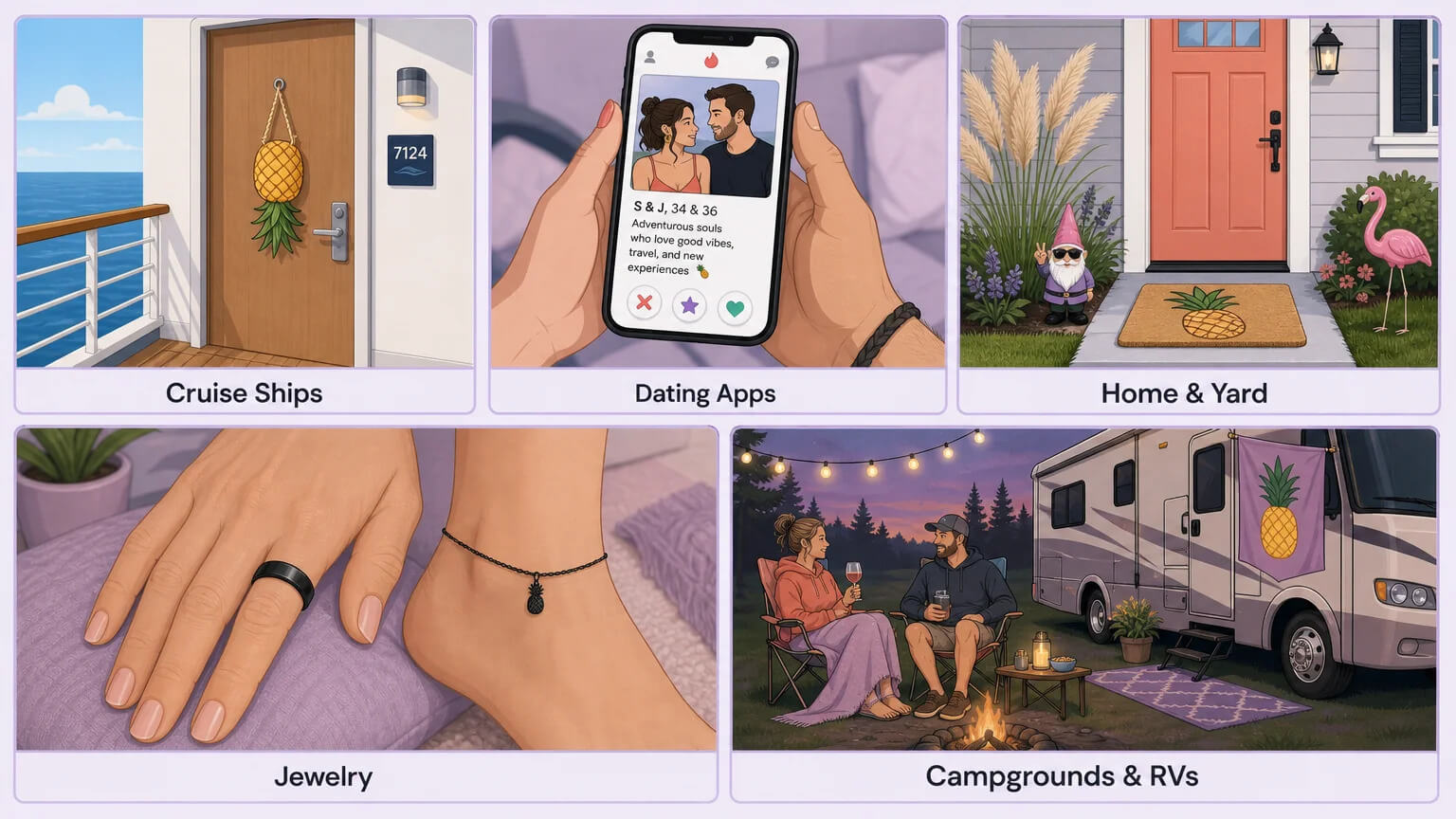
Knowing the pineapple is entry-level. Here is everything else, organized by where you will actually encounter these signals.
On cruise ships. Beyond the door magnet (which is largely folklore), some groups use color-coded loofah systems to indicate comfort levels, though this varies by community. Carnival banned door decorations in 2024. Lifestyle-specific cruises like Bliss and Temptation embrace them openly.
On dating apps. The pineapple emoji appears on Feeld, 3Fun, SDC, Kasidie, and even mainstream apps like Tinder and Hinge, often signaling a couple interested in welcoming a single guest. The unicorn emoji signals a couple seeking a single woman. These function as visual shorthand before any conversation begins. Swinger apps like 3Fun and Feeld build privacy into the structure. Features like hiding from Facebook friends and photo verification are standard.
In home decor and yards. Pampas grass fronds in front yards. White landscaping rocks around a mailbox or pathway. Garden gnomes, especially positioned with intention. Pink flamingos on lawns. Upside-down pineapple welcome mats and flags. All designed to be deniable as mere decoration to anyone not in the know.
As jewelry. A black ring on the right hand, worn on any finger except the middle. That distinction matters, because a black ring on the middle finger symbolizes asexuality. Anklets, toe rings, thumb rings, and pineapple-shaped jewelry work as everyday identifiers in vanilla settings: grocery stores, restaurants, workplaces.
At campgrounds and RV parks. Pineapple decorations, flamingos, and garden gnomes at RV sites extend the symbol beyond cruises to any leisure setting where the community gathers.
Gender dynamics shape every signal. A couple with a pineapple at a lifestyle resort is standard. A single woman seeks couples or singles. A single man faces the most skepticism and strict caps, sometimes as low as five per event. Dr. Ashley Thompson’s 15 years of swinger interviews found that 72 percent of the time, the husband introduces the idea. Once involved, women become the primary gatekeepers, controlling who plays and holding veto power.
The lifestyle lexicon, for quick reference. Unicorn: a single woman. Rhino: a single man. Mermaid: a married woman playing solo. Rainbow: open to everyone. DDF: drug and disease free. Soft swap: sexual activity without full intercourse. Full swap: partner exchange including intercourse. Parallel play: couples side by side without swapping.
How to Engage Respectfully: Etiquette for the Genuinely Curious
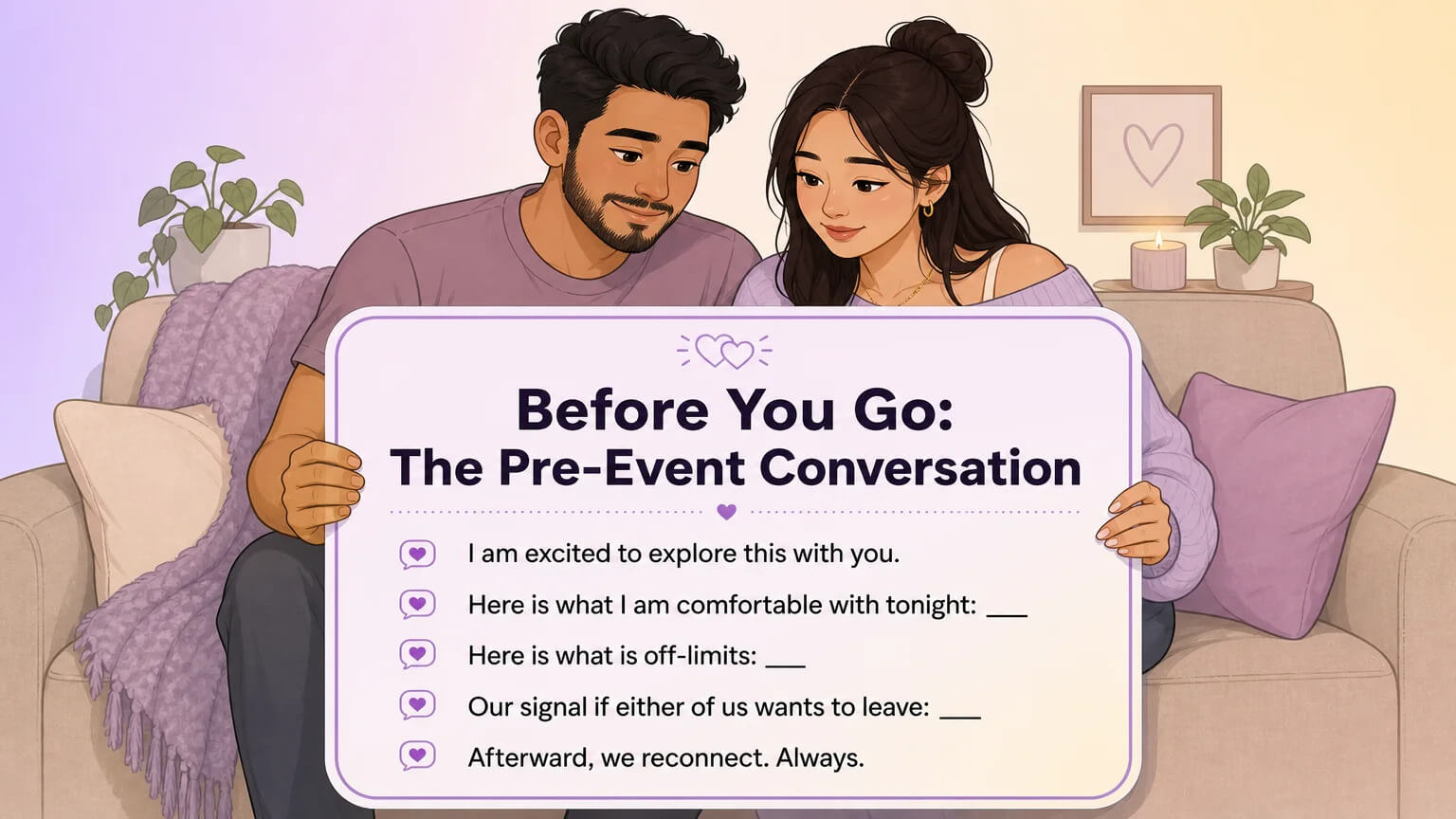
Curiosity is natural. Being the person everyone avoids is optional.
The Conversation With Your Partner
Research confirms it: the husband introduces the idea 72 percent of the time, but once the conversation begins, women become the operational and emotional gatekeepers of the experience. Wanting to explore is a sign of relational abundance, not lack.
Start with honest conversation, not pressure. Go slow. As the anonymous couple from Professor Melissa’s podcast put it: “Talk honestly with your partner, go slow, and do not pressure each other or yourselves.”
Bella and Jase’s most important lesson: focus on your own partner first. When they stopped hunting for play connections and focused on each other, every night got more fun and they found more play partners naturally.
Agree on boundaries before anything happens: safe words, comfort levels, soft or full swap, same-room only, protection always. No exceptions.
Expect jealousy. It is normal. The key is how you communicate through it. Name the feeling and talk through it.
Do not use the lifestyle to fix a struggling relationship. Swinging amplifies what is already there. Strong couples get stronger through vulnerability and deep conversation. Weak foundations get exposed.
Engaging the Community
When you are ready to engage beyond your relationship, the same principle applies.
Ask discreetly: “Are you in the lifestyle?” If they look confused, say “Ignore me” and walk away. Do not push. Do not explain. The exit is clean and expected.
Never approach someone’s partner without both present. This is non-negotiable. Group chats only when first connecting. Never message one-on-one without explicit agreement from everyone.
If declined, accept it graciously. The most successful people in the lifestyle know how to be kind even when declining, because nobody wants to hurt anyone’s feelings.
Respect the “no taking one for the team” principle. Both partners must genuinely want the interaction. If it is not an enthusiastic yes from everyone in the room, it is a hard no.
Modern lifestyle events have built substantial consent infrastructure: consent angels (volunteer safety monitors), strict caps on single men, and dress-down protocols. This is not the old stereotype of a free-for-all.
After playing with others, couples consistently report a surge of intimacy with their primary partner lasting about a week. Eye contact, check-ins, and post-connection debriefs are the rituals that bring you back to each other.
Quick Answers to the Questions Everyone Asks
Is the upside-down pineapple a real swinger symbol or just an internet myth?
Both. The symbol has genuine community roots dating to at least 2008, but its door-decoration use is largely folklore. Experienced lifestyle couples say they have never seen one used authentically. Most pineapple displays on cruise ships today are jokes by non-swingers who know the meme. Real lifestyle connections happen through private online groups and direct conversation, not door magnets.
What is the difference between swinging, polyamory, and open relationships?
Swinging is couple-centric and sex-focused. The couple plays together and preserves emotional exclusivity. Polyamory involves multiple loving relationships with emotional depth; sex is optional. Open relationships are romantically exclusive but sexually open, with partners dating separately. A 2021 study found that communication quality matters more than which model you choose.
Do cruise lines allow pineapple door decorations?
Carnival Cruise Line banned them in November 2024 and will remove pineapple items from cabin doors. Other major lines have not announced formal bans but may remove decorations at crew discretion. Lifestyle-specific cruises like Bliss Cruise and Temptation Cruises allow them, since the entire ship is a lifestyle event.
Can swinging actually strengthen a relationship?
For couples with strong communication, trust, and emotional foundation, yes. Academic research and firsthand accounts confirm the lifestyle amplifies existing dynamics. Strong couples get stronger through vulnerability and deep conversation. Weak foundations get exposed. The lifestyle should never be used to fix a struggling relationship.
What if I have been accidentally signaling without knowing it?
A simple “I am not in the lifestyle, I just like pineapples” is sufficient. The community is trained to accept rejection gracefully, and the standard recovery phrase is “Ignore me.” Context matters enormously. Right-side-up pineapples carry no swinger connotation in most settings. If you are genuinely concerned, avoid upside-down pineapples specifically in settings where the signal is most recognized: cruises, lifestyle resorts, and campgrounds.