
A bowl of car keys on a shag-carpeted floor. Leisure suits. The distant thump of a polyester decade.
That is the image most people carry when they hear the word “swinging.” It is a snapshot from 1974, frozen in amber, replayed by pop culture for fifty years. It has almost nothing to do with what swinging looks like today.
If you typed what is swinging into a search bar, you probably were not picturing key parties. You were picturing something closer to home. A quiet curiosity you have not said out loud yet. A question that surfaced during a conversation with your partner, or a thought that flickered past while scrolling something that made you pause.
This guide answers that question. No judgment. No recruitment pitch. No assumptions about where your curiosity leads. Just a clear, shame-free walk through what swinging actually is, how it works, and what it means for the people who do it.
A 2025 meta-analysis spanning 35 studies and nearly 24,000 participants found no difference in relationship satisfaction between consensually non-monogamous and monogamous couples. Wanting to explore is not a symptom of a broken relationship. It signals something closer to relational abundance: you have enough trust, enough security, enough curiosity to wonder what else is possible. That is not a deficit. That is a surplus.
What Is Swinging, Actually?
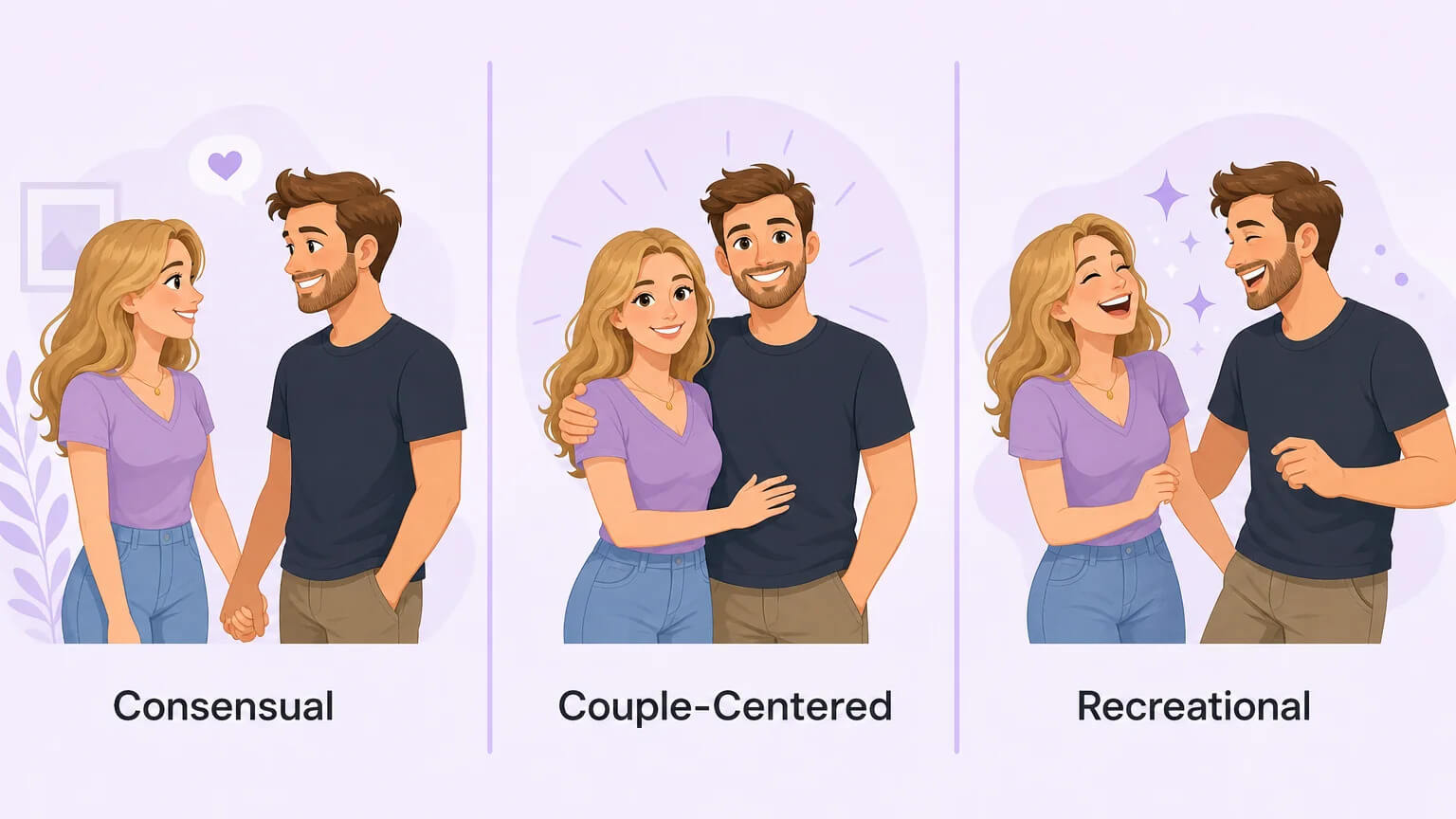
Swinging is a form of consensual non-monogamy (or ethical non-monogamy, ENM) in which couples engage in sexual activities with other people, together, as a shared recreational experience. Both partners know about it, agree to it, and participate at a level they have negotiated in advance.
That definition draws three clean lines around what swinging is and, equally, what it is not.
Swinging is consensual. This is the line that separates swinging from cheating. Both partners know, both partners agree, and both partners are present in the decision. There is no secrecy, no deception. As researcher Terry Gould put it, swingers “swing in order to not cheat.” The transparency is the point.
Swinging is couple-centered. The primary relationship stays the anchor. Couples swing together, whether that means being in the same room physically or sharing the experience afterward. The goal is not to replace the relationship. The goal is to share an adventure and return to each other.
Swinging is recreational. This is where it diverges from polyamory. Swinging is about sexual variety and shared erotic experience, not forming additional romantic partnerships. Dr. Janet Brito, a certified sex therapist, calls it “consensual nonmonogamy” distinct from both cheating and polyamory because the emotional structure is different: the love stays home.
Who swings? The demographic picture is shifting. The core of the community has historically been couples in their late 30s through late 50s, but younger cohorts are arriving in numbers that would have seemed impossible a decade ago. SwingHub reported its under-30 user base doubled. Killing Kittens, the UK-based lifestyle event brand, saw a 400 percent attendance increase. The Kinsey Institute found Gen Z is the most kink-adventurous generation on record. Swinging is not one generation’s thing. It never was.
Soft Swap, Full Swap, and the Spectrum In Between
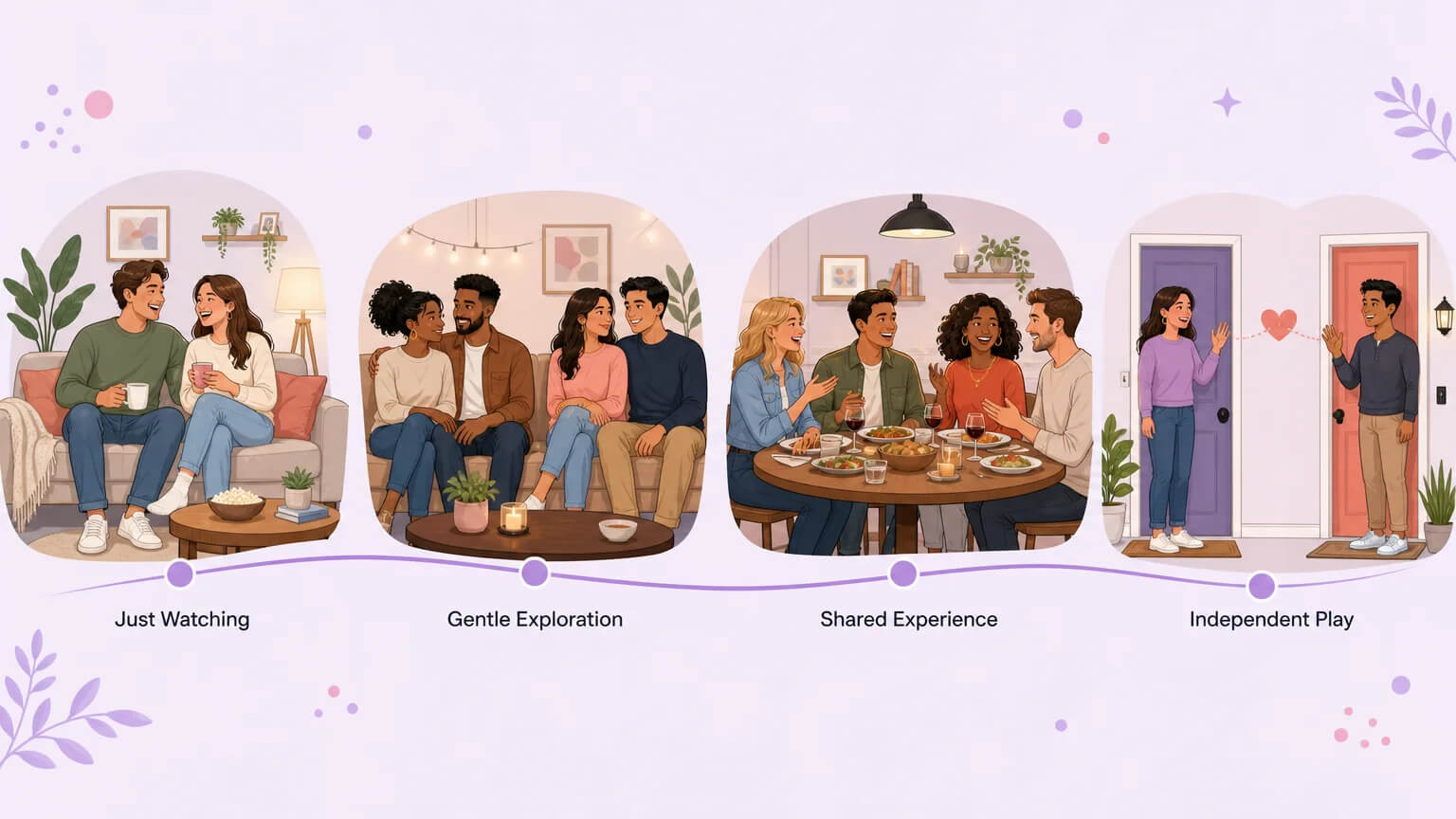
One of the first surprises for newcomers is that “swinging” is not a single activity. It is a spectrum, and most people who explore it spend years finding their preferred place on it.
Think of it less as a ladder you climb and more as a map you explore. No destination is mandatory. No checkpoint must be passed. You and your partner set the pace together.
Soft swap, the specific act of soft swinging, is the most common entry point. It includes kissing, touching, oral sex, and what is sometimes called parallel play: couples having sex next to each other without swapping partners. What it does not include is penetrative intercourse with someone outside your primary relationship. For many couples, this is not a stepping stone. It is the destination. They stay at soft swap indefinitely, and there is nothing incomplete about that choice.
Full swap includes all sexual activities, including penetrative intercourse with other partners. Some couples arrive at full swap quickly. Others take years. Many never go there at all. There is no hierarchy here. Wonder how soft swap and full swap differ from each other? check this: Soft Swap vs Full Swap: Which Swinging Style Actually Fits Your Relationship >>
Then there is the question of proximity. Same-room play means both partners are in the same physical space, able to see, hear, and stay connected to each other throughout. Separate-room play means each partner takes their encounter to a different space. Most couples start same-room and stay there; the visual and emotional tether is part of the point. Couples who eventually explore separate rooms typically do so after establishing deep trust and communication rhythms over months or years.
The only real mistake on this spectrum is doing something you are not both excited about. There is no graduation requirement, no external timeline. Green lights only require green lights from both of you.
Swinging vs. Polyamory vs. Open Relationships: What Is the Difference?
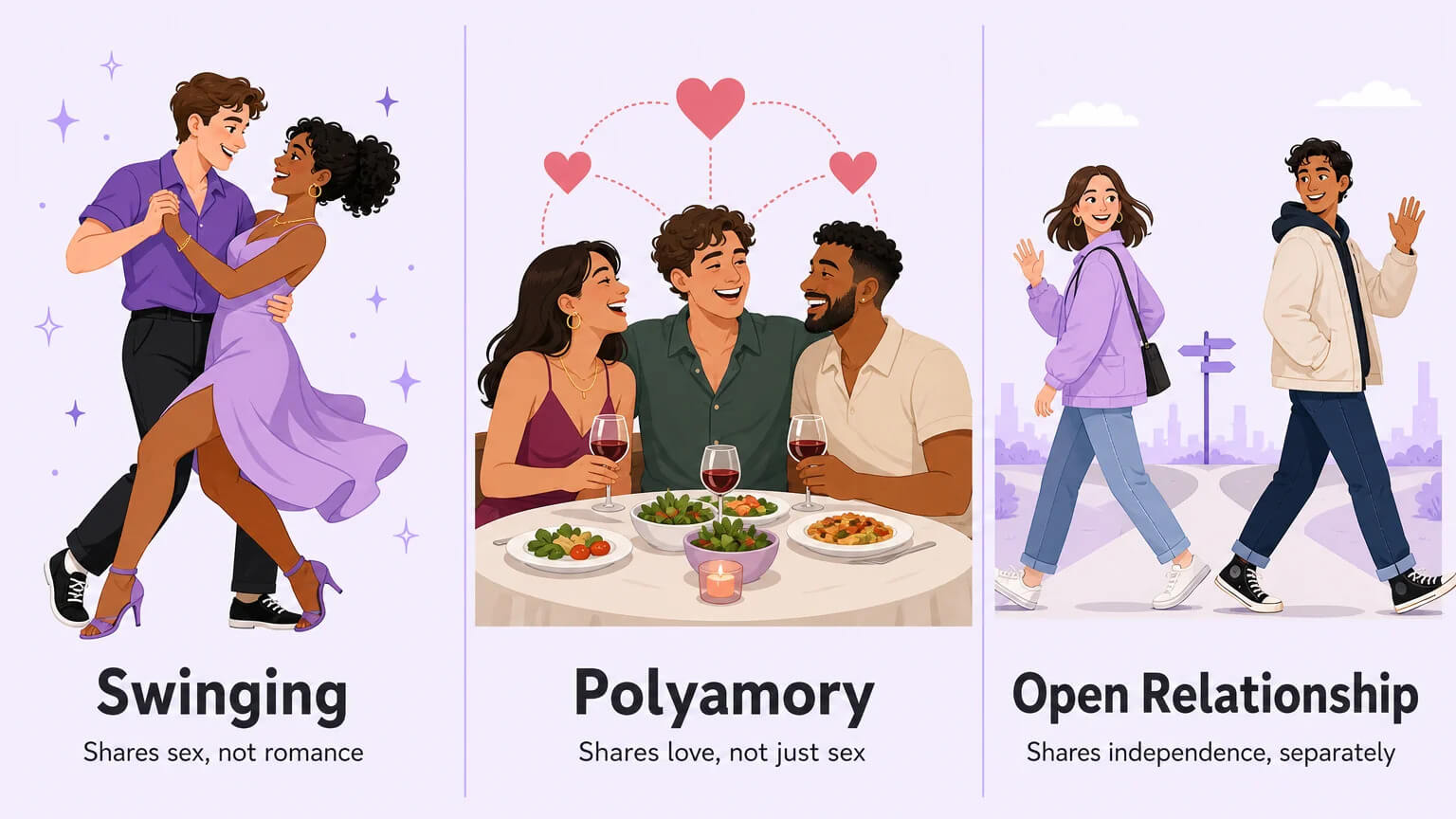
People mix these three terms up constantly. It matters because each structure solves a different set of desires, and walking into one expecting another is how people get hurt.
The core variable is what you are sharing.
Swinging shares sex, not romance. The emotional structure stays intact. Couples explore together, as a team, and the bond between them is the constant. New partners are welcomed into a shared experience, not into the relationship itself.
Polyamory shares love, not just sex. Polyamorous people form multiple romantic attachments simultaneously, with the full knowledge and consent of everyone involved. Each relationship may be emotionally complete in its own right. The goal is multiple loving relationships, each with its own depth.
Open relationships share independence, separately. Each partner typically pursues outside connections on their own, often with fewer shared experiences. The agreement is about freedom and autonomy: you do your thing, I do mine, and we come back to each other.
Short version: swingers share sex, polyamorous people share love, open-relationship people share freedom. All three approaches require communication, honesty, and clear agreements. They are not interchangeable, and knowing which one you are actually interested in is the first step toward not hurting anyone, including yourselves.
5 Myths About Swinging That Need to Die
Cultural stigma leaves behind a residue of bad information. Five myths in particular keep showing up. Each one falls apart under even basic scrutiny.
The first myth is the one that stings most: that swinging means your relationship is broken. The opposite tends to be true. A 2000 study found 60 percent of swingers said the lifestyle improved their relationship. Only 1.7 percent reported being less happy. Swinging does not fix broken relationships, but secure couples who open up tend to stay secure. The communication required to swing well often strengthens what was already there.
A second myth: swinging is just for older people. The median swinger might be in their 40s, but the fastest-growing demographic is under 35. SwingHub’s under-30 users doubled. Killing Kittens attendance rose 400 percent. Gen Z is the most sexually adventurous generation the Kinsey Institute has ever measured.
Then there is the orgy-with-strangers stereotype. Some swingers enjoy group play. Many do not. A large portion of the community only engages in soft swap, builds friendships before play, and treats clubs as social spaces first, sexual spaces second. That image is the 1974 key party in a new costume.
The myth about safer sex also crumbles against the data. 72 percent of swingers consider regular STI testing a community norm. Condom use for penetrative sex with new partners is standard practice at any reputable club or event. The community is not reckless. It has norms, and people who ignore them get sidelined fast.
Finally, the idea that swinging is only for heterosexual couples. The lifestyle has always had room for bisexual exploration, particularly among women, and acceptance of diverse orientations has only broadened. Bi-curious exploration is common and accepted. The community is not a monolith, and neither are the people in it.
How to Bring It Up With Your Partner (Without Making It Weird)

This is the hardest step. Harder than any club door, any first conversation with another couple, any negotiation of boundaries. Nothing in our culture has prepared you for it.
The fear is real because the stakes feel real. You are about to voice a desire your partner may not share, may not understand, may interpret as dissatisfaction with them. That is not a small thing.
The good news: the conversation itself, done well, is not a threat. It is an act of trust. You are choosing to share something vulnerable rather than hide it. That is the opposite of betrayal.
Pick the right moment. Not after an argument. Not during sex. Not at a family dinner. Choose a quiet, private time when neither of you is stressed, rushed, or distracted. A walk. A long drive. A lazy Sunday morning with coffee and nowhere to be.
Lead with curiosity, not demand. The words that open doors: “I have been thinking about something and I want to share it with you. There is no expectation here. I am not asking you to agree to anything. I just do not want to keep thoughts from you that I should be sharing.” This frames the conversation as disclosure, not negotiation.
Name the vulnerability. Say it out loud: “I am nervous saying this because I do not want you to think I am unhappy with us. I am. That is actually why I feel safe enough to bring this up.” This disarms the fear that your curiosity is a veiled complaint.
Do not expect an answer in the same conversation. Your partner has just received information they may have never considered. They need time to process. The goal of the first conversation is not a decision; it is an opening. Tell them: “I do not need you to respond right now. Take whatever time you need.”
Share information, not ultimatums. If your partner is curious but cautious, offer to learn together. Read articles. Listen to podcasts. Talk through hypotheticals. Psychotherapist Tammy Nelson puts it bluntly: “Talk about it to death.” Every conversation before any encounter is a layer of protection against the emotional complexity that follows.
Prepare for any reaction. Your partner might be curious. They might be hurt. They might be confused. All of those are fair responses. Your job is not to manage their reaction. It is to receive it without defensiveness and reaffirm that the relationship is the priority regardless of where this leads.
Reaffirm your relationship at the end. Close with something unmistakable: “I love you. I love us. That is not in question. If the answer is never, I can live with never. I just could not live with hiding a thought from you.”
One final note from Adam and Pris, the educators behind Beyond Monogamy: mutual desire is essential. You cannot talk someone into wanting this. Pressure is the “antithesis to pleasure.” If your partner is not interested, that is the end of the discussion. Swinging only works when both people are walking toward it, not when one is pulling the other.
Your First Steps Into the Lifestyle
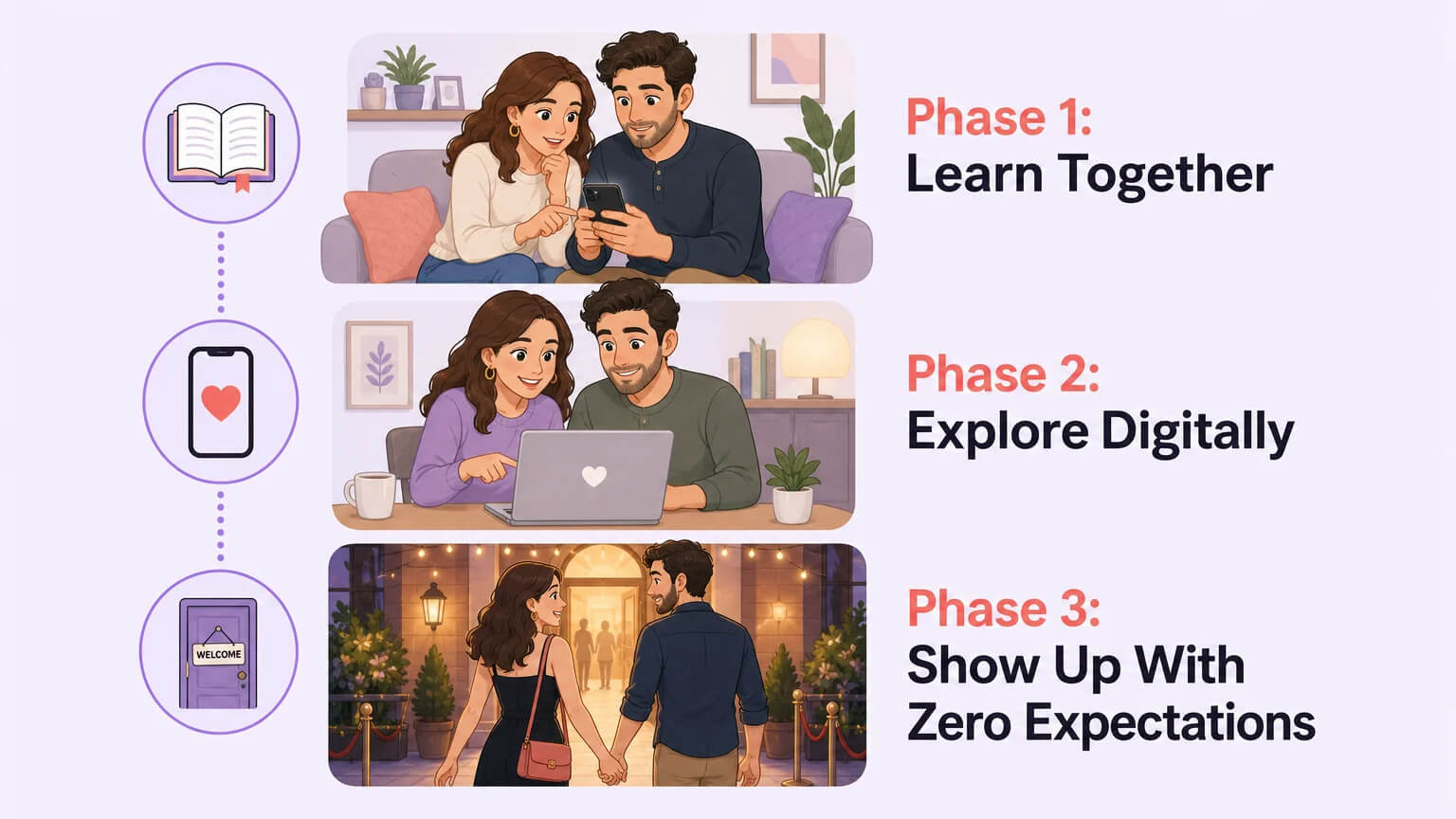
You have talked. You have read. You have agreed, tentatively or enthusiastically, that you want to explore. Now what?
The most important rule of your first step: you do not need to do anything. Showing up is the entire assignment. Every experienced swinger in the room remembers what it felt like to walk through a club door for the first time, and not one of them will judge you for simply being present.
Phase one is learning together. Before you go anywhere, build a shared knowledge base. Read articles and guides. Listen to lifestyle podcasts together and discuss what resonates. The point is not to become an expert; it is to create a shared vocabulary and surface each other’s reactions in a low-pressure environment. Notice what excites each of you. Notice what makes each of you uncomfortable. Both signals matter.
Phase two is exploring digitally. Create a joint profile on a lifestyle platform such as 3Fun, Feeld, SDC, Kasidie, or SLS. A joint profile signals to the community that you are operating as a team. Fill it out together. Choose photos together. Have conversations with potential matches together. The digital phase lets you test the social dynamics without the pressure of a physical encounter. You can practice how you describe yourselves, what you are looking for, and how you respond to interest from others, all from your couch.
Phase three is showing up with zero expectations. Pick a club night, a meet-and-greet, or a lifestyle social event. Before you go, agree explicitly: nothing happens tonight. You are there to watch, to feel the atmosphere, to meet people, and to leave together. This agreement removes the performance anxiety. You are not auditioning. You are tourists in a new city, and the only goal is to see if you like the neighborhood.
Before any first event, answer these questions together: What are we comfortable with tonight? What is completely off-limits? What is our signal if one of us wants to leave? What is our plan for reconnecting afterward?
The answers will change over time. The habit of asking the questions will not.
Swinger Etiquette: What Nobody Hands You a Manual For
Walking into a swinger club for the first time feels like landing in a country where you do not speak the language, and the community even has its own visual shorthand. The upside-down pineapple is the most famous example, though the real story behind that symbol is more nuanced than TikTok would have you believe. The good news: the language is learnable, and the norms are simpler than they seem.
Consent is everything, every time. Ask before you touch. “May I kiss you?” is not awkward; it is the standard. Dr. Jess O’Reilly, a sexologist who has studied lifestyle communities extensively, emphasizes that consent in swinging spaces is explicit and ongoing. A yes from five minutes ago is not a yes now. A yes to one activity is not a yes to another.
“No” is a complete sentence. Learn to decline gracefully: “Thank you, but we are going to pass.” No explanation required. Just as importantly, learn to accept rejection without pressure, visible disappointment, or follow-up negotiation. A “no” received with grace tells the room you are safe. A “no” received with a pout tells the room you are not.
Couples approach couples together. Do not separate a couple or corner one partner while the other is elsewhere. This marks you immediately as someone who does not understand the culture.
The practical stuff matters more than you would think. Most clubs publish dress codes. Follow them. They are part of the social contract, not suggestions. Phones stay away: no photos, no filming, no texting during play. Most clubs confiscate or sticker your phone at the door. Violating this gets you removed, possibly banned. Hygiene is non-negotiable: shower before you arrive, bring breath mints, bring a change of clothes. Many clubs have showers on site; use them between encounters. And do not get drunk. A drink to settle nerves is one thing. Impaired judgment is another. Consent requires clarity, and you cannot give or receive it if you are not fully present.
Do not spectate without consent. Watching is participation. If the event allows spectators, stay in designated areas. Do not hover, do not stare, and do not position yourself near active play without explicit invitation. Respect the space more broadly: clean up after yourself, follow the venue’s policies about where play is permitted, treat the staff well. The community is smaller than you think, and your reputation builds from your first visit.
Aftercare starts the moment you leave. The car ride home, the next morning, the check-in two days later; these are part of the etiquette too. How you treat each other after an encounter matters as much as how you treat others during it.
Safer Sex in the Swinging World
STIs exist in swinging. Anyone who tells you otherwise is either uninformed or dishonest. The numbers warrant a clear-eyed look, but the picture is not the free-for-all that outsiders imagine.
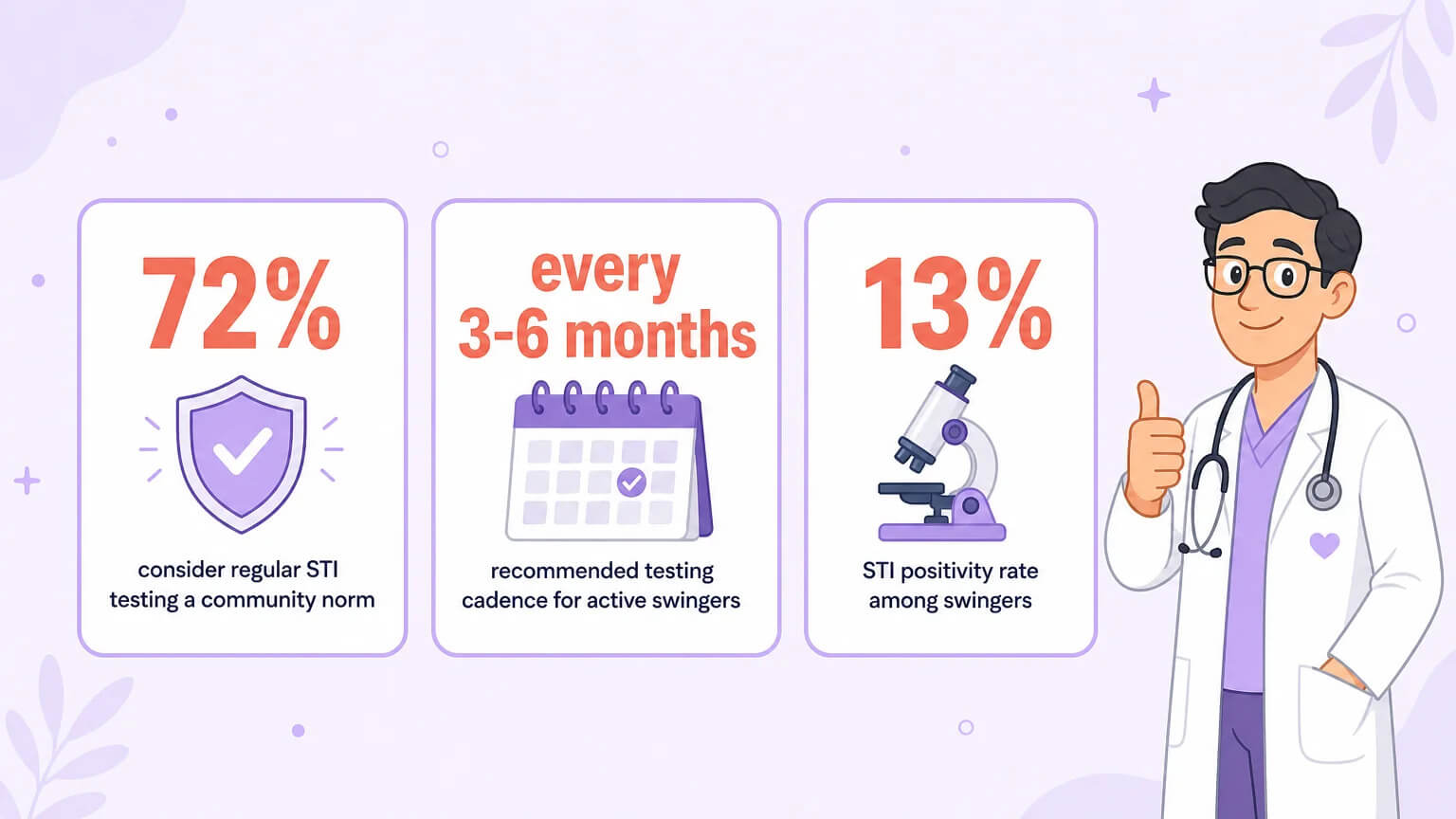
A Dutch study published in BMJ found a 13 percent STI positivity rate among swingers, and 57 percent reported not using condoms consistently. Those numbers are real. They also sit alongside another finding from the same study: 72 percent of swingers consider regular testing a community norm. The gap between the norm and the behavior is where the honest conversation lives.
Testing is the foundation. The standard recommendation is every three to six months, regardless of how many encounters you have had. Many STIs, including chlamydia in roughly 70 to 80 percent of cases, are asymptomatic. You cannot rely on symptoms to tell you when something is wrong.
Condom use for penetrative sex with new partners should be non-negotiable. Yes, sensation is reduced. Yes, it can feel like an interruption. These are real complaints. But the alternative is gambling with each other’s health. Most experienced swingers treat condoms as infrastructure, not an optional accessory.
Disclosure happens before clothes come off. Discuss recent testing, safer-sex preferences, and any relevant health information during the conversation phase, not in the heat of the moment. This signals competence and care, and it sets a standard others in the community will recognize.
One critical gap: only 56 percent of swingers self-identify as swingers when visiting STI clinics. If your healthcare provider does not know your full sexual landscape, they cannot screen you appropriately. Be honest with your doctor. They have heard far more surprising things than “my partner and I explore with other couples,” and the information matters for your care.
Physical safety is only half the equation. Emotional safety matters just as much. A condom protects your body. Communication protects your relationship. You need both.
The Morning After: Emotional Aftercare and Jealousy

Nobody warns you about Tuesday.
The event is Friday. The comedown is Saturday. The reconnection is Sunday. And then Tuesday afternoon arrives, and a feeling you cannot quite name settles into your chest. It is not regret, exactly. It is not jealousy, not in the way you have felt it before. It is just something. Heavy. Unnamed. Present.
This is the “drop,” and it is normal. The physiological and emotional high of a swinging experience is followed by a return to baseline, and the gap between those two states can feel like a loss even when nothing was lost. Naming this in advance is half the work of handling it.
Aftercare is the intentional process of reconnecting, communicating, and caring for each other after a swinging encounter. It begins the moment you leave the event and continues for days. Build from this debrief framework. Ask each other:
- What was your favorite moment?
- Was there anything that felt uncomfortable or off?
- Is there anything you want to do differently next time?
- What do you need from me right now?
- How are you feeling about us?
These questions are not a performance review. They are an invitation to be honest without fear of consequence. The goal is to catch small feelings before they become big ones.
Jealousy deserves its own attention because it will show up. When it does, treat it as information, not failure. Jealousy is not a stop sign. It is a dashboard light; it tells you where your emotional engine needs attention. Ask yourself: what specifically triggered this? Was it seeing your partner kiss someone? The way they looked at someone? Feeling left out of a moment? The more precise you can be about the trigger, the more actionable the conversation becomes.
Build a reconnection ritual. After every encounter, do something exclusively yours. Cook breakfast together. Take a long walk. Have slow, private sex that has nothing to do with anyone else. The ritual signals to your nervous system that the adventure is over and home is still home.
Pause when you need to. If aftercare conversations keep surfacing the same pain, or if one partner consistently feels worse after encounters than before, pause. Swinging will still be there in six months. Your relationship might not be if you ignore the signals.
FAQ
What is a unicorn?
A unicorn is a single person, typically a bisexual woman, who joins a couple for a shared sexual experience. The term exists because these individuals are sought after and uncommon. They are guests in your playground, not toys in your toybox. Treat them as full human beings with their own desires, boundaries, and agency.
Is swinging just for older people?
No. The core demographic has historically been 30s through 50s, but the fastest-growing cohort is under 35. Platforms like SwingHub and Killing Kittens report dramatic increases in younger attendance. Gen Z is entering the lifestyle in numbers that are reshaping the community.
Do swingers still love each other?
Yes. Swinging is a shared adventure that many couples report deepens their bond. The communication, transparency, and mutual trust required to swing well often strengthen the primary relationship rather than diluting it. A 2025 meta-analysis of 35 studies found no satisfaction gap between CNM and monogamous couples.
What happens at a swinger club the first time?
If it is your first visit to a swinger club, the most likely scenario: you will have a drink, talk to people, observe the atmosphere, and go home together. Most clubs have social areas separate from play areas. You are not expected to do anything. Saying “we are just here to check it out” is a complete and respected statement.
What are the biggest beginner mistakes?
Moving too fast, skipping the pre-event agreement conversation, drinking too much, assuming consent instead of asking for it, and treating single guests as props rather than people. The common thread: most beginner mistakes are failures of communication, not failures of character.
Can swinging work if one partner is more into it?
Enthusiasm asymmetry is common. The question is not whether the enthusiasm is perfectly equal. The question is whether both partners genuinely want to explore. If one partner is going along to make the other happy, that is not consent. That is pressure dressed up as agreement. Mutual desire is the foundation. Without it, nothing else holds.
What about religious couples?
Faith and swinging are not automatically incompatible. Many religious couples navigate this tension by separating spiritual commitment from sexual practice, or by framing their exploration as a private dimension of a marriage that remains sacred to them. The negotiation is personal and belongs to you, not to anyone else’s interpretation of your faith.
How do I know if swinging is right for us?
If you can talk about difficult things without falling apart. If you can hear “no” from each other without resentment. If you are both genuinely curious, not just one of you. If your relationship is already secure, not limping. And if you can sit with the possibility that the answer, after all the research and conversation, might still be “not for us.” The couples who do this well are the ones who know they will be fine either way.