You may have heard a lot about swinger signs. Most of it is wrong.
Here is the truth upfront: most people in the lifestyle have never placed an upside-down pineapple on anything. They connect the way everyone else does. Through apps, at clubs, through friends who know friends.
Physical symbols exist. The upside-down pineapple, the black ring, the pampas grass in a British front garden. These have real histories and genuine use within pockets of the community. But they are cultural curiosities, not the operating system. The actual networking happens on your phone, in the vocabulary people use, and in the spaces where the lifestyle gathers.
If you are curious about this world, the internet owes you better than a list of garden ornaments masquerading as a spotting guide. What follows is a tour of what is real, what is digital, and what is myth. You will learn the symbols the community actually recognizes, the app codes and vocabulary that matter, and the viral claims you can safely stop worrying about.
No surveillance framing. No gotcha lists. Just a clear look at how a misunderstood community communicates.

The Confirmed Symbols: Signs the Lifestyle Community Actually Recognizes
Not every symbol you have heard about is real. Of the dozens of supposed swinger signals circulating online, only a handful have consistent, cross-community recognition. These are the ones that people in the lifestyle, not TikTok commenters, confirm as genuine. We filtered out isolated anecdotes, viral fabrications, and signals that belong to entirely different subcultures.
Context still matters more than any single symbol. A pineapple means nothing without the setting around it. But if you are going to learn the language, these are the confirmed pieces.
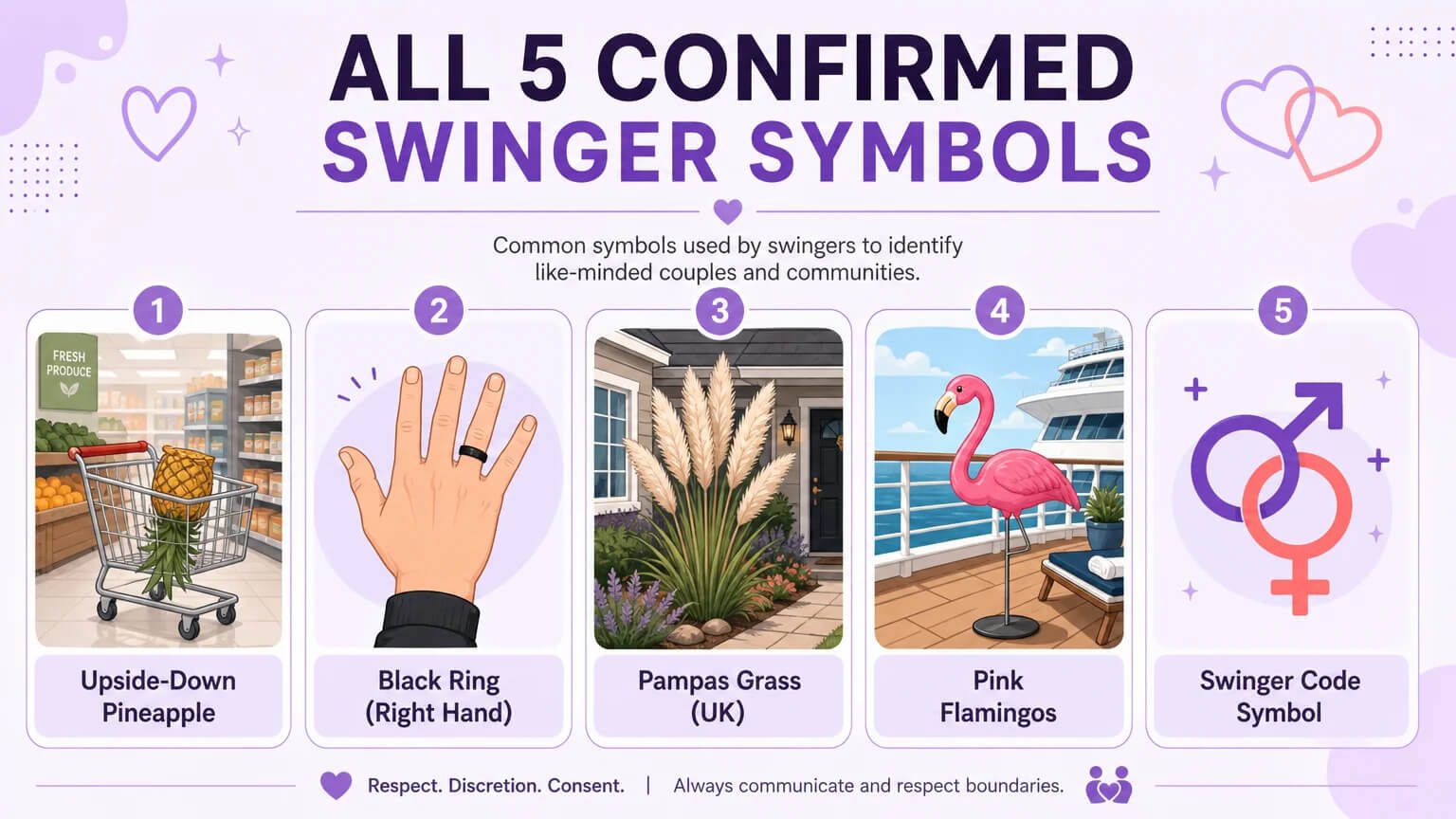
1. The Upside-Down Pineapple: The Universal Symbol (That Most People Use Innocently)
Yes, it is real. The upside-down pineapple is the closest thing the lifestyle has to a universal symbol. If you have heard of exactly one swinger signal, this is it.
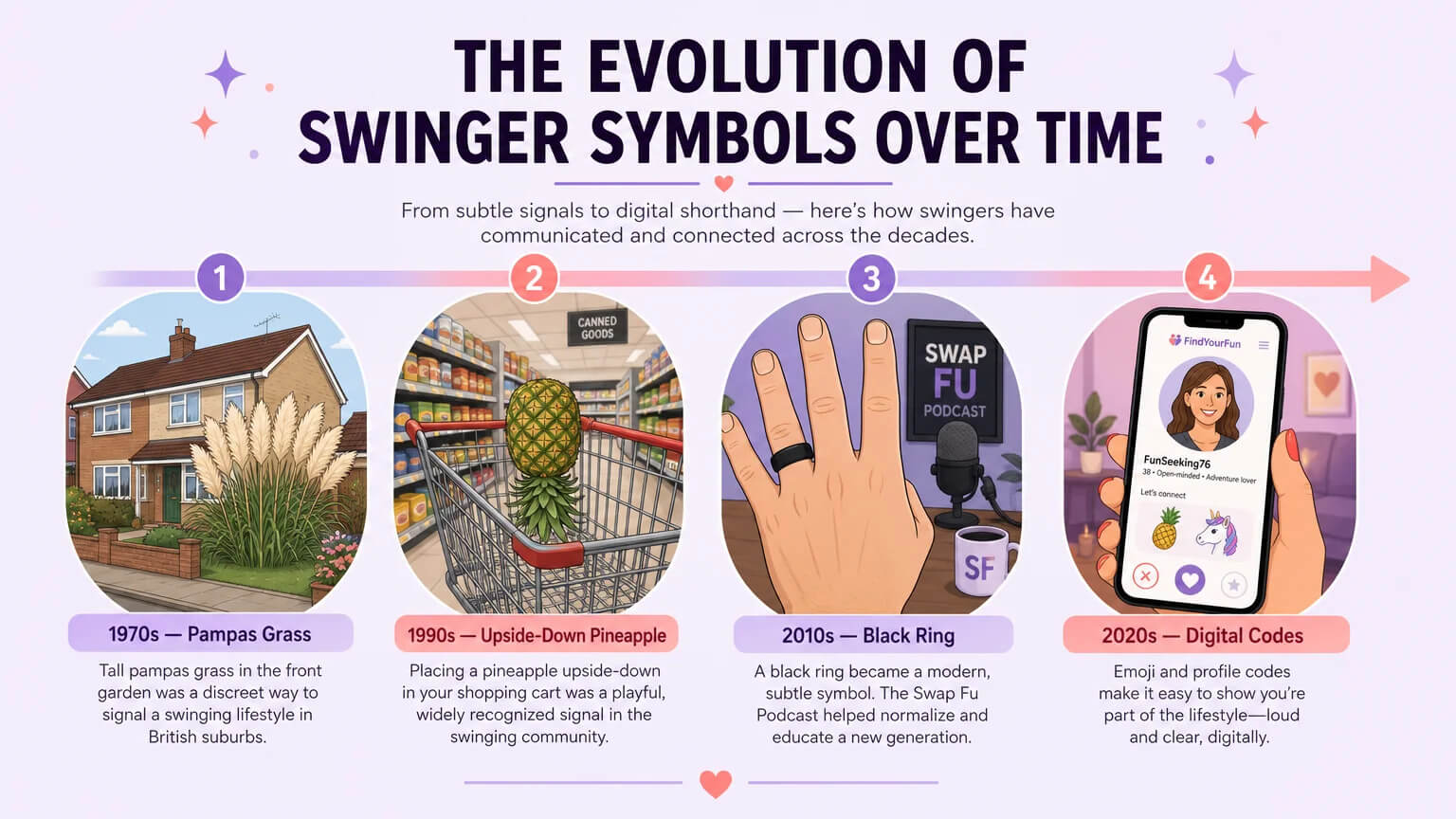
The origin traces back to the 1990s. Swingers would place a pineapple upside-down in their grocery cart. Discreet enough to escape a vanilla shopper’s notice, recognizable immediately to anyone who knew the code. From there it spread to cruise ship cabin doors, RV parks, clothing, jewelry, and eventually TikTok, where #upsidedownpineapple has racked up over 50 million views.
That virality cuts both ways. Carnival Cruise Line banned pineapple door decorations in late 2024. TikTok pranksters have made a sport of placing pineapple stickers on strangers’ belongings, generating awkward knocks on innocent cabin doors. A symbol built for quiet recognition has become too mainstream to function.
The short version: a pineapple at a family resort means nothing. A group of adults wearing upside-down pineapple gear at an adults-only resort tells a different story. We have a full deep dive on the pineapple’s history and cultural impact in our dedicated article.
On a cruise ship or at a lifestyle resort, the pineapple is worth a second look. At a suburban barbecue, the odds of a false positive are sky-high. Context decides which it is.
2. The Black Ring: The Most Practical Signal in the Lifestyle
If you take one practical signal from this article, make it the black ring. Unlike a plant in your front yard or a magnet on your cruise door, a ring travels with you. It goes on when you are open, comes off when you are not. To everyone outside the community, it is just a ring.
The rule: black ring on the right hand, on any finger except the middle.
That middle-finger exception matters. The asexual community has used a black ring on the right middle finger as their symbol since around 2005. The swinger community explicitly asks members to avoid that finger out of respect. Wear your ring on the index, ring, or pinky finger, and the two signals stay distinct.
The Swap Fu Podcast popularized the symbol, and Cooper Beckett, host of Life on the Swingset, later endorsed it with the community’s standard approach line: “I see you are wearing a black ring on your right hand. Maybe we are in the same club.”
Deniable if you misread the room. Respectful if the other person is not interested. Instantly clear to anyone who knows. That is everything a good signal should be.
The black ring is catching on precisely because it solves the problems that make household-object signals unreliable. You control when you wear it. You control which finger it sits on. And if someone does not know what it means, they will not give it a second glance.
If you are curious about signaling your own openness in public, start with a simple black band on your right ring finger. It is the easiest entry point the lifestyle has.
3. Pampas Grass: Britain’s Suburban Swinger Signal
If you grew up in Britain in the 1970s or 1980s, you knew what pampas grass in the front garden meant. You learned it on the playground, the same place you learned which words were swear words and which rumors about so-and-so’s parents were probably true.
The tall, feathery plumes signaled a discreet invitation. The homeowners behind that grass were, according to suburban folklore, open to swinging.
This was not idle gossip. Palmstead Nurseries in Kent saw pampas grass sales drop from 550 plants a year to 250. Bransford Webbs of Worcester stopped stocking it entirely. A suburban legend took a measurable bite out of a plant’s commercial viability.
Broadcaster Mariella Frostrup put it best: “Who knew that pampas grass plants are a signal to fellow swingers? Bought two and put them on my balcony. Neighbours have been swarming!” The short film PAMPAS (2018) by Jessica Bishopp dramatized the myth for a new generation.
Outside the UK and Ireland, the pampas grass association barely registers. In the United States, most people have never heard of it.
Here is the twist: pampas grass is making a comeback among millennials as trendy bohemian home decor. Most buyers are blissfully unaware of the plant’s risqué reputation. As one homeowner put it: “Do fear some older relatives and family members could be getting mixed signals.”
The verdict: a genuine signal in the UK, backed by decades of cultural reinforcement. Meaningless everywhere else. If you are British and over 40, the association is real. If you are anyone else, it is just a plant.
4. Pink Flamingos: The RV Park and Cruise Ship Code
The pink flamingo has lived many lives. Invented in 1957 by Don Featherstone as mass-produced lawn kitsch, it became an LGBTQ+ icon after John Waters’ 1972 film Pink Flamingos. Somewhere along the way, it picked up a third identity: a quiet signal among traveling swingers.
The flamingo’s swinger association concentrates almost entirely in RV parks, campgrounds, and on cruise ships. Nanci Dixon, a writer for RV Travel, got the explanation firsthand from a neighbor at an RV park: “The secret meaning is an invitation to swing.”
But where you see the flamingo is what decides whether it means anything. Many people in the lifestyle do not consider flamingos a reliable signal. Most pink flamingos are exactly what they look like: cheerful, tacky lawn ornaments with no hidden agenda.
The signal is only credible when other clues stack up. An adults-only setting. Multiple flamingos displayed prominently at a campground or on a cruise cabin door. Other lifestyle indicators nearby. These stacked signals matter.
One flamingo in a suburban front yard? That person just likes flamingos. You are reading decoration as declaration.
In an RV park or on a cruise ship where the traveling lifestyle community congregates, maybe pay attention. In a landlocked suburb, you are almost certainly looking at someone who just thinks flamingos are fun.
5. The Swinger Code Symbol: When Subtlety Is Not the Point
Not every swinger sign is a plant or a piece of fruit with a wink-and-nod backstory. Some are built to be read, not guessed.
The swinger code symbol is exactly that: interlocked male and female symbols with plus or minus signs on either side. Three plus signs mean you are looking as a couple. Three minus signs mean you are open to playing solo. Variants with different combinations signal different preferences, but the core idea is the same: more information, less ambiguity.
It appears on wristbands, pendants, and jewelry sold through lifestyle retailers. Less romantic than the pineapple, but also far less ambiguous. If you see someone wearing this symbol, there is no decoding required. They are telling you directly. At a lifestyle event or club, it skips the small talk and gets straight to what everyone is actually wondering.
Where the pineapple leaves you guessing, the code symbol is basically a nametag. Less charming, far more functional.
The Real Infrastructure: Digital Signals and Where Swingers Actually Connect
Physical symbols make for great conversation. But they do not reflect how most people in the lifestyle find each other, especially anyone under 50. Walk through a swinger club and ask how couples met. Almost nobody will point to a pineapple.
The real networking happens on your phone. Dating platforms built specifically for the lifestyle. Profile codes that signal intentions in seconds. A shared vocabulary that cuts through ambiguity faster than any door decoration ever could.
This is the part every other article skips. If you want to understand how the community connects, start here.
1. Dating App Profile Codes: Emoji, Acronyms, and the Digital Handshake
Walk into a lifestyle club and you might see a pineapple. Open a lifestyle dating app and you will see a language. The modern swinger signal is not a plant or a ring. It is a carefully written profile that communicates intentions in seconds to people who speak the code.
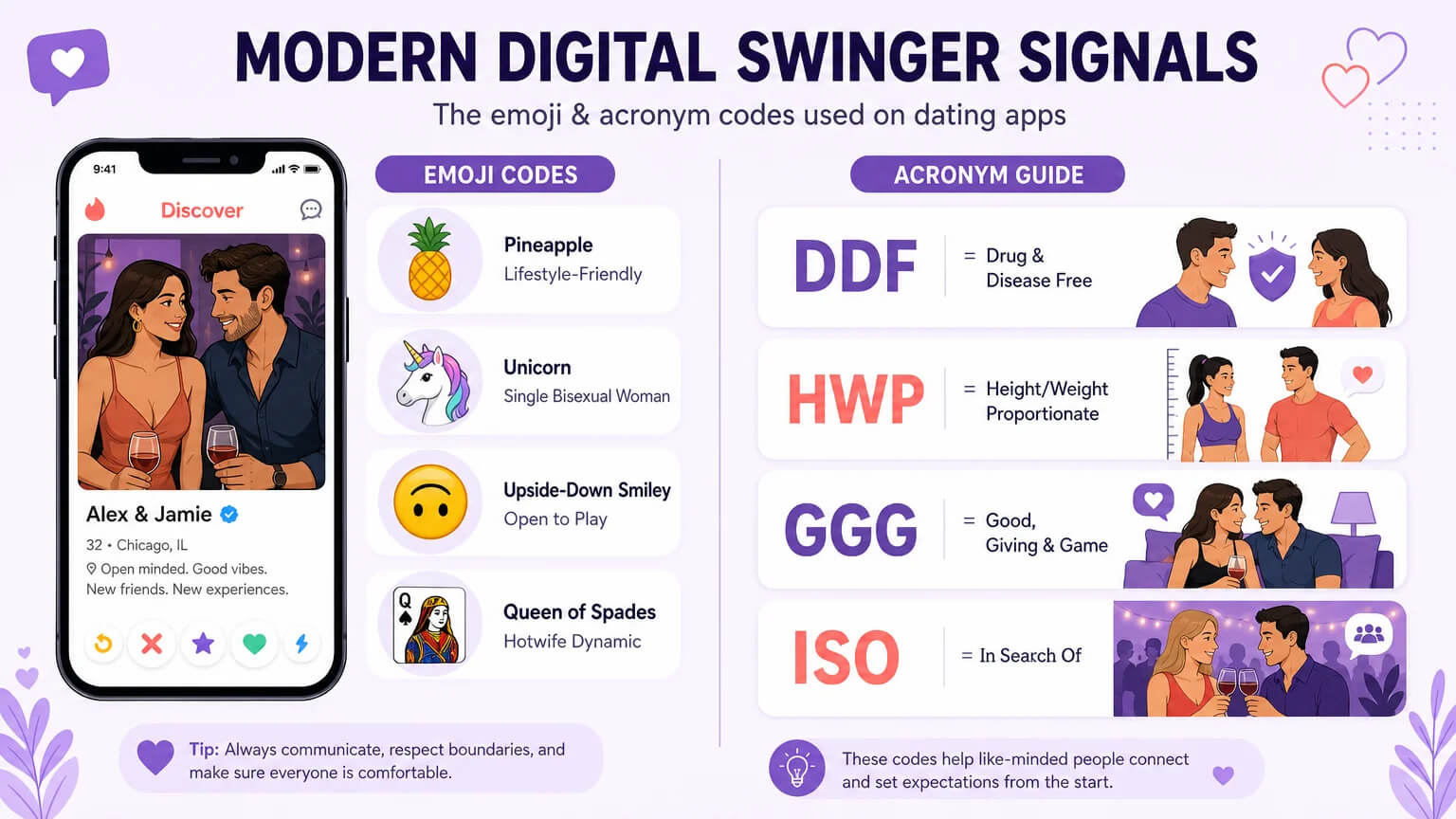
The emoji shorthand comes first. The pineapple emoji signals swinger or lifestyle-friendly and is the most common digital signal by far. The unicorn emoji means a single bisexual woman open to joining couples. The upside-down smiley plays on the pineapple’s orientation as a subtler wink. The queen of spades indicates hotwife dynamics specifically. The pineapple paired with arrows means open to swapping.
Then the acronym vocabulary. DDF means drug and disease free. Treat it as a baseline expectation, not a flex. HWP stands for height/weight proportionate. ISO means in search of. GGG, borrowed from Dan Savage, means good, giving, and game: sexually adventurous and considerate.
On dedicated lifestyle apps like Feeld and 3Fun, the platform itself does half the signaling. Just being there already communicates openness. You do not need a pineapple in your profile photo when the app name says everything. Explicit text descriptions still beat emoji codes every time. The emoji are conversation starters, not contracts.
If you are downloading a lifestyle app for the first time, learn these codes before you start swiping. It removes the guesswork and lets you read profiles accurately from day one. You will spot who knows the culture and who is just copying emoji they saw on TikTok.
2. The App Ecosystem: Where the Lifestyle Actually Lives Online
If you have been scanning yards for pampas grass and cruise doors for pineapples, you have been looking in the wrong places. The lifestyle’s networking happens on your phone.
SDC, Swingers Date Club, has been running since 1999 with over 3 million members across more than 50 countries. It is the established giant: a global directory of clubs, events, and travel listings. Kasidie skews toward the event-focused crowd with strong party and club listings. Feeld is the mainstream-facing option, popular with millennials and the broader ethically non-monogamous crowd. Less swinger-specific but with the largest user base of any platform in this space.
3Fun is the fastest-growing app built specifically for threesomes and couple connections, with joint profile features and location-based discovery. SwingHub is the newcomer, with mandatory AI-powered verification designed to eliminate fakes. That feature reflects how seriously the community takes safety and authenticity.
Beyond apps, the offline world is just as real. Swinger clubs host regular themed nights and welcome newcomers, often allowing first-timers to attend as voyeurs only with zero pressure to participate. Meet-and-greets happen at vanilla bars and restaurants: pre-arranged gatherings where no symbols are needed because everyone in the room is there for the same reason.
Dedicated cruises like Bliss Cruise and resorts like Hedonism II in Jamaica take the guesswork out entirely. If you are there, you are in the lifestyle.
If you and your partner are curious about exploring, download 3Fun or Feeld and create a joint profile. That single step will teach you more about how the community operates than a thousand hours of scanning for pineapples.
3. The Lifestyle Lexicon: Terminology Every Newcomer Should Know
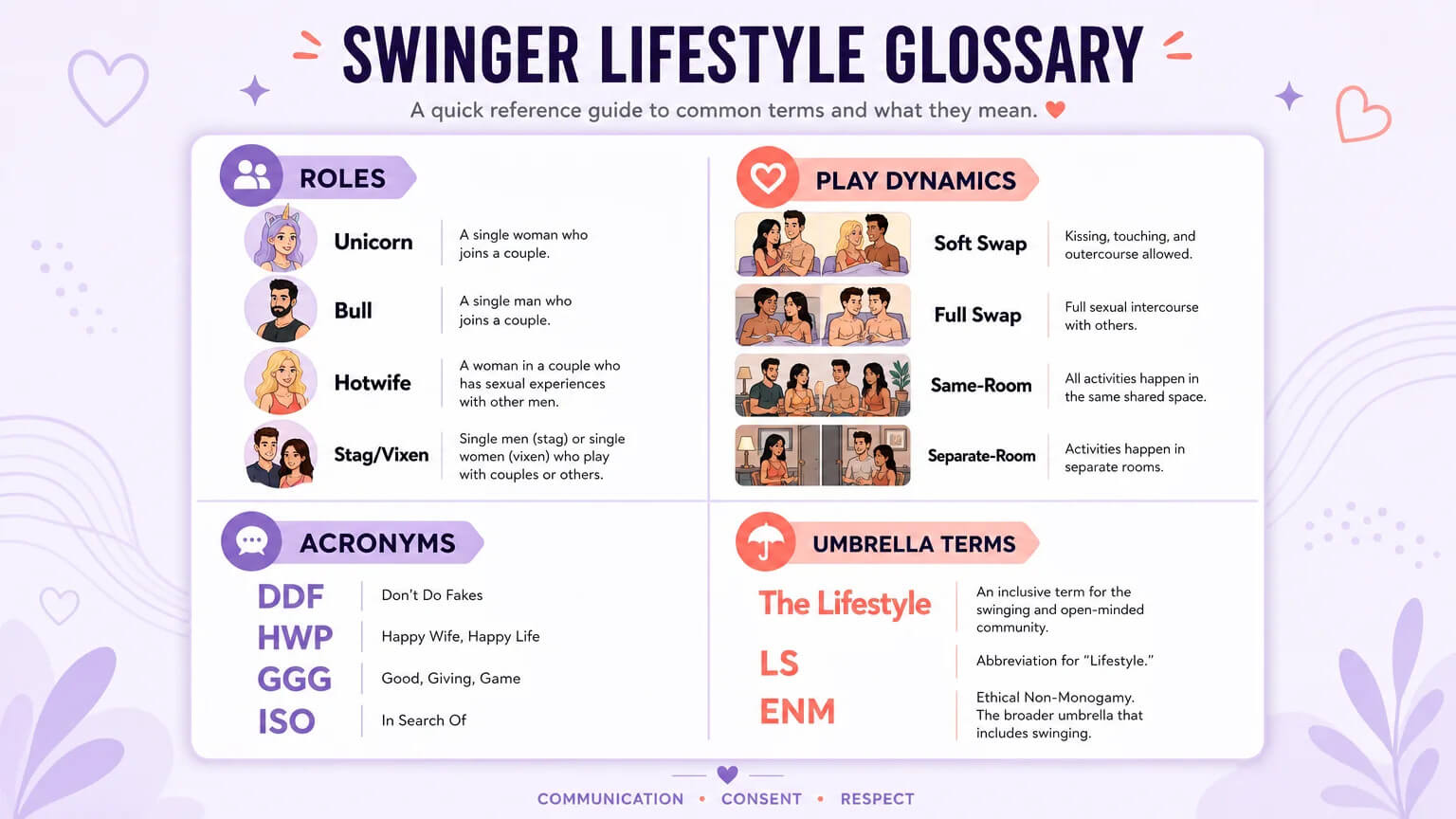
Before there were pineapples and black rings, there were words. The lifestyle’s vocabulary is its most functional signaling system. Drop the right term in conversation and you will either get a nod of recognition or a blank stare. Either way, you have your answer.
Start with the umbrella. “The lifestyle,” or simply “LS,” is how most people in the community refer to it. Nobody says “I am a swinger” the way nobody labels their orientation at a dinner party. “In the lifestyle” signals you know the culture, not just the stereotype.
Then the roles. A unicorn is a single bisexual woman open to joining an existing couple. Rare enough to earn the name, and a term that carries mixed feelings. Some embrace it. Others feel it reduces women to mythical creatures to be pursued. A bull is a dominant male, typically in cuckolding or hotwifing dynamics. Strong connotations, not a general swinger term. A hotwife is a married woman who plays with other partners with her husband’s knowledge and consent.
Stag and vixen describes a couple who plays together without the humiliation or power-exchange elements of cuckolding. The stag is confident, not submissive.
The play dynamics are where clarity matters most. Soft swap means kissing, touching, and oral sex with other partners but no penetrative intercourse. Full swap means penetrative sex with other partners. Same-room play means both couples stay together. Separate-room means they split up.
Then the practical shorthand that appears everywhere: DDF (drug and disease free), HWP (height/weight proportionate), GGG (good, giving, and game), ISO (in search of). These acronyms show up on app profiles, club listings, and event invitations. Learn them and you will read the room correctly from day one.
If you only internalize one section of this article, make it this one. Symbols come and go. The vocabulary is how the lifestyle actually runs. Learn the terms before you worry about the door decorations.
Symbols You Should NOT Misinterpret
For every real swinger symbol, the internet has invented five fake ones. Some started as jokes that got taken seriously. Others are isolated anecdotes that TikTok stretched into “secret codes.” A few belong to entirely different communities but got folded into the swinger-symbol mythology through sheer repetition online.
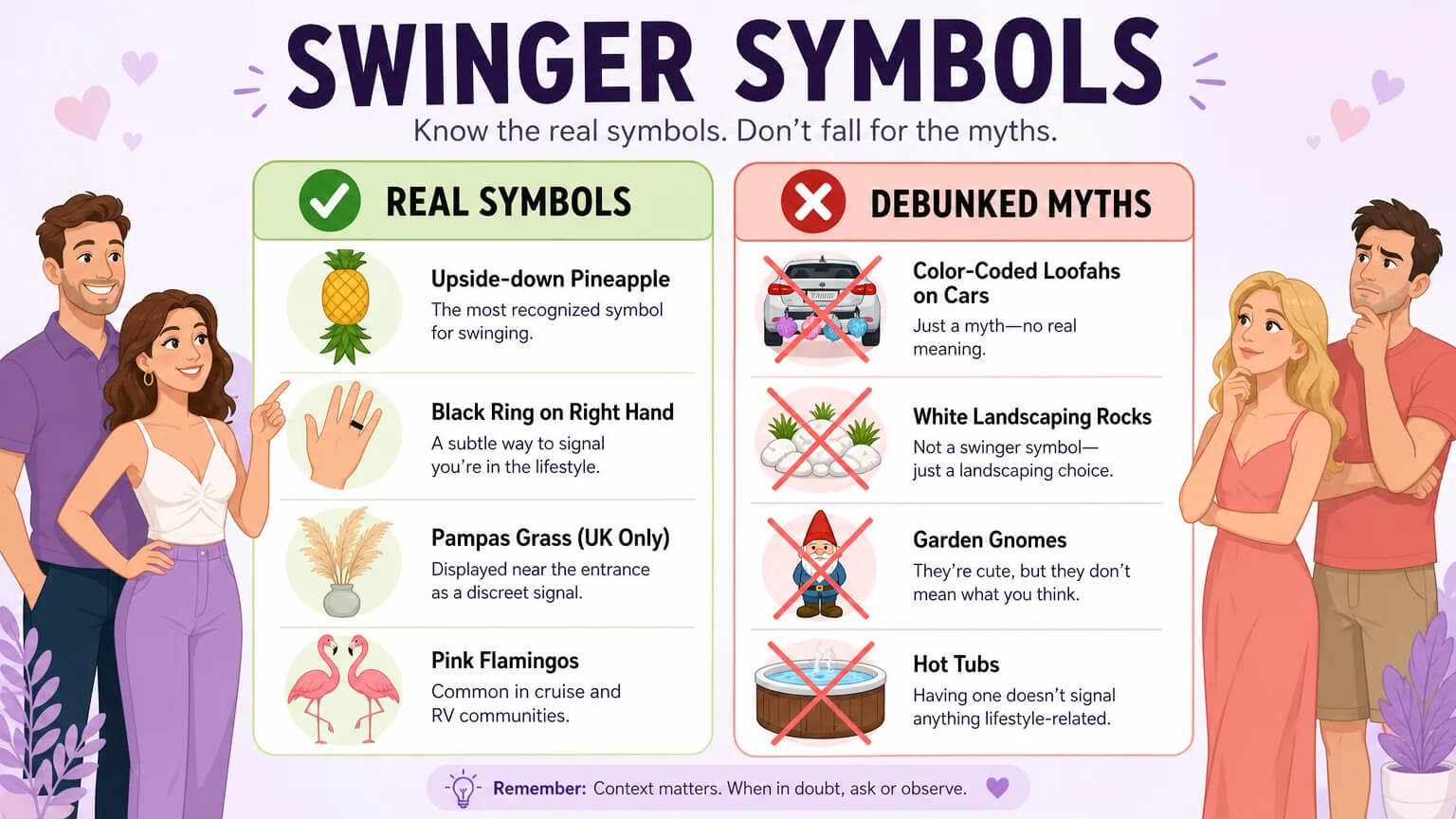
Before you start side-eyeing your neighbor’s garden gnome or your aunt’s loofah collection, here is what you can safely ignore, and why each one falls apart under scrutiny.
1. Niche Symbols That Belong to Other Communities
Not every symbol with a sexual subculture behind it belongs to swinging. Some of the most commonly misattributed signals have their own communities, their own histories, and their own rules. Confusing them is inaccurate and can be genuinely disrespectful.
The queen of spades, appearing on anklets, necklaces, earrings, and tattoos, signals a hotwife arrangement. Specifically, a woman, often white, who prefers or exclusively seeks Black partners within cuckolding or hotwifing dynamics. It emerged around the mid-2000s through internet forums and has drawn criticism within and outside the lifestyle for racial fetishization. It is a distinct subcultural marker, not a general swinger signal.
The bandana or hanky code belongs to an entirely different tradition: 1970s gay male leather and BDSM culture. Colors indicate specific fetishes. Black for S&M, dark blue for anal, light blue for oral, red for fisting. Pocket position signals role preference: left for top or active, right for bottom or passive. Larry Townsend’s The Leatherman’s Handbook II and a San Francisco shop called The Trading Post popularized the code. It occasionally appears in kink-aware swinger crossover spaces but is overwhelmingly an LGBTQ+ leather community tradition. Not a mainstream swinger identification system.
Anklets, toe rings, and thumb rings are frequently cited as swinger signals. Anklets worn on the right ankle supposedly indicate a woman is “taken but open to play.” Some lifestyle retailers sell specific swinger anklets, but adoption is minimal. Most people wearing anklets are not in the lifestyle. If this is the only signal you are going on, you are guessing.
Treat these as what they are: real signals from real subcultures that happen to be adjacent to swinging, not part of it. At a leather event, the hanky code matters. On a lifestyle app, seeing the queen of spades means something specific. In any other context, assume nothing.
2. The Myth File: Loofahs, White Rocks, Garden Gnomes, Hot Tubs, and Other Signals to Ignore
The internet loves a secret code. The problem is that most of the codes are not secret and not real. Here are the four myths that refuse to die, and the people who have debunked them.
The loofah color code. In 2023, TikTok exploded with claims that residents of The Villages, a massive 55-plus retirement community in Central Florida, were using color-coded loofahs on their car antennas to signal swinging preferences. White meant novice. Pink meant soft swap. Black meant full swap.
The reality, confirmed by residents and a former employee who worked there for three years: the loofahs are car identifiers. Period. “All the retirees drive similar cars and old gran can not go around the whole parking lot looking for her car.” The employee added: “I have NEVER once seen anything unseemly in the backseats of those cars.” The loofah code is a viral fiction.
White landscaping rocks. One gated community in Virginia, reportedly Lionsgate in Johnson County, allegedly used white rocks as a swinger signal. A 2008 blog post tracked the rumor and concluded it was “a mere myth born from suburban titillation.” White rocks are standard landscaping across millions of American homes. If they were a swinger signal, the entire suburban United States would be one giant orgy. They are not.
Garden gnomes. One San Diego realtor mentioned a “huge swinger community” in Carlsbad using gnomes as signals, and the internet ran with it. There is zero corroboration from the broader community. Gnomes are garden decorations. That is all they have ever been, and all they will ever be.
Hot tubs. A hot tub industry sales director told the New York Post directly: “The biggest misconception is that hot tubs are the preserve of swingers. They are bought by anyone and everyone.” This myth persists because hot tubs appear in swinger fantasies, not because they appear in swinger signaling practices.
Bonus round: large decorative metal stars on houses and oversized mirrors have both appeared in local radio segments as purported swinger signs. Both are single-source anecdotes with no community confirmation.
If you have been scanning your neighbors’ properties for loofahs, white rocks, gnomes, or hot tubs as evidence of swinging, you can stop. You have been reading fiction. The real signals are either more obvious (the apps, the clubs, the vocabulary) or more subtle (the pineapple in the right context, the black ring on the right hand). None of them involve garden supplies.
FAQ
Do swingers actually use these symbols, or is this all internet mythology?
Some are real but far less common than media suggests. The upside-down pineapple and black ring on the right hand are the most consistently confirmed. Pampas grass is widely believed in the UK, contested elsewhere. Loofahs, white rocks, garden gnomes, and hot tubs have all been overwhelmingly debunked. Most people in the lifestyle meet through apps, clubs, and events, not symbol recognition.
If I see an upside-down pineapple, should I approach the person?
Not based on that alone. Context is everything. At a family resort, a pineapple is almost certainly innocent decor. Even in adult settings, many people are unaware of the swinger connotation. The symbol has gone mainstream enough that people wear pineapple prints with zero hidden meaning. On cruise ships, pranksters put pineapple stickers on strangers’ doors. If you are genuinely interested, look for multiple corroborating signals and use a discreet, deniable opener. Never a direct proposition.
How do I tell the difference between a black ring for swinging vs. asexuality?
The asexual community uses a black ring on the right middle finger, their symbol since around 2005. The swinger community uses a black ring on the right hand on any finger except the middle. Middle finger means asexual. Do not approach with swinger intent. Any other right-hand finger could be a swinger signal or a fashion choice. When in doubt, use the community’s recommended approach line. It is deniable and respectful either way.
Is pampas grass really a swinger signal or just an urban legend?
In the UK, the association is deeply embedded in suburban folklore dating back to the 1970s, embedded enough to measurably impact nursery sales. One Kent nursery lost half its annual pampas grass revenue. Outside the UK and Ireland, the association is barely recognized. Millennials are now reviving pampas grass as trendy bohemian decor, most unaware of the history. In Britain, possibly. Everywhere else, it is just a plant.
What is the difference between the hanky code and swinger symbols?
The hanky or bandana code originated in the 1970s gay male leather and BDSM subculture, not in swinging. Colors signal specific fetishes: dark blue for anal, light blue for oral, red for fisting, black for S&M. Pocket position signals role: left for top or active, right for bottom or passive. While it occasionally appears in kink-aware spaces, the hanky code is an LGBTQ+ leather tradition, not a mainstream swinger identification system. Confusing the two causes real misunderstandings.
What are the modern digital signals swingers use online?
On dating apps, common signals include the pineapple emoji, unicorn emoji, upside-down smiley, and profile acronyms like DDF, HWP, GGG, and ISO. On dedicated lifestyle apps like Feeld and 3Fun, the platform itself signals openness. Explicit text descriptions are more common than emoji codes and leave far less room for misinterpretation. Some people list “LS” or “the lifestyle” in vanilla social media bios as a soft signal.
What is the most reliable way to know if someone is a swinger?
The only reliable way is if they tell you directly or you meet them through a lifestyle-specific channel: a swinger app, club, event, or dedicated cruise or resort. Symbols are inherently ambiguous with high false-positive rates. A pineapple t-shirt at a family resort means something entirely different from one at an adults-only resort. Direct, respectful communication beats symbolic guesswork every time. If you are curious, start with a joint profile on 3Fun or Feeld and attend a meet-and-greet. No symbols required.