
You may have caught the Mormon MomTok story: boundaries dissolved behind closed doors, headlines followed, and for a brief moment, partner exchange got shoved into the mainstream. But the quieter version happens at kitchen tables. Couples, sitting at 10 p.m., one of them finally saying it out loud: “What if there is a way to explore that does not mean going all the way?”
What is soft swinging? Non-penetrative partner exchange. Kissing, touching, and oral sex may be on the table, but vaginal and anal intercourse are not.
That leaves room for confusion, which is why the rest of this article exists. But the core is simple: you explore other bodies while keeping one particular line uncrossed.
What soft swinging is not: a sign your relationship is broken. A halfway measure for couples who cannot handle full swinging. Infidelity with permission. It requires the opposite: honesty, negotiated agreements, and two people choosing an adventure together. That last part matters more than the definition. The “together” is the whole point.
Before you can explore any of this with someone else, you need to be able to talk about it with each other. And before you can talk about it, you need words you both agree on.
Soft Swing, Soft Swap, Full Swap Parallel Play: Clearing Up the Terminology
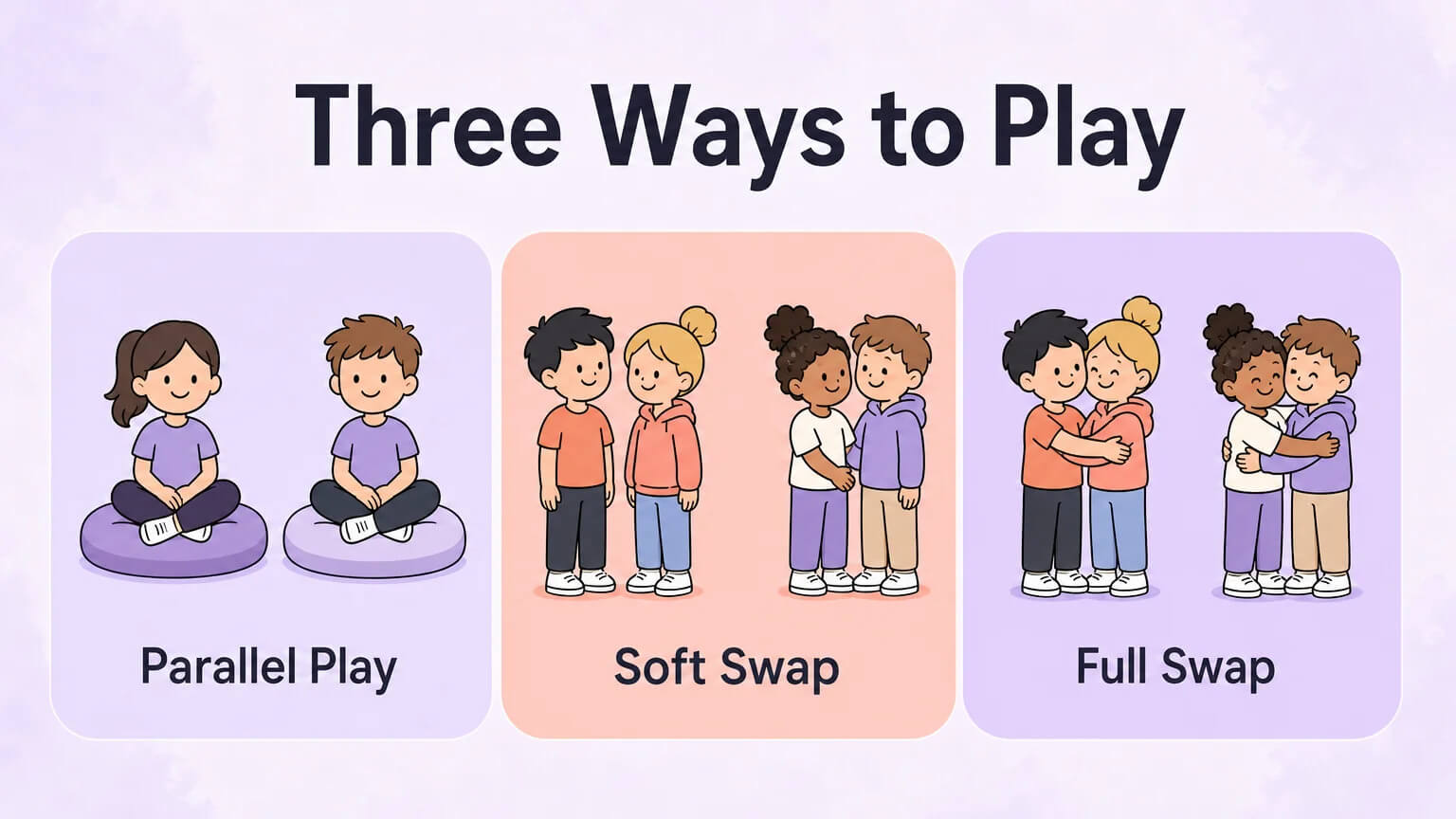
If you have spent five minutes in lifestyle forums, you have seen three different definitions for the same term. One person insists soft swinging means kissing only. Another says it includes oral. A third chimes in that if you are in the same room at all, you are swinging. The confusion creates anxiety, and anxiety kills conversations before they start.
Shared vocabulary is not academic. It is the difference between your partner nodding along and your partner actually understanding what you are proposing.
Parallel play: you and your partner having sex in the same room as another couple, with zero cross-couple contact. No touching, no kissing, no exchange. You see and are seen, but you stay with your own person. For many couples, this is the entire destination, and that is complete.
Soft swap: partner exchange with activities that stop short of penetration. Touching, fingering, hand jobs, oral sex. All potentially on the table. Vaginal and anal intercourse: not on the table. This is what most people mean when they say “soft swinging.” Partners cross the room. Bodies interact. The line at penetration holds.
Full swap: penetrative sex with partners outside your primary relationship. Some couples swim there happily. Some never want to. Both positions are complete.
Soft swinging is the umbrella term. Soft swap is the specific act within it. Parallel play is a setting on the dial. Same-room sex is a modifier, not a category. You can soft swap in the same room or in separate rooms. You can parallel play with another couple across the bed or across the room. The location is a preference.
One thing worth naming: some couples draw their line at kissing, not at penetration. Kissing can feel more emotionally intimate than oral sex. It is the thing you do with someone you love, not just someone you desire. If kissing feels like too much, that is not unusual. It is common enough that it deserves space in the conversation.
Nobody gets to tell you your definitions are wrong. If “soft swap” to you means kissing only and nothing below the waist, that is what it means. The vocabulary serves your comfort. Explain your terms clearly to potential partners and hold the line you drew.
The Soft Swinging Spectrum: Finding Your Comfort Zone Together
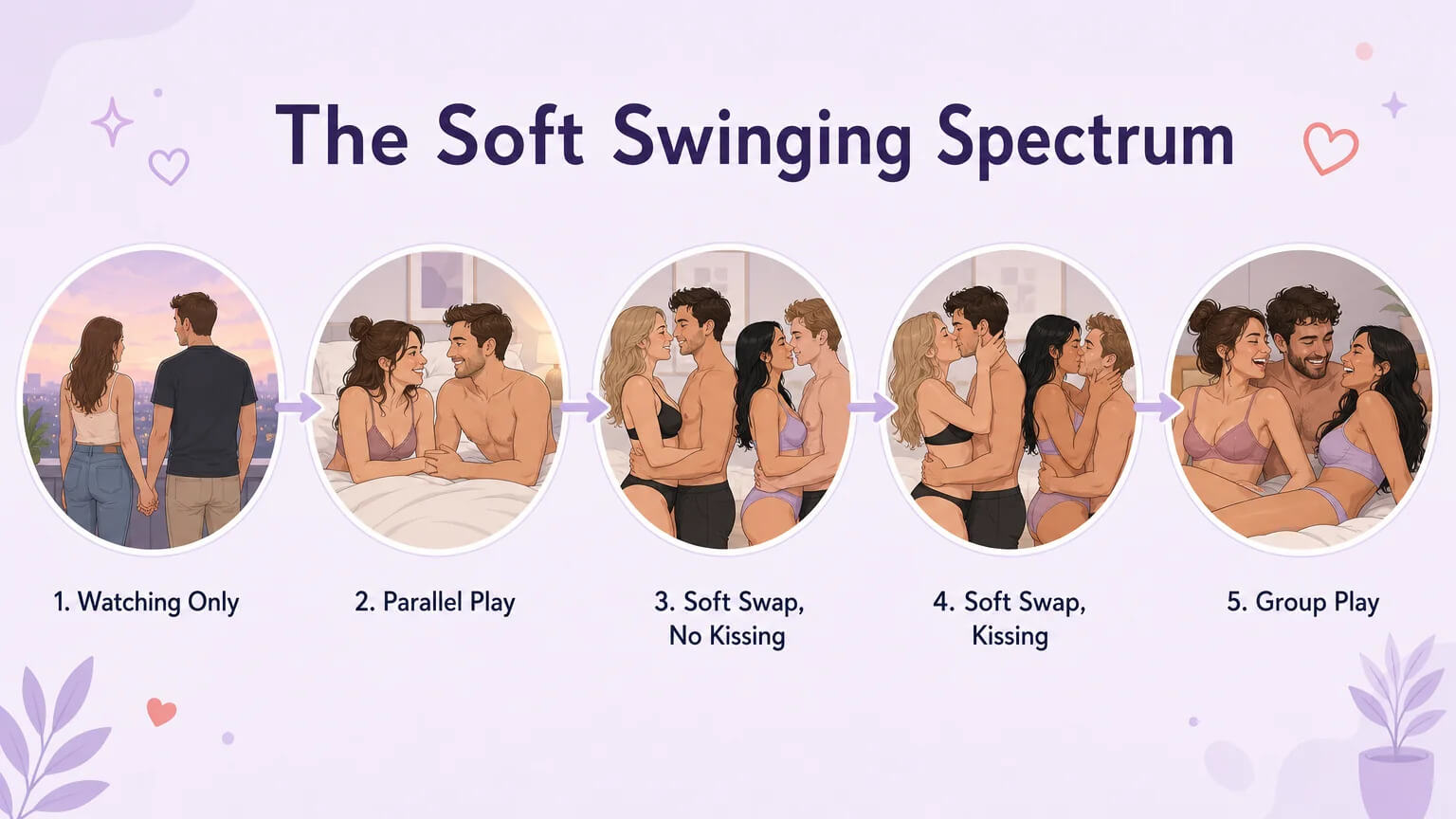
Soft swinging is a dial, not a switch. Nobody hands you a checklist at the door. You choose the intensity. You stay at the level that fits. And you can stop turning the dial at any point, permanently, with no explanation owed to anyone.
The spectrum, lightest to deepest.
Watching only. You attend a club or party with no participation. You observe. You absorb the atmosphere. You go home and talk about what felt electric and what felt like too much. This is research, not a lesser version of swinging. Good fit for couples who are curious but want zero physical involvement.
Parallel play. Same-room sex with your own partner. You feel the energy of another couple nearby without any cross-contact. The novelty comes through shared presence, not shared bodies. Good fit for couples who want to dip a toe without crossing a physical line.
Soft swap, no kissing. Partner exchange with touching and oral on the table, but mouths stay with primary partners. Physical exploration with an emotional guardrail intact. Good fit for couples who want the experience of exchange but need kissing to remain a private language.
Soft swap, kissing included. Full non-penetrative exchange, kissing among all the other activities. Good fit for couples secure enough that kissing no longer registers as a threat. For them, kissing is part of the experience, not a symbol.
Group soft play. Three or more people, all non-penetrative, everyone involved. No sidelines. Good fit for couples and singles who want a shared, overlapping experience where nobody is watching from the edge of the bed.
Same-room versus separate-room is a parallel decision that applies at any level. Some couples need the visual of each other nearby. Others prefer independence within agreed boundaries. Neither is more evolved.
Green lights count only when both of you give them. If one of you is at “watching only” and the other dreams of group play, you are at “watching only.” The person with the tighter comfort zone sets the pace.
Soft Swap vs Full Swap: Two Different Destinations, Not a Ladder
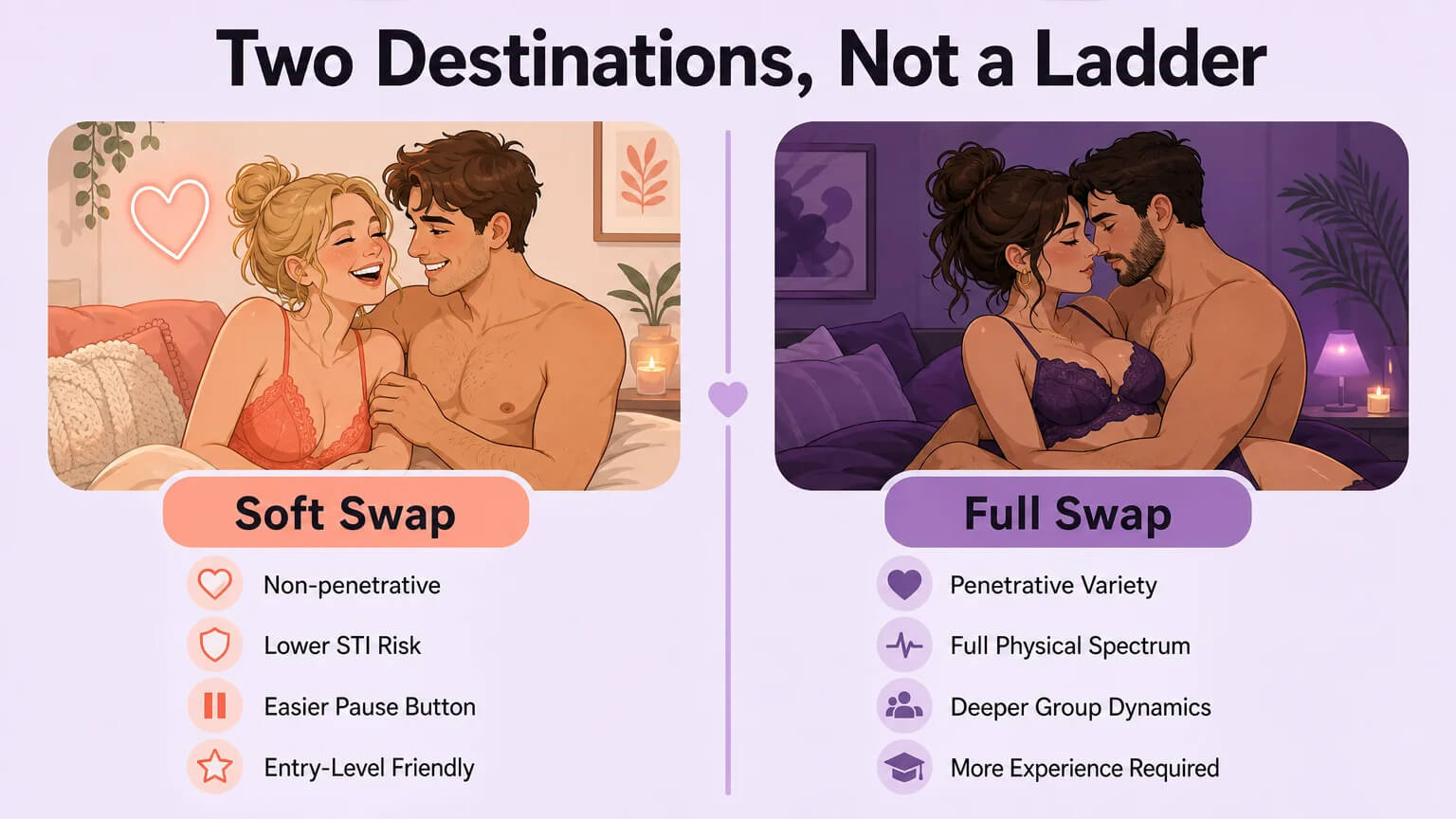
Some corners of the lifestyle treat soft swingers like they are not really swinging, as if non-penetrative exchange is just a waiting room for the main event. This is nonsense.
Soft swinging is a complete experience.
Full swap offers things soft does not. Penetrative variety. Certain group dynamics that require the full physical spectrum. For couples who want that, full swap is the right destination.
Soft swap offers things full does not. Lower STI risk, which matters. Simpler emotional terrain: penetration carries symbolic weight that oral and manual stimulation often do not. An easier pause button. Stopping mid-encounter stays clean when the line is “we do not cross this line.” More room to adjust in real time without anyone feeling rejected. And perhaps most importantly: a lower barrier to entry that lets curious couples test the water without committing to the deep end.
Neither is a promotion. Neither is a demotion. They are different products for different customers, and the customer who wants soft swap is not a customer who has not matured into full. They are a customer who looked at the menu and ordered what they wanted.
The primary demographic for soft swinging is committed couples aged 25 to 45. These are not people who have not graduated yet. They have careers, mortgages, children, and a relationship they value enough to protect while exploring. They are not climbing a ladder. They are furnishing a room.
Boundary drift happens. Some couples start soft and later want more. That is fine. What matters is that it becomes a new conversation, not mission creep. You do not slide from “oral only” to “well, we were in the moment.” You pause, go home, talk, and decide together whether the line moves. If it moves, it moves because you both pushed it, not because one of you drifted past it.
The only wrong speed is one neither of you chose.
How to Bring Up Soft Swinging With Your Partner (Without Making It Weird)

This conversation feels high-stakes because it is high-stakes. You are about to tell the person you love that you have thought about being sexual with someone else. Even inside the frame of “with you, together,” that is a vulnerable thing to say. The nerves are not a flaw. They are the appropriate response.
Some things that help.
Timing matters. Not after sex, when endorphins are still talking. Not during a fight, when trust is thin. Not at a family dinner. Choose a neutral, private moment when you are both relaxed. A walk. A long drive. The couch on a quiet Sunday. Frame it as “I have been curious about something and I wanted to explore it with you,” not “I have a proposal.”
Lead with the relationship, not the activity. Anchor in what you already have: “You and I are solid. This is not about something missing. It is about something we might discover together.” Your partner needs to hear they are not being replaced or found insufficient. The relationship is the point. The exploration serves it.
Ask before you tell. “Have you ever thought about what it would be like to explore with another couple, even just in the same room?” Let them react before you pitch. Their face will tell you more than their words. If they tense up, slow down. If they lean in, you have room.
Share what appeals to you, not what you want them to do. “I think I would find it exciting to be in that environment with you” invites. “We should try a club sometime” pressures. One lands differently.
Leave room for a no, and mean it. “If this never goes anywhere beyond this conversation, I am still exactly where I want to be.” If you cannot mean it, you are not ready to have the conversation.
Three scenarios, three scripts.
The curious-but-hesitant partner: “I hear you. I think I might be open to learning more, but I need to go slow. Can we read about it together first?” Your move: “Absolutely. There is no clock on this.”
The “absolutely not” partner: “I do not think I could ever share you.” Your move: “Thank you for being honest. That door is closed unless you decide to open it.” Then close it. Do not prop it open with your foot.
The “I thought I was the only one thinking about this” partner: “Wait. You too?” Your move: smile. Then get to work on the agreements section.
The goal of this conversation is not a yes. It is that your partner knows they are your person, and curiosity does not threaten that.
Building Your Shared Framework: Agreements That Keep You Both Safe
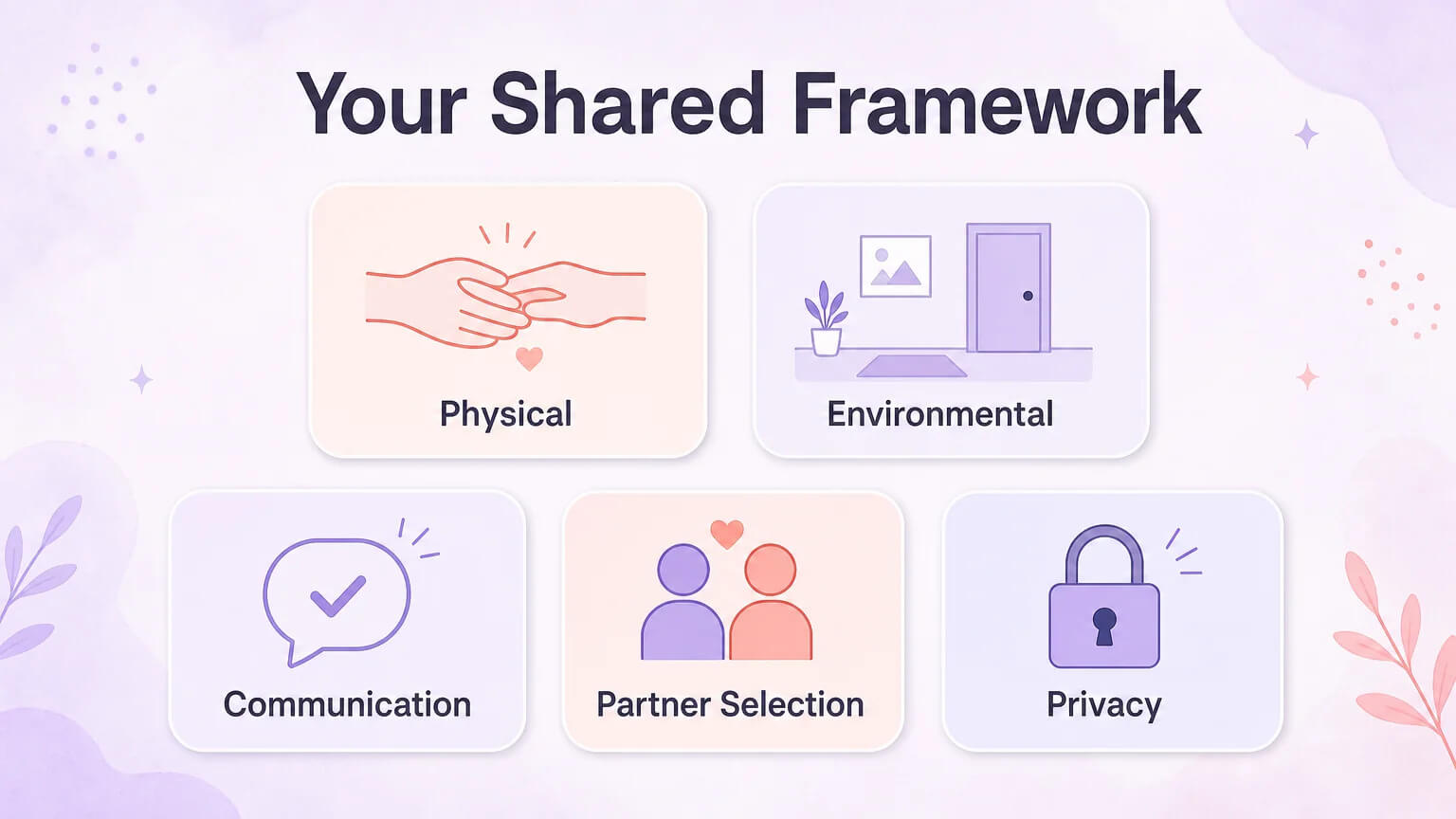
At 3Fun, we use “agreements” or “frameworks,” not “rules.” Rules are what you impose on someone. Agreements are what you build together. The language matters because the posture matters. You are not a manager handing down policy to an employee. You are two people designing an experience that protects both of you.
Every couple should address these before they share a room with anyone else.
Physical boundaries. What is on the table, what is not, and under what circumstances. Be specific. “Oral is fine, kissing is reserved for us” is a clear agreement. “Nothing too serious” is a fight waiting to happen. List the acts. Name the lines. If something changes later, you will have a new conversation. But ambiguity in the moment is how trust gets bruised.
Environmental boundaries. Same-room only? Separate rooms okay? Do you stay within sightline, or is independence part of the appeal? Some couples need the visual of each other to feel safe. Others find it distracting. Neither is more evolved. What matters is that you agree before you arrive.
Communication boundaries. Do you check in during the encounter? Is there a signal for “I need to pause”? A squeeze of the hand. A specific word. “Yellow” for slow down, “red” for stop. These are not mood killers. They are what makes freedom possible in the first place.
Partner selection boundaries. Do you play with people you know? Strangers only? Singles welcome or couples only? There is no universal right answer. There is only the answer you both feel comfortable with. Some couples draw a hard line at friends and coworkers, and that line is wise.
Privacy boundaries. What gets shared and with whom? Who knows you are in the lifestyle? Agree on the circle of trust before you need it. Nothing strains a relationship faster than one partner telling their best friend when the other assumed it was private.
One more thing about the mid-encounter pivot: anyone can call a pause at any time, for any reason, with no explanation owed in the moment. That is not a failure. It is the agreement working. You do not need to articulate why your stomach just dropped. You say the word, and you step out together. The conversation about what happened can wait until you are home.
If it is not an enthusiastic yes from everyone in the room, it is a hard no.
Emotional Prep: What to Do Before You Ever Set Foot in a Club

Emotional preparation is like stretching before a workout. Skip it, and you pull something. The couples who have the worst first experiences are rarely the ones who pushed too far physically. They are the ones who walked in emotionally cold.
Your pre-flight checklist.
Get clear on your “why.” Write it down individually, then compare notes. “I want novelty.” “I want to see my partner desired.” “I want to feel desired by someone new.” “I want a shared adventure that belongs only to us.” If your motivations are wildly different, you have not aligned. If one of you is doing this to make the other happy, pause. That is a time bomb, not a foundation.
Visualize the hard parts. Picture your partner kissing someone else. Picture yourself feeling left out while the other three people seem absorbed in each other. Picture the moment after, both of you sitting in the car with nothing to say. If those images trigger a visceral reaction, you have work to do before go-time. Not because you should not feel those things, but because you should know they are coming and have a plan.
Set realistic first-time expectations. The goal for your first experience is not an incredible orgasm. It is that you both come home feeling closer, regardless of what happened or did not happen. If someone got anxious and you left early, and you held each other afterward, that is a successful first experience.
Plan your reconnection. Decide before the encounter how you will come back together. Will you leave together? Spend the night alone? Have sex when you get home or just hold each other? Discuss your reconnection styles in advance. One of you might want physical reconnection. The other might be emotionally spent and need quiet. Know that about each other before you are in it.
Agree on your off-ramp. What is the signal for “we need to leave now,” and who can deploy it? Both of you, individually, no questions asked. Knowing you can leave makes it possible to stay.
Preparation is not about eliminating nerves. It is about making sure nerves do not make your decisions for you.
Jealousy Is Not the Enemy: How to Handle It When It Shows Up

Jealousy is not the check-engine light of your relationship. It is the fuel gauge. It tells you something needs attention. The question is not “how do I never feel jealous?” No human bypasses jealousy entirely. The question is “what do we do when it shows up?”
Name it without shame. “I am feeling jealous right now.” Said out loud, to a partner who receives it without defensiveness, that sentence defuses half its power. Jealousy thrives in silence. It breeds in the gap between what you feel and what you admit. Say it. Give it air.
Get specific. Jealousy is usually a mask: fear of being replaced, fear of missing out, insecurity about your own desirability, or a need not being met. The feeling is real. The story underneath it is often not. Ask yourself: what am I actually afraid of? The answer is rarely “my partner likes someone else.” It is usually “my partner might like someone else more than me.” Different problem, different solution.
Do not triangulate. Process jealousy with your partner, not with the third person now unwittingly in the middle of your dynamic. The single woman who joined you does not need a late-night text about how hard this has been for you. She is not your therapist. She is a guest who showed up in good faith. Keep the processing inside the primary relationship.
Distinguish between jealousy that needs reassurance and jealousy that needs a boundary adjustment. Sometimes the answer is “I need to hear that you love me.” Sometimes it is “we need to adjust our agreements.” Both are valid. The skill is knowing which one you are dealing with.
Debrief after the feeling passes. What triggered it? What helped? What should change next time? Research by de Visser and McDonald (2007) found that successful swingers manage jealousy through discussion, negotiation, and a strong couple identity. They do not suppress it. They process it. The couples who stay in the lifestyle are not the ones who never felt threatened. They are the ones who learned to sit with the feeling and use it to sharpen their agreements.
Jealousy is not a flaw in your foundation. It is information about what needs attention.
The Aftercare Playbook: What Happens After the Encounter

Reclaiming and aftercare are not the same thing. Reclaiming is “I want to have sex with you to re-establish our physical bond.” It is valid, primal, and common. But it is one flavor of reconnection, not the whole menu.
Aftercare is broader: emotional check-in, physical closeness that may or may not be sexual, processing what happened, and integrating the experience into your relationship narrative. It turns the encounter from a standalone event into a shared memory instead of a wedge.
Three debrief formats, each with a different purpose.
The same-night check-in. Brief. Five to ten minutes. Right after, before sleep. “What was your favorite moment? Is there anything that felt uncomfortable? What do you need from me right now?” This is a temperature check, not a full processing session.
The morning-after debrief. Longer. After sleep and distance. “How are you feeling about last night? Is there anything you would want to do differently next time? Did anything surprise you?” This is where the real processing happens.
The week-later integration. A casual check-in after the experience has settled. “Has anything come up for you since? Do any of our agreements feel like they need adjusting?” Sometimes feelings take days to surface.
The reconnection mismatch is real and common. One partner wants physical reconnection immediately: sex, skin, the reassertion of “you are mine.” The other partner is spent. Drained. Needs quiet and sleep, not more stimulation. Neither is wrong. The problem is not the mismatch. The problem is not discussing it beforehand.
The fix: talk about your reconnection styles before the encounter. “After something like this, I think I would want to have sex with you right away. How about you?” If your styles differ, negotiate. Tonight you hold each other; tomorrow morning you reconnect physically. Or split the difference another way. The point is that neither of you is guessing, and neither of you feels rejected by a partner who simply needs something different.
How to Find Partners (And How to Be Good Ones)
Finding compatible partners takes effort. That effort is part of the process, not a sign something is wrong. If you walked into a regular bar tonight and tried to find a couple interested in the exact same arrangement you are, with aligned boundaries and mutual attraction, you would be there a while. This is why lifestyle-specific platforms exist.
The where. 3Fun is built for exactly this: threesomes, group encounters, and couple-to-couple connections with photo verification and a couple-friendly interface. Dedicated lifestyle apps give you what general dating apps cannot: a community where you spend time connecting, not explaining. Look for platforms with verified profiles, privacy controls that separate your lifestyle presence from your everyday life, and filters that match you with people who share your specific comfort levels. Paid memberships filter out non-serious browsers. Lifestyle-specific forums and well-moderated online communities offer free spaces packed with beginner guides and experienced voices who have already made the mistakes you want to avoid.
The how. Verify before you meet. Meet in public first, with no expectation of play on the first date. Discuss expectations before anything physical happens. Never pressure anyone into a decision on the spot. A “maybe” is a “no” until it becomes an enthusiastic “yes.”
The ethics. Singles are guests in your playground, not toys in your toybox. This is where couples most often get it wrong. Singles, whether women or men, are not interchangeable accessories to your fantasy. They are people with their own boundaries, emotional world, and reasons for being here.
Be clear about what you are offering. Ask what they want. Screen couples the way you hope they screen you: verify identity, discuss experience levels, align on expectations, never skip the pre-meet. Consent must be enthusiastic, ongoing, and revocable at any time, for everyone in the room.
Do not be the couple who treats singles like props. The lifestyle is small. Word travels.
FAQs
Is soft swinging the same as an open relationship?
No. Open relationships involve independent dating where each partner has separate connections. Soft swinging is a team activity. You arrive together, experience together, leave together. The “we” stays intact.
Will soft swinging fix a struggling relationship?
No. Soft swinging is an amplifier. If your relationship is built on trust and communication, it amplifies those. If your relationship has cracks, it amplifies those too, and the cracks widen faster than you can patch them.
Can we stop mid-encounter if one of us is uncomfortable?
Yes. Always yes. No explanation required. You say the word, step out together, and talk about it later. Anyone who pressures you to continue after a withdrawal of consent does not belong in your bed.
How do we handle it if one of us develops feelings for a swap partner?
Feelings can arise. That is not a moral failure; it is human. What matters is what you do. For most soft swinging couples, developing feelings means stepping back from that connection and reinvesting in the primary relationship. Name it early. Do not let it grow in secret.
What if we try it and one of us hates it?
Then you stop. You tried something together, you learned something, and you chose each other. That is a win. The point is to explore together and see what fits. If nothing fits, you still strengthened your relationship by having the conversation.
Do singles participate in soft swinging?
Yes. Single women and single men are part of the community. Some couples prefer inviting a single person rather than swapping. The same agreements apply: clear expectations, respect for everyone’s boundaries, and treating the single person as a guest, not a prop.
How do we protect our privacy?
Use lifestyle-specific apps that separate your vanilla life from your lifestyle profile. Create separate chat handles. Agree on what gets shared and with whom before you share anything. Never out anyone. Their privacy is as important as yours.