Roughly one in five Americans have practiced some form of consensual non-monogamy, according to research published in the Journal of Sex and Marital Therapy. That number lands differently depending on who you are. For some, it is a quiet exhale: confirmation that a private curiosity is more common than they were led to believe. For others, it raises a question they have not yet said out loud: where do I fit in this?
Ethical non-monogamy is not a symptom of a broken relationship. It is a celebration of a secure one. ENM is the umbrella term for relationship structures where all partners agree romantic or sexual exclusivity is not required, built on transparency, ongoing consent, and explicit communication. It covers swinging, polyamory, open relationships, and a half-dozen other structures most articles skip entirely.
This is your field guide to the 12 most common ENM relationship types. What each one actually looks like day-to-day. Who it works best for. Where the common pitfalls hide. By the end, you will have a clearer sense of which lane feels like yours.
Desire does not require an apology. Great relationships do not outgrow adventure. They build a bigger container for it.
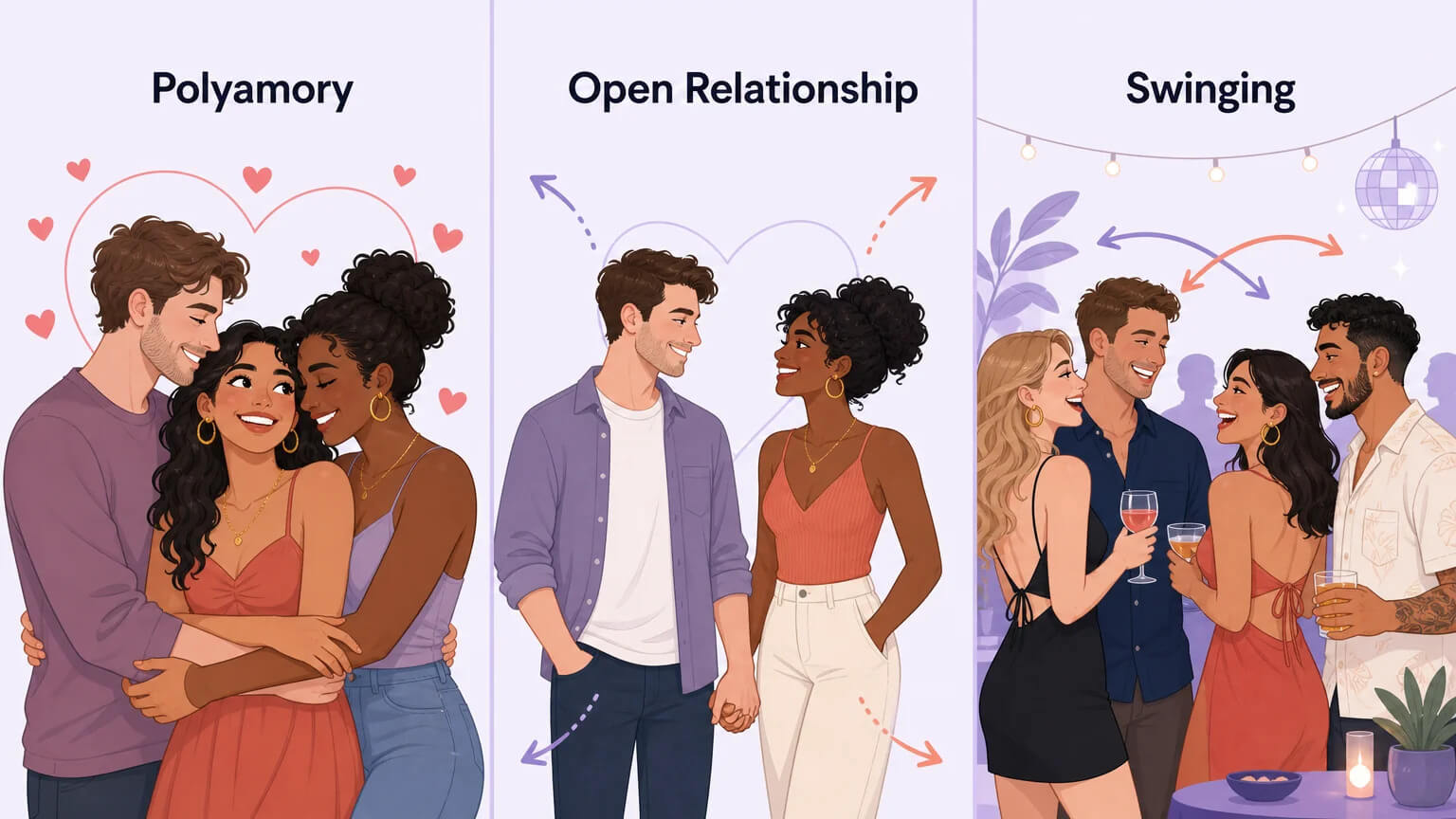
1. Polyamory
Most people hear “polyamory” and picture a free-for-all. The reality is the opposite: polyamory is one of the most communication-intensive relationship structures there is.
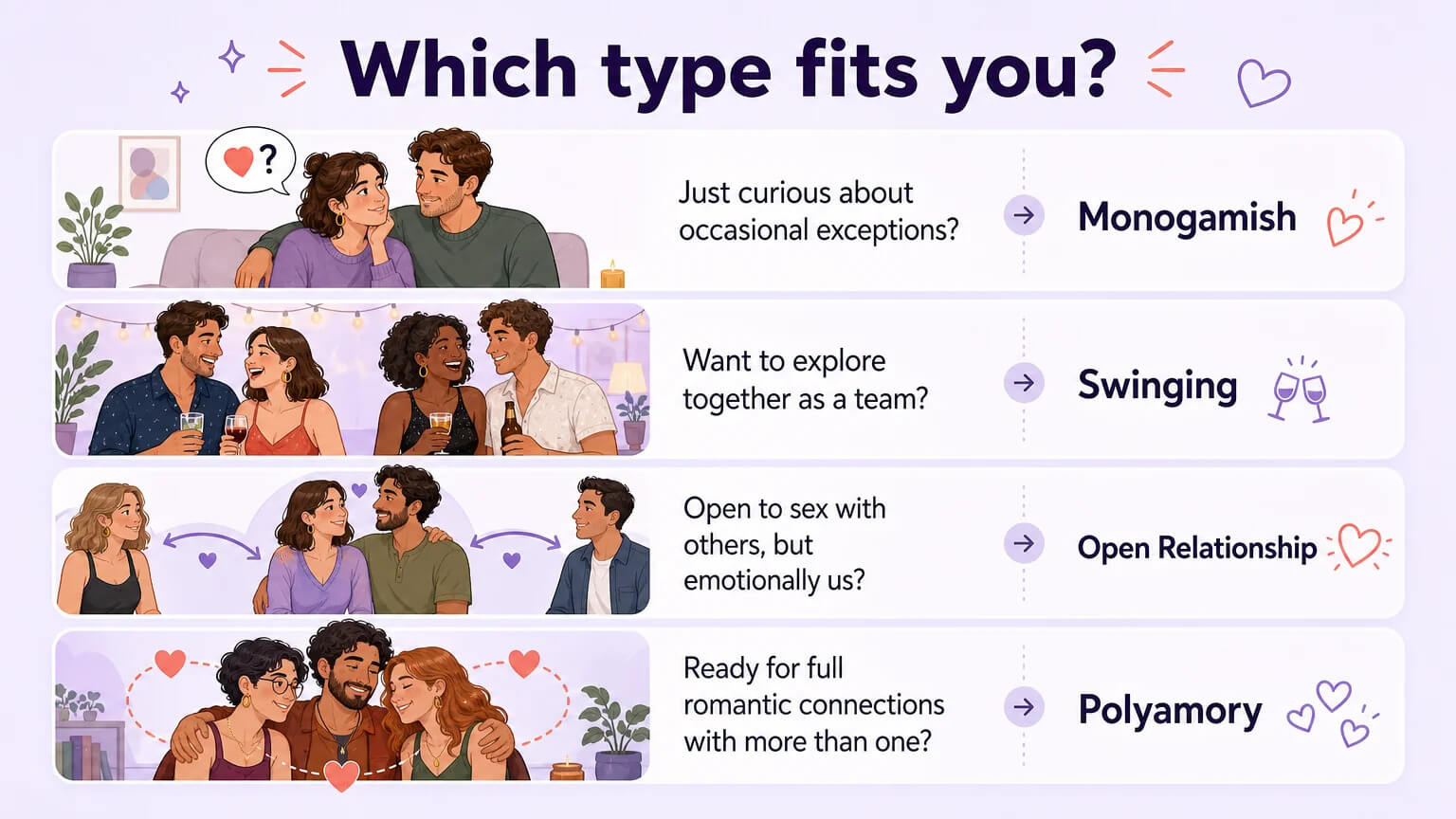
Polyamory means maintaining multiple romantic and emotional relationships at the same time, with the full knowledge and consent of everyone involved. What matters: polyamory is about romantic connection, not just sexual variety. This is what separates it from open relationships and swinging. Someone practicing polyamory is not just sleeping with multiple people; they are building love, emotional intimacy, and ongoing partnership with more than one person at a time.
Dedeker Winston, co-host of the Multiamory podcast, puts it plainly: “The reality is, it’s a lot more talking than sex at the end of the day.”
Leah and Tim, a California couple together for 11 years, have been open for 3 and polyamorous for 1. Their agreements: always inform each other about partners, no secrets, emotional intimacy taken slowly. Their advice: “Move at the pace of whichever one of you is the least comfortable.”
Several subtypes sit under the polyamory umbrella: hierarchical, non-hierarchical, kitchen table, parallel, solo. Several of these get their own sections below. Polyamory is not one thing. It is a category.
Best for: people who want full romantic connections with more than one person, not just sexual variety. Skip if: you want outside connections to stay purely physical.
2. Open Relationships
You love your partner completely. You also wonder what it would be like to explore with someone else. Those two truths are not at war. They are the foundation of an open relationship.
An open relationship is a committed couple’s agreement to allow outside sexual connections while keeping emotional exclusivity. This is the most common starting point for couples new to non-monogamy, and for good reason: it preserves the emotional center of the relationship while creating space for physical exploration.
The emotional contract is straightforward. Both of you are saying: we are each other’s person, and we are also curious humans. The love stays exclusive. The physical perimeter expands.
Here is the question most couples ask silently: does wanting this mean something is missing? The answer is no. Wanting variety does not mean your partner is insufficient. It means you are honest about the difference between emotional commitment and sexual exclusivity. Those are not the same thing, and pretending they are has never made them so.
Open relationships work for couples who are rock-solid at home and curious beyond it. The structure does not ask you to redesign how you love each other. It asks you to be honest about where commitment and exclusivity differ, then build agreements that honor both.
Best for: couples who are emotionally secure and sexually curious. The emotional center holds; the physical perimeter expands.
3. Swinging
Swinging is the most couple-forward form of ENM, and the one most commonly misrepresented as shallow or outdated. It is neither.
Swinging happens when couples engage in sexual activities with other couples or individuals, mostly in social settings, without romantic attachment. The couple is the central unit. Everything flows through the partnership.
The vocabulary matters. A soft swap means non-penetrative play: everything above the belt, or hands and mouths only. A full swap includes penetrative sex. Same-room means you and your partner play together. Separate-room means you go different directions and reconnect afterward. These are preferences, not ranks.
For your first event: go with no expectations, bring a swinger bag (condoms, lube, wipes, gum, extra outfits), never separate on the first visit unless both agreed, and plan aftercare. What happens afterward, between the two of you, is the real event.
Jem and Daz Jones, a UK couple married since 2015, started ENM in 2022 after losing their spark. They attended swinger events as observers first, then explored threesomes. They credit the lifestyle with saving their marriage and describe themselves as “swingamorous.”
The Conversation Starter
“There is something I want to talk about, and you might feel something about it. I am curious about exploring together, not because anything is missing between us, but because I trust us enough to have this conversation. Can we just talk about what that might look like, with no pressure and no timeline?”
The verdict: Swinging is structured, social, and designed for couples who want to explore as a team. If you are reading this as a couple and do not know where to start, start here.
4. Hierarchical Polyamory
In hierarchical polyamory, you have a primary partner: your home base. But calling someone secondary does not make them feel secondary. The label has weight, and it is worth understanding exactly what you are signing up for before you hand it to someone.
Hierarchical polyamory is a structure where one relationship (typically a nesting partner, co-parent, or long-term spouse) holds priority, and other relationships are explicitly secondary or tertiary. The most common shape: a married couple opens to polyamory, each person dates separately, but the marriage retains decision-making primacy.
Dr. Liz Powell, a psychologist and author of Building Open Relationships, warns that hierarchical polyamory practiced as a couple often builds on couple privilege in ways that lead to unethical behavior. Couple privilege is the systemic advantage an established couple holds: making all the agreements, expecting a third person to adapt, holding veto power, having only the dyad legally and socially recognized. This is not an accusation. It is a fact of the structure.
Hierarchy is not inherently unethical. What keeps it ethical is self-awareness: knowing what you are offering a new partner, being honest about the limits, and never using words like “equal” when the structure is explicitly not equal. If your spouse can veto someone you love, say that upfront. Let the other person decide with full information.
Best for: couples who want romantic connections beyond each other but still want a central anchor. Skip if: the idea of ranking relationships makes you uncomfortable; non-hierarchical or solo poly may fit better.
5. Solo Polyamory
You are your own primary partner. That is not a consolation prize. It is a deliberate, powerful choice called solo polyamory.
Solo polyamory means an individual keeps their independence as their own primary. They typically live alone, keep finances separate, and may have multiple romantic partners without merging households or identities with any of them. The center of gravity is not a couple. It is the self.
This is distinct from relationship anarchy, though people often conflate the two. Solo poly focuses on logistical independence and still draws a line between friends and romantic partners. Relationship anarchy is a philosophical rejection of all hierarchies, including the friend/romantic boundary. Many people identify as both, but they are separate concepts.
If you are a single person navigating ENM, solo poly gives you a framework that does not require a partner to be valid. It also gives you a sharper lens for evaluating couples. Agnes, a psychiatric nurse and therapist, offers a red-flag framework every single should know: evasion of direct questions about partner awareness is the biggest warning sign. Terms like “semi-ethical” are contradictions. Unsolicited explicit photos as a first message are not enthusiasm. They are a filter failure.
You are a guest in someone’s dynamic, not a toy in their toybox. The couples who have done their internal work will welcome your questions. The ones who have not will duck them.
Best for: fiercely independent people who want deep romantic connections without cohabitation, financial merging, or the relationship escalator. This is the structure that says: I belong to myself first.

6. Monogamish
You are mostly monogamous. Happily so. But every once in a while, on a trip, at a party, in a specific situation, you both wonder: what if? That is not a crack in your relationship. That is monogamish.
Coined by Dan Savage, monogamish describes a primarily monogamous couple with occasional, negotiated exceptions. The exceptions are specific, agreed-upon, and rare. A threesome on vacation. A hall pass during a work trip. A particular person both of you feel comfortable with. The door opens a crack for a defined moment, then closes again.
The difference from open relationships is frequency and intent. Monogamish couples are not maintaining ongoing outside connections. They are making one-off exceptions inside a monogamous identity. The self-concept is still “we are monogamous,” with an asterisk.
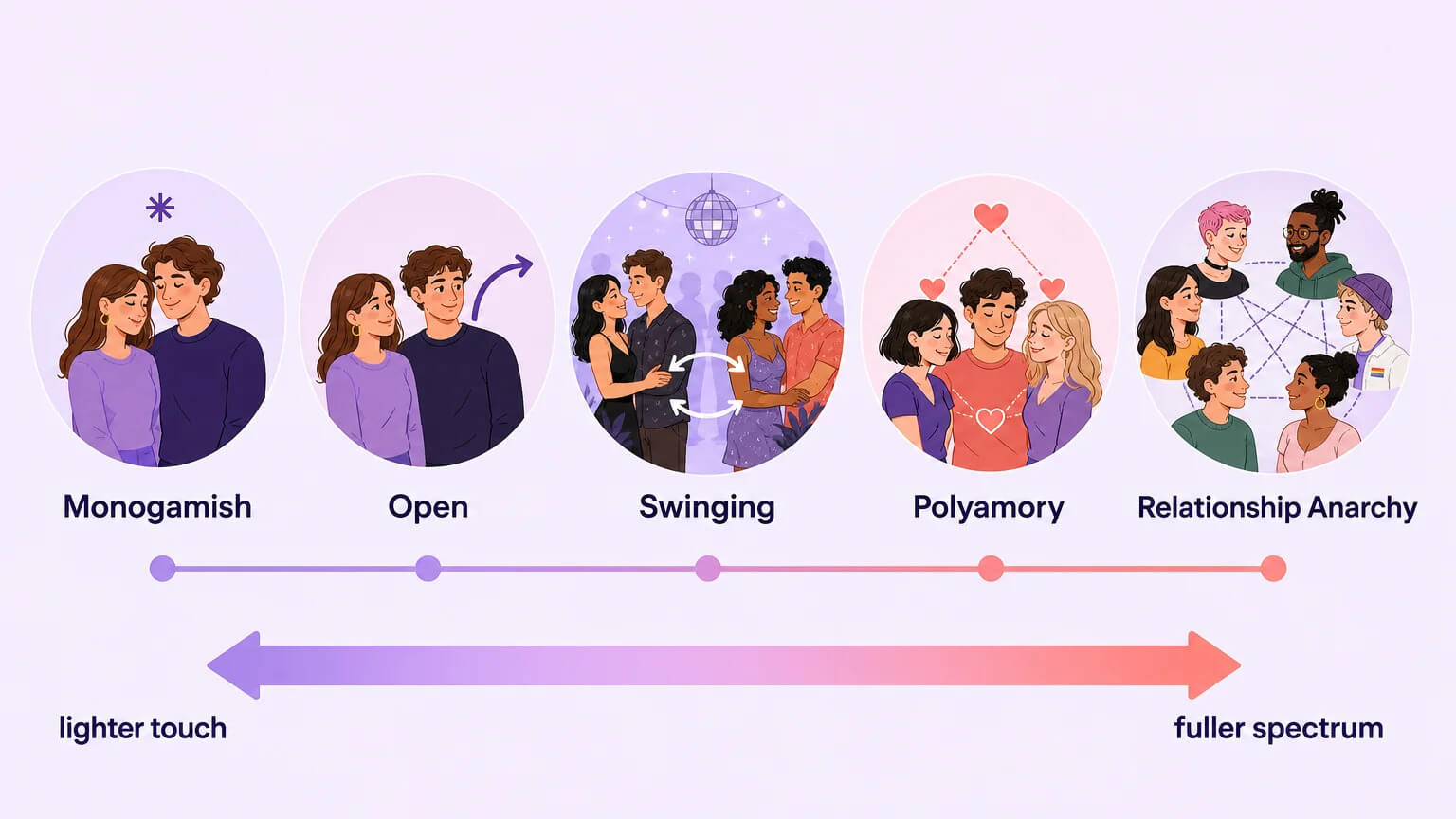
Think of the ENM spectrum as a dial, not a switch. Monogamish is the lightest touch on that dial. It asks for the least structural change to your relationship and carries the least logistical overhead. For couples who are curious but not ready to redesign their entire dynamic, it is the gentlest entry point available. You keep your identity. You add a footnote.
The verdict: Monogamish is the shallow end of the ENM pool, and that is exactly why it works. Perfect for couples who want to dip a toe without rearchitecting their entire relationship.
7. Relationship Anarchy
What if a friendship mattered exactly as much as a romance? What if there were no relationship escalator — no expected path from dating to cohabitation to marriage? That is relationship anarchy, and it is not chaos. It is intentional design.
Relationship anarchy rejects all relationship hierarchies, labels, and the traditional escalator. Every relationship — romantic, sexual, platonic — defines its own terms. A deep friendship can carry equal weight to a romantic partnership. There is no default assumption that a romantic partner gets more time, priority, or access than a close friend.
People confuse this with solo polyamory constantly. Here is the split. Solo poly is about logistical independence: living alone, separate finances, being your own primary. Relationship anarchy is a philosophical rejection of the idea that romantic love automatically outranks friendship. A relationship anarchist might have a romantic partner they see twice a month and a platonic friend they talk to daily, and not rank one above the other. Many people identify as both, but the concepts operate at different levels.
In practice, this is demanding. Agreements are bespoke to each connection. There is no cultural script to fall back on: no “this is what partners do” or “this is how friendships work.” Every expectation must be named, negotiated, and revisited. For people who thrive on clarity, that is liberating. For people who want a predictable structure, it is exhausting.
Best for: people who reject the idea that romantic love should automatically outrank friendship and who are willing to define every relationship from scratch. Skip if: you want clear labels, predictable structures, or the comfort of a cultural script.
8. Throuple (Triad)
Three people, one relationship. A throuple is not a couple plus a guest. It is a triangle where every side carries weight.
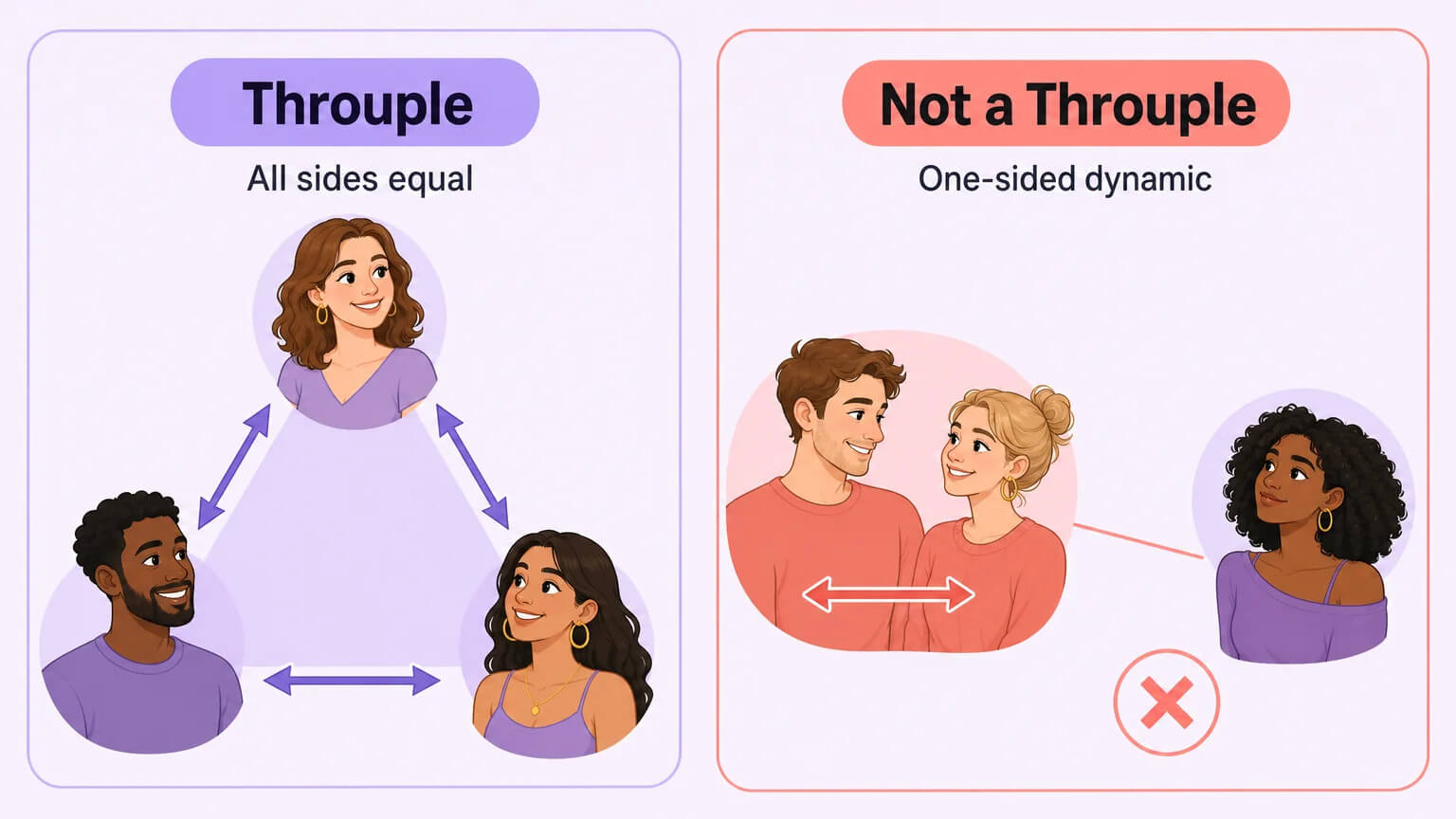
A throuple, also called a triad, is three people in a romantic relationship. Everyone dates everyone else. It is not one person dating a couple; it is three people who all want each other, equally and independently.
There is a healthy version and an unhealthy version of this structure, and which one you build determines whether someone gets hurt. A genuine throuple forms when three people independently want each other, then build a shared relationship from that mutual desire. The unhealthy version: an established couple seeks a third person, often a bisexual woman, to “join” on the couple’s terms. The couple’s agreements are already set before she arrives. Veto power rests in the original dyad. She is expected to adapt to a dynamic she did not help design. The ENM community critiques this pattern not because the desire is wrong, but because the power imbalance is real.
If you are a couple considering a throuple, date separately first. If you cannot handle your partner dating someone without you in the room, you are not ready for a triad. A triangle where two sides hold all the power is not a triangle. It is a line with a third point attached.
Best for: three people who all want each other equally and are willing to do the work of dismantling couple privilege. Skip if: you are a couple looking to “add a third” to fix a spark. That framing is the fastest way to hurt someone.
9. Polyfidelity
A polycule that is closed to outsiders. Polyfidelity combines the emotional depth of polyamory with the exclusivity of monogamy, and it is one of ENM’s most overlooked structures.
Polyfidelity is a closed group where all members are equal partners and agree not to date or seek sexual connections outside the group. Most commonly a triad or quad, though larger polyfidelitous groups exist. The container is sealed. What is inside stays inside.
The boundary is what makes it different from open polyamory. In open poly, partners can seek new connections; the network can expand. In polyfidelity, the group itself is the boundary. This appeals to people who want multiple intimate relationships but also want the emotional safety of a closed system: variety paired with containment.
The catch is honest and unavoidable: polyfidelity requires that everyone in the group is satisfied with the people already inside it. If one person wants to date outside, the structure needs renegotiation. There is no release valve. That is both the strength and the vulnerability of the model. It works beautifully when everyone’s desires align and demands hard conversations the moment they do not.
The verdict: Polyfidelity offers the security of exclusivity and the richness of multiple partners. Rare in practice because it requires everyone’s desires to align perfectly within a closed system, but deeply fulfilling for those it fits.
10. Kitchen Table Polyamory vs. Parallel Polyamory
Do you want your partners to share brunch, or would you rather keep your relationships in separate lanes? This is the kitchen-table-vs-parallel decision, and most people do not realize they will need to make it.
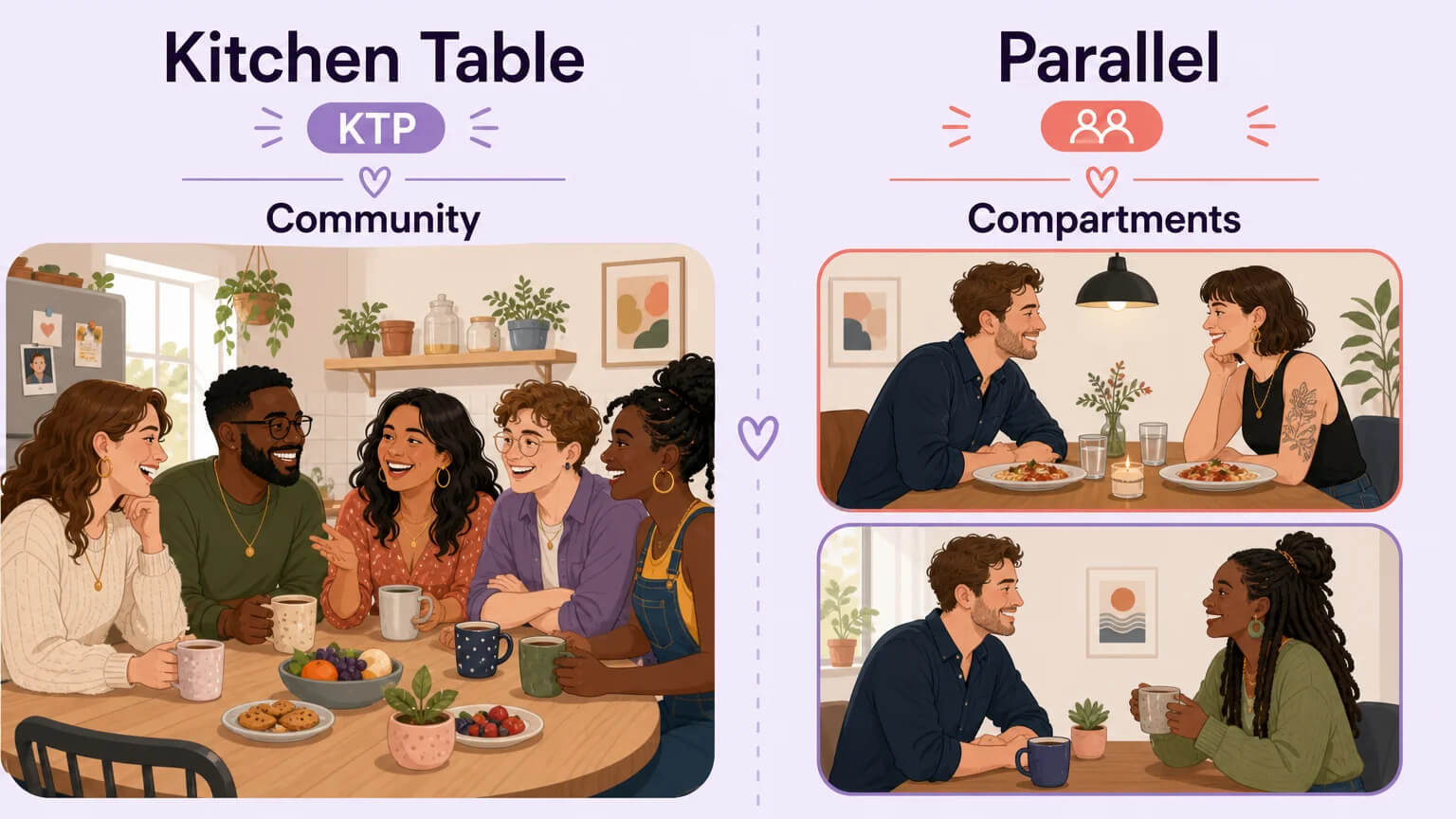
Kitchen Table Polyamory (KTP) means metamours (your partner’s partners) interact comfortably. They might share meals, group chats, even holidays together. The dynamic is communal. Parallel Polyamory means relationships run in separate channels with minimal overlap. You know about each other’s partners but do not socialize with them.
This is a spectrum, not a binary. Most people land somewhere in the middle: comfortable at a birthday party together but not weekly dinners. The variables are simple. How much emotional bandwidth do you have for metamour relationships? Does knowing your partner’s other partners reduce anxiety or increase it?
Some people find meeting metamours reassuring: the unknown is scarier than the known, and a name you can picture is easier to trust than a blank space. Others find it overwhelming: comparison hits harder when the person has a laugh and a presence. Neither response is wrong. Neither is more evolved. The right choice is the one that protects everyone’s peace.
Adam and Pris of the Beyond Monogamy podcast put it in a way that works for both ends of this spectrum: “Reassurance is not optional. It must be consistent, every single time.” Whether your partners share a kitchen table or never meet, the emotional contract with your primary partner does not change.
Quick comparison: Kitchen table = community. Parallel = compartments. Neither is more evolved. The right choice is the one that protects everyone’s peace.
11. Closed V
One person dating two people who are not dating each other, and the group is closed to outsiders. The Closed V is one of ENM’s most stable and least-discussed structures.
In a Closed V, one person (the hinge) has two partners who are not romantically or sexually involved with each other. The arrangement is closed: no one dates outside the V. The hinge is the communication hub. Both partners rely on the hinge for information, emotional reassurance, and scheduling. This is a high-responsibility position. If the hinge drops the ball on communication, both relationships suffer.
The contrast with a triad is useful. In a throuple, all three people interact romantically; there are four dynamics to manage (A+B, B+C, C+A, and A+B+C together). In a Closed V, two people share a partner but not a relationship with each other. This can be simpler than a triad in some ways (fewer intersecting dynamics) and harder in others, because the hinge carries disproportionate emotional labor. There is no direct channel between the two non-hinge partners to resolve tension.
The Closed V works especially well when the two non-hinge partners genuinely do not want to date each other and the hinge has the emotional bandwidth to be the hub for both relationships. It is stable, contained, and far more common in practice than most ENM guides let on.
Best for: when one partner has the bandwidth for multiple relationships and everyone values stability over expansion.
12. Don’t Ask, Don’t Tell (DADT)
Some couples agree: do what you want, just do not tell me about it. DADT sounds like it sidesteps jealousy. In practice, it often amplifies it.
DADT is a relationship agreement where outside connections are permitted but details are not shared. The partner knows it may happen but does not want to know when, with whom, or how.
The appeal is understandable: “I will give you freedom if you give me the comfort of not knowing.” For couples where one partner is more hesitant, it can seem like the gentlest entry point.
Now for why most ENM educators discourage it. DADT makes verifying consent nearly impossible. If you cannot ask “does your partner know about me?” and get a real answer, you cannot confirm you are participating in ethical non-monogamy rather than unknowingly enabling deception. Agnes, the psychiatric nurse and therapist, identifies a pattern: people using “discreet” as code for “my partner does not know I am here.”
DADT also calcifies insecurity rather than resolving it. The unknown is often more anxiety-producing than the known. The silence meant to protect you ends up filling the space with doubt.
DADT can work temporarily in specific contexts — during a transition period, for example — but rarely holds up over time.
The verdict: DADT can work temporarily, but it is a fragile foundation. If you cannot talk about it, you probably should not be doing it. The most secure ENM agreements are built on what you can say out loud, not on what you agree never to mention.
FAQs About ENM Types, Answered
Isn’t this just cheating with a nicer name?
No. The difference is transparency and consent. In ENM, all parties are informed and have enthusiastically agreed to the structure. Cheating relies on deception. If someone’s partner does not know you exist, that is infidelity wearing an ENM mask. The word “ethical” is not decoration; it is the entire point.
Which type is right for us?
Start with self-inquiry: why are you curious? What is your emotional bandwidth? Do you want sexual variety, romantic connections, or both? The ENM Relationship Architect Finder quiz (15 questions, five blueprints) can help frame the conversation, but no quiz replaces the talk you need to have with each other. The answer comes from conversation, not a result screen.
Can this save a struggling relationship?
No. ENM amplifies existing dynamics. It does not fix broken ones. If your relationship has trust or communication issues, adding more people will magnify them. Fix the foundation first. Jennifer Hargrave, a divorce attorney, notes that couples opening up to please a partner rather than from authentic desire are the ones who end up in her office.
How do we handle jealousy?
Jealousy is data, not failure. Kathy Labriola’s approach: identify the trigger, spot negative assumptions (“they are having more fun without me”), challenge those thoughts with evidence, generate balanced interpretations, practice new patterns. Communicate specific needs without trying to control your partner. Compersion is a bonus, not a prerequisite.
How do I start this conversation with my partner?
Timing matters: not during a fight, not drunk, not stressed. Open with: “There is something I want to talk about. It might bring up feelings. Are you in the right headspace?” Lead with curiosity, not demands. Prepare for a no. Reassure consistently. If it is a no, it is a no. Enthusiastic consent is non-negotiable.
What if I am single? Can I still explore ENM?
Yes. Solo polyamory is a valid orientation, not a waiting room for a primary partnership. Be upfront on dating apps. Seek out ENM-friendly communities (3Fun, OKCupid, local poly meetups). Vet couples carefully: ask directly whether both partners are aware and consenting. You are a guest in someone’s dynamic, not a toy in their toybox.