Roughly 1 in 5 single adults in the United States has participated in a consensually non-monogamous relationship. If you searched for ENM relationship rules, you are not looking for judgment. You are looking for structure that works — structure that keeps everyone safe without making anyone feel caged.
The most effective ENM couples do not choose between rules and agreements. They use both, and they understand the difference. Rules provide the non-negotiable guardrails: safety, honesty, consent. Agreements define how partners navigate within those guardrails. They are co-created, revisable, and built on mutual trust rather than mutual suspicion.
As therapist Kate S Loree, LMFT puts it: clear structure, when built collaboratively, creates more freedom than ambiguity ever does. The couples who thrive in ethical non-monogamy do not have fewer boundaries. They have more precise, more carefully negotiated ones.
This article is not a permission slip. It is a map. It assumes you know what you want and are willing to do the work to build it without breaking what you already have. It assumes the people you connect with deserve dignity, not just discretion.
Here are 10 enm relationship rules and agreements, organized from foundational mindset shifts to operational essentials: sexual health, privacy, and repair. Each includes a Conversation Starter script you can read aloud tonight. These scripts are the single biggest gap in most ENM advice — real words for real conversations, not abstractions. No academic theory. No vague “just communicate” advice.
1. Rules and Agreements: Why Your ENM Needs Both
If the idea that boundaries create freedom sounds counterintuitive, blame monogamous culture. It trains us to see boundaries as cages instead of the walls that make a home habitable. Most of us grew up absorbing this framing. Unlearning it is step one.
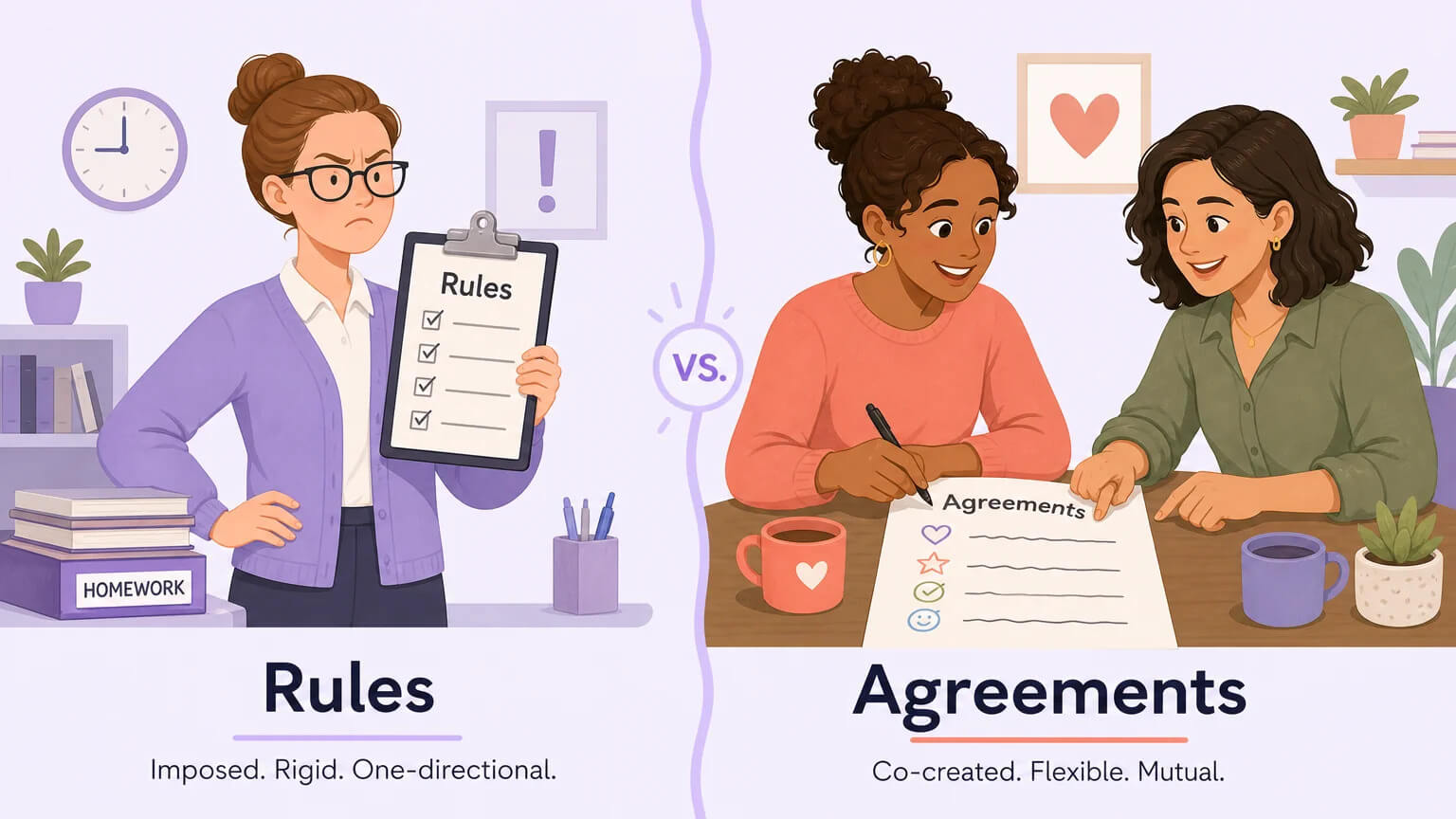
The distinction matters because most couples skip it. They either stack rules until the relationship feels like a parole agreement, or they reject rules entirely and pretend trust alone will hold everything together. Neither works. Rules are the non-negotiable guardrails: everyone consents, everyone is honest, everyone practices safe sex. These are the container. Agreements are the co-created frameworks for navigating within that container: how often you check in, how you handle new relationship energy, what your metamour comfort zones look like.
John and Jackie of Openlove101, 20-year open-relationship veterans, put it plainly: boundaries are personal and evolve with trust, but they need a stable container. Rules without agreements feel like a prison. Agreements without rules collapse under pressure.
Martha Kauppi, LMFT, a CNM therapist, identifies where most breakdowns happen: the creation process, not the content. Couples rush. They avoid tough conversations. They say yes to keep the peace without genuine buy-in. The agreement was set up to fail before anyone broke it. Her solution: time-limited experimental agreements, not permanent ones. An agreement you can revise in six weeks invites honesty. An agreement set in stone invites silence.
That is where agreements do the work rules cannot: they force the conversation that builds the muscle. A rule says “no sleepovers.” An agreement asks “what does sleeping next to someone else mean to each of us, and how do we handle that difference?” One ends the conversation. The other starts it.
Before you write a single agreement, ask three questions about every candidate: Was this created with equal voice from both of us? Does it apply equally? Can we revisit it without fear? If the answer to any of these is no, you do not have an agreement. You have a demand wearing nicer clothes.
The Conversation Starter
“Let’s agree on our non-negotiables first. The rules neither of us would ever break. Then we build our agreements around them together.”
2. The Opening Conversation: Is This Growth or Escape?

A husband agreed to open his marriage because divorce felt impossible. They had just bought a house. He was in school. He spent nine months reading podcasts and forums, trying to make the shape fit. When his wife’s outside relationship ended and she wanted to stay open, they divorced. This is poly under duress. It is preventable.
The single most important question you will answer is “why are we opening?” — not “what rules should we have?” As the Wellbeing with Agnes framework puts it: are you opening from growth (curiosity, identity, shared values) or from escape (disconnection, conflict, a relationship you are afraid to leave directly)?
Three questions need honest answers before you proceed.
First: Is this a shared desire or a compromise? If one partner is enthusiastic and the other is “willing but terrified,” pause. Coerced consent is not consent. The reluctant partner’s yes, extracted under the threat of losing the relationship, will curdle into resentment.
Second: What meaning do you each attach to sex, love, and exclusivity? Mismatched meaning causes far more pain than mismatched rules. If one of you believes sex is always emotionally significant and the other believes it can be purely recreational, no agreement bridges that gap until you name it.
Third: What would make you decide to stop? Can you talk about stopping without it meaning failure? If the answer is no, you are building a trap.
Martha Kauppi warns that “happy spouse, happy house” without genuine buy-in is a common cause of agreement collapse. Do not people-please your way into a structure you do not want.
The Monogamy Experiment recommends a sequence: self-reflect first, use low-pressure language, frame it as exploration not demand, give processing time in weeks not hours, and provide resources instead of pressure. Handing your partner a book is not the same as handing them an ultimatum.
The Conversation Starter
“I have been thinking about how our relationship could evolve, and I would love to hear your thoughts. There is no rush. I am curious about whether this could work for us. I am not convinced it must.”
3. Know Your ENM Type Before You Write a Single Agreement
A couple agrees to “no emotional connections” because they read that was standard ENM practice. They are actually polyamorous. That agreement was a setup for shame and secrecy the moment someone caught feelings. Which they did, because they are polyamorous.
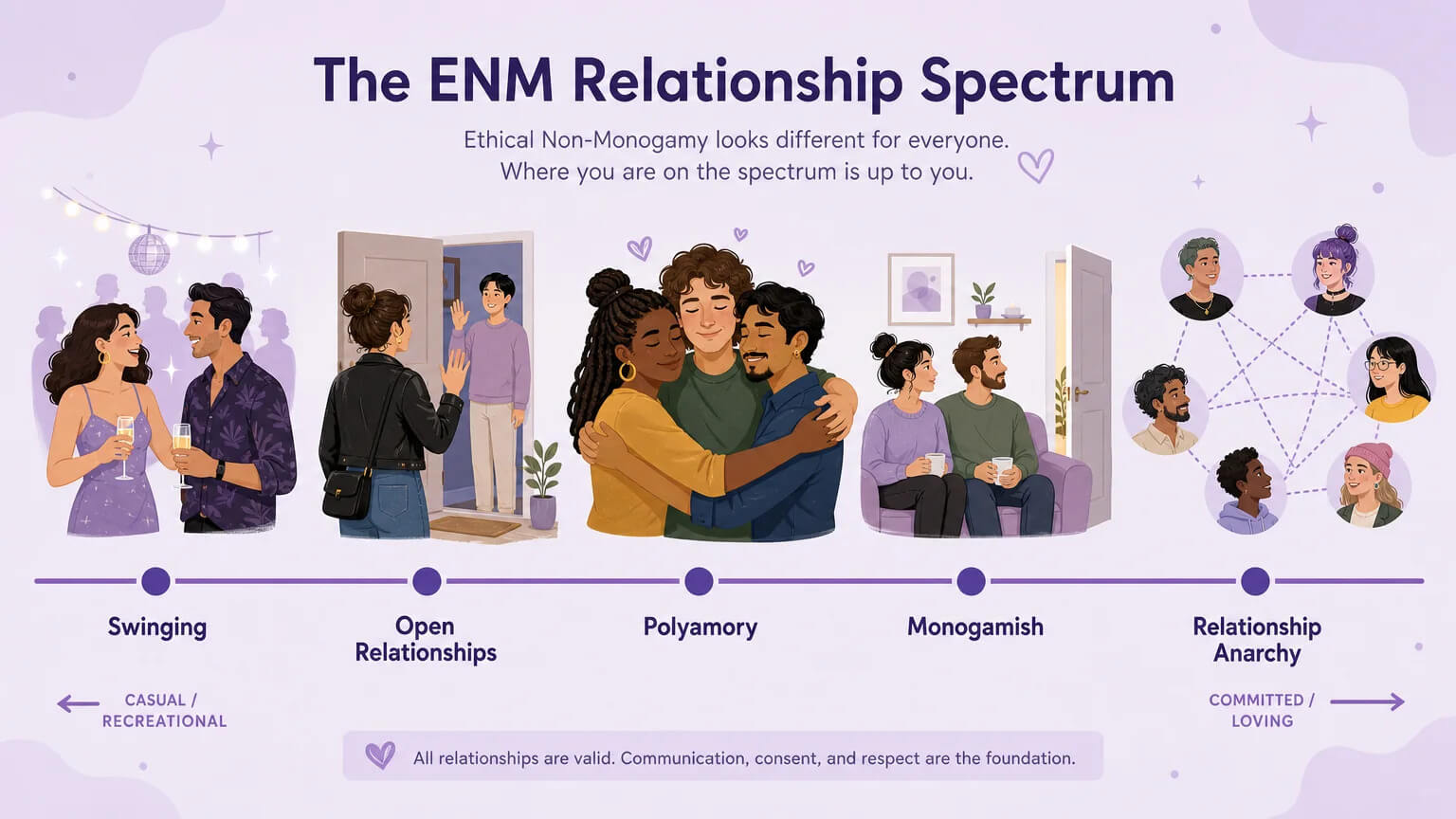
ENM is an umbrella, not a monolith. (If you are new to the term, our guide to what ethical non-monogamy actually means is a good place to start.) Agreements that work for swingers fail for polyamorous people. If you do not name your type first, you will write agreements for a relationship you are not actually in.
Here is the map. Swinging is recreational sex, often together, emotion-free by design. Open relationships allow sexual connections outside the primary partnership, with varying rules about emotional involvement. Polyamory means multiple loving relationships; emotional connections are expected, metamour dynamics are central. Monogamish means rare outside encounters (only when traveling, only threesomes). Relationship anarchy rejects hierarchy entirely; each relationship is defined independently.
Your type determines which agreements are relevant. A polyamorous couple needs metamour agreements. A swinging couple does not. An open couple needs emotional boundary agreements. A monogamish couple’s agreements look entirely different. Generic “ENM rules” miss the point because they were written for someone else’s relationship structure.
The self-assessment question: if your outside connections could develop into love, would that feel like a feature or a bug? Your answer determines which agreements matter and which ones work against your nature. A swinger will never need a metamour protocol. A polyamorous person who skips it walks into an emotional minefield without a map.
The Conversation Starter
“What kind of ENM feels most true to us? Are we exploring together or separately? Are emotions welcome or off the table? Let’s name our type before we name our agreements.”
4. Metamours: How to Relate to Your Partner’s Partners
Your partner is excited about someone new. They want you to meet them at brunch this weekend. Your stomach drops. Are you being unsupportive, or do you just have a different metamour style than your partner assumes?
Metamour dynamics shape daily life more than almost any other agreement, yet they barely appear in introductory guides. The question of how you relate to your partner’s other partners will come up fast. It deserves an answer before it does.
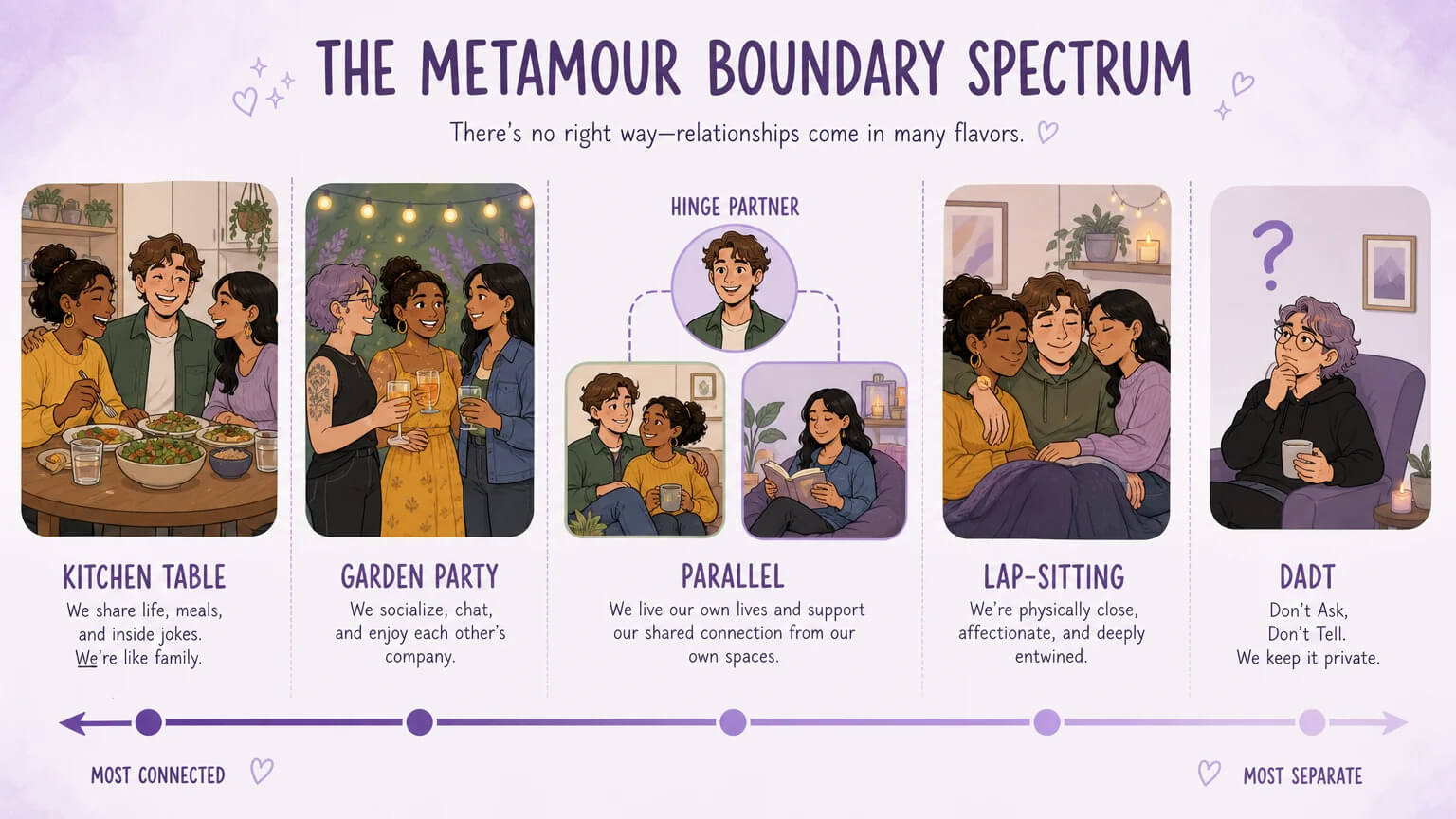
Modern Intimacy research maps the spectrum. Kitchen Table Polyamory means everyone is friends, shares meals, group hangs. Garden Party Polyamory means you interact occasionally at special events, cordial but not intimate. Parallel Polyamory means no direct interaction; all information flows through the hinge partner. Lap-Sitting Polyamory means cohabitating, co-parenting, deeply integrated. Don’t Ask Don’t Tell means minimal to no information shared.
A note on DADT: it is the most commonly attempted and most commonly failed metamour style. Information vacuums fill with worst-case scenarios. Anxiety does not need facts to build a catastrophe. DADT also prevents partners from coordinating practical realities like scheduling conflicts and sexual health disclosures. It feels safer in theory. In practice, it creates more problems than it solves.
Your metamour style is an agreement, not a personality trait. It can evolve as trust builds. A couple might start parallel and move toward garden party arrangements after a year. The point is naming the current setting so nobody operates on unspoken assumptions. Explicit naming prevents the most common metamour conflict: one person expecting friendship, the other expecting distance, neither having said so out loud.
The hinge partner — the person in the middle — carries the communication load. Their job is to relay information clearly without triangulating. If you are the hinge, your integrity determines whether both sides feel safe.
The Conversation Starter
“When I start seeing someone new, how much would you want to know about them? Would you want to meet them eventually, or would you prefer I keep those worlds separate? Let’s name our comfort zone so neither of us has to guess.”
5. Time, Attention, and the NRE Survival Guide
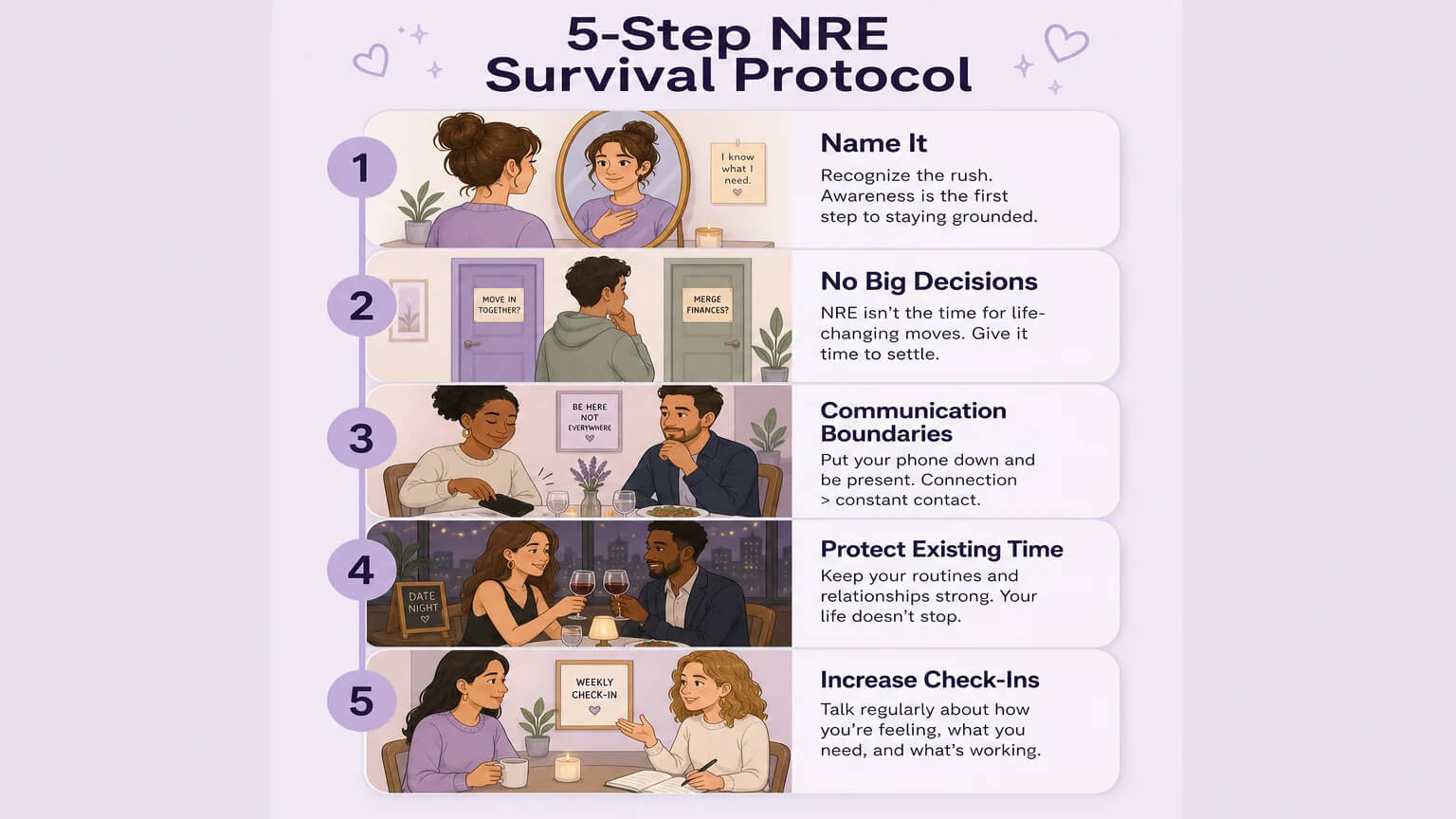
New Relationship Energy is biochemical. It is dopamine, oxytocin, and novelty doing exactly what they evolved to do. It is not a character flaw. It is not a sign your partner loves you less. Naming it removes the shame from both sides: the NRE-experiencing partner is not “falling for someone else,” and the existing partner is not “being needy.”
As Ellecia Paine, a relationship coach with over a decade in ENM, puts it: NRE is what causes the jealousy. Your partner vanishes into a new connection. Suddenly all their attention, energy, and excitement flows outward. You feel invisible. You begin to resent ENM itself.
NRE typically lasts 6 to 18 months. During that window, it produces predictable behaviors: decreased attention to existing partners, idealization of the new person, reduced capacity for ordinary relationship maintenance. You will overestimate the new connection’s compatibility and underestimate the existing one’s value. The protocol exists to correct for that. Predictable problems respond to protocols.
Here is your NRE protocol. First, name it explicitly when it arrives. “I am feeling NRE right now and I want us to be aware of it.” Second, create a “no major life decisions during the first six months of a new connection” agreement. Third, set communication boundaries: no texting the new person during dedicated partner time. Fourth, maintain at least as much quality time with existing partners during NRE as before. Fifth, increase check-in frequency during NRE periods. Weekly instead of monthly. If monthly check-ins were your norm, shift to weekly. If you had one date night, keep it sacred.
Martha Kauppi recommends time-limited experimental agreements for NRE management: explicit, temporary, and reviewable. Set a six-week NRE protocol, then revisit. The point is not to suppress the excitement. It is to keep it from cannibalizing what you have already built.
The Conversation Starter
“When one of us feels that new-relationship excitement, what is our plan? How do we protect what we have while still letting new connections breathe? Can we agree to check in weekly while NRE is active?”
6. Couples Privilege: The Invisible Gravity
Antioch University research found therapists themselves exhibit “dyadic privilege,” assuming the primary couple is the “core” relationship and other partners are threats. If trained therapists carry this bias, of course couples opening up carry it too. It is baked into the cultural operating system.
Couples privilege is the unearned advantage a dyadic couple has that outside partners do not: social recognition, legal protections, shared history, decision-making power. It is invisible to those who benefit from it, obvious to those who do not.
Here is how it shows up in agreements. First, the couple decides when the relationship “opens” and “closes” without input from outside partners. Second, agreements are designed to protect the couple’s comfort at the expense of outside partners’ autonomy. Third, the couple assumes breakups with outside partners are less significant than problems in the primary relationship.
You cannot eliminate couples privilege. You can name it, be transparent about it, and write agreements that soften its impact. Tell outside partners what hierarchy means practically. Give them a voice in agreements that affect them. Replace veto power with guardrails that respect everyone’s agency. If you have been together for a decade and share a mortgage, pretending that does not shape the dynamic is dishonest. Acknowledging it is the beginning of ethical behavior.
Telling a new partner “we want you to feel equal” while reserving the right to close the relationship without their input creates tension. Name it. That is more respectful than pretending it does not exist.
The Conversation Starter
“What advantages do we have that our outside partners do not? How do we make sure our agreements respect their humanity, not just our comfort?”
7. Rethinking Veto Power

Your partner is dating someone you find threatening. They remind you of your partner’s ex, they are more successful than you, and your gut says this person is a problem. You want to say “end it.” That impulse is a veto. It is worth understanding before you act on it.
Veto power allows one primary partner to unilaterally end their partner’s other relationships. Moushumi Ghose, LMFT describes what happens when it is used: outside partners lose their consent and agency, the core values ENM is supposed to protect. Veto also becomes a shortcut. Instead of processing jealousy and insecurity directly, one partner shuts down the trigger. That avoids emotional work but erodes trust over time. Why invest emotionally in a new connection if someone else can end it on a whim?
The healthier alternative is guardrails. A “soft veto” means you can express serious concern and request a pause for renegotiation, but you cannot unilaterally end a relationship. You specify your security needs concretely: “I need dedicated date nights twice a week and no texting during dinner” instead of controlling who your partner sees. You build a relationship audit at defined intervals where either partner can raise concerns before they become crises. These guardrails address the same fear a veto would address, but they do it without removing anyone’s agency. You stay in the conversation.
The goal is not to eliminate fear. It is to handle fear without controlling other people.
The Conversation Starter
“If one of us feels genuinely threatened by an outside connection, how do we handle it? Can we agree that neither of us has the power to unilaterally end the other’s relationships, but that we both have the power to say ‘I need us to talk about this now’?”
8. Sexual Health and Your Fluid-Bonding Network
A partner had barrier-free sex with someone new and did not disclose it. Across ENM forums, people describe this as a trust rupture from which some relationships never recovered. The problem was not the sex. It was the failure to update the network.
Your sexual health in ENM is only as safe as the least communicative person in your network. That is not a metaphor. It is the structural reality of a fluid-bonding network: everyone connected through barrier-free sexual contact, plus everyone they are fluid-bonded to, recursively. Your network shifts every time anyone in it makes a new connection. Here is what that means in practice.
Standard testing cadences need updating for ENM. Quarterly is the practical standard for active networks, not annually. Disclosure must happen before becoming fluid-bonded with a new person. All existing fluid-bonded partners get informed first, not after. Define what constitutes a risk event that triggers notification: barrier failure, new barrier-free partner, STI diagnosis. Agree on privacy boundaries around health information: what is shared and with whom. A new partner can ask: “When were you last tested?” You owe them a direct answer. An existing partner can ask: “Has anything changed in your network since our last check-in?” You owe them the same.
Sexual health conversations in ENM require a level of directness that monogamous culture does not train us for. Discomfort with the conversation is not a reason to skip it. If you cannot say the words “I had barrier-free sex with someone new and here is when I was last tested,” you have communication work to do before you have ENM work to do.
The Conversation Starter
“What is our testing schedule? Who needs to know before either of us changes our fluid-bonding status with someone? Can we agree that disclosure happens before the fact, not after?”
9. The Privacy Map: Who Knows, and What Happens If They Find Out
In the Philippines, where same-sex marriage is not legal and Catholic values dominate, queer ENM couples developed specific privacy protocols: no encounters within the barkada (friend group) to avoid gossip, no people from the same neighborhood or industry, full disclosure after every encounter. These agreements were not about shame. They were about survival.
Most ENM couples face a milder version, but every couple faces some version. The low-grade anxiety of being outed to family, employers, or community does not disappear just because you have decided to live authentically. One partner’s casual disclosure to a friend can become the other partner’s career-risk nightmare.
Build a privacy map. Who in your life knows about your relationship structure? Family, friends, coworkers, children, neighbors? Each category needs a different agreement. The Monogamy Experiment’s social media boundary guide adds a digital layer: no posting or tagging without consent, audience segmentation via private accounts and close friends lists, and the uncomfortable reality that screenshots and cached content outlast intentions.
Then address the “outed” scenario directly. Designate a point person for handling accidental disclosure. Agree on pre-built messaging: “Yes, our relationship structure is intentional and consensual. I am happy to answer respectful questions.” Discuss what each partner needs in the aftermath. A plan makes the fear manageable. Secrets make it worse.
Privacy is not shame. You are not hiding because you are doing something wrong. You are managing disclosure because the world has not caught up. That distinction matters. Say it out loud together at least once.
The Conversation Starter
“Who in our lives knows about our relationship structure? Who should never know? If someone finds out accidentally, what do we say, and who handles it?”
Ready to put these agreements into practice? Our guide to the best ENM dating apps covers where to find partners who respect boundaries and communicate like adults.
10. When an Agreement Breaks: The Repair Protocol
Martha Kauppi, LMFT’s finding is worth sitting with: broken ENM agreements most often stem from a flawed agreement-making process, not from malice. People rush, avoid tough conversations, and people-please. The agreement was set up to fail from the start. Repair starts with understanding what broke in the process — not just who broke the rule.
Every agreement will be tested. The couples who survive have a repair protocol. The ones who do not default to blame and defensiveness, and a broken agreement becomes a permanent scar.
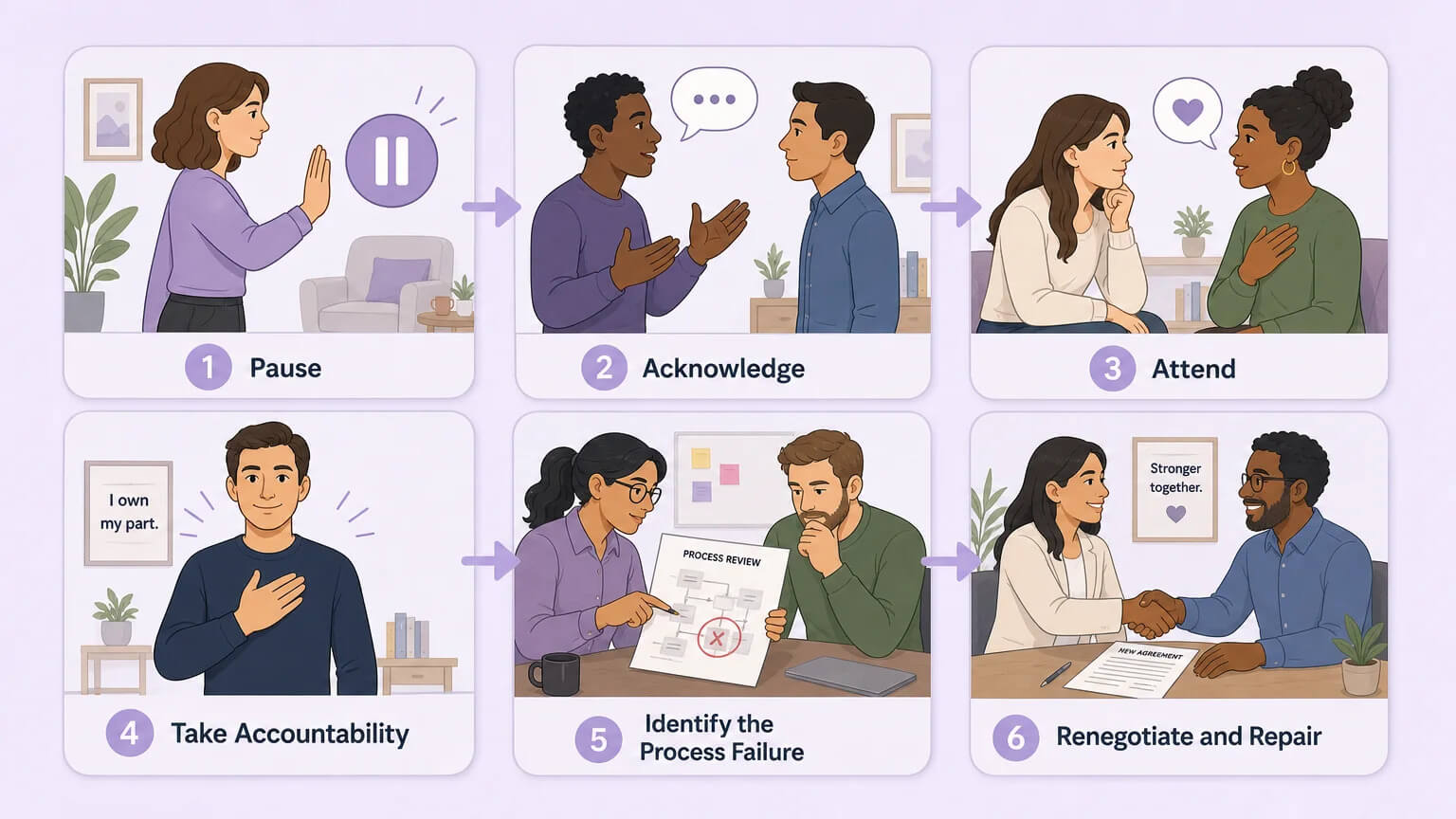
The six-step repair framework, drawn from Kauppi’s CNM therapy best practices:
First, pause outside activities temporarily. You cannot fix the agreement while still operating under the old, broken one.
Second, acknowledge the rupture openly. No deflection, no minimization, no justification. Name what happened plainly.
Third, attend to the hurt partner’s experience before moving to problem-solving. Validation first, solutions second.
Fourth, the person who broke the agreement takes full accountability. No “but you did X first.” No “the agreement was unclear.” Own it completely.
Fifth, identify the process failure. Was the original agreement vague? Was someone afraid to speak up during negotiation? Was there an unspoken need?
Sixth, renegotiate with specificity addressing the root cause, then build a repair ritual: scheduled check-ins, new transparency measures, a written agreement with concrete expectations.
Marisol Westberg, Ph.D. offers a reframe that changes the geometry of the conversation: externalize the problem as “a third presence in the relationship, something separate from the person, something outside of both of them, that they shared the responsibility of dealing with together.” You stand side by side, facing it together — not facing each other across it.
David Cooley’s restorative justice lens focuses on harm caused, needs of those affected, and collaborative repair rather than punishment. Closing the relationship is not a repair. It is a retreat.
The Conversation Starter
“If one of our agreements gets broken, what is our repair process? Can we agree that repair starts with curiosity, ‘what went wrong in our process?’ rather than blame?”
FAQ
What is the difference between a rule, a boundary, and an agreement?
Rules are imposed on someone else’s behavior. Boundaries govern your own: what you will and will not participate in. Agreements are co-created, mutual, and revisable. In healthy ENM, rules are few (consent, honesty), boundaries are personal, and agreements fill the space between.
Do we really need to write our agreements down?
Writing prevents selective memory and “I thought you meant X” drift. A shared note with bullet points works. The free 11-page ENM workbook from South Denver Therapy includes fill-in-the-blank agreement templates and communication scripts for structured guidance.
What is the One Penis Policy and why is it controversial?
The One Penis Policy (OPP) allows a female partner to date other women but not other men. Experienced ENM practitioners view it as a red flag: it is rooted in insecurity, control, or devaluing same-sex relationships. Ask what fear it is managing. That fear is the agreement you need to write.
How often should we revisit our agreements?
Weekly for the first six months. Monthly for the next year. Quarterly after that. After any major life change or significant new connection, schedule a full review.
Can we still have a primary relationship in ENM?
Yes. Hierarchical ENM is valid. The problem is undisclosed hierarchy. Outside partners need to know what “primary” means practically: decision-making power, time priority, veto authority. Transparency converts hierarchy from a trap into a structure everyone can consent to or decline.
What if one of us wants to close the relationship later?
Pausing or closing is a valid agreement. Both partners must discuss it without fear, and outside partners deserve care in the transition. They are not being discarded; the structure they were part of is changing. Can you talk about stopping without it meaning failure?
How do we find an ENM-informed therapist?
Look for AASECT certification, CNM specialization, or ENM experience in therapist profiles. Resources: Psychology Today’s therapist finder with the “non-monogamy” filter, the Kink and Poly Aware Professionals directory, and AASECT’s provider search. Verify ENM competence before booking. A therapist who pathologizes your relationship structure is worse than none.