The word polygamy comes from the Late Greek “polygamia,” a union of “polys” (many) and “gamos” (marriage). It entered English around the 1590s, but the practice it names is far older than the word itself. For most of human history, in most places on Earth, marrying multiple spouses was not exotic. It was ordinary.
The numbers back this up. The Ethnographic Atlas surveyed 1,231 human societies and found that 588 practiced frequent polygyny. More than 80% of documented human cultures permitted some form of multi-spouse marriage. And yet only about 2% of the global population lives in polygamous households today, per Pew Research data. The gap between how common polygamy was and how rare it has become is the question at the center of this article.
You will come away with a framework, not just a definition: what polygamy actually means, why it emerged across civilizations, the forms it takes, where it survives today, and how it differs from the modern consensual non-monogamy movement.
What Polygamy Actually Means: The Three Forms Explained
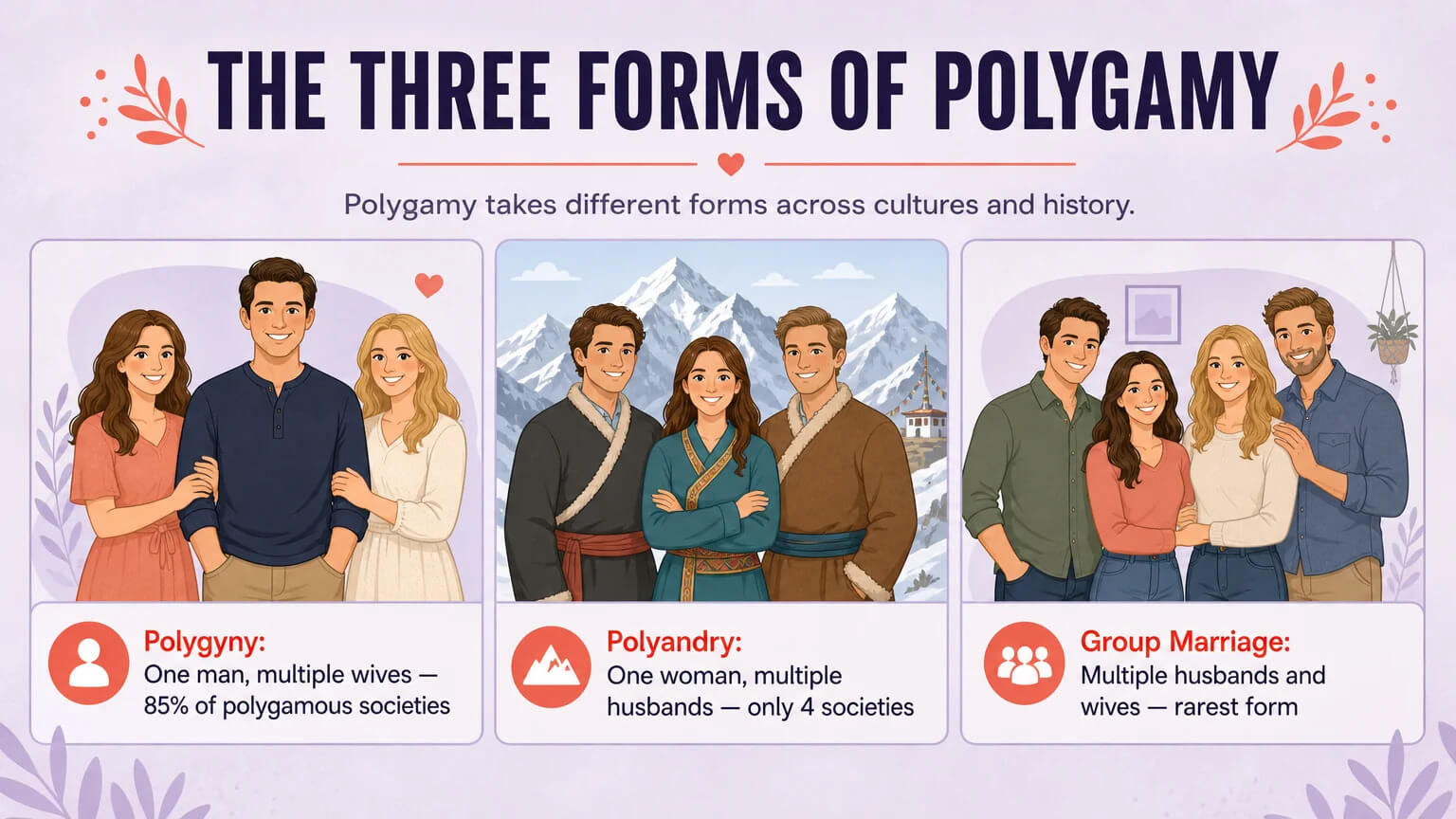
Polygamy is marriage involving more than two spouses. That is the clean definition. But the word is an umbrella, and beneath it are three distinct structures, each with its own logic, prevalence, and cultural footprint.
The first and most common is polygyny: one man, multiple wives. It appears in roughly 85% of historically documented societies that permitted multi-spouse marriage. When most people say “polygamy,” they mean polygyny. You find it across ancient Israel, pre-Islamic Arabia, much of sub-Saharan Africa, imperial China through concubinage, and fundamentalist Mormon communities today.
Then there is polyandry: one woman, multiple husbands. It is vanishingly rare. Only four societies in the entire Ethnographic Atlas practiced it. It survives primarily in Himalayan Tibetan communities where brothers jointly marry one wife to prevent land fragmentation, an arrangement explored in detail later.
The rarest form is group marriage: multiple husbands and wives. It has almost never been institutionalized at scale. Occasional appearances in utopian experiments and a few indigenous societies exist, but it remains more a theoretical category than a widespread practice.
There is also bigamy, which is not a form of polygamy at all. Bigamy is the criminal act of entering a second legal marriage while the first still exists. Polygamy is the broader practice, which may or may not involve multiple legal registrations. In Western countries, the two are often legally synonymous. Conceptually, they are not. The distinction matters because legal systems that treat polygamy as bigamy criminalize entire family structures rather than addressing fraud.
Why Polygamy Existed: The Hidden Logic Behind Multiple Marriages
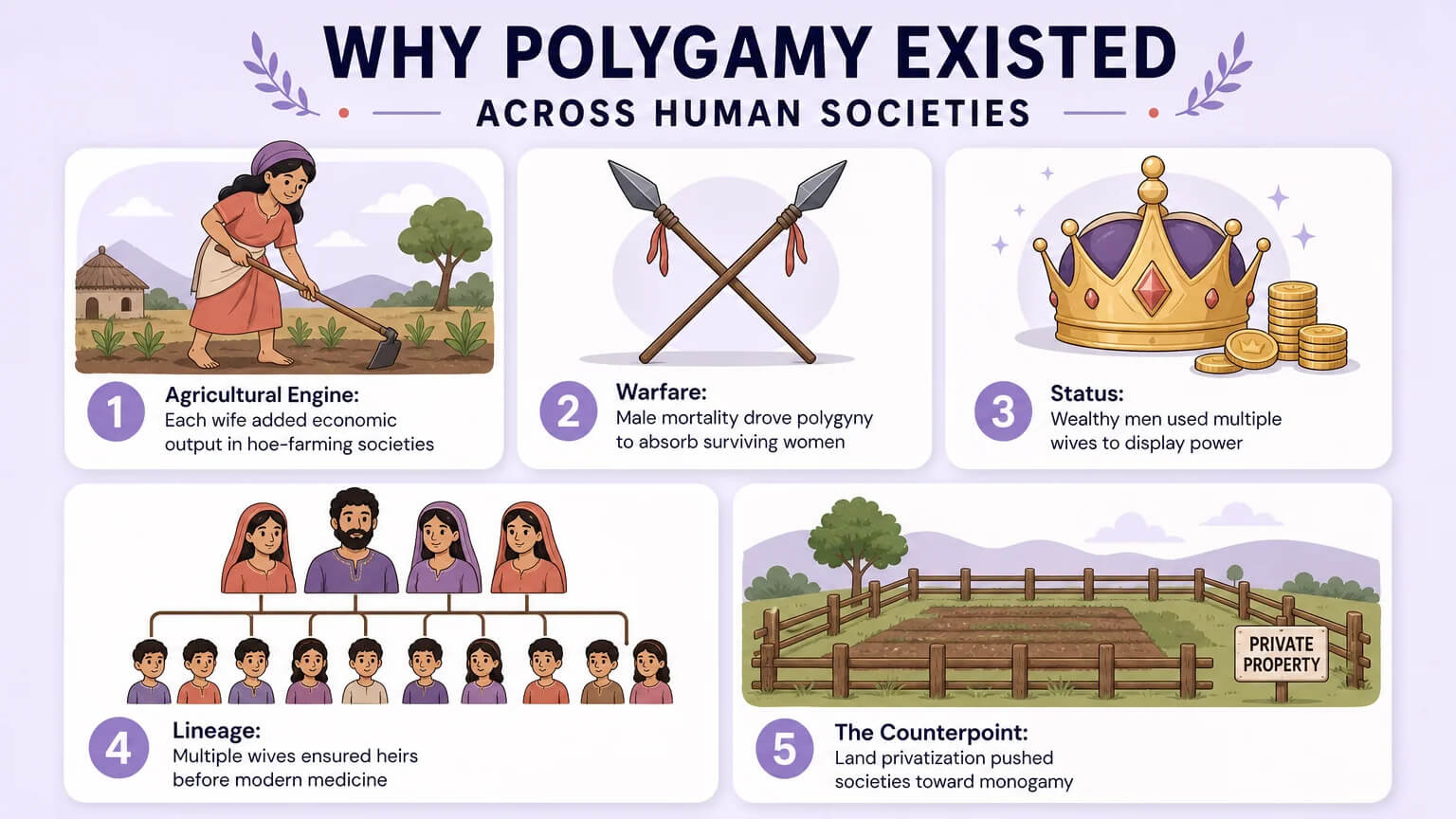
In a hoe-agriculture society where women do most of the farming, an additional wife is a productive asset, not a luxury. This is the Boserup-Goody thesis, and it explains more about global marriage patterns than religion or culture alone ever could.
Start with the agricultural engine. Ester Boserup demonstrated in 1970 that where women perform the bulk of farm labor, polygyny flourishes because each wife adds measurable economic output. Bridewealth, a payment from the groom’s family to the bride’s, reflects this value directly. In plow-agriculture societies, men do most fieldwork. Women’s labor value drops, and monogamy with dowry becomes the norm. Jack Goody called this the great global divide in marriage systems.
Then there was warfare. White and Burton found in 1988 that warfare for plunder and capture of women correlates positively with polygyny. When wars kill large numbers of men, polygyny absorbs surviving women into households. Captured women were integrated into victorious societies through marriage.
Status and inequality played a role too. Henrich, Boyd, and Richerson established in 2012 that polygyny always associates with high-status, wealthy men, even in egalitarian foraging societies. Kings and elites throughout history used polygyny as both status display and political alliance tool: Solomon with 700 wives, Chinese emperors with consorts, Inca rulers distributing secondary wives.
Lineage and inheritance created another pressure. In societies without modern medicine, producing heirs was existential. Multiple wives increased the odds of surviving children. The Code of Hammurabi, circa 1780 BCE, explicitly permitted a second wife if the first was barren.
The counterpoint is land. A 2026 PNAS study found that monogamy spread where agricultural land became scarce and heritable. Elites then had reason to limit legitimate heirs rather than multiply them. Polygamy retreated where land privatization advanced.
Polygamy was never one thing with one cause. It was a flexible strategy that different societies deployed under different pressures. Understanding those pressures makes the practice legible without either endorsing or condemning it.
Polygyny: The Dominant Form Across History
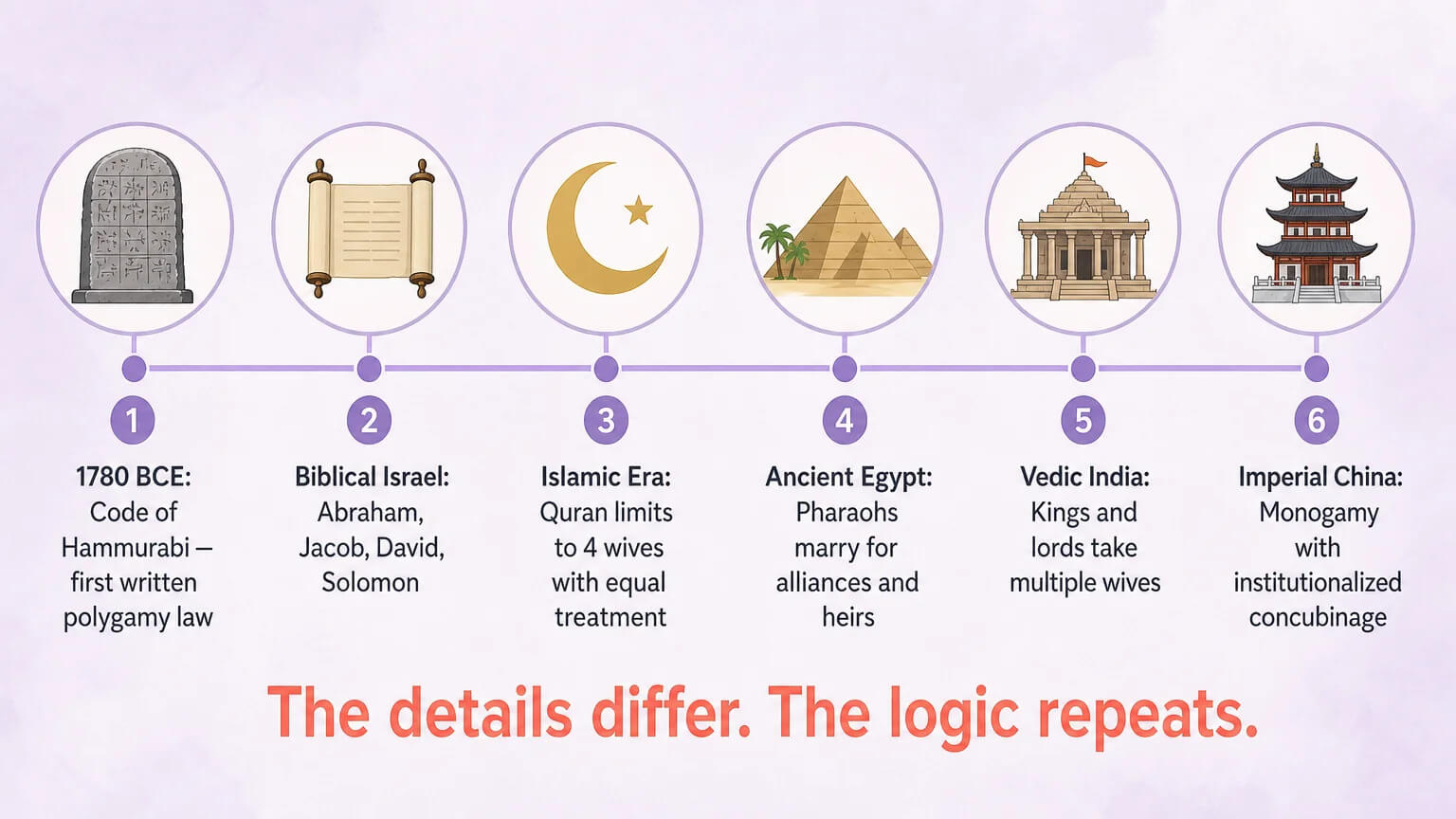
The oldest written evidence of polygamy sits in the Code of Hammurabi, carved into a stone stele in Mesopotamia around 1780 BCE. It allowed a man to take a second wife only if the first was barren or diseased, and it mandated the second wife not be considered equal to the first. Already, 3,800 years ago, societies were regulating the tensions plural marriage creates.
Biblical polygyny followed the same patterns. Abraham took Hagar at Sarah’s suggestion to produce an heir. Jacob married Leah and Rachel. King David had six wives. Solomon had 700 wives and 300 concubines. The Law of Moses did not prohibit polygyny. It regulated it, as recorded in Exodus 21:10 and Deuteronomy 21:15. The shift toward normative monogamy in Christianity came gradually, driven more by Greco-Roman cultural influence than explicit biblical prohibition.
Islam took a different approach: regulation rather than elimination. Quran 4:3 permits up to four wives, conditional on equal treatment. This was historically a limitation on pre-Islamic Arabian unlimited polygyny, not an expansion. Modern practice varies dramatically. Some countries require court permission and proof of financial capacity. Malaysia demands the first wife’s consent alongside court approval. Turkey and Tunisia ban polygamy outright.
Beyond the Middle East, the same structure appeared in different clothes. Egyptian pharaohs maintained royal harems, marrying for diplomatic alliances and heir production. Vedic India’s Rig-Veda records polygyny among kings and wealthy lords; the Laws of Manu placed no cap on the number of wives. Imperial China maintained formal monogamy with institutionalized concubinage: one legal wife, multiple recognized consorts whose children had inheritance rights.
The common thread is hard to miss. Whether in Mesopotamia, Jerusalem, Mecca, Thebes, or Chang’an, polygyny served the same functions: producing heirs, building political alliances, displaying wealth, and concentrating reproductive access among elite men. The details differ, but the logic repeats.
Polyandry: When One Woman Marries Multiple Men
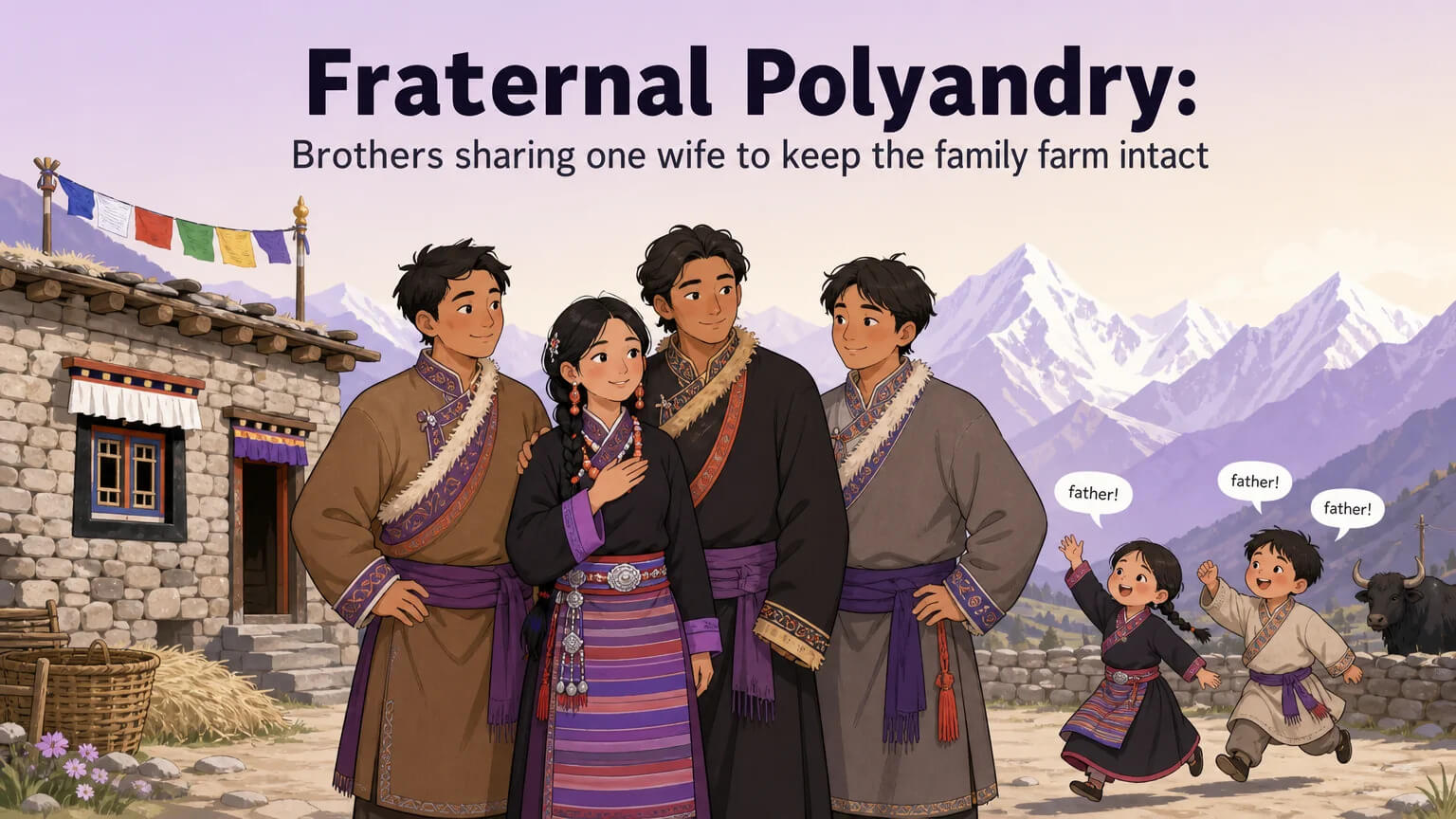
Of 1,231 societies in the Ethnographic Atlas, only four practiced polyandry. It is vanishingly rare, and where it survives, the reasons are environmental. This flips the usual assumption that multi-spouse marriage is always about male dominance.
Fraternal polyandry works like this: in Himalayan Tibetan communities across Tibet, Nepal, and northern India, two or more brothers jointly marry one wife. The eldest brother is the household head. All brothers share work responsibilities and sexual access. Children call all brothers “father.” Nobody tries to identify biological paternity. The family unit is what matters.
The economic logic is straightforward. Melvyn Goldstein of Case Western Reserve University spent years documenting Tibetan polyandry. His conclusion: polyandry is an economic strategy to prevent land fragmentation. In an environment where arable land is scarce, above 12,000 feet, splitting the family farm among multiple sons would create plots too small to sustain a household. One wife means one set of heirs per generation. The farm stays intact. Brothers who practice polyandry achieve a higher standard of living than those who divide land among monogamous households.
Goldstein also debunked the theory that polyandry responded to female infanticide. In Limi in 1974, he counted 60 females versus 53 males aged 15 to 35. There was no shortage of women. It was not about starvation either. It is a land-management strategy.
Polyandry is in decline. A 1988 survey found 13% of Tibetan families practicing it. The number is almost certainly lower today. Economic modernization, tourism, government discouragement, and integration into broader labor markets have reduced the pressure that made polyandry rational. Polyandry is illegal virtually everywhere, including countries where it is culturally practiced. Centuries-old family arrangements exist in a legal gray zone.
Where Polygamy Is Legal Today: A Global Snapshot
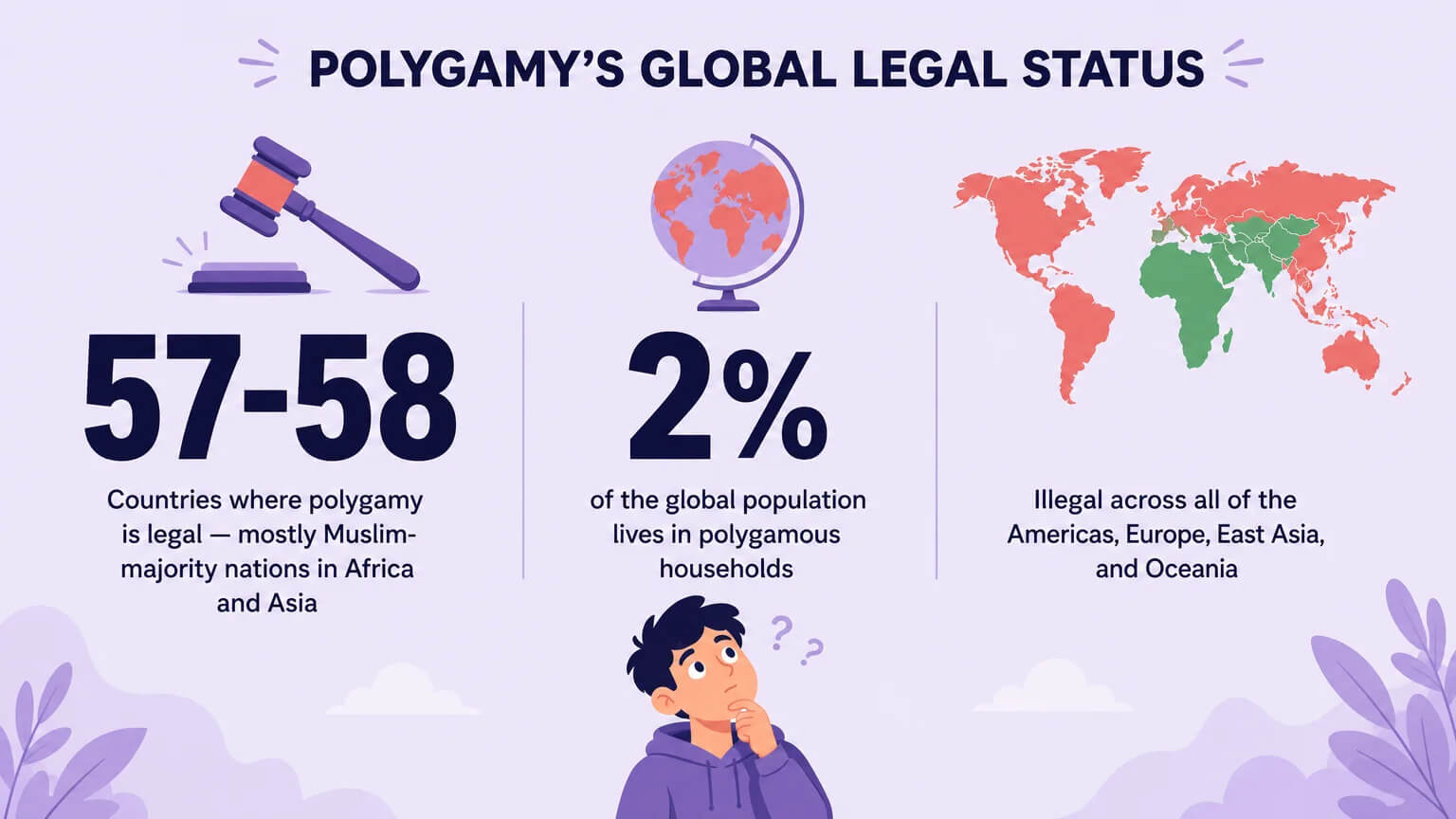
Polygamy is legal in approximately 57 to 58 countries, overwhelmingly Muslim-majority nations in Africa and Asia. It is illegal in all of the Americas, Europe, East Asia, and Oceania. Only about 2% of the global population lives in polygamous households.
The pattern tracks colonial and religious history closely. Countries that inherited European civil law systems criminalized polygamy. Countries where Islamic law survived colonization often preserved regulated polygyny. Sub-Saharan Africa’s “polygamy belt,” stretching through Burkina Faso, Mali, Gambia, Niger, and Nigeria, combines pre-colonial tradition with Islamic legal frameworks. These countries have the highest rates of polygyny globally.
Two countries break the pattern. Turkey and Tunisia, both Muslim-majority, outright ban polygamy with criminal penalties. They are the secularist outliers in the Islamic world, products of Ataturk’s reforms and Bourguiba’s modernizing agenda respectively.
Several monogamous legal systems carve out religious exemptions. India banned polygamy for Hindus in the mid-1950s but permits polygyny for Muslims. Malaysia, Singapore, the Philippines, and Sri Lanka also permit polygyny for Muslims only, with regulations requiring court permission, proof of financial means, and in some cases the first wife’s consent.
There is also movement. As of August 2025, Nepal is actively debating legalization, a significant development given the country’s cultural history with fraternal polyandry and its current monogamy-only legal framework.
The enforcement gap deserves attention. In countries where polygamy is illegal but culturally practiced, women in unregistered spiritual marriages have no legal rights to property, inheritance, or spousal support. The law’s absence does not stop the practice. It strips protections from the people inside it. Ethiopia, DR Congo, Angola, and de facto American fundamentalist communities all live in this gap.
For the full picture of legality of polygamy all over the world, check this guide: Is Polygamy Legal >>
Modern Polygamy: From Fundamentalist Compounds to Reality TV
The Church of Jesus Christ of Latter-day Saints abandoned polygamy in 1890 as a condition of Utah’s statehood. Today, roughly 17 million mainstream Mormons do not practice it. The polygamy that survived did so in fundamentalist offshoots.
The FLDS (Fundamentalist Church of Jesus Christ of Latter-day Saints) represents the darkest end. Under Warren Jeffs, now serving life plus 20 years for child sexual assault, the FLDS operated as an authoritarian system where Jeffs personally assigned and reassigned wives, more than 80 of them, up to 24 underage. In December 2024, offshoot leader Samuel Bateman was sentenced to 50 years for conspiracy involving girls as young as nine. This is coercion that happened to use polygamy as a pretext.
The AUB (Apostolic United Brethren) is the “Sister Wives” group, with approximately 10,000 members based in Bluffdale, Utah. Women can decline marriage, wives must be treated equally, and monogamy is allowed alongside plural marriage. Kody Brown’s family from TLC’s Sister Wives belongs to this group. His 18 children have largely rejected polygamy for themselves.
Independent fundamentalist families, estimated at tens of thousands across the U.S., practice plural marriage outside any organized group. These range from coercive to genuinely consensual, with no central authority.
The media has shaped how most people picture polygamy. Brenda Weber, author of “Latter-day Screens,” argues that media portrayals reduce Mormonism to polygamy, flattening a complex religion into one practice. HBO’s “Big Love” fictionalized Mormon polygamy but struggled with audience sympathy. TLC’s “Sister Wives” evolved over 15 years from celebration of the lifestyle to documentation of family dissolution. The exposure has made polygamy more understood as a family dynamic, though public sympathy remains limited.
What gets lost: the most visible polygamy in Western media is also the least representative. Isolated fundamentalist groups, not the millions of ordinary families in polygamous households across Africa and Asia.
Polygamy vs. Polyamory: Why the Distinction Matters
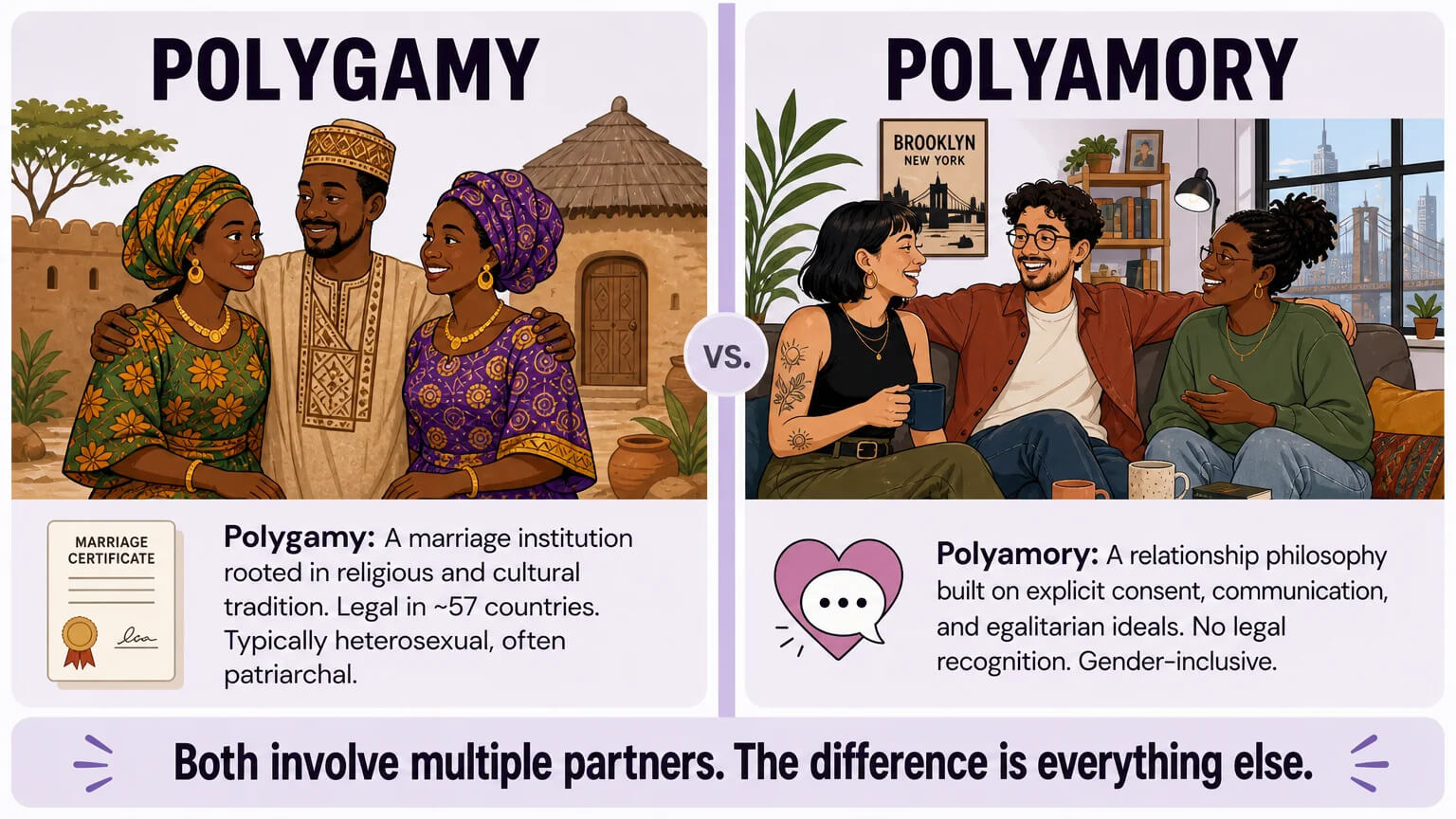
Social media is full of people correcting each other: “the word you’re looking for is polyamory.” Few explain what the actual difference is. It is not semantic nitpicking. It is the difference between an institution and a relationship philosophy.
A polygamous household in rural Mali, structured around Islamic inheritance law and extended family obligations, has almost nothing in common with a polyamorous triad in Brooklyn negotiating date nights and communication check-ins. Calling both “multiple-partner relationships” is technically true and practically useless.
| Dimension | Polygamy | Polyamory |
|---|---|---|
| Basis | Marriage (legal or spiritual) | Relationships (emotional/romantic) |
| Gender dynamic | Typically heterosexual, often patriarchal | Gender-inclusive, egalitarian in principle |
| Origin | Religious/cultural tradition | Modern ethical framework (emerged 1990s) |
| Consent model | Variable, ranges from fully voluntary to coerced | Explicit, ongoing, enthusiastic consent is foundational |
| Legal framework | Legal in approximately 57 countries; illegal elsewhere | No legal recognition anywhere |
| Umbrella category | Standalone institution | Subset of ethical non-monogamy (ENM) |
Polygamy is an institution. It is a way of organizing marriage, inheritance, and kinship that predates modern concepts of individual consent. Polyamory is a relationship philosophy. It is an approach to love and partnership built on explicit consent, communication, and egalitarian ideals.
You can be in a polygamous marriage and practice polyamory. You can be in a polyamorous relationship that has nothing to do with marriage. The overlap is real, but the categories are distinct.
The confusion persists because both involve multiple partners, both exist outside the Western monogamous norm, and popular media uses them sloppily. The modern ENM movement borrowed language, “poly,” that echoes the older term. But the etymology is a coincidence. “Poly” just means “many” in Greek.
Bigamy sits apart from both. It is the criminal offense of marrying someone while legally married to another. It is fraud. It can happen in polygamous contexts or entirely outside them. It is a legal category, not a relationship structure.
If you are weighing monogamy against polygamy more broadly — what the research says about happiness across both, how jealousy works in each, the practical costs of living outside the two-person default, and a framework for figuring out which path fits you — read our full comparison: Monogamy vs Polygamy: More Options Than You Were Told.
Once you know which direction fits you, the next question is practical: where do you actually meet people? Whether you are looking for a faith-based plural marriage, a couple exploring together, or a solo poly connection, the platform you choose shapes everything. We broke down the 10 that matter: 10 Best Polygamy Dating Sites Worth Your Time.
What the Research Actually Says About Polygamy’s Impact
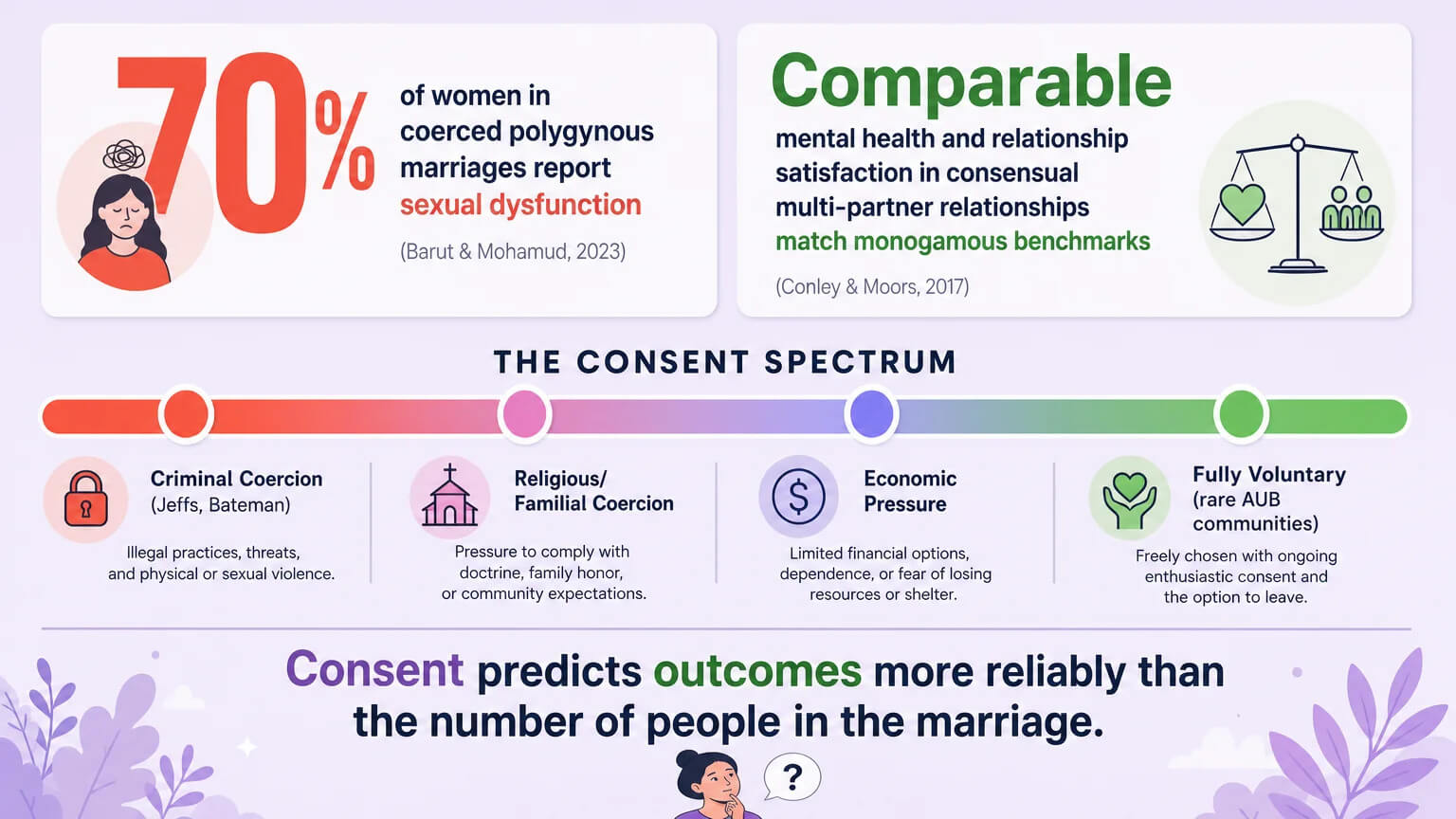
Study after study finds higher rates of depression and anxiety among women in polygamous marriages. But other research finds that multi-partner relationships with high consent and communication produce outcomes indistinguishable from monogamous ones. Which is it? Both. The variable that explains the split is consent.
The concerning data is real and well-replicated. Barut and Mohamud studied 607 Somali women in 2023 and found that those in polygamous marriages had significantly higher scores for anxiety and depression. Nearly 70% of polygamous women reported sexual dysfunction, compared to 56% of monogamous women. “First wife syndrome” showed up clearly: first wives had the highest levels of distress. A meta-analysis of 18 studies across 10 countries confirmed significantly higher odds of depression among women in polygamous marriages.
But here is what those studies are actually measuring. They overwhelmingly sampled women in contexts where polygyny is structured around male authority, economic dependence, and limited female autonomy. When Conley and colleagues in 2017 and Moors and colleagues in 2017 studied consensual non-monogamy with high communication and equity, relationship quality, mental health, and sexual satisfaction matched monogamous benchmarks. The structure was not the problem. Coercion was.
Real-world polygamy exists on a spectrum. At one end: fully voluntary arrangements, rare but documented in some AUB communities where women actively choose plural marriage. Then economically coerced situations, where refusing marriage means destitution. Then religiously and familially coerced, as in FLDS-style groups. And at the far end: outright criminal, as in the cases of Jeffs and Bateman. Bundling all of these into “polygamy causes depression” is both scientifically sloppy and practically misleading.
Even in nominally consensual arrangements, polygyny creates real structural challenges: jealousy between co-wives, unequal distribution of time and resources, complex inheritance dynamics, and social stigma. These are not imaginary.
The quality of consent, communication, and equity predicts outcomes far more reliably than the number of people in the marriage.
FAQ
What is the difference between polygamy, polygyny, and polyandry?
Polygamy is the umbrella term for marriage involving multiple spouses. Polygyny, one man with multiple wives, is the most common form, practiced in roughly 85% of polygamous societies (follow this guide to learn about differences between polygamy and polygyny). Polyandry, one woman with multiple husbands, is rare, found in Himalayan communities where brothers share one wife.
How is polygamy different from polyamory?
Polygamy is marriage-based, typically heterosexual, rooted in religious or cultural tradition. Polyamory is relationship-based, gender-inclusive, built on consent and emotional intimacy. Polygamy is a marriage institution. Polyamory is a subset of ethical non-monogamy. They overlap in practice but are distinct categories.
Is polygamy the same as bigamy?
No. Bigamy is the criminal offense of marrying someone while still legally married to another. Polygamy is the broader practice of having multiple spouses, which may or may not involve multiple legal marriages. In most Western countries, polygamy is prosecuted as bigamy.
Where is polygamy legal today?
Polygamy is legal in approximately 57 to 58 countries, mostly Muslim-majority nations in Africa and Asia. It is illegal in all of the Americas, Europe, East Asia, and Oceania. About 2% of the global population lives in polygamous households. Turkey and Tunisia are the only Muslim-majority countries that ban it with criminal penalties.
Do Mormons practice polygamy?
Mainstream Mormons (The Church of Jesus Christ of Latter-day Saints, roughly 17 million members) do not practice polygamy and officially banned it in 1890. An estimated 50,000-plus people in fundamentalist offshoots still practice spiritual plural marriage outside legal recognition.
Is polygamy harmful to women’s mental health?
Outcomes depend on consent and equity. Coerced polygyny correlates with higher depression, anxiety, and sexual dysfunction. Consensual arrangements with high communication produce outcomes comparable to monogamous relationships. The main driver of harm is coercion, not polygamy.
Why did so many societies practice polygamy?
Five main drivers: female agricultural productivity made each wife an economic asset; warfare killed men and polygyny absorbed surviving women; male wealth inequality let powerful men accumulate wives; high child mortality meant multiple wives ensured heirs; and lineage politics used marriage to build alliances.