Picture you and your partner punching two different destinations into the same GPS. Neither of you checked if they match. This is what unfolds when couples explore ethical non monogamy vs open relationship without first agreeing on what either term actually means.
You landed here because you are trying to figure out which label fits what you want, or what your partner just floated across the dinner table. Maybe you are staring at a dating profile wondering which box to check. Maybe your partner said “I want an open relationship” and you nodded while internally running through every definition you have ever heard. The confusion is not a character flaw. Roughly 4 to 5 percent of people in the United States are currently practicing some form of consensual non-monogamy, a number larger than the entire LGB population. And the single biggest predictor of whether your adventure strengthens your bond or sends you both into separate corners scrolling through a glossary? Definition misalignment. Period.
This article walks through seven dimensions where these two paths split, so you can stop debating semantics and start designing a dynamic that actually works for your team. Think of it as checking the GPS coordinates before you hit the gas.
The ENM Umbrella: A Map Before You Travel
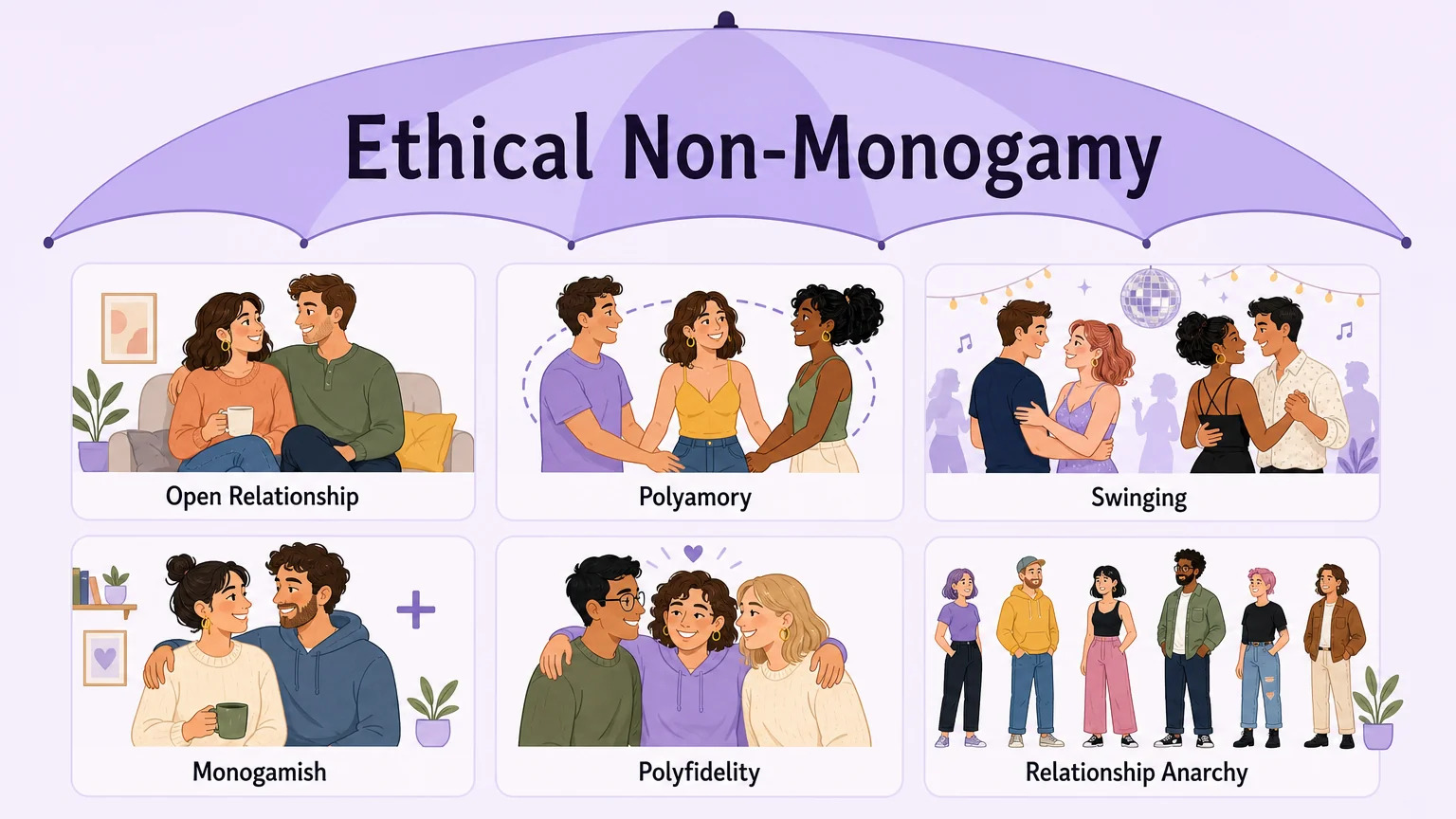
Ethical non-monogamy is not one thing. It is an umbrella, and under it live several distinct relationship structures, each with its own emotional rules and practical realities.
Open relationships sit on one spoke. Polyamory occupies another. Swinging camps out over there. Monogamish couples dabble on the edge. Relationship anarchists refuse the map entirely. Polyfidelity groups build closed circles of three or more. Each deserves a quick definition before we zoom in.
An open relationship keeps the emotional center of a couple while expanding sexual boundaries. You and your partner remain each other’s primary person, but you agree that physical adventures with others are on the table. Polyamory goes further: it opens the door to multiple loving, committed relationships at the same time. Swinging centers on recreational sex, often together at parties or clubs, with emotional exclusivity to the primary pair intact. Monogamish describes couples who are almost entirely monogamous but leave room for occasional exceptions. Relationship anarchy tosses the rulebook: every connection stands on its own, unranked and unlabeled. Polyfidelity is a closed multi-person relationship where everyone is committed to everyone else within the group.
Within open relationships themselves, the variations multiply. Queer Theology outlines at least six structures. Don’t ask, don’t tell keeps outside encounters invisible. Sexually open, emotionally monogamous permits bodies but forbids hearts. Hierarchical setups place the primary couple at the center with clear boundaries around outside connections. Veto arrangements give either partner the power to shut down an outside dynamic. Negotiated, non-hierarchical models treat agreements as living documents rather than rigid contracts. And the sixth, operating under the guise of openness without consent, is what happens when you skip the ethical part entirely.
Why does this matter beyond a vocabulary flex? Because picking a label is an act of setting expectations. When you say “we are open,” you are signaling to your partner and to potential guests what the container looks like. If you mean “sexually open only” and someone else hears “polyamory with full emotional availability,” you have planted a landmine. The labels are not just words. They are promises.
1. What You Are Actually Signing Up For: Scope and Definitions
The most common stumble in the ENM world is not jealousy or scheduling. It is two people using the same word and meaning entirely different things. An ENM profile proclaiming “open to connections” meets a poly match looking for a nesting partner, and both walk away confused.
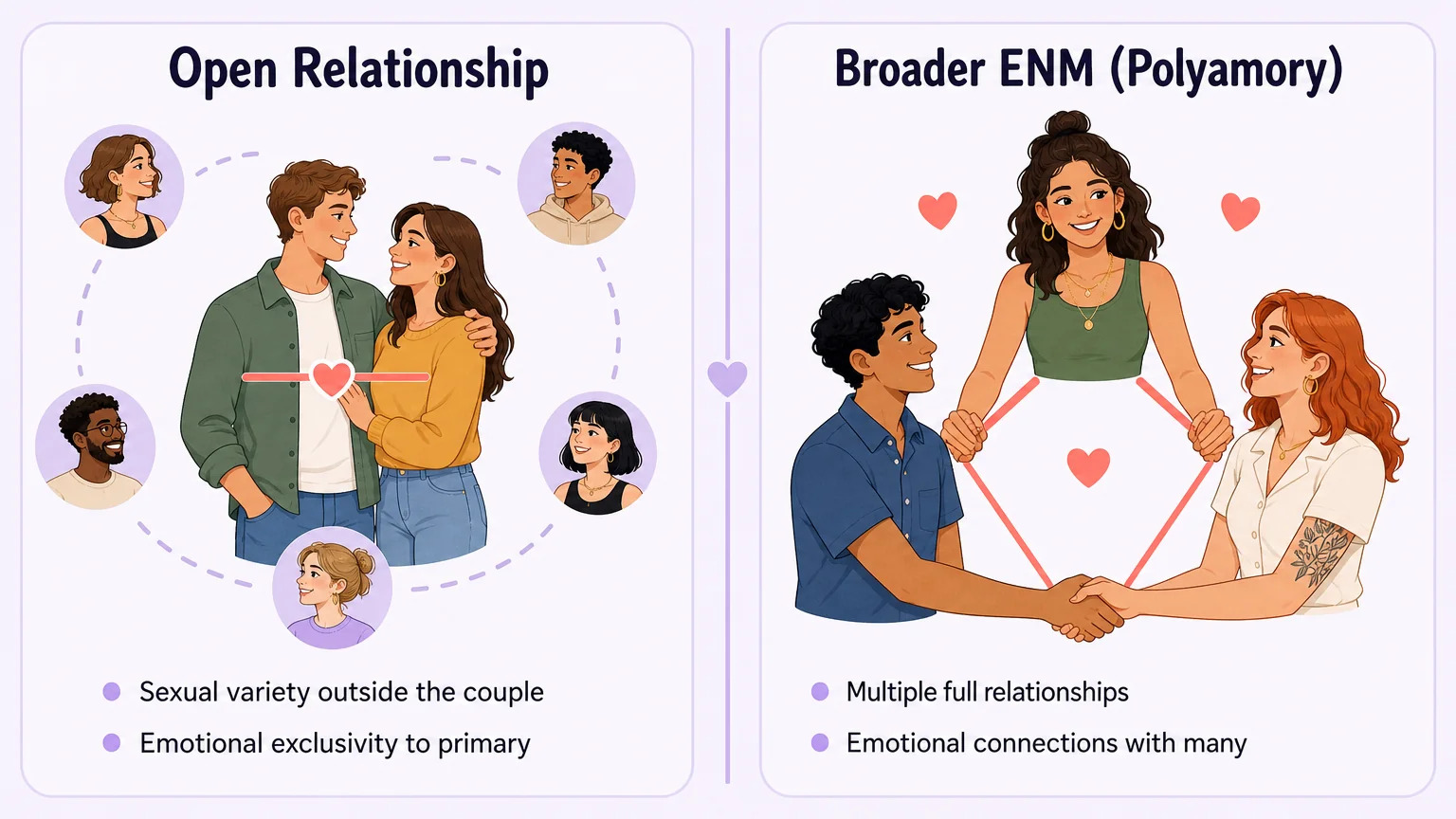
Ethical non-monogamy is the broad commitment to relationship structures that include more than two people, built on consent, transparency, and mutual agreement. It is the umbrella. An open relationship is one specific type of ENM where a couple maintains their primary partnership as the emotional and logistical center while allowing for sexual experiences outside that dyad.
| Dimension | Open Relationship | Broader ENM (e.g., Polyamory) |
|---|---|---|
| Scope | Sexual variety outside the couple | Multiple full relationships possible |
| Emotional Agreements | Emotional exclusivity to primary partner | Emotional connections with multiple partners |
| Hierarchy | Couple is the defined center | Varies (hierarchical to non-hierarchical) |
| Typical Structure | Primary couple plus outside sexual partners | Multiple committed partners, possibly nesting |
| Best For | Couples exploring together from a secure base | Individuals or couples open to multiple loving bonds |
Where it gets messy: an ENM profile might mean anything from “I swing twice a year” to “I have three life partners and we share a mortgage.” An open relationship profile is more specific but still needs clarification: sexually open only, or emotionally open too? Repeats allowed or one-and-done? Do you tell each other about dates or keep them private? The label is a starting point, not a contract.
Best for couples who want to keep their relationship as the anchor while exploring sexual variety together. Skip if what you actually want is multiple loving partnerships with full emotional availability. Be honest about which one you are describing before anyone swipes right.
2. The Elephant in the Room: Can You Really Promise ‘No Feelings’?
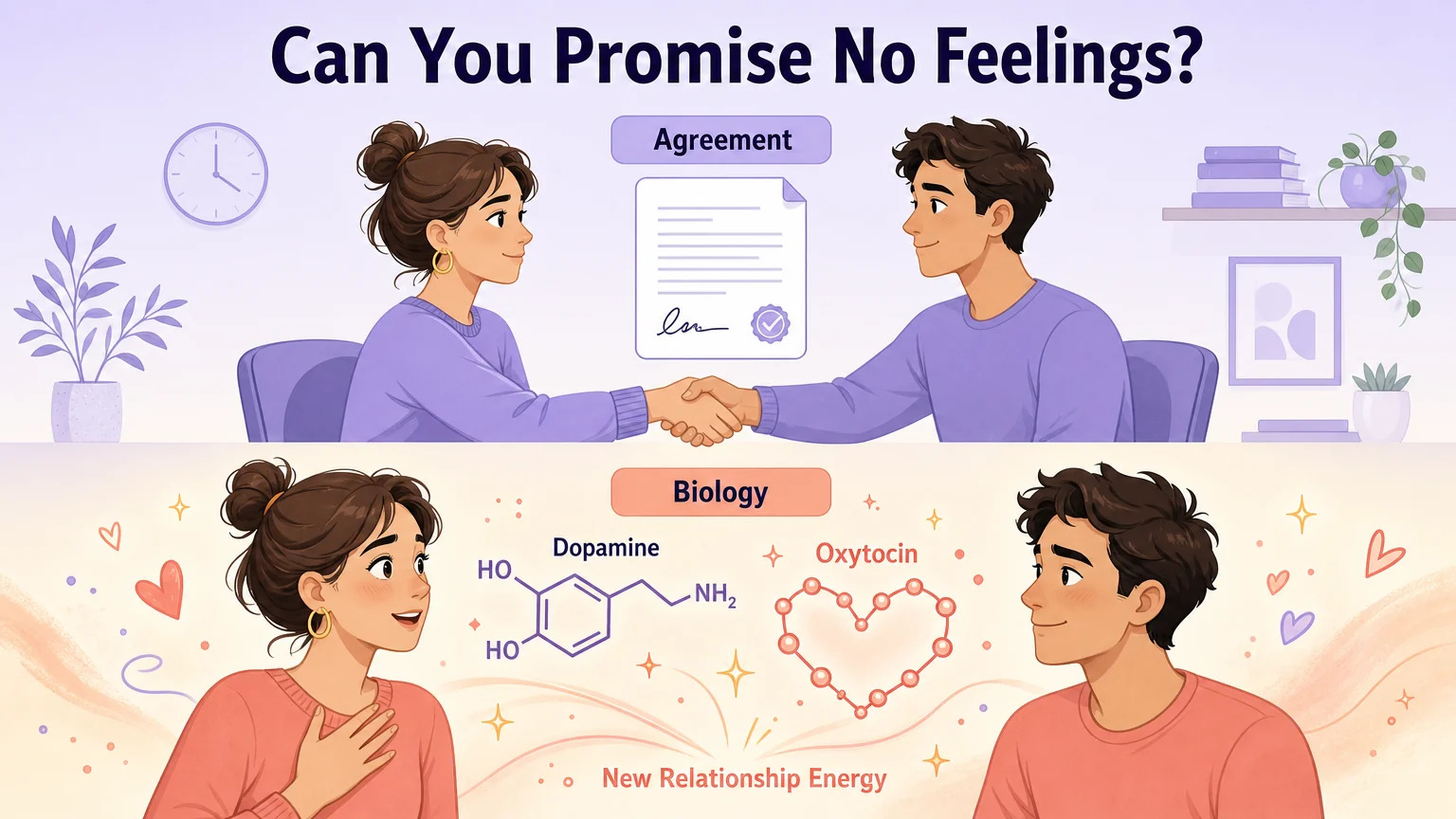
Sex with other people, but no catching feelings. That sentence has launched a thousand therapy sessions and a fair number of breakups. It is the defining promise of many open relationships, and it may also be the most precarious one you can make.
The biology is not on your side. Oxytocin surges during physical intimacy. New relationship energy floods your brain with dopamine and makes every text message feel like a small miracle. You can set agreements, but you cannot negotiate with your neurochemistry. As Brian G. Murphy of Queer Theology puts it plainly: you cannot decide how you feel about someone. The sexually open, emotionally closed model is aspiration, not a blueprint.
Lola Phoenix writes that no relationship definition will save you from your partner leaving you. Labels should describe your needs, not contain your fears. Ellecia Paine observes that couples who build elaborate frameworks to prevent feelings often spend more time managing the framework than enjoying the connections. Most couples, she notes, spend more time sitting on the edge of beds with tissues than living the fantasy.
What actually happens when someone catches feelings despite the agreement? The no-repeats arrangement is the most common casualty. You agree to one-time encounters only, then you meet someone who is funny and warm and the sex is great. Suddenly the boundary feels arbitrary. You renegotiate. Or you hide it. Neither outcome is what you signed up for.
The couples who thrive do not pretend feelings are impossible. They discuss what happens if feelings arrive before they ever appear. They build regular check-ins into their calendar instead of waiting for a crisis. They learn the word compersion, the joy of seeing your partner happy with someone else, and practice it like a skill. Some couples find that acknowledging the possibility of emotional connection takes the pressure off and makes the whole enterprise feel less like a high-stakes gamble.
The Verdict: You cannot promise no feelings, but you can promise honest conversations when they show up. That second promise is the one that actually holds.
3. Who Comes First: Hierarchy, Priority, and What ‘Primary’ Actually Means
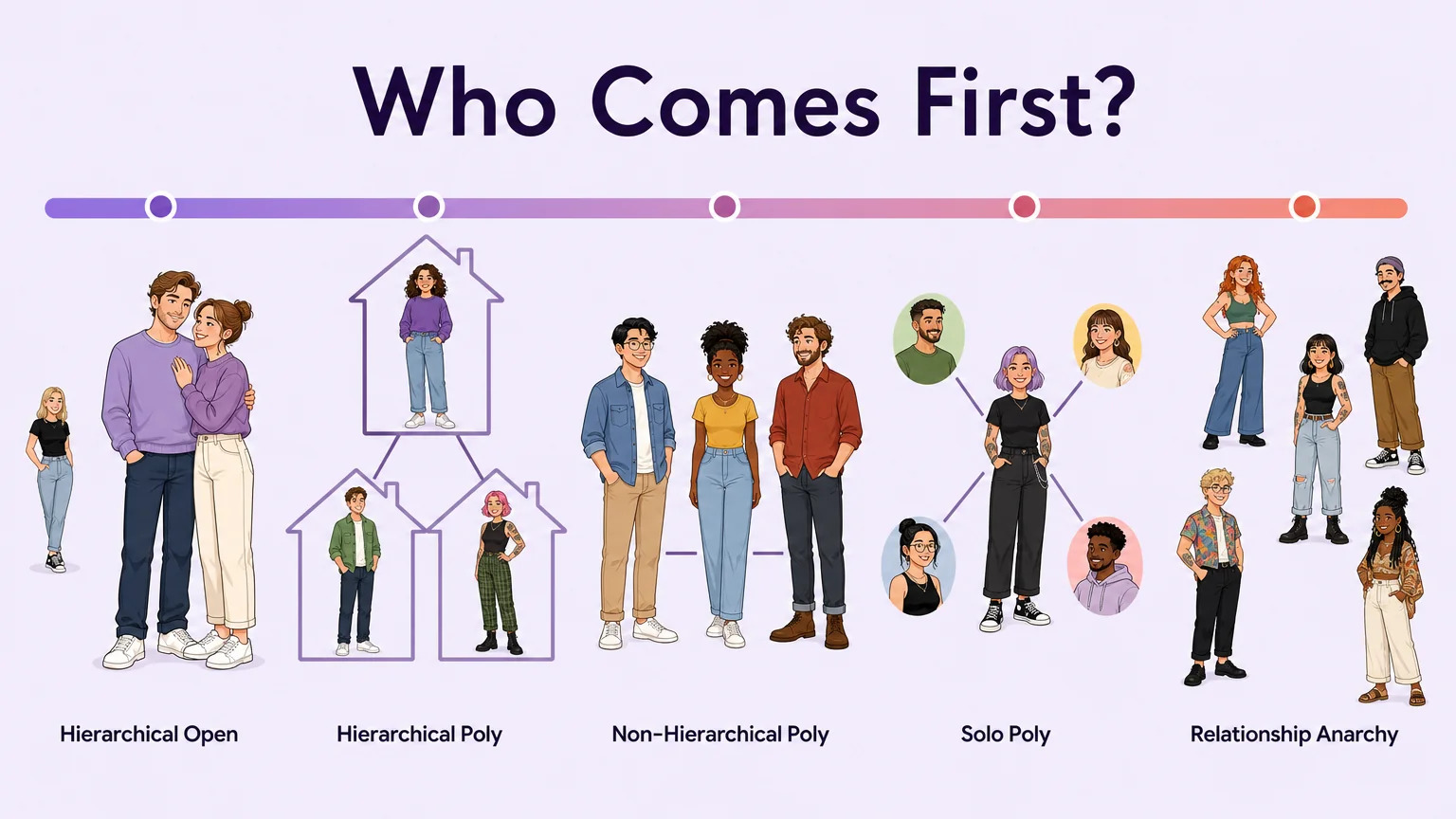
Your partner texts during a date with someone new. Are you in the emergency room, or do they just want to know where the coffee filters are? That is hierarchy in practice: the invisible ladder of priority every relationship structure builds, whether you name it or not.
Open relationships make hierarchy explicit by design. The couple is the center. Outside connections orbit around that core. When conflicts arise, the primary partnership gets the first claim on time, attention, and decision-making. The assumption is that you and your partner are each other’s default person.
Broader ENM structures spread hierarchy across a spectrum. Hierarchical polyamory keeps the concept but adapts it: you might have a nesting partner who shares your home plus other committed partners who do not. Non-hierarchical polyamory attempts to flatten the ladder, giving each partner equal standing in decisions that affect them. Solo polyamory rejects the couple-as-center model, treating each relationship as independent. Relationship anarchy refuses to rank anyone at all.
The secondary partner’s emotional reality deserves honest attention. It can be disorienting to build a genuine connection with someone only to discover your date nights evaporate whenever the primary partner has a rough day. The hinge person, the one dating both a primary and a secondary, carries the weight of coordinating expectations across relationships with different stakes and different access to reassurance.
Then there is the veto. Some couples give each other the power to shut down an outside connection at any time. It sounds like a safety net. In practice, it often leaves secondary partners feeling disposable and primary partners feeling surveilled.
Best for open relationships: couples who want clear structure and are comfortable naming the partnership as the priority. Skip if the idea of someone else having the power to end your connection sits wrong with you, or if you would feel diminished being anyone’s secondary forever.
4. Tuesday at 7pm: What Daily Life Actually Looks Like
Theory sounds clean. Wednesday night at 7pm, when you are coordinating who has the kids, who has a date, and whether the guest room sheets are clean, is where the map meets the road.
Open relationships tend to run on a simpler calendar. You and your partner share a household, a budget, and a default assumption that evenings belong to the two of you unless one of you has scheduled otherwise. An outside date is an exception that gets penciled in, not a recurring standing appointment.
Broad polyamorous ENM often requires what practitioners call Google Calendar polyamory. Multiple partners, each with their own connections, create scheduling chains that would make a project manager reach for aspirin. A Tuesday night might involve coordinating across four people’s availability for a two-hour window.
STI protocols are another practical divide. An open couple might agree to test every three months, share results, and use protection with outside partners. A polycule of five people, each with their own outside connections, needs a more robust system. Risk profiles compound, and trust becomes a network property rather than something between just two people.
Household logistics tell a similar story. Open couples maintain one home with one set of bills and one refrigerator to argue about. Multi-adult poly households split mortgages three ways, coordinate across different dietary needs, and navigate whose turn it is to buy toilet paper for four.
Then there is the unglamorous part nobody writes about in dating app bios: managing new relationship energy when you still have to show up for your primary partner, processing jealousy while folding laundry, and having a check-in conversation at 10pm when you both would rather sleep.
Quick Comparison: Open relationships keep the logistical load of a couple plus occasional guests. Polyamory expands the load to match the relationship web. Neither is easier. They are different kinds of complicated.
5. Who Knows? Disclosure, Stigma, and Living Out Loud
You had an incredible date. You are glowing. And you cannot tell anyone at work because your open relationship is not something your boss would understand. That loneliness hits differently depending on which ENM structure you choose.
Open relationships often come with a built-in invisibility cloak. From the outside, you look like a monogamous couple. You go to family dinners together. Your outside adventures exist in a compartment most people never see. This makes passing easier, but it also means carrying a piece of your life that nobody reflects back to you.
Broader ENM, particularly polyamory with multiple visible partners, makes passing harder. When you show up to the office holiday party with a different partner than last year, people notice. The OPEN 2024 survey of over 4,500 respondents across 71 countries found that 60 percent face stigma related to their relationship structure.
Healthcare is its own minefield. ENM practitioners report doctors refusing routine STI testing with comments like “if you would just be monogamous.” Finding a therapist who does not pathologize your relationship structure takes work. These are systemic problems you still have to live inside.
A double life wears differently on everyone. Some find compartmentalization manageable. Others describe it as slowly eroding their integrity. You start omitting pronouns, editing stories, becoming fluent in strategic ambiguity.
This is not all or nothing. Many ENM practitioners are out to close friends but not at work. Some are open with family but not on social media. You do not owe anyone your full story. You get to decide your disclosure boundaries one relationship at a time.
The Verdict: Open relationships offer more structural invisibility, which can be a feature or a cage. Broader ENM forces visibility sooner. Neither path eliminates stigma, but choosing your disclosure strategy together prevents it from becoming a source of resentment.
6. When the Label Stops Fitting: Can Open Relationships Evolve?
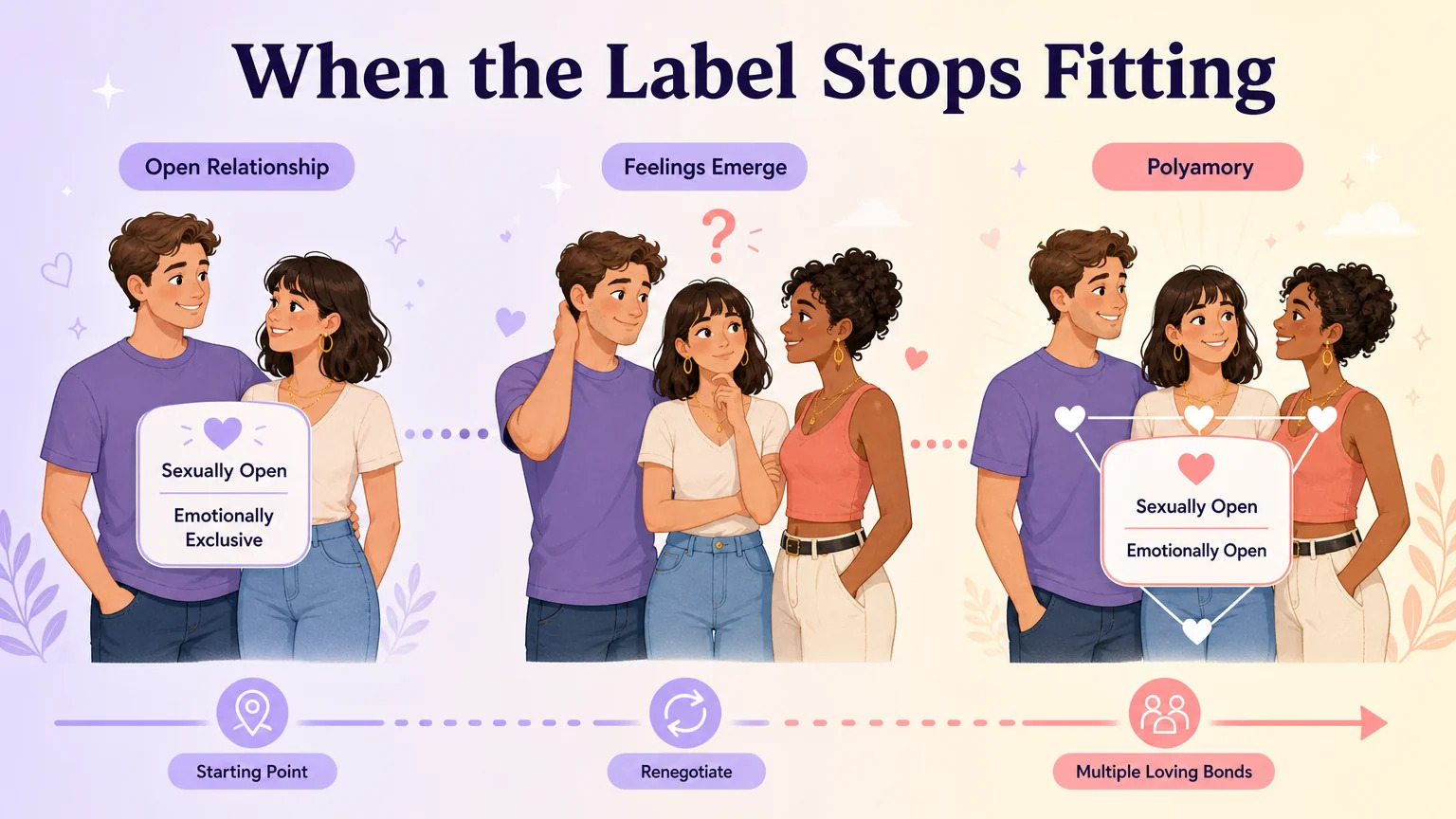
Most people practicing ethical non-monogamy do not land on their final form on the first try. Labels shift. Agreements get rewritten. The open relationship you launched two years ago might feel cramped now that you have met someone you actually want to keep around.
The most common evolution runs from open to poly. A couple opens up intending to keep things casual. Someone meets a person they genuinely like. The no-feelings agreement frays. Suddenly you are negotiating sleepovers and whether “I love you” is an option. This is not a failure. It is evidence the plan responded to real people rather than hypotheticals.
Can it go the other direction? A polycule simplifies back into an open relationship? Yes, but the emotional risks are higher. De-escalating a loving relationship to make space for your primary partnership is a particular kind of heartbreak.
Before you evolve anything, have a concrete conversation. What would actually change in your day-to-day life if you shifted from open to poly? More overnights? Shared calendars with a third person? The label matters less than the logistics it unlocks. Lola Phoenix offers the clarifying question: if you stopped calling it an open relationship and started calling it polyamory, what would be different, and what would scare you about that difference?
When not to evolve: if you are changing your label to accommodate someone who wants something you do not, if you are doing it to avoid losing a partner, or if it feels like a downgrade rather than an expansion.
Direct Recommendation: Pick the structure that fits today, then set a three-month check-in to ask whether it still does. The point is not picking perfectly on the first try. It is staying in conversation long enough to let the right shape emerge.
7. Making the Call: How to Know Which Path Is Yours
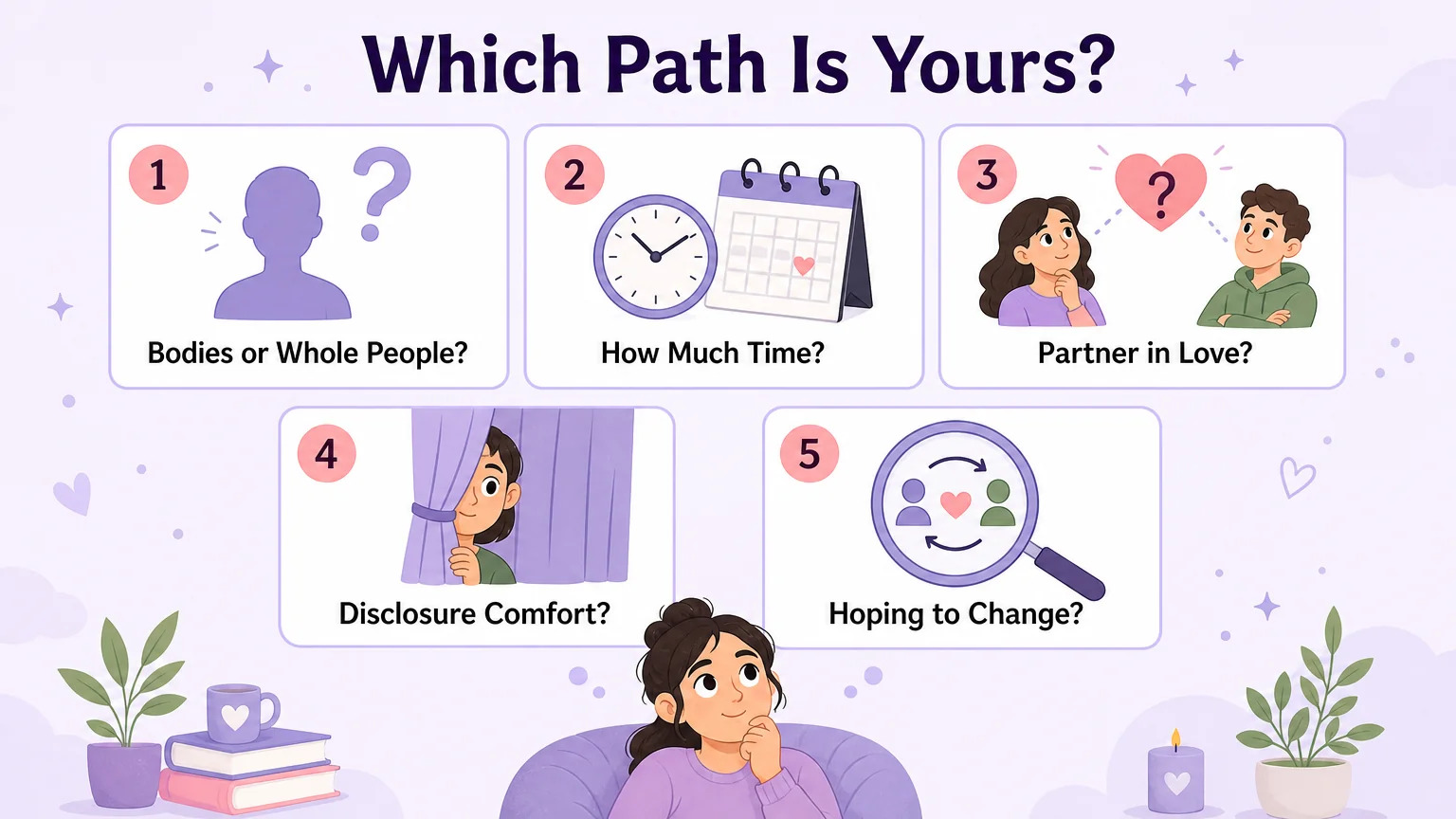
You have the map. Now figure out where you actually want to go. These five questions will get you there faster than any personality quiz.
First, when you picture outside connections, do you see bodies or whole people? Sexual variety without emotional entanglement points toward open. Full relationships with emotional depth point toward broader ENM. Neither answer is wrong.
Second, how much time do you realistically have? An open relationship asks for one night every couple of weeks. Polyamory asks for multiple evenings per week plus bandwidth to stay present across several relationships. Be honest about your calendar.
Third, can you handle your partner falling in love with someone else? If “absolutely not,” an open relationship with clear emotional boundaries is likely your ceiling. If “I think so, with support,” you have room to explore.
Fourth, what is your disclosure comfort zone? Open relationships let you stay relatively invisible. Polyamory pushes toward visibility. Your tolerance for explaining your life to family, coworkers, and doctors matters.
Fifth, what are you actually hoping this will change? ENM amplifies existing dynamics. Strong communication gets stronger. Cracks become chasms. If your answer involves “fixing” something, pause and work on that first.
Three myths to release. One: poly people cannot commit. Commitment across multiple relationships is no less real. Two: open relationships are just infidelity with permission. The word “ethical” draws the line. Three: you must pick a label and keep it forever. Most practitioners iterate before finding the structure that fits.
What if you and your partner want different things? Spend three months under one set of agreements without permanently naming anything. Then revisit with actual experience instead of hypothetical fears.
Best for open relationships: couples with a strong foundation who want exploration within a clear couple-centric structure. Best for broader ENM: people emotionally capable of loving more than one person, willing to trade simplicity for depth. Skip both if you are using ENM as a softer exit from a relationship you are already done with.
The Bottom Line
Open relationships tuck exploration inside the structure of a primary partnership. They offer clarity at the cost of some emotional range. Broader ENM opens the door to multiple full relationships, giving you more connection at the cost of more complexity.
Studies consistently find that what predicts satisfaction is not the label but the quality of your communication. Couples who talk about hard things before they become crises, revisit agreements instead of treating them as law, and give each other room to change their minds report higher satisfaction regardless of whether they identify as open, poly, or something else entirely.
Three next actions. First, have the definition conversation with your partner using the comparison table from section one as a shared reference point. Second, write down three agreements and schedule a one-month revisit. Third, find your people. Apps like 3Fun connect couples and singles already navigating these questions, so you do not have to explain yourself from scratch every time you meet someone new.
Before you make any decision, run it through one filter: are you giving each other permission, or are you giving each other a map? One builds fences. The other builds agreements. Which one describes your team?
FAQ
What is the difference between ENM and an open relationship?
ENM, or ethical non-monogamy, is the umbrella term covering all consensual relationship structures that include more than two people. An open relationship is one specific type of ENM where a primary couple agrees to sexual experiences outside their partnership while maintaining emotional exclusivity. All open relationships are ENM. Not all ENM is an open relationship. Polyamory, swinging, and relationship anarchy all fall under the same umbrella but differ significantly in emotional rules and daily logistics.
Is ENM just infidelity with permission?
No. Infidelity relies on deception and broken agreements. Ethical non-monogamy is built on consent, transparency, and mutual agreement from everyone involved. The word “ethical” is not window dressing: all parties know the structure and have agreed to it freely. The partner who stays home in these two scenarios has entirely different experiences. In infidelity, they are lied to. In ENM, they are part of the design.
Can an open relationship become polyamorous?
Yes, and this is one of the most common evolution paths. A couple opens up for sexual exploration, someone develops feelings for a regular partner, and the agreement expands to accommodate emotional connection. Discuss this possibility before it happens. Agree on what you will do if feelings emerge: talk about it immediately, take space to process, or shift the agreement. Couples who handle this transition well treated it as a possibility from day one, not a betrayal of the original plan.
What are the most common mistakes beginners make?
The top four: entering ENM without agreeing on what the terms mean to each of you specifically, trying to use non-monogamy to fix existing relationship problems, creating agreements designed to prevent feelings rather than to support connections, and treating new partners as accessories rather than whole people with their own needs. The couples who avoid these pitfalls share one habit: they talk more than they think they need to, especially about the uncomfortable parts.
How do I know if ENM is right for me?
Start with an honest self-check: is your interest genuine curiosity, or a last-ditch effort to save a struggling relationship? ENM amplifies existing dynamics. If your foundation feels solid and you are drawn to explore rather than escape, ENM might be a fit. If you are hoping non-monogamy will fix something broken, address the break first. Either way, start by reading, listening to podcasts, and finding communities before you open any apps.