An estimated 13 million Americans practice consensual non-monogamy. One in five adults has tried a polyamorous relationship at some point. Yet most of those people have never gotten a straight answer to the most basic legal question about their own lives.
Is polyamory legal? Having multiple consensual romantic relationships is not a crime in any Western country. You will not go to jail. You will not be prosecuted. Loving more than one person, in itself, violates no law.
But the question that actually matters is not whether polyamory is illegal. It is what happens when the law pretends your family does not exist.
Take Bryan, Cam, and Tristan. Together eight years, cohabiting seven, sharing a New York apartment and a mortgage. If one of them lands in a hospital tonight, the other two have zero legal right to visit him. If the married couple dies, the third partner cannot inherit the apartment he helped pay for, because co-op laws only recognize immediate family. The law does not punish their relationship. It refuses to see it.
This article is a map: where you stand, where you are protected, what is at risk, and exactly what you can do about it. If you want the headline answer and nothing else, skip to the FAQ at the end. If you want to understand what the law actually says about your life, start here.
Is Polyamory Illegal? A Direct Answer
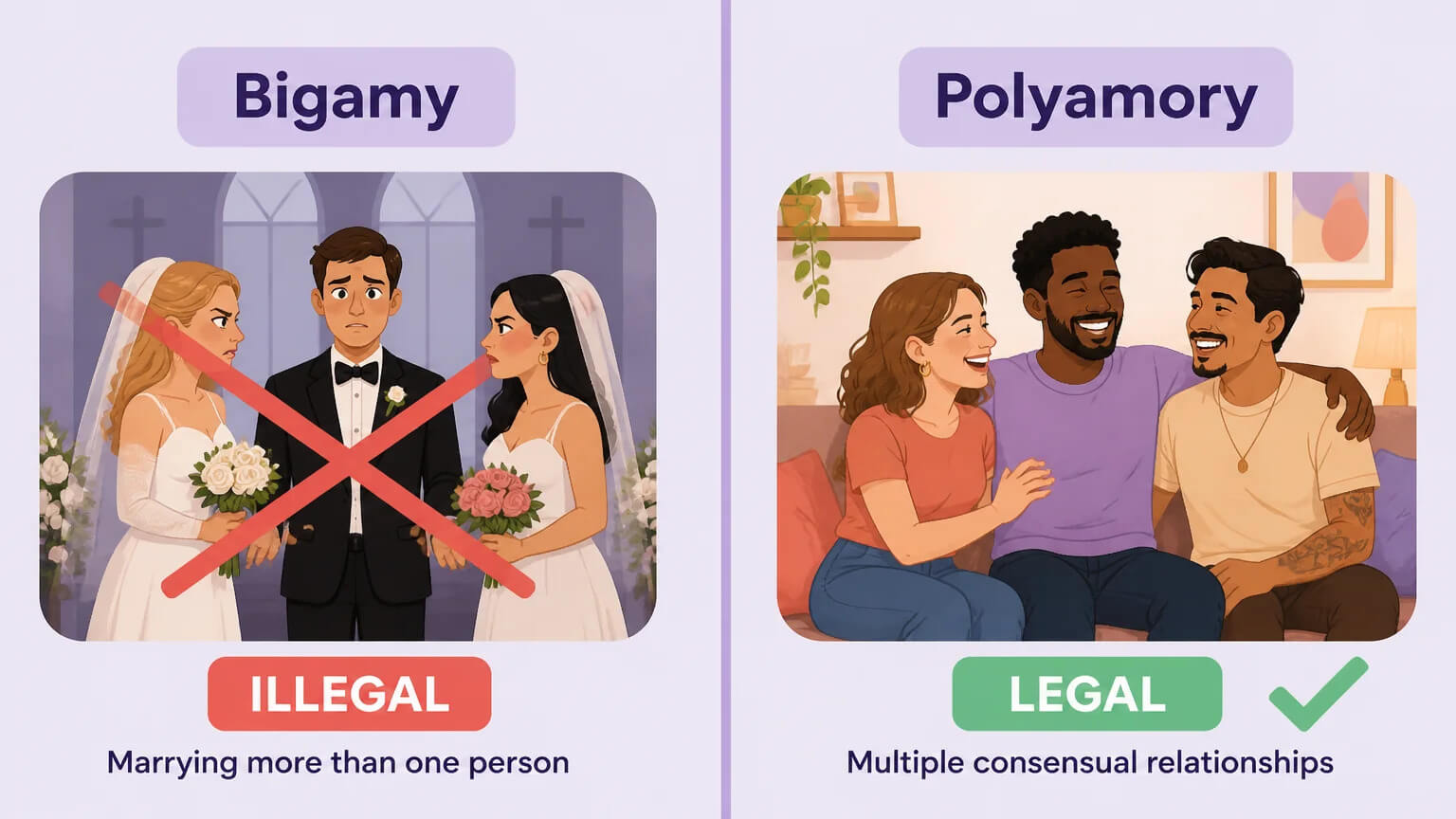
No. Having multiple consensual romantic relationships is not a crime in any Western country. You can love, date, cohabit with, and build a life with multiple partners. You cannot legally marry more than one person at the same time. That is the line that matters.
The word for marrying more than one person is bigamy, and it is illegal in all 50 US states and under federal law. Bigamy is the crime. Polyamory is the relationship structure. Those two things are legally distinct, even if pop culture and a handful of outdated statutes blur them together.
The blur matters, because 16 US states still have criminal adultery laws on the books. Wisconsin classifies adultery as a felony, carrying up to three and a half years. Michigan goes further: up to five years. These laws are almost never enforced against consensually non-monogamous adults, but their existence creates a legal shadow that most people in polyamorous relationships do not know they are standing in.
Polyamory exists in a gap between “not a crime” and “not protected.”
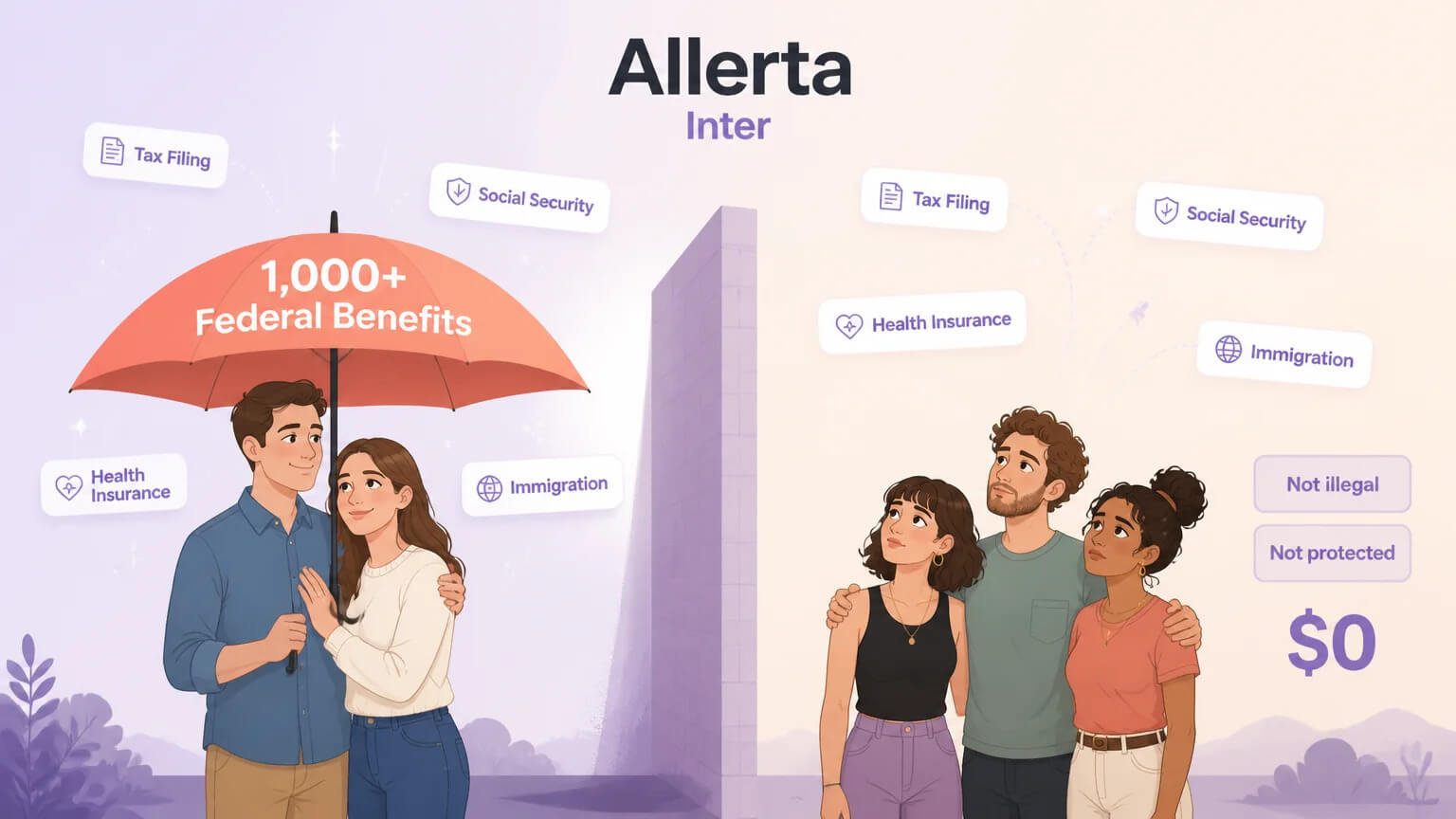
Roughly 1,000 federal marriage benefits sit on the other side of that gap. Joint tax filing. Social Security survivor benefits. Spousal immigration sponsorship. Federal employee health insurance coverage for multiple partners.
All of it walled off. Not because polyamory is illegal. Because the legal system was built for two. It does not punish you for loving more than one person. It also does not lift a finger to protect what you have built together.
But change is coming, one city council vote at a time.
Where Your Relationship Has Legal Standing
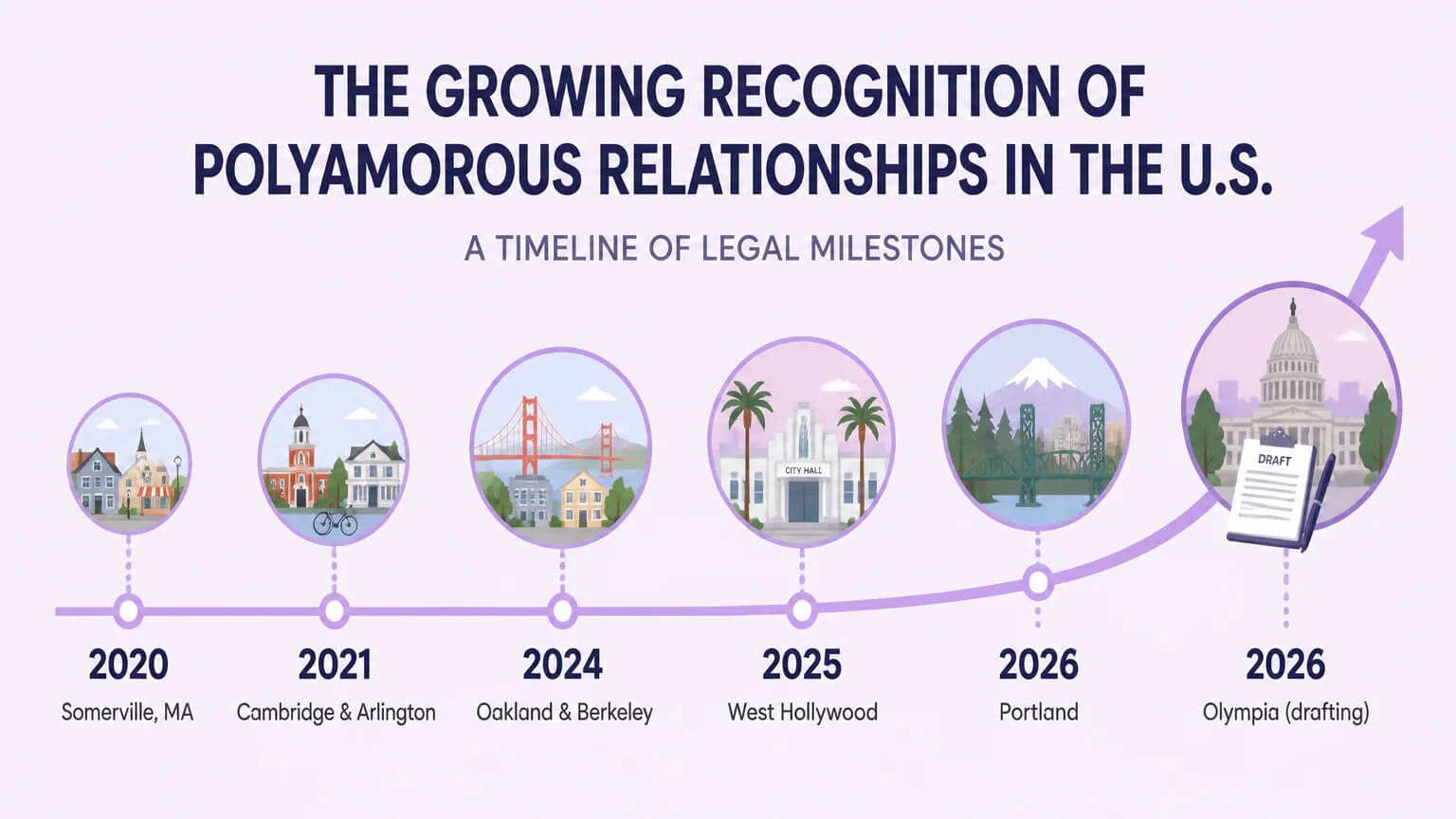
Most people assume polyamorous relationships have zero legal recognition anywhere in the United States. That has not been true since June 2020.
Somerville, Massachusetts became the first US city to extend domestic partnerships to three or more people. The ordinance covers hospital visitation, healthcare decision-making, correctional facility access, and school access. Cambridge followed in March 2021. Arlington did the same one month later. Three small cities in the same state, building something that had never existed before.
Then the momentum shifted west. Oakland and Berkeley, California both passed anti-discrimination ordinances in February 2024, protecting “family and relationship structure.” These differ from the Massachusetts model. They do not grant partnership rights. They make it illegal to fire someone, evict someone, or deny someone service because of their relationship structure. One city prevents harm; the other grants recognition. Both are necessary.
West Hollywood raised the stakes in May 2025. Its ordinance added anti-discrimination protections and directed the City Attorney to evaluate a multi-partner domestic partnership registration program. The architect was Vice Mayor John Heilman, who created the nation’s first domestic partnership registry for same-sex couples in 1985. He has been building this infrastructure for 40 years.
Portland, Oregon expanded anti-discrimination protections to include family and relationship structure, effective April 2026. Olympia, Washington announced it was drafting a similar ordinance in January 2026. The Pacific Northwest is the newest front.
Let’s be clear about what these ordinances actually cover. Hospital visitation: yes, in cities with domestic partnership registration. Healthcare decision-making: yes. School access: yes. Protection from being fired for your relationship structure: yes, in cities with anti-discrimination ordinances.
Health insurance for multiple partners: no. Federal tax benefits: no. Social Security: no. Immigration rights: no. The roughly thousand federal marriage benefits stay walled off no matter what any city council does. This is real progress. It is also a foundation, not a finished building.
That is the US picture. The rest of the world is writing a different one.
Polyamory Laws Around the World
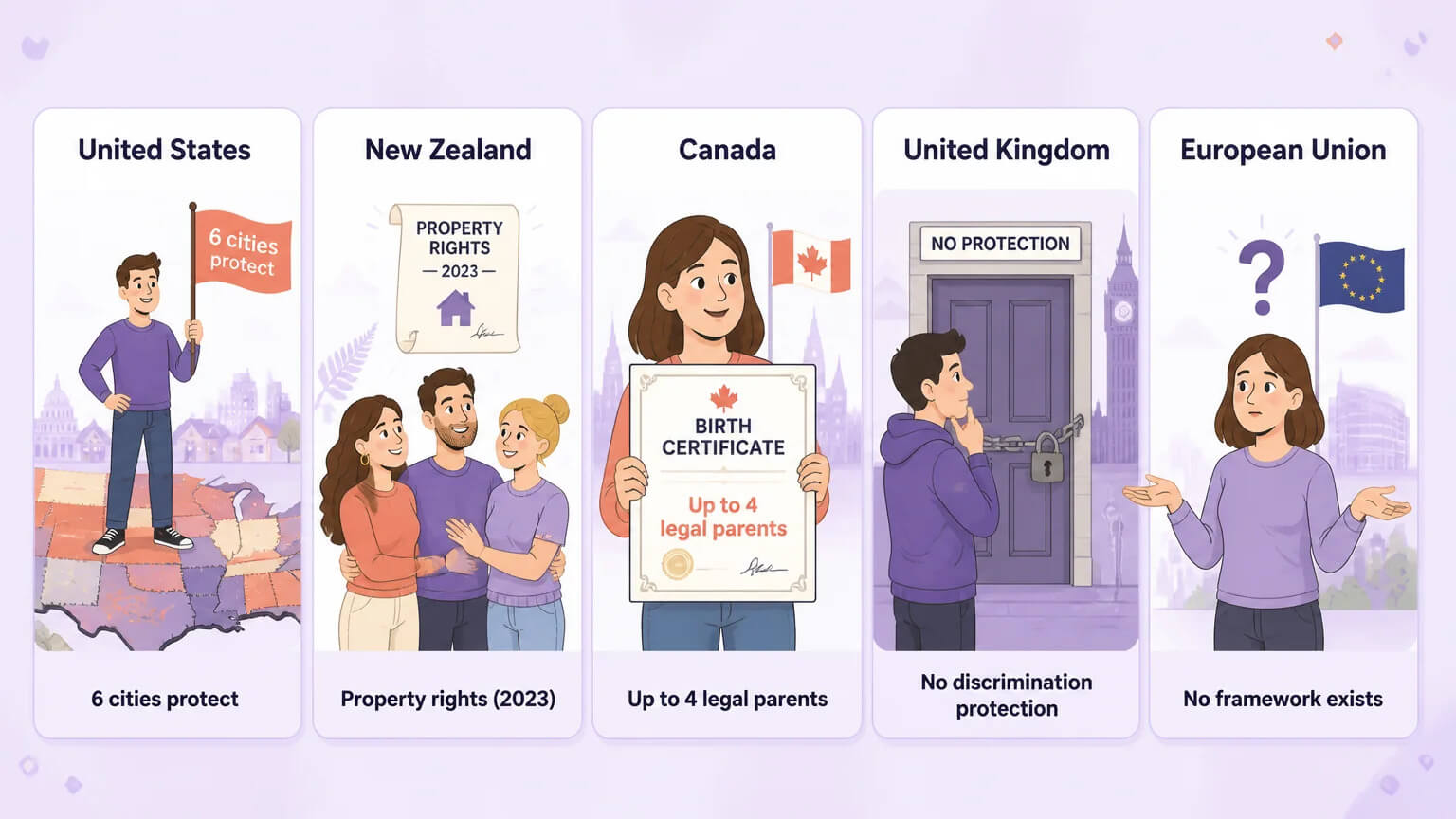
The US approach is city by city, ordinance by ordinance. Other countries are taking different paths. Some are ahead in surprising ways. Some are behind despite progressive reputations. None has solved the underlying problem.
New Zealand made the biggest move so far. In 2023, the Supreme Court ruled in Mead v Paul that the Property (Relationships) Act could apply to polyamorous relationships by subdividing a throuple into three qualifying de facto relationships. Two years later, the Family Court divided a $2.175 million rural property equally into one-third shares, ordering payments exceeding $600,000. This was a landmark: the first Commonwealth supreme court to extend property rights to a polyamorous family. It was also controversial. Dissenting judges called it “artificial” to “shoehorn” a three-person relationship into a “coupledom paradigm.” The court found a path. Whether it was the right path is still debated.
Canada leads on parenting. Four provinces (Ontario, British Columbia, Saskatchewan, Newfoundland and Labrador) allow up to four parents on a birth certificate. British Columbia’s Supreme Court ruled in 2021 that a polyamorous triad could all be named legal parents of a child. A written parental agreement before birth is required. Polygamy remains illegal under Canada’s Criminal Code. The parenting door is open; the marriage door remains locked.
The United Kingdom presents a contradiction. Polyamory is not a crime, but it has no protected characteristic status under the Equality Act 2010. Discrimination based on polyamorous identity is not illegal. Only two people can be named as legal parents on a birth certificate. Bigamy remains a criminal offense punishable by imprisonment. The UK is socially tolerant in posture and legally conservative in practice.
Australia offers no specific recognition or protection. The European Union varies by country. The Netherlands is broadly the most socially tolerant, but no EU member state has built a specific legal framework for multi-partner recognition.
The pattern is the same everywhere: no country has solved this. Every jurisdiction is improvising. Some through courts, like New Zealand. Some through city councils, like the United States. Some through parental recognition, like Canada. The law is moving, but it moves at the speed of institutions, not the speed of people’s lives.
The Real Risks: Housing, Employment, and Custody

Why does any of this matter? Because the gaps are not theoretical. They hit where it counts: keeping a roof over your family, keeping your job, keeping your kids.
Where You Can Live
An estimated 70% of US residential land is zoned single-family. Twenty-three of the 30 largest US cities have laws limiting how many unrelated adults can live together. The typical cap is three to five people. Detroit caps at two. This means a polyamorous family can be legally barred from living together regardless of how legitimate their relationship is.
Look at Bryan, Cam, and Tristan again. If both married partners died, the third could not inherit the co-op apartment he helped pay for, because co-op laws only allow inheritance by immediate family members. Housing insecurity is not just about zoning. It is about what happens to the home you built when the law looks at your family and sees strangers.
A countercurrent is building at the state level. Iowa, Oregon, Colorado, Washington, and New Hampshire have prohibited cities or HOAs from restricting how many unrelated people can live together. State-level reform is beginning to preempt local occupancy limits. It is slow. It is real.
Whether You Can Be Fired
In most of the United States, you can be fired for being polyamorous. There is no federal protected class. Only the handful of cities covered in the previous section offer any protection.
The Harvard Law article on this topic reported a pattern: people have been fired after employers discovered their polyamorous relationships through dating apps or social media. A profile mentioning openness to non-monogamy made its way back to a boss, and the job disappeared. This creates what advocates call a forced closeting effect: polyamorous people hide their relationships from coworkers to avoid career consequences. The “shadow of the law,” as one legal scholar put it, forces a constant calculation about whether being open could cost a livelihood.
Who Gets to Parent
Family courts apply the “best interests of the child” standard, and that standard has historically disadvantaged polyamorous parents. The pattern echoes how LGBTQ+ parents were treated before marriage equality: courts have used relationship structure as evidence of unfitness even without any demonstrated harm to children.
The data tells a different story. Dr. Elisabeth Sheff’s longitudinal research on adult children of polyamorous parents found they excel at communication, conflict resolution, and taking responsibility. They benefit from exposure to many different adults and learn to interact comfortably with people from varied backgrounds. The empirical evidence contradicts the “harm to children” argument. But evidence does not always win in family court.
None of this is insurmountable. Protecting yourself takes paperwork. The next section tells you exactly what to do, in order, starting this week.
Your Legal Protection Playbook: 10 Steps That Protect Your Family
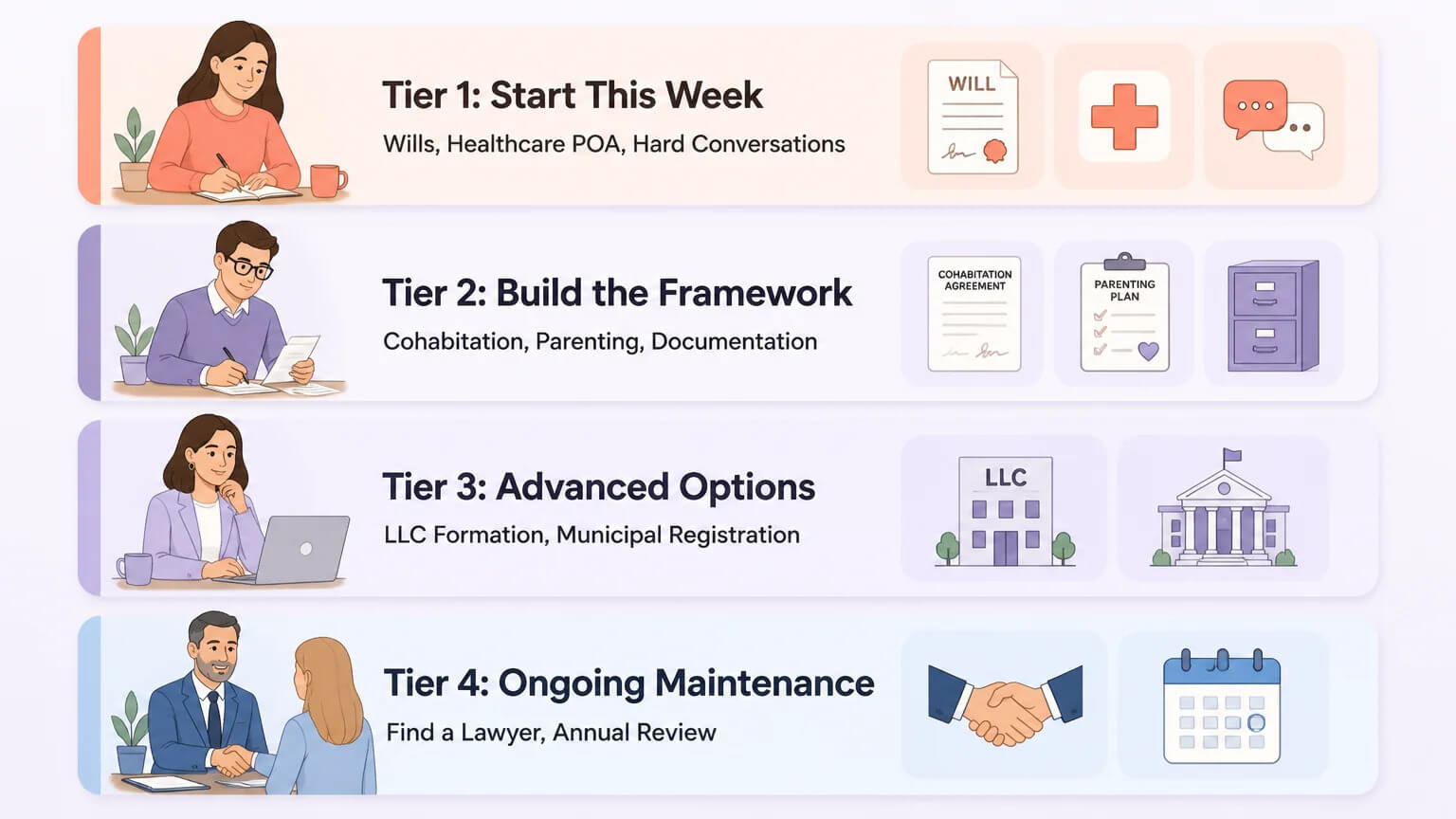
The risks are real. They are also manageable. Polyamorous families have been building legal safety nets for decades. The tools exist. They are not as elegant as marriage, but they work. Here is the playbook. Start at step one.
Tier 1: Start This Week
1. Execute wills for all partners. Designate each partner as beneficiary for the assets you want them to receive. This is your baseline. Legally binding everywhere. Cost: $500 to $2,000 depending on complexity. Without it, your assets go to legal next of kin, not the people you chose.
2. Set up Healthcare Power of Attorney for every partner. This is the document that gets you into the hospital room and gives you a voice in medical decisions. Simple to execute. Recognized everywhere. Without it, a partner of eight years can be barred from the bedside because a hospital’s definition of “family” does not include them.
3. Have the hard conversations before you sign anything. Legal documents should reflect agreements you have already made, not create them under pressure. Talk about what happens if someone gets sick, if the household splits, if a child is born. Write it down together first. Then hand it to a lawyer.
Tier 2: Build the Framework
4. Draft and sign a cohabitation agreement. Define property ownership, financial contributions, and exit procedures. Customizable to any relationship structure. One limitation to know about: cohabitation agreements are not universally enforceable, and judges may decline to apply them in polyamorous breakups. But a signed, written agreement is persuasive evidence of intent. It is far better than nothing.
5. Create parenting agreements if children are involved. Document custody intentions and guardianship preferences. Courts give weight to documented intentions even in jurisdictions where three-parent birth certificates are not available. Do not wait for a crisis to decide who is responsible for the kids.
6. Document everything. Written agreements carry more weight than verbal ones. Emails confirming shared decisions, signed notes from household discussions, a shared file with agreed terms. It does not have to be formal. It has to exist.
Tier 3: Advanced Options
7. Consider forming an LLC for joint property ownership and shared benefits. This is complex and requires actual business activity, but some families use it for property co-ownership and shared health insurance plans. You need a lawyer for this. Do not attempt it with a template.
8. Register for municipal domestic partnership if you live in Somerville, Cambridge, Arlington, or (pending) West Hollywood. The registration grants hospital visitation, school access, and healthcare decision-making rights within those cities. It does not travel if you move, but it is the closest thing to legal recognition currently available in the United States.
Tier 4: Ongoing Maintenance
9. Find a polyamory-aware family lawyer. Organizations like the Polyamory Legal Advocacy Coalition (PLAC) and the Chosen Family Law Center can help with referrals. A lawyer who understands your relationship structure will build better documents than one encountering it for the first time.
10. Review and update all documents annually or after any major life change. A will written five years ago may not reflect who is in your life today. A healthcare POA from before you met your current partner is worse than useless. Set a calendar reminder.
Diana Adams, co-founder of PLAC, frames the strategy clearly: rather than pushing for state or national recognition of polyamorous marriages, advocates should focus on helping people get benefits within the current legal system. The tools exist. They require effort that marriage automates. But they protect what you have built, and protection is the point.
Where Polyamory Rights Are Heading
Thirty-one percent of millennials say their ideal relationship is non-monogamous. Among younger adults, this is not a fringe position. It is approaching a plurality. The legal system moves slower than culture, but culture is the engine that eventually drives law.
The Polyamory Legal Advocacy Coalition, co-founded by Diana Adams and Dr. Heath Schechinger, is building the infrastructure for a national movement. Their approach is deliberately incremental and coalition-built. They are compiling a lobbying toolkit using a seven-step model that has already produced results from Somerville to Portland: build coalition, identify supportive councilors, draft with legal experts, share personal stories, present data, frame broadly, and replicate.
The framing matters. Kimberly Rhoten, LGBTQ policy director for the Boston mayor’s office, puts it directly: multi-partner domestic partnership policies cover a far broader range of human arrangements than romantic polyamory alone. Extended kinship networks. Platonic lifemates. Siblings sharing a household. Close friends caring for each other into old age. Thirty-eight percent of American adults are single, and they would all benefit from legal protections that cover many different partnership configurations, not just polyamorous ones. This is not a niche cause dressed up as a broad one. It is a broad cause that has been mistakenly treated as niche.
The movement has found unlikely allies. Some libertarian and conservative voices see government limits on relationship structure as government overreach, regardless of their personal views on polyamory. The coalition is wider than most people expect.
Alexander Chen of Harvard Law draws the parallel directly: the “slippery slope” argument against polyamory rights echoes arguments used to deny universal suffrage and same-sex marriage. It has been deployed so often to deny rights that, in hindsight, we wonder why anyone bought the argument.
The people pushing these ordinances forward are people in relationships exactly like yours, deciding to be visible and to advocate. The legal terrain in 2035 will be shaped by what happens in city council chambers between now and then. You do not have to be an activist to benefit from the momentum. But knowing the trajectory helps you plan.
FAQ: Polyamory and the Law
Is polyamory illegal?
No. Having multiple consensual romantic relationships is not a crime in any Western country. What is illegal is bigamy: being legally married to more than one person at the same time. You can love, date, and live with multiple partners. You cannot legally marry more than one.
Can I be fired for being polyamorous?
Yes, in most of the United States. Polyamory is not a federally protected class. Only a handful of cities with anti-discrimination ordinances (Oakland, Berkeley, Portland, Somerville, Cambridge, Arlington, West Hollywood) offer protection based on family or relationship structure. In the UK, polyamory is not protected under the Equality Act 2010.
Can polyamorous people get married?
No country legally recognizes marriages between more than two people. Commitment ceremonies have no legal force. Some US cities (Somerville, Cambridge, Arlington, MA) offer multi-partner domestic partnership registration as an alternative, but this does not grant access to federal marriage benefits.
What US cities recognize polyamorous relationships?
Six cities have passed relevant protections. Somerville, Cambridge, and Arlington, MA offer multi-partner domestic partnerships (2020 to 2021). Oakland and Berkeley, CA passed anti-discrimination ordinances (2024). West Hollywood, CA added anti-discrimination protections and is exploring domestic partnership registration (2025). Portland, OR expanded anti-discrimination protections effective April 2026. Olympia, WA is drafting a similar ordinance.
Can a child have three legal parents?
In four Canadian provinces (Ontario, British Columbia, Saskatchewan, Newfoundland and Labrador), yes, with a pre-birth parental agreement. Up to four parents can be listed on a birth certificate. In the US, a few states (California, Delaware, Louisiana, Maine, Pennsylvania) allow more than two legal parents in certain circumstances, but this is not standard.
What legal documents do polyamorous families need?
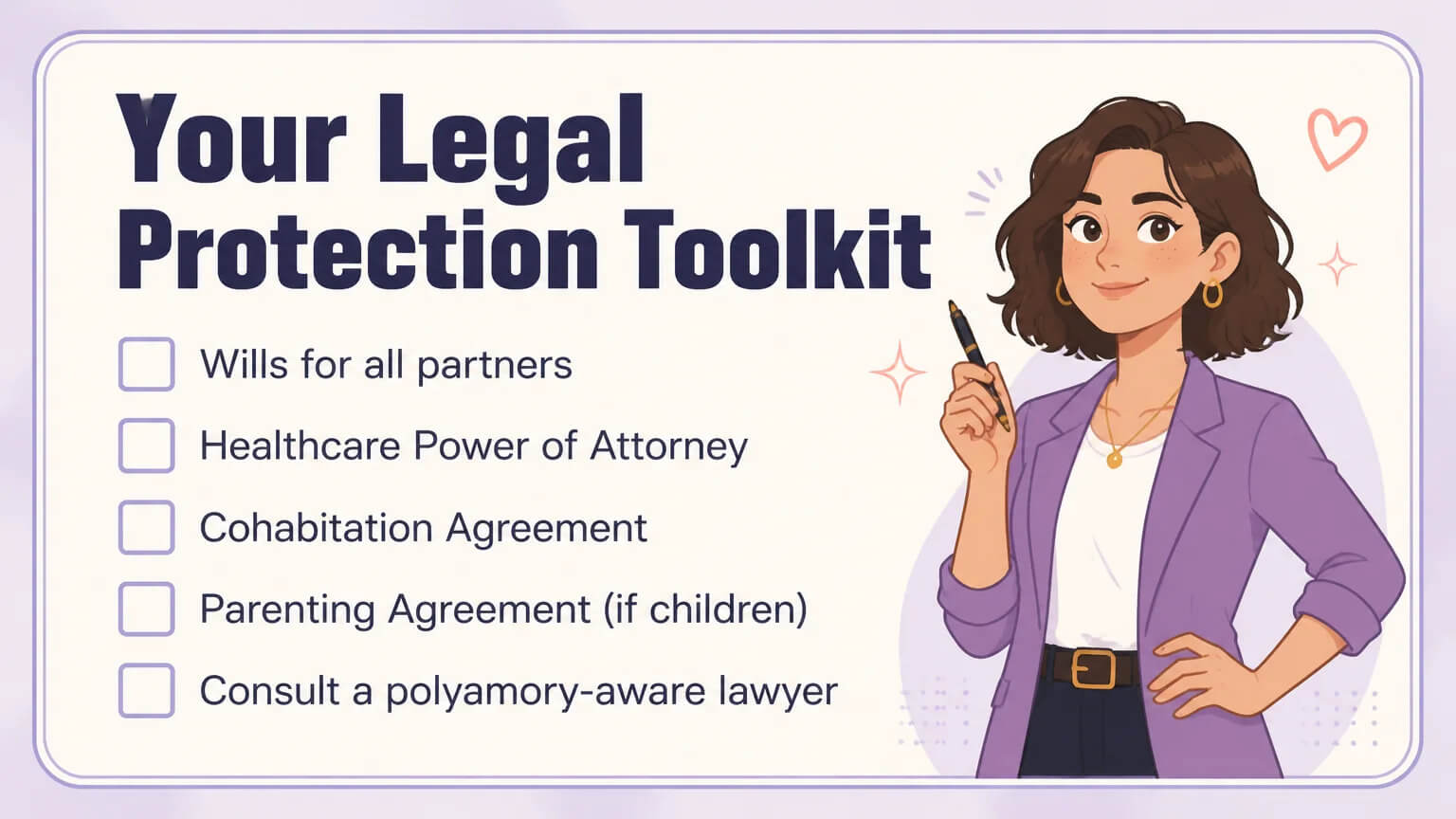
The core toolkit: wills to designate beneficiaries, healthcare power of attorney for medical decisions, cohabitation agreements for property and finances, and parenting agreements if children are involved. Some families also use LLCs for property co-ownership. Consult a polyamory-aware family lawyer. PLAC and the Chosen Family Law Center can help with referrals.
Is polyamory recognized in the UK?
Not legally. Bigamy is a criminal offense. Polyamory is not a protected characteristic under the Equality Act 2010, meaning discrimination based on polyamorous identity is not illegal. Only two people can be named as legal parents on a birth certificate. The Law Commission is considering broader family law reform, but no changes are imminent.
Can immigration law recognize multiple partners?
No. US immigration law recognizes only one legal spouse. You can sponsor only one person for a green card through marriage. Being in a polyamorous relationship can complicate immigration cases if USCIS perceives ambiguity. Be clear. Document everything.
The law may not have caught up to your relationship yet. That does not make your family any less real.