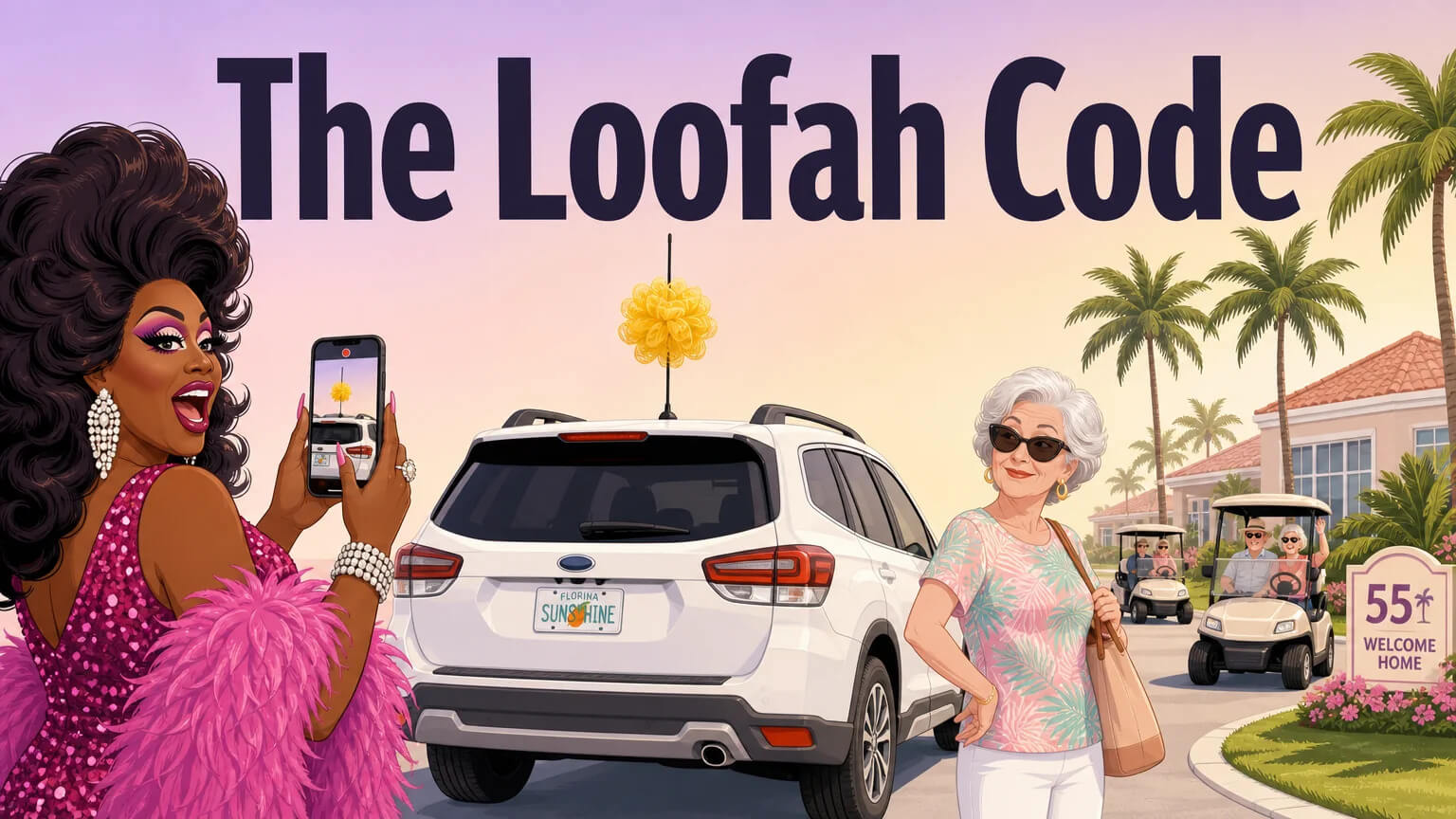
January 2023. Orlando drag queen Tora Himan films a quick TikTok while driving through The Villages, Florida’s massive retirement community. She pans across a parking lot, zooms in on cars with loofahs attached to their roofs, and sets the video to the viral “Oh No” audio. The caption: “They are everywhere!” Three million views later, the loofah swinger meaning had gone from obscure Reddit joke to international news.
It is a bath sponge. The kind that costs four dollars at any drugstore and lives in your shower caddy. For two years running, this object became the internet’s favorite “secret sex code.”
The story involves a drag queen, a retirement community the size of Manhattan, a decades-old lowrider tradition almost nobody talks about, and a question worth sitting with: why do we want secret codes to be real so badly?
A Drag Queen, a Reddit Post, and a TikTok Walk Into a Retirement Community
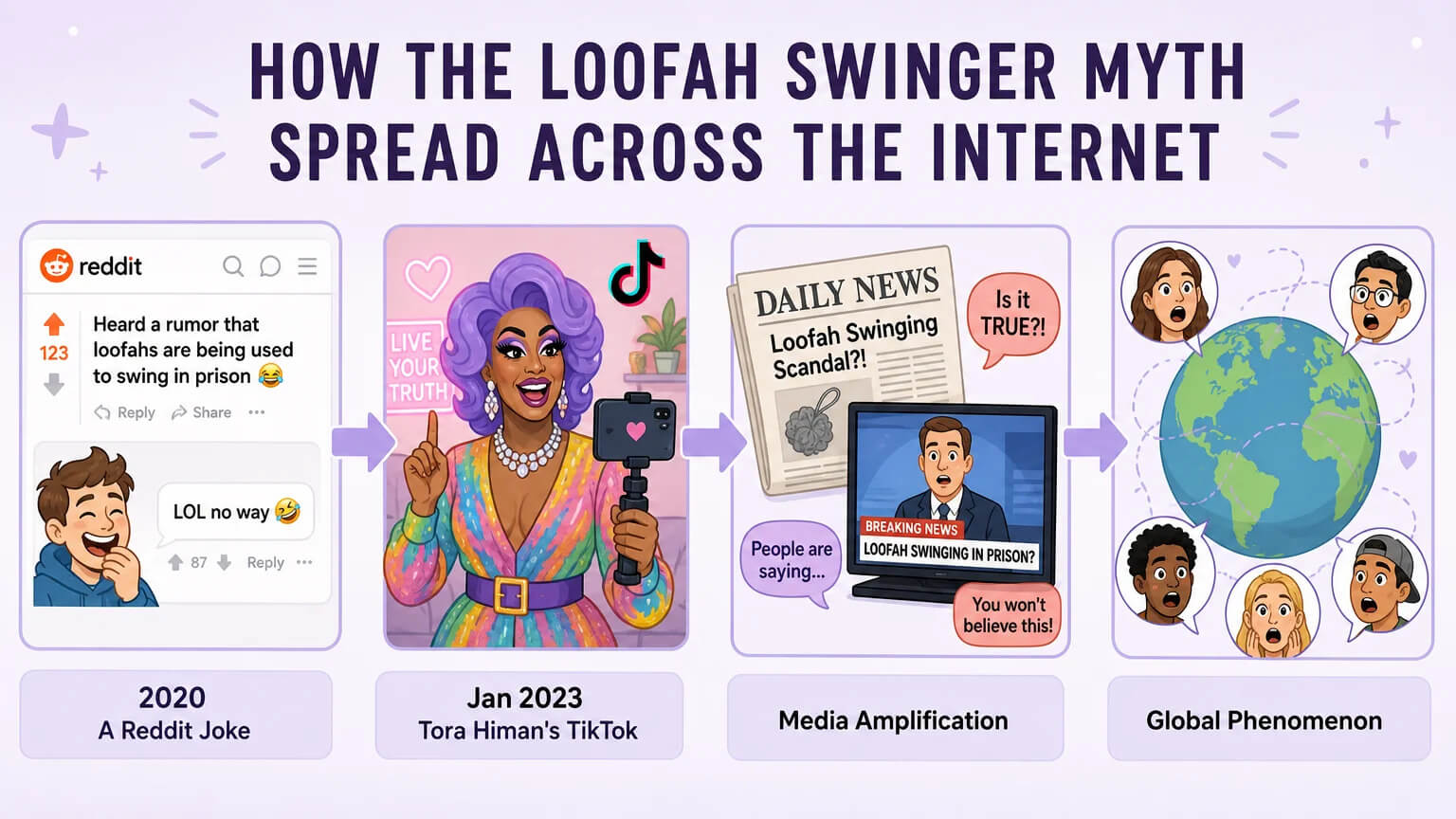
The loofah code was born as a joke. Sometime around 2020, a Redditor posted what they called “a friendly guide so you don’t make the same mistake I did”: a seven-color chart mapping loofah colors to sexual preferences. White for novices. Purple for voyeurs. Pink for soft swap. Teal for bisexual. Black for “anything goes.” It was playful, detailed, and completely fabricated.
The post simmered in niche internet corners for roughly three years. Then Tora Himan changed everything.
Himan is an Orlando drag queen, winner of Camp Wannakiki Season 2, and drag daughter of Ginger Minj. She filmed loofahs on cars while driving through The Villages and set it to the “Oh No” audio. A colorful drag performer plus a mysterious retirement community plus the implied secret sex lives of seniors: the algorithm ate it up. Three million views crashed into the mainstream within days.
The media followed. The New York Post ran with it. The Daily Mail amplified it. Hundreds of outlets published the color chart as if it were established fact, each one pointing to the last as “confirmation.” Nobody sent a reporter to verify whether 80-year-olds in Florida were using bath sponges to coordinate partner swaps. Within weeks, a Reddit inside joke had been laundered through enough headlines to feel true. The internet manufactures lore faster than it fact-checks anything.
What’s Actually Happening in The Villages (Spoiler: It’s Parking)
The Villages is not a small retirement home with a few dozen frisky seniors. It spans three counties, covers an area larger than Manhattan, and houses over 145,000 residents. It is the largest planned retirement community in the world.
And nearly everyone there drives the same car.
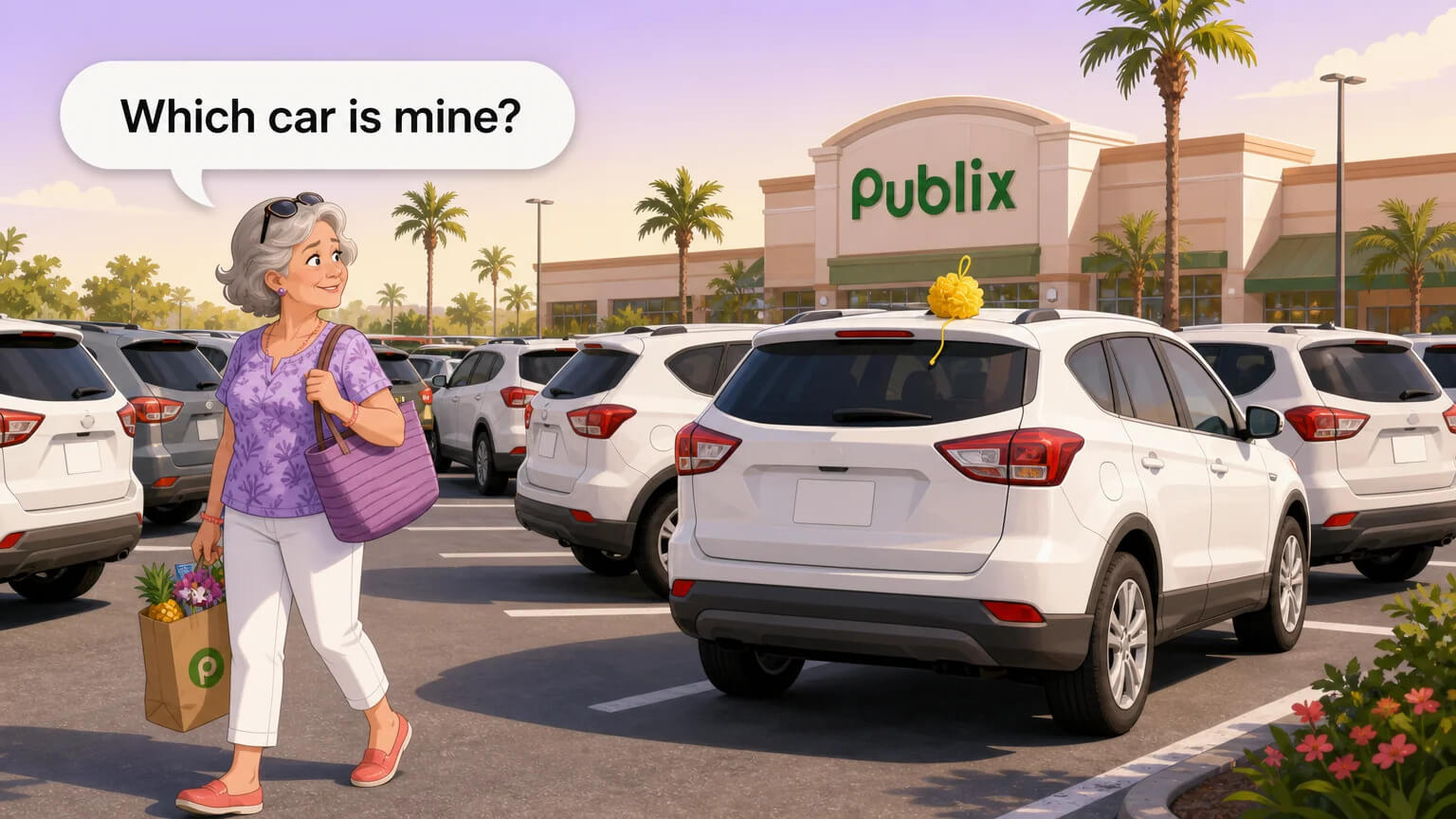
Head to a Publix parking lot on a Tuesday afternoon and you will see rows of nearly identical white and gray SUVs stretching to the horizon. Golf carts, too. Same make. Same color. The loofah? Not a sex code. It is a practical solution to the question every resident faces: which car is mine?
Residents use pool noodles, ribbons, flags, and yes, loofahs to spot their vehicles. One woman’s daughter told interviewers her mom uses a loofah “because she gets lost and that’s why she has it so she can tell her white SUV from all the other white SUVs.”
Jerry and Linda of “The Villages Newcomers” scouted nearly 2,000 vehicles and found zero loofahs. One former employee who worked there three years put it bluntly: “Trust me, all the people I have met are definitely not swingers as most can barely stand without assistance.”
Then there is the “STD capital of America” label. It traces to a single 2006 Orlando TV segment quoting an unnamed gynecologist. The Tampa Bay Times investigated. Sumter County had roughly 1 in 10,000 seniors with STDs versus 6 in 10,000 statewide, lower than most of Central Florida. Dr. Marivic Villa, an internist who ran a clinic there for 20 years, said it plainly: “In reality, I don’t see much STDs. People just want to paint the picture that old people here are like young people in New Orleans.”
Resident Heather, interviewed by YouTuber Peter Santanello, captured the frustration: “It’s not what you think and it’s frustrating. People just have a preconceived idea.”
Author Andrew Blechman spent months inside The Villages for his book Leisureville. His summary: “You put a bunch of people in a terrarium with beer and Viagra and things happen.” He found gossip, one-night stands, and serial monogamy. An organized swinging scene? He never found one.
Every Decade Gets Its Own “Secret Sex Code” Panic
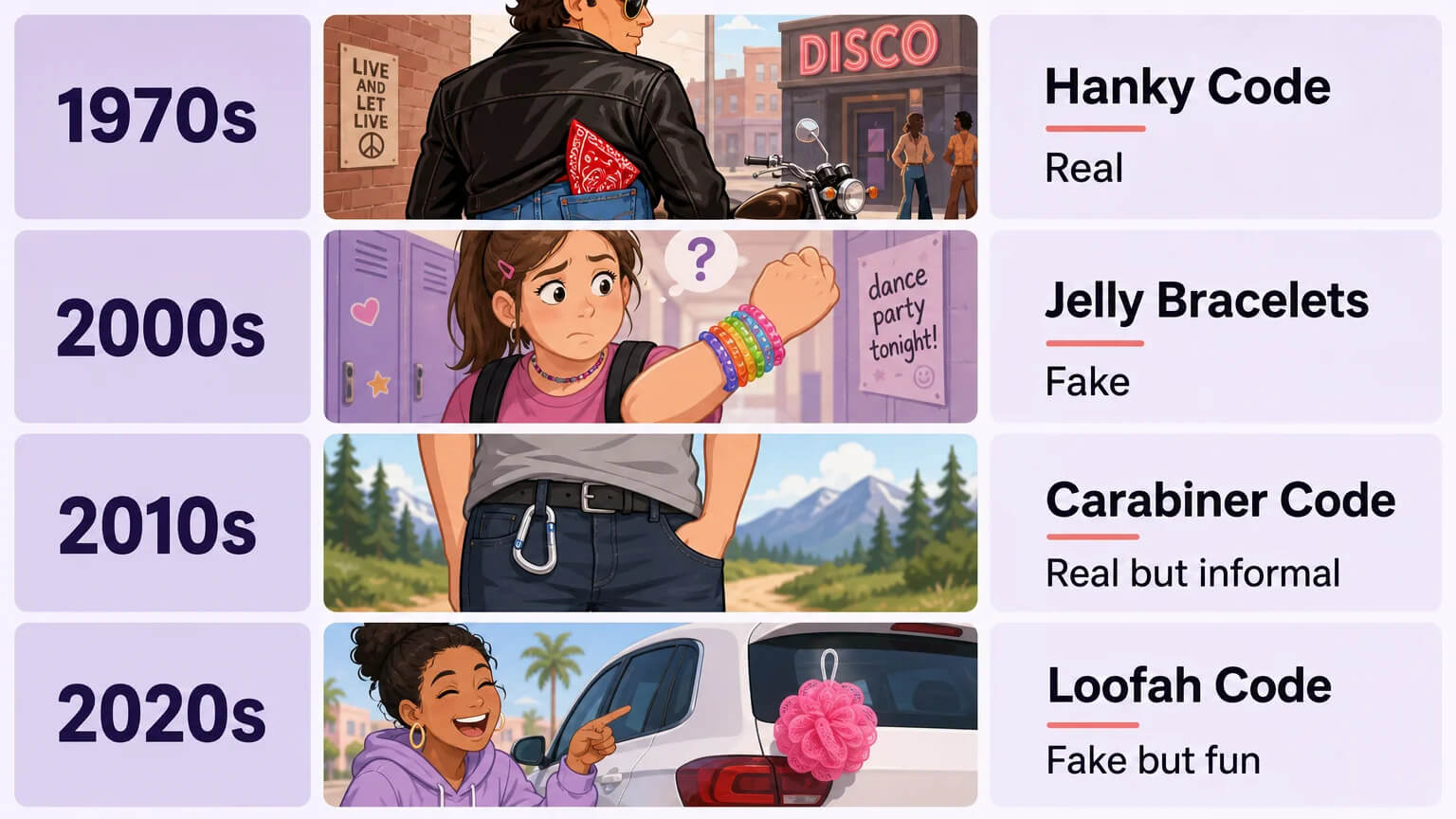
The loofah belongs to a recurring cultural cycle: we invent secret sex codes, become collectively obsessed, debunk them, and invent new ones.
The 1970s had the hanky code: colored bandanas in back pockets that genuinely signaled sexual preferences within gay leather and BDSM subculture. A covert language developed when being out was dangerous. The AIDS crisis and internet dating made it obsolete, but it was authentic while it lasted. People needed it.
The early 2000s gave us jelly bracelets: “shag bands” where snapping a colored bracelet supposedly obligated the wearer to perform a specific sex act. Completely fabricated. Schools across the US and UK banned them anyway.
The carabiner code occupies a middle ground. Real but informal in LGBTQ+ communities: wearing a carabiner on certain belt loops can signal relationship status or role. It is also worn for purely practical reasons. It means something only when the wearer intends it to. Nobody mistakes a hardware store run for a mating call.
Now loofahs join the lineup. Before them, upside-down pineapples. After them, whatever the next viral TikTok decides.
Smaldino, Flamson, and McElreath modeled this pattern. Their work on covert signaling identifies three dynamics: saturation (signals stabilize into conventions), cycling (signals get replaced as outsiders learn them), and suppression (meaningful signals never emerge because the risk is too high). The loofah code is textbook cycling: a supposed secret spread so far through media that it became useless as a code, then morphed into irony. A viral signal is no signal at all.
The Lowrider Loofah: A Completely Different Story From the 1980s
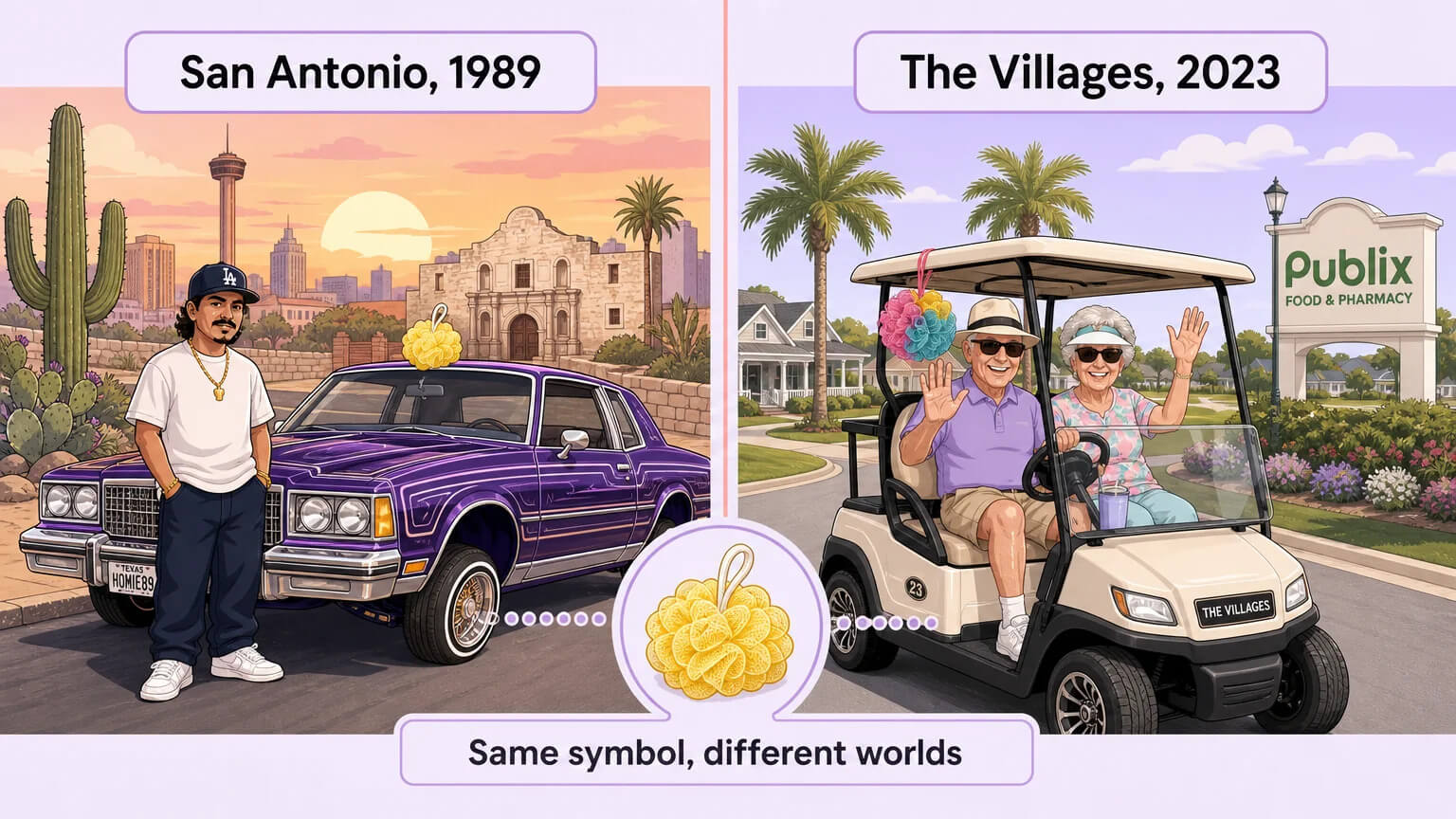
Before The Villages was even built, Hispanic and Latino lowrider communities in San Antonio, Los Angeles, and Albuquerque were putting loofahs on cars for entirely different reasons.
Starting in the late 1980s and early 1990s, loofahs appeared on top of lowrider cars across the American Southwest. Three meanings circulated within the community: sexually active and looking, ready to party, or proud of your culture and roots. A loofah on a lowrider in San Antonio might mean something slightly different from one in Albuquerque. Whether any single interpretation was “the” meaning is beside the point. What matters is that loofahs on cars as cultural symbols existed independently, in a completely different subculture, decades before a Reddit post attached them to Florida retirees.
The lowrider loofah was organic, local, uncentralized. No viral TikTok invented it. No tabloid amplified it. It simply existed, passed among people who shared a context.
Subcultural symbols bubble up in specific places. A lowrider scene in San Antonio. A parking lot in The Villages. Each community develops its own logic and its own relationship with the symbol. The Florida myth, turbocharged by TikTok and tabloids, retroactively colonized a much older and more interesting tradition. It flattened three decades of local meaning into a single viral punchline and erased the cultural specificity that made the lowrider loofah meaningful in the first place.
One viral myth has a way of drowning out the quieter stories that were already there.
What the Lifestyle Community Actually Uses (and What They Think of the Loofah Thing)

The upside-down pineapple IS genuinely used as a swinger signal. On cruise ship cabin doors. At lifestyle events. On Feeld profiles. As jewelry and tattoos. Intimacy coach Kiley George confirmed it: “It’s really become a way for us to show our identity.” The black ring on the right hand is also real, popularized by the Swap Fu podcast. These signals work because they emerged from within the community, not from a viral TikTok made by someone outside it.
But here is what swingers say about relying on symbols: they do not.
“We certainly don’t assume and definitely don’t approach random pineapple wearers,” one community member put it. Another noted that symbols are “amusing but unreliable” as actual signals. The gap between what the internet imagines and what the lifestyle community does is wide.
Most rumored signals fall into one of two camps. Pampas grass, pink flamingos, garden gnomes, and purple porch lights? Too common to be meaningful. White landscaping rocks at a specific gated community in Virginia? Too obscure for anyone outside that one neighborhood to recognize. A pineapple on a shirt proves nothing. A pineapple on a shirt plus a black ring plus explicit conversation? That is different.
The more reliable method is simpler than any code. Dedicated platforms like 3Fun, Kasidie, SDC, and Feeld. Lifestyle clubs and resorts like Secrets Hideaway in Florida or Desire Resorts in Mexico. House parties through trusted introductions. And the most reliable signal of all: “Are you in the lifestyle?” It is an acceptable, respectful icebreaker. No loofah required.
Some residents of The Villages now keep loofahs specifically “to mess with tourists.” The myth has become the joke. The real shortcut was never a symbol. It was talking to people.
The Short Answers
Is the loofah code real?
Almost certainly not as an organized practice. Resident interviews, surveys of nearly 2,000 vehicles, journalist research, and former employee testimony found zero evidence of a loofah-based swinger signaling system. The consistent explanation: parking lot identification in a community where everyone drives the same car. Some swingers may have playfully adopted loofahs online, but this has no verified connection to The Villages.
Where did the loofah code come from?
A Reddit post around 2020 first circulated the color-coded loofah chart as a joke, three years before it went viral. In January 2023, Orlando drag queen Tora Himan’s TikTok showing loofahs on cars in The Villages hit millions of views. The New York Post, Daily Mail, and hundreds of outlets amplified the story without verification. The chart was presented as an established code, but investigative journalism and resident testimony have since debunked it.
Is the upside-down pineapple a real swinger symbol?
Yes. Unlike the loofah code, the upside-down pineapple is genuinely used on cruise ship cabin doors, at lifestyle events, on swinger dating apps like 3Fun, and as jewelry and tattoos. The hashtag #upsidedownpineapple has over 50 million views on TikTok. But context is everything. A pineapple alone proves nothing. Swingers themselves say they never approach someone based solely on a pineapple. Ask directly instead.
Is The Villages really the STD capital of America?
No. The Tampa Bay Times traced the myth to a single 2006 Orlando TV segment quoting an unnamed doctor. Sumter County had roughly 1 in 10,000 seniors with STDs versus 6 in 10,000 statewide, lower than most of Central Florida. Dr. Marivic Villa, an internist who ran a clinic there for 20 years, said it plainly: “In reality, I don’t see much STDs. People just want to paint the picture that old people here are like young people in New Orleans.”
What do swingers use to identify each other?
Dedicated platforms like 3Fun, Kasidie, SDC, and Feeld. Lifestyle clubs and resorts. House parties through trusted introductions. Symbols like upside-down pineapples and black rings on the right hand serve as secondary conversation starters, not primary identification methods. “Are you in the lifestyle?” is the gold standard: an acceptable, respectful icebreaker that requires no bath-sponge cryptography.
Why do we believe in secret sex codes like the loofah myth?
Pattern-seeking brains love hidden knowledge. Covert signals satisfy our curiosity about secret worlds. The idea of seniors having active sex lives is titillating and taboo, making it highly shareable. Media amplification creates the illusion of verification through repetition: if hundreds of outlets all run the same story, it starts to feel true. Academic researchers point to the ageism factor, making it, as one journalist put it, “too good a story to fact-check.”