You thought you’d feel jealous, or angry, or crushed. Instead, you felt something else entirely. A current running underneath the surface, one you didn’t ask for and definitely didn’t expect. There’s a word for this, cuckquean. It’s older than you’d expect, and more common than anyone talks about.
A cuckquean is a woman who derives sexual arousal from knowing, watching, or imagining her male partner being sexually intimate with another woman, with her full knowledge and enthusiastic consent. You’re not broken. You’re not alone. Roughly one in four heterosexual women share this fantasy, according to research by Dr. Justin Lehmiller at the Kinsey Institute. Here is what it means, why it happens, where it fits in your relationship, and what to do with it.
What Is a Cuckquean, Exactly?
A cuckquean is a woman who derives sexual arousal from knowing or watching her male partner have sex with another woman, with her full knowledge and consent. That last clause is the entire difference between a kink and a betrayal.
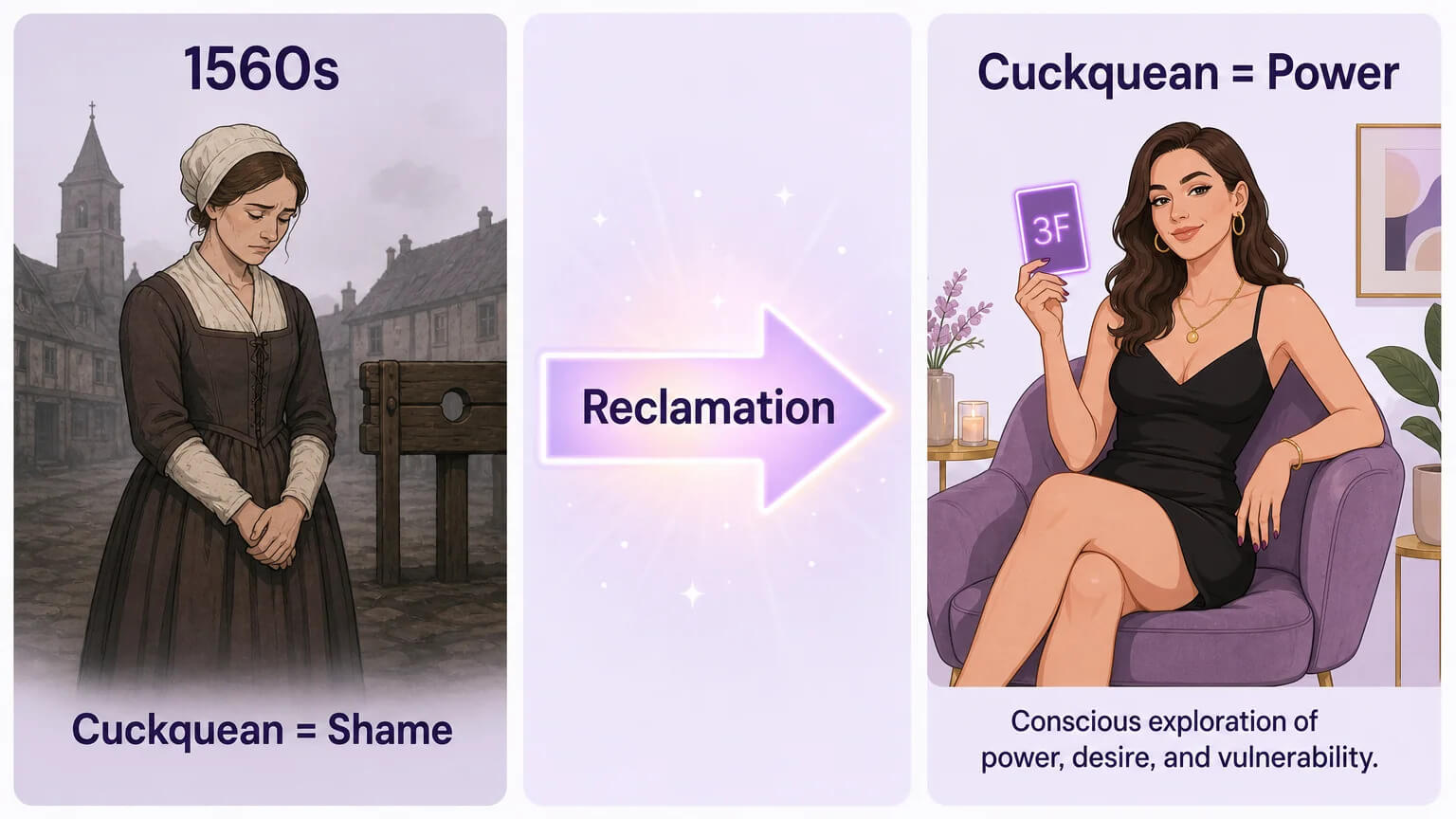
The word itself lands hard. It dates to the 1560s, combining “cuck” (from cuckold, tracing back to the Old French cocu for cuckoo, the bird that lays eggs in other birds’ nests) with “quean,” an Old English pejorative for a disreputable woman or hussy. The word was built to shame. A cuckold was simply a betrayed husband. A cuckquean was branded a degraded woman by her very name. The suffix encoded moral judgment before she ever took a single action.
That historical charge is precisely why modern reclamation matters. When a woman knowingly claims this word, she converts a slur into a signal. As the Columbia Journalism Review noted, most people don’t even know the female equivalent of “cuckold” exists. Society buried the term so thoroughly that women who experience these desires often spend years without language for what they feel. They know something is there. They have no framework to hold it.
The bright line separating cuckqueaning from being cheated on is enthusiastic consent. When a woman knows, wants, and helps design the encounter, she is not a victim of circumstance. She is a participant in a dynamic she helped architect. The same act, with consent, transforms from infidelity into intimacy.
Countess Diamond, a dominatrix interviewed by Cosmopolitan UK, frames it this way: cuckqueaning is “a conscious exploration of power, desire, and vulnerability” rather than mere infidelity. It “centers the woman’s experience: the jealousy or suspense she feels, the control she holds, or the emotional release she may achieve.” She is not being left behind. She is directing the scene. And while the term originated in a heteronormative context, modern usage has expanded to encompass any combination of genders and orientations. The word bends to fit the people who claim it.
Cuckquean vs Cuckold, and Why the Difference Matters
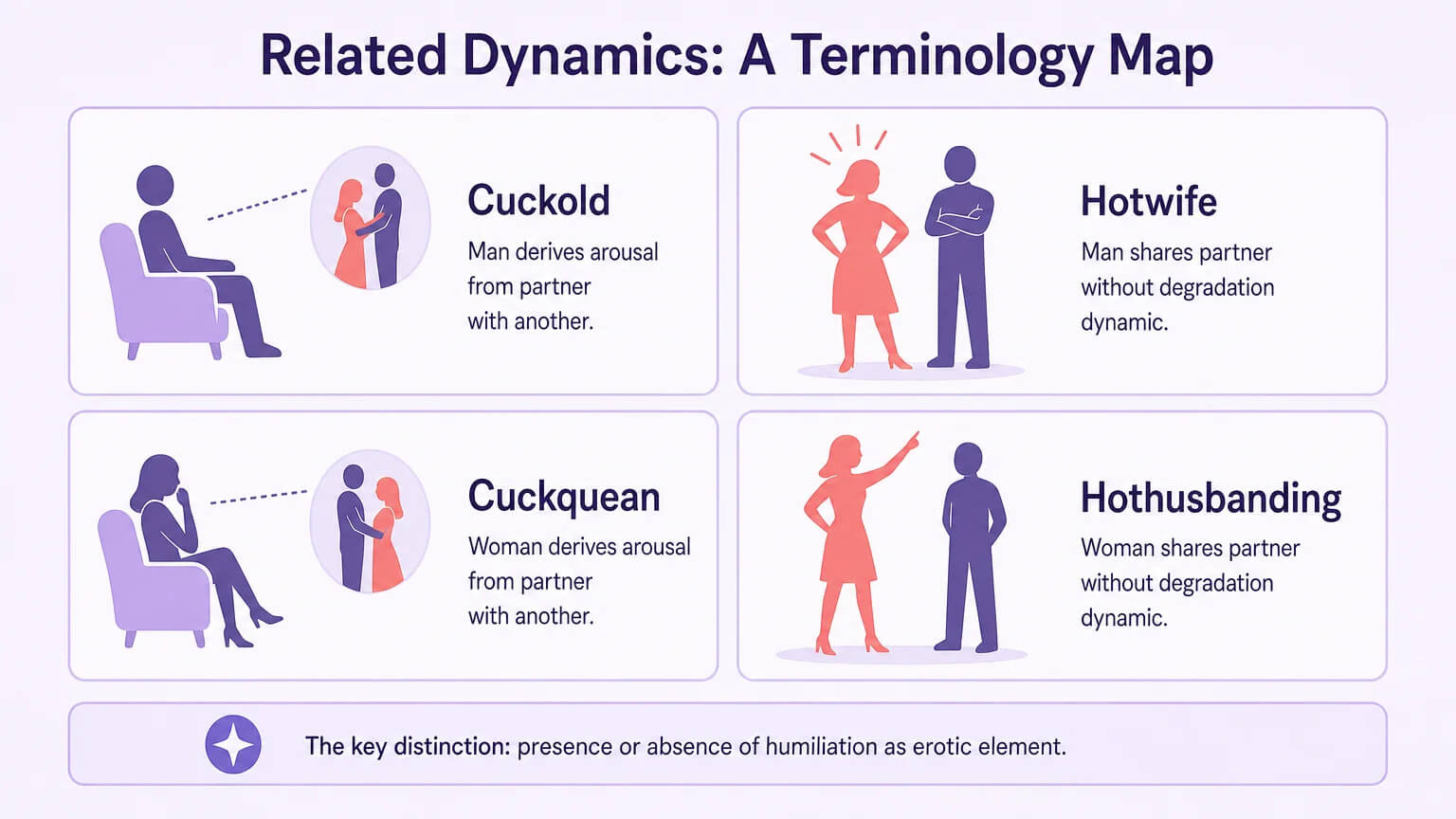
The asymmetry is baked into the language itself. A cuckold is simply a betrayed husband. A cuckquean was historically branded a “hussy.” The word was never neutral. This isn’t etymological trivia. It explains why so many women feel an extra layer of shame about these desires before they even name them. Society has always been more comfortable punishing female desire than male transgression.
Beyond the history, there is a practical distinction that matters for anyone exploring this territory. Both cuckolding and cuckqueaning involve consensual non-monogamy with a watching or knowing partner, but the gender dynamics, community infrastructure, and power structures differ significantly. The cuckold community has an established taxonomy: stag, bull, hotwife, cuck. There are forums, dedicated online communities, podcasts, and decades of shared language. The cuckquean community is still actively building its shared vocabulary. Women exploring it often have fewer reference points and fewer visible peers to learn from.
Then there is the distinction that sex advice columnist Dan Savage has drawn more sharply than anyone: cuckqueaning versus hothusbanding.
Cuckqueaning involves an element of humiliation, degradation, or the erotic charge of being symbolically cheated on. The arousal lives in the transgression, the displacement, the emotional sharp edge of the scenario. Hothusbanding is the same arrangement without the degradation. The woman experiences compersion, the empathetic joy of witnessing her partner’s pleasure, and retains full control of the scene. Savage puts it plainly: “A woman into hothusbanding enjoys sharing her husband with other women. She’s interested in watching her husband pleasure and be pleasured in a purely physical way. She’s not interested in being cheated on.”
This is not a semantic debate. It is a consent and negotiation tool. If you tell a partner you’re into cuckqueaning and they start degrading you, but what you wanted was hothusbanding, the experience goes sideways fast. These two dynamics look identical from the outside and feel entirely different from the inside. Knowing which label fits your desire is the first step in communicating it clearly to a partner. Words set the stage. The wrong word builds the wrong scene.
The Psychology Behind Cuckquean Desire
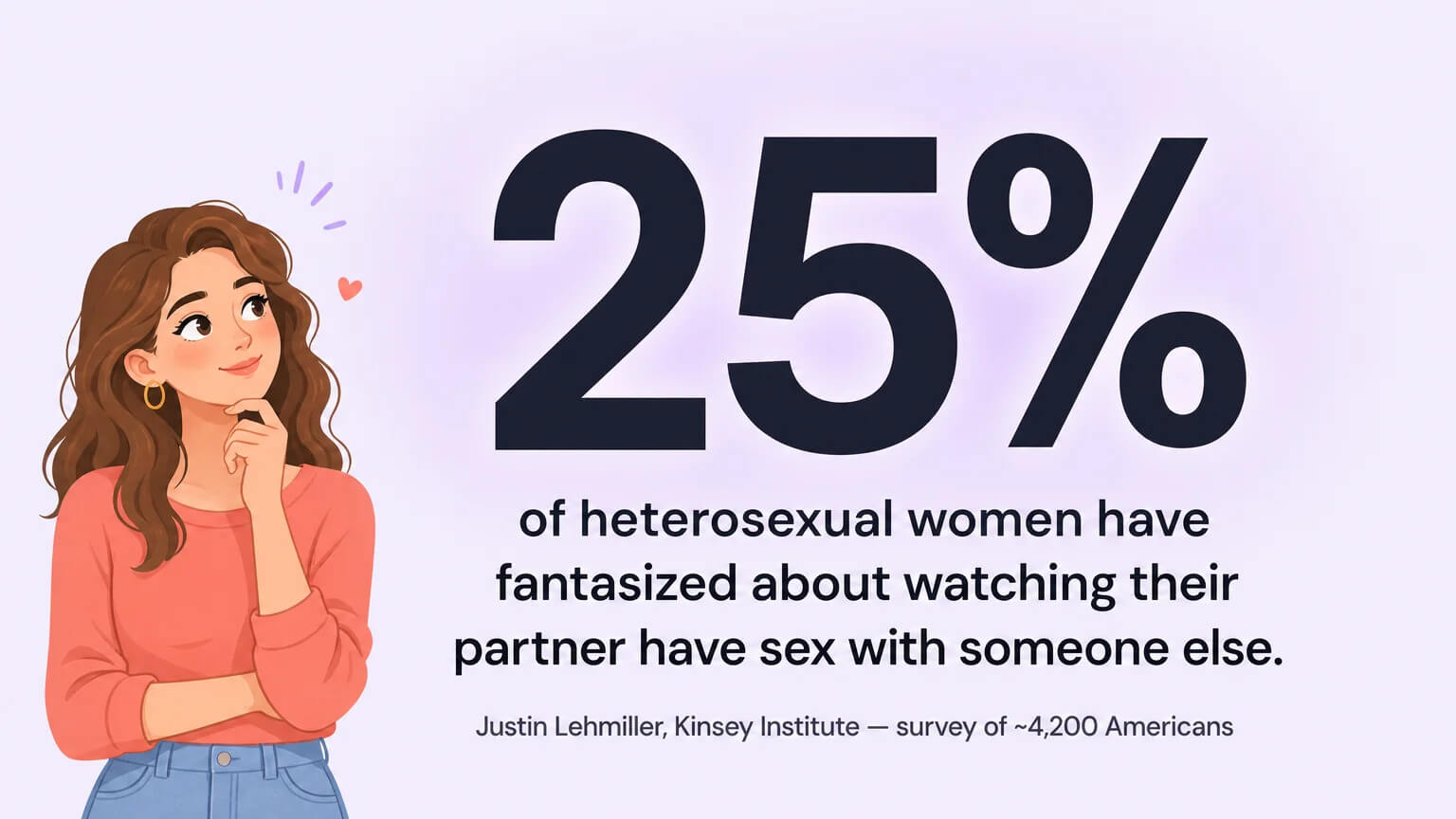
Here is the number that changes the conversation: Justin Lehmiller’s national survey of roughly 4,200 Americans found that approximately 25% of heterosexual women have fantasized about watching their partner have sex with someone else. You are not an outlier. You are part of a statistically significant cohort. Lehmiller himself notes this points to “the need for more research focused on women’s cuckolding desires.” The data reframes the entire question. It’s not “why do you have this fantasy?” It’s “why does nobody talk about how common it is?”
That “what’s wrong with me?” question most women ask themselves first has an answer. Nothing is wrong. The research points to two distinct psychological mechanisms operating beneath the surface, and they often coexist in the same person.
The first is compersion: the empathetic joy of witnessing your partner’s pleasure with someone else. Think of it as the opposite of jealousy, but more active than mere tolerance. It is genuine arousal rooted in your partner’s enjoyment. Research links compersion to secure attachment styles, not insecure ones, and to strong communication quality within the relationship. Neurologically, mirror neurons fire in empathetic simulation while the ventral striatum’s reward circuits release dopamine. Your brain recodes a threat signal into a reward. The circuitry that evolved to detect social danger gets repurposed into a source of pleasure.
The second mechanism is zelophilia, the clinical term for arousal from jealousy itself. The pang becomes the turn-on. This is distinct from compersion and maps directly to what Evita Sawyers, a woman who shared her cuckquean fantasy life publicly for the first time on Marie Thouin’s podcast, describes as “emotional masochism.” It isn’t about pain for its own sake. It’s about the intensity of the feeling. Sawyers describes pushing emotional limits as creating a state of “invincibility,” like lifting weights but for emotional capacity. “That shit turns me on,” she says of the “revelation space” that emotional pain opens. Marie Thouin, the researcher who interviewed her, describes the dynamic as “riding a line between pleasure and pain.” For Sawyers, compersion was never present in her cuckquean fantasies: “I was not happy for them. I was just turned on.” The two mechanisms genuinely operate on separate tracks.
Dr. David Ley, clinical psychologist and author of Insatiable Wives, found that cuckolding fantasies and behaviors are generally positive for participants, not evidence of psychological disturbance. His work directly counters the older clinical assumption that these desires indicate pathology. The sperm competition theory, which suggests men may be biologically driven to compete for fertilization, gets a brief nod as a potential evolutionary driver for the male side of the equation. But for women, the social and relational factors carry far more explanatory weight.
The through-line: whether your desire runs through compersion, zelophilia, or a blend of both, the research points to these being variations of normal human sexuality, not dysfunction. The strongest predictor of whether acting on these desires goes well is not the presence or absence of the fantasy. It is the quality of communication in the relationship that holds it.
The Cuckquean Spectrum: From Private Fantasy to Full Dynamic
You can be a cuckquean entirely in your own mind and never take a single step into the real world. That is a complete and valid way to engage with this desire. No asterisk, no caveat, no “not yet.” The inner world is not the waiting room for the outer one.
Evita Sawyers coined a useful distinction during her conversation with Marie Thouin. “Fantasy” is what’s hot in your head. “Fant-asy” is what you would actually do. For Sawyers, the answer to the latter is an emphatic “absolutely not.” She knows she’s “too volatile” and keeps her elaborate cuckquean scenarios strictly in the mental realm. She didn’t just imagine her partner with someone else. She needed specific details that would cause her real-life pain, the “taboo of them disregarding me,” to make the fantasy work. The erotic charge came from precisely what would wound her in reality. That podcast recording was the first time she had ever told anyone about these fantasies. Not friends, not partners, not therapists. Nobody. She had carried them alone her entire adult life.
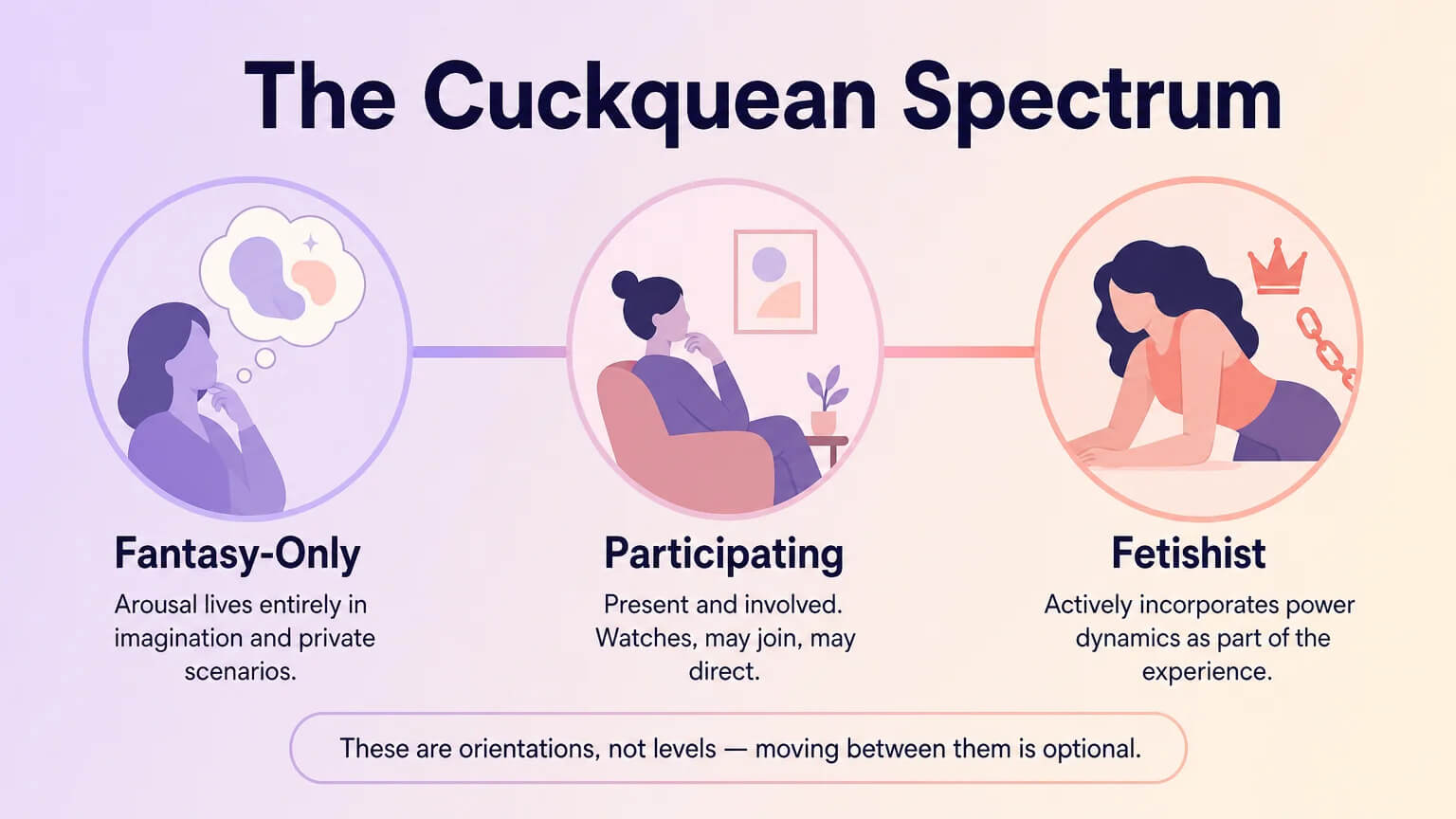
The spectrum has three broad archetypes, and they are orientations, not levels to progress through. Moving between them is optional, not inevitable.
The Fantasy-Only cuckquean lives her arousal entirely in imagination, dirty talk, and solo scenarios. She may never speak the fantasy aloud to anyone. The mental space is the safe container, and that container is complete.
The Participating cuckquean is present and involved. She watches, she may join, she may direct the scene from the sidelines. The arousal comes from the lived experience of witnessing her partner in action. She is in the room and in control.
The Fetishist cuckquean actively seeks humiliation, degradation, and verbal taunting as core components of arousal. The emotional charge of being symbolically displaced is the engine of the experience. For her, the sharp edges are the point.
Two real examples anchor this spectrum at different points. Nikki Glaser, the comedian, told the Call Her Daddy podcast in an episode that drew nearly 800,000 views that she “kinda likes it” when her boyfriend hooks up with other women. E! News, Page Six, and Sky News Australia all covered the moment. A mainstream celebrity, no shame, no apology, normalizing what most women keep locked away. On the other end, MelissaBound is a 62-year-old transgender woman who has lived as a cuckquean submissive in a 40-plus-year BDSM triad with her dominant partner Miss Marie and a third partner. She spent 37 years living “someone else’s life” before transitioning 15 years ago. That is not an experiment. That is a life built around authentic desire.
Figuring out where you land on this spectrum is not a diagnostic process. It’s self-discovery. The only wrong answer is pretending the question doesn’t exist.
The Cuckcake: Who Is the Third Person in the Room?

Most discussions of cuckqueaning focus on the couple. The other woman rarely gets the same attention.
The cuckcake is the third woman in the dynamic, the counterpart to the “bull” in cuckolding. But unlike the bull, whose role is culturally legible even when stereotyped, the cuckcake’s experience is largely invisible. She exists in the narrative mostly as a function, not a person. The couple has their exploration. She is the tool they use to explore it. That framing needs to be dismantled.
What motivates a woman to join a cuckquean dynamic? The reasons are as varied as any other sexual choice. Sexual curiosity. Compersion. A desire for low-commitment sexual variety. Attraction to the couple as a unit, both people in it, not just the husband. Enjoyment of being desired and watched. A genuine friendship with the couple that includes erotic energy. The thrill of being chosen as the third. None of these motivations make her a prop, and none of them obligate her to stay if the dynamic stops working for her.
Her boundaries matter as much as anyone else’s. She is not a service provider unless she explicitly identifies as one, and even then, she sets the terms of that service. Her emotional safety is not secondary to the couple’s exploration. She needs to know the answers to questions couples often forget to ask: What happens if feelings develop on any side? Is she expected to be discreet, or can she talk about her experiences with her own support system? Will she be discarded the moment one partner gets uncomfortable, and if so, how will that be handled? Is she allowed to end the dynamic, or only the couple?
“She is a guest in your playground, not a toy in your toybox.”
Red flags a potential cuckcake should watch for: couples who have not discussed boundaries between themselves before approaching her. Couples who treat her as a therapist or a relationship bandage, bringing her in to fix something that’s already broken. Couples who withdraw consent unevenly with no communication, where one partner ghosts and the other scrambles. Couples who haven’t considered her aftercare needs because she “isn’t the one who needs it.” Couples who can’t articulate what they want beyond a vague fantasy, expecting her to fill in the blanks.
A cuckcake who feels safe, respected, and genuinely desired returns. One who feels like a prop disappears, and tells her friends. The community is smaller than you think. Reputation travels faster than desire.
Where Cuckqueaning Fits in Ethical Non-Monogamy
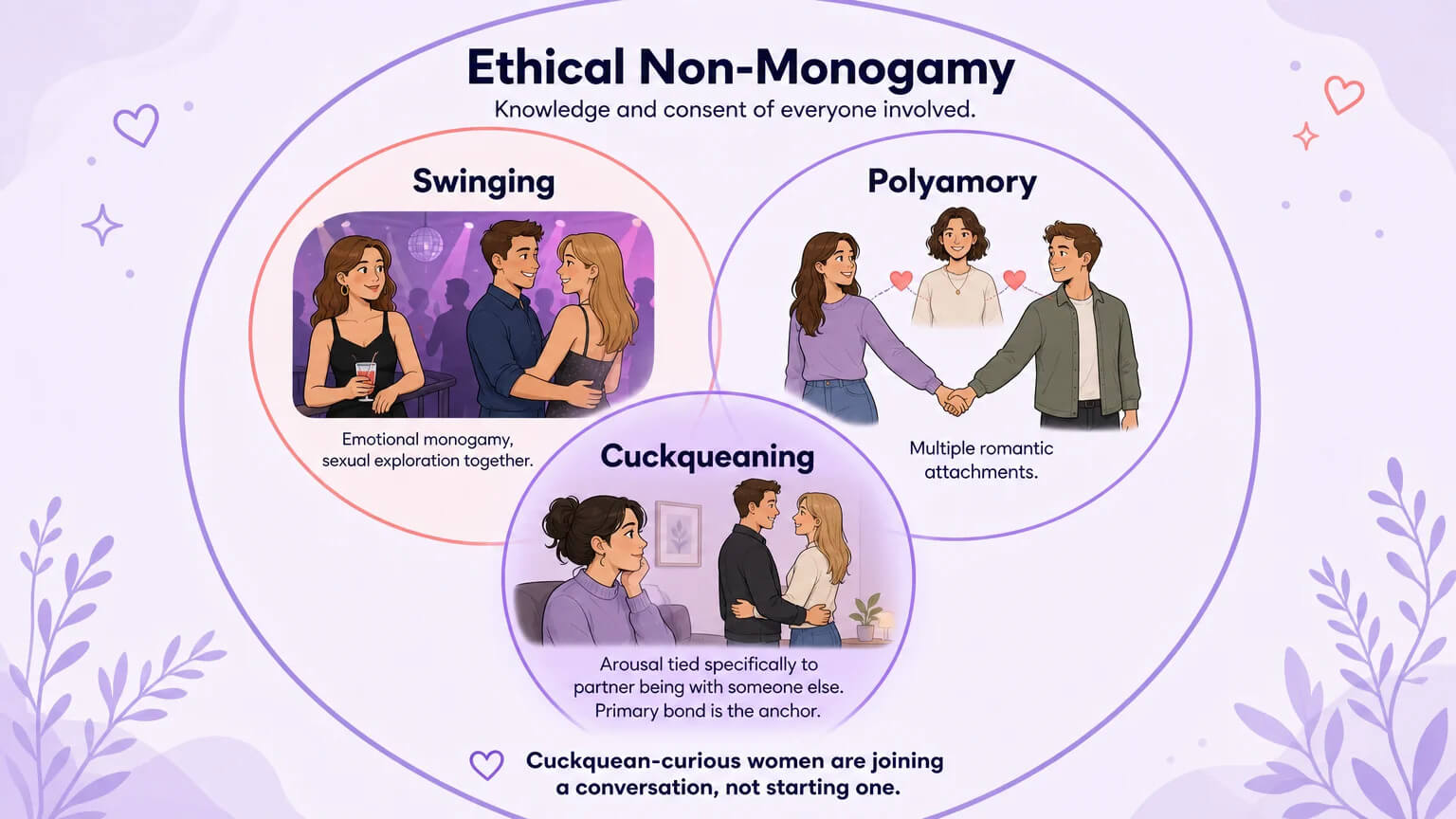
Cuckqueaning lives under the ethical non-monogamy umbrella, the same broad category that includes swinging, polyamory, and open relationships. The unifying principle across all of them is identical: knowledge and consent of everyone involved. Without that, it’s not ENM. It’s infidelity with extra vocabulary. You can call something by a community term, but if one person involved doesn’t know they’re in the arrangement, the term is just a lie wearing a nicer outfit.
The connection to swinging is particularly relevant because that’s where many cuckquean-curious women first encounter their desire. At a club, an event, a party. She watches her partner with someone else, maybe for the first time, and the reaction is not what she expected. The jealousy she braced for never arrives. Something else shows up instead: curiosity, heat, an unexpected current of arousal she has no name for. That moment of self-discovery is the doorway many women walk through.
Research by Kimberly and Hans from 2017 found that swinging couples often maintain “emotional monogamy” while engaging in extra-dyadic sex. The emotional bond stays between the primary partners. The sexual exploration happens together, even when one partner is watching rather than participating. The couple is the team; the sex is the shared project. This framework maps cleanly onto many cuckquean arrangements where the primary romantic bond remains the anchor.
Cuckqueaning is distinct from general swinging because the woman’s arousal is specifically tied to the act of her partner being with someone else. She may or may not participate herself. Her desire is routed through his experience, his pleasure, and the scene she’s constructed around it. In polyamory, the goal is often multiple romantic attachments with emotional depth across relationships. Cuckqueaning typically preserves the primary romantic bond as the sole emotional anchor, with the erotic energy flowing through the partner’s experience rather than through multiple independent romantic connections.
Here is what matters most: cuckquean-curious women are not inventing something from scratch. There are forums, platforms, events, and best practices already in circulation. The path has been walked by women who asked the same questions, felt the same hesitation, and figured out what works through trial and error. You’re joining a conversation, not starting one.
Moving from Fantasy to Reality
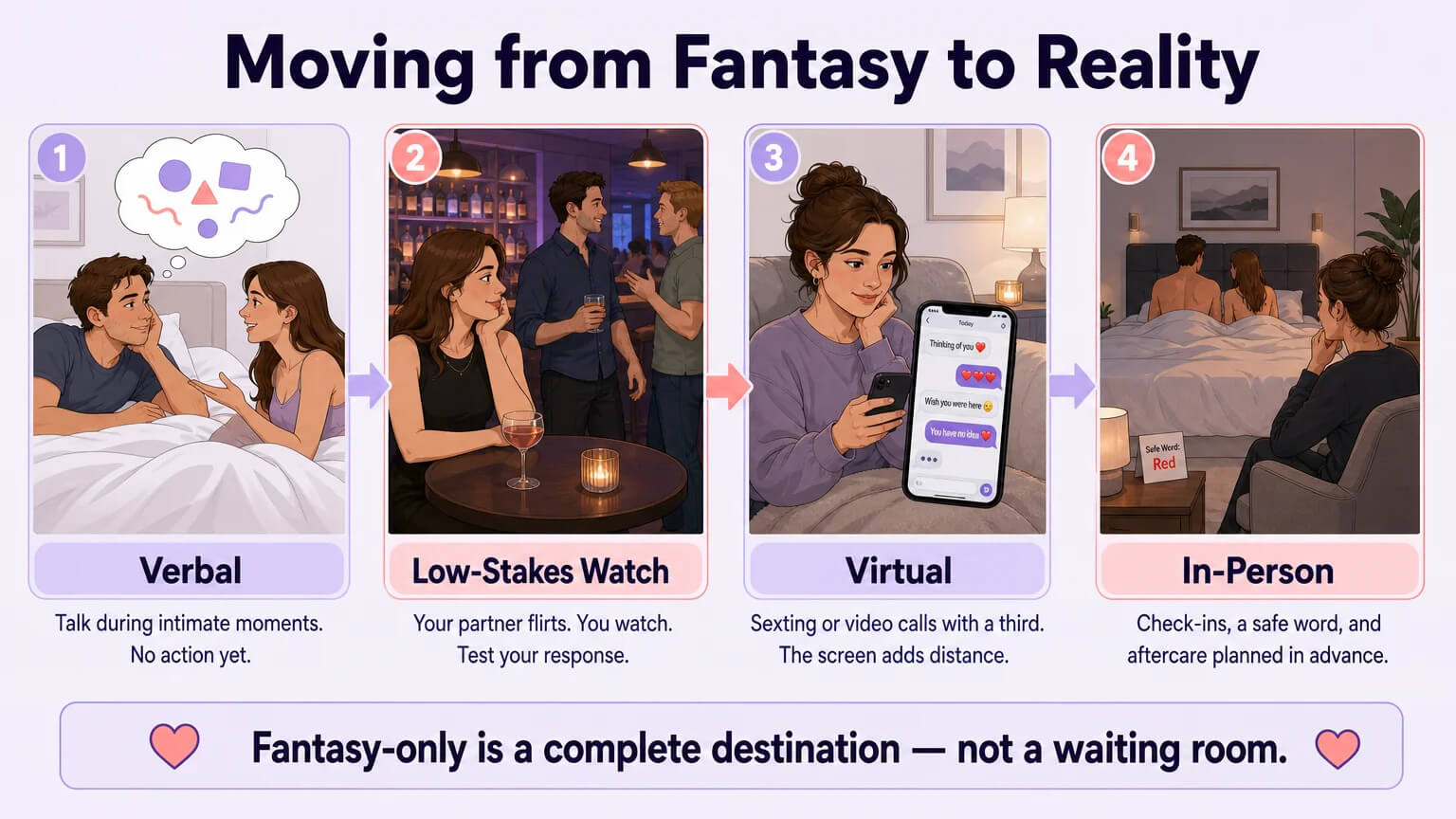
Most cuckquean fantasies never leave the mental space. That is a complete outcome, not a failure to launch. The fantasy itself can be the destination. For couples who do want to explore further, this framework respects the weight of what you’re moving toward.
Phase 1: Verbal. Talk about the fantasy during intimate moments without planning any action. Describe scenarios to each other. Notice what arouses each of you and what produces hesitation. Pay attention to the details that land differently for each of you. This phase can last months or years. There is no urgency and no expiration date on curiosity. If you never move past this phase, you’ve still deepened your communication in a way most couples never approach.
Phase 2: Low-Stakes Observation. Your partner flirts with someone at a bar while you watch from across the room. Or you browse a dating app together and discuss who catches your eye and why. Test the emotional response in controlled micro-doses before any clothes come off. These small experiments produce real emotional data without the momentum of a full encounter.
Phase 3: Virtual. Your partner sexts or video-calls with a third party while you’re present, or you hear the details afterward. The screen provides a layer of distance while still generating authentic emotional data. Pay attention to what lands differently in reality than it did in imagination. The gap between the two is where most of the useful information lives.
Phase 4: In-Person with Guardrails. The first real encounter happens with frequent check-ins, a safe word everyone knows (including the cuckcake), and heavy aftercare planned in advance. The goal is not a perfect scene. The goal is a survivable one that gives you honest information about whether this works for your relationship in practice, not just in theory. Debrief everything afterward: What worked? What brought up unexpected feelings? What needs to change before next time, if there is a next time?
A conversation starter to open the door:
“I’ve been thinking about something I’m curious to explore with you. There’s no pressure and no timeline. I just wanted to start the conversation.”
Lead with curiosity, not a demand. Emphasize mutual benefit. Make space for your partner’s reaction. They don’t need an answer today. They need to know this is an invitation, not an ultimatum. Accept “no” gracefully if it comes. “Thanks for being honest with me. I’m glad I can talk to you about this.” That response is itself a form of intimacy.
Evita Sawyers’ counterpoint belongs here as grounding. She has elaborate cuckquean fantasies and zero desire to act on them. Both paths, fantasy-only and real-world exploration, are complete destinations. Neither is a waiting room for the other.
What Nobody Tells You About Exploring Cuckqueaning
Every couple thinks they’re the exception to the common mistakes. Most aren’t. Here is what goes wrong, so you can be the couple that sidesteps it.
Rushing. Going from “we talked about it once” to “we’re meeting someone Saturday” is the most reliable way to produce a crisis. The fantasy needs time to breathe in your relationship before it meets the real world. You are introducing a third person’s body, emotions, and presence into a system built for two. That system needs time to reinforce itself before it takes on that weight.
Skipping aftercare. Aftercare is not optional. It is the reconnection ritual that tells your nervous system the threat is over and the bond is intact. Cuddling, talking, reassurance, sex between the two of you, or simply sitting together in silence. Plan it before the encounter, not as an afterthought. The cuckcake may need her own aftercare too. That is not the couple’s optional extra; it’s part of the deal.
No boundaries. “Let’s just see how it goes” is a boundary vacuum, and something will fill it. Decide in advance: Are you present or not? How much detail do you hear afterward? What acts are on or off the table? Is kissing allowed? Overnights? Ongoing communication with the cuckcake outside of your presence? Write it down. It’s a living document, not a legally binding contract. Revisit it regularly. Boundaries evolve as you learn.
Treating jealousy as failure. Jealousy will show up. It is not evidence that you’re doing it wrong. It is evidence that you’re human. The question is whether you have a plan for processing it together. Jealousy that gets metabolized in conversation becomes intimacy. Jealousy that gets suppressed becomes resentment.
Forgetting the cuckcake has boundaries too. She is not a tool for your growth. Her needs, her safety, and her exit path are equal priorities. If she uses the safe word, everything stops. No negotiation, no “just one more minute.” Her consent is as real as yours.
Assuming the reality will match the fantasy. It won’t, and that’s fine. The real thing is messier, more surprising, and often more intimate than the scripted version. Someone will say something awkward. A position won’t work. An unexpected feeling will surface mid-scene. That’s all normal. The best encounters are responsive, not scripted.
None of this is meant to scare anyone off. It’s the cost of admission. The couples who thrive aren’t the ones who never hit turbulence. They’re the ones who built shock absorbers.
Cuckquean Questions, Answered Directly
Am I normal if I have cuckquean fantasies?
Yes. Justin Lehmiller’s survey of roughly 4,200 Americans found that approximately 25% of heterosexual women share this fantasy. You are part of a statistically significant group, not an outlier.
What’s the difference between cuckqueaning and infidelity?
Consent. Infidelity happens without your knowledge or agreement. Cuckqueaning is a dynamic you co-create, with boundaries you set and enforce. The entire meaning of the act changes when you choose it.
Does being a cuckquean mean I have low self-esteem?
Not inherently. The dynamic can involve submission or degradation as erotic elements, but healthy cuckqueaning requires the opposite of low self-esteem. It requires enough security to separate your partner’s sexual variety from your own worth.
Can I be a cuckquean without ever acting on it?
Yes. Evita Sawyers has built an entire erotic inner world around cuckquean fantasy and has zero intention of bringing it into reality. Fantasy-only is a complete, valid destination.
How do I tell my partner?
Outside the bedroom, in a relaxed moment, leading with curiosity rather than a demand. Try: “I’ve been thinking about something I’m curious to explore with you. No pressure, no timeline. I just wanted to start the conversation.” Give them space to process without needing an immediate answer.
Is cuckqueaning part of the swinger lifestyle?
It overlaps. Many cuckquean-curious women first encounter the dynamic at a swingers’ club or event, and the skill set (communication, boundary negotiation, aftercare) transfers directly. But cuckqueaning is its own orientation within the broader ENM family.