There is a weight to carrying a desire you cannot say out loud. You replay the words, imagine her face, and each time the scenario ends the same way: fear that speaking this truth will change how she sees you forever. You are not broken for having this fantasy. Sperm competition theory suggests men who witness a partner’s infidelity may experience heightened arousal, an evolutionary response. What you are carrying is not a defect. It is a wiring millions of men share and most never name.
The how to get my wife to cuckold me question does not start with a script. It starts with a distinction. Ethical cuckolding, both partners fully consensual and engaged, has nothing to do with the historical term’s association with unknowing infidelity. One is a shared adventure. The other is betrayal. That difference is the entire framework.
This guide is not about manipulation. It is about creating conditions where both partners feel respected and the outcome strengthens the relationship. As Dr. David Ley, a psychologist and sex therapist, warns: “Jumping straight in is a recipe for disaster.” What follows is a graduated, consent-forward process that puts the relationship above the fantasy. Doing this right matters more than doing it fast.
Note: If you are the girls and want to know how to cuckold your husband, please check this guide: How to Cuckold Your Husband: A Guide for Curious Wives.
Step 1: Know What You Are Actually Asking For
A husband sits his wife down and says he wants her to cuckold him. He describes a scenario involving submission, power exchange, and verbal humiliation. She recoils. The conversation ends. The door closes.
What he actually wanted was to watch her experience pleasure with another man while remaining equals, a stag/vixen arrangement where both partners stand on the same ground. He used the wrong word, described the wrong dynamic, and may have permanently shut a door that the right framing would have opened. This happens constantly because most men use “cuckold” as a catch-all without knowing the alternatives exist.
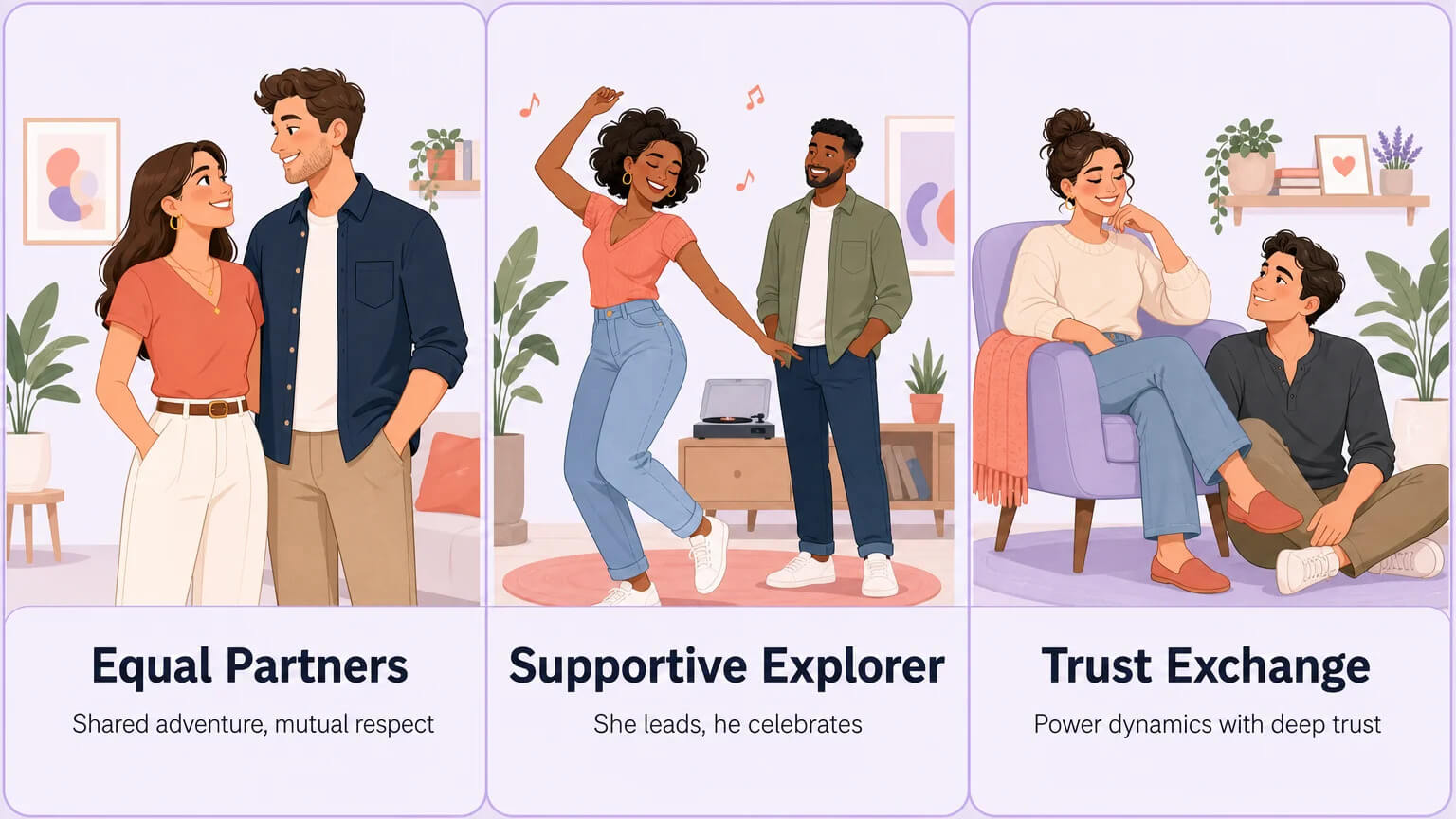
Three distinct dynamics sit under the umbrella most people casually call cuckolding, and you cannot negotiate what you cannot name.
Stag and vixen is the dynamic of equals. The husband, the stag, may also play with others or may not. The wife, the vixen, is the focus of the encounter. The husband’s arousal comes from witnessing her pleasure and desirability, not from degradation. Zero humiliation. This is peak confidence, not weakness. It says: “My partner is extraordinary, and I want to see her experienced that way.”
Hotwifing keeps the husband monogamous while the wife has sex with others. No submission element. No humiliation. The husband’s role is supportive and voyeuristic. His pleasure is secondary to hers, and that asymmetry is the point, but it does not involve power exchange. He is not beneath her. He is beside her, watching.
Cuckolding involves a submissive husband, a wife who holds the power, and some degree of humiliation or degradation central to the arousal. This exists on a spectrum. Light verbal teasing at one end. Intense psychological power exchange at the other. Not all cuckolding looks the same, but the humiliation thread runs through all of it.
These labels are imperfect starting points. Many couples move between them or create hybrids. But you cannot have the conversation until you know which one you actually mean. If you ask for cuckolding but mean hotwifing, you are describing a dynamic your wife may never want and you may not actually enjoy.
Knowing which dynamic fits is only the first question. The harder one is why you want it.
Step 2: Examine Your Own Motivations First

John wanted his wife to cuckold him. He brought it up, she eventually agreed, and after his first real experience, he felt fear. Then nausea. Then intrusive thoughts, spiraling into suicidal depression. John was not weak or uniquely broken. He was unprepared, and he had never examined why he wanted what he asked for.
His story, documented in the “When Cuckolding Turns Dark” podcast, is what happens when fantasy collides with unexamined psychology. Do not skip this section.
Before you say a word to your wife, sit with these questions. No one is grading you. But the answers determine whether this journey heals or harms.
Is this coming from relational surplus or deficit? Surplus sounds like: “Our relationship is strong, our communication is solid, and I want to explore deeper trust and celebration of my partner.” Deficit sounds like: “We are disconnected, I feel inadequate, and maybe this will fix it.” The first can support this exploration. The second is a ticking clock on a bomb.
Can you handle her genuinely enjoying it, not just performing for you? Picture her lost in pleasure with someone else. Not performing for your gaze. Actually gone in it. If that image triggers panic rather than compersion, sit with that feeling before involving her.
Are you prepared for a genuine and permanent no? If you bring this up and she says no, and the door closes forever, is this fantasy still something you are glad you understand about yourself? If the answer is no, your next step is not this article. It is a kink-aware therapist.
The distinction between healthy and unhealthy motivation matters. Healthy motivations include compersion, trust, celebration of your partner’s desirability, and a desire for deeper honesty. Unhealthy motivations include using the kink to confirm feelings of worthlessness, self-medicating depression through eroticized inadequacy, or escalating porn consumption that has detached arousal from real intimacy. One community member put it plainly: “I think cuckold porn is due to a severe need to feel bad about myself, and feel inadequate.”
Venus Cuckoldress, one of the most visible educators in this space, states explicitly: “Cuckolding is a bad idea if you think it will fix your relationship.” This requires trust and communication, not a desperate repair attempt. If you are coming from deficit, the work is individual therapy first.
Try this: write down your answer to one question before reading further. “If my wife says no and the door closes forever, is this fantasy still something I am glad I understand about myself?” If the answer is no, you have your next step. It is not in this article.
Step 3: Start the Conversation the Right Way
This conversation should not be a demand, an ultimatum, a confession that already has a specific person attached, or a one-time ask that gets re-litigated every week until she caves.
Dr. Nerdlove received a letter from a husband who had asked his wife to open their marriage “more times than he can remember.” The advice was blunt: “Respecting a partner’s no means accepting it the first time, not asking again hoping for a different answer.” That is not permission. That is pressure. And pressure is not consent.
The first conversation is not about getting a yes. It is about creating safety.
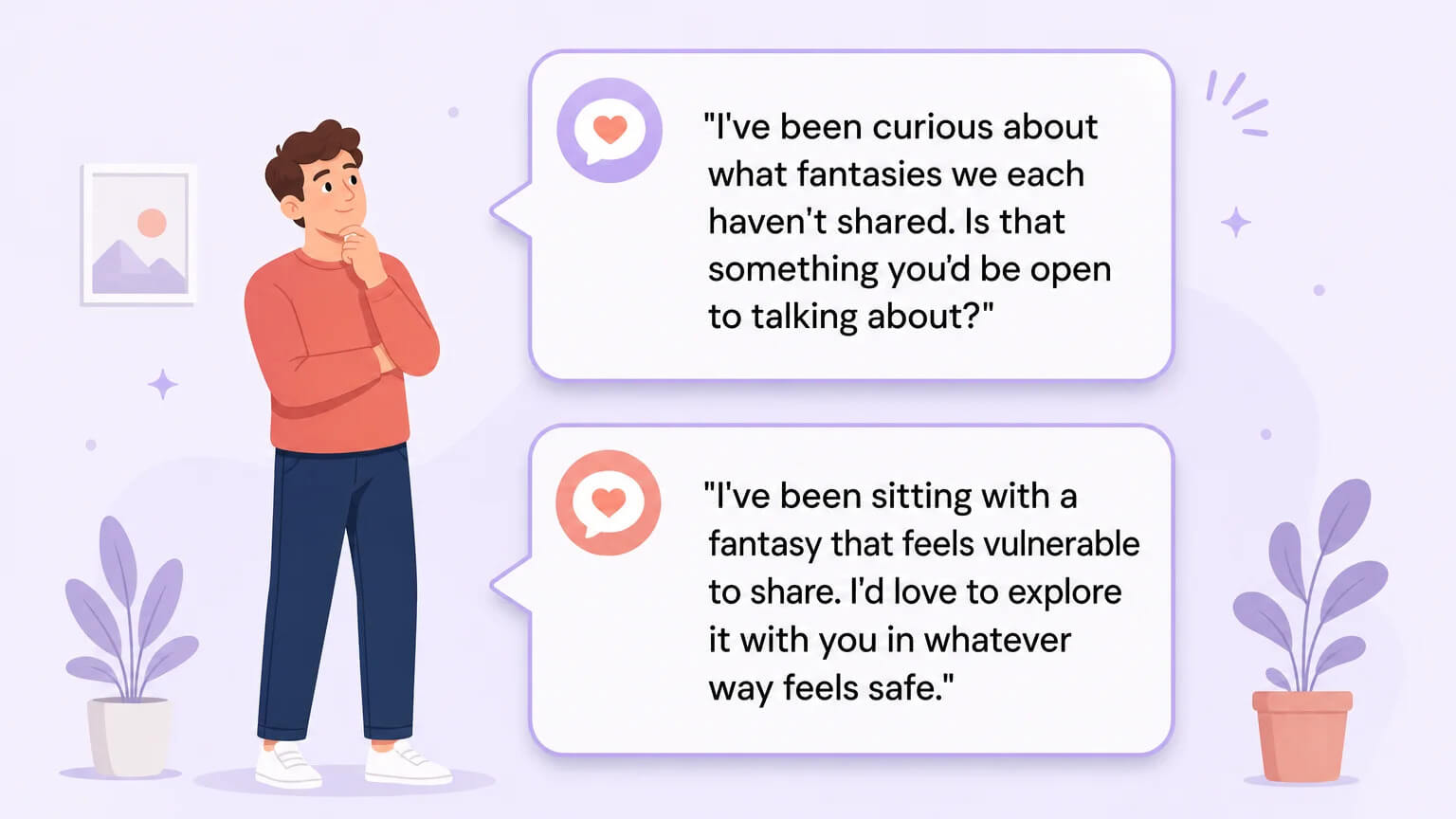
Start with a general conversation about fantasies, not cuckolding specifically. You might say: “I have been curious about what fantasies we each have that we have not shared. Is that something you would be open to talking about?” This opens the door without shoving her through it.
Use external resources as neutral ground. Listen to a podcast episode together. Read an article. Discuss it as “people in this lifestyle,” not “us.” This creates distance. It lets her react to the concept before she has to react to you wanting it. She can say “that sounds complicated” about strangers without it being a referendum on your marriage.
When you are ready to share your own desire, be vulnerable, not demanding. Frame it as: “I have been sitting with a fantasy that feels vulnerable to share. I would love to explore it with you in whatever way feels safe, even if it is just talking.” Emphasize “us,” not “I want.”
Dr. Frankie Bashan, a sex and relationships therapist, advises doing a temperature check on your relationship before raising this. If you are mid-fight about dishes or simmering with unspoken resentments, wait. This conversation needs a clean emotional surface.
Give explicit permission to say no. Say the actual words: “You can absolutely say no at any point, and I want you to know that. This is a curiosity, not a requirement.” Then mean it. Do not bring it up again the next day. Do not sulk. Do not withdraw affection. Those are coercion.
Plan for weeks or months of discussion, not one conversation. Consider working with a kink-aware couples therapist. The goal of the first conversation is not a yes. It is a door that stays open.
Watch out for the single most destructive mistake: bringing up a specific person you already have in mind. If you already know who you want her to sleep with, you are not introducing a fantasy. You are asking permission to facilitate a specific affair. That conversation ends marriages.
Step 4: Build Your Foundation of Trust and Boundaries
The wife from the Anxious FLR channel set three rules that she credits with saving her marriage. Rule one: this will not be the main show of our intimacy. Rule two: what the experience looks like is largely up to my comfort. Rule three: sometimes we just need to be us without any third-party dynamic.
These are not the rules most husbands expect. They are not about what she is allowed to do or how often or with whom. They are about protecting the primary relationship. And her husband had to accept that his fantasy does not dictate her reality.
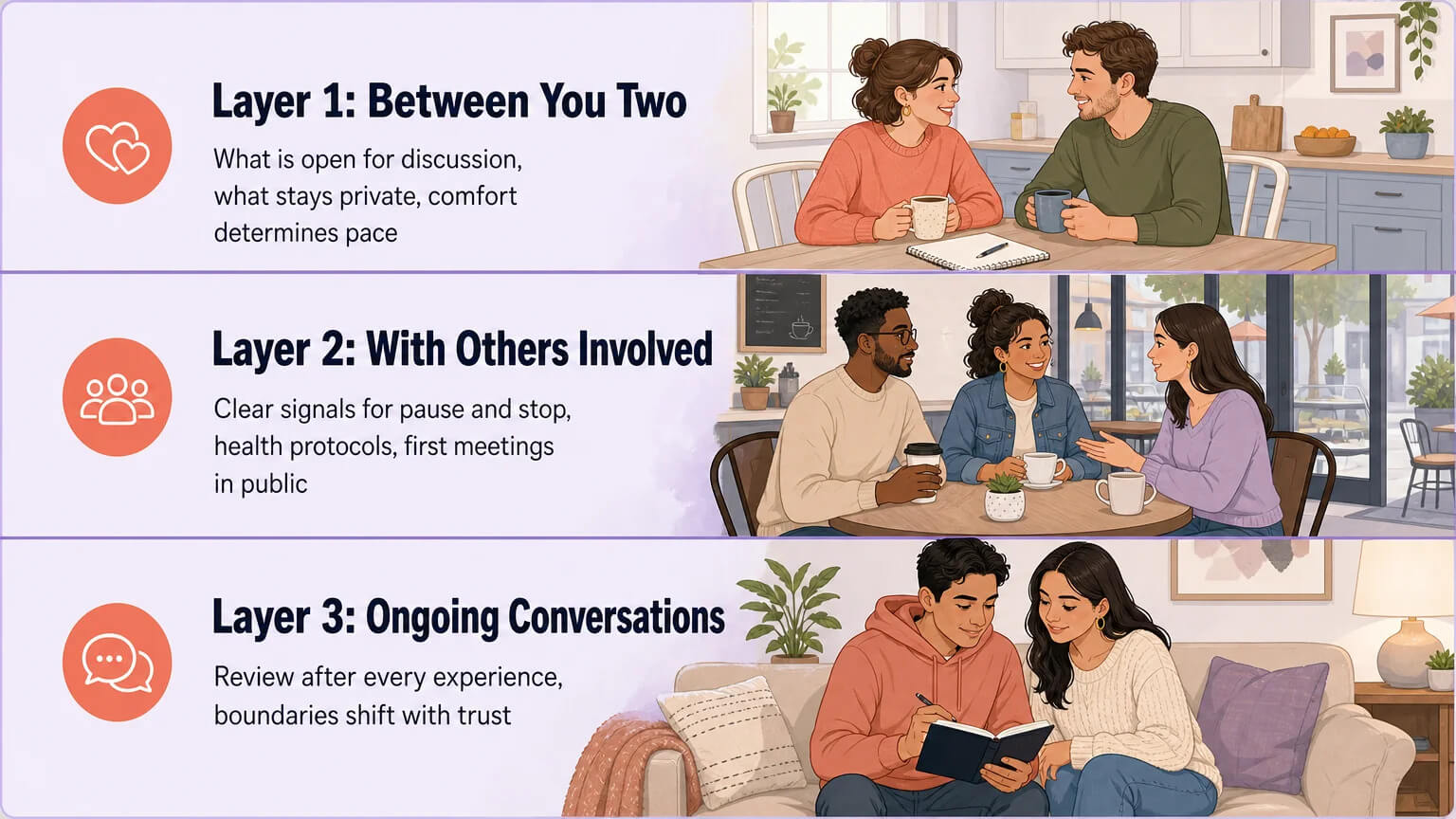
The couples who survive this lifestyle are the ones who build the container before they fill it. Here is the three-layer boundary system that makes exploration safe enough to be genuinely hot.
Layer one, the couple. What acts are allowed and off-limits. What locations. What communication happens outside scenes. Rules about photos, videos, and emotional involvement with thirds. The wife’s comfort determines the pace. This is not negotiable. If she needs to slow down, everything slows down.
Layer two, with the third. A safe word system everyone can use: a hard stop word like “red” that immediately ends all activity, a pause word like “yellow” for “slow down, I need a moment,” and a non-verbal tap-out signal for when speech is difficult. Safer sex protocols including condoms for all contact and STI testing requirements. Privacy rules: no personal information disclosure until trust is established. First meetings always in public, separate transportation, someone trusted knows where you are.
Layer three, ongoing check-ins. After every experience, review what worked and what did not. Boundaries shift. Discuss changes as a couple and with the third before the next encounter, never mid-scene. A written agreement is not a contract set in stone. It is a living document that evolves with your comfort.
Does this kill the spontaneity? The couples who skip this step are the ones who end up in therapists’ offices or divorce proceedings. Rules are not the enemy of heat. They are the foundation that lets you turn up the temperature without burning the house down.
The takeaway: rules do not kill the heat. They are what let you explore without destroying what you already have. If you cannot agree on boundaries, you are not ready to cross them.
Step 5: Take Graduated Steps Before Going All In
You have waited years to say this out loud. She has tentatively agreed to explore. You want to go straight to the main event. That impulse is what Dr. David Ley warns against. You do not know how you will feel until you feel it, and it is better to discover that in a reversible step than in a moment you cannot take back.
Two complementary frameworks map the path forward.
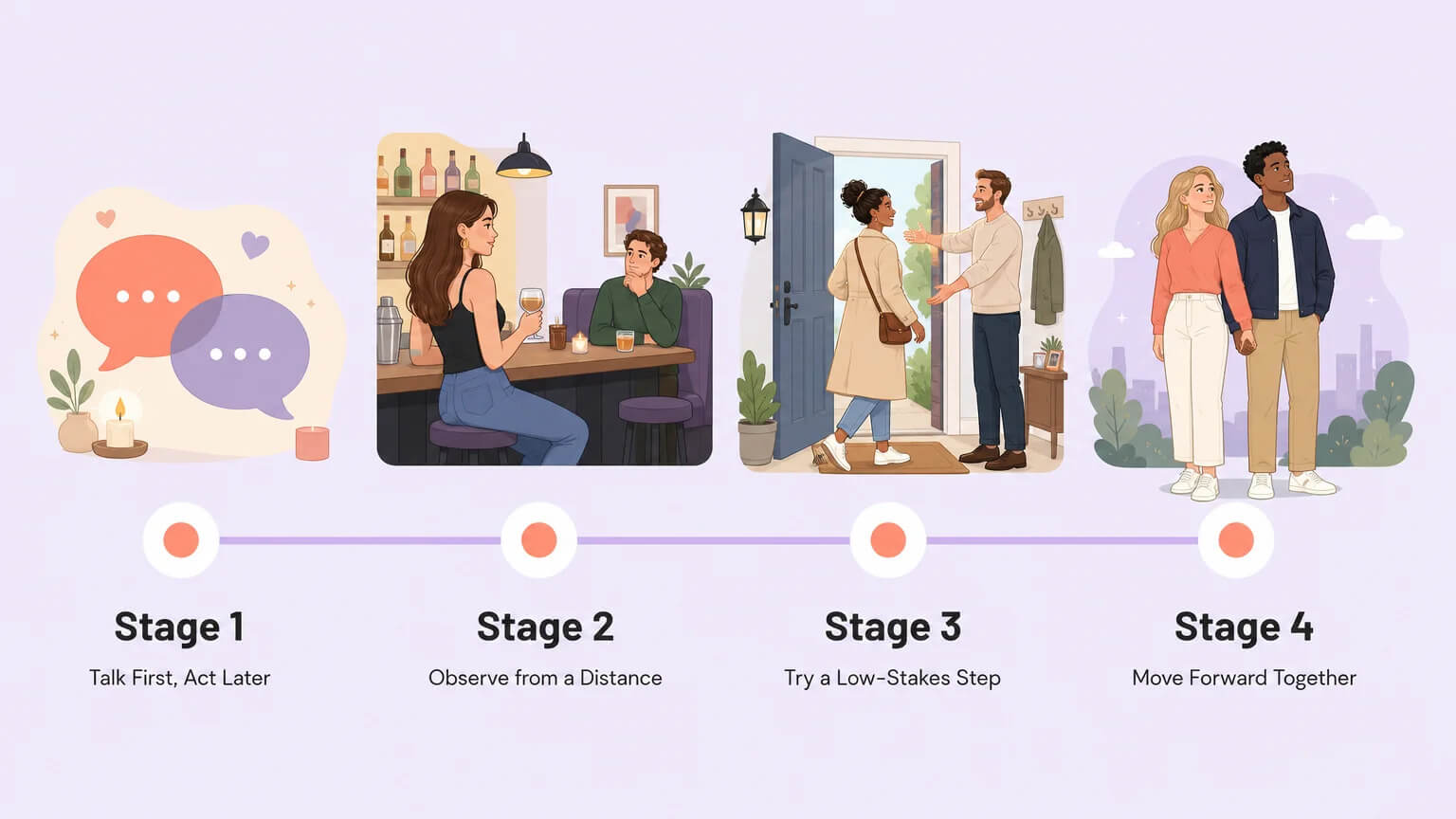
The Healthline escalation, medically reviewed by certified sex therapist Janet Brito, outlines four stages. Stage one: verbal fantasy only. Talk about it during sex. Keep it in imagination. Stage two: watching from a distance, like her flirting at a bar while you observe. Stage three: a date-night trial where she goes on a date, sex may or may not happen, and you debrief afterward. Stage four: full participation.
Adreena Winters, author of “So You Want to Be a Cuckold?”, describes four emotional stages: Discovery, Acceptance, Exploration, and Integration. The first framework is about actions. The second is about the internal work.
The date-night trial is the most important step most couples skip. Send her on a date. You stay home. No cameras, no live updates. You sit with the feeling. When she comes back, you talk about what you each felt. This tests real-world jealousy and emotional readiness without the full intensity of witnessing. Many couples learn everything they need to know from this step alone.
The husband from the “When Cuckolding Turns Dark” podcast discovered after one real experience that the fantasy was precisely that, a fantasy, and was better kept there. He stopped real-life exploration but incorporated fantasy talk into their sex life in a healthier way. This is not a failure story. It is a success story. The graduated approach let him discover the boundary before permanent damage occurred.
Online exhibitionism or camming offers a middle ground: the wife engages with others virtually while the husband watches. This respects her boundaries around physical contact while exploring the dynamic. Not every path leads to full cuckolding, and the paths that stop short are not lesser.
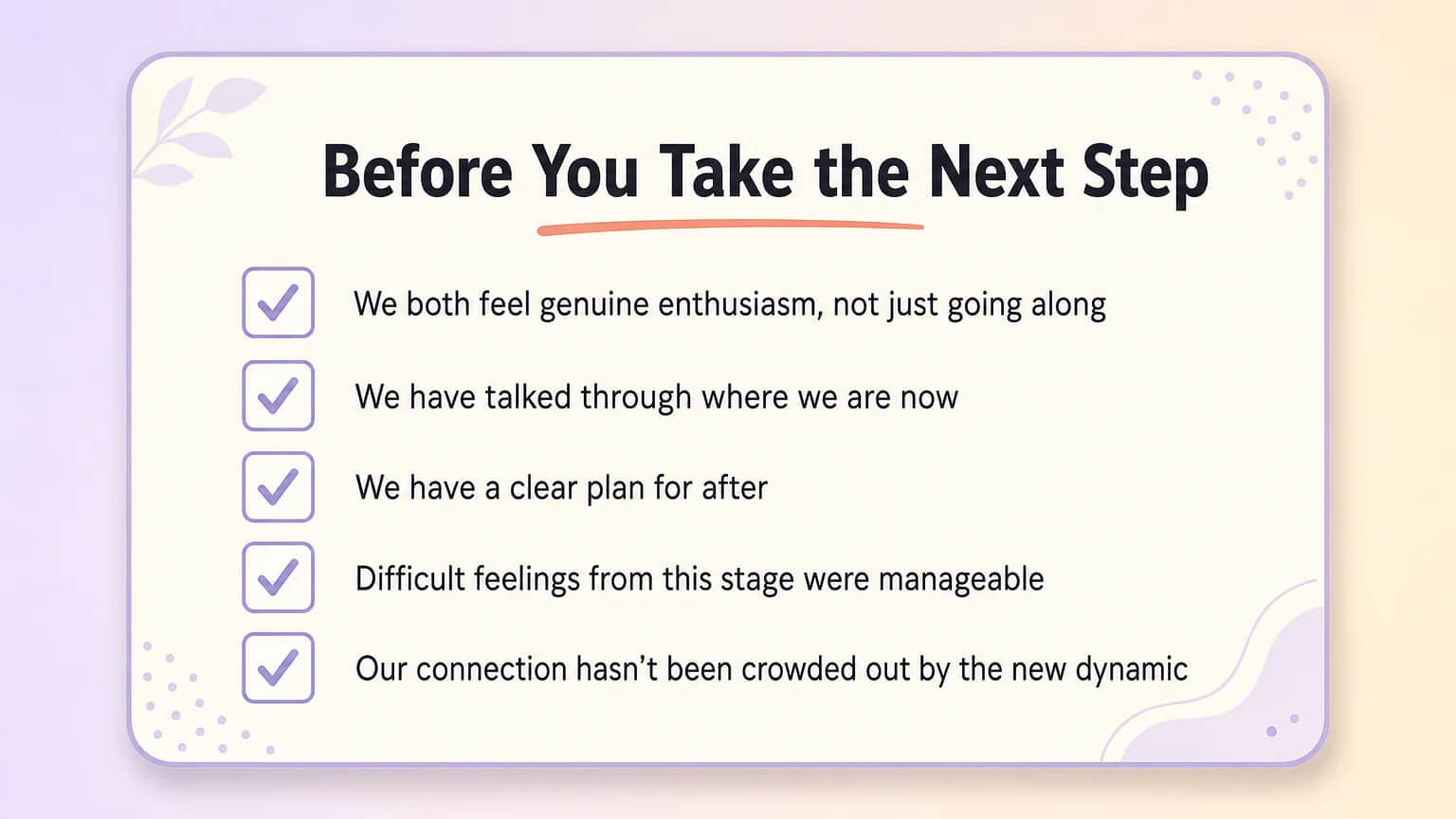
Signs you are ready to advance: both partners feel genuine enthusiasm, not resigned agreement. You have debriefed the current step thoroughly. You have a plan for aftercare. Signs you need to stay put: one partner is “going along with it,” jealousy from the current step was unmanageable, the fantasy is consuming all your intimate life and crowding out vanilla connection.
Once you have built comfort with fantasy and graduated steps, the practical question becomes unavoidable. How do you find the right person, and what happens after you do?
Step 6: Handle What Happens After the Experience

After his first real cuckolding experience, John described nausea, intrusive thoughts, and suicidal depression. He was not weak. He was unprepared for the neurobiological reality that intense sexual experiences create endorphin rushes followed by crashes, what the kink community calls “drop.” This can hit hours or days later, and the cuckold is particularly vulnerable because his experience combines arousal, jealousy, submission, and exclusion into one overwhelming cocktail.
The experience itself is only half the story. What happens in the hours and days after determines whether this brings you closer or drives you apart. Aftercare is not a nice-to-have. It is the difference between a story you tell together and a story you recover from.
Aftercare is the emotional and physical support after a vulnerable experience. Dr. Elisabeth Sheff, an expert on polyamory and kink, notes that post-sex communication, pillow talk, cuddling, and satisfying touch are often more important for relationship satisfaction than the sex itself. Aftercare regulates the nervous system and prevents emotional drop.
Here is the non-negotiable protocol. Immediate physical reconnection: skin-to-skin contact, cuddling, warmth, hydration. Verbal reassurance: “I love you,” “We are okay,” “That was for us.” Non-judgmental debriefing where both partners share what felt good, what was surprising, and any mixed feelings, without the other partner getting defensive.
Aftercare and reclaiming sex serve different purposes. Aftercare regulates the nervous system and provides emotional safety. Reclaiming sex is the act of reconnecting sexually as a couple, reaffirming “we are still us.” Both matter. Neither replaces the other.
The next-day check-in is essential. Feelings surface twenty-four to forty-eight hours later. A follow-up conversation where both partners can say “here is what is still sitting with me” prevents resentment from calcifying. Skip this, and you are letting unprocessed emotion harden into permanent damage.
Warning signs that mean stop everything: persistent depression beyond a few days, severe anxiety, obsessive thoughts about the experience, withdrawal from the relationship, using the fantasy to avoid vanilla intimacy entirely. If these appear, pause all activity and consider a kink-aware therapist. The willingness to stop entirely is what separates couples who survive this from those who do not.
Some couples navigate the aftermath and find that the level of honesty required made every part of their relationship stronger. Others discover the fantasy was better than the reality and choose to stop with their marriage intact. Both are successful outcomes. The goal is not to avoid hard feelings. It is to have a plan for them before they arrive. If you cannot agree on aftercare, you are not ready for what comes before it.
FAQ
What if she says no?
Accept the no immediately and permanently. Do not guilt-trip, re-negotiate, or ask again. Process your feelings through journaling or a kink-aware therapist. After giving space, say: “I fully respect your decision. I will not bring it up again unless you do.” Respecting a no is the only path that preserves the relationship and, paradoxically, the only path that might eventually lead to a genuine reconsideration. Pressure destroys both.
What does my wife actually feel when I bring this up?
Shock, confusion, self-doubt. The most common fear: “Am I not enough?” Many women associate love with sexual exclusivity, so the fantasy can feel like rejection. She may worry this is a pretext for you to sleep with others, or fear losing your respect. One wife wrote to Dan Savage after ten years: “It makes me feel worthless as a sex partner. I will not stay much longer if this continues.” Her experience hinges on whether the exploration feels mutual or like a sacrifice.
Is this healthy or is something wrong with me?
It depends on where the desire comes from. For some, cuckolding desires are rooted in confidence, compersion, and secure attachment. For others, depression, low self-esteem, or porn escalation. The key diagnostic: relational surplus or deficit? If driven by a need to feel bad about yourself, explore it with a therapist first. If it comes from celebrating your partner’s pleasure and deepening trust, it can be healthy. The difference determines whether this journey heals or harms.
How do we find and vet a third safely?
Use vetted platforms: lifestyle parties, referrals from trusted friends, community-vetted online spaces. Avoid random hookup apps. Always meet in public first with zero expectation of play. Chat as a group. Check references. The best vetting tool: hold a boundary and watch their response. Respectful acceptance is the greenest flag; pushback is the reddest. Red flags: vague about STI testing, pressuring for rapid escalation, disrespecting past partners, refusing to speak with both partners, or focusing only on their own fantasy.
What are the most common mistakes?
Five stand out. Using cuckolding to fix a broken relationship. Rushing from fantasy to reality without graduated steps. Pressuring a reluctant partner after she has said no. Letting the kink take over the entire sex life and crowd out vanilla intimacy. Choosing the wrong third party without proper vetting. Each is preventable. The guardrails only work if you use them.
Can we go back if we try it and hate it?
Once the conversation is opened, and especially once an experience has happened, the relationship may not return to its previous shape. Some couples discover the fantasy was better kept as fantasy and stop real-life exploration while incorporating fantasy talk in healthier ways. Others find the experience permanently altered how the wife sees her husband or how the husband sees himself. The graduated approach in Step Five is designed to let you discover your boundary in a low-stakes step before crossing into something you cannot take back. The willingness to stop, and to mean it, is the safety net under every step of this process.