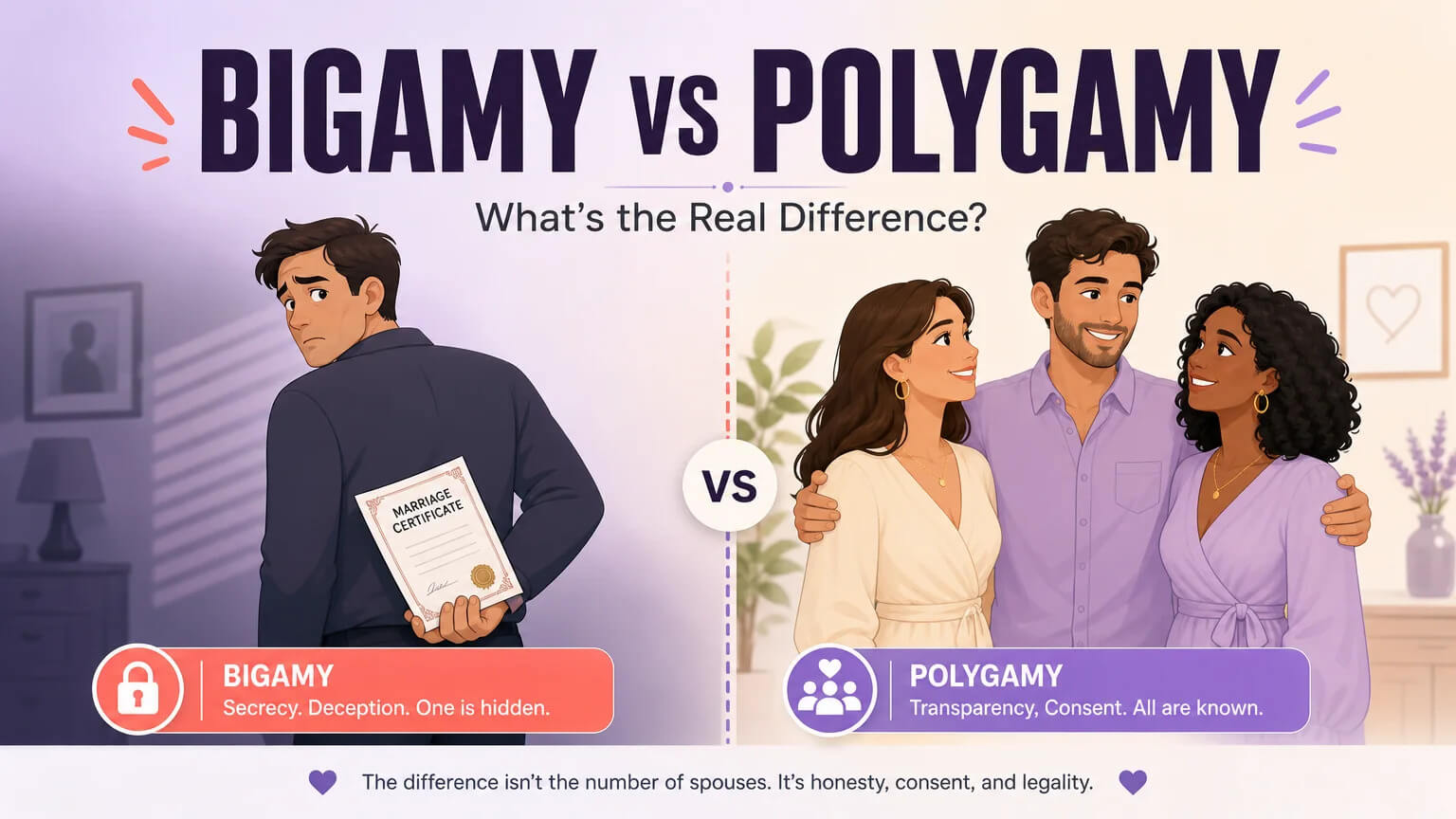
Most people cannot tell bigamy vs polygamy apart. Headlines, TV dramas, and casual conversation toss the terms around like synonyms. One person tweeted, “Bigamy or polygamy? That’s my husband,” and the post went viral because it captured the confusion exactly.
But these words describe different things. One is a crime defined by secrecy. The other is a marital practice with thousands of years of history and legal recognition across much of the world.
What follows is the legal definitions, the consent question, where each is legal or illegal, what the words literally mean, the different forms multi-partner marriage takes, and what actually happens when bigamy hits a courtroom. By the end, you will not confuse the two again.
The Landscape: Two Terms, Endless Confusion
The confusion between bigamy and polygamy is not just a vocabulary problem. It reflects a deeper mismatch. Both terms describe situations where one person has more than one spouse. That is where it stops.
Bigamy is a crime in virtually every country on Earth. Polygamy, by contrast, is legally recognized in over 50 sovereign states and has been the dominant marriage model across most of human history. Anthropologist George Murdock found it culturally favored in 77 percent of societies worldwide, 415 out of 554 in the Standard Cross-Cultural Sample.
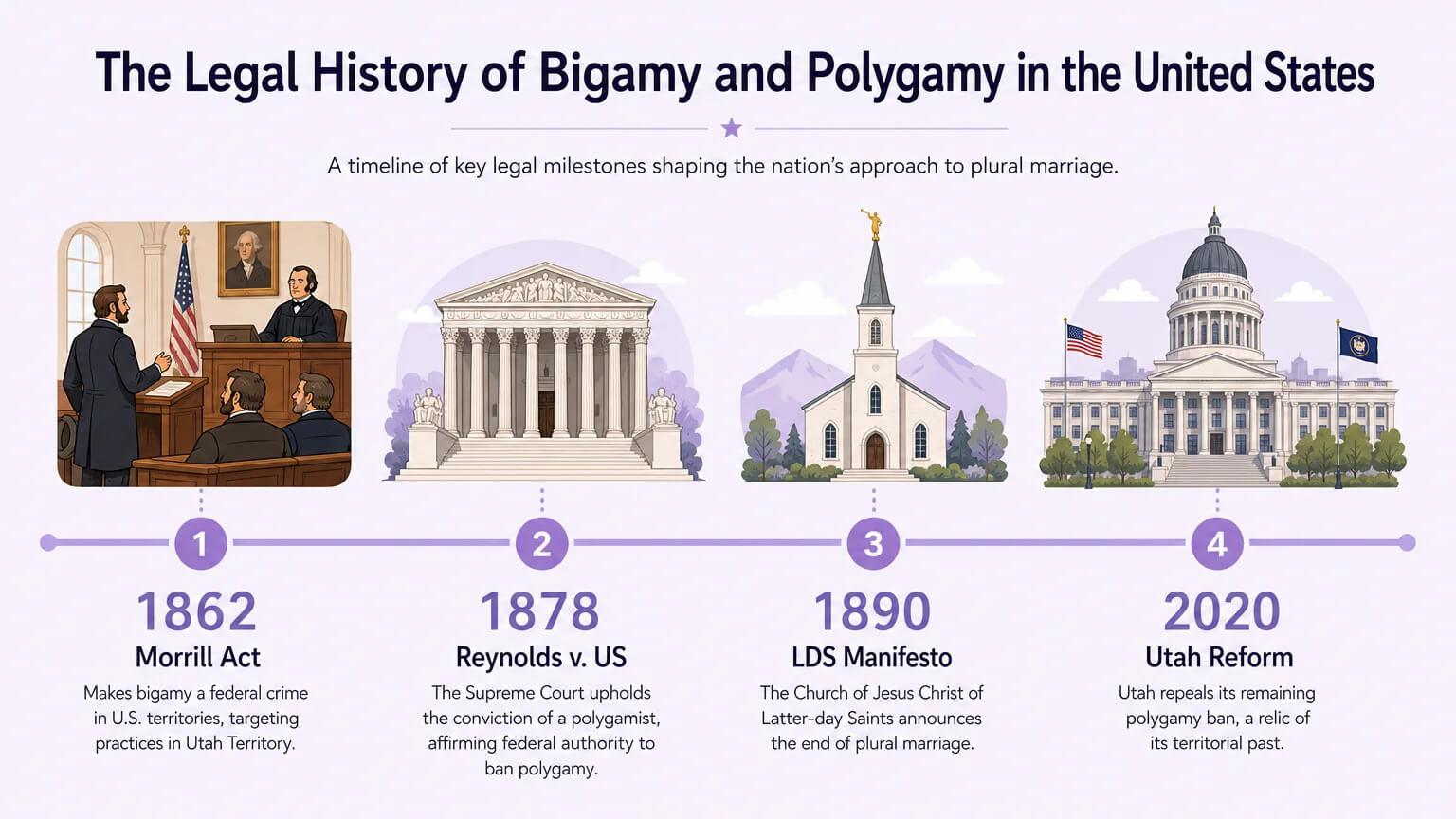
These terms blur together because of 19th-century American history. Federal anti-bigamy laws, the Morrill Act of 1862 and the Edmunds Act of 1882, were written specifically to target Mormon plural marriage. The legislation collapsed the legal and cultural meanings together. The Supreme Court cemented this in Reynolds v. United States (1878), ruling that religious belief cannot justify criminal conduct. Here, they come apart.
1. Core Definitions: What Each Term Actually Means
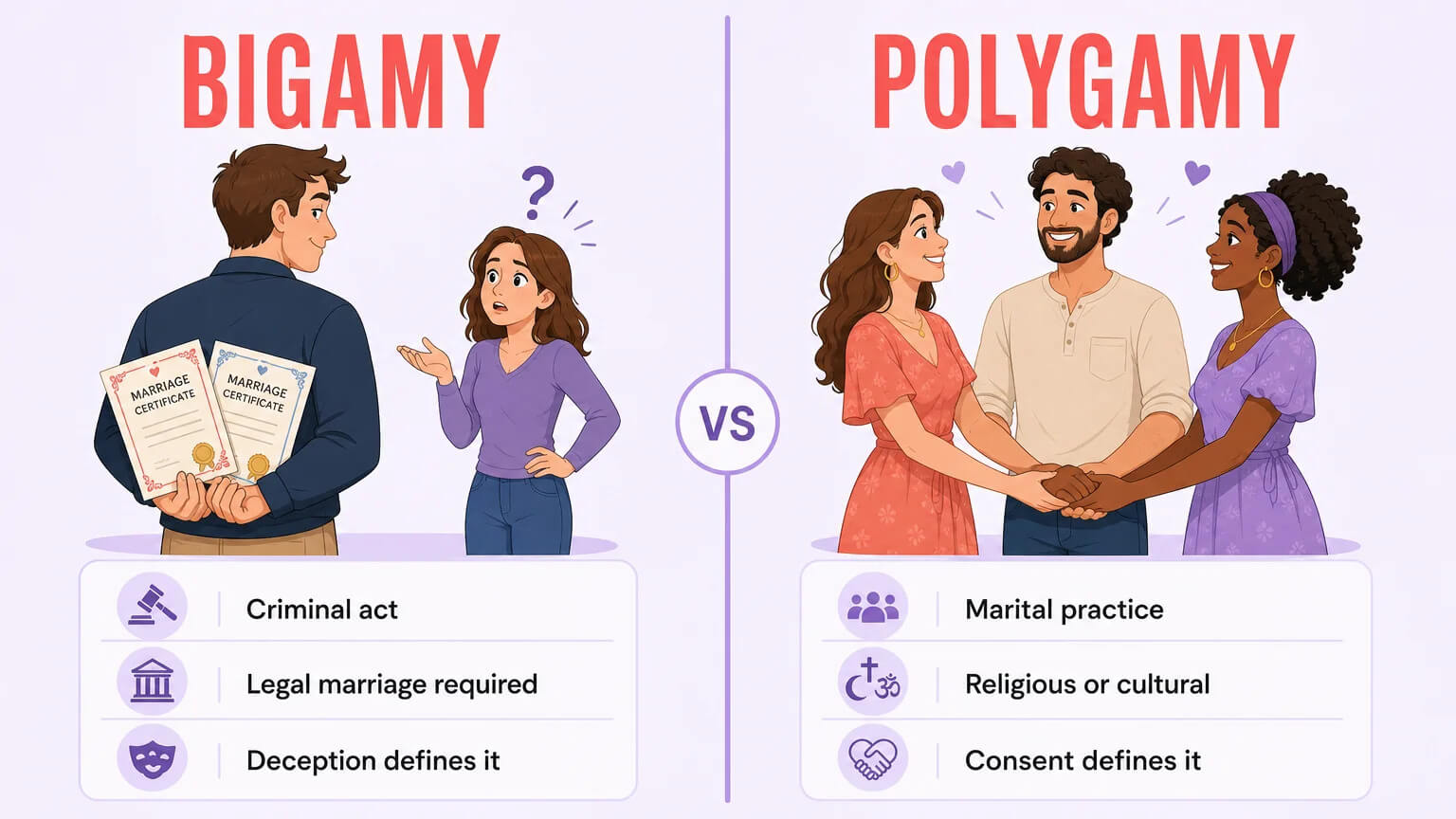
Bigamy is the crime of marrying someone while still legally married to another living person from whom no valid divorce has been obtained. It has three elements: a prior valid legal marriage that has not been dissolved, a subsequent marriage ceremony rather than just cohabitation, and a second spouse who is typically unaware the first marriage exists.
Bigamy is a specific criminal act, not an ongoing lifestyle. Enforcement hinges on a formal marriage license or ceremony. Without that paperwork, the conduct may be adultery or fraud, but it is not bigamy in the legal sense. Cohabitation alone, a religious ceremony with no license, or an informal partnership never triggers a bigamy charge.
Polygamy is the broader practice or condition of having more than one spouse simultaneously, typically with the knowledge and consent of all parties. Unlike bigamy, polygamy does not require a legally registered marriage. It can encompass religious-only ceremonies, customary marriages, or de facto plural unions that exist outside any formal registration system.
The distinction is this. Bigamy always involves a legal marriage certificate plus deception of at least one spouse. Polygamy may or may not involve legal marriage, and all parties are typically aware of the arrangement. Bigamy is a single criminal act, prosecuted through the courts. Polygamy is an ongoing relationship structure, recognized or tolerated across dozens of legal systems.
2. Consent vs. Deception: The Dividing Line
The consent question is where bigamy and polygamy diverge most sharply, and where the real harm concentrates.
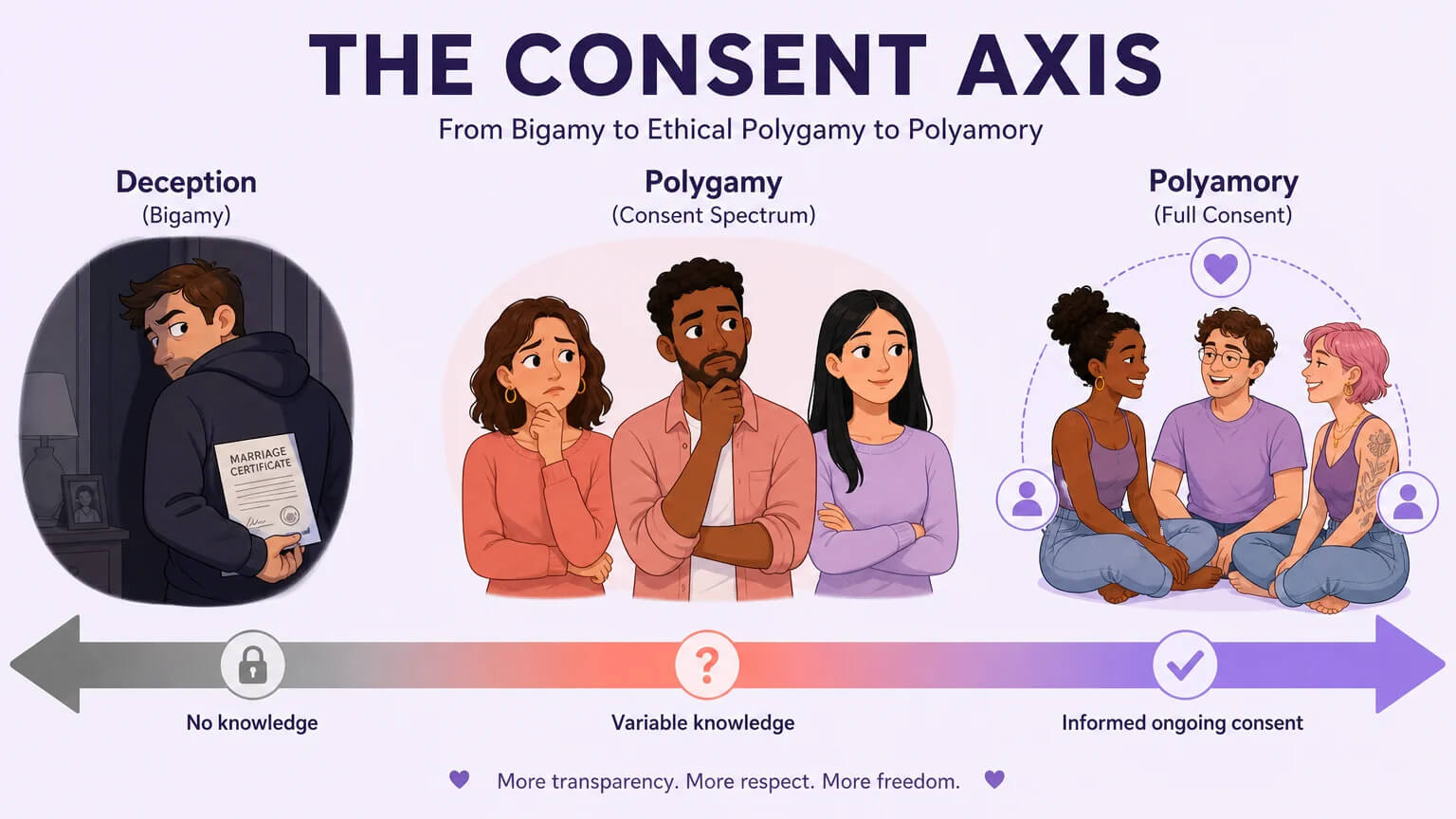
In bigamy, the second spouse is almost always a victim of fraud. They entered what they believed was a lawful marriage. They may have had children, bought a home, and built a life, only to discover their partner was already legally bound to someone else. The deception is definitional. If everyone knew about and consented to the arrangement, it would not be bigamy.
In polygamy, at least in its idealized form, all parties know about each other and consent to the arrangement. The reality is messier. Critics, including UN human rights bodies and the CEDAW committee, argue that in many polygamous contexts, economic dependency, social pressure, and arranged marriage traditions compromise women’s consent. Jess Lewis of The Ethics Centre in Australia notes that polygamy “more often occurs alongside arranged marriages, child marriages, dowries and other practices that revoke the autonomy of women and girls.”
Heath Schechinger, PhD, a counseling psychologist at UC Berkeley, draws a sharper line. Polyamory, he explains, is rooted in feminism, gender equity, and flat power structures. Polygamy is rooted in religious fundamentalism and complementarianism, where men and women receive prescribed but different roles.
On consent, the comparison is not “bigamy equals bad, polygamy equals consensual.” Bigamy is definitionally deceptive. The second spouse is unaware by definition. Polygamy exists on a spectrum of consent, and the legal frameworks that govern it determine where on that spectrum any given polygamous marriage falls. The form that requires court approval, spousal consent, and proof of financial capacity is a fundamentally different institution from the form practiced in secrecy.
3. Legal Status: Criminal Offense vs. Cultural Practice
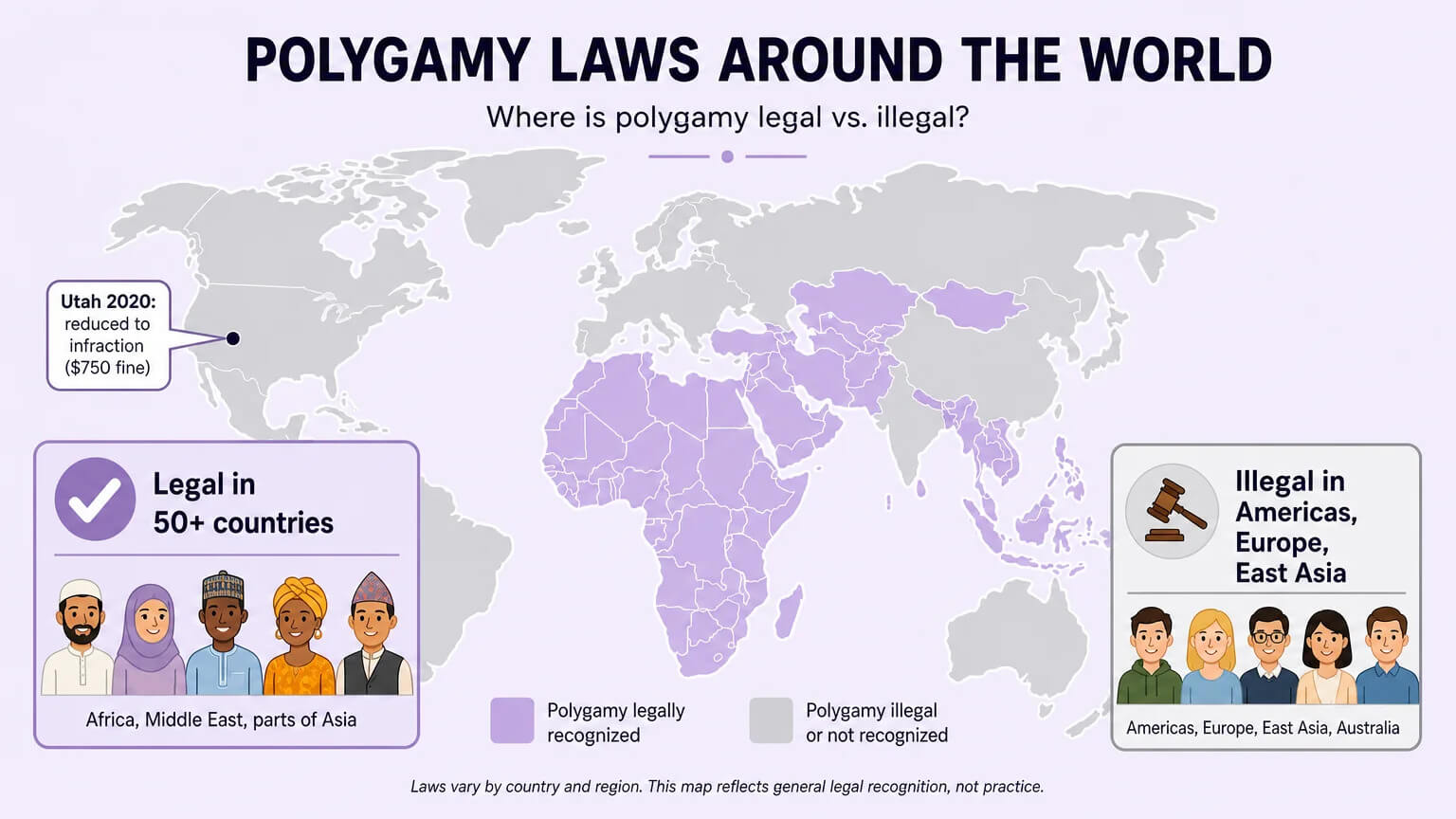
Bigamy and polygamy sit at opposite ends of the law.
Bigamy is a crime in every U.S. state and virtually every country on Earth. Under federal law (18 U.S.C. Section 2811), bigamy in U.S. territories and federal enclaves carries up to five years imprisonment and a $500 fine. The statute includes three affirmative defenses: the prior spouse was absent for five successive years and believed dead, the prior marriage was dissolved by a valid decree, or the prior marriage was declared void by a court.
State penalties vary dramatically. Hawaii treats it as a petty misdemeanor, carrying up to 30 days in jail. Mississippi and Texas classify it as a felony with up to 10 years imprisonment. California treats it as a “wobbler,” chargeable as either a misdemeanor (one year county jail) or a felony (16 months to three years in state prison).
Polygamy is more complicated (check the full picture of legality of polygamy worldwide). It is legally recognized in over 50 sovereign states, concentrated in Africa, the Middle East, and parts of Asia. Most Muslim-majority countries permit polygyny with up to four wives under Quran 4:3, conditional on financial capacity, consent of existing wives, and court approval. Polygamy is illegal throughout the Americas, Europe, East Asia, and Australia, though some Western countries (Sweden, Germany, France, the UK, Switzerland) may recognize polygamous marriages performed legally abroad for limited purposes like immigration benefits.
In 2020, Utah broke from the U.S. consensus by reducing bigamy between consenting adults from a felony to an infraction: a fine of up to $750, no jail time. The explicit policy goal was to bring polygamous families “out of the shadows” so they could report crimes, access healthcare, and engage with social services without fear of felony prosecution.
Immigration is one of the few areas where bigamy laws receive active enforcement. A bigamy conviction or polygamous practice can render a person permanently inadmissible to the United States and ineligible for naturalization. The 1892 Immigration Act barred polygamists from immigrating, and this exclusion remains current law.
4. Where the Words Come From: Etymology Unpacked
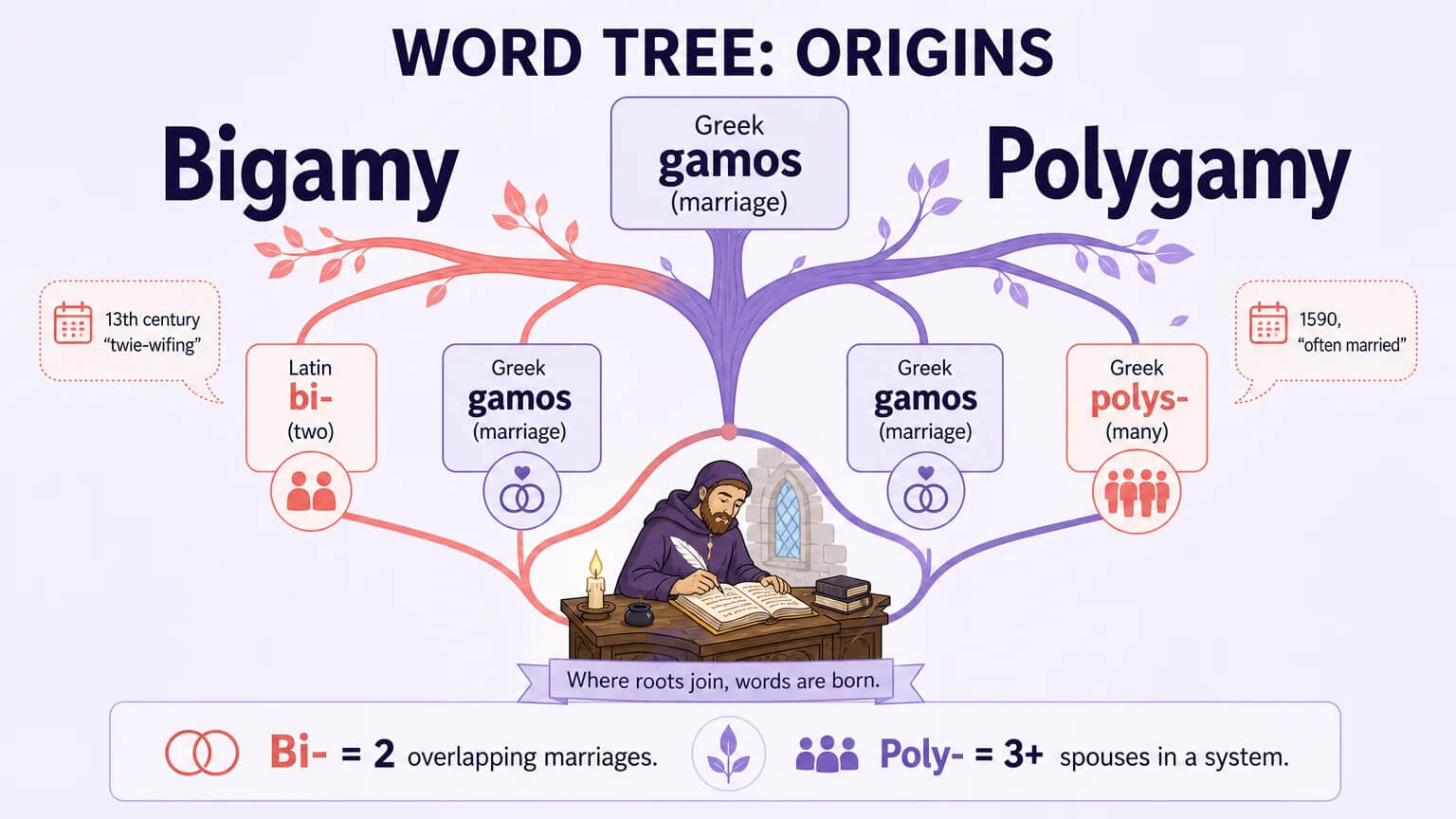
The words themselves are the cleanest way to remember the difference.
Bigamy entered Middle English in the 13th century from Old French “bigamie,” from Medieval Latin “bigamia,” from Late Latin “bigamus,” meaning “twice married.” It is a rare hybrid word combining Latin “bi-” (two) with Greek “gamos” (marriage). The pure Greek form would have been “digamia,” but medieval scribes mixed their classical roots. A circa-1250 English text translated it literally as “twie-wifing”: two-wiving. The root “bi-” equals two tells you exactly what bigamy is: one person, two overlapping legal marriages.
Polygamy arrived later, around 1590, from Late Greek “polygamia,” from “polygamos,” meaning “often married.” It is purely Greek: “polys” (many) plus “gamos” (marriage). The root “poly-” equals many tells you polygamy is about three, four, or more spouses within a recognized system.
One historical note: in medieval Catholic canon law, “bigamy” meant something entirely different. Thomas Aquinas used it to describe a person who married twice in succession after a spouse’s death, not simultaneously. A “bigamus” was barred from holy orders. A widower who remarried could not become a priest. This medieval usage has no connection to the modern criminal definition but shows how the terms have shifted over centuries.
5. The Many Forms of Multi-Partner Marriage
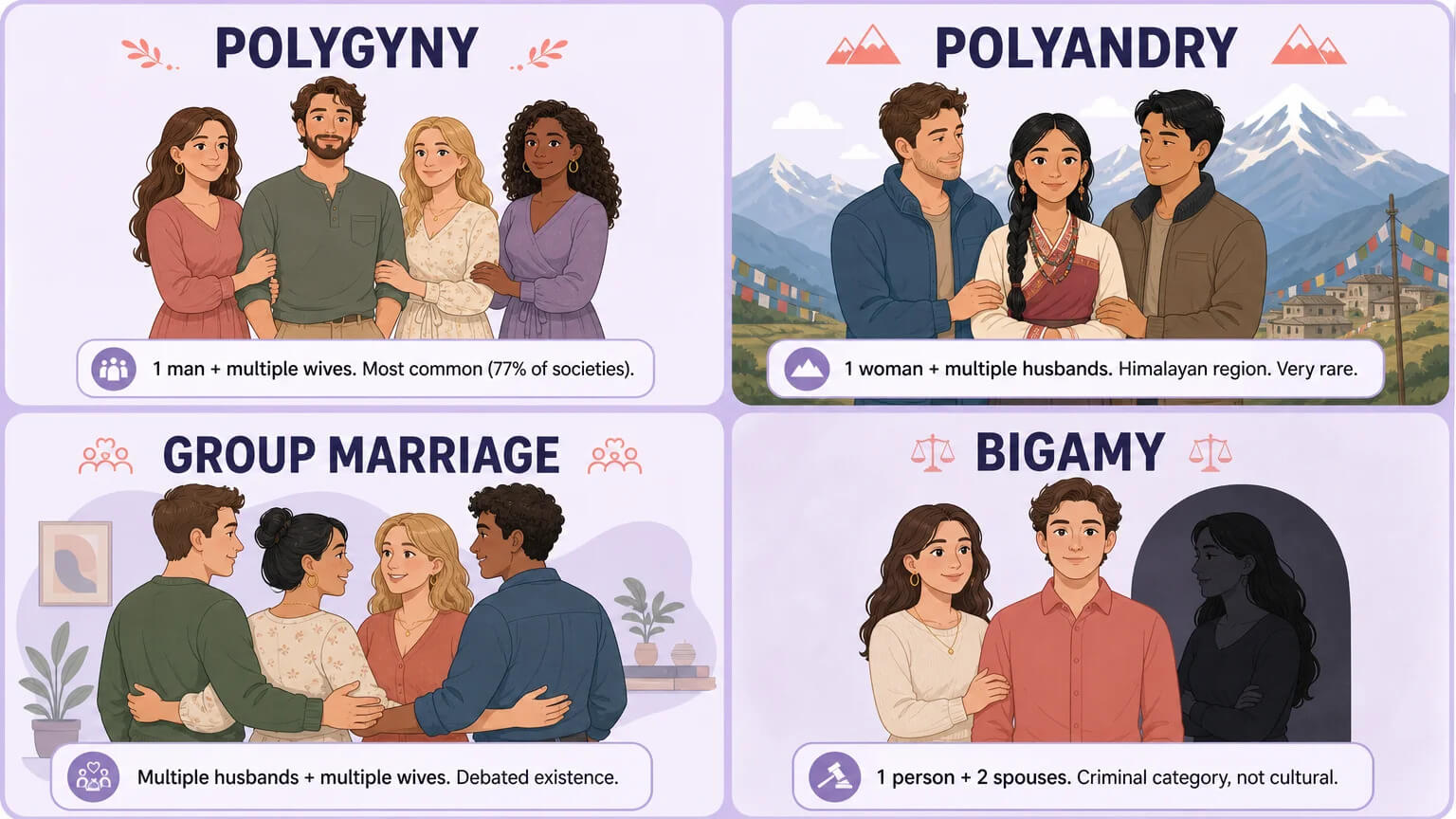
Polygamy is a family of marriage structures, not a single practice. Anthropologists recognize four distinct forms, and understanding them is essential to using the terminology correctly.
First, polygyny: one man with multiple wives. This is the most common form by a wide margin, culturally favored in approximately 77 percent of societies in George Murdock’s cross-cultural sample. Subtypes include sororal, where co-wives are sisters, and non-sororal. This is the form permitted in Islam with up to four wives under Quran 4:3. Hebrew patriarchs practiced it: Abraham with Sarah and Hagar, Jacob with Leah and Rachel. It has been historically widespread across Africa, the Middle East, and Asia.
Second, polyandry: one woman with multiple husbands. Extremely rare, found in fewer than 1 to 5 percent of societies. Concentrated in the Himalayan region, where fraternal (adelphic) polyandry among Tibetans in Nepal sees brothers marry one woman to prevent land fragmentation across generations. The Nayar of India practiced a non-fraternal form.
Third, group marriage: multiple husbands and multiple wives forming one family unit. So rare that anthropologists debate whether it has ever existed as a stable, recognized institution.
Fourth, bigamy: one person with two spouses. Anthropological taxonomies classify it separately precisely because criminal law and deception define it, not cultural acceptance.
When someone says “polygamy” in casual conversation, they almost always mean polygyny. And bigamy sits outside the cultural taxonomy entirely. It is a legal category, not an anthropological one.
6. What Happens When the Law Steps In: Real Consequences
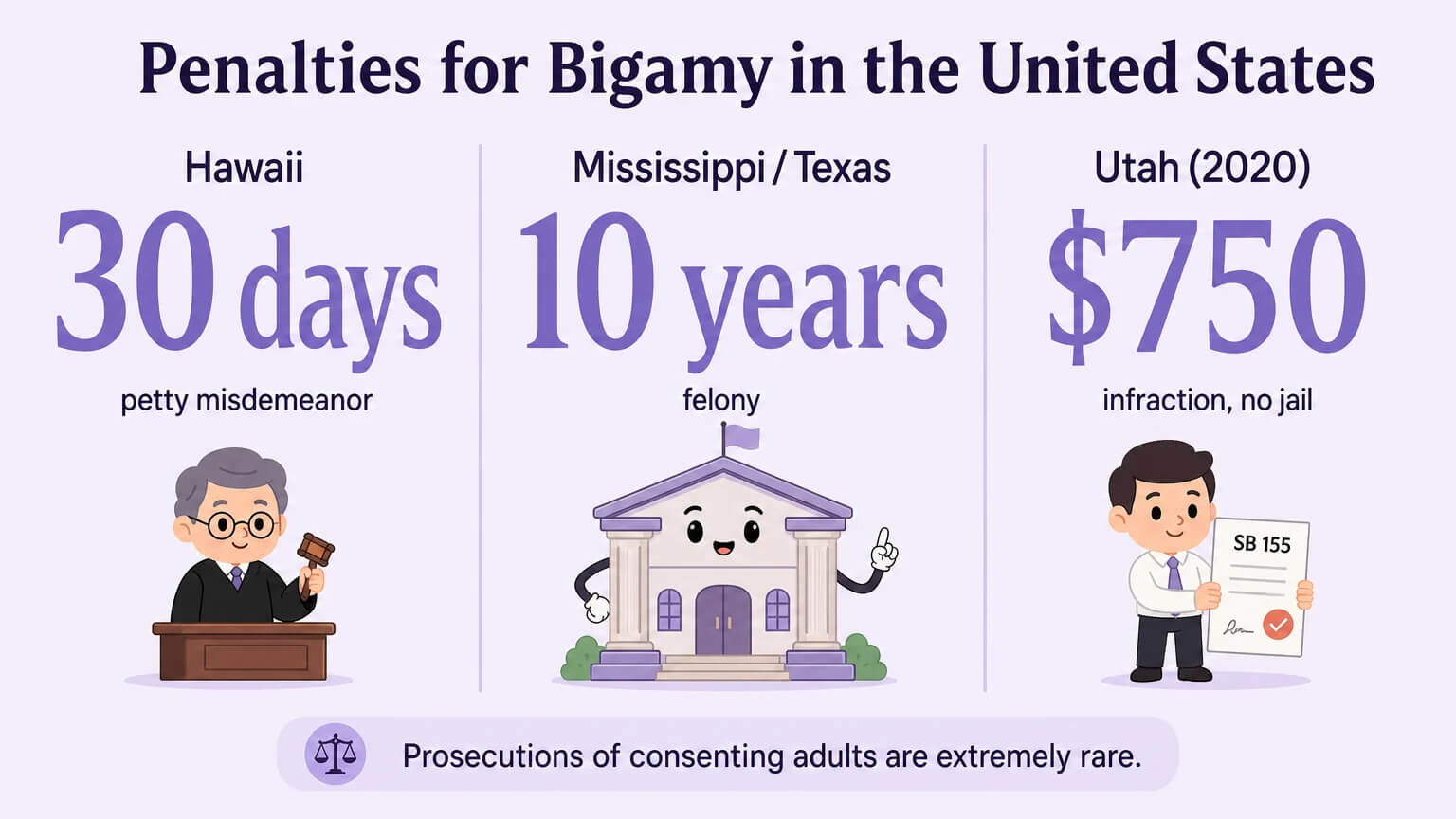
The statutes and the courtroom tell different stories. The real-world consequences break into criminal prosecutions, family law fallout, and the enforcement gap.
On the criminal side, modern prosecutions follow a clear pattern. In 2025, a Singaporean man named Vaithialingam Muthukumar received three months and three weeks in jail after his first wife, a hospital employee, saw him leaving a delivery suite where his second wife had just given birth. In the Philippines, Erwin Bonbon y Tia received four to eight years imprisonment for marrying three women without dissolving any prior marriage. In Florida, Henry Betsey Jr. married three women via dating apps and received two years probation. In Texas, former youth pastor Luke Cunningham was reindicted on 16 counts of sexual assault of a child with a bigamy enhancement, a first-degree felony carrying a $500,000 bond.
The pattern: prosecutions almost always involve fraud, financial exploitation, or abuse of minors, not consenting adult polygamy.
On the family law side, a bigamous marriage is “void ab initio”: invalid from the start. Divorce is legally unavailable. Only annulment applies. The financial implications are enormous. Assets accumulated over decades may not be subject to equitable distribution because the marriage never legally existed. The “putative spouse doctrine” in states like California, Arizona, and Louisiana partially protects an innocent spouse who married in good faith, granting rights to property division and spousal maintenance. Pennsylvania goes further: under Bordone v. Bordone (2025), if a couple cohabits in good faith after the prior marriage is dissolved, the bigamous marriage can be rehabilitated and become legally valid.
The law universally protects children’s rights. It separates the parents’ criminal conduct from the child’s right to support and inheritance, regardless of the marriage’s void status.
Then there is the enforcement gap. Despite the statutes on the books, bigamy prosecutions against consenting adults are extraordinarily rare. A 1984 Oklahoma prosecutor put it bluntly: “No 12 people on a jury panel are going to give a damn if this guy is subsequently married.” Historical 19th-century federal data showed bigamy at 0.14 percent of the criminal docket. In the UK, about 70 cases are reported annually. The real-world risk for consenting adults in polygamous relationships is near zero, but the legal vulnerability remains.
The Bottom Line: Why the Distinction Matters
Bigamy and polygamy share a syllable and nothing else. Bigamy is a criminal act: marrying someone while still legally married to someone else, defined by deception, prosecuted (rarely) under criminal law, and carrying penalties from fines to prison time. Polygamy is a marital practice: having multiple spouses simultaneously, spanning thousands of years of human history, legal in over 50 countries, and existing in multiple cultural forms from Islamic polygyny to Himalayan polyandry.
The distinction carries weight in three situations. If you are entering a marriage and need to verify your partner is legally free to marry, a bigamous marriage can be annulled and your financial protections may vanish with it. If you are navigating immigration law, bigamy is a bar to entry, permanent residency, and citizenship. And if you are trying to understand multi-partner relationships in their proper legal and cultural context rather than lumping everything under one wrong label, the difference matters.
Here is the short version. Bigamy is about breaking the law. Polygamy is about breaking the norm.
FAQ
What is the difference between bigamy and polygamy?
Bigamy is the criminal act of marrying someone while still legally married to another living person. Deception defines it: the second spouse typically does not know the prior marriage exists. Polygamy is the broader practice of having multiple spouses simultaneously, typically with the knowledge and consent of all parties, and often rooted in cultural or religious tradition rather than involving a legal marriage certificate. The short version: bigamy is always a crime; polygamy may be a cultural norm.
Is polygamy legal anywhere in the world?
Yes. Polygamy, specifically polygyny (one man, multiple wives), is legally recognized in over 50 sovereign states, primarily across Africa, the Middle East, and parts of Asia. Most Muslim-majority countries permit up to four wives under Islamic law, subject to conditions including financial capacity, consent of existing wives, and court approval. Polygamy remains illegal throughout the Americas, Europe, East Asia, and Australia, though some Western countries recognize polygamous marriages performed legally abroad for limited purposes like immigration benefits.
What are the penalties for bigamy in the United States?
Bigamy is a crime in all 50 states. Penalties range from a petty misdemeanor in Hawaii (up to 30 days jail) to a felony with up to 10 years imprisonment in Mississippi and Texas. Federal law (18 U.S.C. Section 2811) provides up to five years imprisonment for bigamy in U.S. territories. Utah reduced bigamy between consenting adults to an infraction, a fine of up to $750 with no jail time, in 2020. In practice, prosecutions of consenting adults are extremely rare; most modern bigamy cases involve fraud, financial exploitation, or abuse of minors.
What are the different types of polygamy?
Anthropologists recognize four main forms. Polygyny, one man with multiple wives, is the most common form, culturally favored in approximately 77 percent of societies historically. Polyandry, one woman with multiple husbands, is extremely rare and concentrated in the Himalayan region where fraternal polyandry (brothers sharing one wife) prevents land fragmentation. Group marriage, multiple husbands and multiple wives in one family unit, is exceptionally rare and debated. Bigamy, one person with two spouses, is classified separately in some taxonomies due to its criminal and deceptive nature rather than cultural acceptance.
What’s the difference between polygamy and polyamory?
Polygamy is about marriage: having multiple spouses within a formal legal or religious marriage framework. It is typically heterosexual, gender-structured (usually one man with multiple wives), and rooted in religious or cultural tradition. Polyamory is about relationships: having multiple consensual romantic or sexual relationships without the requirement of marriage. It is gender-egalitarian, rooted in feminism and queer movements, and defined by informed ongoing consent. The core distinction: polygamy is a marriage system; polyamory is a relationship philosophy. A person can be polyamorous without being polygamous, and vice versa.
How often are bigamy laws actually enforced?
Very rarely against consenting adults. No comprehensive nationwide modern statistics exist because the crime is charged so infrequently. Historical 19th-century data show bigamy cases represented 0.14 to 0.44 percent of criminal dockets. Modern prosecutors consistently decline to bring charges, citing resource constraints, jury indifference, and the availability of civil remedies like divorce and annulment. Enforcement typically occurs only when bigamy is accompanied by fraud, financial exploitation, immigration fraud, or abuse of minors. The real-world risk for consenting adults in polygamous relationships is near zero, but the legal vulnerability remains on the books.
Can a bigamous marriage be annulled?
Yes. A bigamous marriage is “void ab initio,” invalid from the start, and can be annulled rather than divorced. Standing rules vary by jurisdiction. The Philippine Supreme Court ruled only the innocent spouse has standing to seek annulment; a guilty spouse cannot use their own crime to dissolve the marriage. In the U.S., some states like Pennsylvania allow “rehabilitation”: if the couple cohabits in good faith after the prior marriage is dissolved, the bigamous marriage can become legally valid (Bordone v. Bordone, 2025). Other states like Connecticut do not permit cure by cohabitation. The “putative spouse doctrine” in California, Arizona, and Louisiana protects an innocent spouse’s property rights.
What is the Mormon Church’s position on polygamy?
The mainstream Church of Jesus Christ of Latter-day Saints (LDS, 17 million-plus members worldwide) strictly prohibits polygamy and excommunicates practitioners. The practice was formally discontinued by the 1890 Manifesto and the 1904 Second Manifesto under threat of federal property seizure. However, approximately 37,000 fundamentalist Mormons continue plural marriage through schismatic groups including the FLDS (roughly 8,000 to 10,000), AUB (roughly 7,500), Kingston Group (roughly 1,500), and independents (roughly 15,000). The mainstream LDS Church has no affiliation with these groups.