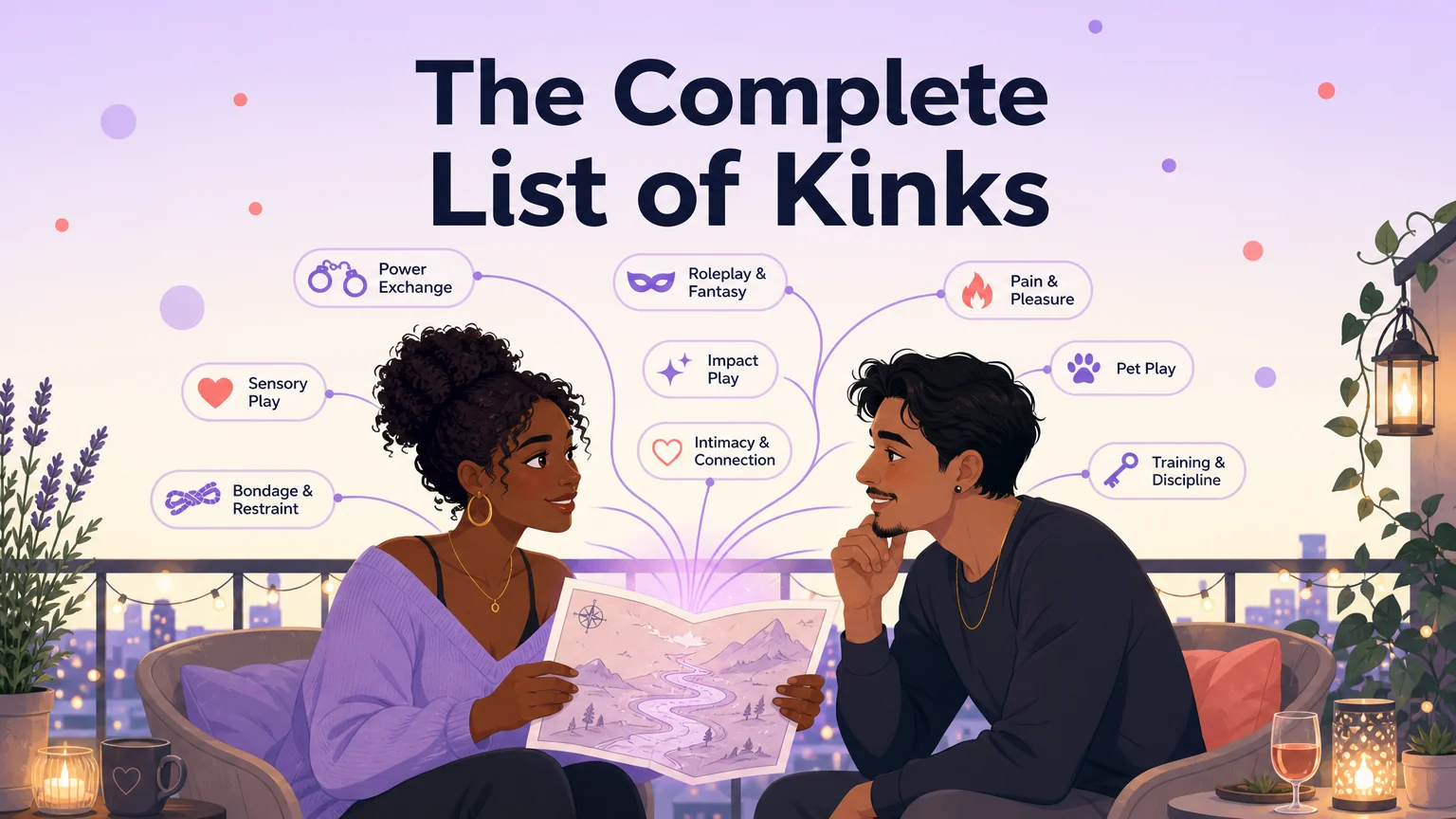
A kink is any non-traditional sexual practice or fantasy that brings arousal through power, sensation, or taboo. And before exploring what this list of kinks, two frameworks to remember: SSC (Safe, Sane, Consensual), the oldest consent model born in the 1980s gay leather community, and RACK (Risk-Aware Consensual Kink), which adds an honest edge: some activities carry real risk, and the point is to understand those risks together before you begin.
What follows is not a ranking. It is a map. Ten categories, 144 kinks, each one explained. Take what fits. Leave what does not.
1. BDSM & Power Exchange
BDSM is an umbrella covering bondage, discipline, dominance, submission, sadism, and masochism. 46.8% of adults have tried some form of it. The through-line is consensual power exchange: one person leads, another follows, and both get something they need from the arrangement.
The Kinks
Dominance & Submission (D/s): One partner leads, the other yields control within agreed limits. The appeal is trust made physical.
Sadism & Masochism (S&M): Sadists enjoy giving sensation, including pain; masochists enjoy receiving it. The brain’s pain and pleasure pathways overlap, and consensual intensity creates a euphoric loop.
Bondage & Discipline (B/D): Bondage restricts movement; discipline enforces rules. Together they create a container where the submissive does not have to decide and the dominant holds the structure.
Switching: Moving between dominant and submissive roles depending on scene, partner, or mood. About 30% of kink community members identify as switches.
Brat Taming: A submissive who pushes back or “misbehaves” on purpose, paired with a dominant who enjoys the chase. The dynamic is playful, not broken.
Master/Slave dynamics: A more formal D/s where the power exchange is total within the agreed container, often including rituals, protocols, and a sense of being owned.
Total Power Exchange (TPE): The dominant holds authority over every area of the submissive’s life within agreed boundaries. About 12% of practitioners maintain 24/7 dynamics.
Collaring: Placing a collar on a submissive, often in a formal ceremony. A collar can mean “we are playing tonight,” “you are mine for this relationship,” or “you are mine permanently.”
Protocols: Agreed-upon rules for how partners interact: forms of address, who enters a room first, who speaks. They create structure that lets both people relax into their roles.
Contracts: Written agreements spelling out limits, expectations, duration, and safewords. Not legally binding, but psychologically binding in a way conversation alone sometimes is not.
Safewords: A pre-agreed word that stops all play. “Red” for full stop, “yellow” for slow down. Non-verbal signals serve the same function when speech is restricted.
Aftercare: The emotional and physical care after a scene: water, blankets, quiet conversation. Across 11,000 couples surveyed, aftercare scored higher than any other BDSM dimension.
Gentle Domination (Gentle Femdom): Dominance expressed through praise and nurturing rather than sternness or pain. The structure of D/s with a warm tone.
Daddy Kink / Mommy Kink: A power-exchange dynamic where one partner takes a nurturing, protective role and the other receives that care and guidance. The “daddy” or “mommy” here is an archetype of affectionate authority between consenting adults, not a family role. Distinct from age play: many practitioners never engage with age regression or little space.
Service Submission: A submissive whose devotion takes the form of acts: fetching drinks, running baths, anticipating needs. The arousal comes from being useful.
Punishment & Discipline: Consequences for broken rules, delivered within the scene. The purpose is reinforcement of the structure both people agreed to, not cruelty.
Predicament Bondage: The submissive is positioned so any movement creates discomfort. The body becomes the trap. Requires precise negotiation and safety awareness.
Sensation Play (in BDSM context): Texture, temperature, pressure, and vibration used for physical intensity that is not primarily painful. Altered states through the body.
Orgasm Control: The dominant decides when or if the submissive orgasms. Edging, denial, or commanding release on cue. The power is in the permission.
Free Use: A consensual arrangement where one partner makes themselves sexually available to the other without needing permission asked each time. A subtype of CNC where the emphasis is availability, not resistance — the partner being used may keep gaming, reading, or texting through it. Blanket consent is negotiated upfront; safewords remain absolute.
Your move: “I want to try something where I lead and you follow for 20 minutes. One safeword. After, we get under a blanket and talk about it.”
Desire does not require an apology, and the structure of BDSM is not a symptom of a broken relationship. It is a celebration of a secure one.
2. Sensory Play

Sensory play heightens or removes specific senses to change how the brain processes pleasure. 49% of kink practitioners engage in some form of sensory play, making it one of the most accessible entry points.
The Kinks
Temperature Play (Ice): Running ice along a partner’s spine or inner thigh while they are blindfolded. The cold is sharp and surprising, and the body does not know whether to recoil or lean in.
Temperature Play (Warm Wax): Low-temperature candles dripped onto skin. The sting of the drip followed by the warmth of the cooling wax creates its own rhythm. Household candles are unsafe for this.
Blindfolds & Sensory Deprivation: Removing sight routes all attention through touch and anticipation. The single most recommended beginner kink: it requires only a sleep mask and presence.
Impact Play (spanking, flogging, paddling): Rhythmic striking from a warm-up tap to a deep thud. Spanking is the top-reported BDSM activity at 38% of practitioners. Start light, build slow, check in often.
Pain Kink (Pain Play): A preference for consensual pain as a source of arousal and pleasure. Impact play is one way to feed it, and the sadist/masochist dynamic is one way to share it, but the desire itself is its own entry on the map: sting, thud, ache, burn, and pressure are all dialects of it.
Electrostimulation (violet wand, TENS): Mild electrical current via specialized devices. Violet wands create static-like surface sensation; TENS units deliver deeper muscle-level pulses. Education before application.
Feather & Fur Play: The lightest possible touch, often after heavier sensation, to reset the nervous system. Contrast is the vocabulary.
Wartenberg Wheels: A medical-grade pinwheel rolled across skin. It can be feather-light or sharp enough to leave trails. The uncertainty of each roll is the draw.
Fire Play (fire cupping, fire wands): Brief application of flame or heated cups to skin using specialized tools. Edge play territory requiring hands-on training.
Textured Fabrics (silk, velvet): Running different fabrics across a blindfolded partner. Silk slides, velvet grips. Sensory language without pain or intensity.
Tickling: Sustained tickling can tap the same psychological register as other forms of surrender. A safeword or non-verbal signal is essential.
Sounding: Inserting a sterile, lubricated metal rod into the urethra. Anatomically advanced. Sterility is non-negotiable; education comes first.
Nipple Clamps & Suction: Clamps apply adjustable pressure that intensifies over time; suction draws blood flow to the surface. The most intense moment is often the removal.
Pinwheels & Light Scratching: Lighter tools or fingernails drawn across skin. The sensation lives between tickle and scratch, keeping the nervous system guessing.
Full Sensory Deprivation Scenes: Blindfold, noise-canceling headphones, and sometimes restraint removing all external input. Requires significant trust and a grounding plan.
Your move: “Lie down and close your eyes. I am going to touch you with a few different things. Tell me which you want more of and which less.”
Great sex is not always about more. Sometimes it is about paying closer attention to less.
3. Psychological Kinks
Some of the most intense kinks never touch the body. They live entirely in the mind. BDSM practitioners report higher sexual satisfaction not because of the kink itself but because they communicate more directly about what they want (Carty & Davidson, 2024).
The Kinks
Praise Kink: Being told you are good, beautiful, doing well. One of the most common kinks across all genders and roles, crossing every category on this list.
Degradation (consensual): Being called names or reduced in status within a scene, with clear boundaries around which language is in play. Aftercare is non-negotiable.
Humiliation Play: Similar to degradation but focused on specific acts: being made to crawl, being laughed at, being exposed. The boundary between the two is personal and must be discussed.
Small Penis Humiliation (SPH): A specific form of humiliation play where one person consensually degrades or mocks another’s penis, its size, usefulness, or adequacy. You do not need a small penis to enjoy it; the arousal is in the roleplay, not the anatomy.
Erotic Hypnosis (Hypnokink): One partner guides the other into trance and plants suggestions for sensation or altered perception. Requires consent, practice, and a plan for coming back out.
Mind Control Roleplay: A fantasy version of brainwashing where the “controlled” partner acts as if they cannot resist. Pure roleplay; the fun is in the pretense.
Corruption Kink: Arousal from “corrupting” someone perceived as innocent or inexperienced, or being the one led across that threshold. The arc runs no, to yes, to demand: a moral guard erodes until the person moves from refusing, to agreeing, to independently asking for more. Always consensual adult roleplay; the thrill is in the staged transformation, not real coercion.
Fear Play: Consensual fear-seeking in a controlled environment. The adrenaline is genuine. The safety underneath is the point.
Mask Kink: Arousal from wearing a mask or seeing a partner in one, spanning horror masks, masquerade, BDSM hoods, and gas masks. The mask erases your everyday identity and the inhibition that comes with it. What steps out from behind it is whoever you decide to be.
Tease & Denial: Bringing a partner to the edge of orgasm repeatedly without release. For the person teased, the world shrinks. For the teaser, the control is the reward.
Edging: Stopping stimulation right before orgasm, then starting again. Done over an extended session, the eventual release is significantly more intense.
Forced Orgasm: Continuing stimulation past the point where the submissive would normally stop. This can tip from pleasure into overwhelm quickly. A safeword remains essential.
Orgasm Denial: A longer-term version of tease and denial, sometimes lasting weeks. The sustained arousal changes how the submissive experiences their own body.
Ruined Orgasm: Stimulation stops at the exact moment orgasm begins, producing a release that is physically present but psychologically hollow. The ultimate expression of orgasm ownership.
Bimbofication: Adopting a hyper-feminine, intellectually submissive persona, often with costume and makeup. The appeal is in exaggerated gender performance and abandoning intellectual expectations.
Brainwashing Fantasy: A scenario where the submissive’s identity is “rewritten” by the dominant. Pure fantasy; the appeal is in the imagined loss of self.
Objectification (consensual): Being treated as an object: furniture, a doll, a statue. For the objectified person, the relief is in not having to be human. For the objectifier, the power is in the removal of personhood.
Your move: “I want to try something where I tell you exactly what I like about you while we are in bed. You just receive it. No performance.”
The mind is the largest erogenous zone. Everything else is just wiring.
4. Role Play & Fantasy
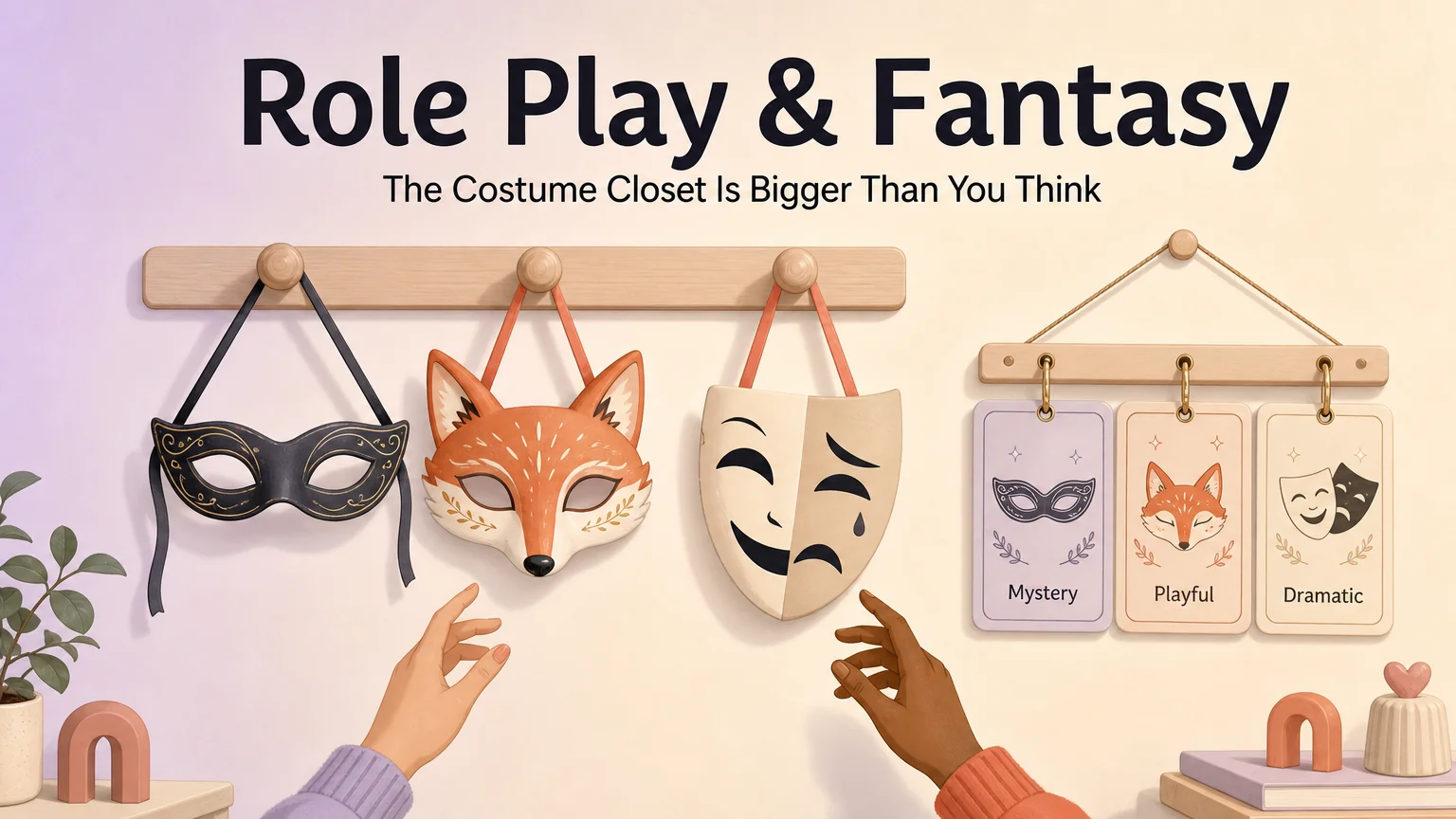
Role play lets people step outside their identity and responsibilities to access a version of themselves that wants something the everyday self cannot ask for. 97% of people have had sexual fantasies, and 45% of kink practitioners engage in role play.
The Kinks
Teacher/Student: One person knows more than the other. It mirrors real-life authority gradients in a safe, reversible container where no actual grading is involved.
Doctor/Patient (Medical Play light): The “doctor” conducts an examination while the “patient” submits. The power comes from the vulnerability of being undressed and touched by someone in clinical authority.
Boss/Employee: Workplace power dynamics translated to the bedroom, where the stakes are zero and the thrill is in the taboo.
Stranger-at-a-Bar: Two people pretend to meet for the first time and pick each other up. The charge is seduction without history. Couples use this to see each other fresh.
Age Play (Caregiver/little, DD/lg, DD/lb, Mommy/little): One partner takes a nurturing role while the other adopts a younger headspace. This is about the dynamic of being cared for without adult responsibility, not about actual children.
Pet Play (puppy, kitten, pony): The submissive adopts animal mannerisms while the dominant acts as owner. The appeal is being freed from human social expectations.
Cosplay & Uniform Play: Dressing as a character or in a uniform that carries authority. The costume is a permission slip: the character asks for what you want.
CNC (Consensual Non-Consent): A scene that plays out as if consent is absent when in reality it was negotiated in detail beforehand. Edge play requiring safewords, trust, and mandatory aftercare.
Abduction Fantasy: A subset of CNC involving being “taken” or “captured.” The appeal is the removal of agency within a container where agency was fully exercised during negotiation.
Somnophilia (Sleep Kink): Arousal from a sleeping or unconscious partner, or from being that partner while the other initiates. A CNC subset where one person is asleep (or pretending to be) and the other takes the active role. For the active partner, the draw is being trusted with total vulnerability. For the passive partner, it is being desired without having to perform. Consent is negotiated while both are wide awake.
Interrogation Scenario: The dominant interrogates the submissive, who withholds until they “break.” The tension comes from the contest of wills.
Cheating Fantasy (roleplay only): A couple pretends one is stepping outside the relationship. The charge comes from the taboo experienced safely within the actual relationship.
Celebrity/Fan: One person plays the famous figure, the other the admirer. The power differential is built in. No autographs are signed.
Delivery Person: Someone arrives with a package and the transaction becomes something else. The tension between service and seduction writes itself.
Photographer/Model: The “photographer” directs the “model” into revealing poses. Direction plus exhibitionism in one setup.
Home Invasion Scenario: A more intense CNC subset involving someone “breaking in.” Requires the highest level of trust and preparation. Negotiation should cover what both people need afterward.
Your move: “What if we met at a bar this Friday, used different names, and you tried to take me home?”
You are not leaving your partner. You are borrowing someone else’s name to remember why you chose theirs.
5. Bondage & Restraint
Bondage restricts movement so the brain can let go of control. When someone cannot move, they also cannot perform, manage, or decide. 67% of kink practitioners engage in bondage, and Shibari-specific workshops have grown 40% year over year.
The Kinks
Verbal “Don’t Move” Command: No rope, no cuffs, just a voice and the instruction to stay still. Bondage at its most elemental. The submissive could move; they choose not to.
Silk Scarves & Neckties: Household items as wrist or ankle ties. Soft and accessible. They can slip and tighten, so never leave someone alone in improvised restraints; keep safety shears within reach.
Soft Cuffs (under-bed systems): Velcro or fleece-lined cuffs attached to a strap system under the mattress. Comfortable, adjustable, self-releasing. The practical first purchase for restraint without rope.
Leather & Metal Cuffs: A step up in weight and symbolism. Leather smells like intention; metal locks with a click that lands in the chest.
Collar & Leash: A collar signals belonging; a leash adds directional control. Collars range from day-collar jewelry to thick leather with locking buckles.
Rope Bondage (Western functional): Practical ties focused on restraint and position. Western rope prioritizes function, quick-release knots, and safety over aesthetics.
Shibari/Kinbaku (Japanese artistic rope): Rope as art and communication. The tying itself is the scene, sometimes taking an hour or more. The person in the ropes often enters an altered headspace from the sustained attention alone.
Spreader Bars: A rigid bar with attachment points for wrists or ankles, forcing limbs apart. Simple geometry, significant vulnerability.
Mummification (wrap bondage): Wrapping the body in plastic wrap or fabric from shoulders to ankles. Full immobilization creates profound sensory pressure. Breathing must remain unrestricted; communication requires pre-arranged signals.
Suspension Bondage: The person is lifted partially or fully off the ground by ropes. Advanced work requiring knowledge of anatomy, weight distribution, and emergency procedures.
Predicament Bondage: The submissive is positioned so any movement creates discomfort. Requires attentive monitoring; discomfort can shift from interesting to dangerous without the bound person noticing.
Chastity Devices: A locking device preventing sexual activity without the keyholder’s permission. Worn for hours, days, or weeks. A constant physical reminder of who holds the key.
Hoods: Removing sight and sometimes sound through a leather or fabric hood. More immersive than a blindfold. The anonymity of being faceless is a release in itself.
Straitjackets: Total upper-body immobilization. Harder to escape than they look in movies. Someone must remain present and attentive at all times.
Your move: “I want to try tying your wrists with this scarf. One knot. You can pull out anytime. If you like it, we add five minutes. If not, we stop and get ice cream.”
The hottest restraint in the room is not the rope. It is the trust that lets someone tie it.
6. Body Worship
Body worship is exactly what it sounds like: one person’s body part becomes the entire focus of a partner’s attention. Foot fetishes alone account for 33% of all fetish-related interests, and for a neurological reason: feet and genitals occupy adjacent regions in the brain’s somatosensory cortex.
The Kinks
Foot Fetish (massaging, kissing, trampling): The most common body-part fetish. Wires cross in the brain: a foot massage becomes something else. Trampling adds a domination element.
Hand Fetish: Watching a partner’s hands handle objects, gesture, or grip a steering wheel. Veins, knuckles, nail shape: the attraction is in the detail.
Hair Pulling & Hair Worship: A firm grip at the base of the scalp, a brush run slowly through long hair, washing someone else’s hair as service. The scalp is wired to the nervous system in ways most people do not think about until someone pulls.
Muscle Worship: Touching, massaging, or simply staring at a partner’s muscles with sustained attention. Validation of physical effort made intimate.
Size Kink: Arousal from a pronounced physical size difference between partners — height, build, hand size, or overall body mass. The erotic charge routes through power, vulnerability, and contrast rather than any single measurement.
Tattoo & Piercing Appreciation: Tracing lines of ink with fingers or tongue. The art becomes an erogenous map. Piercings add their own sensory feedback.
Scent/Smell Fetish (olfactophilia): Arousal triggered by a partner’s natural scent: worn clothing, unwashed skin after a workout. One of the most primal attractions, and one of the least discussed.
Body Writing: Words written on skin with marker or lipstick: “mine,” “good girl,” a partner’s name. The marks wash off. The feeling of being inscribed lasts longer.
Naval/Belly Button Play: A specific fixation on the navel as an erogenous zone. Sensitivity varies widely; for those who respond, the response is strong.
Feederism (Feedism): A kink centered on the eroticism of feeding, eating, and weight gain. It spans a broad spectrum from fantasy-only dirty talk and padding to intentional gaining with a partner. The roles are feeder (derives pleasure from feeding and fattening), feedee (enjoys being fed and gaining), encourager (motivates from a distance), and mutual gainer (both partners gain together). The dynamic can range from nurturing and devotional — belly rubs, home-cooked meals, food as a love language — to BDSM-informed power exchange. Consent and harm reduction are foundational. Most practitioners keep extreme immobility as fantasy, not a goal.
Armpit Fetish: Attraction to the look, smell, or taste of a partner’s armpits. Natural scent is often the primary draw.
Glasses Fetish: Attraction to people wearing glasses, or to the act of putting them on or removing them. The transformation is the thing: casual to focused, soft to sharp.
Voice Fetish (auralism): Arousal triggered by a partner’s voice: the register, cadence, a specific word. A partner who can weaponize a whisper has a skillset.
Pregnancy Fetish: Attraction to the physical changes of pregnancy. For some, it is about fertility; for others, it is aesthetic: the curve, the fullness, the body transforming.
Your move: “I want to spend 15 minutes just on your hands. No sex. No goal. Just me and whatever you tell me feels good.”
Attention is an act of love. Sometimes the most radical thing you can do is slow down enough to notice your partner in detail.
7. Group Dynamics
95% of men and 87% of women have fantasized about multiple-partner scenarios. Only 23% act on those fantasies, while 79% want to. The barrier is usually not desire. It is communication.
The Kinks
Threesomes (MFM, FMF): Three people, endless configurations. The most common group-sex scenario and often the entry point for couples. Negotiate roles before clothes come off.
Swinging (soft swap): Couples swap for everything except penetrative sex. The most common entry point because it allows exploration with a lower perceived risk threshold.
Swinging (full swap): Couples exchange partners for penetrative sex. Requires clear agreements about barriers and the understanding that feelings may surface neither person predicted.
Voyeurism (watching with consent): Arousal from watching others with their knowledge. 60% of people have voyeuristic fantasies. The appeal is presence without performance pressure.
Exhibitionism (being watched with consent): Arousal from being seen during sex. 42% of people have exhibitionistic fantasies. The watcher’s gaze becomes part of the act.
Cuckolding: A man watches his female partner with another man, often with humiliation elements. The arousal comes from a mix of jealousy, compersion, submission, and taboo.
Cuckqueaning: The same dynamic reversed: a woman watches her male partner with another woman. The emotional territory is similar, with differently gendered dynamics.
Stag/Vixen Dynamic: A couple where the male partner enjoys sharing his partner without the humiliation element. His response is closer to “look what I have” than “look what I cannot satisfy.”
Hotwifing: A married woman has sex with other men with her husband’s encouragement. The husband’s arousal is tied to his wife’s pleasure and desirability.
Gangbangs: One person with three or more partners simultaneously. Having a trusted person present who is monitoring the central person’s wellbeing is standard practice.
Sex Parties & Orgies: Organized gatherings with formal rules, dungeon monitors, and designated aftercare areas. Read the rules before showing up. Every legitimate party posts them.
Same-Room Sex (no swapping): Two or more couples have sex with their own partners in the same room. The charge comes from proximity without the complexity of partner exchange.
Group Masturbation: A circle of people masturbating together, each focused on themselves but aware of the group. The vulnerability of being seen in self-pleasure is the intensity.
Cam Shows (performing for audience): Performing sexual acts on camera for an online audience. The exhibitionist charge is amplified by viewer anonymity and performer control.
The “Guest Star” Dynamic (couple inviting a third): A couple invites a single person into their bed where the couple remains the primary unit and the third is an honored guest. The distinction from unicorn hunting is respect for the third’s autonomy.
Your move: “Before we ever involve another human, let us just talk about the fantasy. No plans. No pressure. I want to know what you picture.”
Three bodies do not triple the complexity. They square it. The couples who navigate this well talk more, not less.
If this is your territory, 3Fun is built for exactly that: couples and singles exploring ethically, together. But the map starts with the conversation you and your partner have next.
8. Object & Material Fetishes
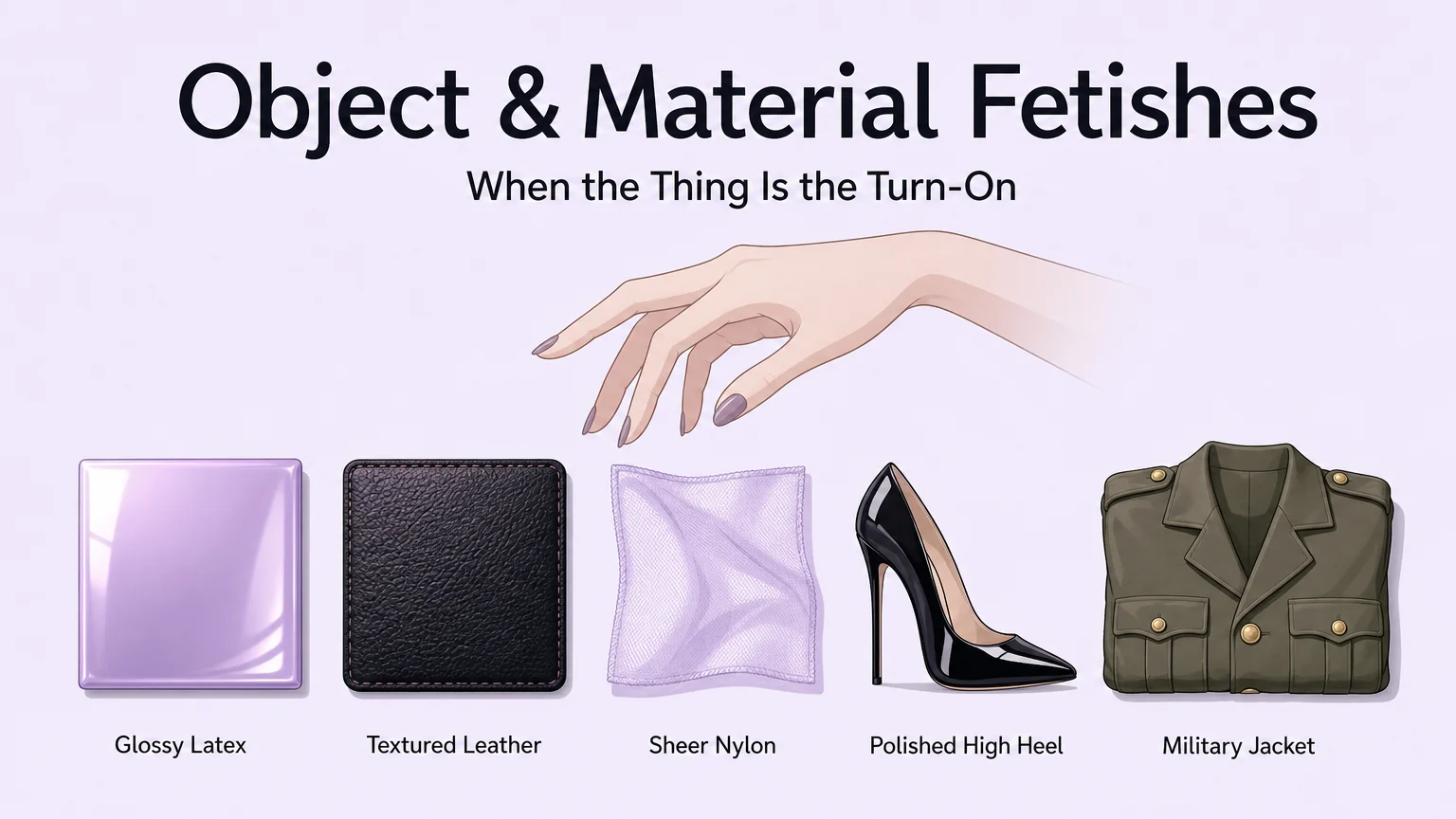
Material fetishes are about texture, transformation, and the way clothing changes the story of an encounter. Objects like shoes and boots account for 30% of fetish-related preferences. The through-line: the material becomes a second skin that signals a different version of the person wearing it.
The Kinks
Latex & Rubber: Shiny, tight, unforgiving. Latex clings to every contour and reflects light in a way that makes the body look manufactured. The process of dressing is itself a ritual.
Leather: The smell, the sound, the weight. Decades of subcultural history and unmistakable visual authority.
Nylon & Stockings: The sheen, the seam up the back of a calf, the sound of stockinged legs crossing. Often tied to vintage aesthetics and the idea of being wrapped in something delicate.
High Heels: The arch of the foot, the extension of the leg line, the sound on a hard floor. Heel worship often involves kissing, licking, or being stepped on.
Uniforms (military, medical, flight attendant): The uniform carries institutional authority. The fetish is about accessing or submitting to that authority. Removing the uniform is as charged as wearing it.
Gloves (leather, latex, evening): Gloves transform hands into instruments. A gloved hand feels different on skin and depersonalizes touch, which can be clinical or deeply sensual.
Corsets & Shapewear: A corset reshapes the torso, restricts breathing, and enforces posture. Tightlacing is its own subculture with progressive training.
Lingerie Fetish: A specific arousal response to lace, straps, garters, and the framing of the body. The garment is not a wrapper. It is the main event.
Boot Worship: Licking, kissing, or being stepped on by boots. A dominance signal. Bootblacking, the act of polishing a partner’s boots as service, is a recognized sub-practice.
Sneakers & Athletic Wear: A contemporary fetish tied to casual dominance, youth culture, or athleticism. The smell of worn sneakers, the look of someone in gym clothes.
Diapers (ABDL): Adult Baby/Diaper Lover is a community and identity, not a punchline. For some, it is about regression and comfort; for others, humiliation or sensory preference. The community emphasizes consent and hygiene.
Your move: “I bought these leather gloves and I want to touch you while wearing them. If you hate it, they go in the drawer.”
What you wear changes who you become in bed. Sometimes a pair of gloves does more work than a script.
9. Edge Play & Advanced
Edge play covers activities where risk cannot be eliminated, only managed. These are not beginner kinks. They require education, mentorship, specific equipment, and the understanding that things can go wrong even when everything is done correctly.
The Kinks
Breath Play (choking, bagging): Restricting oxygen to create altered states. High-risk: brain damage can occur in under two minutes. Learn anatomy and warning signs. Many experienced practitioners consider this the single highest-risk activity in BDSM.
Knife Play: Running the edge of a knife across skin without cutting. The threat of the blade is the sensation. Uses dulled or purpose-specific blades.
Blood Play: Intentional drawing of blood requiring sterile equipment, bloodborne pathogen knowledge, and wound care protocols.
Needle Play (temporary piercing): Sterile needles inserted through the top layer of skin and removed after the scene. Surgical precision required. Cross-contamination can cause serious infection.
Medical Play (examinations, speculums): Medical instruments and scenarios in a kink context, from light roleplay to actual speculum use. The more invasive the procedure, the more training matters.
Fire Play (fire wands, cupping): Application of flame or heated implements using alcohol-based fuel. Requires a fire safety spotter, a wet towel, and fuel-type knowledge.
Water Sports (also called: urolagnia, urophilia, urine play, piss play, and golden shower): Sexual activity involving urine. More stigmatized than dangerous. For practitioners, the intimacy of sharing something private is the power.
Primal Play (chasing, wrestling, biting): Engaging as animal selves: growling, wrestling, chasing. Strips away human social layers for instinctual connection. Negotiate whether bites break skin.
Gun Play: A firearm in a scene, typically unloaded but carrying immense psychological weight. Catastrophic risk if safety fails. Many kink spaces ban this entirely.
Electrocution Scenes: Electrical devices creating sensations from tingly to painful. Electricity follows paths through the body; the person applying it must understand them. Never above the waist with certain devices.
Branding & Scarification: Permanent body modification as a kink act. Not reversible. Carries infection risk and leaves marks for life. Not a scene decision.
Enema Play: Using enemas for sexual or sensation purposes. Requires medical-grade equipment, body-temperature water, and solution safety knowledge. The colon absorbs fluid rapidly.
Fisting: Inserting the entire hand into the vagina or anus. Requires patience, generous lubrication, and the receiving partner setting the pace absolutely. Not about force; about slow, sustained opening.
Your move: “Before we go near this, let us agree: we will never learn breath play from a blog post and try it tonight. If we want this, we learn it properly or not at all.”
No one owes you their edge. Edge play without education is not edge play. It is injury waiting for a name.
10. Emotional & Relational Kinks

Some kinks do not involve a single physical act. They live in the daily texture of a relationship: how you speak to each other, the rituals you keep, the roles you inhabit across weeks and years.
The Kinks
Praise as Daily Practice: Praise kink taken off the mattress and into the morning. A partner who tells you over coffee that you are appreciated. The steady warmth of being valued out loud, on purpose.
Service Submission: One partner expresses devotion through acts: preparing meals, managing schedules, anticipating needs. The satisfaction is in being useful to someone who values the use.
Romance & Courtly Love as Kink: Grand romantic gestures treated with the intensity others reserve for impact play. Handwritten letters, candlelit dinners planned days in advance. Romance is not the prelude. It is the kink.
Jealousy Play (consensual): Intentionally leaning into jealousy within a negotiated container. The point is to touch the edge of a powerful emotion, feel it, and come back. The conversation afterward is where the intimacy lives.
Possession & Belonging (“mine,” “yours”): One partner belongs to the other. Not as a threat; as a promise. The words are small. The feeling underneath is a combination of safety and surrender.
Collaring Rituals & Ceremonies: A collar as a commitment ceremony with witnesses, vows, and chosen permanence. Some are as carefully planned as weddings. The couple writes their own meaning into the gesture.
Morning/Night Protocols: Daily rituals that reinforce the dynamic: a specific greeting each morning, a bedtime routine, coffee delivered with the same words every day. Protocols are the scaffolding that holds a power exchange upright.
Rules & Tasks (daily assigned): The dominant assigns tasks; the submissive completes them and reports back. Tasks range from practical (drink water, journal) to symbolic (write a line of devotion, send a photo at noon).
Caregiving (caretaker/little dynamic): One partner provides nurturing and guidance while the other receives from a softer headspace. The caretaker’s authority is tenderness; the little’s submission is trust.
Devotion & Worship: Devotion to one partner as the organizing principle of a relationship. Closer to reverence than BDSM submission. The worshipping partner finds meaning in the act of adoration itself.
Your move: “What if I brought you coffee in bed every morning for a week, the same way, the same words, and we see what that builds?”
The most durable kinks are not the ones that end when the scene does. They are the ones woven into Tuesday morning.
FAQ
Am I normal for being into something on this list?
Yes. 97% of people have sexual fantasies, many in kink territory. 46.8% of adults have tried BDSM at least once. What you want is statistically ordinary. Shame often comes from believing you are alone in it, and the data simply does not support that belief.
How do I bring this up with my partner?
Choose a private, relaxed moment that is not during sex. Use “I” statements: “I have been curious about something and I want to share it with you.” Frame it as an invitation, not a demand. Start with education together: read an article, use a yes-no-maybe list as a neutral starting point. Springing a kink on someone mid-sex skips the conversation. And the conversation is the whole point.
What is a Yes-No-Maybe list?
A checklist of sexual activities where each item is marked “yes” (I want this), “no” (hard limit), or “maybe” (open to discussing). Both partners fill it out separately, then compare. It turns abstract conversation into a concrete document and reveals overlap you might never find through talk alone. Free templates exist online.
What do I do after trying something new?
Aftercare. Physical comfort (water, snacks, blankets, gentle touch), emotional check-ins (what felt good, what was difficult), and time. Intense scenes cause hormone surges that plummet afterward, creating what the community calls “the drop.” Aftercare is part of the scene, not a separate event.
How do kink and non-monogamy overlap?
They overlap significantly but are not the same thing. Many kink practitioners are monogamous; many non-monogamous people are not into kink. What they share is explicit communication, negotiated boundaries, and the understanding that one person does not have to meet every need. The communication skills developed in one transfer cleanly to the other.
Where do I find community and resources?
FetLife is the largest online kink community, with over 10 million registered users. Munches (casual non-play social meetups in restaurants) are the standard entry point for in-person community. For education, look for workshops at local dungeons or kink conventions. The NCSF Kink Aware Professionals directory lists therapists and medical providers who understand kink. The BDSM test at bdsmtest.org is a useful self-discovery starting point. Start with community, not with gear. The people will teach you what to buy. If your curiosity runs toward threesomes, swinging, or ethical non-monogamy specifically, 3Fun is purpose-built for that: couples and singles exploring together with privacy and zero judgment.