Roughly 1 in 7 people have had a sexual fantasy involving feet. That is not a fringe statistic. It is your neighbor, your coworker, someone at every dinner party you have ever attended.
What is a foot fetish? Clinically called podophilia, it is a pronounced sexual interest in feet where a person experiences arousal from looking at, touching, smelling, or incorporating feet into sexual activities. The definition is simple. The social baggage around it is not.
Here is the distinction that matters: having a fetish is not the same as having a disorder. Most people with foot fetishes function normally, happily, and without any distress. Fetishistic disorder requires both the attraction and clinically significant impairment in daily life, a threshold most people with foot fetishes never approach.
This guide covers what a foot fetish is, why it happens, how common it is, the history, the economics, navigating it in relationships, exploring it safely, and where things are headed.
If you came here nervously, this is the exhale.
What a Foot Fetish Actually Is (and What It Is Not)
The gap between the punchline and the reality could fill a canyon. Pop culture treats foot fetishes as a joke. Science treats them as a variation of human sexuality with clearly defined parameters.
Podophilia is a pronounced, persistent sexual interest in feet. The DSM-5-TR, the diagnostic manual mental health professionals use, draws a clear line between “this is something I enjoy” and “this is a clinical concern.”
Here is what it says for fetishistic disorder. Criterion A: at least six months of recurrent, intense sexual arousal from nonliving objects or a highly specific focus on nongenital body parts. Feet are explicitly listed as an example. Criterion B: clinically significant distress or impairment in social, occupational, or other important areas of functioning. Criterion C: the attraction is not about cross-dressing clothing or devices designed for genital stimulation.
Here is what matters: both Criteria A and B must be met. Having the attraction alone is not a disorder. Someone whose partner happily incorporates foot play into foreplay does not qualify for a diagnosis. Someone who finds feet arousing and never experiences distress about it does not qualify either.
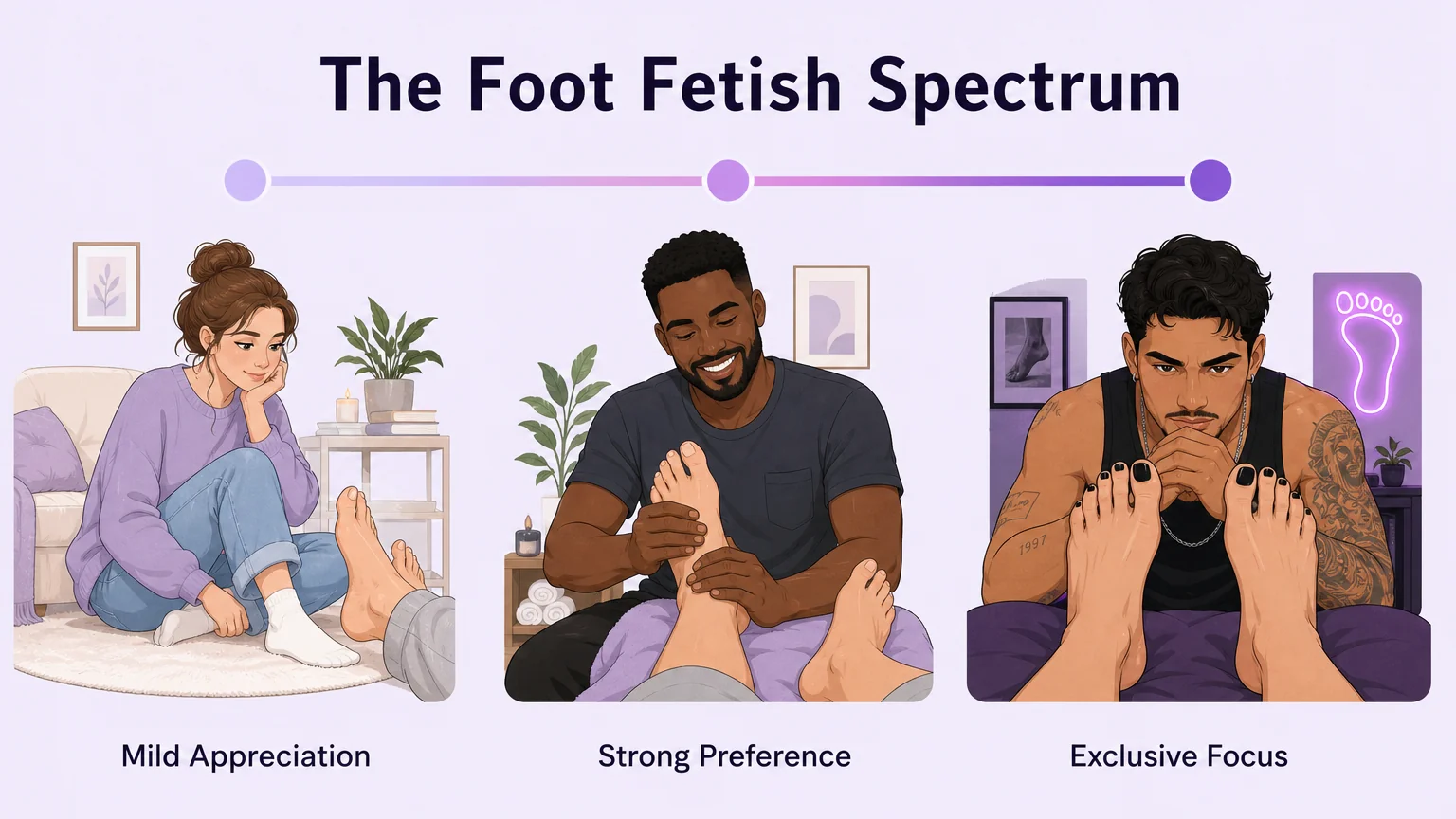
This is where the spectrum becomes the more useful frame than the diagnosis. Foot fetishes range from mild appreciation (someone who finds feet aesthetically pleasing and a nice addition to sex) to exclusive requirement (someone who cannot reach arousal without foot involvement). Most people sit somewhere in the middle.
“Am I normal?” The DSM itself answers: yes. Having a sexual interest in feet is a variation of human sexuality, not a pathology. Dr. Carol Queen frames it precisely: a fetish can be “an extra special hot sort of sexual superpower in terms of responsiveness.”
Why Feet? The Science and Theories Behind the Attraction
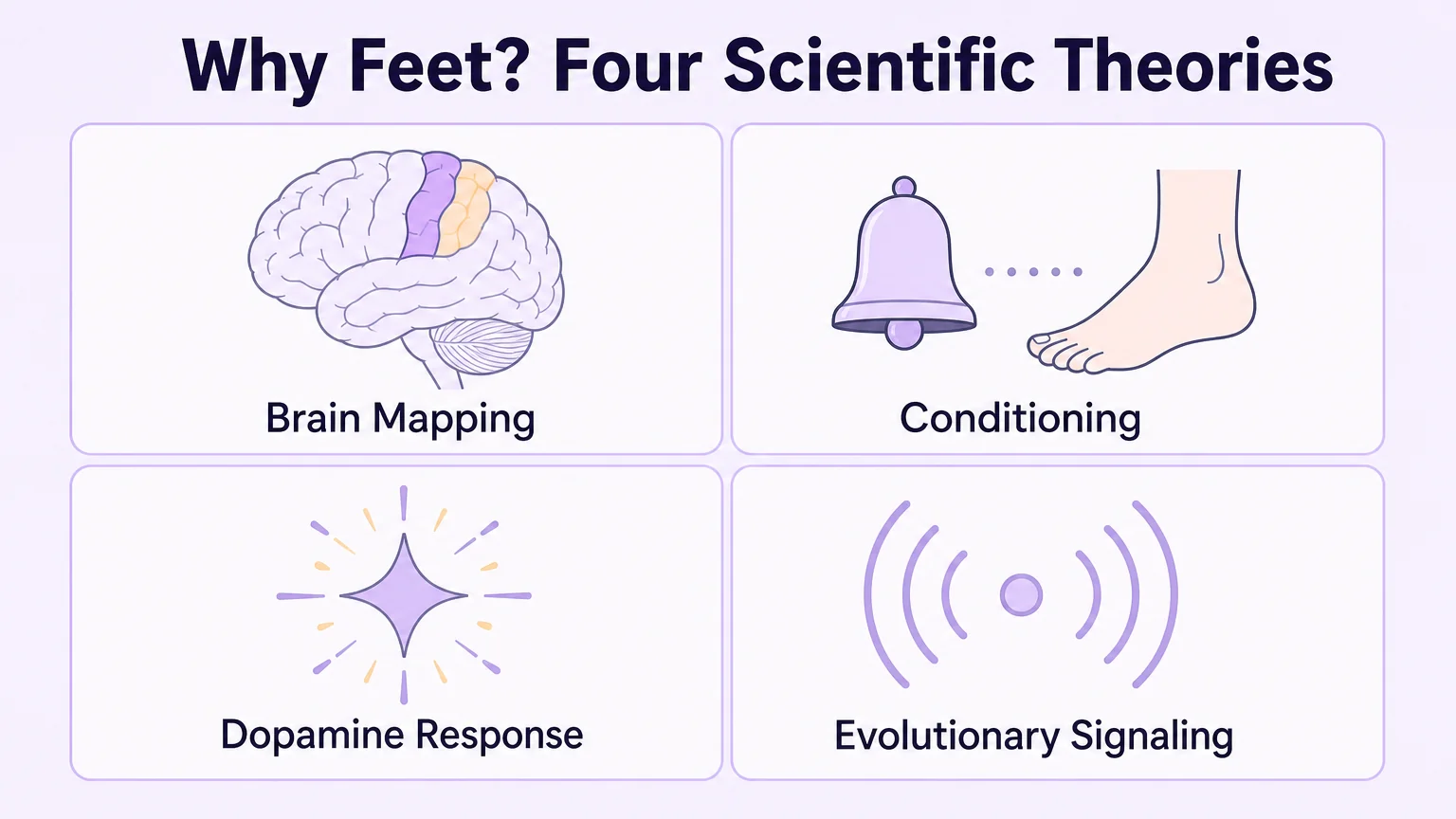
Why feet? Science has several theories, none definitive. The truth is probably a mix. Anyone who tells you it is solved is oversimplifying.
The most famous explanation comes from neuroscientist V.S. Ramachandran. In the brain’s sensory cortex, there is a body map called the Penfield homunculus. The region that processes foot sensation sits right next to the region that processes genital sensation. The idea: signals sometimes cross over between adjacent regions, and feet acquire erotic charge through neural proximity. It is elegant, intuitive, and widely repeated.
It also lacks empirical support. A 2014 study by Turnbull and colleagues, published in the journal Cortex, directly tested this theory with roughly 800 participants. Feet scored surprisingly low on erogenous ratings, about 1.3 out of 10. There was no correlation between how close two body parts sit in the sensory cortex and how erogenous people rate them. Decades of direct electrical stimulation of that brain region never produced erotic sensations. The researchers suggested the insula, a deeper brain region involved in emotional processing, might be a more likely candidate.
Then there is conditioning. Classical conditioning, where feet become paired with sexual arousal through positive experiences, has experimental backing. In 1966, researcher Stanley Rachman showed that neutral stimuli, including boots, could be conditioned to produce arousal when paired with nude photos. The brain builds associations. If feet were part of an early arousing experience, that pathway strengthens.
The dopamine-taboo effect adds another layer. When something feels slightly forbidden, the brain releases dopamine tied to anticipation and reward. That tiny thrill amplifies attention. Feet carry layers of interpretation: vulnerability, closeness, care, and playful transgression.
There is also an evolutionary perspective. Feet carry concentrated pheromone signals. Some researchers suggest shape recognition, feet share a phallic silhouette, may play a role, though this remains speculative.
None of these theories are definitively proven, and for most people, the “why” matters less than the “what now.”
How Common Are Foot Fetishes, and Why Men Report Them More
If you gathered ten people in a room, statistics suggest at least one has had a sexual fantasy involving feet. That number holds across studies.
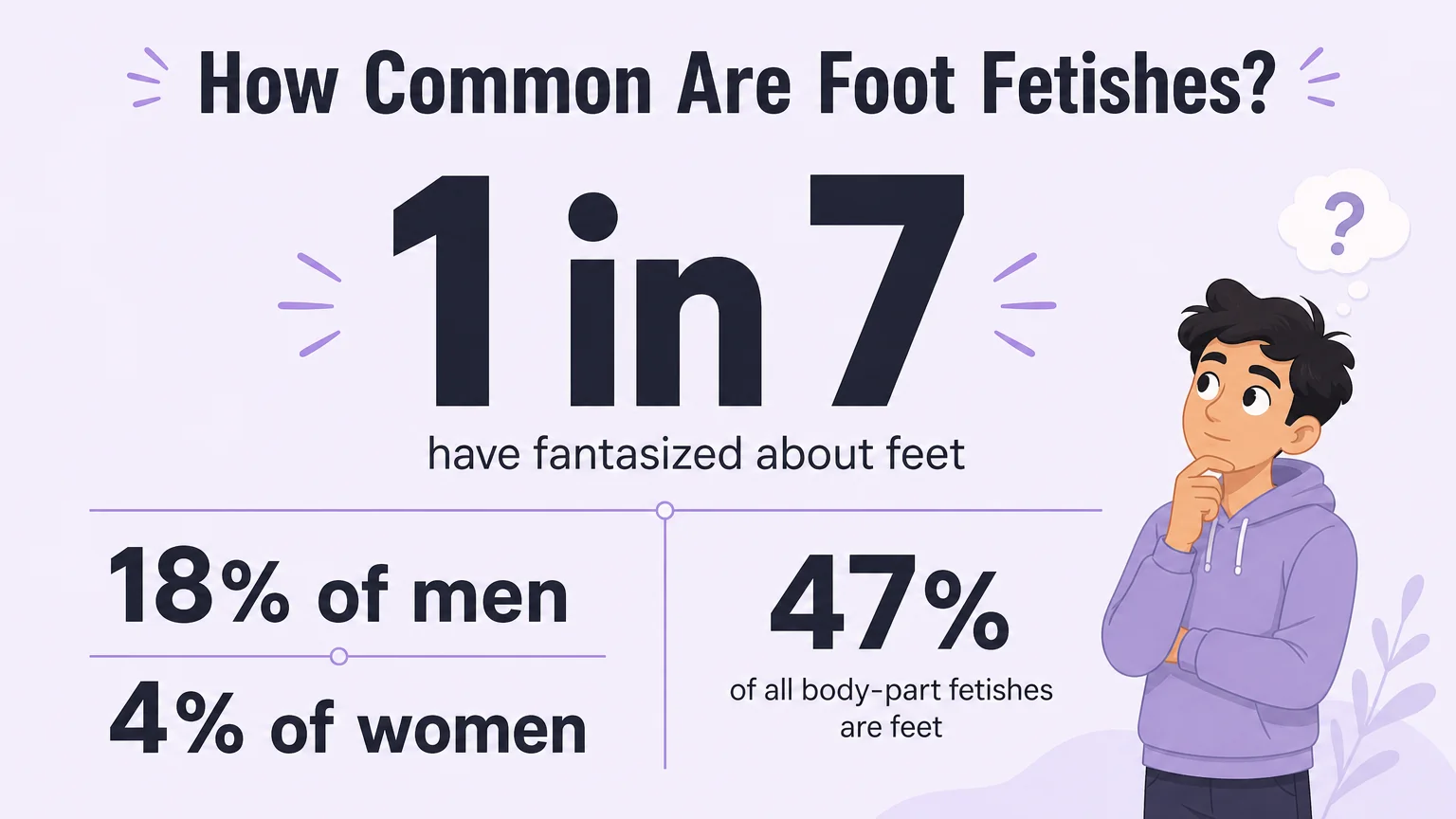
About 14 percent of people, roughly 1 in 7, have had at least one sexual fantasy involving feet. When you look at recurring interest, the numbers sharpen: roughly 17 to 18 percent of men and 4 to 5 percent of women report foot fetish interests. Gay and bisexual men report the highest rates at approximately 21 percent.
A 2007 study by Scorolli and colleagues found that feet and toes accounted for nearly half, 47 percent, of all body-part fetishes. Feet are the single most fetishized non-genital body part by a wide margin. A 2017 Belgian population survey confirmed the pattern: 17 percent of men versus 4 percent of women agreed or strongly agreed with having a fetish interest in feet.
The gender gap raises an obvious question: why? The leading scientific explanation comes from Dawson and colleagues in 2016. When researchers controlled for sex drive statistically, the gender difference in paraphilic interests disappeared entirely. Higher average sex drive in men fully accounted for their greater reported paraphilic interests (learn more about why men like feet).
Additional factors stack on top. Men are three to four times more susceptible to stressful prenatal environments, which increases susceptibility to paraphilias. Cultural norms also play a role: men face less social penalty for acknowledging unconventional sexual interests, so women likely underreport. Some research by Castellini and colleagues in 2018 found higher rates of fetishism in women for certain categories, supporting the underreporting hypothesis.
Stigmatized interests produce unreliable data. But the takeaway is straightforward: if you have a foot fetish, you are far from alone. Millions of people share this attraction.
Foot Attraction Is Older Than You Think: A Brief History
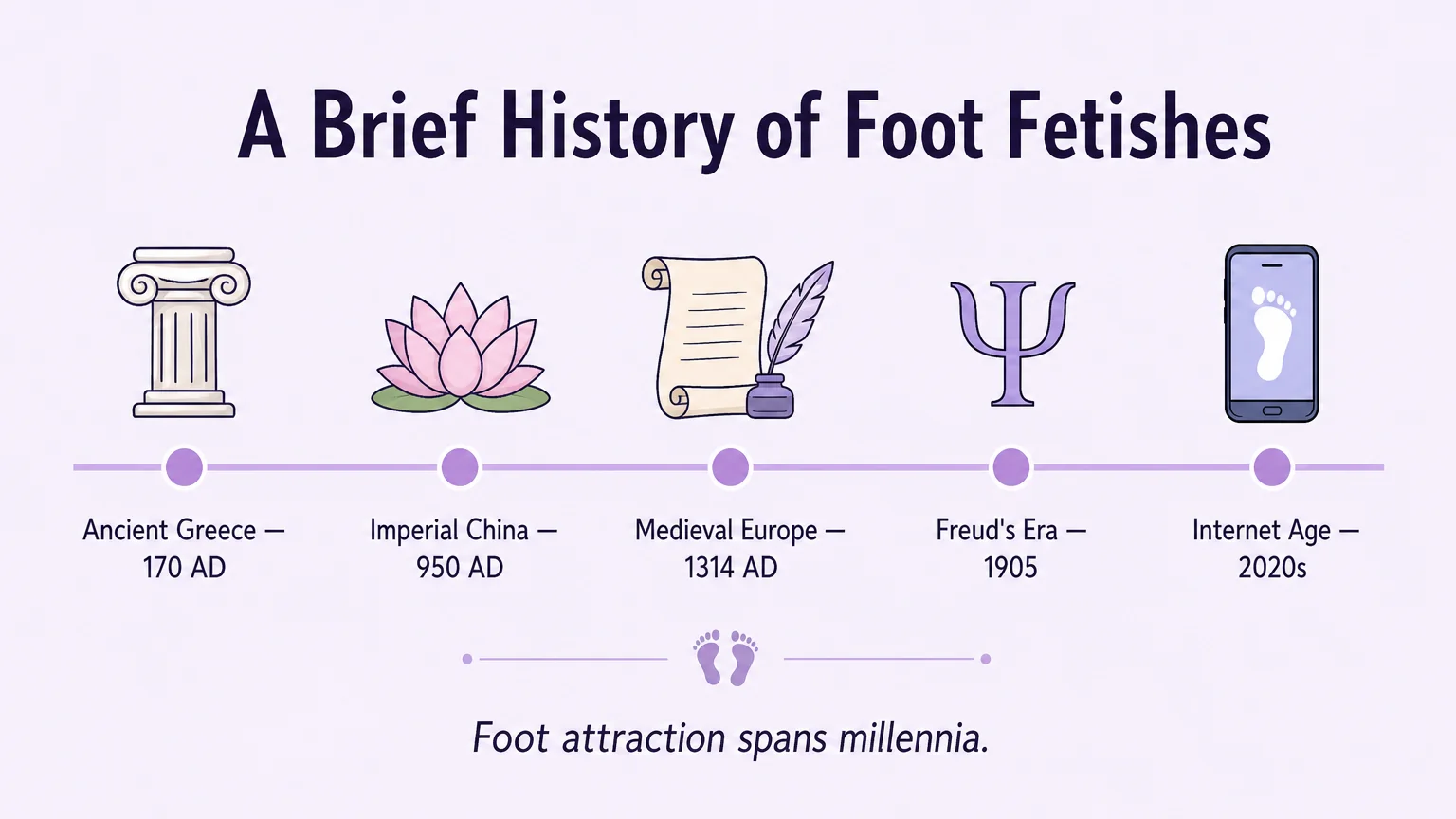
Foot fetishism did not begin with the internet. It did not begin with Quentin Tarantino. It did not even begin with Freud.
The first written example comes from ancient Greece, where poet Philostratus wrote verses titled “To a Barefoot Woman” and “To a Barefoot Boy” around 170 to 250 AD. Egyptian hieroglyphics and the Kama Sutra also contain references to foot-related eroticism. The word “fetish” comes from the Portuguese feitico, meaning “charm” or “sorcery,” later applied to sexuality by Binet (1887) and Freud (1905).
The most powerful historical example is Chinese footbinding. Beginning around AD 950 during the Southern Tang dynasty, the “golden lotus,” a bound foot of roughly three inches, became intensely eroticized. Thousands of poems, beauty contests, and works of erotic literature were devoted to bound feet. In imperial China, a foot fetishist would never have been considered abnormal, because his entire social environment took his erotic interest for granted and catered to it.
The first European description came from Franciscan missionary Odorico da Pordenone, traveling Asia from 1314 to 1318. Medieval writer Pierre Bersuire (d. 1362) interpreted feet as metaphors for sexual organs and viewed footbinding as a model for European women.
The point is clear: what counts as a “fetish” versus “normal” sexuality is culturally defined. In one society, foot attraction is a stigmatized paraphilia. In another, it is institutionalized, celebrated, and entirely conventional.
Freud’s now-discredited theory (castration anxiety, feet as penis substitute) is a cautionary example of cultural bias masquerading as clinical authority.
If foot attraction has always been with us, the internet era has transformed it in ways no ancient poet could have predicted.
The Billion-Dollar Foot: How the Internet Turned a Fetish Into an Economy

The global feet imagery market was valued at $2.1 billion in 2024 and is projected to reach $2.78 billion by 2026. That is roughly 32 percent growth in two years.
FeetFinder, the largest dedicated marketplace, reports over $100 million in total buyer spend, 8 million verified users, 12.5 million feet pictures sold, and more than 1 million creators as of 2026. It operates on a 20 percent commission plus a monthly subscription fee. OnlyFans, with 4.19 million creators and over 305 million fan accounts, has a significant foot-content niche and takes 20 percent with no monthly fee.
The internet sells a fantasy about this economy. The income distribution tells a different story. The top 1 percent of foot content creators earn $5,000 to $12,000 per month. The top 10 percent earn $1,000 to $3,000 monthly.
Fifty percent of all creators earn less than $100 per month. Over 60 percent of feet-only OnlyFans creators earn under $150 monthly in their first three months. Nearly two-thirds struggle to reach 10 paid subscribers in month one. This is not passive income. It is a real, competitive business.
Cultural context that signals normalization: singer Lily Allen revealed in 2024 that she makes more money each month selling pictures of her feet on OnlyFans than from her Spotify streams. Google searches for “feet pics” have grown over 5X since 2018. The term “foot fetish” is searched roughly 1.7 million times annually in the United States alone. FeetFinder reports annual transaction growth exceeding 40 percent.
This economy exists because the demand is real, widespread, and increasingly unashamed. That visibility changes how people experience foot fetishes in their actual relationships.
When Your Partner Has a Foot Fetish: A Guide for Both Sides

Telling someone you are attracted to their feet can feel like handing them a weapon and hoping they do not use it. Being on the receiving end is disorienting too. Both sides need guidance.
If You Have a Foot Fetish and Want to Share It
Do not bring it up during sex. Do not disclose on date one. Choose a relaxed, private setting: over dinner, on a walk, during a drive.
Be specific. Coach Shelby Devlin recommends saying: “This is why I like this. These are the fantasies I have and these are the things I actually want to do.” Let your partner pick from a menu. Come prepared for questions and offer to go at their pace.
If your partner reacts negatively, psychotherapist Pamela Stephenson Connolly advises talking frankly and kindly, helping them understand your needs while making them feel wholly loved.
If Your Partner Just Told You They Have a Foot Fetish
Recognize that disclosure was an act of trust. Listen and ask questions. You do not need to respond immediately. It is always okay to say you need time.
Start slow. A foot massage is low-stakes and pleasant regardless of how you feel about feet. Set boundaries. Rog Butler offers the “football test”: if someone pours time, money, and energy into football, we call it passion. Applied to sex, we call it a problem. Ask yourself: is anyone being harmed? Can they dial it back?
The stakes are high. One woman let friends convince her a boyfriend’s foot fetish was a “red flag.” She ended the relationship, then regretted it. He was too hurt to return. Ramon, co-host of the Foot Fetish Podcast, describes “poor men that are in marriages for 40 years” who told their wife and were rejected, or stayed silent the entire time.
It does not have to go that way. Nicole, whose partner has a foot fetish, says it “gives me a little bit of power in the bedroom which is fun.” Dr. Carol Queen frames it through compersion: “If it makes you light up like that, I love it when you light up like that. Let’s go.”
How to Explore Foot Play: Activities, Boundaries, and Safety
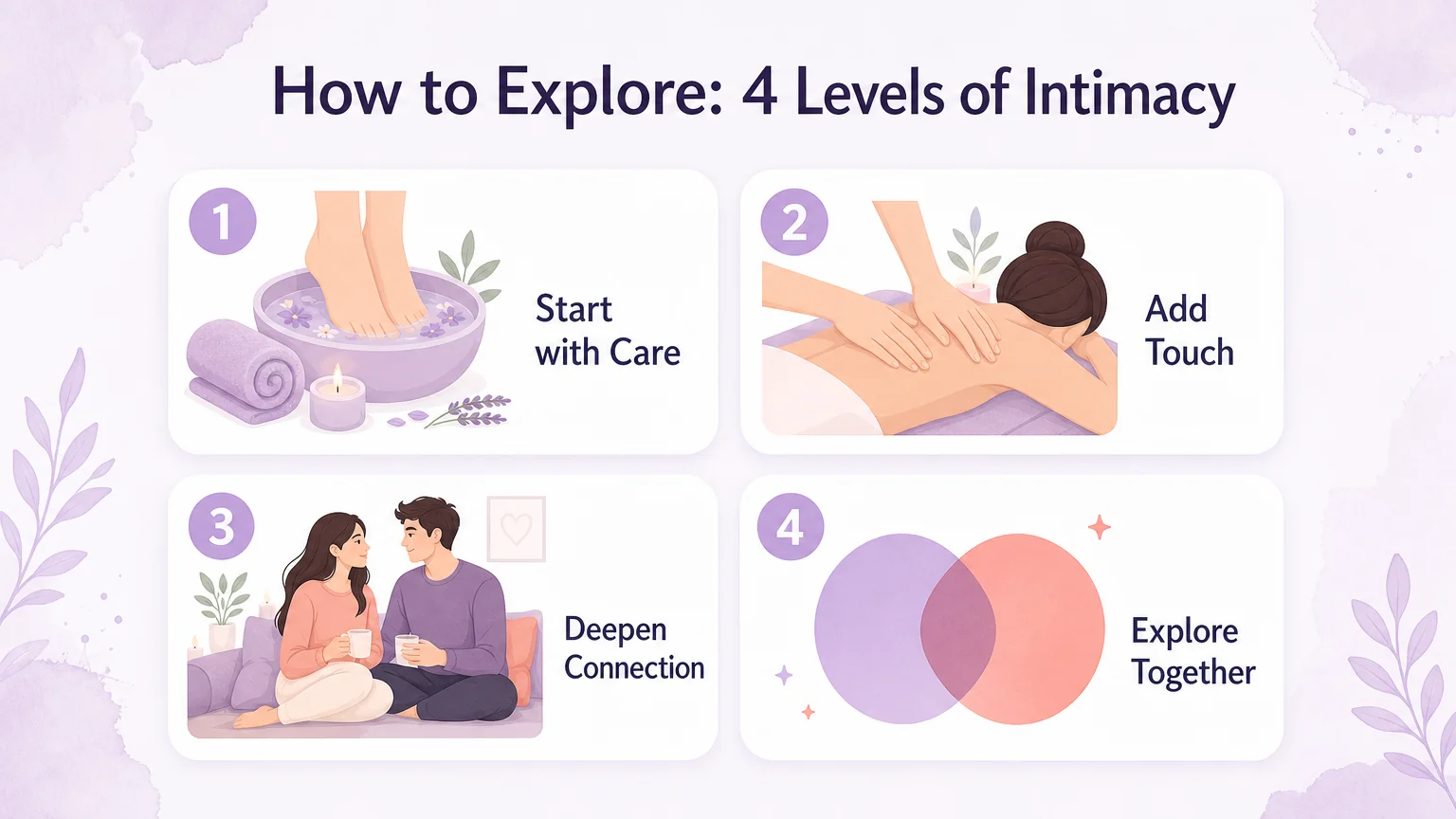
Foot fetish exploration should feel like an invitation, not an expectation. Start with the easiest step and climb from there.
Level one: the no-pressure entry points. A pedicure together turns grooming into foreplay. Foot selfies sent as a tease. Wearing specific sandals on date night as a deliberate signal. As Nicole puts it: “I’m going to wear the sandals that have a little bit more peekage for my partner so that he can see and know that I’m paying attention.”
Level two: sensory exploration. A foot massage. Feet are packed with nerve endings. Even people with zero interest in feet often find this arousing. Gentle tickling. Kissing the tops of feet and around the ankles.
Level three: more direct. Toe sucking, sometimes called “shrimping.” Shoe play: kissing shoes at the toes and ankle, working with straps and soles.
Level four: genital contact. A “foot job,” where the partner uses feet to stimulate genitals. Foot worship, the adoration and attention that some partners find surprisingly empowering.
The creative, relationship-specific layer makes this playful. Ramon’s wife calls foot play “the cheat button,” an instant arousal trigger even when he is not initially in the mood. Some couples explore D/s dynamics through foot worship as consensual power exchange. Others designate specific “fetish nights” to maintain balance.
On the practical side of safety, a few guardrails make all the difference. Trim toenails before foot-involved genital contact. Sharp edges cut delicate skin. Ensure feet are free of open sores or wounds before mouth or genital contact. Skin-to-skin contact can transmit genital herpes, syphilis, HPV, and fungal infections like athlete’s foot. CDC-recommended vaccinations for hepatitis A, hepatitis B, and HPV are worth a doctor’s visit. Regular STD testing keeps everyone informed. Avoid foot-genital contact if either partner has an active skin infection.
Exploration should be mutual, paced, and fun. If something is not working, say so. If something is working, say that too. This is not a performance. It is a shared experiment.
From Punchline to Mainstream: The Quiet Normalization of Foot Fetishes

Searches for “feet pics” have grown over 500 percent since 2018, with some cities logging 89 percent year-on-year surges. A social media user captured the shift perfectly: “Is a foot fetish even a fetish now? It’s so normalized.”
Reality shows like Love Island feature contestants openly discussing foot attraction. Lily Allen, an internationally known musician, casually monetizes her feet on OnlyFans and discusses it publicly. FeetFinder has 8 million verified users, a number that only exists because millions of people are comfortable enough to sign up. Dedicated dating apps exist specifically so foot fetishists never have to have the disclosure conversation with someone who might reject them. Online communities give people a shared identity where shame dissolves in numbers.
But the normalization is a trajectory, not a destination. Ramon from the Foot Fetish Podcast describes “the boobs guys and the ass guys high-fiving and then there’s this misshapen guy in the corner that’s the feet guy.” He notes “there’s still a great deal of shame in the foot fetish community about who we are.”
Foot fetishes are old, common, and scientifically interesting. For most people, they are one thread in the larger fabric of sexuality. If you have one, you are in good company. If your partner has one, you just got a window into who they are. The more we talk about it plainly, the less power the stigma holds.
Frequently Asked Questions About Foot Fetishes
Is having a foot fetish a mental disorder?
No. A foot fetish is a healthy variation of human sexuality. The DSM-5 only classifies it as fetishistic disorder when the fantasies cause clinically significant distress or impairment in daily functioning. Most people never meet that threshold.
What is the difference between a kink and a fetish?
A kink is any non-normative sexual interest. A fetish is a supercharged focus on a specific object or body part that becomes a central source of arousal. Some people need the fetish element to function sexually. For others, it enhances arousal but is not required. For more details, please check this guide: Fetish vs Kink: The Distinction Nobody Explains Clearly.
Can foot play transmit STDs?
Yes. Skin-to-skin foot play can transmit genital herpes, syphilis, HPV, and fungal infections. The CDC recommends vaccinations for hepatitis A, hepatitis B, and HPV, plus regular STD testing. Avoid foot-genital contact if either partner has open wounds or active skin infections, and trim toenails beforehand.
At what age do foot fetishes typically develop?
Onset typically occurs during puberty but can begin earlier. Some people recall awareness as young as ages three to five, hyperfixating on feet in picture books or having early experiences that became core memories.
Are there different types of foot fetishes?
Yes. Preferences vary enormously. Some prefer clean feet. Others want them sweaty. Some like bare feet, others prefer shoes, socks, stockings, or sandals. Some enjoy worship. Others simply find feet attractive. This is a spectrum, not a monolith.
Can you make money selling feet pictures?
Yes, but the income distribution is steep. The top 1 percent earn $5,000 to $12,000 monthly. Half earn less than $100. Over 60 percent of feet-only OnlyFans creators earn under $150 monthly in their first three months. Success requires consistent output, niche positioning, and treating it as a real business.