
Surveys consistently find that roughly one in three kink practitioners has explored some form of erotic humiliation. That is not a fringe interest. It is one of the most common desires people bring into their sex lives, and it lives inside a contradiction: wanting to feel embarrassed, degraded, or brought low during sex sounds backward when everything else in our culture tells us sex should build us up.
That contradiction is exactly where the heat lives.
Far more people engage in kink than label themselves practitioners. When researchers ask about specific behaviors rather than identity, the numbers jump. You are in more company than you know. This is not about explaining away the desire or diagnosing it. It is about understanding why it works, how to do it safely, and what it looks like inside a relationship built on trust. We will define it, distinguish it from its dangerous look-alikes, explore the psychology that makes it tick, and walk through the practical how-to, from your first whispered phrase to full-scene negotiation and aftercare.
What Is Erotic Humiliation? Defining the Undefinable
Erotic humiliation sits inside the BDSM umbrella as a form of consensual psychological sadomasochism: one person administers a controlled experience of shame or embarrassment, and another receives it, both for sexual arousal. Neha Bhat, a clinical sex therapist, puts it plainly: “Erotic humiliation is the consensual use of psychological humiliation in a sexual context.”
Definitions that stay clinical only get you halfway. Humiliation play is about the consensual suspension of dignity within a container of trust. A partner calling you “dirty” in the grocery store aisle lands differently than the same word whispered during negotiated play. The meaning is not in the word. It is in the agreement surrounding it.
Researchers Giannini and colleagues captured this in a 1998 study: participants assign humiliating meaning to specific acts, objects, or body parts. The meaning is not embedded in the act itself. What counts as humiliating is deeply personal and constructed.
The elements that make it erotic rather than harmful are threefold: consent, which must be enthusiastic and revocable at any moment; context, the negotiated container of the scene; and aftercare, the deliberate process of closing the loop when the scene ends. Remove any of these three, and play becomes something else. Your boss publicly shaming you is not erotic humiliation. The power is real rather than performed, and your consent was never part of the equation.
Before we go further, one distinction matters more than any other.
Humiliation vs. Degradation: The Distinction That Keeps Play Safe
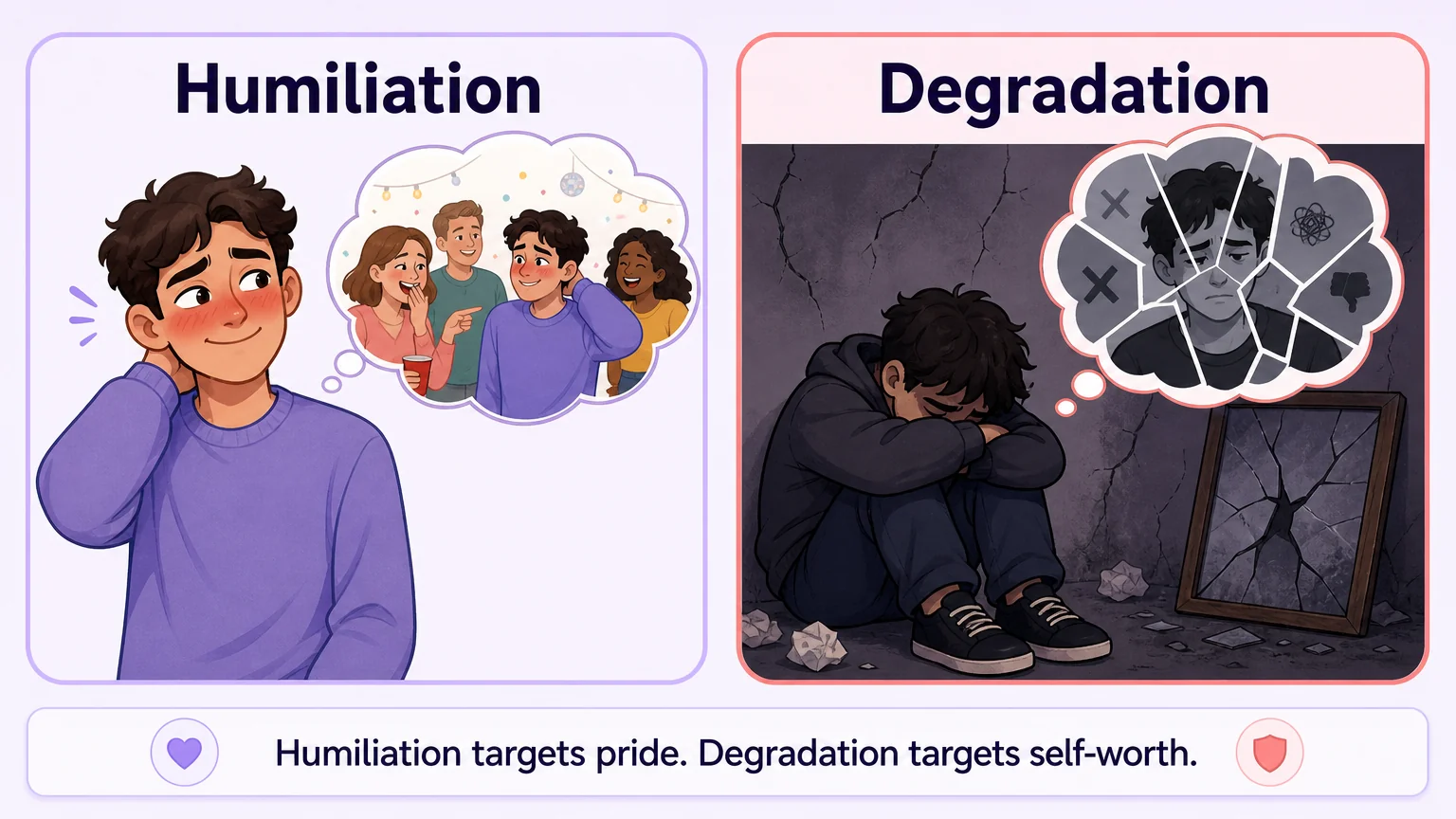
Humiliation targets your social standing, your pride, your sense of how others see you. Degradation that crosses the line targets your core sense of self-worth. One is play-acting at the edges of identity. The other can erode the foundation.
Humiliation: “Look at you, so desperate you would beg for it.” The sting is in the exposure of desire, not in the suggestion that you are worthless. Degradation that wounds: “You are nothing, you have always been nothing, you will never be anything.” That aims at the self, not the situation.
This distinction is the load-bearing wall of ethical humiliation play. Without it, you are guessing. When a partner hears “you are worthless” and believes it, the scene has failed. The words landed on identity, not situation. That is the difference between a scene that strengthens your relationship and one that silently corrodes it. With the distinction clear, you can navigate the entire landscape safely.
Most experienced players do not work in pure categories. They work the gradient. Princess Kali, author of Enough to Make You Blush, calls the sweet spot affectionate degradation: the style of play where the words are harsh but the underlying message is “I see all of you, including this, and I am still here.” A phrase like “my dirty little slut” works as affectionate degradation because the possessive “my” signals treasured belonging rather than disposability. The goal is a contained experience of shame that dissolves when the scene ends, not reinforcement of someone’s actual insecurities.
The safety rule: if the words would still wound after the scene ends and aftercare is complete, they do not belong in play. Test every phrase against that standard before it leaves your mouth.
The Psychology of Erotic Humiliation: Why Getting Brought Low Feels So Good
We do not need a therapeutic reason for sexual desire. Some people just find humiliation hot, and that is the entire explanation. Desire does not require an apology.
But for those who want to understand the machinery, three lenses each capture part of the picture. None is the whole answer. All of them are useful.
The first is neurological. The same brain regions that process physical pain also process social humiliation. Naomi Eisenberger and her colleagues demonstrated this in a landmark 2003 fMRI study published in Science: social rejection lights up the same neural circuitry as physical injury. The body does not always distinguish between “I am in danger” and “I am pretending to be in danger.” The chemical cascade is real either way. The same neurochemistry makes a roller coaster thrilling: risk experienced inside safety produces exhilaration. As professional humiliatrix Betty Pickles puts it: same rush as a roller coaster.
The second lens comes from psychologist Roy Baumeister’s escape-from-self theory. People carrying heavy cognitive loads, high-control professionals, caregivers, often find relief in surrendering the burden of selfhood. Humiliation play becomes a structured vacation from having to hold it together. Moushumi Ghose, MFT, confirms the pattern: people seek the opposite of their daily life in sexual fantasy. Those constantly in control may crave the release of vulnerability.
The third lens is sociological. Midori frames it as “the temporary removal of the societal performance of self.” We spend our days managing how we are seen. In a humiliation scene, you stop managing. You are seen, in Jane Boon’s phrase, in “an exquisite experience of being fully seen, especially for those things you rarely share because they are viewed as shameful.” The person seeing you stays. That acceptance is the opposite of what the words suggest.
None of these explanations are required. Desire does not need a thesis. The only qualification for a kink: it is consensual and causes no lasting harm. If all you take from this section is permission to stop pathologizing your own desire, that is enough.
The Many Forms of Humiliation Play: A Menu, Not a Checklist
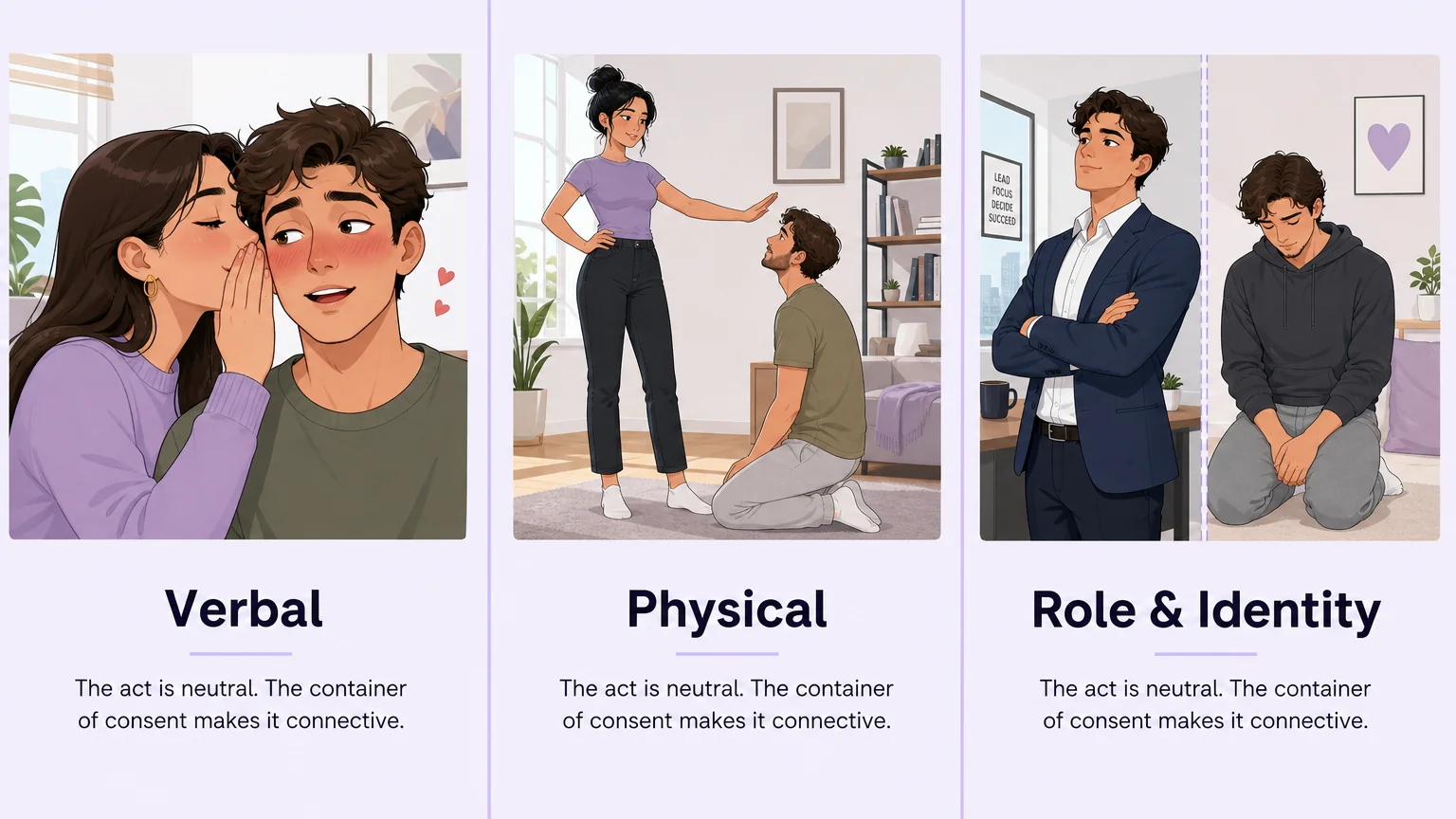
There is no universal list of humiliating acts, because what stings one person leaves another cold. The same phrase that makes someone blush with arousal makes someone else shrug. That personal variability is the feature, not the bug. Your humiliation play is a fingerprint, not a template.
Still, having a map helps. The landscape falls into three broad categories.
Verbal humiliation. This is the most common entry point, and the data bears it out. Roughly 70 percent of sadomasochistic practitioners have recently engaged in verbal humiliation, according to a Finnish study of 184 practitioners. It includes name-calling, mockery, shaming language about desire or body, being talked about in the third person while present, and forced confession of fantasies. The words matter less than who is saying them and why.
Physical and situational humiliation. Positions that feel exposed or undignified. Acts of service framed as demeaning. Body writing. Being made to ask for basic things: permission to speak, to move, to orgasm. These are not about physical intensity. They are about the psychological frame.
Role and identity play. Scenarios that invert the person’s daily identity: the powerful executive being treated as incompetent, the feminist being called gendered slurs in a negotiated context she chose. Gender exploration through degradation. Pet play. Objectification. The arousal comes from the contrast between who you are outside the scene and who you become inside it.
For couples and groups exploring together, a few dynamics are worth naming explicitly. Comparative play, where one partner is told the third “does it better,” can be electric but requires pre-negotiation and a debrief that explicitly separates scene-talk from reality. Being directed by one partner while another watches. Service-oriented submission where one person serves the couple. In every variation, the act itself is neutral. The container of consent and aftercare is what determines whether it is connective or corrosive.
Humiliation Play in ENM and Couple Dynamics: The Territory No One Maps

Nearly everything written about humiliation play assumes two people in a monogamous relationship. But for anyone exploring ethical non-monogamy, the question is different: how does this work when we are opening our relationship or inviting someone in?
Start with couples exploring together. The shared vulnerability of trying humiliation play can deepen intimacy in ways vanilla sex rarely touches. You are handing each other a map of your interior and saying “handle this carefully.” But it also requires alignment. One partner being more into it than the other is not a failure. It is data. The rule is simple: the more hesitant partner sets the pace, always. The more enthusiastic partner does the emotional labor of patience. Green lights only require green lights from both of you.
Now add a third person. The power dynamic is inherently asymmetrical: two people who know each other’s bodies and histories, plus one person who is new. The couple’s job is to name that asymmetry and create safety around it, not pretend it does not exist. If you cannot articulate why the third person is safe with you, you are not ready to invite them in. The single’s guide phrase is worth memorizing: “You are a guest in their playground, not a toy in their toybox.” Your desires matter equally. Your limits are as non-negotiable as theirs. A couple who treats you as a prop rather than a person is not a couple you should play with.
Comparative dynamics deserve honest treatment. A scene where one partner is told the third “does it better” can produce intense arousal, but the line between hot and hurtful is thin. Negotiate the specific language before the scene. Agree on a debrief that explicitly separates what was said in character from what is true. If either partner leaves the scene wondering “do they actually mean that,” the negotiation was incomplete.
Group aftercare is not optional. It is not just the submissive who needs reassurance. All three people need to exit the scene intact. Each person speaks to what they experienced and what they need. The couple who treats aftercare as an afterthought is the couple whose third never comes back.
The most attractive thing you can bring into the lifestyle is absolute clarity. That goes double when humiliation play enters a group dynamic.
The Negotiation Framework: Six Conversations Before the First Word Is Spoken

“Just communicate” is correct and useless. People need structure, not slogans. A six-phase negotiation framework you can follow tonight:
Phase one: Name the desire without shame. Script fragment: “I have been curious about something, and I want to talk about it. Not because I need us to do it, but because I want you to know this part of me.” You are not asking for a yes. You are offering an invitation.
Phase two: Yes, no, maybe mapping. Do not just list acts. List specific words. One person’s “slut” is another person’s hard limit. Create three columns: green for enthusiastic yes, yellow for curious but uncertain, red for absolutely not. “Name-calling” is too broad. Write the actual words. The exercise builds intimacy before you enter a scene.
Phase three: Establish the container. When does the scene start and end? What space? What signals “we are in scene” versus “we are back to us”? A specific piece of jewelry. A collar. A phrase. Something that marks the boundary between scene and reality.
Phase four: The traffic-light safeword system. Green means “more of that.” Yellow means “pause, adjust, recalibrate but do not stop the scene.” Red means “full stop, scene over, immediate aftercare.” They are not failure. They are the safety net that makes risk-taking possible. A Dom who makes you feel guilty for using a safeword is using kink language as cover.
Phase five: The aftercare menu. Both people list what they will need after. The submissive might need physical comfort and verbal reassurance. The Dom might need to hear that they are not a monster. Specificity matters. “A weighted blanket and you telling me I am safe” is actionable. “Comfort” is not.
Phase six: Schedule the 24-to-48-hour debrief before you start. This is non-negotiable. The debrief is where you process what worked, what did not, and what you learned about each other. It is part of the scene. Answer: what worked, what did not, what surprised you, what you want more of, what you want less of, whether anything still stings.
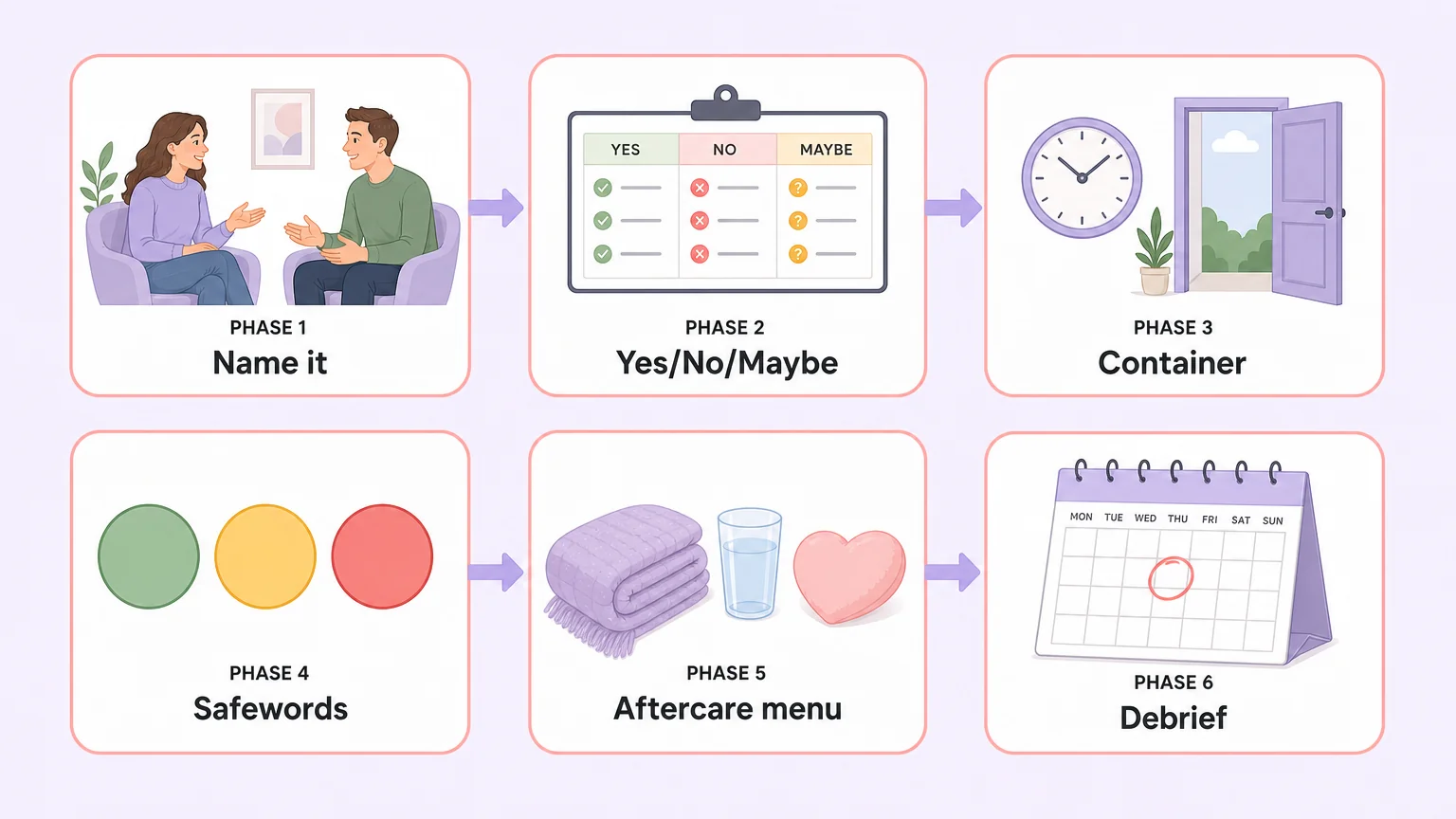
Follow it, and you will never be one of those couples who has a bad experience and spends six months pretending it never happened.
Crawl, Walk, Run: A Progression That Keeps You Safe
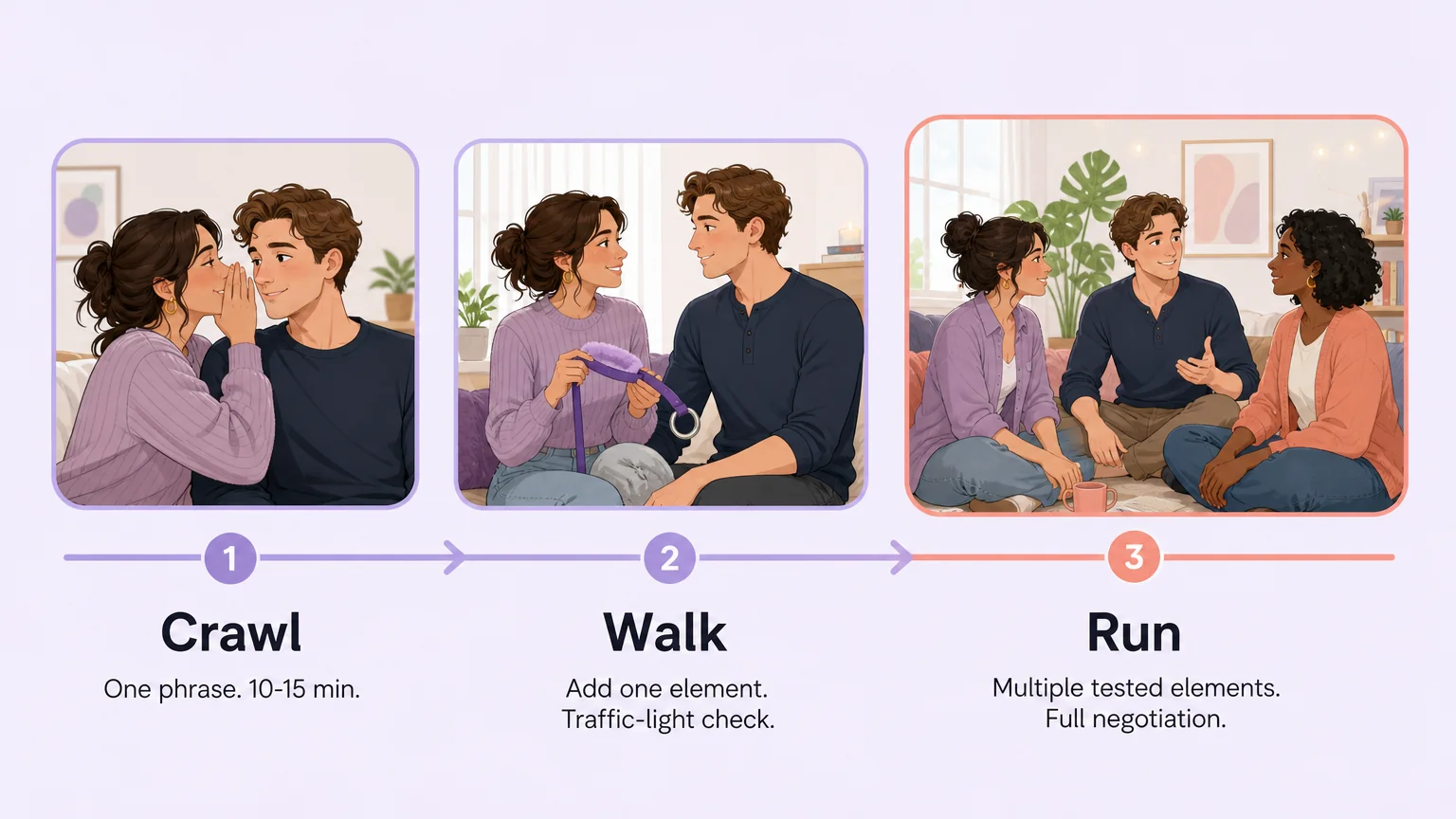
The rule that prevents most humiliation-play disasters: one new element per scene. Not three. Not “let’s try everything.” One. The brain needs data to process whether something worked. If you change multiple variables at once, you cannot know which one caused the reaction. You cannot learn from an experiment with no control.
Crawl. Choose one phrase, one single phrase, from your green column. Use it once during sex. Keep the scene to 10 to 15 minutes. Debrief immediately afterward. That is the entire crawl phase. If it lands well, great. If it lands strangely, you have data, not damage. Either way, you learned something.
Walk. Add one physical or situational element: a position, an act of service, a prop, a role. Extend the scene to 20 to 30 minutes. Introduce the traffic-light check mid-scene: the Dom checks in with “color?” and the sub responds green, yellow, or red. This normalizes check-ins as part of the scene, not an interruption of it. Checking in is not breaking character. It is proving the container holds.
Run. Layer multiple elements that you have already tested individually. Consider involving a third person if that is part of your exploration. Full negotiation, full aftercare, scheduled debrief. The run stage is where the scene starts to match the fantasy. But it only works because crawl and walk built the foundation beneath it.
The most important progression rule: if any stage produces a genuine negative reaction that persists after aftercare, you do not progress. You either repeat the stage with adjustments, or you accept that this particular element is not for you. That is not failure. That is the system working exactly as designed. The goal is not to power through discomfort. The goal is to find the edge of what feels good and stay on the right side of it.
The Dom’s Side of the Equation: Guilt, Drop, and the Labor No One Talks About
After your first scene where you called your partner names or made them crawl, you probably felt like a bad person. Most Doms do. Most Doms never say it out loud.
That feeling is not evidence that you are a bad person. It is evidence that you are a decent person doing something counter-instinctual within a negotiated container. The guilt is the proof that the degradation was roleplay. If it felt easy and costless, that would be the real red flag.
Dom drop is real, and it is the same neurochemical crash the sub experiences: adrenaline and endorphins receding, leaving guilt and doubt in their wake. The difference is cultural. The sub is expected to need comfort. The Dom is expected to provide it. Both are true, and both need care. Kink educator Evie Lupine frames it this way: the goal is not to become someone who can degrade a partner without feeling anything. The goal is to feel it, process it, and choose to do it again because the container is solid and the connection is worth it.
Practical guidance for Doms. Do not improvise new degrading content mid-scene. Stick to what was negotiated. Your brain in scene-space is not your best ethical-reasoning brain. Watch for non-verbal cues: a sub who goes quiet or still may be dissociating, not enjoying. Ask. The traffic-light check is as much for your safety as theirs. If you are not sure, stop.
Aftercare for the Dom is specific. You need to hear, explicitly, that your partner wanted what happened, enjoyed what happened, and still sees you as the person they trust. If you need to cry, cry. If you need to be held, ask. Dominance is not stoicism. The Dom who refuses aftercare for themselves is the Dom who burns out, or worse, stops feeling the guilt and crosses into something that is no longer play.
Aftercare for Humiliation Play: Closing the Loop So the Scene Stays Where It Belongs

Post-play shame is a chemical event, not a moral verdict. Adrenaline and endorphins are temporary. When they recede, usually within hours to days, the emotional floor drops out. You did not do something wrong. Your brain is just out of gas. That reframe alone stops the self-recrimination that keeps people from trying again.
Immediate aftercare starts with the body. Skin-to-skin contact. A weighted blanket. Water. Food. The body exits fight-or-flight before the mind processes anything. A brain still flooded with stress hormones cannot receive reassurance.
For humiliation play specifically, verbal reassurance has a required shape. The Dom explicitly reverses the scene’s framing: “The things I said were roleplay. They are not true. You are [specific genuine affirmation].” Generic “you did great” does not cut it. The sub needs to hear that the degradation was contained, that the person who said those things is not the person handing them water.
For the Dom: you need to hear that your partner is okay, that they wanted the scene, that they do not see you differently. Ask for that reassurance directly.
The 24-to-48-hour debrief is where the scene gets integrated into the relationship rather than sealed off as “that weird thing we did one time.” Both people answer: what worked, what did not, what surprised you, what do you want more of, what do you want less of, is there anything that still stings. If something still stings after 48 hours, you stop doing that thing until you understand why.
Aftercare is not recovering from damage. It is the second half of the experience, the part where you prove to each other that the container held.
Red Flags and Emotional Safety: When Humiliation Play Stops Being Play
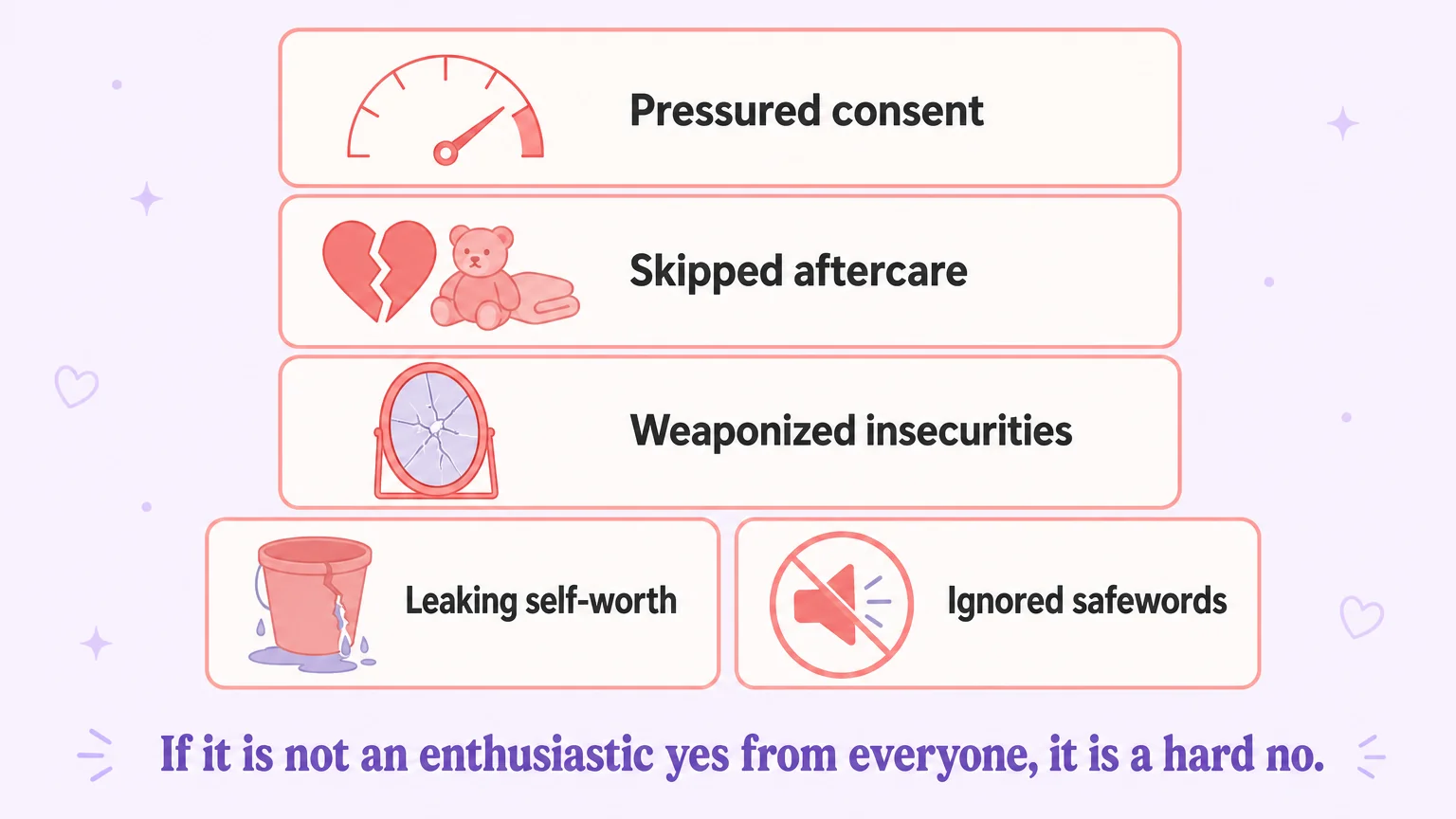
The DSM-5-TR draws a clear line: a paraphilia becomes a disorder only when it causes clinically significant distress, impairment, or risk of harm to self or others. Having a humiliation kink is not a diagnosis. It becomes a concern only when it stops being consensual, contained, and connective.
Five specific red flags separate play from harm.
One: Consent is pressured rather than enthusiastic. “I guess so” and silence are not yes. If someone agrees because they are afraid of losing the relationship, that is coercion wearing the mask of consent.
Two: Aftercare is consistently skipped or dismissed. If the Dom treats aftercare as optional or burdensome, the container is broken. No aftercare means no scene. Period.
Three: The degradation targets the sub’s actual insecurities. The things they told you in vulnerability, now weaponized in a scene they did not negotiate. That is not play. That is betrayal.
Four: The sub’s outside-of-scene self-worth is deteriorating. If they are carrying the scene’s language into daily life, if “maybe I really am worthless” becomes a thought they cannot shake, the scene is leaking. You stop until the container is rebuilt.
Five: Safewords are ignored, mocked, or treated as failure. A Dom who makes you feel guilty for using a safeword is not a Dom. They are an abuser using kink language as cover. Walk away.
The single rule that replaces all five: if it is not an enthusiastic yes from everyone in the room, it is a hard no. That rule scales from one whispered word to a full-group scene. If you are not sure, ask. If you are still not sure, stop. The only wrong move in humiliation play is pretending you are fine when you are not.
FAQ: The Questions People Are Afraid to Ask Out Loud
Does having a humiliation kink mean I have low self-esteem?
No. Research finds no correlation between kink interests and low self-esteem. Many people drawn to humiliation play are high-functioning and confident. The kink is about the contrast with daily life, not the absence of confidence. Roughly 43 percent of women in kink communities enjoy receiving verbal humiliation. That is preference, not pathology.
How do I know it is humiliation play and not emotional abuse?
The litmus test is what happens when the scene ends. Abuse continues. Play stops. In healthy play, both people feel more connected afterward. If you dread the scene or feel worse about yourself, that is not play.
How do I tell my partner I want this without freaking them out?
Lead with the relationship, not the kink. “I trust you enough to share something vulnerable” beats “I want you to call me names.” Use crawl-walk-run to frame it: one small thing, not a sex-life rebuild. Let them sit with it. The goal is to be known.
Can singles explore humiliation play safely?
Yes. Vet thoroughly: negotiate as you would with a long-term partner, use a written yes/no/maybe list, tell a trusted friend where you are going. A Dom who resists your limits is a red flag. Move on.
We are new to both ENM and kink. Where do we start?
Start with one, not both. Open your relationship or explore kink first. Stacking both multiplies emotional variables past what couples can process. If you must explore both, the more hesitant partner sets the pace, always.