
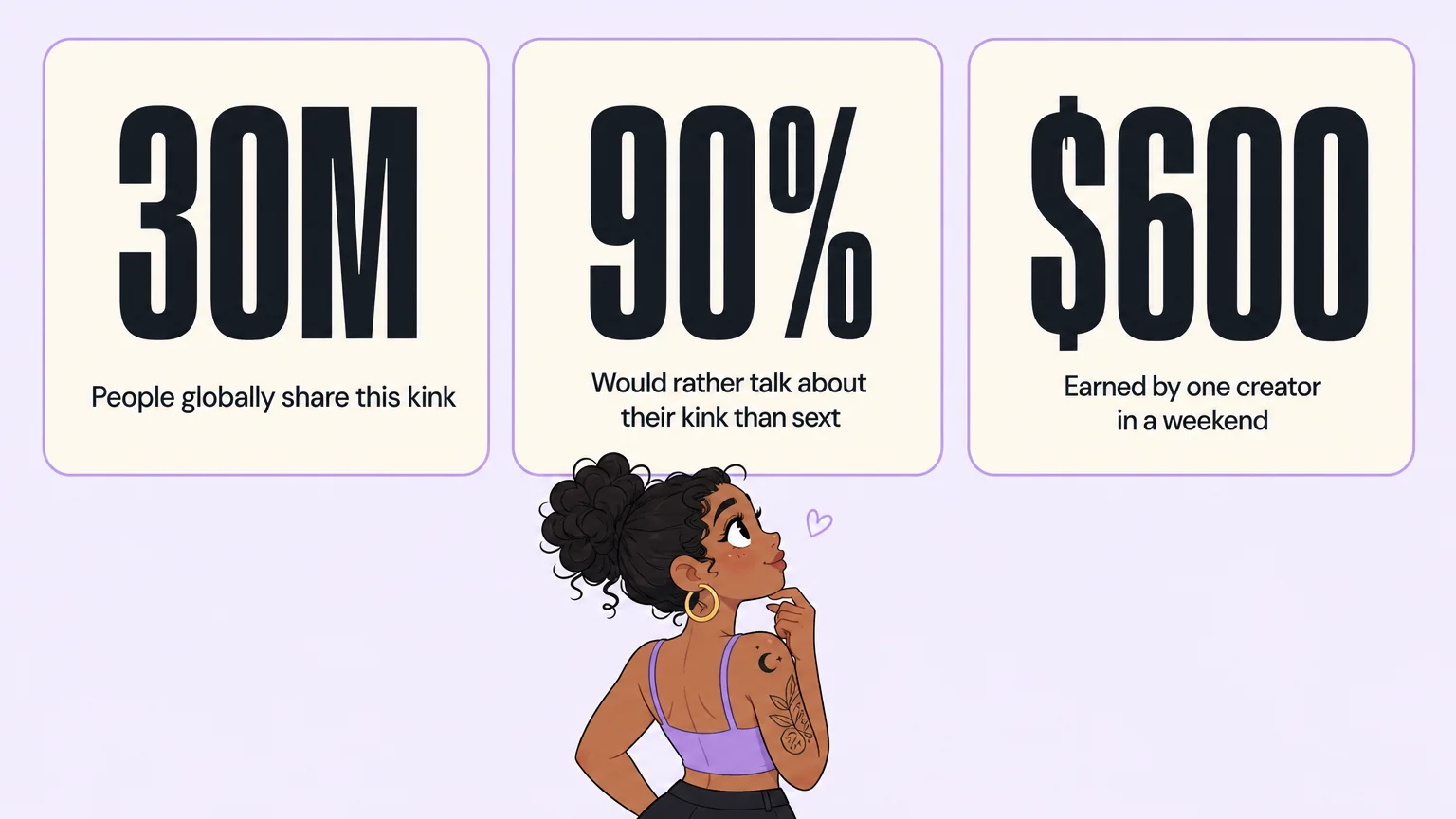
Feederism (increasingly called feedism within the community) is a kink where sexual arousal comes from feeding a partner, being fed, and the resulting weight gain. It sits under the fat fetishism umbrella, but it is about process, not just bodies. Consent, care, and deep emotional connection build the foundation for most practitioners. Community estimates put the global number around 30 million people. You are not alone in being curious.
This guide walks through what feedism actually looks like, why it feels so compelling, the many forms it takes, and how couples explore it together. No sensationalism. No judgment. Just what you actually want to know.
What Feederism Actually Is (And What It Is Not)
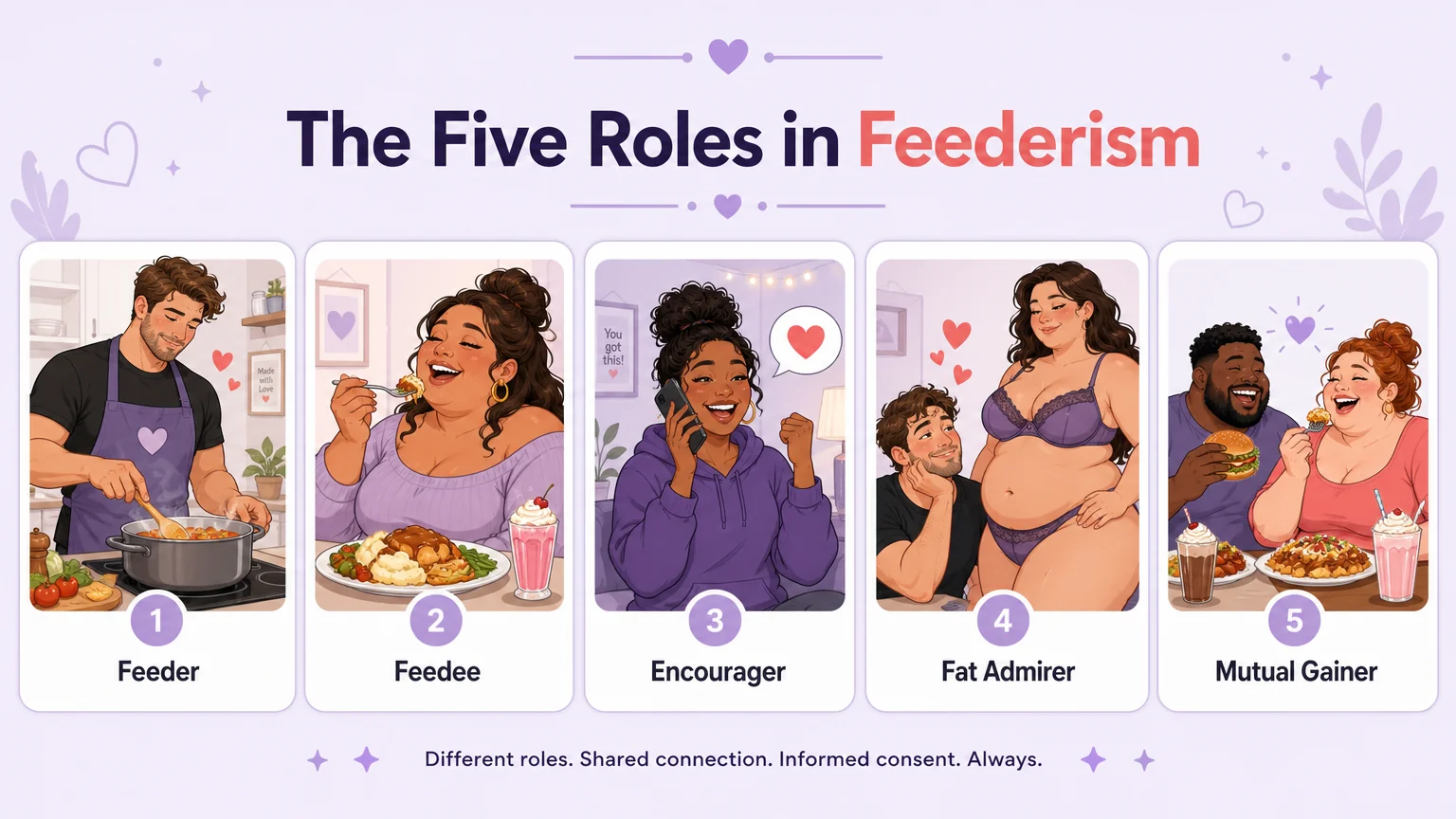
Feedism is built on roles, and the roles immediately show you this is more nuanced than “one person feeds another.”
A feeder derives pleasure from feeding and fattening a partner. A feedee (also called a gainer) enjoys being fed, the sensations of fullness, and gaining weight. An encourager motivates from a distance, often online, without ever physically feeding anyone. A fat admirer (FA) is attracted to larger bodies without necessarily being into the feeding process itself. And a mutual gainer shares the journey with a partner, both gaining together and blurring the line between feeder and feedee.
These are not rigid boxes. Plenty of people shift between them depending on the partner, the moment, or the phase of life.
Now for the distinction most outsiders miss: feedism is about the process, not just the body. A fat admirer likes big bodies the way someone else likes tall partners or redheads. A feedist is turned on by the act of eating, feeding, and the transformation of gaining. As the Feabie community FAQ puts it, feedees find bigness “positive, affirming and sexy” as an active journey. A feedee does not even need to be large. Gains might be a few pounds, hundreds, or none at all. The kink lives in the mentality as much as the physical result.
A quick note on the words themselves. “Feederism” is the older, more common term. It is what you will find in academic papers and Wikipedia. “Feedism” is the community-preferred alternative, coined to de-emphasize the feeder role and make the language more egalitarian. Both terms are correct. No one will side-eye you for using either.
A quick word on eating disorders, since the two get confused. Eating disorders are defined by distress, loss of control, and negative body image. Consensual feedism is intentional, desired, and experienced as positive. The distinction matters. Some practitioners are eating disorder survivors who use feedism as a form of reclamation. They are eroticizing the very thing they were taught to hate. That is not pathology. That is healing on your own terms.
The Emotional Engine: Why Feederism Feels So Good

If you have only read academic papers about feedism, you would think it is about something called “morphophilia” or “transgressive food arousal.” Those are real theories with real academic backing. They also completely miss the point.
Ask actual practitioners why feedism works for them, and they describe something far more human.
First, there is the nurturing dimension. Feeding someone is one of the most primal acts of care we have. For feeders, watching a partner gain weight because of food you prepared, meals you shared, indulgence you encouraged. That is a tangible manifestation of love you can see and touch. One community member put it plainly: “They got fat because they are so happy and well taken care of.” Saffron Dubois, a self-identified feeder and self-described “mommy dom,” connects her kink to a deeply maternal satisfaction after a hysterectomy: “maybe I find some maternal satisfaction in giving life through food.”
The next layer is vulnerability. Sharing your deepest desire with a partner when that desire is widely misunderstood creates an extraordinary bond. One feeder described it as creating “an extra dimension” that most couples never access. When someone sees the thing you are most ashamed of and calls it beautiful, that rewires something. Shame becomes the raw material for connection.
For many feedees, there is a body reclamation piece. We grow up in a culture that teaches us to shrink, literally and metaphorically. Take up less space. Eat less. Be less. Choosing to grow, to indulge, to be adored at a larger size is a conscious rebellion against that. It transforms eating from a shame cycle into a pleasure cycle. Food itself gets rewritten: what was once the enemy becomes the medium of intimacy. A former feedee described being “treated like a goddess” at higher weights while her feeder expressed reverence, not tolerance.
The taboo itself carries an erotic charge. Breaking the most rigid cultural rule we have, “you must not get fat,” inside a consensual, celebratory container. That transgression, freely chosen, is part of the appeal.
Roughly 90% of Saffron Dubois’s online clients would rather talk about their kink and why they have it than engage in purely sexual exchange. That statistic tells you something important. The hunger here is not just for food. It is for being understood.
The Many Shapes of Feederism: Fantasy to Lifestyle
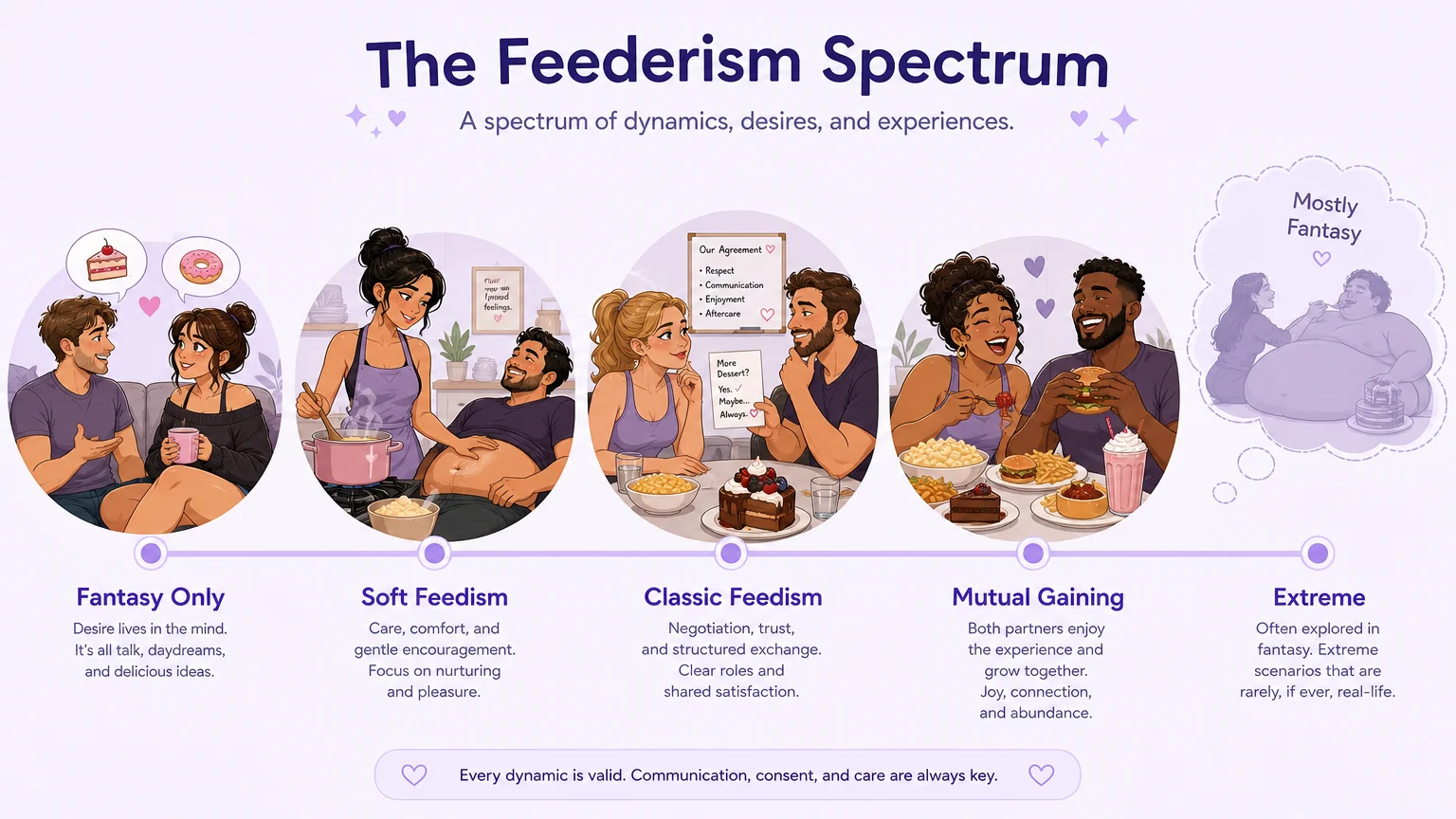
Feedism runs on a spectrum, and most people live somewhere in the middle.
On the near end, there is fantasy-only engagement. A couple dirty-talks about stuffing scenarios during sex. Someone uses pillows under their clothes to simulate a larger body during roleplay. No weight is actually gained. The arousal comes entirely from imagination and play. For many, maybe most, this is where they stay. The community fully affirms this as valid participation. You do not need to gain a pound to belong here.
Move along the spectrum and you hit soft feedism: gentle, nurturing, built around food as a love language. Belly rubs, home-cooked meals, praise instead of degradation. Weight gain, if it happens, is welcomed as “love made visible.” Never forced. Never humiliating. This is where a lot of couples land when they explore together. It layers naturally onto existing intimacy.
Classic feedism adds more intentionality around weight gain but stays within consensual, health-conscious boundaries. Feeders and feedees negotiate goals, set limits, and prioritize each other’s wellbeing. The power exchange can be present or absent depending on the couple.
Mutual gaining is exactly what it sounds like: both partners gain together, encouraging each other, blurring the line between feeder and feedee. The dynamic becomes “let us get fat and happy together.” The hierarchy dissolves into partnership. Research confirms these relationships exist and that feeder and feedee are not mutually exclusive roles.
Content creation exists across the spectrum. Feedees document their gaining journeys for an audience of encouragers, sometimes monetizing through platforms like Feabie or Fantasy Feeder. One creator reported earning over $600 in a weekend. When done ethically and on the creator’s own terms, it is a form of sex work that can be empowering. When financial pressure overrides health boundaries, the line between empowerment and exploitation collapses.
On the far end sit the extremes: immobility fantasy, mostly kept as fantasy, and death feederism, widely condemned within the community. These represent a tiny fraction of practitioners. As mutual gainer Martin Silva told VICE, only “a small number ever take it to those levels.” Media coverage fixates on them because they are shocking, not because they are representative.
Soft Feederism: When Nurturing Becomes Erotic

Most people’s first exposure to feedism is the extreme end. Media coverage amplifies the loudest, most intense voices, and the gentlest branches of the kink rarely make the story. That is a shame, because an entire branch of it runs on tenderness.
Soft feedism rejects the BDSM-informed power dynamics that characterize much of classic feederism. There is no humiliation. No name-calling. Words like “pig” or “obese” do not enter the vocabulary, not even in a kink context. Instead, the erotic charge comes from care elevated to worship.
Picture a partner who cooks elaborate meals not as control but as devotion. Who rubs your belly after a full dinner not as mockery but as reverence. Who watches your body change over months and sees proof of love, not a project. Weight gain becomes “love made visible,” a gentle, consensual side effect of being adored, not a goal pursued at any cost.
The language of soft feedism tells you everything: nurturing, mutual care, body worship, food as a love language. The dynamic is “let me take care of you” rather than “let me control you.” For couples already exploring kink, ENM, or just looking to deepen their intimacy, this is the most natural entry point. It layers easily onto what you are probably already doing: cooking for each other, feeding each other bites at restaurants, enjoying indulgence together. The kink is in making it intentional.
The Softening resource at softening.neocities.org is the primary community hub for this approach. It was built specifically to fill the gap left by mainstream feedism spaces, which default to heterosexual male-feeder framing. Softening centers queer and trans perspectives and integrates fat liberation politics with feedism education. Its consent guidelines are unambiguous: without risk-aware consent, “it is not feederism, it is abuse.” That standard applies regardless of how gentle the dynamic looks from the outside. Secret feeding is never acceptable outside of pre-negotiated roleplay.
On the practical side: soft feedism also prioritizes harm reduction. The fantasy of immobility may exist, but the practice stays grounded in mutual wellbeing. Belly rubs over force-feeding. Praise over degradation. Health as a shared value, not an afterthought.
Feederism, Kink, and Community: Where This All Lives
Feedism does not exist in a vacuum. It overlaps with a constellation of adjacent kinks that deepen the experience or serve as entry points for people who are curious but not ready to name themselves feedists.
Body worship and belly worship are the closest cousins. They bring erotic focus to a partner’s physical form without necessarily involving feeding. Food play is the entry-level bridge many couples cross before realizing feedism is their specific thing: honey licked off skin, chocolate sauce body painting, controlled feeding during sex.
D/s dynamics weave through much of feedism. The feeder exerts control over consumption, the feedee submits, and both get off on the exchange. This can range from gentle “pleasure Dom” energy, praise for eating well with soft rewards, to stricter protocols with negotiated rules and consequences.
Breeding kink, pregnancy kink, inflation play, and transformation fantasies all orbit nearby. The community accepts that these lines blur, and most people engage with more than one. Think of adjacent kinks as doors in a hallway. You might walk through three or stay in one room forever. Neither is more valid.
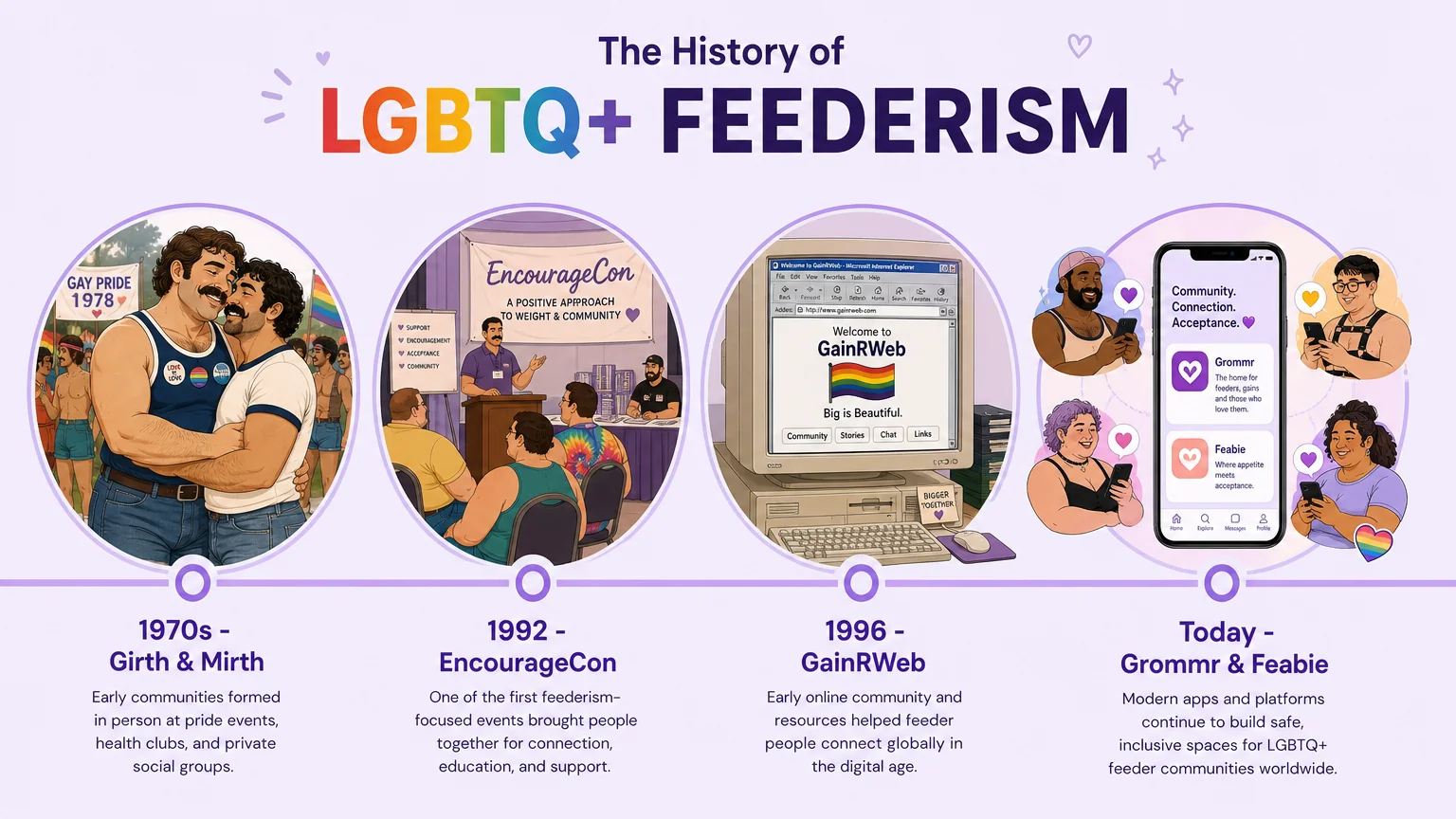
The LGBTQ+ dimension deserves its own spotlight because it has its own history. The gay male gainer community traces back to the Girth and Mirth movement of the 1970s, predating the heterosexual feederism community online by decades. The first dedicated gainer event, EncourageCon, happened in 1992, before most people had internet access. GainRWeb launched in 1996 as the first website for gay men into weight gain.
Today, Grommr serves gay and bi male gainers and encouragers, while Chasable celebrates the chub-bear intersection. For sapphic and lesbian feedists, dedicated Discord servers like the Sapphic Feedism Server provide gender-specific community. The Squishy Committee Discord is explicitly LGBTQ+ friendly with a zero-tolerance policy for harassment and death feedism content.
If you are looking to find your corner: Feabie is the mainstream all-gender social network with over 97,000 users and mobile apps. Fantasy Feeder is the original platform, launched in 2003 with over 70,000 active members. It is where terms like “feeder,” “feedee,” and “BBW” were coined and popularized. Reddit’s r/Feederism is a low-stakes, anonymous entry point. Tumblr still hosts an active feedism blogging scene with a strong queer presence.
Most major platforms actively moderate against death feederism and non-consensual content. Feabie removes violation content through its moderation team. The Squishy Committee Discord writes its zero-tolerance policy directly into its server rules.
Each space has its own norms and culture. Lurk first. Read how people interact. Then engage when you feel ready.
How to Explore Feederism With a Partner
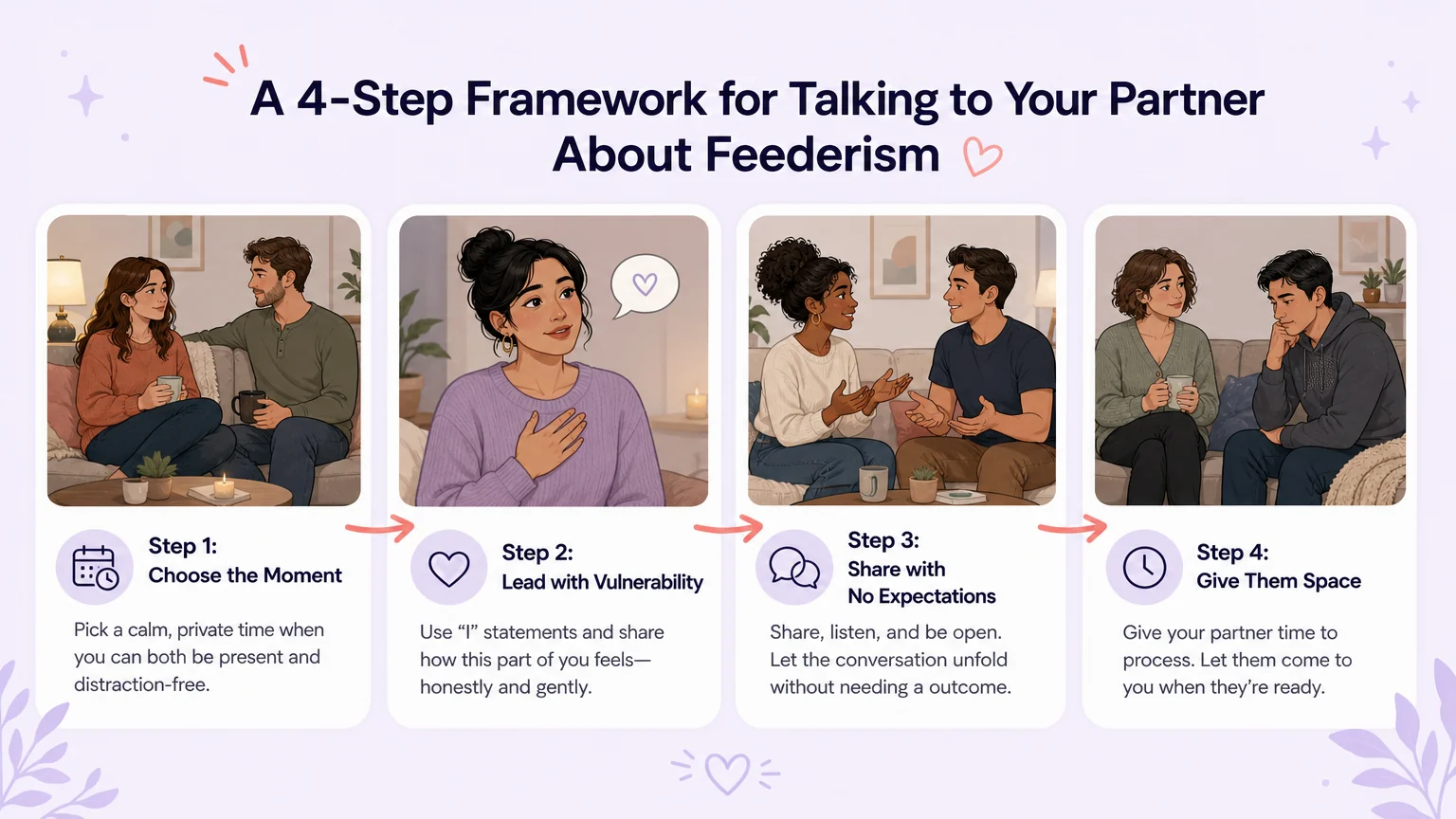
The gap between “I am curious about this” and “let us try it” is where most couples get stuck. Here is how to bridge it.
Start with the conversation, not the kitchen. Choose a neutral, private moment. Not during sex, not right after a heavy dinner. Lead with vulnerability: “I would like to share something personal about intimacy when you are in a good headspace. Is now okay?” Name your nervousness out loud. It builds trust instead of performing confidence you do not feel.
Introduce feedism simply, without projecting expectations onto your partner: “I am into a kink called feedism. I find the act of feeding and being fed really erotic. It can include weight gain and body admiration. It is something that has been part of my sexuality for a while.”
Then say the single most important sentence in the entire conversation: “I have absolutely no expectations of you with this. I am sharing because I trust you, not because I need you to change.” That one line distinguishes disclosure from pressure.
Invite their thoughts and give them space. “How does it feel hearing that? You do not have to have an answer right now.” If they are not into it, that is information. The goal is honesty, not conversion.
If your partner is curious, start comically small. The Paige Bond podcast, featuring feeder Saffron Dubois, offers entry-level food play that requires zero commitment to weight gain: honey licked off a partner’s skin, chocolate syrup body painting, berries and fruit used during intimacy.
A few ground rules. Avoid irritants. Cayenne pepper has no business anywhere near genitals. Generally avoid inserting food into the vagina; a strawberry is about the limit. Wash hands between handling different ingredients. Shower after.
And for the love of everything: laugh. Food play is inherently goofy. Hollandaise sauce, apparently, has the ideal temperature, thick consistency, and texture for body-licking play. You will feel ridiculous. That is part of it. The goal is not performance. It is play. Starting small and laughing through the mess creates the safety to try bigger things later, if you both want to.
For couples in ENM or threesome dynamics, feedism can layer onto existing connections in interesting ways. One partner might be your feeder while another is not. Kinks do not need to be universal across all your relationships. The same consent and communication principles that govern ENM apply here: negotiate boundaries clearly, check in regularly, honor limits. If you are on 3Fun, you already know how to have these conversations. Feedism is just another flavor to add to the menu.
The RACK framework, Risk-Aware Consensual Kink, is the community standard. All partners must understand the risks before consenting. Consent is ongoing. A yes once is not a yes forever. Secret feeding is abuse, not kink. Never pressure a partner about their pace of gaining or if they want to stop. It is their body. Period.
FAQ
Isn’t feederism just abuse?
The overwhelming majority of feedism relationships are fully consensual. Force-feeding without consent is universally condemned within the community. Without risk-aware consent, community guidelines state, “it is not feederism, it is abuse.” Immobility is mostly kept as fantasy. Extreme non-consensual cases exist, as they do in any community, but sensationalized media coverage does not represent the norm.
Is feederism unhealthy?
There are genuine health risks with intentional weight gain, including diabetes, heart disease, and joint stress. Many practitioners engage only in fantasy and roleplay with no physical weight gain. Those who do gain often maintain regular medical care, eat balanced but larger portions, and set mobility-conscious weight limits. The community distinguishes between fantasy, including immobility fantasies, and reality. One warning: air or water inflation into the stomach can be fatal.
What is the difference between a fat admirer and a feeder?
Fat admirers are attracted to larger bodies. Feedists are aroused by the process of eating, feeding, and gaining. For fat admirers, size is a preference, like preferring tall partners or redheads. For feedists, the transformation is the erotic point. A feedee does not even need to be large; the kink lives in the mentality as much as any physical result.
Can LGBTQ+ people be into feedism?
Absolutely, and the community spans all orientations. Gay male gainers have their own decades-long history, from Girth and Mirth in the 1970s to Grommr today. Sapphic feedists have dedicated Discord servers. Feabie, the largest platform at over 97,000 users, is explicitly all-gender. Academic research confirms that gender and sexuality stereotypes “break down upon examination” of the actual community.
Is feedism connected to BDSM?
Significantly, yes. The feeder-feedee dynamic commonly mirrors dominant-submissive dynamics: control over consumption as erotic power exchange. Many practitioners explicitly frame feedism within BDSM principles of “safe, sane, consensual.” But not all feedism includes BDSM elements. Soft feedism deliberately omits power exchange. Mutual gaining is egalitarian by design. Like most things in kink, the answer is “it depends on how you do it.”
How do I know if I am into feedism?
Common early signs often appear before sexual awareness: childhood fascination with bellies or weight gain scenarios, arousal at feeding or being fed, finding before-and-after weight content sexually compelling, attraction to encouraging a partner’s indulgence. Many community members report these feelings emerging before they had language for them. The Feabie FAQ’s advice: “dive in and start chatting with people.” Fantasy-only exploration is valid. You do not need to gain weight to confirm this interest.
What is death feederism and how common is it?
Death feederism is a fringe extreme where participants fetishize gaining weight to a fatal endpoint. It is widely condemned. Multiple platforms, including Feabie and community Discords, explicitly ban death feederism content. It represents a tiny fraction of practitioners. Media fixation on these extreme cases has created significant PR issues for the consensual majority. If your first exposure to feedism was death feederism content, you saw the outlier, not the center.