You are mid-kiss and something shifts. Words fall away. A sound escapes your throat that you did not plan to make, a growl, low and involuntary. The other person’s eyes change. The air between you thickens with something older than language.
That flicker of wild impulse you usually suppress? It has a name. It is called primal play, and it is one of the most intensely intimate ways human beings explore instinct, power, and surrender together.
Primal play is the consensual exploration of raw, instinct-driven energy: predator and prey dynamics, chase, capture, and surrender, stripped of the scripts that govern everyday intimacy. It is not about pretending to be an animal. It is about accessing something your body already knows how to do.
This guide covers what primal play is, why it feels so neurologically intense, how it differs from rough sex and other kinks, how to explore it safely, and what experienced players wish they had known before they started. No judgment. No euphemisms. Just the playbook.
What Is Primal Play?

Primal play is a form of consensual kink that taps into raw, pre-socialized instinct. Not roleplay. Not performance. It is the deliberate choice to quiet the part of your brain that manages social etiquette and let the part that governs survival, desire, and impulse take the wheel.
Here is the distinction that matters: primal play is not pet play. Pet play is domestic. It draws on dynamics of training, grooming, ownership, and structured hierarchy. Think puppy/owner, kitten/owner. Primal play is wild. There is no owner. Nobody is being trained. The energy comes from instinct, not obedience. The headspace is predator and prey, hunter and hunted, chase and capture.
Primal play may or may not include sex. The intensity lives in the dynamic itself: the circling, the tension, the pursuit, the moment of claiming. For many practitioners, the mental state is the point. The physical acts serve the headspace, not the other way around.
Kali V, a primal educator and founder of Pack Vadon with over twelve years in the kink community, describes primal as “not just a kink role, but a way of moving through the world.” That framing matters. For some, primal is a scene activity. For others, it is closer to an identity.
The two primary roles are Predator and Prey. The Predator embodies the hunter, the stalker, the chaser: hyper-focused, patient, attuned to every signal from their partner. The Prey embodies the chased, the alert, the one who surrenders, or fights back within negotiated bounds. These roles exist on a spectrum. Some people switch. Some identify with neither and instead gravitate toward less common archetypes: the Hunter (more patient, more strategic), the Alpha (protective, pack-oriented), or the Mate (partnership-focused, bonded).
What unites all of them is the same thing: a willingness to meet someone in a place where words are secondary and instinct leads.
Primal Play vs. Rough Sex, Pet Play, and CNC: Key Differences
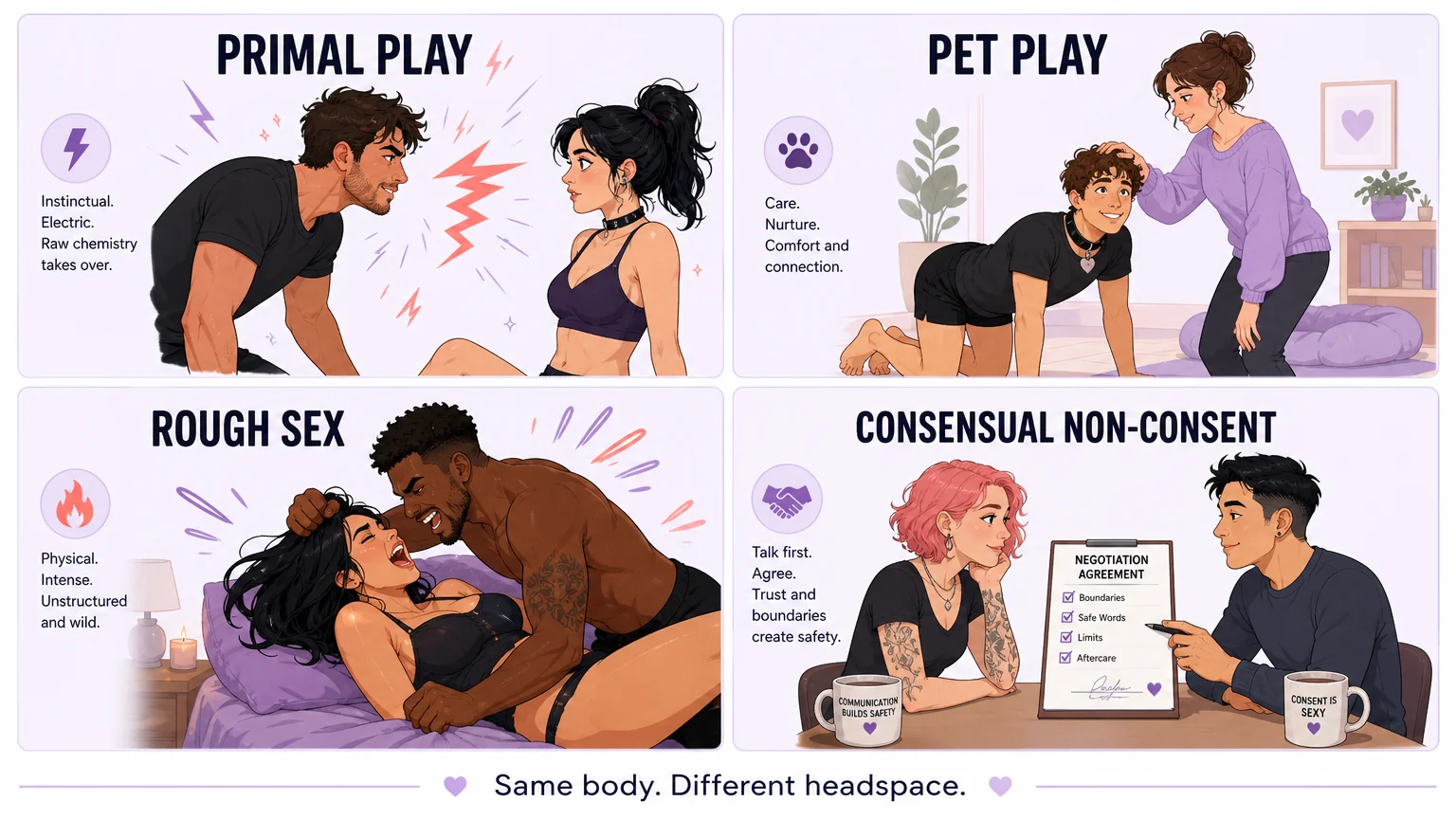
Primal play gets confused with three other things constantly. Here is how to tell them apart.
Primal play vs. pet play. Pet play is domestic. The psychological frame is one of training, nurturing, and structured hierarchy: a puppy and their owner, a kitten and their handler. Primal play is wild. The psychological frame is one of instinct, freedom, and raw power exchange. No owner. No training. When a pet play scene “goes feral,” the two can briefly overlap, but the core energies are distinct: one draws on domestication, the other on untamed nature.
Primal play vs. CNC (consensual non-consent). This is the comparison that causes the most confusion, and for good reason. Both can involve wrestling, pinning, forceful capture, restraint, and physical struggle. The difference is in the intent. CNC is about simulating a non-consensual encounter within negotiated boundaries. The psychological frame is “I am being taken against my will.” Primal play is about unleashing wild, instinctive energy. The psychological frame is “I am accessing a part of myself that civilization suppresses.” They can overlap in physical acts but diverge in headspace. One is about the illusion of violated consent. The other is about stepping outside the need for language entirely.
Primal play vs. rough sex. Rough sex is unstructured physical intensity: harder, faster, more. There is no negotiated scene framework, no role dynamic, no narrative arc. Primal play is a structured scene with thematic immersion. It has roles. It has a dynamic. It has an arc: circling, stalking, chasing, capturing, claiming. Primal play may not include penetrative sex at all. Rough sex is, by definition, sexual.
The framework, then: primal play is about raw impulses, not pretending to be an animal. About wildness, not violence. About accessing something older than language that lives in your nervous system right now.
Predator and Prey: The Core Dynamic of Primal Play
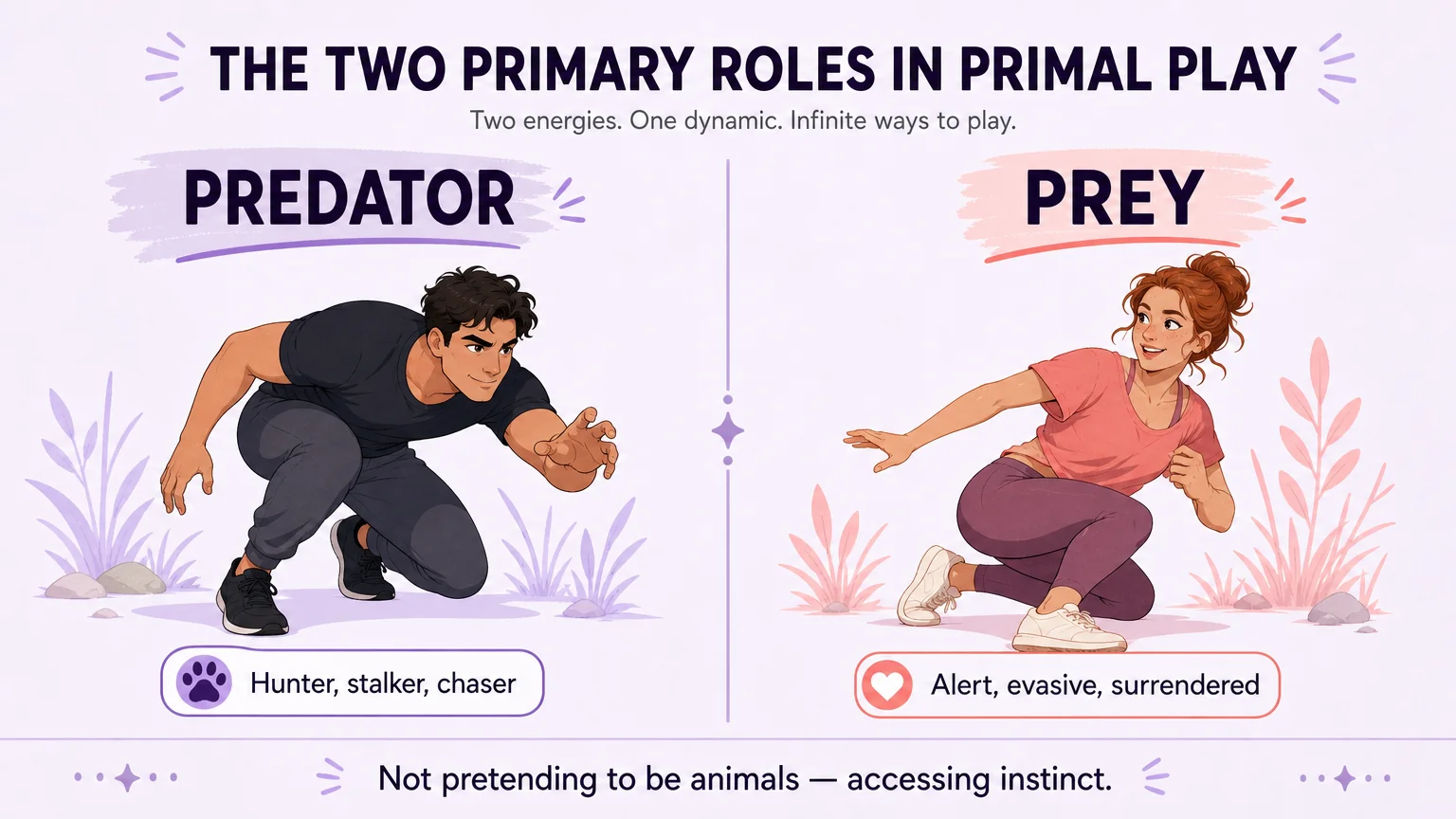
The predator/prey dynamic is the engine. Everything that makes primal play intense, the neurochemical cascade, the altered mental state, the depth of connection afterward, flows from the tension between these two roles.
The Predator headspace. Hyper-focused presence. Heightened sensory awareness. The predator tunes into their partner’s breathing, scent, micro-movements, and shifts in energy with an attention that everyday cognition rarely permits. The thrill is in the hunt, the patience, the calibration: knowing exactly when to close distance and when to let the tension build. The satisfaction is in the capture, the claiming, the resolution of pursuit. Lee Harrington, a prominent educator in the primal community, speaks about shadow work in this context: for some, the predator role offers a consensual channel for aggression that has no other sanctioned outlet. Stepping into it is not losing control. It is directing control with absolute precision.
The Prey headspace. Heightened alertness. The adrenaline of flight. The surrender of being caught. The relief of yielding. Here is the paradox at the center of the prey experience: the prey holds real power through consent and safewords even while performing powerlessness. The surrender is real in the scene and entirely voluntary outside of it. That tension, feeling completely overtaken while knowing you are safe, is what produces the altered state prey describe as liberating. It is the same mechanism that makes a roller coaster thrilling: your body registers danger, your mind registers safety, and the gap between them is where the exhilaration lives.
Roles exist on a spectrum. Not everyone fits neatly into predator or prey. Some people switch depending on the partner or the day. Some identify as Hunters: more patient, more strategic, less about the chase and more about the long game. Some identify as Alphas: protective, pack-oriented, less invested in capture than in guardianship. Some identify as Mates: partnership-focused, bonded, drawn to the connection rather than the contest. The terminology matters less than understanding what draws you. A person who has never growled in their life but feels a pull toward embodied, instinct-driven connection is no less “primal” than someone who has been in the scene for a decade.
For some, primal identity extends beyond scenes entirely. It shapes how they move through the world, how they read social dynamics, how they experience their own body. Kali V frames this as a philosophy of embodied authenticity: less time in your head, more time in your senses. The spectrum runs from “sometimes, in the bedroom” to “this is how I understand myself.” Every position on that spectrum is valid.
Understanding the dynamic is step one. Step two is understanding why it feels the way it feels. And that question has an answer buried in your brainstem.
Why Primal Play Feels So Intense: The Neuroscience
The same neural architecture that makes wolf pups chase each other across a clearing exists in your brain right now. Primal play is not a weird kink your body somehow learned. It is your oldest neural hardware doing exactly what it was built to do.
Jaak Panksepp, the father of affective neuroscience, identified seven primary-process emotional systems conserved across all mammalian brains. One of them is the PLAY system. It operates independently of the neocortex: the thinking, planning, self-monitoring part of your brain that handles language and social filtering. Electrical stimulation of these ancient subcortical circuits produces consistent emotional responses across species, from rats to humans. The PLAY system survives even after radical neo-decortication, which means it does not need your higher brain to function. It predates thought.
When you enter primal headspace, a specific neurological shift occurs. Your prefrontal cortex, responsible for planning, self-monitoring, impulse control, and social filtering, dials down. Your limbic system, the amygdala and hypothalamus, governing survival instincts and emotional drives, takes the wheel. This is cognitive hypofrontality. It is the same mechanism behind flow states in athletes and musicians, but channeled through predator/prey dynamics instead of basketball or Bach.
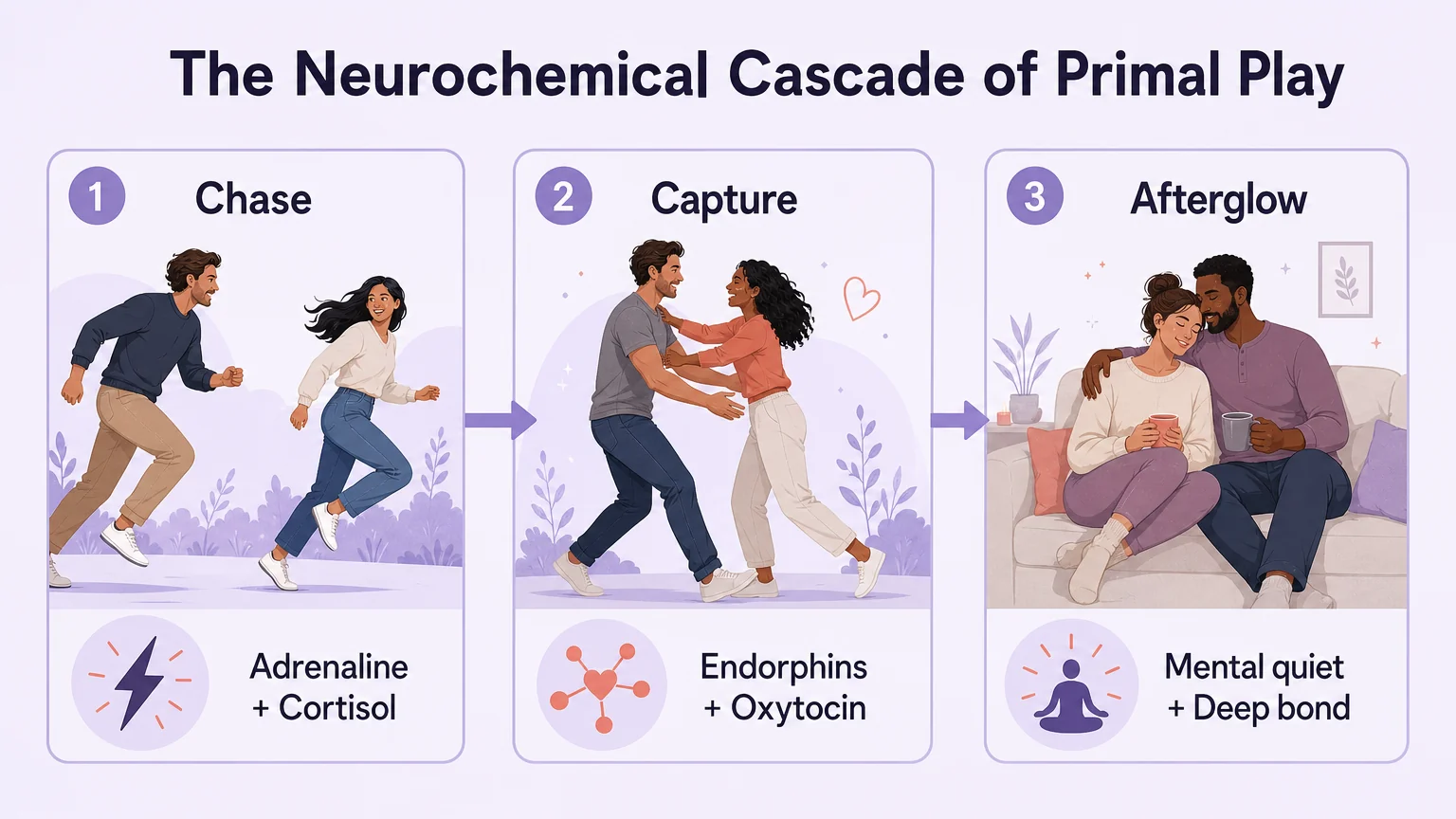
Here is how it unfolds, step by step. The chase activates your sympathetic nervous system. Adrenaline and cortisol flood your bloodstream. Your pupils dilate. Your heart rate climbs. Your body is now in a state that evolution designed for survival, and it does not care that the threat is consensual. Then comes the capture. The moment of contact triggers a surge of endorphins, your body’s natural opioids, and oxytocin, the bonding hormone. The fear chemicals do not simply shut off. They transfer.
This is excitation transfer theory, first described by Dolf Zillmann. The physiological arousal from the frightening or thrilling stimulus does not dissipate when the threat resolves. It lingers in your body and amplifies whatever comes next. The capture feels more intense than standalone sexual arousal because your nervous system is already running at full throttle. The same mechanism makes horror movies enjoyable and roller coasters exhilarating. In primal play, it creates a pleasure spike that your body reads as more profound than anything a calm nervous system could produce.
A 2025 study by Widman et al. in Evolutionary Behavioral Sciences measured exactly this. Using pupil dilation, heart rate, and electrodermal activity during evolutionarily salient scenarios, mate competition, threat, pursuit, the researchers found significant arousal increases across multiple measures. Evolutionarily relevant situations trigger measurable, embodied arousal states that are distinct from generic sexual stimuli. Primal play harnesses that wiring deliberately.
The result is a mental quiet that other kinds of sex or kink often do not produce. The prey experiences something close to ego dissolution: the self that worries, plans, and filters disappears into pure sensation. The predator experiences hyper-focused, almost meditative presence: the world narrows to the partner’s breath, movement, scent, and energy. Both states are variations of the same neurological event. Your oldest brain, temporarily unchained from your newest one, doing what it was built to do.
Primal Play Safety: Consent, Safewords, and Aftercare
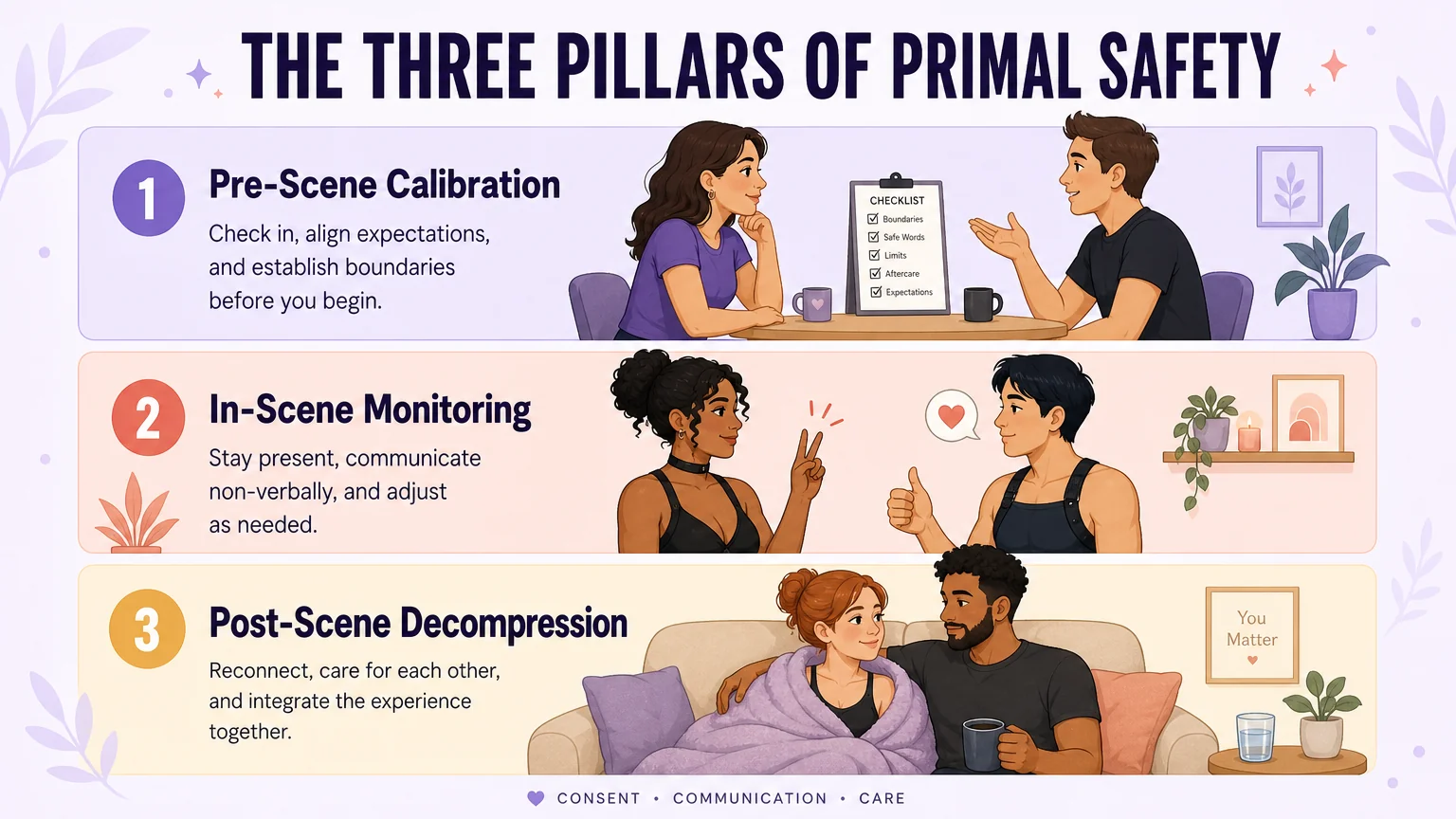
Safety is not the buzzkill that gets in the way of intensity. It is the foundation that lets intensity go further. The people who have the deepest primal experiences are not the ones who throw caution out the window. They are the ones who built a container strong enough to hold what they unleashed.
Primal play is classified as edge play by many practitioners because intentionally evoking raw, unfiltered emotion increases both physical and psychological risk. Adrenaline masks pain. Prey in full flight mode may not register an injury until the scene ends. Predators deep in hunting headspace may push past limits they would never cross in a calmer state. This is not a reason to avoid primal play. It is a reason to approach it with a framework that matches the intensity.
The Three Pillars of primal safety are Pre-Scene Calibration, In-Scene Physiological Monitoring, and Post-Scene Decompression.
Pre-Scene Calibration. Before anything physical happens, both partners need to align on what is about to happen and what is not. The National Coalition for Sexual Freedom recommends a negotiation that covers: intentions and desires for the scene, specific roles and dynamics, the full list of activities on the table (chase, capture, restraint, marking, vocalizations, resistance, sexual contact), hard limits and soft limits, medical conditions and injuries, marking rules (what kind, where, visibility concerns), chase area boundaries, time limits for the scene, sobriety confirmation, and explicit agreement on whether sex is part of this scene or not. A yes can become a no mid-scene. A no cannot become a yes. That principle is non-negotiable.
Primal negotiation must account for adrenaline’s pain-masking effect. Someone in chase-or-capture mode may not register a twisted ankle, a bruised rib, or a bite that broke skin until well after the scene concludes. Both partners need to know each other’s physical vulnerabilities before the adrenaline makes them invisible.
In-Scene Physiological Monitoring. The traffic light system is the universal standard for a reason. Green means all good, keep going. Yellow means pause and check in. Something needs adjustment, but the scene does not need to end. Red means stop this activity immediately. In primal play, verbal safewords are not enough. Speaking breaks primal headspace, and a prey in deep flight mode may not be able to form words. Non-verbal safeword alternatives are essential: a hand squeeze pattern (partner squeezes back to confirm), a double-tap on any body part, dropping a held object, a specific grunt or sound. These must be negotiated before the scene and practiced until they are automatic.
Continuous monitoring means watching skin color, breathing patterns, muscle tension, and eye tracking for signs of dissociation. Distress presents differently from play resistance. Play resistance is engaged, responsive, dynamic. Distress shows as freezing, uncharacteristic stillness, or sudden breath shifts. The predator’s responsibility is to read these signals in real time. This is not a performance burden. It is the price of access to someone else’s nervous system.
Post-Scene Decompression. Primal aftercare is not generic BDSM aftercare. After a primal scene, both partners need grounding: the re-integration of instinctual headspace back into everyday cognition. Prey may need reassurance that the surrender was consensual and safe, that the person who chased them is also the person who will hold them. Predators need to come back from the predator. Dom-drop is real and under-discussed: the emotional crash after accessing aggressive headspace can manifest as guilt, disorientation, or a hollow sense of isolation. Both roles need non-role-based touch, quiet presence, and the explicit signal that the scene is over and the relationship is intact.
An aftercare kit should be assembled before the scene, not scrambled for after: soft blankets, comfortable clothing, water or electrolyte drinks, sugary snacks to stabilize blood sugar, soothing lotion or balms for impacted areas, and a first aid kit. The neurobiology of aftercare explains why this matters: the sympathetic nervous system activation during the scene, the endorphin, adrenaline, and oxytocin surge, does not taper gently. It can plummet. Sub-drop and dom-drop are not signs that something went wrong. They are predictable physiological responses to the withdrawal of a massive neurochemical event. The crash can hit 24 to 72 hours after the scene. Plan for it. A next-day check-in is not optional.
One warning deserves its own paragraph. If a partner expresses a complete lack of aftercare need, treat that with caution, not relief. It may signal dissociation or a freeze response rather than genuine resilience. At minimum, ensure basic physical safety and a firm check-in the following day.
The intensity that makes primal play powerful is the same intensity that makes safety non-negotiable. You cannot have the depth without the container.
How to Start Exploring Primal Play: A Step-by-Step Guide
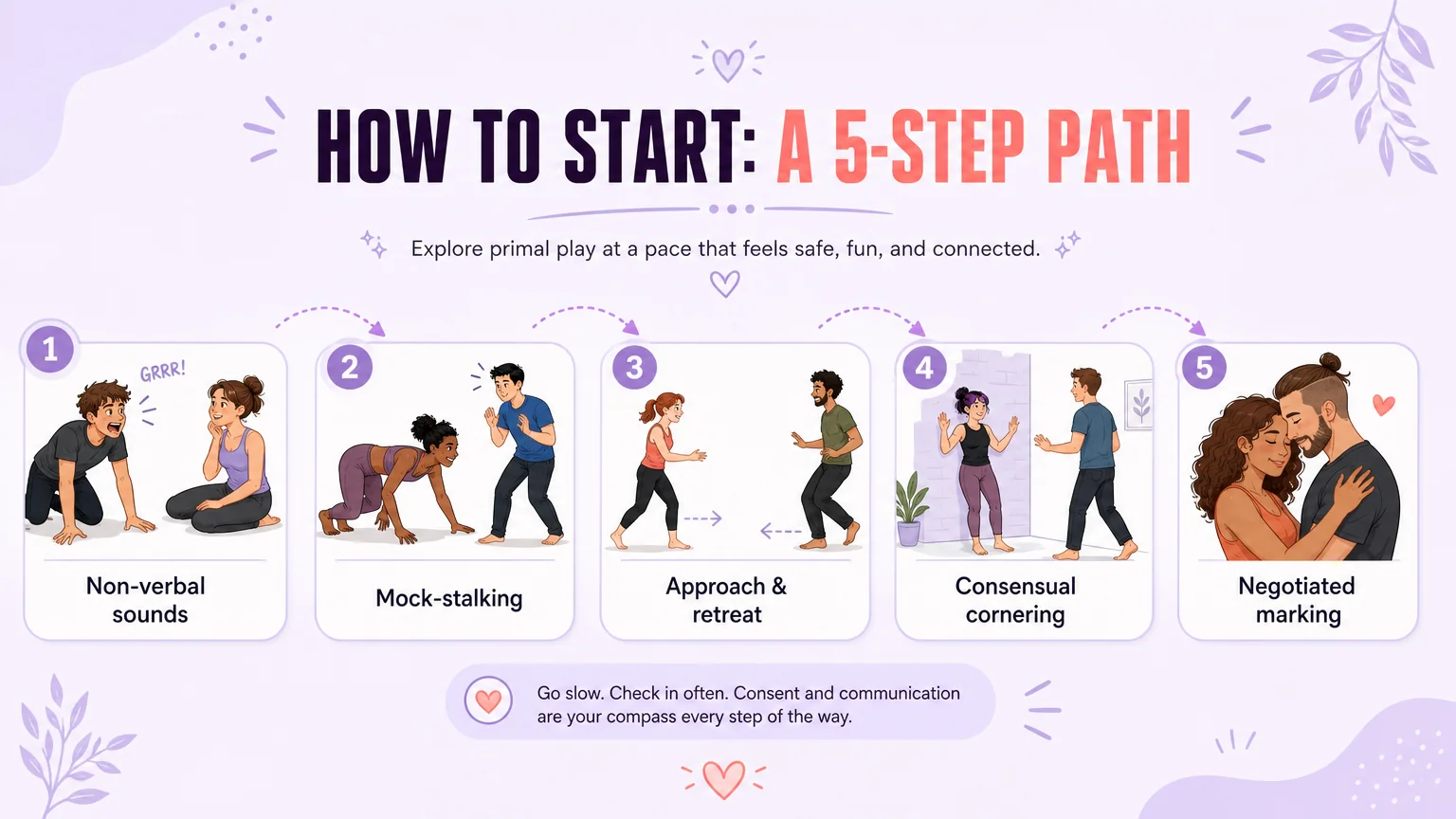
Most people have never said “I want to chase you” or “I want you to hunt me” out loud. The awkwardness is not a sign that you are bad at this. It is a sign that you are about to be honest in a way most people never are.
Start with the conversation. Pick a calm, non-sexual moment. Use collaborative, curious language: “I have been curious about exploring a more instinctual side of intimacy. Have you ever felt that pull, the urge to chase, or be chased, or skip the script entirely?” You can share an article or a video. You can describe the feeling without naming the kink: “Sometimes during sex I feel something older kick in, and I want to understand it. Can I tell you about it?” The goal is not to convince. The goal is to open a door and see if they walk through it.
Follow the 5-step progressive exploration path. Do not jump from “I am curious” to a full chase scene. The best primal dynamics are built over time.
Step 1: Non-verbal sounds. During regular intimacy, introduce growls, whimpers, or heavy breathing without words. Notice what happens. Gauge the other person’s response. This is the lowest-stakes way to test whether an instinctual dynamic resonates between you.
Step 2: Mock-stalking. In a safe, private space, one partner moves with intentional predatory body language, lowered stance, slow movement, maintained eye contact, while the other experiments with alert, evasive posture. This is play-acting, not an actual threat. The point is feeling the dynamic in your body before any physical contact occurs.
Step 3: Approach and retreat. The predator approaches. The prey backs away. Repeat. The tension builds without physical touch. This is where you learn each other’s pacing, where you discover what distance creates the strongest pull.
Step 4: Consensual cornering. The prey allows themselves to be backed against a wall or into a corner. The predator closes distance slowly. Both partners check in throughout. The prey can safeword out at any moment. The escape route is psychological, not physical. That is precisely what makes the surrender feel real within safety.
Step 5: Negotiated marking. Biting, scratching, claiming within pre-agreed limits. This is where the scene becomes fully physical. Every mark has been discussed beforehand. Nothing is improvised.
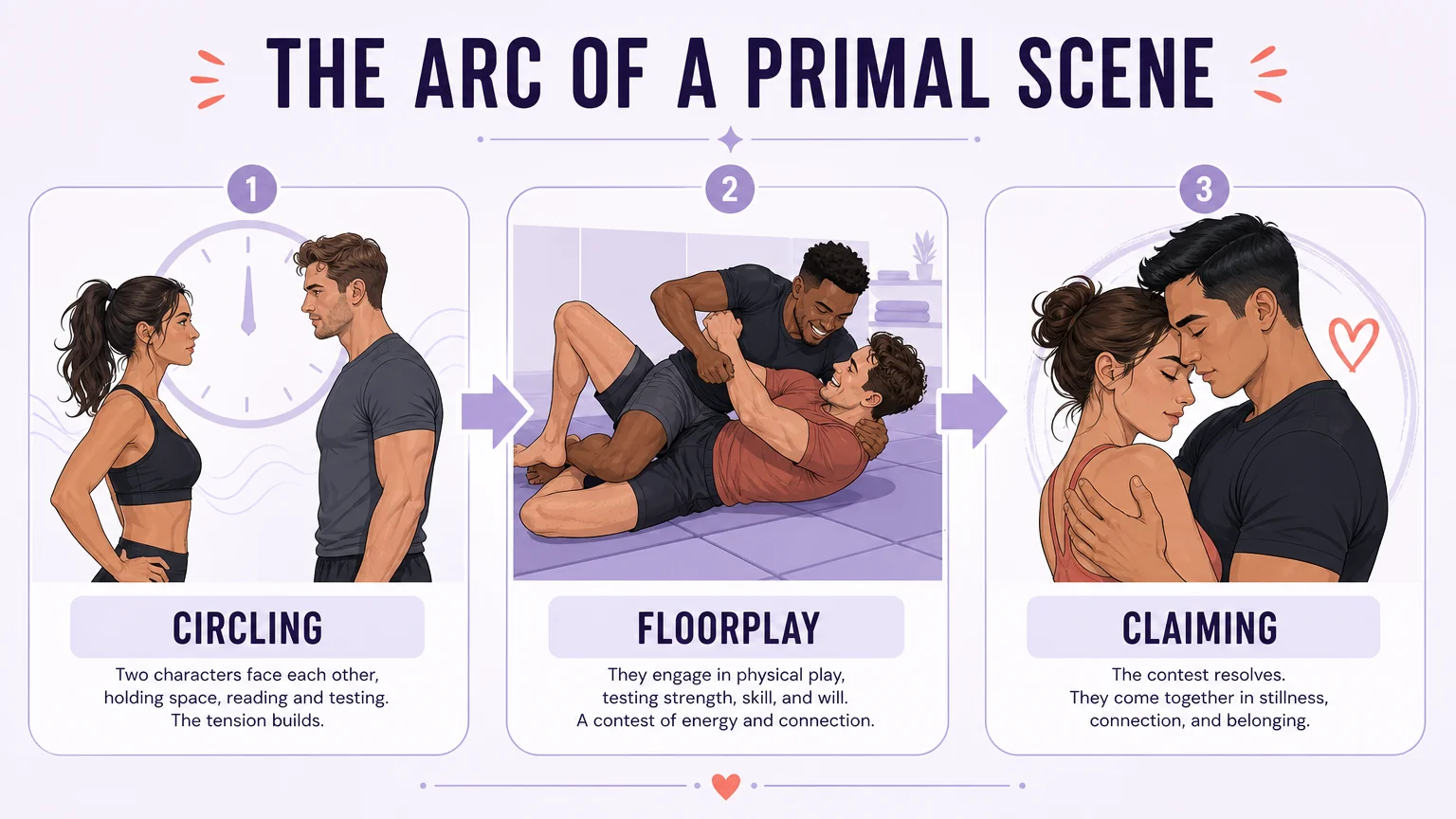
Structure your scenes. A primal scene is not a free-for-all. It has an arc, drawn from APEX primal class methodology: Circling, Floorplay, and Claiming.
Circling builds tension. Partners take in each other’s scent, energy, and body language. Eye contact. The space between bodies. This stage drops both partners into primal headspace before anything physical begins. Floorplay is the physical contest: wrestling, pinning, struggling, the prey fighting back within negotiated bounds. Claiming is the resolution: marking, holding, the closure of the chase. The entire arc may or may not include sex. What it always includes is a beginning, a middle, and an end: a complete experience rather than an escalation without shape.
Debrief after every scene. What worked, what did not, what surprised you, what you want more of. Speed is the enemy of depth. The people who have the best primal experiences are the ones who built trust first and escalated slowly.
7 Common Primal Play Mistakes Beginners Make
These are things real players learned the hard way. None of them are character flaws. All of them are avoidable.
1. Using “no” and “stop” as part of the fantasy while expecting them to function as safewords. The fix is simple: choose clearly artificial safewords that can never be mistaken for in-scene dialogue. The traffic light system or a non-verbal signal removes ambiguity. If “no” is part of the scene, the safeword must be something else entirely.
2. Rushing into a full chase scene without building the dynamic first. The chase is earned. It is the climax of a progression, not the starting point. Follow the 5-step path from the previous section. If you skip straight to the woods, you are gambling with someone’s nervous system.
3. Over-relying on verbal communication during scenes. Speaking breaks primal headspace for both predator and prey. Growls, posture, eye contact, and body language carry more information in less time. Learn to read them.
4. Playing under the influence. Adrenaline is already altering your perception and pain threshold. Adding alcohol or substances amplifies every risk, from missed injury to blurred consent. Sobriety is a prerequisite, not a suggestion.
5. Assuming aftercare is only for the prey. Predators experience dom-drop: the emotional crash after accessing aggressive headspace. They need grounding, non-role-based touch, and the explicit confirmation that their partner is okay. Skipping predator aftercare is how you create guilt that outlasts the scene.
6. Treating primal play as “just rough sex with growling.” Without negotiation, roles, and a scene structure, you are missing what makes primal play distinct and you are operating without the safety net that intensity demands.
7. Expecting to find the right partner quickly. One practitioner spent two years vetting before finding a Dom she trusted enough for primal play. Vetting takes time because the trust threshold is higher than it is for almost any other kind of intimacy. Go to munches. Meet people face to face. Watch how someone handles small boundaries before trusting them with big ones. As one community member puts it: creeps cannot maintain their good-side facade for long.
The meta-lesson across all seven: primal play rewards patience. The people who have the best experiences built trust first and escalated slowly. There is no shortcut.
The Primal Play Community: Packs, Events, and Primal Identity
Primal play can feel isolating. It is less visible than rope bondage or impact play. Finding your people takes effort. But they exist, and they are more organized than you might expect.
A pack, in primal terms, is a group bound by shared instinctual dynamics rather than formal hierarchy. FetLife defines it as a close-knit group beyond casual friendship, though not necessarily romantic or sexual. Packs can function as educational communities, play networks, or chosen families. The Hototo Pack Discord, for example, operates as a primal pack with BDSM resources, online and offline events, and an explicitly LGBTQIA+ inclusive community.
In-person education is growing. APEX (Arizona Power Exchange) hosts primal-focused classes like “Better Prey! Back to our Primal Roots.” The Primal Arts Festival, listed on FetLife, offers structured learning on predator/prey dynamics. Kali V teaches classes on primal identity and created the Primal Hunt, along with a unique colored ribbon system for role signaling within the community.
Not all primal play is sexual. The Primal Play Sisterhood+, facilitated by Paulina Bolek, defines primal as “Authentic; Play = Connection” and runs workshops where clothes stay on. The focus is nervous system regulation, embodied connection, and boundary exploration through co-regulation. This is an important use case for people who want the neurochemical and psychological benefits of primal play without a sexual context.
For some practitioners, primal is not a role they step into during scenes. It is how they understand their baseline state. Kali V frames it as a philosophy of embodied authenticity: being physically in touch with your body, less in your head, engaging from a more instinctual, unfiltered place. Primal identity can encompass joy, silliness, tenderness, and grief, not just intensity. The unifying thread is shedding social masks to connect from a more honest place.
To find community: search FetLife for local primal groups, attend classes at kink conventions, join the relevant Discord servers. Vet communities the same way you vet partners: observe how members treat each other, how they handle disagreement, whether their actions match their stated values. Good primal spaces, like good primal partners, are built on the same foundation: consent, communication, patience, and respect for the power of what you are accessing.
Primal Play FAQ: Common Questions About the Primal Kink
What is primal play?
Primal play is a consensual kink that taps into raw, pre-socialized instinct: predator/prey dynamics, chase, capture, and surrender, outside the scripts of everyday intimacy. It is about accessing wild energy, not pretending to be an animal. A full definition with the distinction from pet play is in the section “What Is Primal Play?” above.
Do I need to identify as an animal to do primal play?
No. Primal play is about accessing instinct, not adopting an animal persona. It is distinct from both pet play (which draws on domestic dynamics like training and ownership) and therian/otherkin identities (which involve identifying as non-human). You do not need to be “a wolf” to access the part of you that already knows how to hunt or flee.
Is primal play the same as CNC?
No. CNC (consensual non-consent) simulates a non-consensual encounter. Primal play unleashes wild, instinctive energy. They can overlap in physical acts (wrestling, pinning, forceful capture) but diverge in intent and headspace. The full distinction framework is in “Primal Play vs. Rough Sex, Pet Play, and CNC.”
How is primal play different from rough sex?
Rough sex is unstructured physical intensity. Primal play is a negotiated scene with roles, dynamics, and a narrative arc (circling, chase, capture, claim). Primal play may not include penetrative sex at all. Rough sex, by definition, does.
What safewords work best for primal play?
The traffic light system (Green = good, Yellow = check in, Red = full stop) plus non-verbal alternatives. Verbal safewords are not enough because speaking breaks primal headspace. Add a hand squeeze pattern, a double-tap on any body part, or dropping a held object. Details are in “Primal Play Safety.”
Do I need special equipment?
No equipment is required. Primal play is driven by bodies and energy. Some players use props (claws, blindfolds, knee pads) but they are optional. What you do need: a padded play area, an aftercare kit, and a removal plan for anything that could cause injury during a tackle or fall.
Can primal play be non-sexual?
Yes. The Primal Play Sisterhood+ runs workshops focused on nervous system regulation and embodied connection where clothes stay on. Primal play can function as catharsis, stress relief, or community bonding without a sexual component.
What is a primal pack?
A group bound by shared instinctual dynamics rather than formal hierarchy. Packs can be educational communities, play networks, or chosen families. More detail is in “The Primal Play Community” section.
How long does it take to come back from primal headspace?
It varies widely. Some people return in minutes. Others need days to fully equalize. The neurochemical crash window of 24 to 72 hours means aftercare should extend beyond the immediate post-scene period. A next-day check-in is standard practice for intense scenes.
How do I find a primal partner?
Start with someone you are already intimate with, if that applies: use the conversation starters in “How to Start Exploring Primal Play.” If you are looking, FetLife groups, kink conventions, and primal-specific Discord servers are the best starting points. Vet face to face, over time. The trust threshold for primal play is higher than for many other kinks, and that is not something to rush.
Is primal play safe?
With proper negotiation, practiced safeword systems, environmental preparation, and aftercare, yes, within the RACK (Risk-Aware Consensual Kink) framework that acknowledges heightened risk and takes informed steps to manage it. Without those elements, the adrenaline-driven intensity creates real physical and psychological risks. Full safety coverage is in “Primal Play Safety.”
What if I cry or have a strong emotional reaction during primal play?
This is common and is not a sign that something went wrong. Primal play accesses deep emotional territory. Tears, big releases, and unexpected emotions are part of the cathartic value of the practice. Your aftercare plan should account for emotional release and hold space for it without judgment.
Can I be primal and also into other kinks?
Absolutely. Most primal players participate in multiple kink communities. Primal is one dynamic among many, and it integrates with broader BDSM practice, ENM/polyamorous dynamics, and vanilla intimacy. There is no purity test.
Am I weird for being curious about this?
No. The same PLAY system that makes wolf pups chase each other exists in your brain. The impulse toward instinct-driven, embodied intensity is neurologically coherent and evolutionarily conserved. Curiosity about primal play is curiosity about a part of yourself that millions of years of mammalian evolution kept intact for a reason.