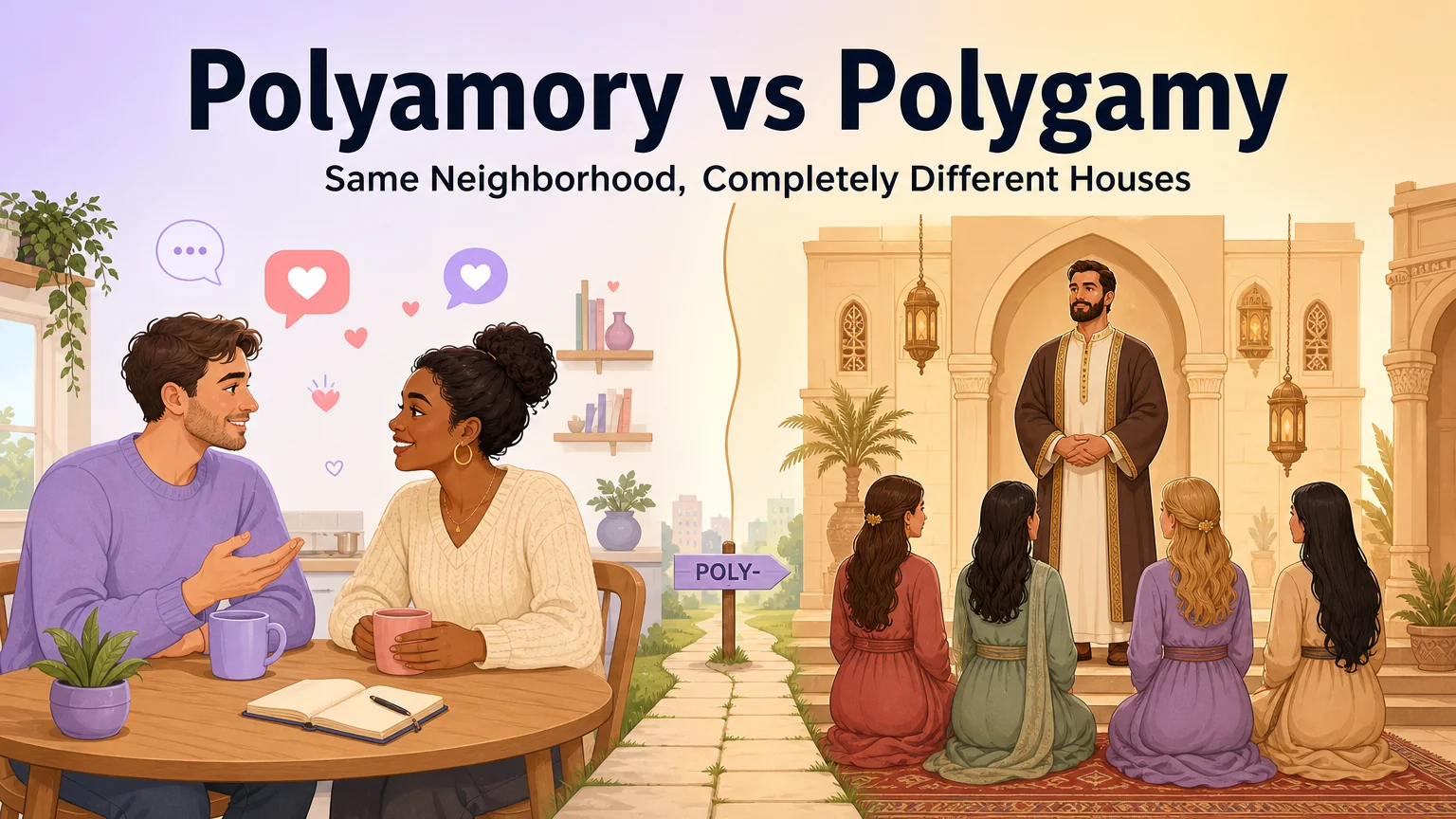
You’re swiping through profiles and someone lists “polyamorous.” A few swipes later, you catch a documentary reference to “polygamy.” Same prefix. Same general idea. Two totally different worlds.
Here’s the thing: both words start with poly- (many). That’s where the overlap ends. One describes a 35-year-old movement built around consent, equality, and loving multiple people with everyone’s full knowledge. The other describes a marriage structure older than recorded history, rooted in religious tradition, and usually patriarchal.
If you’ve ever wondered what actually separates these two (or you’re exploring whether ethical non-monogamy fits your relationship), knowing the difference isn’t vocabulary trivia. It’s the difference between walking into the right room and walking into the wrong one.
First, Let’s Get the Definitions Straight
Before we compare, let’s name what we’re talking about. Not the dictionary version. The lived version.
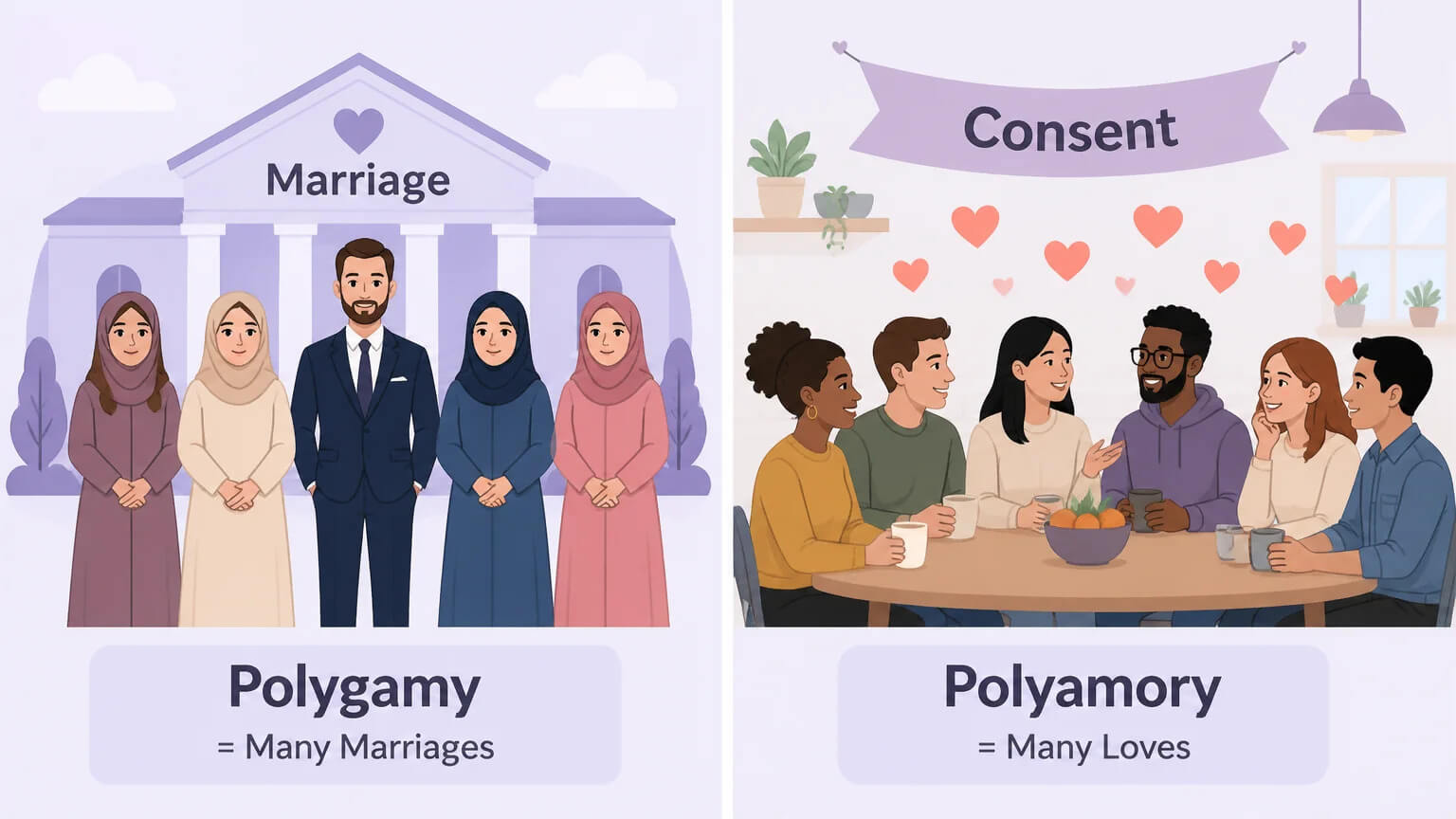
Polygamy means having multiple spouses. The word itself tells the story: poly- (many) plus -gamy (marriage). In practice, it’s almost always one man married to multiple women. Researchers call this polygyny. It’s legal in roughly 57 countries, concentrated in Muslim-majority nations in Africa and the Middle East. It’s criminalized throughout the West. About 2% of the global population lives in polygamous households, with the highest rates in Burkina Faso (36%), Mali (34%), and Gambia (30%). The container is marriage.
Polyamory means having multiple loving relationships with the full knowledge and consent of everyone involved. Poly- (many) plus -amor (love). The word was deliberately coined in 1990 by Morning Glory Zell-Ravenheart around a kitchen table in Mill Valley, California. She wanted a word that meant “many loves,” not “many spouses.” The Oxford English Dictionary added it in 2006. Roughly 1 in 5 American adults have tried some form of consensual non-monogamy. About 1 in 9 have specifically practiced polyamory. The container is consent.
The suffixes do the heavy lifting. -gamy means marriage. -amor means love. Everything else flows from there.
1. Consent: Who Decides, Who Knows
“If it’s not ethical and it’s not consensual, it’s not polyamory.” That’s the community’s north star, and it’s not marketing. It’s the atomic difference between these two models.
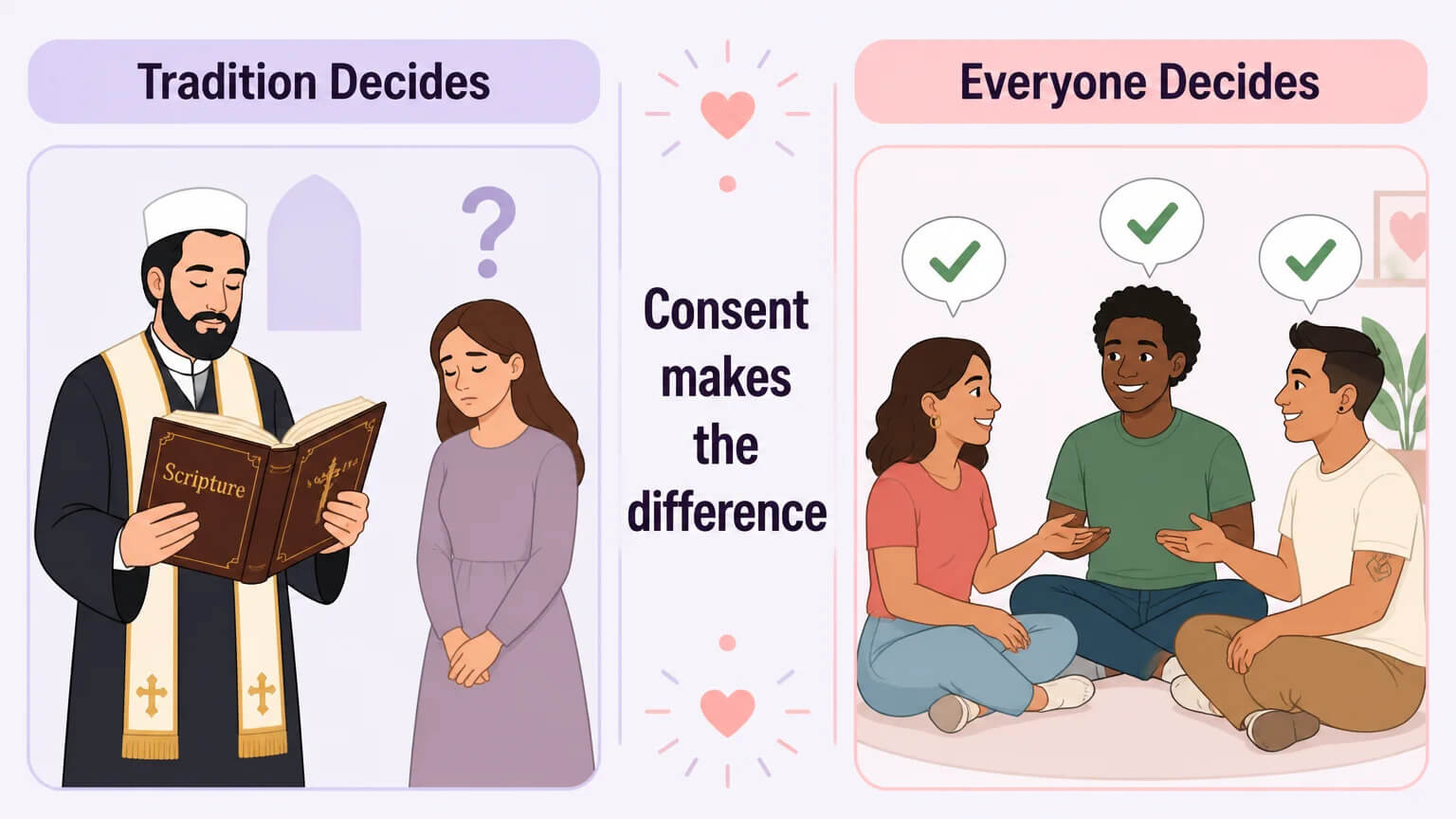
In traditional polygynous marriages, the existing wife or wives may have no formal say in whether the husband takes another spouse. In some interpretations of Islamic family law, a husband doesn’t need his first wife’s permission to marry again. In fundamentalist Mormon communities, spiritual directives override individual consent. The structure doesn’t require everyone at the table to say yes.
Polyamory does. Informed, enthusiastic consent from every person involved is non-negotiable. The framework is FRIES: Freely given, Reversible, Informed, Enthusiastic, Specific. If any partner is in the dark, uncomfortable, or going along to avoid losing someone, the community doesn’t call that polyamory. It calls it cheating with extra vocabulary.
Polygamy asks: “What does tradition permit?” Polyamory asks: “What does everyone in this room actually want?” Those are different questions with different answers.
If you’re exploring non-monogamy, consent isn’t a checkbox. It’s the whole game. The difference between an agreement and coercion is whether “no” is a safe answer.
2. Gender: Patriarchal Structure vs Egalitarian Ethos
Polygamy isn’t “multiple people marrying each other.” It’s almost always one man marrying multiple women. The gender arrow points one direction.
Polygyny dominates globally, from West African family compounds to Gulf State households to fundamentalist Mormon enclaves. Polyandry (one wife, multiple husbands) exists in pockets of Tibet, Nepal, and Sri Lanka but is vanishingly rare. The structure encodes male authority as a feature. It wasn’t designed to be equal; it was designed to concentrate power.
Polyamory was built from the ground up as gender-neutral and deliberately anti-patriarchal. Researcher Elisabeth Sheff put it plainly: “One of the most distinguishing characteristics of polyamory is that it allows women multiple partners.” The 2025 OPEN community survey found only 24% of CNM respondents identify as heterosexual. Only 71% identify as cisgender. This is a community that skews heavily queer, gender-diverse, and feminist.
One system was designed by and for men within hierarchical religious traditions. The other was built by queer feminists, counterculturalists, and people who explicitly rejected that template. If gender equality is non-negotiable for you, the distinction writes itself.
3. Roots: Ancient Religious Tradition vs a 35-Year-Old Movement
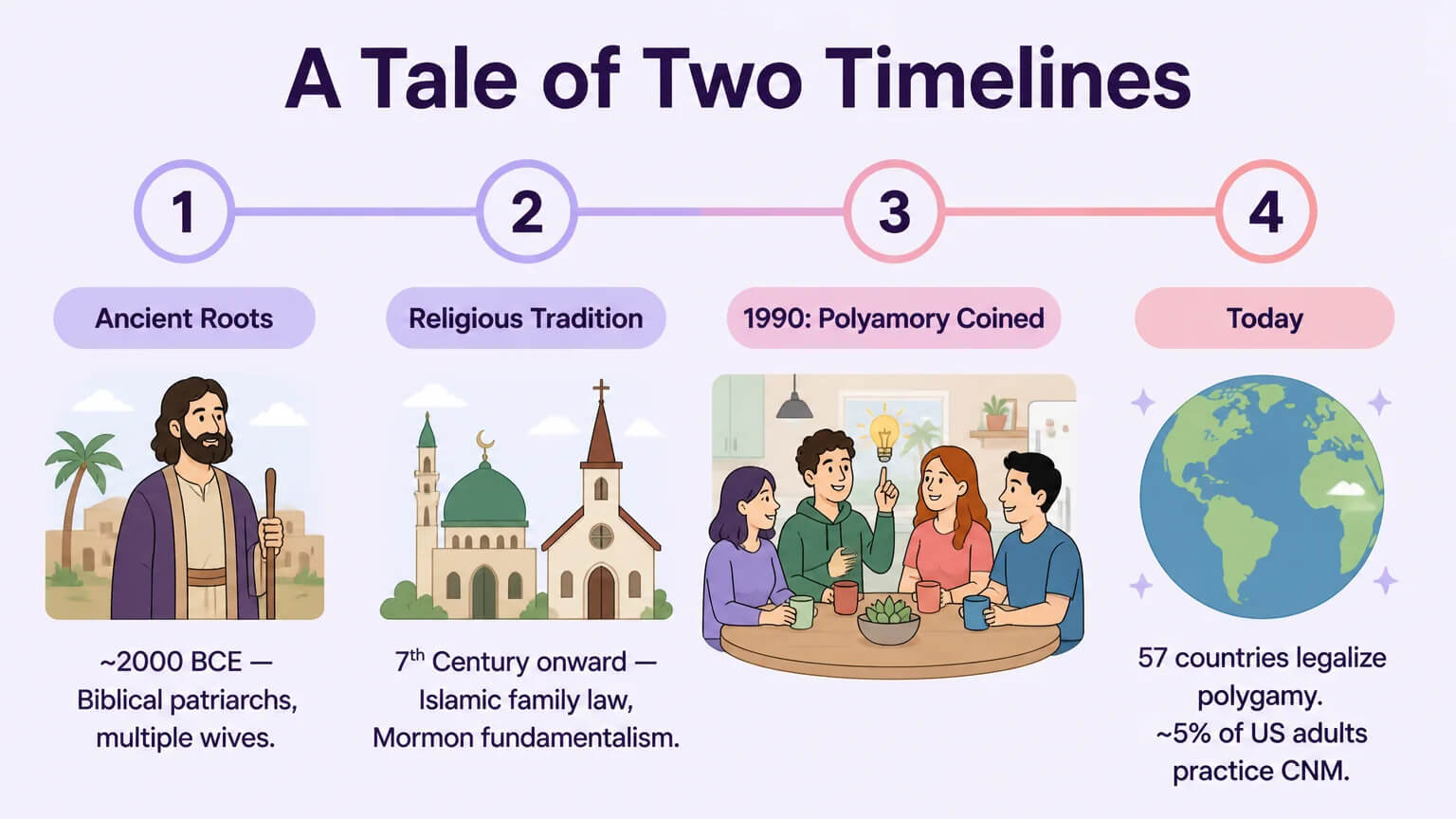
King Solomon had 700 wives. The word “polyamory” was coined the same year the Hubble Space Telescope launched. Their origins explain almost everything about how they operate.
Polygamy has been practiced for millennia. Biblical patriarchs like Abraham and David had multiple wives. Pre-Islamic Arabian tribes practiced it. Chinese emperors maintained vast harems. Today it survives primarily in Muslim-majority countries under Islamic family law and in fundamentalist religious communities like certain Mormon offshoots. It’s embedded in scripture, inheritance systems, and centuries of precedent. The rules were written long before you were born.
Polyamory was born in 1990 in a California kitchen. Morning Glory Zell-Ravenheart, her husband Oberon, Deborah Anapol, and Paul Glassco sat down and invented a word for what they were already living. The first online community (alt.polyamory on Usenet) launched in 1992. The OED added the word in 2006. The academic research explosion is even newer: 94 papers from 2010 to 2019, and 90 more in just 2020 to mid-2023.
This is a movement still figuring itself out in real time. Polygamy comes with inherited rules. Polyamory comes with the responsibility of writing your own. One is an inheritance. The other is an invention. Choose accordingly.
4. The Law: Criminalized Marriage vs Unrecognized Relationships
You can go to prison for polygamy in all 50 U.S. states. You can’t go to prison for polyamory. But you can lose custody of your kids.
Polygamy is criminalized throughout the Western world as bigamy. In Canada, fundamentalist Mormon leaders Winston Blackmore (25 wives) and James Oler (5 wives) were convicted and sentenced. In the U.S., polygamy is prosecuted most aggressively in Utah and Arizona, often targeting fundamentalist Mormon communities. It remains legal in those 57 countries across Africa, the Middle East, and parts of Asia, almost all Muslim-majority.
Polyamory occupies a stranger legal space. Having multiple unmarried partners is perfectly legal. But the legal system has no category for your family. No jurisdiction anywhere recognizes more than two legal parents. Custody battles can weaponize your relationship structure against you. Inheritance requires elaborate workarounds: trusts, powers of attorney, cohabitation agreements, sometimes LLCs to hold shared property. Family attorney John-Paul Boyd describes polyamorous families as “attempting to discern whether they fit within particular definitions.” They don’t. That’s the problem.
Neither structure fits the legal system’s assumption that family equals two people. The difference: polygamy is actively punished with criminal penalties. Polyamory is just ignored until something goes wrong, at which point the absence of legal recognition becomes a weapon that can be used against you in court.
For CNM families who want to protect themselves, the standard toolkit includes durable powers of attorney for healthcare decisions, revocable living trusts for shared assets, explicit wills that name all partners, cohabitation agreements that function like prenups for multi-partner households, and sometimes LLCs to jointly own property. None of these are perfect substitutes for marriage. They’re patchwork. But they’re what exists while the law catches up.
5. The Emotional Architecture: Jealousy, Compersion, and the Communication Tax
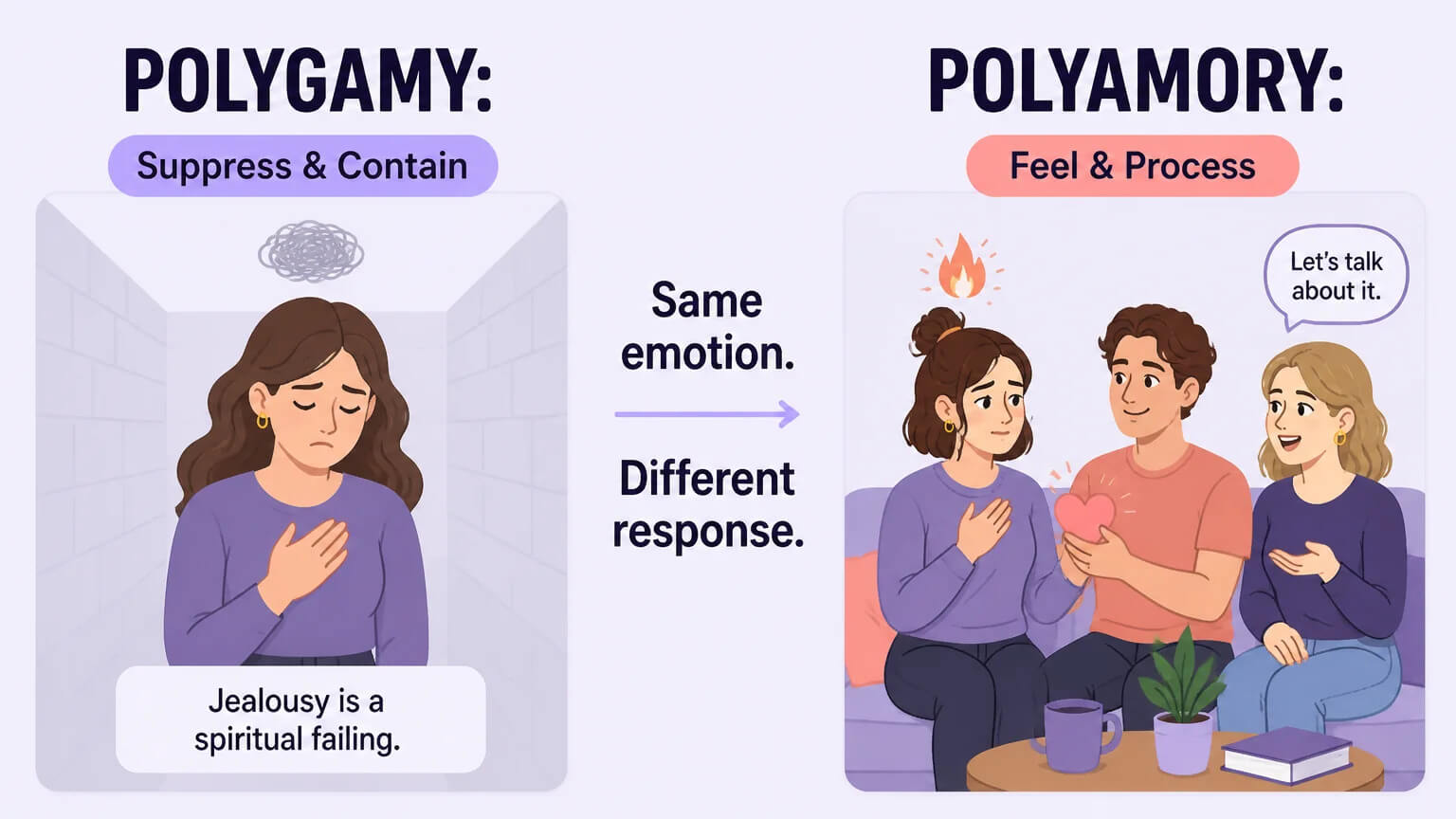
“I could never do polyamory. I’m too jealous.” Here’s what that assumes: that polyamorous people don’t get jealous. They absolutely do. They just handle it differently.
In traditional polygyny, jealousy is managed through structure. Separate households. Clear hierarchy. Religious obligation. Wives may be expected to suppress jealousy as a spiritual discipline. The husband’s authority resolves disputes. This can work as emotional containment, but it frequently buries resentment that surfaces in other ways: depression, competition between wives, estranged children.
Polyamory treats jealousy as data. A dashboard light indicating where your emotional engine needs attention. Authors Jessica Fern and David Cooley describe jealousy as “a single word covering many nuanced feelings”: anger, fear, possessiveness, sadness, loneliness, inadequacy. The work isn’t eliminating the feeling. It’s identifying which one you’re actually experiencing and addressing the root, not the symptom.
Then there’s compersion: the word for feeling genuine joy when your partner finds happiness with someone else. It’s not required for healthy polyamory. But it can be cultivated: start by practicing genuine happiness for friends’ successes, then extend that muscle to romantic contexts. Many people report it took years of conscious effort, and it coexists with jealousy rather than replacing it.
The communication tax is real. Polyamory demands more conversations, not fewer. Regular check-ins. Explicit agreements. Metacommunication means stating the goal of a conversation before you start it, so your partner knows whether you’re asking for support, solving a problem, or just sharing. “I’m not asking you to fix anything. I just need you to hear me.” That sentence alone prevents more fights than most couples will ever know.
One practical framework from polyamory educators: before any difficult conversation, signal which of five goals you’re serving. Connection and closeness. Sharing information. Asking for support and comfort. Solving a problem together. Making a decision together. When both people know which mode the conversation is in, the defensiveness drops. You stop fighting about whether to fix something when the other person just wanted to be heard.
6. The Relationship Spectrum: From Polygyny to Relationship Anarchy
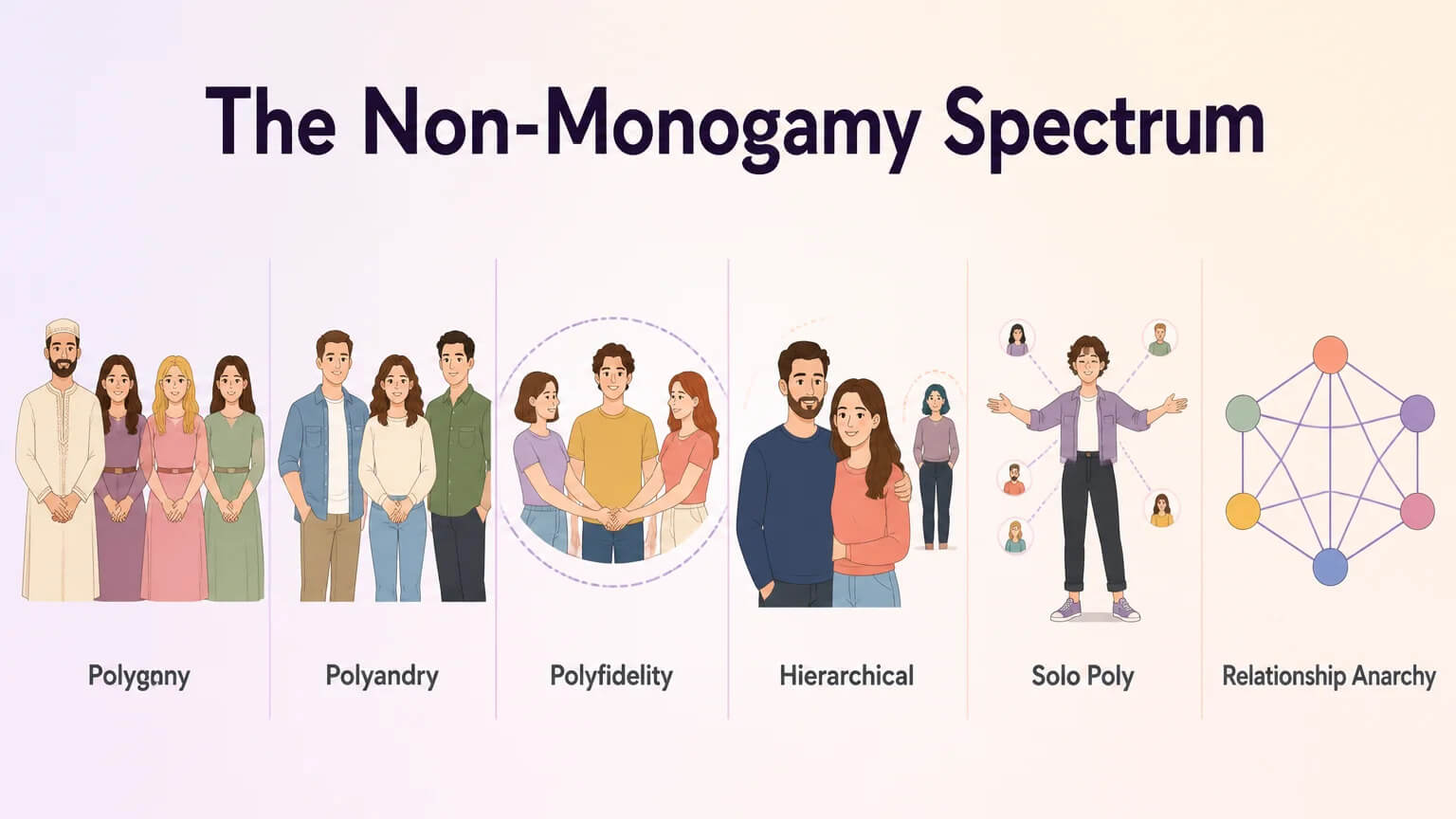
“Polyamory” isn’t one thing. It’s at least five different things sharing the same name.
Polygamy gives you two options. Polygyny: one man, multiple wives. Polyandry: one woman, multiple husbands. That’s the menu.
Polyamory is a spectrum:
Polyfidelity: A closed group of three or more people exclusive to each other. Like monogamy, but with more people in the circle.
Hierarchical polyamory: Primary partner plus secondary partners. Clear priorities, clear agreements about what’s shared and what’s protected.
Solo polyamory: Multiple intimate relationships with no primary partner, no cohabitation, and no relationship escalator. Autonomy is the point. The relationship with yourself is the primary one.
Kitchen table polyamory: Everyone is comfortable enough to share meals together. Metamours (your partner’s other partners) become friends. Group dinners, shared holidays, open communication across the whole network.
Parallel polyamory: Partners know about each other but don’t interact. Different worlds, same person. Sometimes this is preference; sometimes it’s what keeps things functional when personalities clash.
Relationship anarchy: Rejects all hierarchy. No type of relationship (romantic, sexual, platonic) is inherently more important than another. Originated from Andie Nordgren’s manifesto. You build each connection from scratch without borrowed rules.
The question isn’t “am I polyamorous?” It’s “which version, if any, fits how I actually want to live?”
7. What Daily Life Actually Looks Like
Definitions are clean. Daily life is Google calendars.
In polyamorous households, scheduling is a legitimate relationship skill. Families with children report expanded support networks: more adults means more hands for childcare, more perspectives on parenting decisions, more financial contributors. Elisabeth Sheff’s 20-year longitudinal study found children in polyfamilies tend to be confident and healthy, with parents practicing collaborative, free-range parenting styles. A 2024 Canadian study of CNM parents found “the vast majority reported that benefits considerably outweighed difficulties.”
The challenges are real. Time management across multiple relationships takes genuine work. New Relationship Energy (the intoxicating early phase of a new connection) can make existing partners feel displaced. And the world is built for couples: housing applications, hospital visitation, school enrollment forms. Every form that asks for “spouse” is a small reminder that your family doesn’t fit the template.
In polygynous households, daily life typically revolves around the husband as central authority. Wives may live in separate homes or share a compound. Sister wife dynamics range from genuinely cooperative to quietly competitive. Children are raised collectively, but within a clear patriarchal structure where the father’s word is final.
Both models create extended family networks. The difference is who holds the power within them. And for all the practical complexity, the people living these lives describe something more ordinary than outsiders expect. Groceries. School runs. Arguments about whose turn it is to do dishes. The same texture as any other family, just with more people at the dinner table.
8. The Myths That Won’t Die
Most of what people think they know about polyamory and polygamy comes from TV shows, tabloids, and that one friend who had a bad experience. Let’s clear the lens.
“Polyamory is just cheating with a vocabulary.” Cheating requires deception. Polyamory requires disclosure. If everyone knows and everyone consents, it’s not cheating by definition. If someone is in the dark, it’s not polyamory.
“Poly people don’t get jealous.” They do. They just don’t treat jealousy as a stop sign. It’s information, not a verdict.
“It’s all about sex.” Asexual and demisexual polyamorous people exist. Emotional intimacy is the core. Sex may or may not be part of the picture.
“It’s a phase before real commitment.” Multi-decade polyamorous families raising children together will disagree. Commitment looks different, not absent.
“Polygamy is always oppressive.” Some women in polygynous households report genuine satisfaction, community, and shared domestic labor that makes life easier than solo parenting. The structure can be patriarchal without every individual experience being miserable. Nuance exists.
“It’s the same everywhere.” Polygamy in a West African village, a Gulf State city, and a fundamentalist Mormon compound in Utah are three completely different experiences. Context reshapes everything.
“If you’re polyamorous, you can’t be religious.” Polyamory is predominantly secular, but spiritual polyamory exists. Some people practice polyamory within Pagan, Unitarian Universalist, and liberal Christian communities. The distinction is that polyamory treats spiritual belief as personal, not structural. Nobody is required to marry anyone because scripture says so.
The goal isn’t defending or attacking either model. It’s seeing them clearly enough to make your own call.
The Bottom Line
Polygamy is marriage multiplied: ancient, religious, patriarchal, and illegal in the West. Polyamory is love multiplied: modern, secular, egalitarian, and built on consent as the non-negotiable foundation.
If you want a structure that comes with inherited rules and clear hierarchy, that’s closer to polygamy’s architecture (legal issues aside). If you want to co-create your relationship agreements from scratch with equal partners, polyamory was designed for that.
Ask yourself: is gender equality non-negotiable for you? Do you need a tradition to follow, or do you want the freedom to build your own? Are you opening from a place of security and abundance, or trying to fix something that’s already breaking?
The win isn’t picking the right label. It’s knowing yourself well enough to pick honestly. Great relationships don’t outgrow adventure. They build a bigger container for it. But the container needs to be one you actually chose, not one you inherited by default.
And if you’re not sure yet, that’s fine. Read. Talk to your partner. Join communities. Nobody needs to decide tomorrow. The people who thrive in any relationship model (monogamous, polyamorous, or somewhere in between) share one thing: they stopped doing what they were told and started asking what they actually wanted.
FAQ
Is polyamory just cheating with extra steps?
No. Cheating involves deception and broken agreements. Ethical polyamory requires informed, enthusiastic consent from every person involved. If everyone knows and everyone consents, it’s not cheating. If someone is in the dark, the community doesn’t call it polyamory.
Can polyamorous people get married?
A pair within a polycule can legally marry each other. No country currently recognizes marriages of three or more people. Many polyamorous families use legal workarounds like powers of attorney, wills, trusts, and cohabitation agreements to approximate the protections marriage provides.
What’s the difference between polyamory and an open relationship?
Open relationships typically focus on physical and sexual connections outside the primary partnership without romantic attachment. Polyamory involves multiple loving, emotionally intimate relationships. Both fall under the ethical non-monogamy umbrella but have different centers of gravity. Check this guide to find more details >>
Where is polygamy actually legal?
Roughly 57 countries, almost all Muslim-majority nations in Africa and the Middle East. It’s criminalized throughout the West. About 2% of the global population lives in polygamous households.
Do polyamorous people raise children?
Yes. Research suggests children in polyfamilies develop well, with expanded support networks as a key benefit. The challenges are external: stigma and legal discrimination, not the family structure itself. See Section 7 for the full picture.
How do I start the conversation with my partner?
Use metacommunication. State your goal before you speak: “I just want to share something. I’m not asking for any decisions today.” Use “I” statements. Don’t demand. Give them time to process. This is an ongoing dialogue, not a one-time announcement. See Section 5 for the communication framework.
Is polyamory right for us?
It tends to work when both partners genuinely want it (not one going along to keep the other), you have strong communication skills or are willing to build them, and you’re opening from a place of security rather than trying to fix a broken relationship. Polyamory amplifies existing dynamics. It doesn’t repair them.