
Your partner comes home buzzing from a date. They are lighter than they have been in weeks, carrying a glow you recognize from the early days of your own relationship. Instead of the knot in your stomach you expected, you feel something else. A warmth. An unexpected lightness in your own chest.
That feeling has a name. What is compersion, exactly? It is the joy you feel when someone you love experiences joy with someone else. The definition is simple. The experience is not. This thing has roots 2,500 years deep, a biological signature, a dark side, and a lot of cultural baggage wrapped around it.
Compersion, Defined: More Than the Opposite of Jealousy
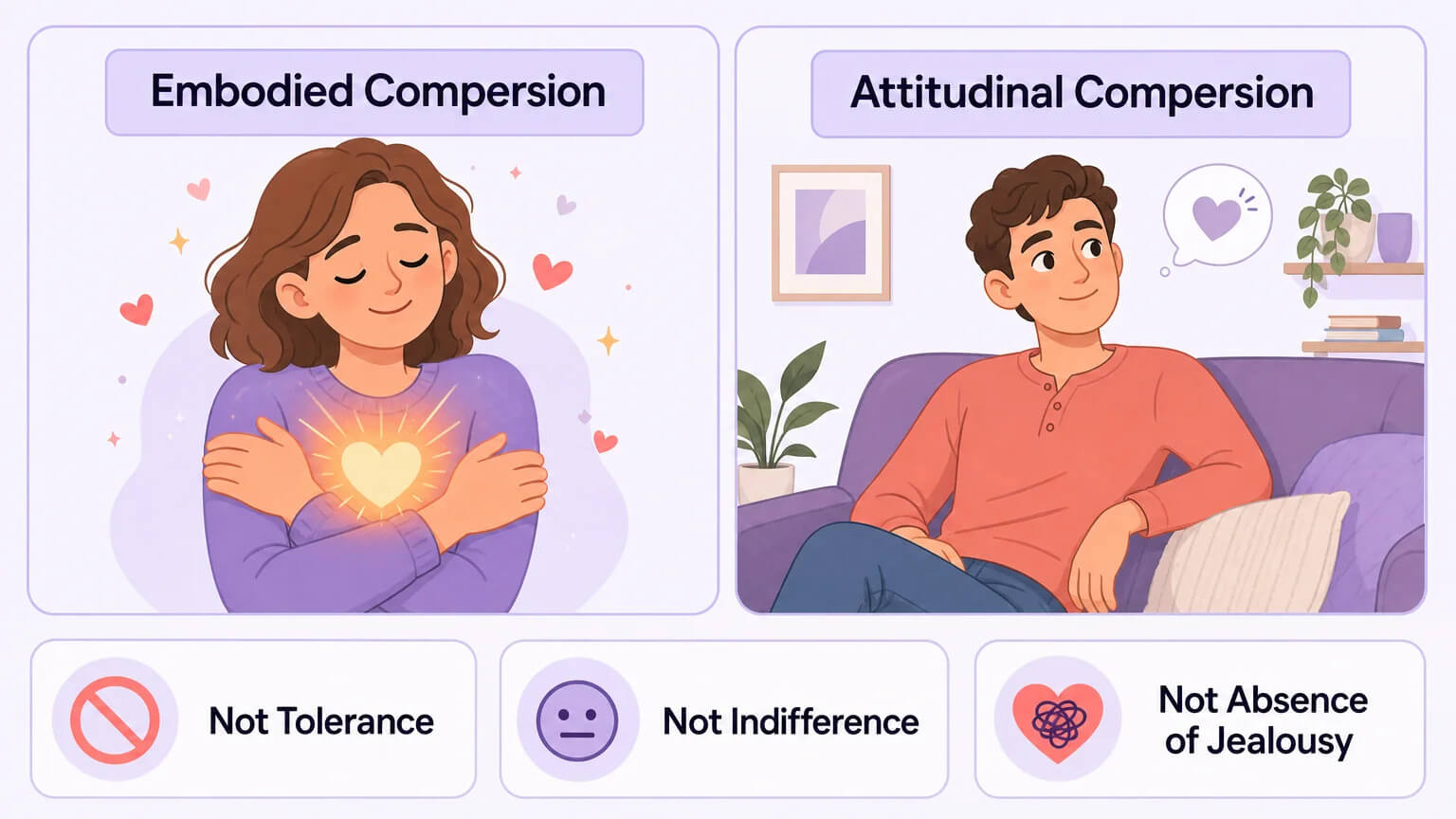
Compersion is the experience of joy or happiness in response to a loved one’s positive experience with another person. That is the cleanest version. The layers underneath matter more.
Marie Thouin, who wrote the book on this topic, splits it into two types that make sense of how the feeling actually lands. Embodied compersion is visceral: a physical warmth, a flutter, a genuine thrill that lives in the body. Attitudinal compersion is cognitive: a stance you take, a way of framing the situation. “I am glad this is happening for them” counts just as much. Both types are valid.
This matters because it removes the performance pressure. You do not need a full-body rush of euphoria every time your partner connects with someone else. Sometimes compersion looks like sitting on the couch and meaning it when you say “That sounds like it was really good for you.”
Compersion is also not tolerance, indifference, or the absence of jealousy. Tolerance is gritting your teeth. Indifference is checking your phone because you genuinely do not care either way. Absence of jealousy is a blank space. Compersion is a positive presence. It adds something.
The word itself comes from the Kerista Commune, a polyamorous community in San Francisco during the 1980s. They needed language for something English could not hold. So they built it.
Where the Word Comes From: Kerista, Buddhism, and the Long History of Shared Joy
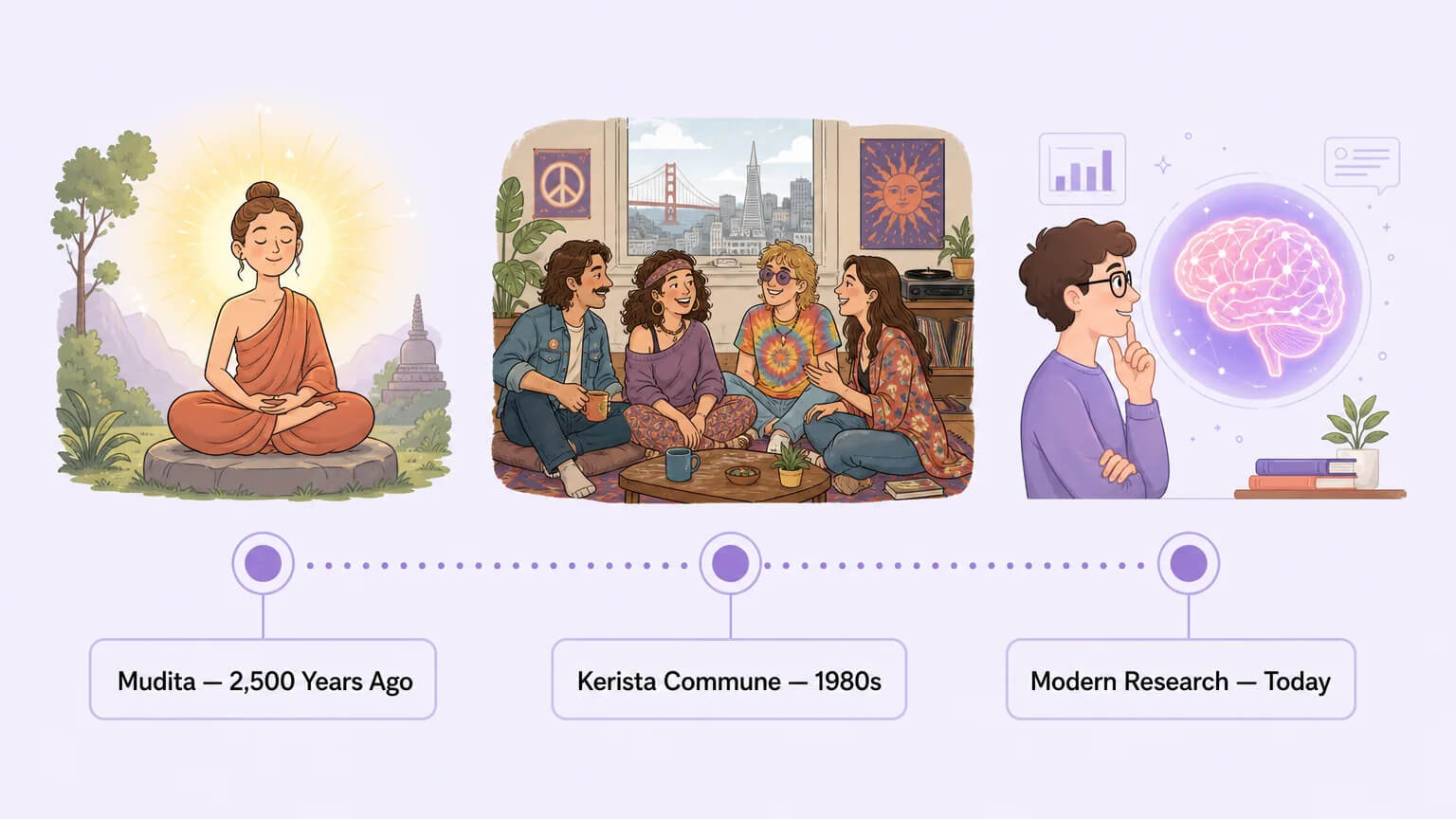
The Kerista Commune gave us the word in the 1980s. A group of people in an intentional polyamorous community looked at their emotional landscape and realized they needed vocabulary that did not exist. They coined “compersion” to describe the happiness of watching a partner’s joy with someone else.
The feeling is ancient.
Roughly 2,500 years before Kerista, Buddhist teachings described mudita: “sympathetic joy,” one of the four brahmaviharas, or divine abodes, alongside loving-kindness, compassion, and equanimity. Mudita is the practice of finding genuine happiness in the good fortune of others. Not envy. Not comparison. Joy because someone else is experiencing something wonderful.
Both traditions treat shared joy as a practice, not a fixed trait. You cultivate mudita the same way you develop patience. This is not something you are or are not. It is something you get better at.
Researchers Yuen, Zorlein, and Walter made this connection explicit in a 2024 paper titled “It is not just the opposite of jealousy: a Buddhist perspective on compersion.” Their central argument: love need not be zero-sum. One person’s joy does not subtract from yours. Buddhist psychology understood this millennia before Western relationship science caught up.
Cross-cultural patterns reinforce the point. In collectivist cultures, shared joy is assumed, not treated as radical. When relationships are communal by default, feeling threatened by another person’s happiness makes less intuitive sense. Compersion feels like a big deal in individualistic cultures because those cultures run on scarcity assumptions about love and attention.
The Neuroscience of Feeling Joy for Someone Else’s Joy
Compersion is not just a nice idea. It has a biological signature.
When you feel compersion, your reward pathways activate. The ventral tegmental area and the nucleus accumbens, the same regions involved in pleasure, motivation, and social bonding, light up. Oxytocin surges. That warmth is not metaphorical. It is neurochemical. Your empathy networks, including the insula and anterior cingulate cortex, engage to process and mirror the emotional experience of someone you care about.
Jealousy activates a different set of regions. The dorsal anterior cingulate cortex and the insula light up the same way they do during physical pain. Social rejection and romantic jealousy share neural real estate with a broken bone. Your brain processes the threat of losing connection as a genuine injury.
These systems are not either/or. They operate simultaneously. You can feel the sting of jealousy in your social pain networks at the exact same moment your reward pathways register warmth at your partner’s happiness. Neuroscience confirms what people in non-monogamous relationships have been saying for decades: feeling both at once is not a contradiction. It is how the brain works.
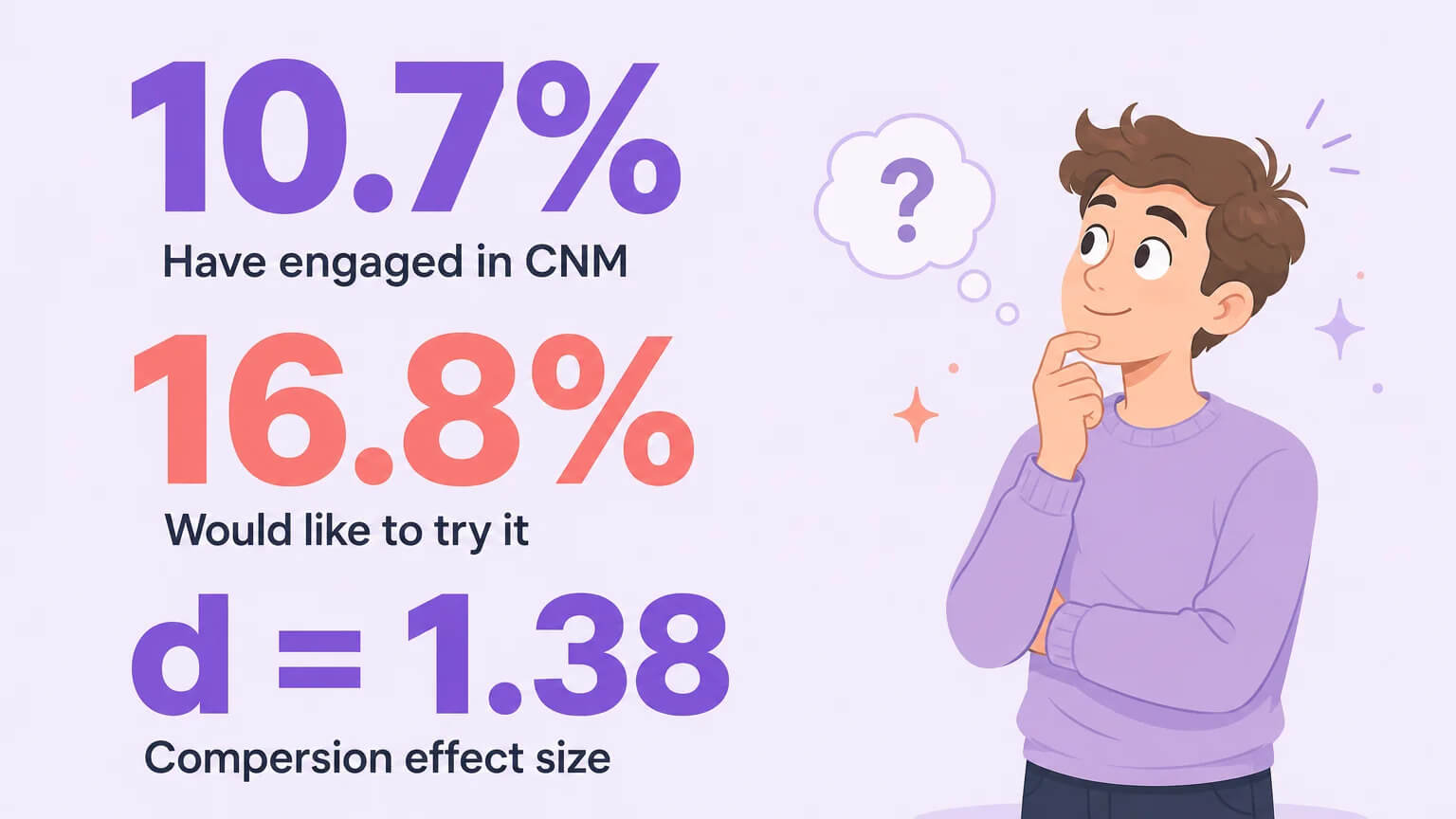
A 2024 study by Buczel, Szyszka, and Mara in the Archives of Sexual Behavior put numbers behind it. Consensually non-monogamous individuals scored significantly higher on compersion measures than their monogamous counterparts, with a large effect size of d = 1.38. That is not marginal. It is substantial. But the distributions overlap. Plenty of monogamous people experience compersion, and plenty of non-monogamous people do not. The lifestyle does not create the feeling. It creates more contexts where the feeling becomes relevant.
Neural pathways strengthen with use. Every time you reach for empathic joy instead of threat perception, you are rewiring the circuits. Compersion is a skill in the same sense that playing an instrument is a skill. The brain changes with repeated effort. There is no fixed ceiling.
Compersion and Jealousy Can Coexist: They Are Roommates, Not Opposites

The most damaging idea about compersion is that it sits opposite jealousy on a single scale. If compersion shows up, jealousy must be absent. If jealousy appears, compersion has failed. That is not how it works. These are independent systems running on parallel tracks. They coexist in the same person, about the same situation, at the same moment.
Effy Blue, a relationship coach who works with non-monogamous dynamics, puts it well. “Jealousy is a fire alarm,” she says. “Find out if there is a real fire or burnt toast.” The alarm is information. Compersion does not disable it. It adds another system that registers warmth instead of smoke.
The Buczel study mapped a pathway: cognitive empathy leads to compersion, which reduces the intensity of jealousy, which increases relationship satisfaction. Notice what comes first. You do not eliminate jealousy and then earn compersion as a reward. You build empathy first. That opens the door.
This shifts the question entirely. Instead of “How do I stop feeling jealous so I can feel compersion?” the right question is “How do I connect more deeply with my partner’s experience?” That is a question you can actually work with. Compersion does not need jealousy to leave the room before it can enter. They share space.
Accepting this is itself a relief. The shame of feeling jealous when you are supposed to feel compersion is often more painful than either emotion alone. When jealousy stops being a failure state, you can hold both feelings with less friction.
Who Feels Compersion? What the Numbers Actually Say
The data on who feels compersion and how often is more interesting than most summaries suggest.
Moors and colleagues surveyed 3,438 U.S. adults in 2021 and found that 10.7% had engaged in consensual non-monogamy, with another 16.8% saying they would like to try it. Roughly one in ten people have direct experience. More than one in four are open to the idea. This is not a niche emotion.
The Buczel 2024 study confirmed that CNM individuals score higher on compersion measures, with that large d = 1.38 effect. But the distributions overlap a lot. The finding is about averages, not absolutes. Being non-monogamous does not guarantee compersion, and being monogamous does not prevent it. CNM relationships create more opportunities to practice. Practice makes the response more accessible.
Attachment theory adds another layer. People with secure attachment find compersion easier. When your baseline is that you are safe and loved, someone else’s joy is less threatening. Anxious attachment makes it harder through hyper-vigilance. The anxious brain scans for threats. Avoidant attachment makes it hard through distance. Neither posture makes celebrating a partner’s independent joy easy.
Agency matters. Compersion is significantly more common among people who chose non-monogamy freely rather than agreeing to it under pressure. When the structure reflects genuine desire, the emotional landscape shifts. You cannot bully yourself into compersion. You cannot negotiate your way there from resentment.
How Compersion Shows Up Across Different Relationship Styles
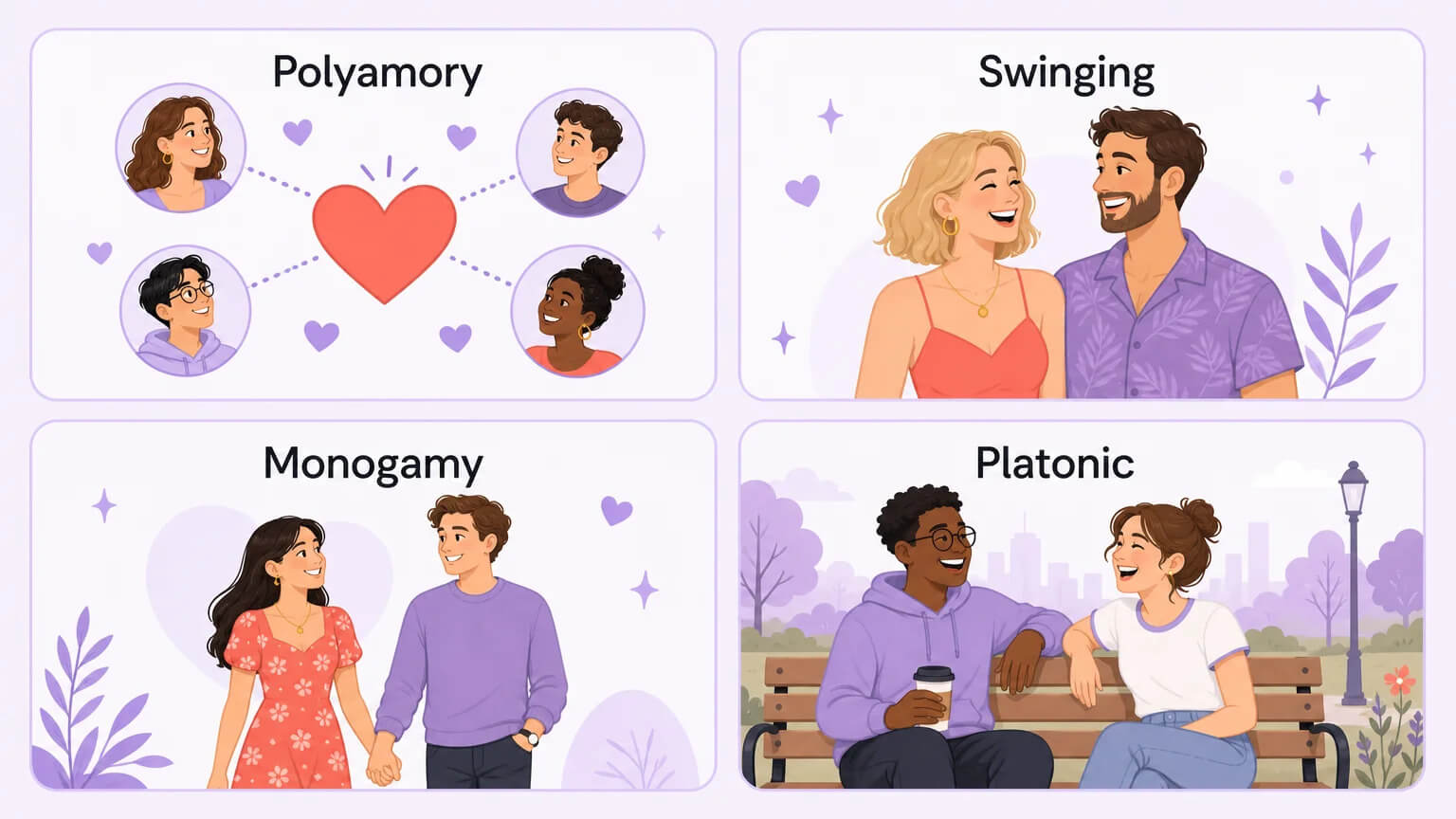
Compersion is most commonly discussed in polyamory, but it is not exclusive to any one structure. The same mechanism fires in different contexts.
Polyamory is the classic example. When your partner is actively dating and building connections with other people, compersion becomes relevant on a regular basis. Metamour joy, the warmth you feel toward your partner’s other partners, is one of its most distinctive forms. You are happy your partner is happy, and you are also happy that someone else gets to experience the person you love.
Swinging and stag-vixen dynamics produce a more embodied, sexually charged version. Watching your partner experience pleasure with someone else, or hearing about it afterward, activates compersion through a different door. The feeling is less “I am so happy you found emotional connection” and more “Your pleasure is my pleasure.” Same emotion. Different flavor.
Monogamous relationships produce compersion too, though it rarely gets named. The pride you feel watching your spouse nail a presentation. The warmth when a friend describes falling in love. The quiet satisfaction of seeing your sibling succeed. The mechanism is identical, but monogamous culture lacks a word for it, so the experience passes by unlabeled.
Platonic compersion might be the most universal form. Your best friend gets the promotion. Your colleague’s project lands. Your roommate aces the exam. You feel warmth because the same neural pathway is firing. If you have ever been genuinely thrilled for a friend’s success, you already know what compersion feels like. Non-romantic compersion is low-risk training for the harder work of feeling it in romantic contexts.
How to Cultivate Compersion: Practical Exercises That Go Beyond Basic Advice
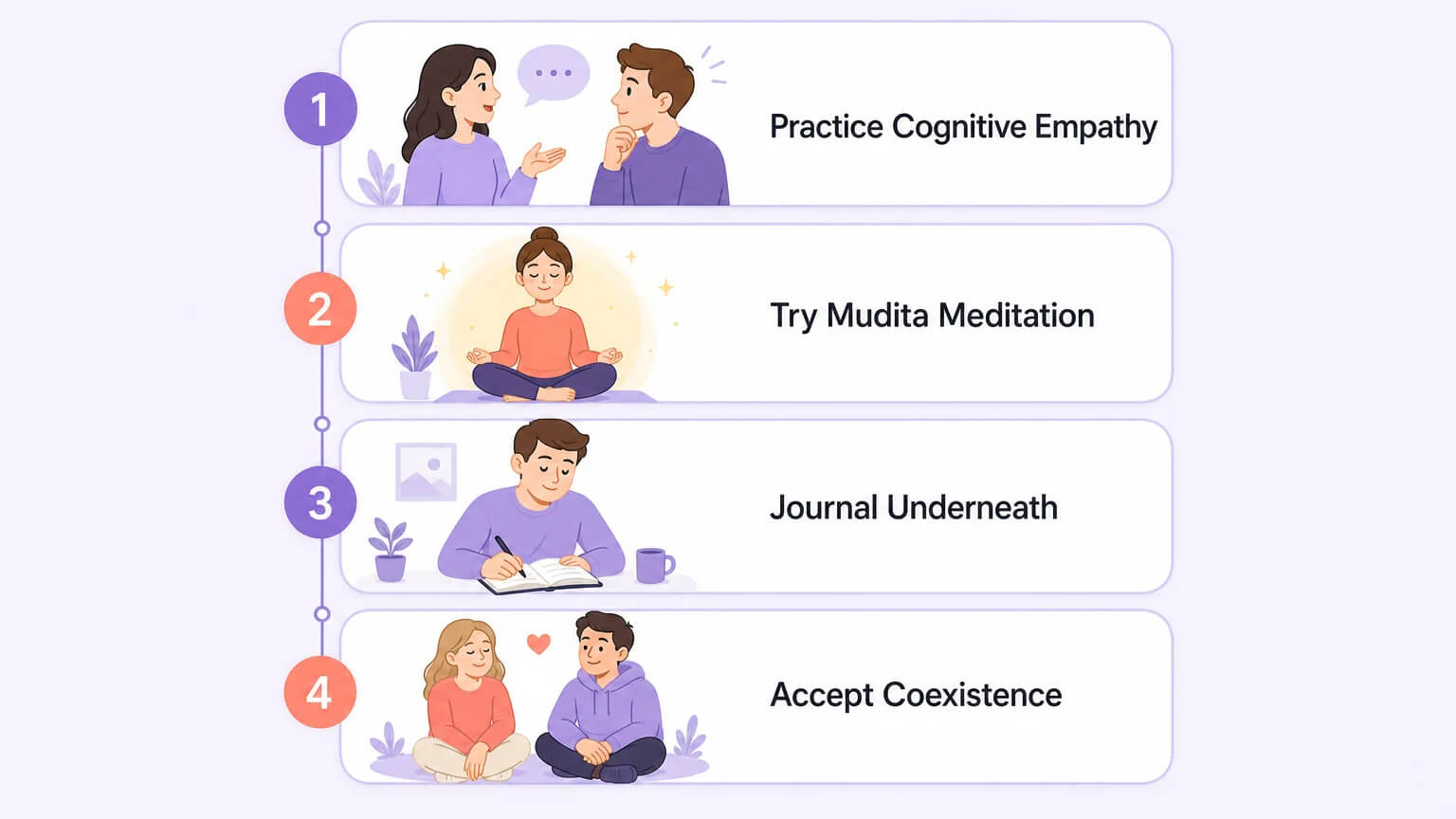
Most advice on compersion stops at “try to be happy for them.” That is the destination described as if it were the directions. Try these instead.
Practice cognitive empathy. Ask your partner about a positive experience they had with someone else. Not the details that trigger comparison, but the emotional texture. What felt good. What surprised them. What they are still thinking about. Your only job is to understand their experience from the inside. Do not insert yourself. Do not relate it back to your relationship. Just hear what it was like for them. Cognitive empathy is the doorway. Compersion is what waits on the other side.
Try mudita meditation. This comes directly from the Buddhist tradition. Start by directing appreciative joy toward someone you genuinely admire. Picture something good happening to them and sit with the feeling of being happy for them. Then shift to a neutral person, someone you pass on the street. Practice generating the same warmth for their imagined good fortune. Then, if you are ready, move to someone you find difficult. Five minutes a day reshapes the neural pathways.
Journal underneath the blockage. Ask yourself one question and write without censoring: “What would it mean about me if my partner’s joy with someone else were a threat?” The answers that surface are often surprising. “It would mean I am replaceable.” “It would mean they prefer them.” “It would mean I am not enough.” These are not facts. They are hypotheses your brain generated, probably a long time ago, that you have been treating as true. Writing them down makes them visible. Visible beliefs are easier to challenge.
Accept coexistence. Compersion and jealousy will live alongside each other during this practice. The goal is not pure, uncomplicated joy. The goal is to stretch your capacity for empathic happiness while the jealousy does whatever it does in the background. Marie Thouin describes compersion as a spectrum from “I can handle this” all the way to genuine, full-bodied joy. The middle is a valid place to live. You do not need to reach the far end to have made real progress.
When the Pressure to Feel Joy Becomes Its Own Problem
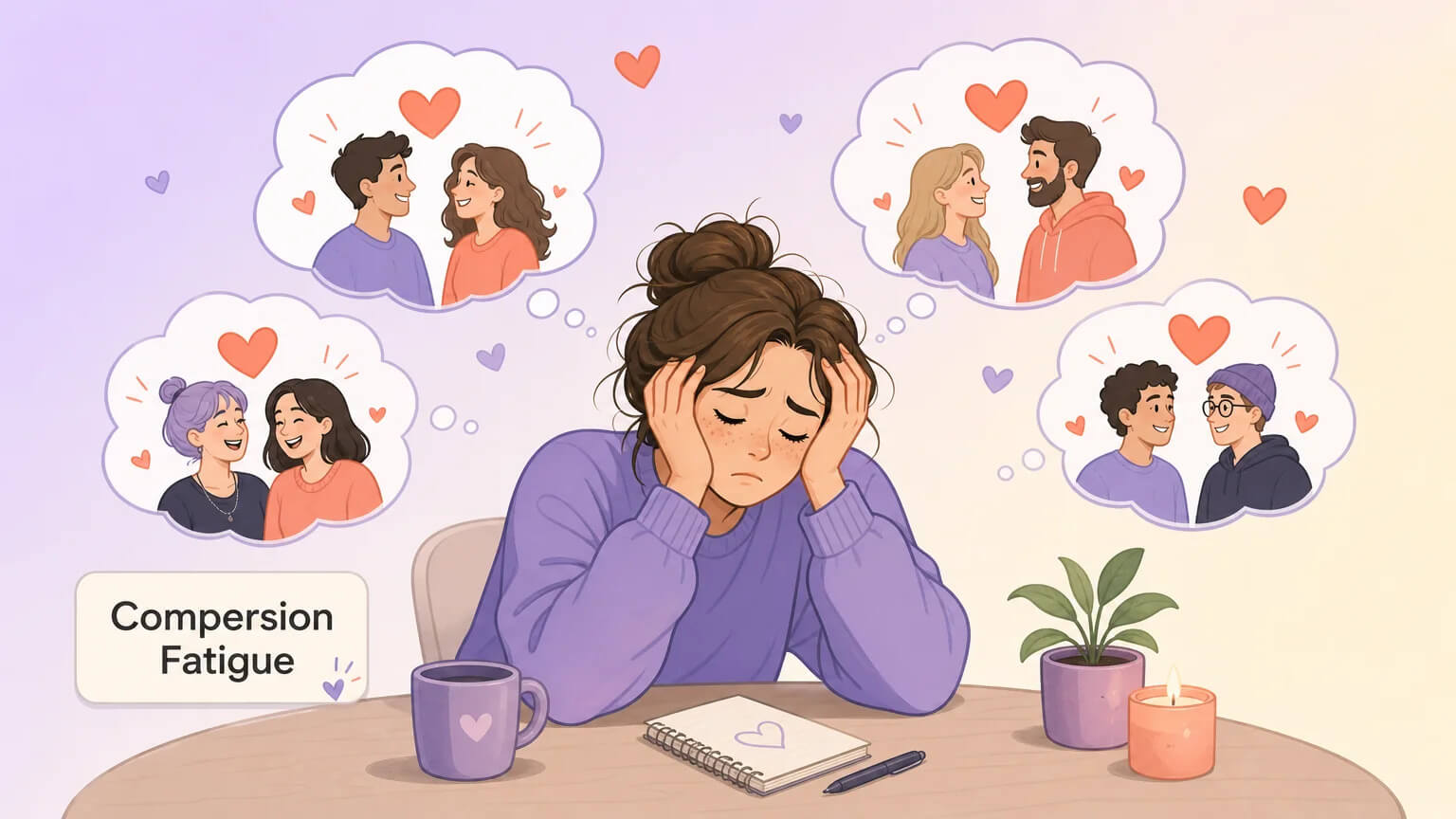
Compersion is not a prerequisite. It is not a membership card you flash at the door of non-monogamy. And the pressure to feel it can create a loop that is worse than not feeling it at all.
The loop works like this: you do not feel compersion, so you feel shame about not feeling it, and the shame blocks the openness that compersion requires, which confirms your fear that something is wrong with you. Each turn tightens the knot. Pressure to perform compersion as proof that you are evolved, or enlightened, becomes the very thing that makes compersion impossible.
Daniel Dashnaw, a couples therapist who writes about non-monogamous dynamics, calls this “compersion fatigue.” It is the emotional burnout that sets in when the expectation to feel joy overrides your need for rest, clarity, or your own boundaries. It is not a personal failure. It is a predictable response to an unreasonable standard.
The Pincus Center has called out the toxic positivity in polyamorous culture directly. The idea that “real” polyamorous people have transcended jealousy and live in permanent compersion. Nobody meets that standard, and trying to meet it causes more harm than the jealousy it is meant to solve. Insisting everyone feel compersion is emotional policing. It takes a beautiful, optional experience and turns it into another way to feel like you are not enough.
The fix is simple: lower the stakes. Neutrality is a valid baseline. “I am okay with this” is a complete emotional position. It does not need to escalate into joy to be healthy. If compersion visits, welcome it. If it does not, you are still doing fine. The most secure people are often not the ones who feel the most compersion. They are the ones who are most honest about what they actually feel.
Compersion Beyond Romance: The Life Skill Hiding in Plain Sight
Compersion is not just about your partner dating other people. That framing sells it short. It is a life skill that shows up everywhere, and recognizing it in non-romantic contexts makes it easier to access in the harder ones.
Your best friend lands the job they have been chasing. Your sibling calls with news of an engagement. A colleague pulls off a project that should have taken twice as long. The warmth you feel is compersion. Same mechanism. Same neural pathway. You have been practicing this skill your whole life without naming it.
What makes romantic compersion harder is not that the mechanism is unfamiliar. It is that the stakes are higher. Your partner’s joy with someone else brushes up against attachment fears, self-worth, and cultural stories about exclusivity in ways that your friend’s promotion does not. The feeling is the same. The obstacles are different.
Non-romantic compersion is low-risk training. Every time you practice genuine happiness for a friend’s success, you strengthen the same circuits that romantic compersion depends on. You do not need to be in a non-monogamous relationship to build the muscle. You only need to notice when you are already feeling it and name what it is.
Compersion is not a specialized emotion for a specialized lifestyle. It is a fundamental human capacity for shared joy that most people access regularly without recognizing it. The romantic context is simply the most intense training ground. If you can feel it for a friend, you have the capacity. The rest is practice, patience, and permission to be where you are.
Common Questions About Compersion
Is compersion necessary for healthy non-monogamy?
No. Compersion is a bonus, not a requirement. Plenty of people in healthy, long-term non-monogamous relationships never feel it. Neutrality and a general sense that “this works for us” are sufficient. It is not the price of admission.
Can monogamous people feel compersion?
Yes, and they do regularly, often without naming it. The pride of watching your partner succeed, the genuine happiness at a friend’s romantic news, the warmth when your sibling achieves something meaningful. Monogamous culture just does not have a word for it.
Can compersion be learned?
Yes. It can be cultivated and made more accessible over time. Cognitive empathy exercises, mudita meditation, and self-investigation journaling all strengthen the relevant pathways. The goal is not to force the feeling but to remove what blocks it.
Can compersion be unhealthy?
Yes, when it becomes performative. If compersion is being used to suppress genuine distress, bypass necessary boundaries, or prove your worth as a partner, it has become a coping mechanism rather than a genuine experience. The feeling should add something, not extract something from you.
What if I never feel compersion?
Then you are in good company. It is not a diagnostic test, and its absence is not a symptom of anything wrong. Some people are wired for it, some are not, and most fall somewhere in the middle. “I never feel compersion and I am fine with that” is a complete and valid position.