You are lying in bed after a party. The room is quiet, the guests are gone, and your partner turns to you. “Have you ever wondered what it would be like?”
The silence that follows carries more weight than the question itself. You are not alone in that silence. Thousands of people search for this article every month, not because they have decided, but because they have started asking.
Underneath that question sits a quieter fear: “If I am curious about polyamory, does that mean I do not love my partner enough?”
No. It does not.
Desire does not require an apology. Curiosity about one path does not invalidate the path you are already on. This is not a flaw in your foundation; it is an extension of your adventure.
This is not a manifesto for either side. It is a map. By the end, you will understand what each structure actually asks of you, what the data says about who thrives where, and how to have the conversation with your partner and with yourself without burning anything down.
Stop asking which one is better. Ask which one fits who you actually are. Let us find out.
What Are We Actually Comparing? A Terminology Foundation
Most arguments about monogamy vs polyamory are actually arguments about definitions neither side has agreed on. People use “polyamory” and “open relationship” as synonyms. They treat ethical non-monogamy and swinging as the same thing. They argue past each other because they never stopped to align on what the words mean.
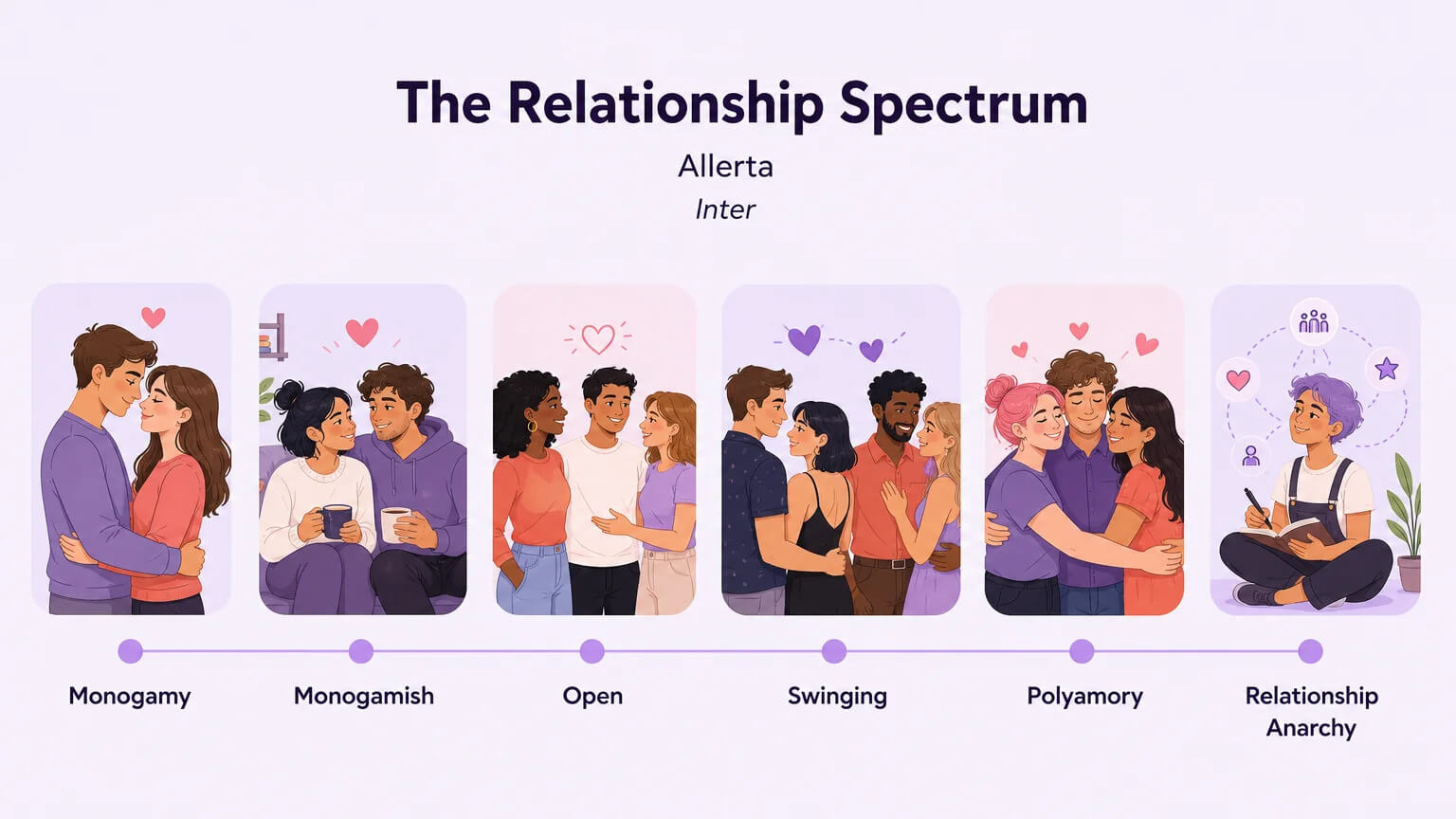
Clarity comes before comparison. Here are the terms, arranged from most familiar to least.
Monogamy. Sexual and emotional exclusivity with one partner. This is the cultural default, supported by law, religion, and social infrastructure. When most people say “relationship,” this is what they picture. It is not wrong. It is just not the only option.
Monogamish. Dan Savage coined this term for couples who are mostly monogamous with negotiated exceptions. A hall pass. A once-a-year Vegas agreement. A “you can kiss her but nothing more” understanding at parties. Monogamish is the bridge concept that helps people see this is not binary. You do not have to relocate to either end of the spectrum.
Open relationships. Sexual non-exclusivity without additional romantic attachments. Partners can have outside physical connections, but the emotional architecture stays singular. Many people who say they are “in an open relationship” mean exactly this.
Swinging. Sexual encounters pursued as a couple, typically at events or parties. Emotional exclusivity is maintained within the primary relationship. The shared nature of the experience is part of the appeal.
Polyamory. Multiple simultaneous romantic relationships with the knowledge and consent of everyone involved. This is about love, not just sex. As Claire Perelman, a sex therapist, explains: most people in ENM are not in love with all their partners. Polyamory is the specific subset where romantic attachment is part of the picture.
Relationship anarchy. No hierarchical labels. Each connection is negotiated on its own terms without default expectations or prioritizing of partners. This is the least prescriptive end of the spectrum.
All of these fall under the umbrella of ethical non-monogamy (ENM). The word “ethical” separates conscious, structured non-monogamy from deception. Polyamory is a specific form of ENM, not a synonym for all of it.
Polyamory itself comes in forms: hierarchical (primary, secondary, tertiary partners), non-hierarchical, solo poly (no primary partnership), and polyfidelity (a closed group of three or more). Polyamory is not one thing. It is a category.
Criterion 1: Emotional Architecture: How Love Is Structured
In monogamy, you are asking one person to be your lover, co-parent, best friend, emotional processing unit, intellectual sparring partner, and primary source of physical affection. In polyamory, you are asking multiple people to hold different pieces of that mosaic.
Which architecture sounds more demanding?
The answer depends entirely on who you are.
A woman on the Dr. Daf Show described her monogamous marriage of eight years. Both partners were “fronting,” she said. Hiding parts of themselves to fit the relationship mold. She kept certain desires quiet. He kept certain curiosities buried. Neither was being dishonest. They were being shaped by the container they had chosen.
After transitioning to polyamory, she found she could share different aspects of herself with different partners. The intellectual side with one. The playful side with another. The vulnerable side with someone else. This was not fragmentation. It was self-knowledge.
But monogamy offers something else: a singular focus that creates a depth of intimacy distributed attention cannot replicate. When one person sees all of you and that singularity is the point, the knowing runs deeper than anything multiplicity can offer. Monogamy channels emotional energy into one place. That concentration produces a specific kind of closeness that breadth cannot match.
Neither architecture is more evolved. They are different floor plans for different families.
Polyamory does not guarantee authenticity any more than monogamy guarantees depth. People can front in any structure. People can hide in any agreement. The fronting woman from the Dr. Daf Show did not stop performing because she chose polyamory. She stopped performing because she chose to stop performing.
The question is not which structure is better. The question is which structure lets you stop performing.
Criterion 2: Communication and Agreements: The Terms of Engagement

The scariest sentence in a relationship is not “I am leaving you.” It is “I have been thinking about something, and I do not know how to say it.”
Monogamy comes with a pre-written script. Exclusivity is assumed. Many couples never negotiate because culture did it for them. Unspoken expectations are the most common source of relationship fracture.
Polyamory assumes nothing. Every boundary, every agreement must be surfaced and negotiated. You cannot coast on a script that does not exist.
Here is a framework for exploring the monogamy vs polyamory question. The point is clarity, not an outcome.
First, clarify values separately. Each partner identifies what they value: security, freedom, novelty, depth. Write it down before comparing notes.
Second, share without demanding. Present thoughts as exploration, not ultimatum. “I have been curious about connecting with someone new” lands differently than “I think we should open up.”
Third, distinguish fantasy from action. Clarify whether this is hypothetical or concrete. Many partners catastrophize because they assume the latter.
Fourth, agree on a pause-and-process window. Set a timeframe, two weeks is common, so both can reflect without pressure. The goal is not agreement. It is a container where both feel safe enough to be honest.
Fifth, know when to bring in support. A couples therapist familiar with both monogamous and CNM dynamics can facilitate without taking sides. If the conversation circles the same drain, professional guidance is not failure. It is a tool.
The Conversation Starter
A script couples can read aloud together. It is designed to open the door without pushing anyone through it.
“Thank you for sitting down with me. I love what we have. This is not about something missing. I have been curious, and I wanted to explore that with you rather than alone. I have been reading about different relationship structures, not because I have made decisions, but to understand the landscape first. How would you feel about us learning about this together, with no commitment to change anything? If the answer is no, I hear that. If the answer is ‘I need time,’ I will wait. There is no clock on this conversation.”
The first conversation is rarely the last. Processing takes time. The goal is not a decision. The goal is a door that stays open.
Criterion 3: Jealousy: Dashboard Light, Not Stop Sign
One of the largest polyamory subreddits, with over 410,000 members, averages twelve jealousy-related questions every 24 hours. The monogamy-focused subreddit, with 171,000 members, averages two.
If you thought polyamorous people do not get jealous, the data says otherwise. They get jealous constantly. The difference is not the absence of jealousy. The difference is the relationship to it.
Monogamy culture often treats jealousy as proof of love. “If you are not jealous, do you even care?” Jealousy gets romanticized as passion, which makes it harder to examine. When the emotion signals something worth protecting, questioning it can feel like disloyalty.
Polyamory culture treats jealousy as an emotion to process, like sadness or anger, not as a verdict on the relationship. The question is not “Should I be feeling this?” but “What is this feeling telling me about what I need?”
Andrew Briggs, a cultural critic who studied these communities, frames jealousy as an evolved emotion that does not care about modern safeguards. Your brain’s threat-detection system was not built for negotiated non-monogamy. The emotion persists. The question is what you do with it.
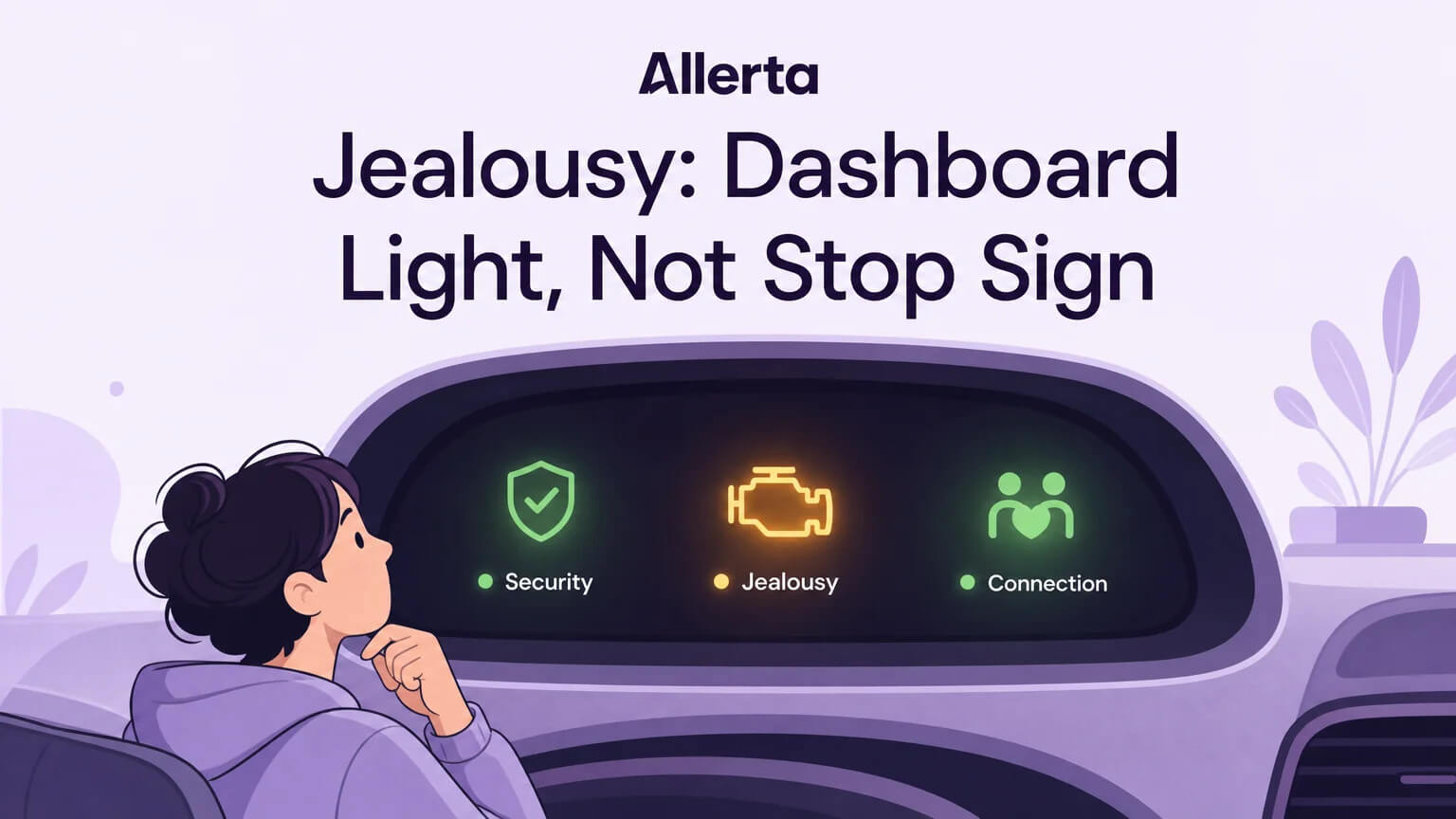
Jealousy is a dashboard light. It points to something: fear of abandonment, insecurity about your own worth, a boundary that needs renegotiating, an unmet need for reassurance. The feeling is not the problem. Ignoring it is.
Briggs also points to a paradox worth sitting with: lack of jealousy can itself feel like lack of passion. Some people need a certain amount of possessiveness to feel desired. That is not wrong. It is information about which structure fits you.
Jealousy does not mean your relationship structure is failing. It means you are paying attention and care about what you have. What you do with it is the choice.
Criterion 4: Freedom, Autonomy, and Personal Growth
Ask someone why they chose polyamory and they will tell you about freedom. Ask someone why they chose monogamy and they will tell you about freedom.
Same word. Two different experiences. Here is what each side actually means.
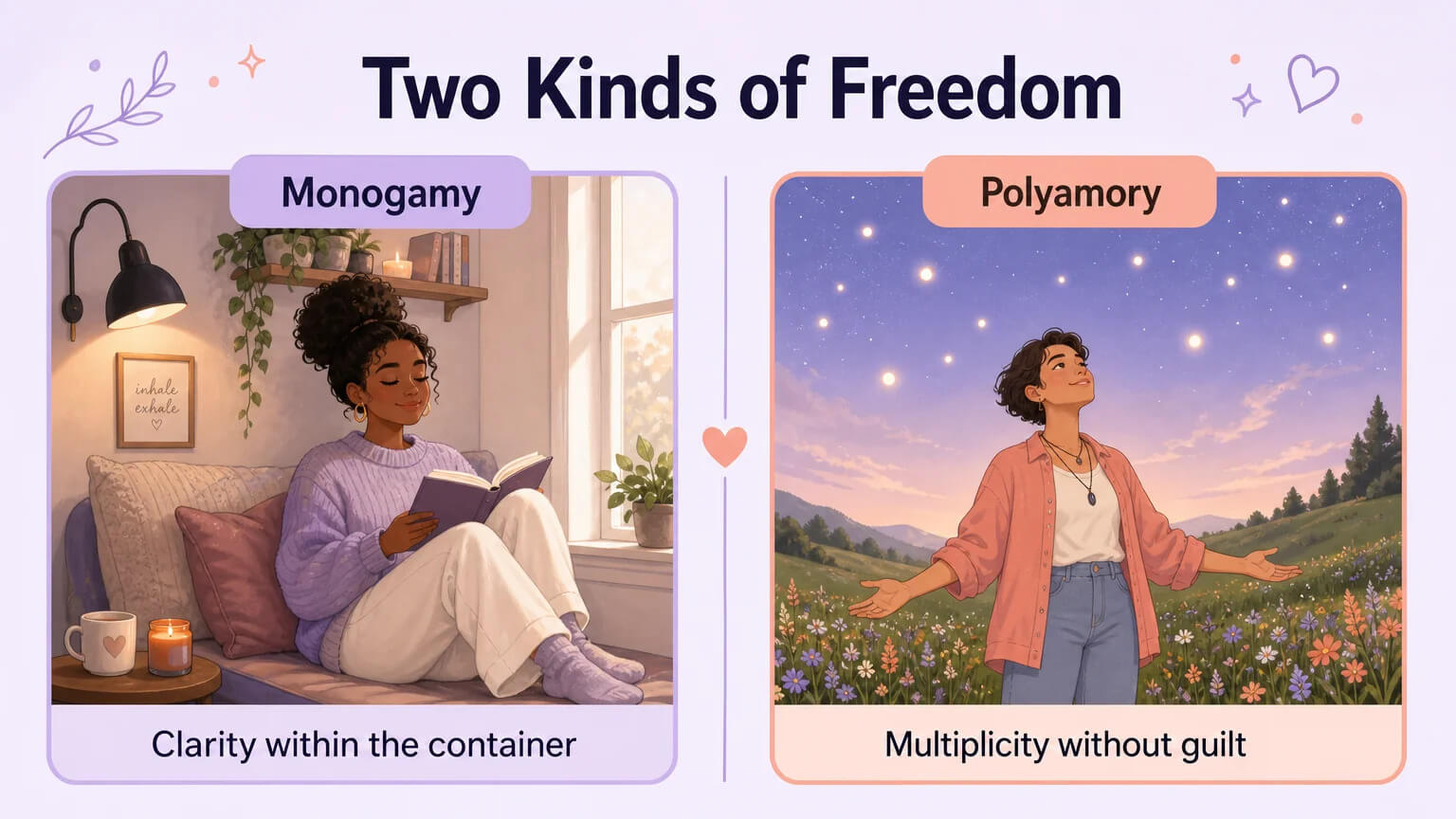
Monogamy’s freedom: clarity within the container. When the boundaries are defined, one partner, exclusivity, you are free from the ongoing negotiation that polyamory requires. Your energy goes into deepening one connection rather than managing several. For many people, this clarity is more liberating than unlimited options. Not having to choose can be its own kind of freedom.
Polyamory’s freedom: multiplicity without guilt. When you can form connections without violating your relationship agreement, you are free to explore parts of yourself that a single partnership might not activate. Different partners reflect different facets. The self-knowledge that comes from seeing yourself through multiple lenses is genuine personal growth, not indulgence.
The psychologist Daniel Burgess, a licensed marriage and family therapist with over fifteen years of clinical experience, puts it simply: people are happiest when their relationship structure matches their authentic values and desires. The freedom that matters is not the number of partners. It is the alignment between what you believe and how you live.
Both structures close some doors while opening others. Monogamy asks you to trade romantic variety for singular depth. Polyamory asks you to trade singular focus for distributed maintenance. Neither path offers freedom from consequence. They offer different freedoms at different costs.
The values-behavior alignment principle, well-established in self-determination theory, is the real headline of the monogamy vs polyamory discussion. Misalignment is what produces the feeling of being trapped, regardless of which side of the spectrum you are on.
If monogamy feels like a cage and polyamory sounds like the key, ask a sharper question: is it the structure that feels confining, or is it the specific relationship you are in?
Criterion 5: The Single Person’s Experience: What Couples Need to Know

Every article about monogamy vs polyamory is written for the couple making the decision. What about the person on the other side? The single person who matches with a couple and has no way of knowing whether they are entering a thoughtfully negotiated arrangement or a relationship landmine with their name on it.
In monogamy, singles date other singles. The power dynamic is, at least in principle, equal. Both people are evaluating each other on the same terms. No one is entering an architecture someone else already designed.
In polyamory and ENM dynamics that involve an existing couple, the single person enters a structure they did not help build. The couple has history, shared language, inside jokes, and a bond that predates them. Navigating this requires emotional intelligence from all three people. Too often, the single person is the only one who has done the work.
Here is what singles in ENM communities want couples to understand.
Be clear about what you are offering before the first date. “Seeing where things go” is a shrug dressed up as openness, not an agreement framework.
If your agreements with your partner differ from your partner’s, say so. A single person cannot respect agreements they do not know exist. Disclosure is the baseline requirement for consent.
They are a guest in your playground, not a toy in your toybox. Guests get to know the agreements of the house. Guests can leave whenever they want, for any reason. Guests are treated with respect precisely because they are choosing to be there. They are not lucky to be invited. The invitation is mutual.
If you have ever been treated as disposable by a couple who had not done their own work, hear this clearly: that was not about you. That was about two people who opened a door they had not finished building. The problem was never your worth. The problem was their preparation.
Criterion 6: Privacy, Stigma, and the Real-World Costs
Monogamous couples never have to ask whether posting a photo together will cost them their job, their custody arrangement, or their relationship with their family. Polyamorous and ENM people ask that question every day.
The asymmetry is stark. Monogamy enjoys near-universal social celebration. A $72 billion wedding industry. Over 1,000 federal legal rights for married couples. Religious endorsement. Cultural infrastructure that treats the monogamous couple as the default unit of social organization.
Polyamory carries documented risks: employment discrimination, housing discrimination, child custody losses, social ostracism, family rejection. The same behaviors, viewed through different cultural lenses, produce radically different consequences.
Decide early what your disclosure framework is. Who needs to know? Who does not? There is no universal answer, but there should be an intentional one. Defaulting to secrecy creates its own strain.
For professional couples: understand your employer’s policies, your industry’s norms, and your local legal landscape before making anything public. Some employers have explicit non-discrimination policies that include relationship structure. Most do not.
For people using dating platforms: use apps designed for polyamory communities where your profile is not visible to colleagues. A face photo on a lifestyle app and a face photo on LinkedIn are the same face. Search algorithms do not care about your compartmentalization.
For parents: the legal landscape around polyamory and child custody varies by jurisdiction. If children are involved, consult a family law attorney familiar with non-traditional family structures. This is not about hiding. It is about protecting.
The stigma is real. It is also slowly changing. One in fourteen Britons now report being open to exploring polyamory, according to YouGov tracking data. Visibility is rising. Acceptance follows visibility, slowly and unevenly.
You do not owe anyone your full story. You do owe yourself a life you do not have to hide. The gap between those two truths is where most people live. It is navigable.
Criterion 7: Practical Complexity: Time, Energy, and Emotional Bandwidth
The stereotype is that polyamory is complicated and monogamy is simple. Both are complex. Monogamy hides its complexity in emotional fusion and unmet needs. Polyamory wears its complexity on the outside: calendars, check-ins, metamour dynamics. The question is which flavor of complexity you would rather manage.
Monogamy’s hidden complexity. One person absorbs all of your emotional output. When they are unavailable physically, emotionally, sexually, there is no backup. The pressure on a single relationship to meet every need creates a specific kind of strain that polyamory distributes across multiple connections. Because the cultural script is the default, many couples never articulate what they actually want from each other. They assume. And assumption is friction waiting to happen.
Polyamory’s visible complexity. Scheduling is a relationship skill. The joke about Google Calendar being a polyamory tool exists because it is true. Time management, emotional bandwidth allocation, metamour dynamics, and the constant communication overhead are real costs. You cannot coast on autopilot when multiple people’s feelings depend on your attention.
Joli Hamilton, a relationship researcher who has lived polyamory for years, talks about cultivating easeful polyamory. Stable. Not constant drama. The goal is not excitement. The goal is sustainability. Experienced polyamorous people figure out that system design matters more than passion. The same is true for long-term monogamous couples who settle into comfort. Both paths converge on the same destination: a relationship architecture that runs without constant emergency maintenance.
The WebMD framework offers practical anchors: schedule quality one-on-one time intentionally, address how much time you will have available in your relationship agreement, and keep communicating as issues arise. These are not polyamory-specific tools. They are relationship tools that polyamory forces you to learn faster.
The complexity of your relationship structure only feels like a burden when the structure does not fit you. When it fits, the work feels like maintenance, not martyrdom. Google Calendar is annoying. Living a life that does not match your values is worse.
Criterion 8: Relationship Satisfaction: What the Data Actually Says
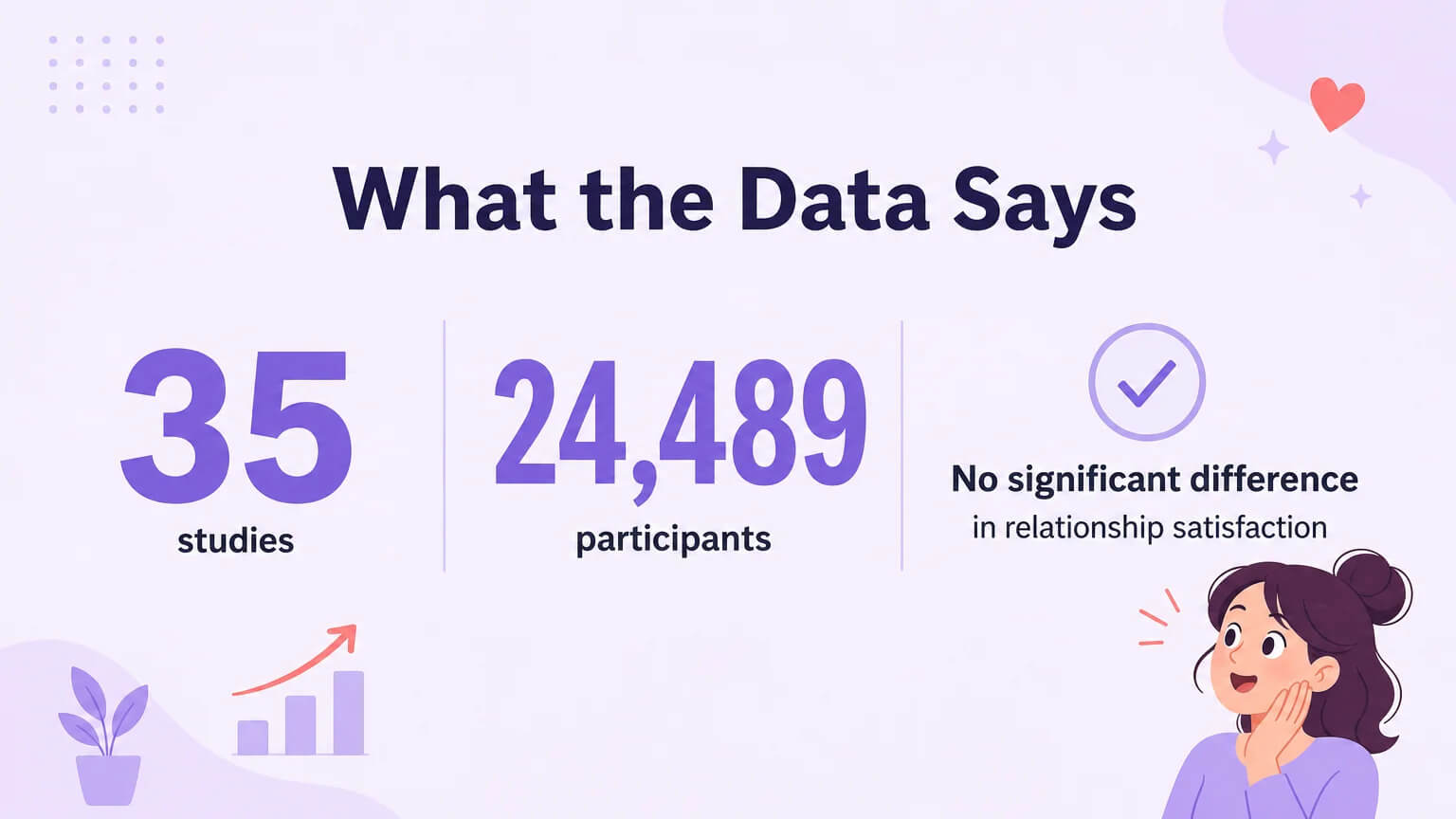
In 2025, researchers published the largest meta-analysis ever conducted on the monogamy vs polyamory question: 35 studies, 24,489 participants. Their conclusion? Relationship satisfaction between monogamous and consensually non-monogamous people is statistically indistinguishable.
Monogamous: 5.25 out of 7. Polyamorous and CNM: 5.2 out of 7. The statistical measure, Hedges’ g, was minus 0.05, with a p-value of 0.496, well above the threshold for significance.
Sexual satisfaction tells the same story. Monogamous: 5.34 out of 7. CNM: 5.4 out of 7. Hedges’ g of 0.06, p-value of 0.393. No meaningful difference. Results held across heterosexual and LGBTQ+ samples, published in the Journal of Sex Research, a flagship peer-reviewed journal.
What the data does NOT say: that polyamory is superior, or that it works for everyone. It says that on average, neither structure produces reliably higher satisfaction.
The real headline is values-behavior alignment. People are happiest when their relationship structure matches their values. Monogamous people in monogamous relationships report high satisfaction. CNM-oriented people in CNM relationships report comparable satisfaction. Monogamous people forced into CNM report low satisfaction, and CNM-oriented people constrained to monogamy report the same. Dr. Joel Anderson, the lead author, puts it directly: satisfaction is not about structure. It is about how people communicate, connect, and meet each other’s needs.
A fair look at the research means acknowledging its limits. Monogamy studies suffer from selection effects and survivor bias: studies primarily sample people who stay together, so they skew satisfied. CNM studies suffer from small samples, typically 50 to 200 participants, short follow-ups, and stigma confounds. Neither side can claim definitive causal evidence. Better longitudinal studies are needed before anyone makes strong claims.
The research will not tell you which structure to choose. What it will tell you is that either choice can work if it is actually your choice, made honestly and freely.
The Bottom Line
Monogamy is not broken. Polyamory is not a solution. Both are valid architectures for organizing love, and the best available research shows that either can produce deeply satisfying relationships, provided the people inside them actually want to be there.
Three principles hold across every criterion this article examined.
Values-behavior alignment is the strongest predictor of satisfaction. If your relationship structure matches what you genuinely believe and desire, you are likely to thrive. If it does not, no amount of effort will make it feel right.
Agreement matters more than structure. Betrayal hurts the same way in every relationship model. What destroys trust is not who sleeps with whom. It is who broke which promise. Daniel Burgess, LMFT: violating relationship agreements harms relationships regardless of structure. Infidelity in monogamy and breaking agreements in polyamory are equally devastating.
You are allowed to change your mind. Many people move between structures across their lives. A monogamous chapter does not invalidate a polyamorous one, and vice versa. The person you were at twenty-five does not get to bind the person you are at forty.
Start with honest self-examination, not comparison. Before you ask “monogamy or polyamory?” ask three sharper questions. What do I actually want? What am I afraid of? What would I choose if no one were watching?
Monogamy is a valid choice, not a biological imperative. Polyamory is a valid choice, not a relationship upgrade. The only wrong answer is the one you did not choose freely.
FAQ
Is polyamory just infidelity with extra steps?
No. The critical distinction is consent and transparency. Infidelity involves deception and violation of agreements. Ethical non-monogamy requires all partners to know about and consent to the arrangement. The word “ethical” exists specifically to draw this line. The external behaviors can look similar. The ethical foundations are opposite.
Are humans naturally monogamous or polyamorous?
This is debated, and there may not be a clean answer. Evolutionary biology points to both monogamous and non-monogamous mating strategies across human history. The more useful framing is that humans are flexible, and individual variation is significant. What is “natural” matters less than what works for you specifically.
What is the difference between polyamory and polygamy?
Polyamory is having multiple consensual romantic or sexual partners. Polygamy is having multiple spouses. Polygyny, one man with multiple wives, is the most common historical form and is typically patriarchal. Neither polygamy nor polyandry, one woman with multiple husbands, is legal in the United States. Polyamory does not involve marriage to multiple people and is generally egalitarian. Check this guide to learn more about polyamory vs polygamy.
Can someone be monogamous while their partner is polyamorous?
Yes. This is called a mono-poly relationship. It is one of the more challenging configurations because partners have fundamentally different relationship orientations. Success depends on the monogamous partner genuinely being comfortable, not just tolerating, and the polyamorous partner respecting agreed-upon boundaries. It is not advisable if one partner is agreeing under duress.
Is polyamory bad for children?
No large-scale research on child outcomes in stable polyamorous families exists. What we know from existing research: children benefit from stability, low conflict, economic security, and involved caregivers. They suffer from instability, high conflict, and neglect, regardless of how many adults are present. Claims that polyamory harms children typically misapply research on single-parent households to committed multi-adult families, which are fundamentally different situations.
Is polyamory an orientation like being gay, or is it a lifestyle choice?
This is contested within the community itself. Some people experience polyamory as an innate orientation: they have always felt capable of loving multiple people, and monogamy feels unnatural. Others frame it as a relationship structure choice made based on values and preferences. Both perspectives are valid. There is no scientific consensus.
What are the signs that monogamy is not working for someone?
Red flags include: one partner feels strongly about exploring multiple relationships, one partner has been unfaithful, the couple cannot agree on boundaries, neither partner is bothered by the thought of the other being with someone else, and one or both partners feel limited or trapped. These issues can sometimes be resolved in therapy but may signal a need for a different structure.
Is polyamory growing or fading in popularity?
Awareness and acceptance are rising. The YouGov tracker shows one in fourteen Britons open to exploring polyamory. Gen Z shows lower actual participation than Millennials and Gen X: only 5 percent of Gen Z uses non-monogamous dating platforms, compared to 38 percent for Millennials and 20 percent for Gen X. Justin Lehmiller of the Kinsey Institute notes the stereotype of Gen Z as the “sexually liberated poly generation” does not match the data. The trend is toward visibility rather than mass adoption.