
The phrase “swinger club” usually paints a specific picture. Dim lighting. Strangers in masks. Something between a music video and a cautionary tale. That picture, for the vast majority of clubs, is wrong.
A swinger club is a membership-based social venue where consenting adults meet for connection and sexual encounters in a staff-managed, policy-governed environment. You pay an entry or membership fee to be there. You do not pay for sex. Everyone in the room is a participant on equal terms.
Curiosity about these spaces does not require a disclaimer. This is a map for an adventurous team, not a permission slip for a guilty couple. Ahead: what these spaces look like inside, how the different formats work, the etiquette that holds the room together, what to pack and budget, and the health practices that let you play informed instead of scared.
What a Swinger Club Actually Is (And What It Definitely Is Not)
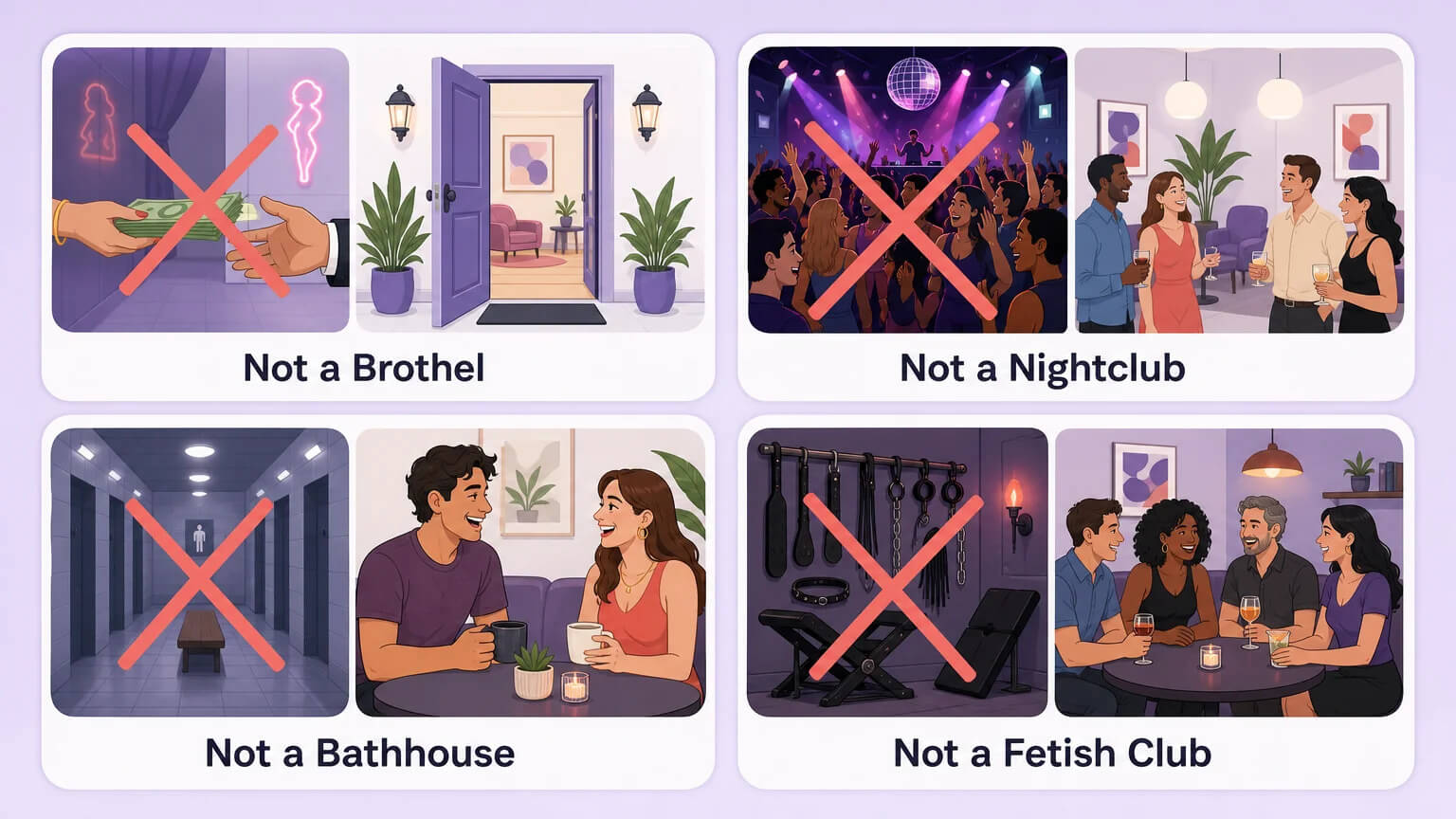
A swinger club, also called a lifestyle club or sex club, is a commercial venue where adults gather to socialize and engage in consensual sexual activity with other patrons. Couples and single women make up the primary audience; single men may be permitted on select nights. The defining line: you pay to enter a space, never to access a person. There are no hired sex workers. Patrons are equals.
That definition clears one fog bank. Let’s clear up four more.
It is not a brothel. In a brothel, money buys access to a worker’s body. In a swinger club, money buys access to a venue. Nobody in the room is getting paid to be there. Everyone walked through the same door for the same reason: curiosity, desire, or both.
It is not a regular nightclub with fewer boundaries. A swinger club runs on more structure than a mainstream club, not less. Consent protocols are explicit and enforced. Phones are banned or stickered in play areas. The environment is built around privacy and community norms rather than alcohol sales. The dance floor may feel familiar. The operating system underneath it is different.
It is not a gay bathhouse. Bathhouses typically center anonymous, silent, individual encounters. Swinger clubs are couple-centric and socially driven. Conversation, dancing, and human connection come before anything physical. The social area is not a hallway you pass through on the way to something else. For many attendees, it is the main event. People come for the community as much as the play.
It is not strictly a fetish or BDSM club. Some overlap exists. You may find a dungeon room or bondage furniture in certain venues. But swinger clubs center partner swapping, group play, and voyeurism rather than kink protocol. In a dedicated dungeon, negotiated scenes, safewords, and aftercare form the central architecture. In a swinger club, conversation and social chemistry drive the evening. Both communities value consent. They operationalize it differently.
The verdict: a swinger club is a social venue first. The playrooms exist, and they matter, but they sit behind a social filter that most newcomers do not expect. Conversation, dancing, and human connection precede everything else.
On-Premise vs. Off-Premise: The Types of Swinger Clubs and Parties
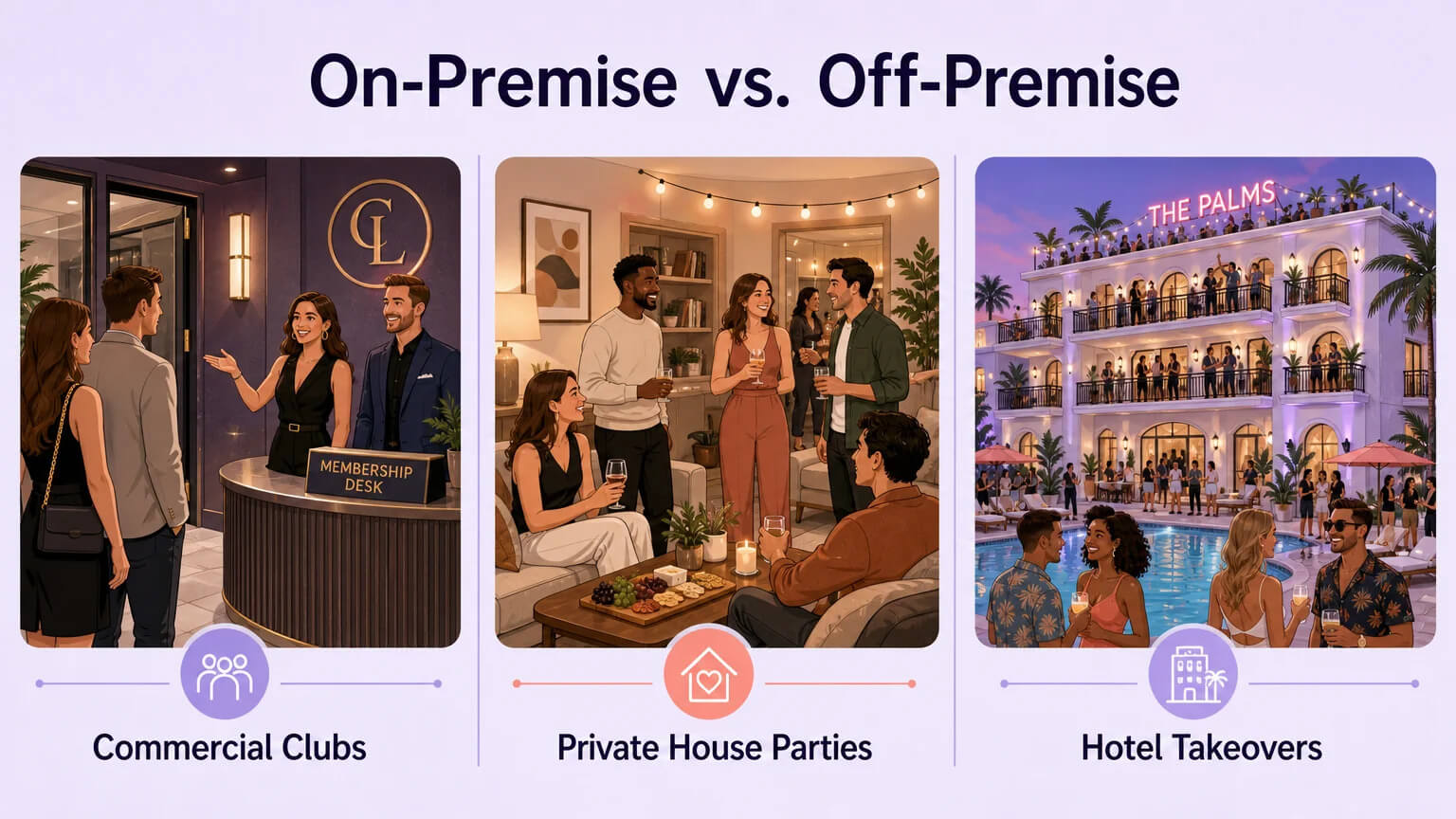
Not all swinger clubs operate the same way. The single decision that shapes your entire experience is whether the venue is on-premise or off-premise.
On-premise clubs have dedicated rooms where sexual activity happens on site. These range from private rooms with doors to semi-private curtained alcoves to open voyeur areas where watching is part of the experience. When someone says “lifestyle club,” this is usually what they mean. The full arc of the night, from socializing to dancing to play, unfolds under one roof.
Off-premise clubs are purely social venues. You meet people, dance, flirt, and make connections, but no sexual activity occurs on site. Whatever happens next happens elsewhere. These are lower-pressure entry points for couples who want to experience the community before deciding whether to go further.
Within those two categories, three venue formats define the landscape.
Commercial lifestyle clubs are staffed venues with membership systems, security, posted policies, themed nights, and built-in social infrastructure. Many employ host couples who give newbie tours and make introductions. You can research them online, sort your membership beforehand, and walk into a controlled, predictable environment. Best for couples who want the full experience in one night with staff and structure backing them up. Skip if you want an intimate, small-group atmosphere.
Private house parties are smaller gatherings held in someone’s home. Guest lists are pre-vetted, often referral-only. The atmosphere tends to be warmer and less institutional. You will likely know fewer people at the door, but the room itself is cozier. These suit people who already have a connection in the community and want a relaxed, familiar setting. If you are brand new without an existing network, these are hard to find without an invitation.
Hotel takeovers are large-scale, multi-day events where an entire hotel is booked exclusively for lifestyle attendees. Think 200 to 300 people, sometimes more, across multiple floors, with daytime social activities and nighttime parties spanning a full weekend. Events like Naughty N’awlins in New Orleans or Candygasm2 in Niagara Falls sit at the immersive end of the spectrum. These are built for experienced lifestyle participants looking for a weekend-long experience. If you are a first-timer, start with a single-night club visit before committing to a full weekend.
What You Will Actually See Inside: A Swinger Club Walkthrough

The front half of a well-run swinger club looks like an upscale lounge. The back half is where the playrooms live. The two zones are physically separated, and you can spend the entire night in the front without ever setting foot in the back. That is completely normal.
Arrival and check-in. You hand over your ID at the front desk. Staff verify your age, process your membership or nightly entry, and review the house policies. If you are new, say so. Most clubs identify first-timers and offer a tour. Take it. A host couple or manager will walk you through the layout, explain how the spaces work, and introduce you to a few regulars. That ten-minute orientation is the difference between feeling like an outsider and feeling like you know the map.
The social areas. The bar, the dance floor, the DJ stage, the high-top tables, the VIP section, the pool table, the photo backdrop area. This part of the club hums like any well-appointed lounge on a Saturday night. People talk, laugh, and dance. Outfits range from sharp cocktail attire to themed lingerie, depending on the night’s dress code. The energy is social, not predatory.
The locker rooms. You change from street clothes into club attire here. Lockers secure your valuables. The bathrooms in many clubs are well-appointed: mouthwash, wipes in every stall, full-length mirrors, lounge areas for changing. This is where you shed the outside world and step into the club’s atmosphere.
The play areas. On the other side of a door or hallway, the tone shifts. Private rooms with doors that close. Semi-private spaces with curtains you can draw. Open voyeur areas where watching is permitted. Themed rooms, from tropical to mirrored to dungeon-style, vary by venue. Staff change sheets and clean between uses. Some clubs offer content rooms you can rent for additional privacy. No phones, no cameras, no drinks in these spaces.
Social spaces and play spaces are separated by design. Nobody stumbles into a scene by accident. You set the pace.
One thing to know before you arrive: the room may feel clique-ish when you walk in. Regulars know each other. People have their circles. This is familiarity, not hostility. The community is warm once you are inside it. The first fifteen minutes are simply the door you have to walk through.
This is a concrete walkthrough for couples who want to replace anxiety with a mental map. If you are not ready to picture the physical reality, skip ahead. No vague reassurance here.
Consent, Etiquette, and the Unwritten Code That Holds the Room Together
A well-run swinger club frequently enforces stricter behavioral standards than a mainstream nightclub. That sounds counterintuitive until you think about it: when the entire premise of the space depends on people feeling safe enough to be vulnerable, anything that threatens that safety gets removed, fast.
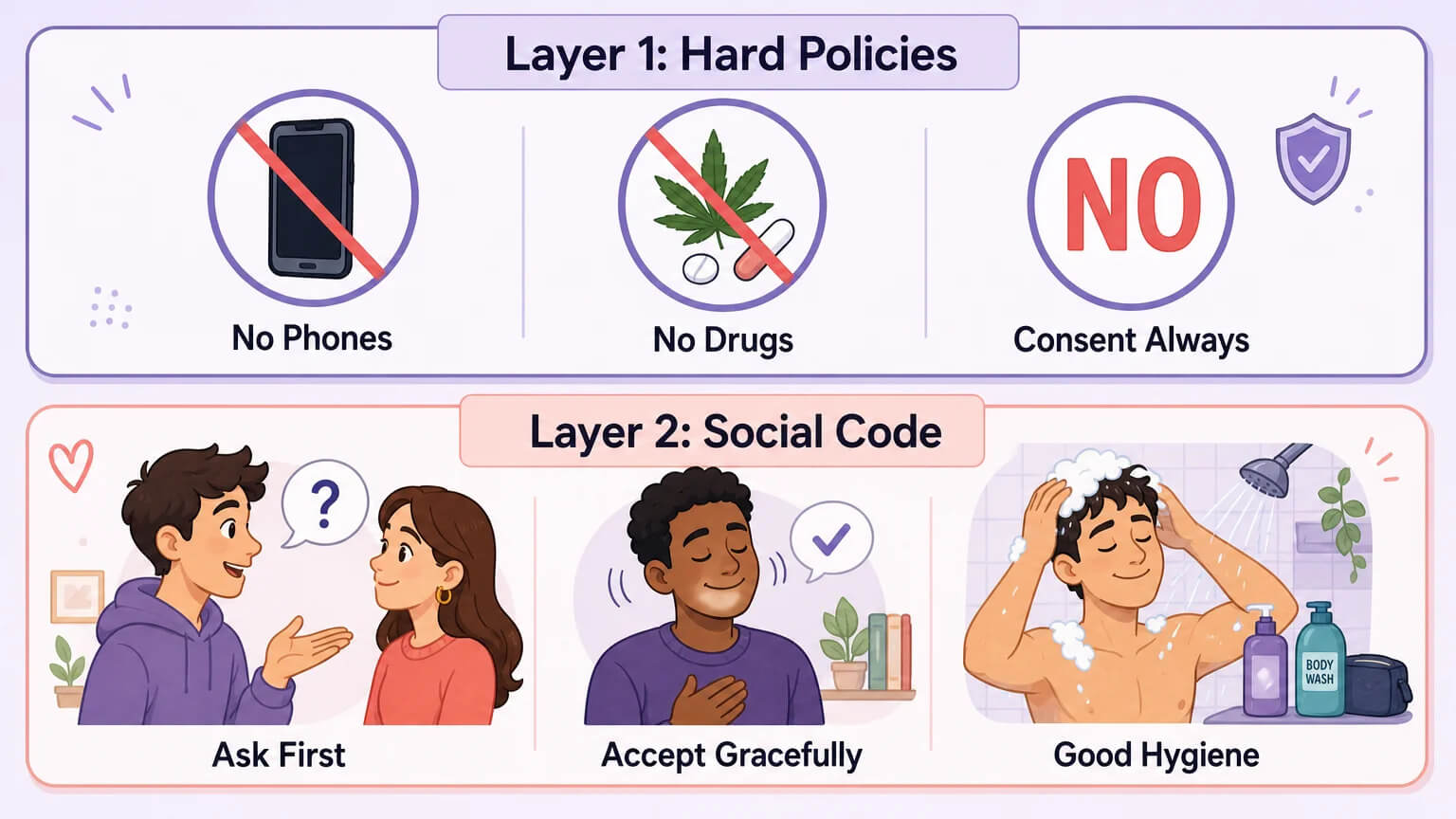
There are two layers to the social grammar.
Layer 1: The hard policies. “No means no” is non-negotiable and universally enforced. Violating it is the fastest way to get banned, and clubs do not hesitate. No phones or cameras in play areas. Some clubs sticker your phone camera at the door. Privacy is sacred. No drugs. Do not interrupt active scenes. Stand back, stay quiet, and let people have their experience. Staff can and do remove people who violate these policies. Clubs self-police strictly to keep situations from spiraling. Former security staff describe an environment where the community enforces its own standards, and intoxicated or predatory patrons are handled swiftly.
Layer 2: The social code. Ask before any touch, every time, verbally. Nudity or revealing clothing is not an invitation. One lifestyle educator put it plainly: a body part being visible does not mean it is available. Unwanted touching, including the casual butt-slap that some people treat as harmless, is a consent violation. It happens, and the community calls it out.
Accept rejection with grace. A simple “no thank you” is a complete sentence. You do not owe an explanation. Neither do they. The interaction ends there, no hard feelings.
Do not stare. Looking is human. The unblinking, jaw-dropped stare that follows someone across the room is not. It makes people uncomfortable, and in a space built on comfort, that matters.
Hygiene is a form of respect. Shower before you go. Brush your teeth. Wear deodorant. These are baseline expectations, not optional courtesies.
Tip the staff. Bartenders, cleaners, hosts. Many rely on tips. Bring cash.
Some clubs use non-verbal systems to simplify boundaries. At Oasis Aqualounge in Toronto, green armbands signal “open to being approached,” while red means “not looking to play tonight.” No conversation required. No awkward explanation. Just a color that says everything.
If you remember three things: ask before touching, accept no with grace, and keep your phone in your locker. Everything else flows from those.
Your First Night: How to Prepare, What to Budget, and What to Pack

A widely-shared story makes the rounds in lifestyle circles. A man took his wife of four years to a swinger club without discussing expectations beforehand. He wanted to observe. She ended up spending the night with two other people. He described it as the most regretful decision of his life.
The lesson is not that clubs are dangerous. The lesson is that unspoken assumptions are. Before you go, sit down with your partner and answer these questions together: What are our comfort zones? What is off the table entirely? What is open to discussion in the moment? Set a signal or phrase you can use to check in mid-evening. Agree on what “success” looks like for your first night. Watching only? Playing together in the club environment? Open to more if the right situation presents itself? Any answer is valid. The only wrong answer is not having one.
First-time couples consistently say two things afterward: they wish they had communicated more explicitly beforehand, and they wish they had been more proactive about approaching people instead of waiting to be approached. Going in without expectations does not mean going in without a plan. It means staying open to whatever happens inside the framework you built together.
What to pack. Bring your own condoms and lube. Clubs often supply them, but you are responsible for your own safety. If you need latex-free options, do not rely on the house supply. Pack an outfit change: something club-appropriate for arrival, something you feel confident in for later, and comfortable clothes for the ride home. Add gum or mints, chapstick, body spray, and any toys you want with you. If the club is BYOB, bring your own alcohol in an insulated cooler bag, even if you do not drink. The bag doubles as your mixer setup.
What it costs. Couples typically pay $75 to $150 for entry. Single women often enter free or at a heavy discount, ranging from $0 to $100. Single men pay $100 to $200, and access is frequently restricted to specific nights with caps on numbers. Annual memberships may be additional. BYOB clubs charge a setup or mixer fee. Add outfits, supplies, tips, and transportation. A realistic all-in estimate for a couple: $150 to $300 for the night. Club Coliseum SW in Mexico City charges approximately $1,750 MXN, roughly $100 USD, with a drink credit included.

Before you go, do your research. Use lifestyle platforms like SDC and Kasidie to find vetted club listings. Check the club’s website for theme nights, newbie-friendly events, and dress codes. Sort your membership online beforehand so you are not filling out paperwork at the door. If the club offers table reservations, take one. Having a dedicated spot to return to reduces first-night anxiety more than most people expect.
The verdict: a prepared couple walks in as a team. An unprepared couple walks in as two people hoping for the best. The difference is a conversation that takes thirty minutes and costs nothing.
Safer Sex and STI Awareness: What the Lifestyle Community Actually Practices
The STI conversation makes some people uncomfortable. In the lifestyle, it is table stakes. Active swingers tend to be more informed and more proactive about testing than the general population, precisely because the risk is real and acknowledged rather than ignored.
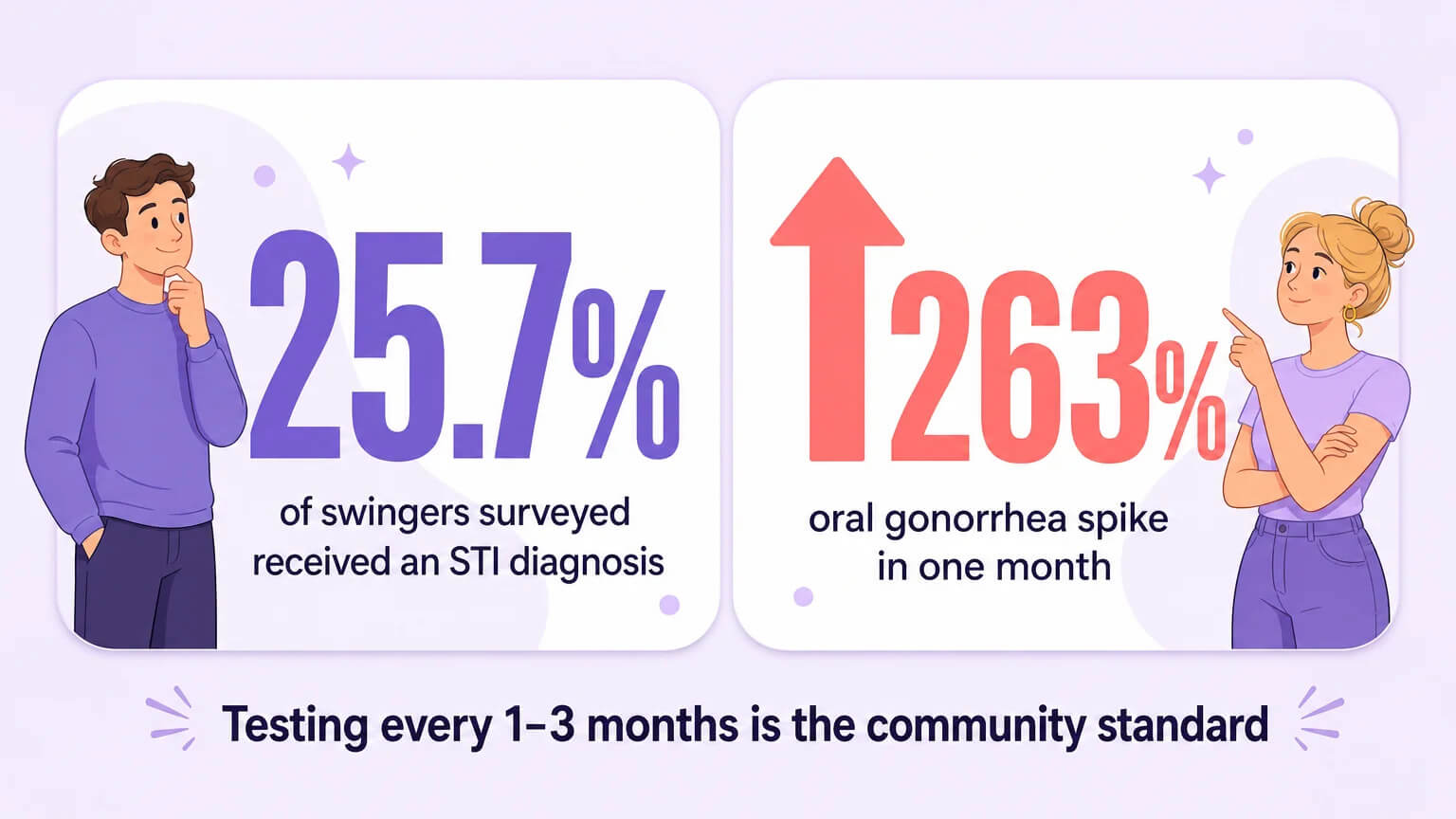
A Belgian study found that 25.7% of swingers surveyed had received an STI diagnosis at some point. Higher frequency of swinging correlates with higher diagnosis rates. The risk is elevated. That is the starting point.
What most outsiders miss: the community has developed its own serious health norms in response.
Testing cadence. Every one to three months if you are highly active. Every three to six months as a baseline. This is faster than what most primary care doctors recommend for the general population, because the exposure profile is different.
Site-specific testing is not optional. Standard STI panels use blood and urine samples. Those miss infections at the sites where swingers are actually exposed. You need oral and rectal swabs. Oral gonorrhea positivity among swingers spiked from 1.28% to 4.65% in a single recent month, a 263% increase. A throat swab catches what a urine test cannot.
Ask for the tests by name. Mycoplasma genitalium and Trichomoniasis are routinely omitted from standard panels. Most doctors will not include them unless you specifically request them. If your healthcare provider does not understand why you need these tests, find one who does.
Condom protocol. Use them. Change them between partners and between different body sites. Bring your own supply, especially if you need latex-free options. Do not rely on the club’s stock.
Disclosure norms. Discussing STI status before play is normalized in the lifestyle community. It is not awkward. It is expected. The conversation takes thirty seconds and signals competence.
Additional tools. For highly active individuals, Doxy-PEP, a post-exposure prophylaxis, and PrEP for HIV prevention are options worth discussing with a lifestyle-aware healthcare provider. They are not substitutes for testing and condoms. They are additional layers.
The community’s approach to health manages risk with the same clarity and communication that governs everything else in the lifestyle. Knowing the landscape lets you play informed instead of scared.
For couples and singles who want to understand the actual risk profile and the protocols that reduce it. Skip this section if you are not ready to have direct conversations about testing and sexual health. Those conversations are part of the lifestyle, not a footnote to it.
FAQ: Swinger Clubs, Answered Honestly
Do I have to have sex if I go to a swinger club?
No. This is the most important thing to understand. Many first-timers only watch, socialize, or have sex with just their own partner. Participation is always optional, and nobody will pressure you. The most common newbie experience is simply absorbing the atmosphere and going home. You set your own pace.
What should I wear to a swinger club?
Dress like you are going to an upscale lounge. Check the club’s website for the night’s theme. Many venues have specific dress codes: cocktail attire, lingerie, fetish wear, or color themes. Bring an outfit change: something confident for later in the evening, comfortable clothes for the ride home. Effort is noticed and respected in the lifestyle community.
Can single people go to swinger clubs?
Yes, but the experience differs dramatically by gender. Single women are typically welcomed with free or heavily reduced entry. Single men face higher fees, restricted nights, and caps on numbers to maintain gender balance. Some clubs ban single men entirely on certain nights. Research the club’s single policy before you go. Respect, patience, and social awareness are non-negotiable for single men in these spaces.
How do I handle jealousy or insecurity?
Jealousy is normal. How you handle it as a team is what matters. Set your comfort zones before you go. Use a check-in signal during the evening. Debrief together afterward. Share everything you felt, not just what happened. Leaving early is always an option. Many couples attend several times before playing with others. Start slow. The lifestyle should add to your relationship, not test it.
What are the most important etiquette rules?
Ask before touching, every time. Accept no with grace. No phones in play areas. Good hygiene is baseline. Do not stare. Do not interrupt active scenes. Tip the staff. Violating consent is the fastest way to get banned. If you remember nothing else: everyone in the room deserves the same respect you would want given to you.
How do I find a good swinger club near me?
Use lifestyle platforms like SDC and Kasidie for vetted club listings and event calendars. Read the club’s website thoroughly. Look for newbie-friendly orientation nights, which many clubs offer specifically for first-timers. Check reviews on lifestyle platforms, not just general search. For your first visit, prioritize clubs with explicit orientation processes and host couples over the venue with the best reputation. A welcoming introduction matters more than a trendy address.
Are swinger clubs safe? What about STIs?
Clubs are structurally safer than unvetted encounters. Consent is enforced. Security is present. Phones are banned in play areas. STI risk is real and elevated. A quarter of swingers surveyed in one study reported receiving an STI diagnosis at some point. Active swingers mitigate this through frequent site-specific testing every one to three months, consistent condom use, and open disclosure norms. Knowing the facts lets you make informed choices. The community’s health practices are more rigorous than most newcomers expect.