You are at a dinner party, scrolling your phone, or deep in a group chat, and someone drops the word “polycule.” You are curious, maybe intrigued. You are not the first person to Google this at 11 p.m.
A polycule is a network of people connected through overlapping romantic, sexual, or platonic relationships inside consensual non-monogamy. The term is a portmanteau of “polyamory” and “molecule.” Picture a molecular diagram where each person is an atom and each relationship is a bond. Some bonds are romantic, some are sexual, some are the quiet friendship between two people who happen to love the same person.
This is not a relationship model built on chaos or commitment-phobia. It runs on more communication, more explicit agreements, and a level of intentionality most monogamous relationships never touch. Whether you are curious, considering exploring, or just want to understand what your friend meant, you will walk away with a real map of how polycules work, what they look like day to day, and whether any of this might be for you.
The word gets thrown around a lot. The reality is stranger, warmer, and more human than the internet lets on.
What Is a Polycule, Actually?
The simplest version: if you are dating someone, and they are also dating someone else, you just drew the first two bonds of a polycule. You are connected to your metamour (your partner’s other partner) whether you ever meet them or not. That connection is real, and it is part of your polycule.
Here is the part most explainers skip. A polycule is not the same thing as “dating multiple people.” The difference is that the connections form a network. Each person is a node, each relationship is a bond, and the shape that emerges is larger than any individual pairing. Think of it like an extended chosen family tree where not everyone shares a bed, but everyone shares a context.
When Does My Situation Count?
If you or your partner have more than one romantic or sexual connection, and those connections are consensual (everyone knows and agrees), you are already inside a polycule structure, even if nobody in your life uses that word. A simple V (you, your partner, their other partner) is a polycule. Size does not define it. Consent does. You do not need five people, a shared Google Calendar, and a group chat called “The Cule” to qualify.
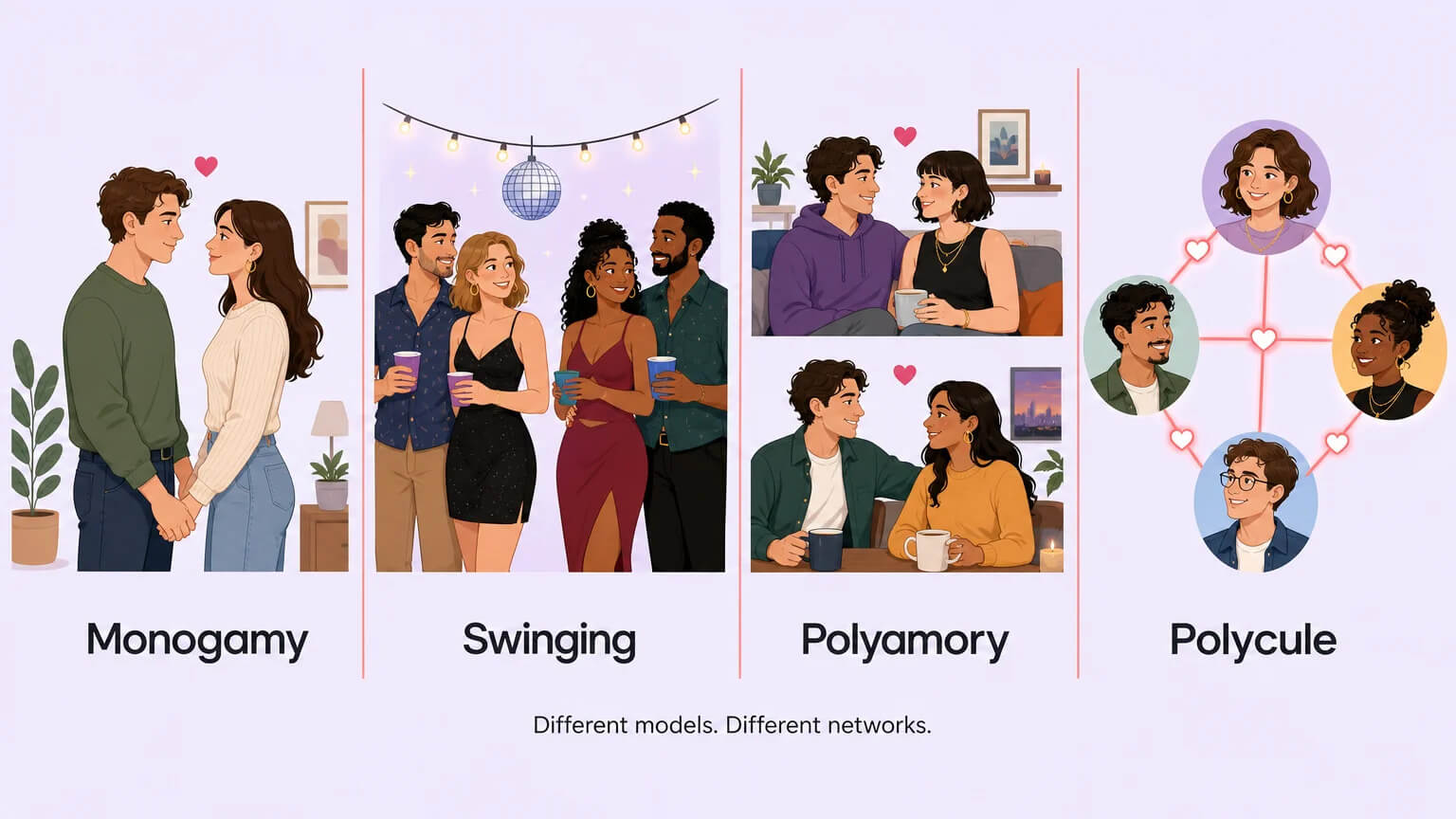
Distinct from Swinging and Other Models
Swinging is primarily recreational sex, often as a couple. Polyamory is about multiple romantic or emotional relationships. A polycule is the specific network that forms around those relationships. You can swing without forming a polycule. You can be polyamorous without living in a kitchen-table arrangement. And deception cannot build one. Consent and transparency are the walls that hold the whole structure up. As researcher Riki Thompson, PhD, puts it: the key is that everyone involved knowingly agrees to the structure.
Understanding what a polycule is technically is easy. Understanding what it feels like to exist inside one is harder, and it is what the rest of this article is for.
The Shapes a Polycule Takes
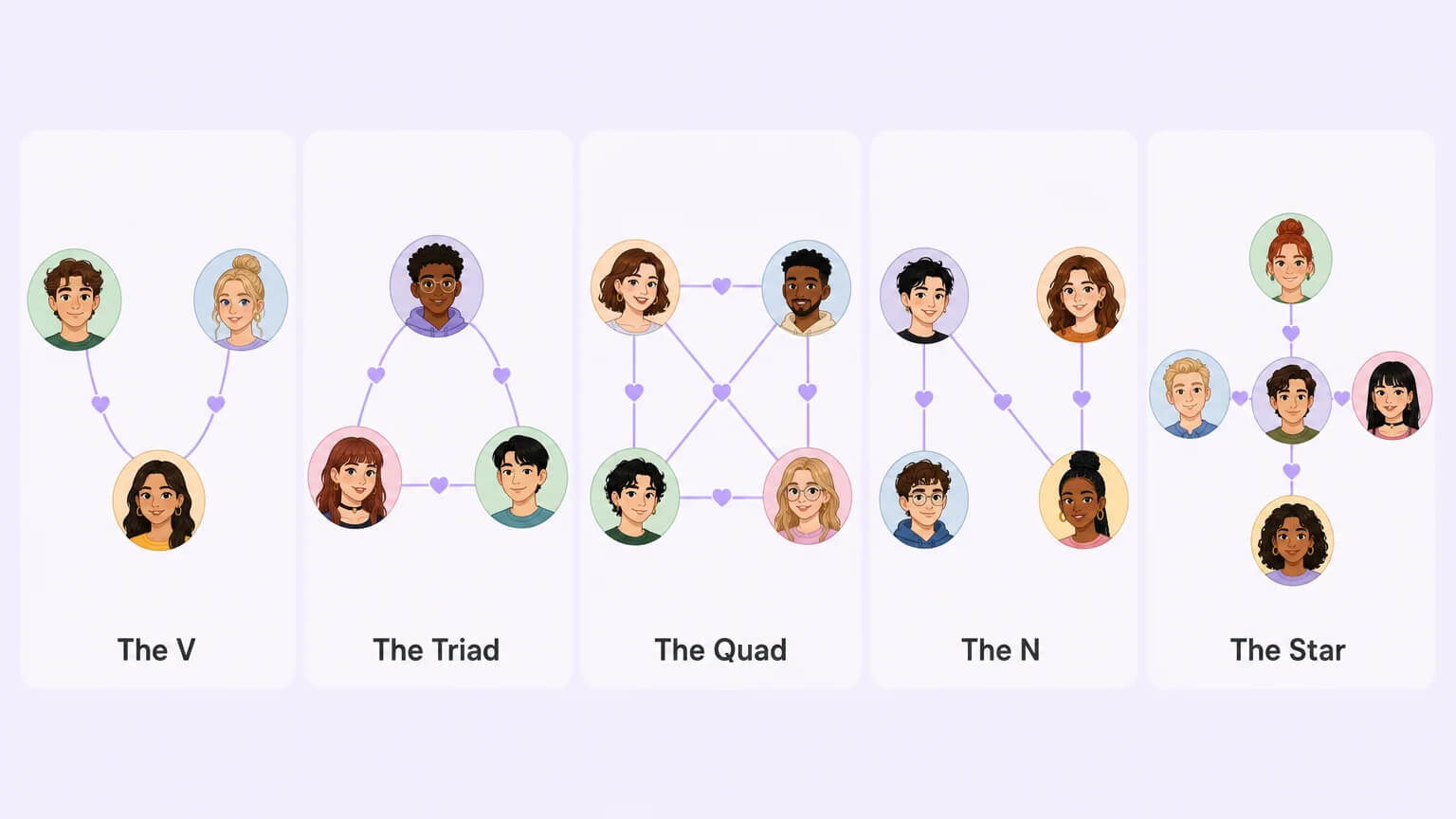
No two polycules look the same, but most fall into a handful of recognizable patterns.
The V. One person (the hinge) dates two people who are not dating each other. This is the most common entry point, and the hinge carries most of the weight. If they are not skilled at communication, the whole structure wobbles.
The Triad (or Throuple). Three people all romantically or sexually involved with each other. Mainstream media loves this shape, probably because it photographs well. It also requires the most negotiation. Every dyad (A and B, B and C, A and C) plus the group dynamic all need tending.
The Quad. Four people connected, often two existing couples whose relationships overlap. The Seattle polycule profiled by Seattle’s Child is a quad-plus: five adults and four kids across two homes with shared calendars and chore charts.
The N (or Z). Two couples where one person from each forms a third, cross-connecting relationship. Picture two Vs sharing a hinge.
The Star (Solo Poly). One person dates multiple people who may never meet, creating a network held together by one autonomous node. This model prioritizes independence.
Kitchen Table vs. Parallel
Kitchen table polyamory means everyone is comfortable sharing a meal. Metamours might be friends, co-parent, or simply enjoy knowing each other. This is chosen ease, not mandatory closeness.
Parallel polyamory means metamours acknowledge each other’s existence but have minimal or no direct contact. Both are valid. Neither is more “evolved.” The only metric is whether it works for the people inside it.
Try this: pull out a piece of paper. Write your name in the center. Draw a line to each person you are romantically or sexually connected to. Now from each of those people, draw lines to anyone they are connected to. You just mapped your polycule. The shape is a description, not a judgment. It can change tomorrow.
Quick-Reference Terminology
- Metamour: Your partner’s other partner.
- Hinge: The person in a V who dates two people who are not dating each other.
- Nesting partner: A partner you live with.
- Compersion: Joy when your partner experiences joy with someone else.
- NRE (New Relationship Energy): The 6-to-18-month infatuation phase.
- Poly-saturated: The point at which you cannot handle more relationships.
- Kitchen table: Metamours comfortable sharing meals and being friends.
- Parallel: Metamours with minimal or no direct contact.
Myths the Internet (and the FTX Scandal) Got Wrong
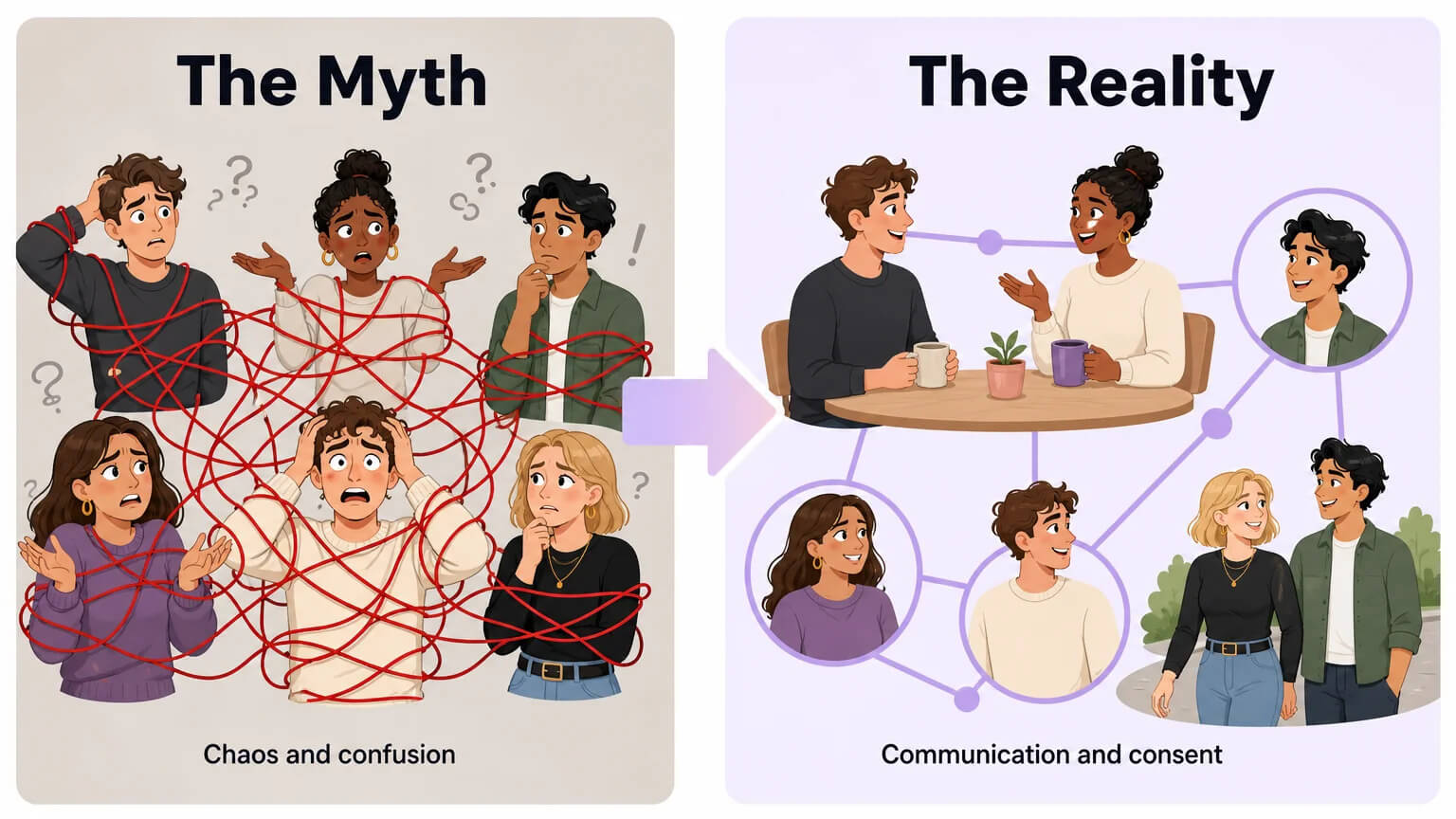
If your only exposure to polycules came from a viral tweet, a scandal headline, or a reality TV show, you have been fed a caricature. The internet loves a polycule story the way it loves a plane crash: the spectacle, not the thousands of safe landings.
Myth 1: “Everyone in a polycule sleeps with everyone else.” In most polycules, most people are not directly involved with each other. Your partner’s partner is in your polycule. That does not mean you are dating them. It means you share a connection through someone you both care about.
Myth 2: “Polyamory is just infidelity with a vocabulary lesson.” The defining difference is consent. Infidelity involves deception and broken agreements. Polyamory operates on transparency where everyone knows and agrees to the structure. An AASECT-certified sex therapist notes the highest risk factor in polyamorous sexual health is not pathogen transmission. It is communication failure.
Myth 3: “Polycules are unstable and never last.” Some do. Some do not, same as monogamous relationships. About 30 percent of people who try polyamory would do it again, but retention reflects how people enter: coerced, poorly prepared, or trying to repair a broken relationship.
Myth 4: “Polyamorous people do not get jealous.” They absolutely do. Jealousy is navigated, not eliminated. The goal is curiosity about what jealousy signals, not using it to control a partner. David Hague, a therapist with 11 years of clinical experience, describes the approach as curiosity rather than suppression.
Myth 5: The FTX scandal as polycule representative. When Caroline Ellison’s blog described her “hierarchical polycule” as an “imperial Chinese harem” with “vicious power struggles for rank,” it damaged public understanding. Researcher Riki Thompson notes this framing is “contrary to the ethos of polyamory.” What Ellison described was a power dynamic dressed in poly language, not a polycule working as intended.
Most polycule content goes viral because it is bizarre or scandalous, not because it represents how most people live. The real story is quieter, more administrative, and built on communication skills most people were never taught.
The Emotional Engine: Jealousy, Compersion, and NRE
The Beyond Monogamy podcast put it honestly: “The fantasy of more sex, more freedom, more adventure collides with the reality of more calendar management, more conversations, more emotional labor.” Nobody posts their polycule’s Tuesday night check-in on Instagram. The highlight reel is not the life.
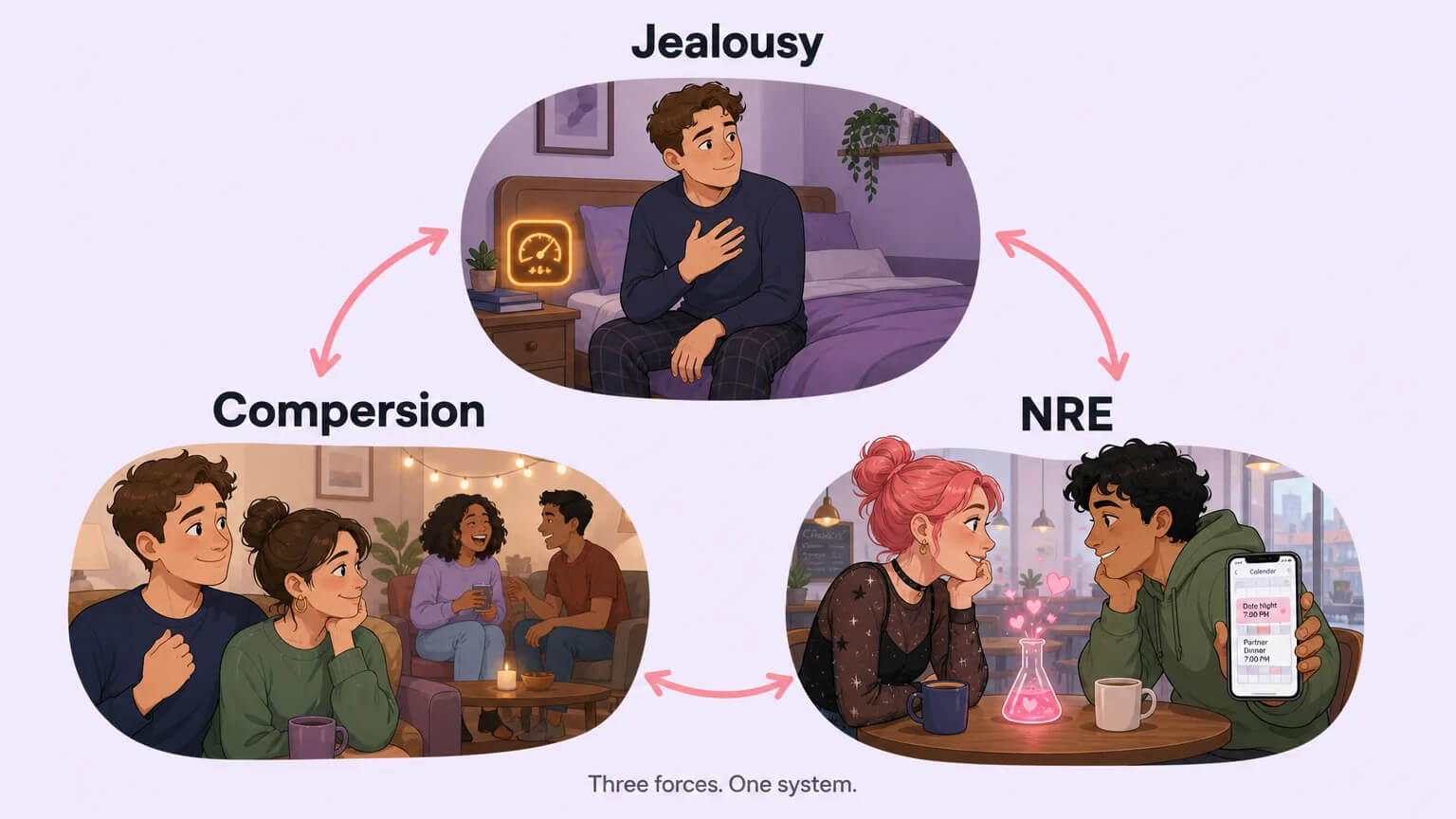
Three emotional forces power every polycule. They are not bugs in the system. They are the system.
Jealousy is a dashboard light
Jealousy is not a sign that you are doing polyamory wrong. It is a signal that something needs attention. What is it telling you? Are you feeling insecure about your place? Not getting enough time? Is an old wound being pressed? The jealousy itself is rarely the real problem. It is the signal pointing at the real problem.
When jealousy hits, ask three questions before reacting: What specific thing am I afraid of losing? Is that fear based on something happening now, or something from my past? What would I need from my partner right now that is not about controlling their other relationships? Write the answers down before you start the conversation.
Compersion coexists with jealousy
Compersion is the feeling of joy when your partner experiences joy with someone else. Here is the part most people do not say: it can coexist with jealousy in the same moment. You can feel a pang of insecurity and genuine happiness for your partner simultaneously. Neither cancels the other out.
Compersion is a skill, not an innate trait. Start small. Can you celebrate that your partner had a good first date? Can you be glad they found someone who shares an interest you do not? Build from there.
NRE is intoxicating and worth watching
NRE (New Relationship Energy) is the 6-to-18-month infatuation phase where a new connection feels like the center of the universe. It is real brain chemistry: dopamine, oxytocin, the works. The danger is not NRE itself. It is what happens when one partner is swimming in it and another is on the outside watching. NRE can make people impulsive, over-promise, and neglect existing relationships.
The antidote is to name it, acknowledge it, and protect existing relationships during the wave. Tell your nesting partner: “I am deep in NRE right now and I know that might affect how present I seem. Let us schedule intentional time so you do not get the leftovers.”
Polyamory does not eliminate hard emotions. It gives you a framework for working through them out loud, with the people involved, instead of alone in your head. That is the upgrade, and it is the whole point.
How to Not Be a Terrible Metamour

Nobody hands you a manual when you enter a polycule. Most people learn the etiquette by accidentally violating it and dealing with the fallout. Here is what actually works.
Let the hinge be the hinge. If your partner and your metamour are having a conflict, you are not the mediator. You are not the messenger. Do not get triangulated into their drama. Support your partner without managing their other relationship for them.
Meet metamours in neutral territory. Coffee shop, not someone’s home. Set a time limit so everyone knows when it ends. Acknowledge the weirdness out loud: “This is a little strange, and I am nervous, and I bet you are too.” Saying it defuses it.
Do not expect friendship. Cordial is a win. Kitchen table polyamory is an option, not a requirement. If you and your metamour end up as genuine friends, beautiful. If you end up as people who can politely share space at a birthday party, that is also working.
Ask for what you need, do not keep a tally. Scheduling is genuinely hard, and it is easy to feel slighted when your partner spends a Saturday with someone else. The answer is to state your need (“I would like a weekend day together in the next two weeks”), not to tally who got which night.
When joining an existing polycule, move slowly. You are entering an ecosystem that existed before you. The fastest way to alienate everyone is to demand equal time, equal status, or equal holiday invitations on week two. Build relationships individually, not as a bloc.
If you are the hinge, own the emotional labor. You chose to connect these people. The communication burden is yours. Do not make your partners manage each other because you are uncomfortable having hard conversations.
Respect that not everyone wants to be visible. Some people are out as poly. Some are not. Some have jobs, families, or communities where disclosure carries real risk. Never out someone else’s relationship structure without explicit permission. Privacy is not shame. It is safety.
Treat your metamours the way you hope your partner’s other partners treat you, even when nobody is watching.
The Real-World Toolkit

Most of polycule life is not glamorous. It is calendar negotiations, STI test result sharing, and conversations that start with “Can we check in about something?” and end an hour later with both of you feeling closer. Here is the infrastructure.
Where Modern Polycules Are Born
Feeld is the go-to app for ENM dating, with a “Constellation” feature linking up to five partner profiles. OkCupid has about 50 million users with explicit polyamory filters and 22 gender identity options. 3Fun is built for couples exploring together, with linked accounts that let both partners chat simultaneously.
Use multiple apps: Feeld for the ENM community, OkCupid for broader reach, and 3Fun if you are a couple exploring as a team. State your relationship structure in the first two lines of your profile. Ambiguity wastes everyone’s time.
Safer Sex in a Network
Multi-partner sexual health requires more explicit protocols, but it is not scarier than monogamous sexual health. Best practice: quarterly full-panel testing including pharyngeal, rectal, and urethral or cervical swabs. Blood work alone misses throat and rectal STIs, which are often asymptomatic.
Establish a fluid bonding agreement: verifiable recent tests plus a three-month quarantine window. The person with multiple partners is responsible for disclosure across the network. The most cautious person’s boundaries set the safety floor for everyone.
Scheduling Is the Real Skill
Google Calendar is the default. Most polycules run multiple shared calendars. Some invent a fictional partner named “Alan” to block off alone time, a running joke that points at a real need. The Cule Kids track outside dates on a shared “Cule Log” so nobody feels surprised. Alone time is a scheduling requirement, not a failure.
A Tuesday, Realistically
The five-adult, four-kid Seattle polycule shuttles between two homes, negotiating food preferences, bathroom schedules, and quiet hours. The Cule Kids podcast about the pros (always someone to talk to, varied perspectives) and the cons (not getting invited to weddings because there are not enough seats). The texture of daily life is not constant drama or constant sex. It is constant coordination.
When a Connection Ends
Polycule breakups have ripple effects. You may lose not just one partner but metamours, shared friends, routines, and future plans. Grieving a metamour you never met is real.
Best practices: let the hinge manage their own breakup. Renegotiate boundaries with ex-metamours around shared spaces and events. Decide: parallel (no contact) or continued friendship? Either is valid. Validate the grief. Resources like “The Polyamory Breakup Book” by Kathy Labriola exist for exactly this.
The logistics are real. The emotional labor is real. The reward is real too. You decide.
The Questions Everyone Asks (Eventually)
Is a polycule the same as a throuple?
No. A throuple (triad) is one type of polycule where three people are all connected. A polycule is the bigger umbrella: Vs, triads, quads, and networks of 20 or more. Every throuple is a polycule, but not every polycule is a throuple.
Do I have to date everyone in a polycule?
Absolutely not. Your partner’s partner is in your polycule. That does not mean you are dating them. In most polycules, most people are not directly involved with each other.
How many people are in a typical polycule?
The most common entry point is three (a V). The largest documented is 20, the Boston polycule profiled by the New York Times in 2024. Size is limited by scheduling capacity, emotional bandwidth, and poly-saturation.
What if I get jealous?
You will. Everyone does. The question is what you do when it arrives. Curiosity, not control. Communication, not suppression.
What is the difference between kitchen table and parallel?
Kitchen table: metamours are comfortable sharing meals and may be friends. Parallel: metamours acknowledge each other but have minimal contact. Both are valid. Neither is more “evolved.”
How do I tell if someone is actually polyamorous versus just being unfaithful and calling it poly?
Consent and transparency are the tells. If everyone involved knows and agrees, it is polyamory. If someone hides partners, dodges questions, or unilaterally opens the relationship without their partner’s buy-in, that is deception wearing a vocabulary lesson.
What dating apps work for finding polycule partners?
Feeld is the go-to app with its Constellation partner-linking feature. OkCupid has the largest user base with explicit polyamory filters. 3Fun is best for couples exploring together. Use multiple apps and state your structure in the first two lines of your profile.
Is this for me?
Only you can answer that. Green flags: genuine desire, honest communication skills, a stable existing relationship, and enthusiastic consent from everyone involved. Red flags: trying to fix a broken relationship, feeling coerced, carrying unhealed betrayal trauma, or running from something rather than toward something. Start by reading “Polysecure” by Jessica Fern, listening to the Multiamory podcast, and finding a poly-friendly therapist. Take six months. Do not rush.