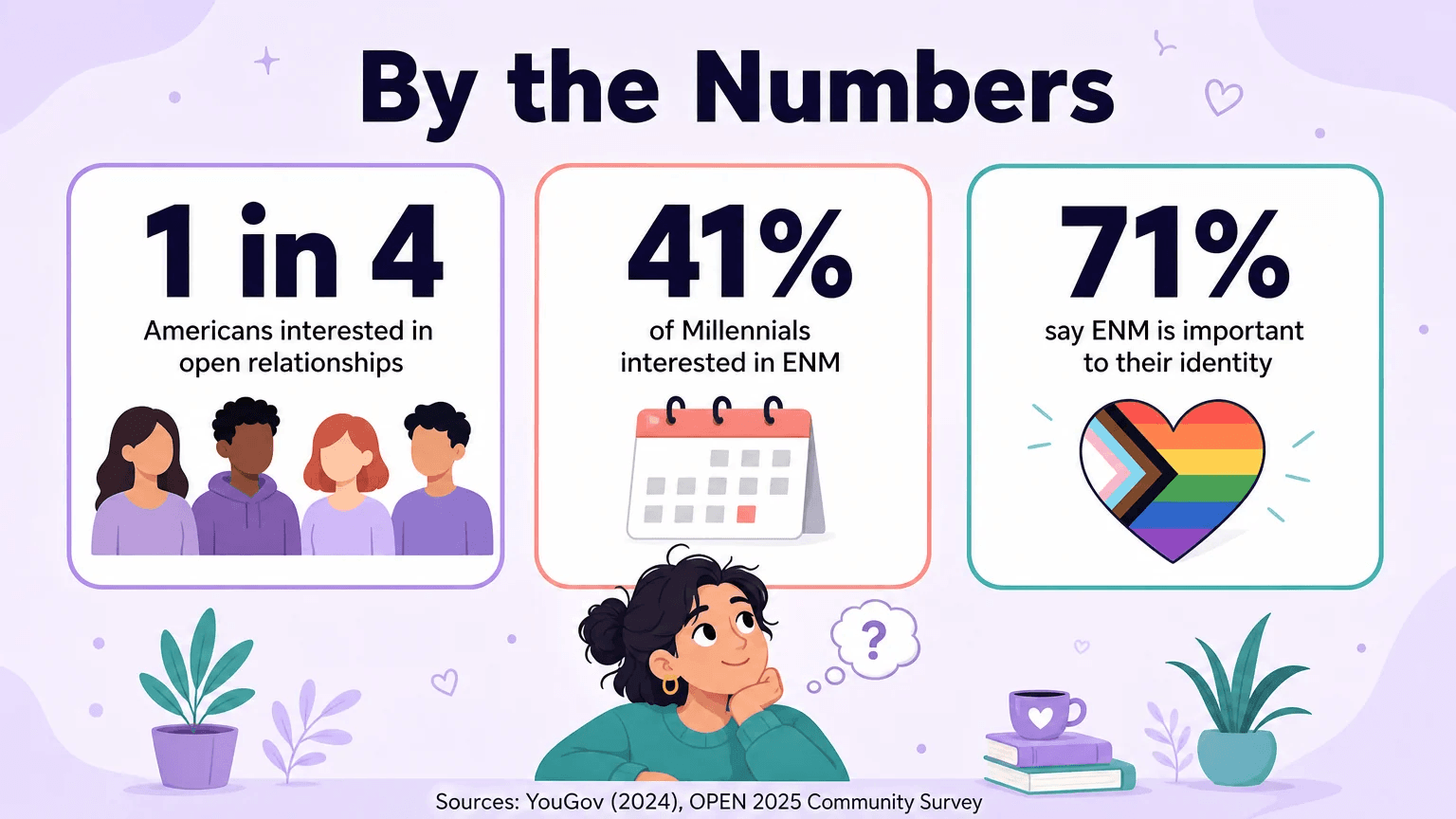
One in four Americans is interested in an open relationship. Among Millennials, that number hits 41%, according to a YouGov poll of over 23,000 people. One in five adults has tried ethical non-monogamy at some point. The numbers are not fringe.
Yet for most people, saying the words how to ask for an open relationship out loud feels like defusing a bomb and nobody handed you the manual.
YouTuber Justin Brown described what happened when his partner made the request: “It destroyed me, and it also destroyed the relationship. Just the request itself.” His logical brain saw the appeal. His emotional brain spiraled. “Was I not enough?”
The desire is not the problem. Nobody teaches you how to have this conversation, and that is the problem.
Most guides skip the hard part. This one does not. You get three word-for-word conversation frameworks, emotional prep for both sides, and a roadmap from self-reflection to first steps. Whether you are asking or you just got asked, you will find a way through this with honesty and care.
Dr. Abby Medcalf, a relationship psychologist with nearly 40 years of experience, puts it simply: “The goal is not the outcome. It is the conversation itself.”
Step 1: Get Clear on Your Why Before You Say a Word
Most people who feel pulled toward non-monogamy have never sat down and asked themselves why. They feel a vague restlessness, a curiosity about something missing. But when your partner’s first question is “Why?”, vague does not hold up.
Danielle Palomares, a trauma and attachment therapist, warns that opening a relationship is not a repair tool. It widens existing cracks. If your relationship lacks baseline trust, communication, or repair skills, ethical non-monogamy will make all three harder.
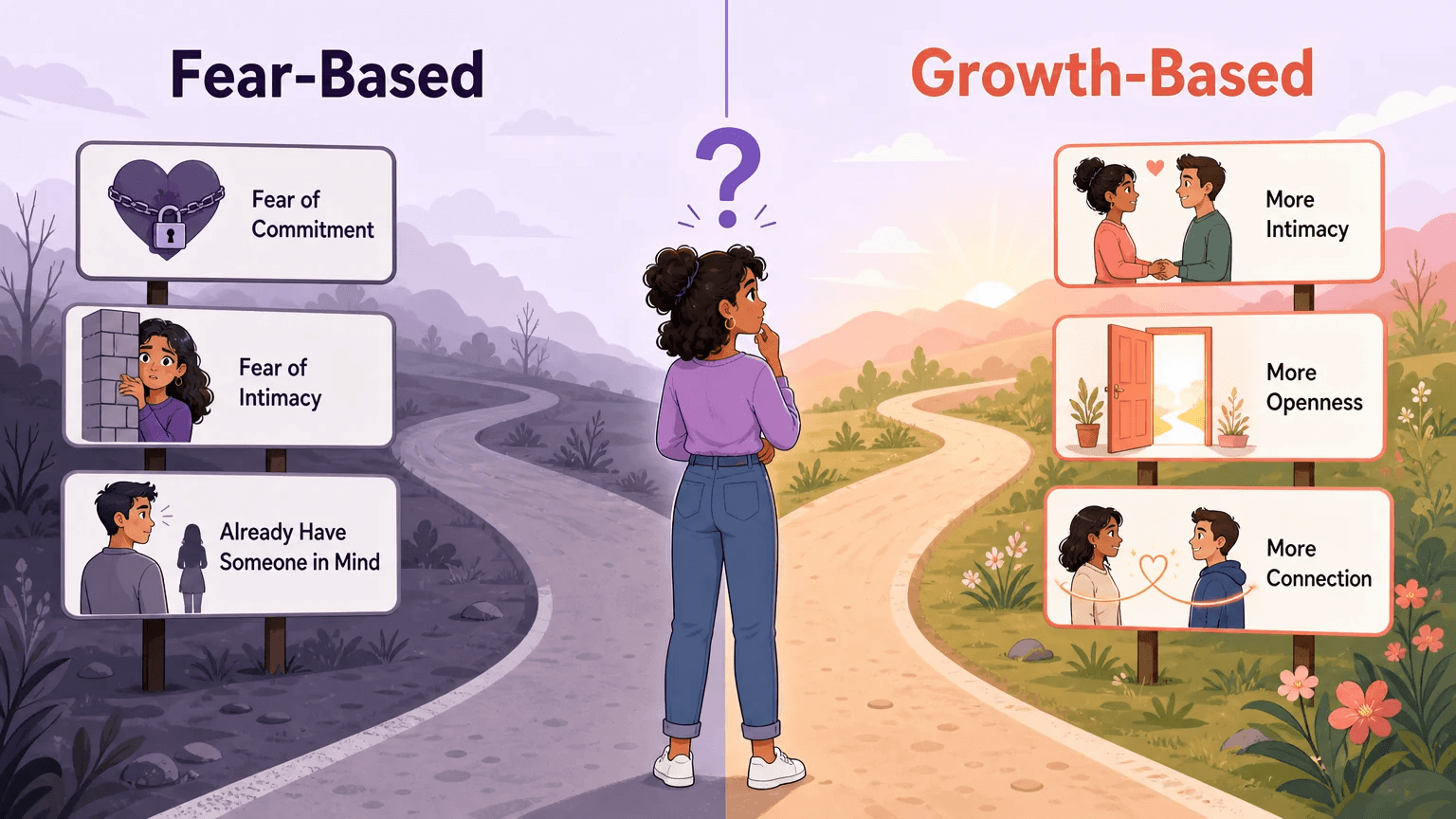
Dr. Medcalf offers a filter that actually works: fear-based motivations are red flags. Fear of commitment. Fear of intimacy. Past trauma you have not processed. Already having someone specific in mind.
These reasons lead to fear-based outcomes. The only reason that holds up under honest self-examination is growth-based: you want more intimacy, more openness, and more connection in the relationship you already have.
She also points out something people miss. Sometimes sex and emotional intimacy get confused. Someone who feels emotionally distant may only know how to feel close through sex, so they ask to open the relationship when what they actually need is a deeper bond with the partner right in front of them.
Before you say a word to your partner, write down three specific reasons you want this. Then test each one: is this fear talking, or is this growth? If your why cannot survive your own scrutiny, it will crumble under your partner’s.
Step 2: Do the Emotional Prep Work (Before the Talk)
There is an asymmetry here that catches people off guard. You have had months, maybe years, to sit with this desire. Your partner gets seconds.
Justin Brown described his partner’s request landing like a wrecking ball. Not because the request was wrong. Because he had done none of the inner work required to hear it. The gap between your processing time and theirs is the biggest risk in this conversation. Closing it starts with you.
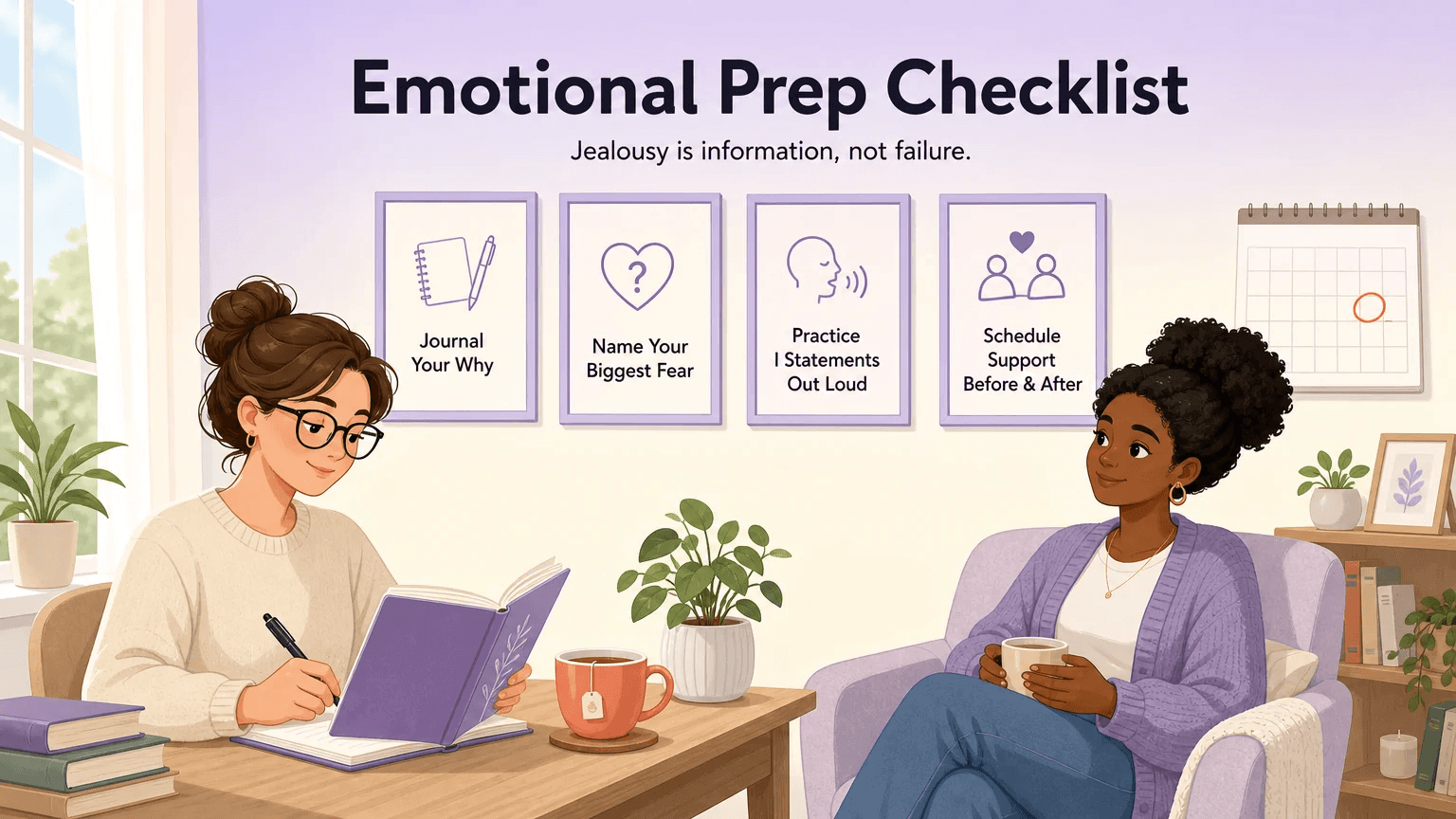
Paige Bond, a therapist who specializes in non-monogamy, recommends a practical emotional prep checklist.
Journal about what you want and why until you can say it without stumbling. Name your biggest specific fear: rejection, judgment, abandonment. Practice “I” statements out loud. In the car, in the mirror, with a therapist. Pick a calm, private setting with no time pressure.
Plan something restorative for after the conversation, no matter how it goes. Line up support: a friend, therapist, or community you can process with.
Zhana Vrangalova, PhD, a professor at NYU and creator of Open Smarter, offers a reframe worth sitting with: jealousy is not a failure signal. It is information. It points toward unmet needs, deeper fears, patterns worth examining. The difference between monogamous and non-monogamous people is how they approach jealousy, not whether they feel it.
Schedule a therapy session for the week before and the week after the conversation. If your current therapist is not affirming of non-monogamy, the Polyamory-Friendly Professionals Network directory can connect you with someone who is.
Preparing emotionally does not mean controlling the outcome. It means being steady enough to stay present no matter what happens.
Step 3: Set the Stage and Know What to Say
The right words at the wrong time fail. Perfect timing with no script leaves you frozen. This section gives you both.
What not to do: not during an argument, not right after sex, not when either of you is stressed or exhausted, not in public, not via text, and never as a hypothetical during a fight about something else.
Instead, ask for consent to have the conversation: “I have been reflecting on something about relationships, and I would love to talk about it with you when we both feel settled. When would be a good time?” This shows respect. It gives your partner agency from the first sentence. It short-circuits the ambush dynamic that makes people defensive.
Choose a private, neutral space with enough time that nobody is glancing at the clock. A daytime weekend window, not a weeknight. Both of you sober. Never open with “We need to talk.” That phrase spikes cortisol all by itself. Say “I would love to talk with you about something” instead.
If your heart is pounding just reading this, that is normal. Your voice will probably shake. Fine. The goal is honesty, not a performance. Here are three frameworks. Pick the one that fits who you are.
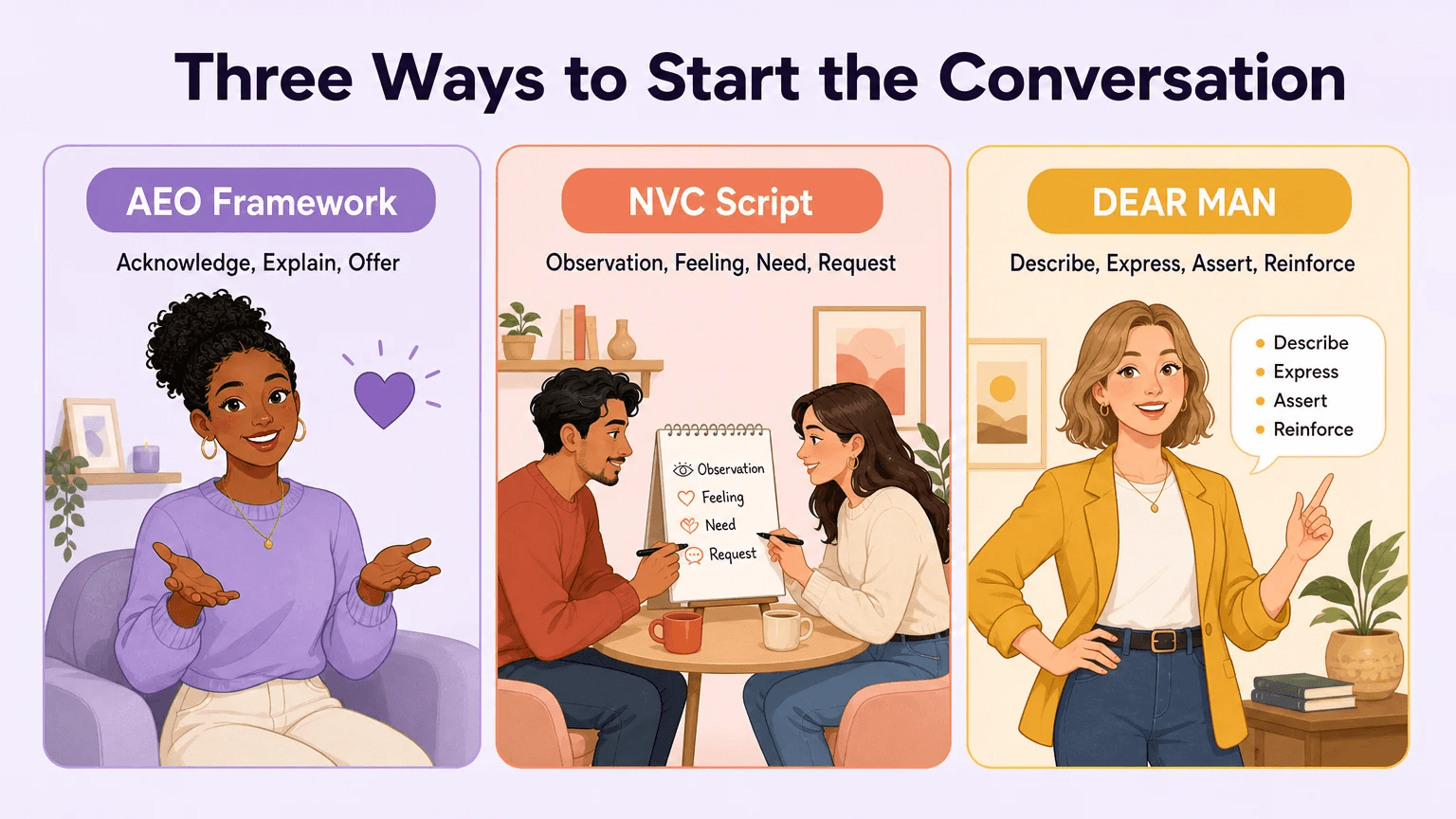
The AEO Framework (Acknowledge, Explain, Offer) — Best for anxious initiators who want to lead with care.
Acknowledge: “I know this might feel unexpected and probably stirs up some big feelings.”
Explain without demands: “I feel curious about monogamy alternatives, but also anxious about hurting you.”
Offer a low-stakes next step: “I would love for us to read Opening Up by Tristan Taormino together, just talk through it chapter by chapter, no pressure to change anything. What do you think?”
Give processing time: “You do not need to respond to any of this right now. I just wanted to open the door to talking about it.”
The NVC Script (Observation, Feeling, Need, Request) — Best for emotionally literate couples.
“When I think about relationships in general, I sometimes feel curious about what other forms of connection might feel like, because I value growth and honesty in our relationship. Would you be willing to explore what ethical non-monogamy means to each of us, just as a discussion?”
The DEAR MAN Script (Describe, Express, Assert, Reinforce) — Best for direct communicators.
“I have noticed we have built something really strong together over the years. I feel a mix of nervousness and hope bringing this up. I would like us to have an open, no-pressure conversation about what ethical non-monogamy could look like for us. I think talking about this openly could actually bring us closer, regardless of what we decide.”
Stick to “I” statements. “I have been curious about what non-monogamy might feel like,” not “You are not enough for me.”
Step 4: Navigate Their Reaction
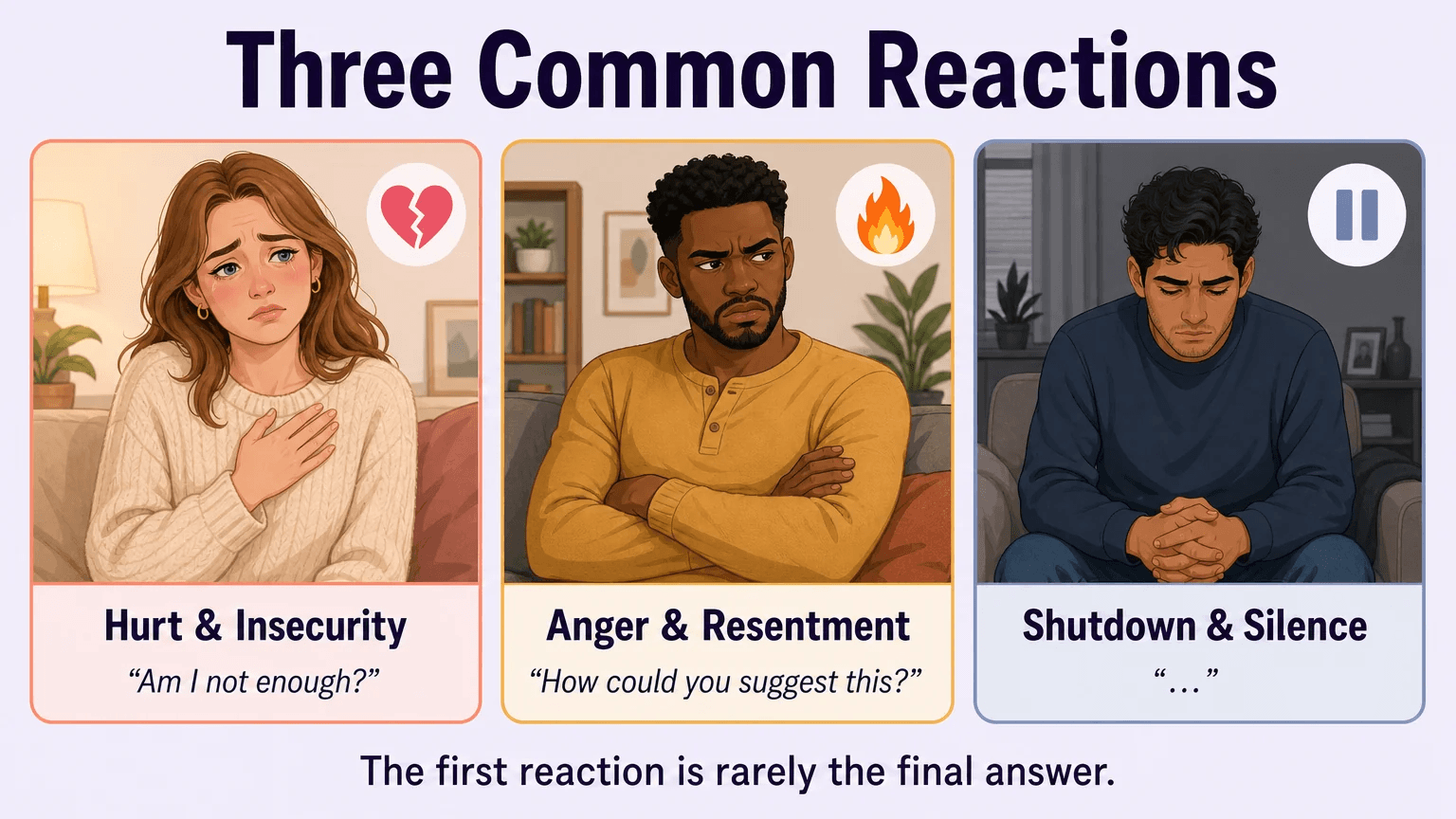
Your partner’s first reaction is rarely their final answer. Most initiators mistake the initial emotional wave for a permanent rejection. Or worse, they try to argue through it. Your job here is simpler and harder: prove, by staying calm, that you meant it when you said this was a conversation, not a demand.
Three reactions are most common.
Hurt and insecurity. Your partner says some version of “Am I not enough?” This is the deepest fear, and it deserves room to breathe, not a rebuttal.
Your script: “I can see this is hard to hear. Thank you for being honest with me.” Do not launch into reasons they are enough. Do not explain the logic of non-monogamy. Just sit with the hurt.
Anger and resentment. “How could you even suggest this?” Your partner feels ambushed, even if you did everything right in Step 3. Your script: “I do not want to rush you. We do not need to decide anything today, or this month.” Patience is the only move that works.
Shutdown and silence. Your partner stares at the floor and says nothing. Your instinct will scream at you to fill the silence, explain more, convince. Do not.
Your script: “Take whatever time you need. I have been sitting with this for a while. You deserve that same space.”
Then there is the “maybe.” When your partner says “I do not know” or “I need to think about it,” this is not a no. It is an invitation to slow things down. Your script: “I hear you, and I am not in a rush. Let us both sit with this and come back when it feels right.”
For the receiving partner, Dr. Medcalf offers a reframe: “Your partner is saying to you: I have so much trust and faith in our relationship. You make me feel so safe that I feel like I can spread my wings a little.”
You are not being told you are not enough. You are being told you built something strong enough to hold an honest conversation.
Step 5: Give It Room to Breathe
The days and weeks after the first conversation are when most couples either grow closer or fracture. What you do during this window matters more than what you said in the initial talk.
Here is the timeline reality. You have probably been thinking about this for months, maybe years. Your partner deserves comparable processing time. Therapists consistently recommend days, weeks, or even months before the follow-up conversation. This is fairness, not stalling.
Before ending the first conversation, agree on a specific check-in date. “Let us both sit with this and come back to it next Sunday afternoon. Does that feel right?” This gives the receiving partner a clear container and stops you from anxiety-driven check-ins every six hours.
While you wait, do not hover. Journal your own reactions. Read one of the foundational books, Opening Up or The Ethical Slut, so you can discuss them together later. Do not “accidentally” bring it up at dinner.
For the receiving partner, Justin Brown’s five-question framework is worth working through alone. What is the relationship you have with yourself? Is your relationship helping you both grow? Can you handle one-sided monogamy? Do you both want to be with other people? And the most important one: why does your partner want this? Talk to a therapist or a trusted friend who will not judge either path.
Eleanor Gordon-Smith reminds us there is a “big spectrum of stuff between no access to desires and all-out participation.” Exploring fantasies together, visiting a sex club just to observe, reading books before any action. This waiting period is where the real work begins. It is not dead air.
Step 6: Come Back Together
The follow-up conversation is where you move from “should we?” to “how would we?” Martha Kauppi, LMFT and author of Polyamory: A Clinical Toolkit for Therapists, provides a framework that turns this from a debate into a design process.
Her five steps:
First, look within. Each person clarifies their own values, desires, and fears before negotiating. Second, communicate and explore. This is creative exploration, not decision-making. Third, get specific. “I want sexual adventure” is fog. Turn it into concrete scenarios.
Fourth, do not rush. Listening to your partner’s perspective is not the same as agreeing with it. Fifth: frame a first experiment, not a forever agreement.
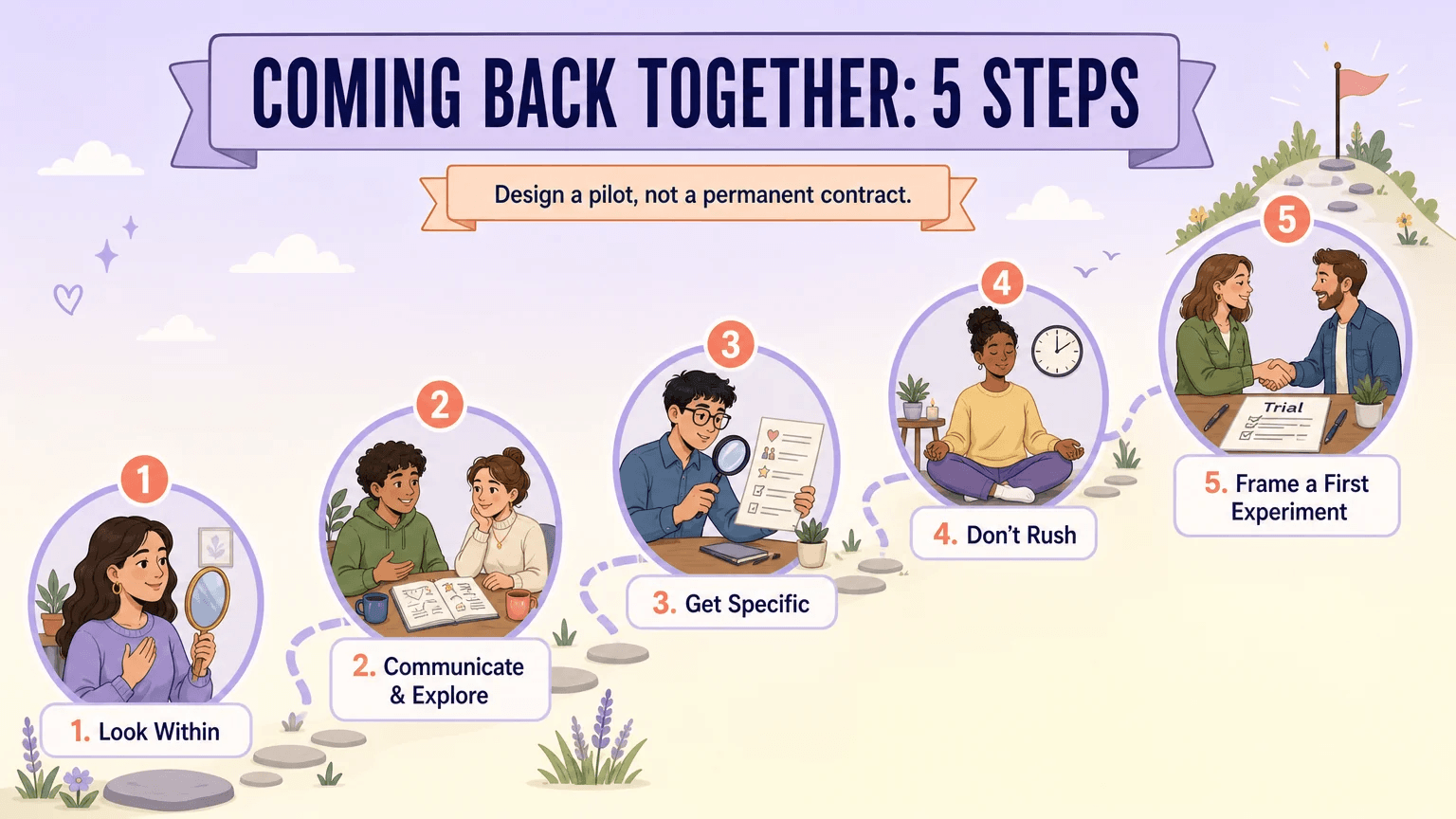
This is the mental move that takes the pressure off. You are not signing a permanent contract. You are designing a three-month pilot with a hard check-in date. You are saying: we can try something, evaluate it honestly, and adjust.
Dr. Medcalf adds an unusual step: before coming together for the final conversation, each person should decide individually, alone. This keeps one partner’s answer from shaping the other’s.
Realistically, you may not land on the same page. When partners cannot agree, three paths exist. A one-sided arrangement can work in theory if the monogamous partner feels genuinely secure, but therapists flag this as high risk. Forcing a dynamic that feels wrong leads to resentment. The third path: acknowledging the misalignment and asking whether the relationship can hold both people’s needs. It is painful but honest.
There is also middle ground. Eleanor Gordon-Smith suggests starting with exploration that involves no outside people: sharing fantasies, reading books together, visiting a sex club to observe. These steps clarify what you actually want before anyone else enters the picture.
The agreement is the starting line, not the destination.
Step 7: Build Your Agreements Together
Agreements have a branding problem. They sound like a list of things you cannot do. But the healthiest non-monogamous dynamics flip this: agreements are not restrictions. They are what makes exploring feel safe instead of terrifying.
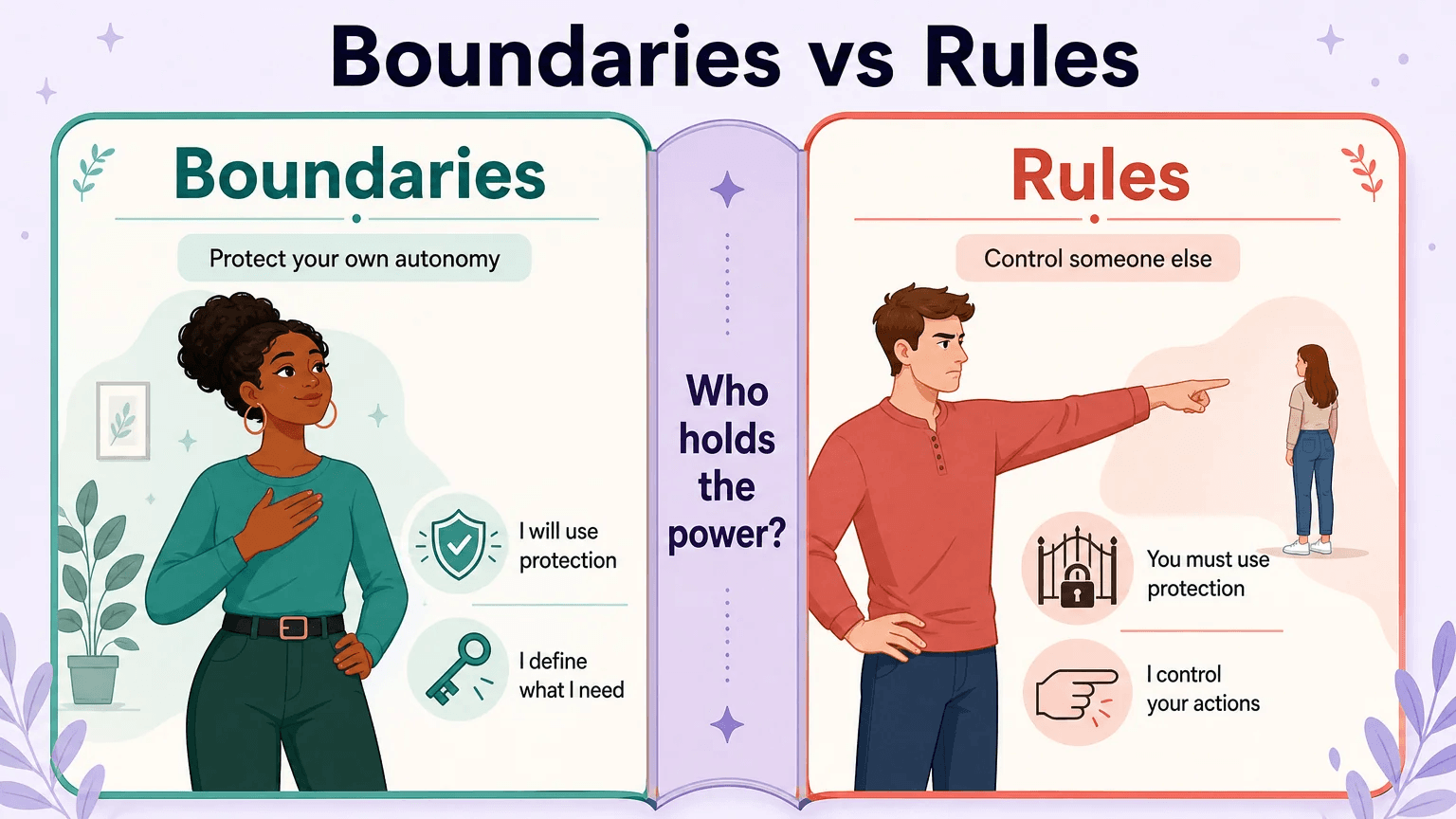
The most useful distinction in all of ENM is boundaries versus rules. A boundary protects your own autonomy: “I am not comfortable going to that restaurant because it is special to us.” A rule controls someone else: “You cannot go to that restaurant.” The difference is who holds the power.
Therapists recommend discussing seven categories before anyone acts on anything. Expect this to take multiple sittings.
Types of connections. Casual sex only? Ongoing relationships allowed? Emotional intimacy permitted? Be explicit.
Off-limits categories. Coworkers, close friends, exes, family members. Define these early. Finding a mismatch after the fact is a preventable wound.
Time and resource boundaries. How much time per week? Protected days for your primary relationship? Overnights allowed? Time is the resource most couples underestimate.
Sexual health and safety. STI testing frequency, barrier use requirements, disclosure obligations if risk exposure changes. Not romantic, but non-negotiable.
Communication agreements. How much detail do you share about outside encounters? Check-ins before or after dates? Some couples want a highlight reel. Others want to know nothing beyond logistics. Neither is wrong.
Emotional boundaries. What happens if one partner feels more connected to an outside partner? Are “I love you” statements allowed? This is the category most couples avoid and the one that causes the most pain when left unspoken.
Privacy and discretion. Who do you tell? Friends? Family? Kids? Social media presence?
The OPEN 2025 Community Survey of 5,885 respondents across 65 countries found that 61% have experienced stigma or discrimination. Discretion is not shame. It is self-protection.
The “one penis policy” needs to be named. When a man in a heterosexual relationship permits his female partner to explore with women but not with other men, it is always unethical. It treats same-gender relationships as less real. If the framework only protects one person’s comfort, it is not an agreement. It is a veto.
Step 8: Take Your First Steps
You have had the conversations. You have your agreements. Now what? The post-agreement vacuum is tricky. Some couples rush into action and burn it all down. Others freeze and never take a step. Both are pacing problems.
Give yourselves a minimum of two to four weeks after the agreement before any outside dates or app downloads. Use that time to read together. Opening Up and The Ethical Slut are the standard starting points. The Jealousy Workbook by Kathy Labriola is worth working through before jealousy has something real to attach to. The free ENM Workbook from South Denver Therapy provides structured worksheets.
Digital privacy matters. Use apps designed for non-monogamous dating like 3Fun instead of general dating apps where discretion is harder. Create a separate photo set that is not reverse-image-searchable to your social media. Agree on what happens if someone you know spots your profile. Never share partner details or explicit photos without enthusiastic consent from everyone involved.
Community makes this sustainable. The OPEN 2025 survey found that 71% of respondents say ENM is “very” or “extremely important” to their identity. Find local ENM meetups. Join online communities like Reddit’s r/nonmonogamy and r/polyamory. Use directories like the Polyamory-Friendly Professionals Network to find a therapist who will not pathologize your relationship structure.
For singles: disclose by the first or second date, absolutely before anything gets physical. A simple script: “I want to be upfront about how I date. I practice ethical non-monogamy, which means I date more than one person with everyone’s consent. Happy to talk more about it.” Add ENM to your dating profile to filter upfront.
When you do take those first steps, watch for New Relationship Energy. It is intoxicating by design, and it will quietly pull your focus away from the relationship you already have. The original bond needs ongoing investment. NRE is exciting. Do not let that excitement starve the connection that made this whole thing possible.
FAQ
How do I know if I am asking for the right reasons vs. trying to escape my relationship?
Dr. Abby Medcalf’s filter: fear-based motivations are red flags. Fear of commitment. Fear of intimacy. Already having someone specific in mind. A vague sense that something is missing.
All of these signal the issue is inside your current relationship, not somewhere else. The only motivation that holds up: you want more intimacy, openness, and connection in a relationship that is already strong. See Step 1 for the full breakdown.
What is the difference between boundaries and rules?
A boundary protects your own autonomy: “I will use protection with all partners.” A rule controls someone else: “You must use protection with all partners.” The difference is who holds the power. The healthiest ENM dynamics prioritize boundaries over rules. See Step 7 for the full framework. And if you want more information about open relationship rules, you can check this guide >>
How do I handle jealousy when it comes up?
Jealousy is not a sign that opening up was a mistake. Zhana Vrangalova, PhD, describes it as information, something pointing toward unmet needs or deeper fears. Practical tools: keep a jealousy journal to track triggers, practice self-soothing to handle emotional waves on your own, use cognitive reappraisal to challenge automatic negative thoughts, and cultivate compersion, the joy in your partner’s happiness with others.
Can an open relationship work if only one partner wants it?
Rarely. One-sided arrangements are possible if the monogamous partner feels genuinely secure, but therapists consistently flag this as high risk. Charlotte Monk warns that opening up just because you do not want to lose your partner creates resentment for both of you. The three paths: a one-sided arrangement, continuing despite knowing it is not right, or acknowledging the misalignment and considering whether the relationship can hold both people’s needs. See Step 6.
How long should this whole process take from first conversation to first experience?
There is no universal answer, but therapists converge on a minimum of several weeks to months. Your partner deserves processing time comparable to the months or years you have had. Martha Kauppi’s “first experiment” framing from Step 6 is the healthier model: a time-limited trial with a scheduled evaluation date, not a permanent switch flipped overnight.
What if I am single and want to date non-monogamously? How do I bring this up?
Disclose by the first or second date, before anything gets physical. Script: “I want to be upfront about how I date. I practice ethical non-monogamy, which means I date more than one person with everyone’s consent. Happy to talk more about it.” Add ENM to your dating profiles to filter upfront. Apps like 3Fun are designed for non-monogamous dating. See Step 8 for the full singles roadmap.