
You are scrolling a dating app, mid-conversation with someone interesting, and they mention “my nesting partner.” Or you are at a party, half-listening to a friend describe their relationship configuration, and the term lands somewhere between familiar and alien. You nod. You file it under “things I should probably understand.” Then you open a search bar.
That moment of curiosity is why you are here.
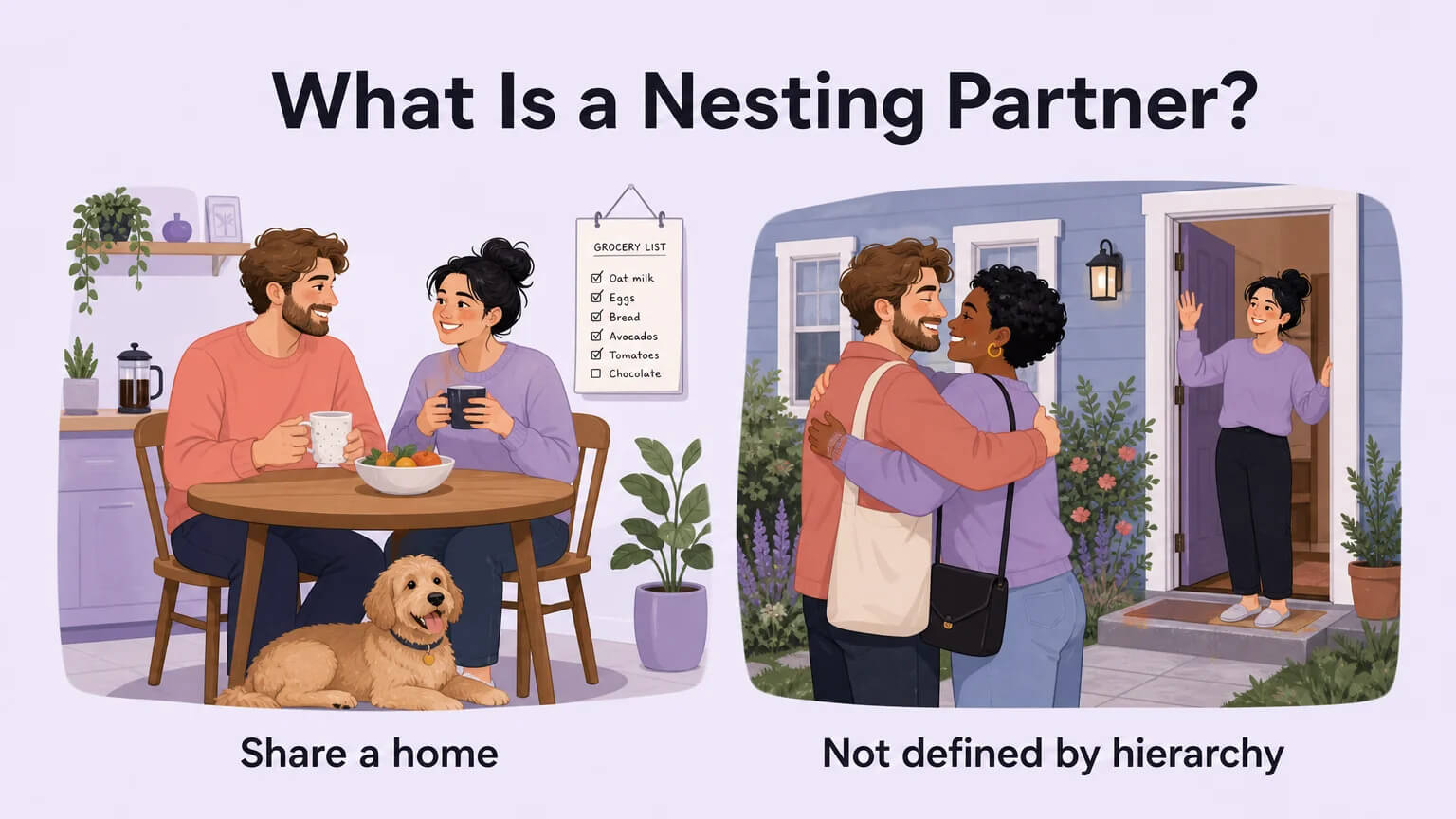
A nesting partner is someone you share a home and domestic life with, inside a polyamorous or ethically non-monogamous relationship structure. The “share a nest” part is literal. You live together. You split bills, groceries, morning routines. But the relationship architecture around that shared home can look completely different from couple to couple.
This guide is not a glossary entry that leaves you with more questions. It covers where the term came from (older than you think), how it differs from primary and anchor partners, what the transition from dating to nesting looks like in real life, the legal and financial side nobody writes about, how different configurations handle nesting, the actual benefits and tradeoffs, and what happens when nesting ends. By the end, you will know the definition, how to navigate the conversation, and how to protect yourself legally if things shift.
This works whether you are brand new to ENM, actively dating and considering cohabitation, or already nested and navigating a change. No jargon without explanation. No assumptions about your relationship structure.
What Is a Nesting Partner: Definition, Origin, and What It Actually Means
The term “nesting partner” traces back to Robert Heinlein’s 1961 novel Stranger in a Strange Land, where characters form “nests”: shared domestic arrangements among multiple adults that blend intimacy, household, and chosen family. The polyamory community adopted the language decades later. Around 2018 to 2020, as ENM visibility grew in mainstream spaces, the term entered dating-app vocabulary and stuck.
So what does it mean today?
A nesting partner is a romantic or intimate partner with whom you share a home and the daily logistics of living together. Bills. Groceries. Morning routines. Maybe children or pets. The defining feature is cohabitation, not relationship hierarchy. You can have a nesting partner who is not your “primary” partner. You can nest with someone you are not romantically involved with. The term describes a living arrangement, not a rank. Getting this distinction right shapes expectations around time, space, and decision-making with every partner in your network.
Nesting points to shared domestic space, not relationship priority. Marriage is optional. Many nesting partners never marry. And a nesting partner can simultaneously be a primary, secondary, or anchor partner. These labels describe different dimensions. They are not competing boxes.
Consider Alex and Jordan. They have been dating for two years, signed a lease together six months ago, split utilities, co-parent a dog, and hold a weekly Sunday check-in about household logistics. Alex also dates Sam, who lives separately. Jordan has a comet partner in another city. Alex and Jordan are nesting partners. The term describes their shared home life, not the entirety of their relationship structure.
Relationship therapist Casey Lee, LPC, emphasizes that nesting is intentional cohabitation rather than default escalation. The couple that slides into living together because one lease ended has not made a nesting decision. They have avoided one.
Nesting Partner vs Primary Partner vs Anchor Partner: A Side-by-Side Comparison
Using the wrong label for a partner can create real friction. Calling someone your “primary” when they thought you were “nesting” implies a hierarchy they may not have agreed to. Getting the language right is not pedantry. It is consent and clarity.
These three terms get confused constantly, even within polyamory communities. Here is how they actually differ.
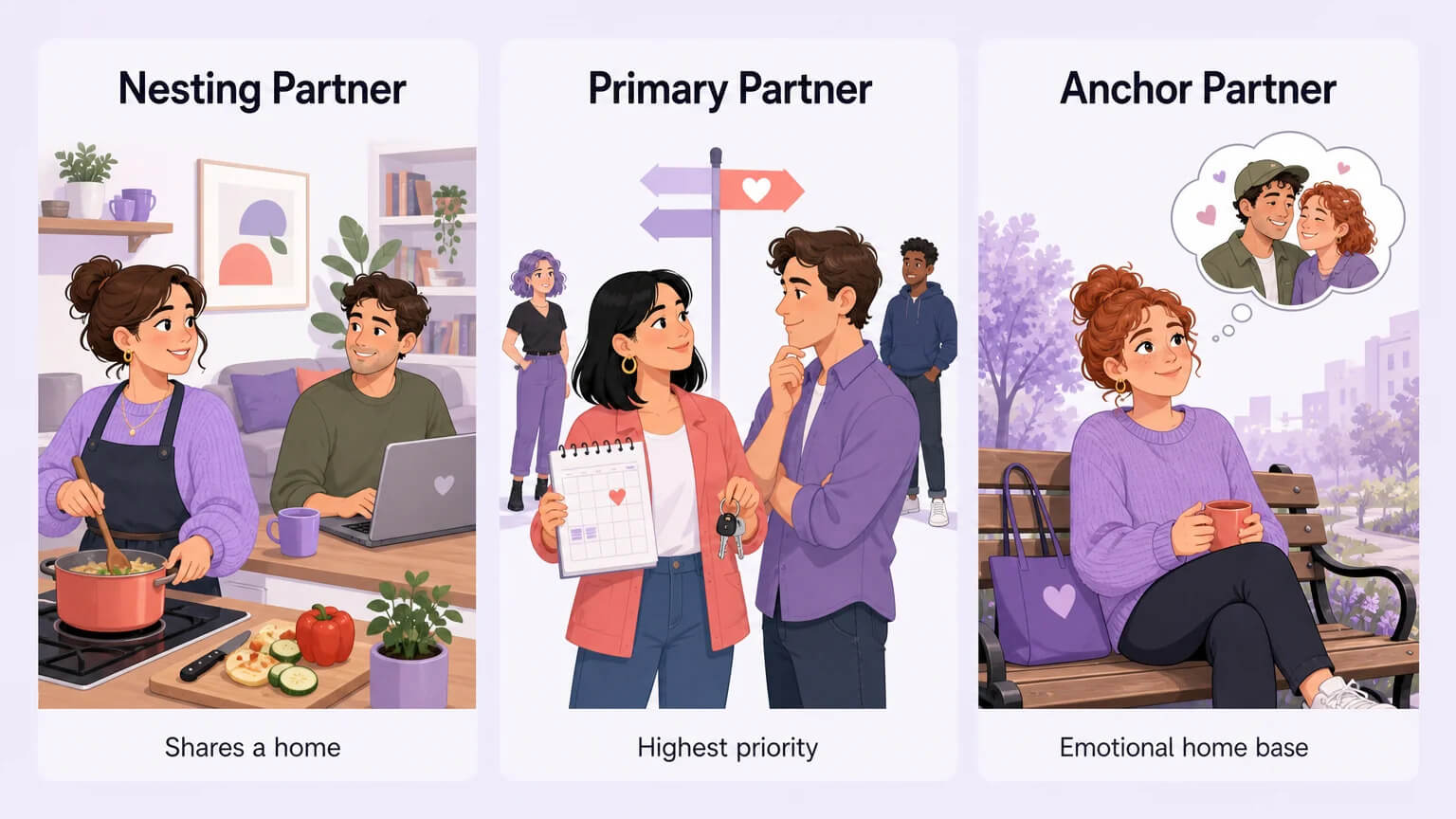
Cohabitation. Nesting partners share a home by definition. It is what makes the term mean something. Primary partners commonly cohabit, but the label does not require it. Anchor partners may or may not live with you.
Hierarchy. Nesting partners operate with optional hierarchy. The label itself does not indicate ranking. Primary partners are defined by hierarchy: this person comes first in decision-making, time allocation, and life planning. Anchor partners explicitly reject hierarchy. The term describes a stable emotional base without implying anyone outranks anyone else.
Emotional primacy. Nesting partners may or may not be your most significant emotional connection. The term does not speak to that dimension. Primary partners typically carry emotional primacy. Anchor partners are defined by emotional grounding: your stable base, your home in the emotional sense, deliberately without hierarchy.
Practical entanglement. Nesting partners share household logistics. Shared finances, legal ties, and children are common but not universal. Primary partners typically have high practical entanglement extending into life planning and major decisions. Anchor partners vary widely. Some share finances and children. Others maintain near-complete autonomy.
A quick way to sort it out. Ask yourself three questions. Do we share a home? If yes, “nesting” fits. Do we operate with clear priority over other relationships? If yes, “primary” fits. Is this person my emotional home base without the implication they outrank anyone else? If yes, “anchor” fits.
You can answer yes to more than one. Relationship researcher and educator Leanne Yau notes that these labels describe different dimensions, not competing categories. A partner can be both nesting and primary. Or nesting and anchor. Or anchor but not nesting. The language is a tool for clarity, not a tax form.
How to Move from Dating to Nesting Partners: Steps and Conversation Scripts
Most nesting-partner content stops at definition. The hard part is the actual transition, when you have other partners, existing entanglements, and no cultural script for any of it. What follows is drawn from therapists and ENM educators who have guided hundreds of people through this.
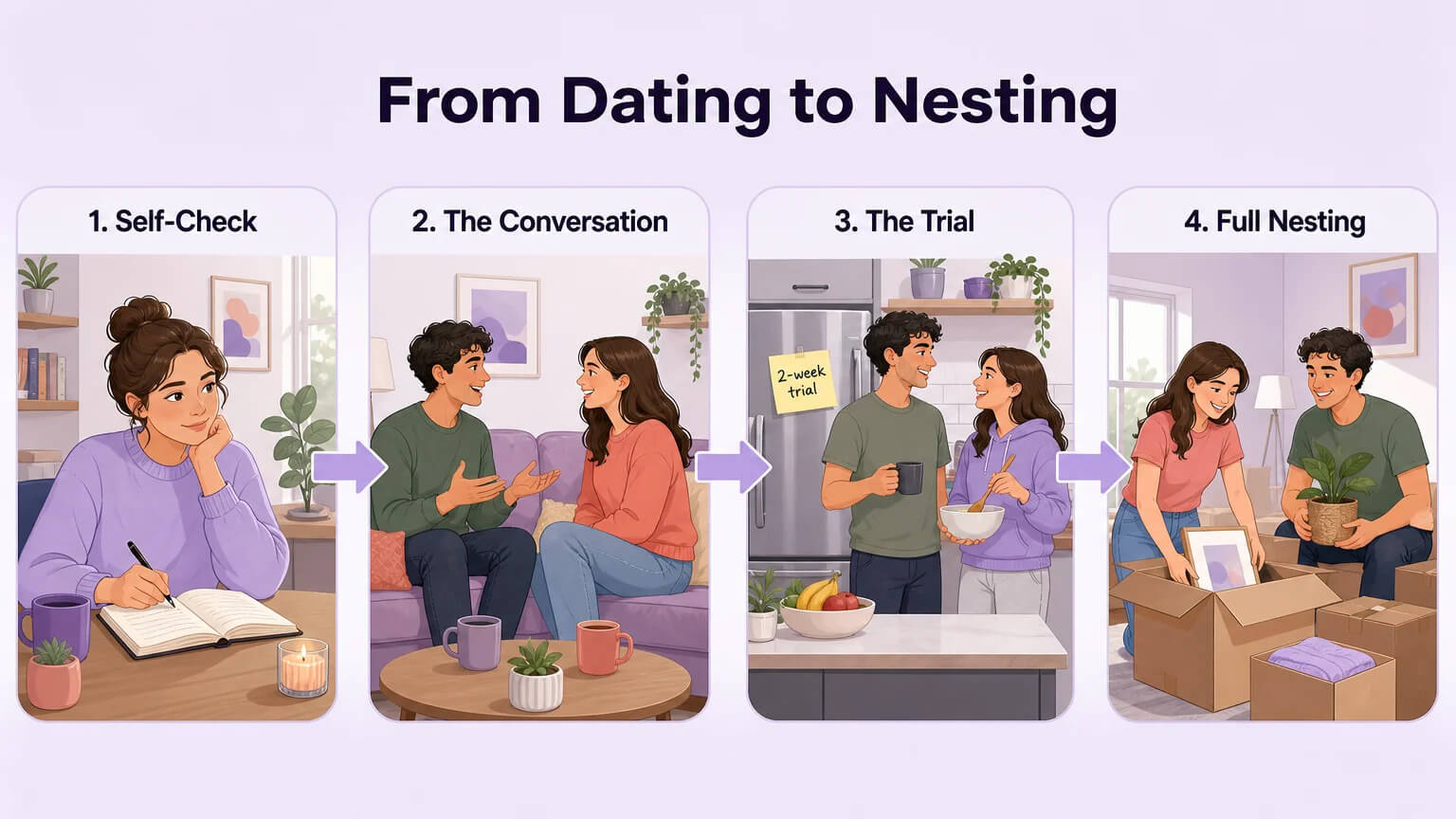
The self-check comes first. Before any conversation, get clear on your own answers. Do you want to nest because you genuinely want shared domestic life, or because it feels like the “next step” the relationship escalator demands? How will nesting change your availability to other partners? What are your non-negotiables around guests, shared space, and alone time? Casey Lee, LPC, recommends writing your answers down first. Know what you want and where you are flexible before the negotiation begins.
Then the conversation. Bring it up as an exploration, not a proposal. “I have been thinking about what sharing a home would look like for us. I would like to talk through whether that is something we both want, not as a default step, but as an intentional choice. Can we set aside time this weekend?” Key topics: what changes for your other partners, what financial model works, what guest agreements feel right, and what a trial period could look like. Do not resolve everything in one sitting.
Then the trial. Dr. Joli Hamilton recommends a two-week trial period with a defined check-in before signing a lease. Treat it as an experiment, not a commitment. Define success criteria together: what would make you both feel ready to proceed, and what would give either of you pause?
Then full nesting. Once committed, build recurring rituals: a weekly household check-in separate from date night, a quarterly “how is this working for everyone” conversation covering impacts on non-nesting partners, and a shared calendar.
Nesting partners who slide into cohabitation without these conversations end up negotiating everything retroactively under the pressure of an active lease. The upfront work is cheaper than the cleanup.
Legal and Financial Considerations: Cohabitation Agreements, Money, and What Happens If Things Go Wrong

Here is an uncomfortable truth most nesting-partner guides skip. When married couples separate, there is a legal system: divorce court, property division statutes, spousal support frameworks. When nesting partners separate, there is typically nothing. No default protections. No automatic rights. You are roommates in the eyes of most legal systems, regardless of how entangled your lives are. This is not a reason to avoid nesting. It is a reason to nest with intention.
The most important document for nesting partners is a cohabitation agreement: a written understanding that spells out who owns what, how shared property gets divided if you separate, who stays in the home, how shared pets are handled, and what financial obligations each person carries. It covers the questions you hope you never need answered. It is not a prenup (a prenup requires marriage), but it serves a similar protective function. Having a lawyer review your agreement is worth the cost, especially if you own property together or have children.
Financial models. Three common approaches. First, completely separate finances with split bills: cleanest, highest autonomy, works well when incomes are similar. Second, proportional contribution based on income: fairer when incomes diverge, each person contributes the same percentage of their income to shared expenses. Third, partial pooling: a joint household account for shared expenses while keeping personal accounts separate. This balances autonomy and practicality.
Children and legal parenthood. If nesting partners raise children together, legal parentage can be complex, particularly when more than two adults are involved. Some jurisdictions allow three-parent legal recognition. Most do not. This affects medical decisions, school enrollment, inheritance, and custody. This requires jurisdiction-specific legal advice. Do not assume goodwill will carry you through.
The legal default for unmarried cohabitants is thin. But the upside is real: nesting partners design their own agreements rather than inheriting a one-size-fits-all marital contract. That is alignment with ENM values: intentionality over assumption, applied to the least romantic dimension of sharing a life.
Can You Have Multiple Nesting Partners? Configurations, Dynamics, and the Solo Poly Question
If you searched “can you have multiple nesting partners,” you are not alone. The answer is yes.
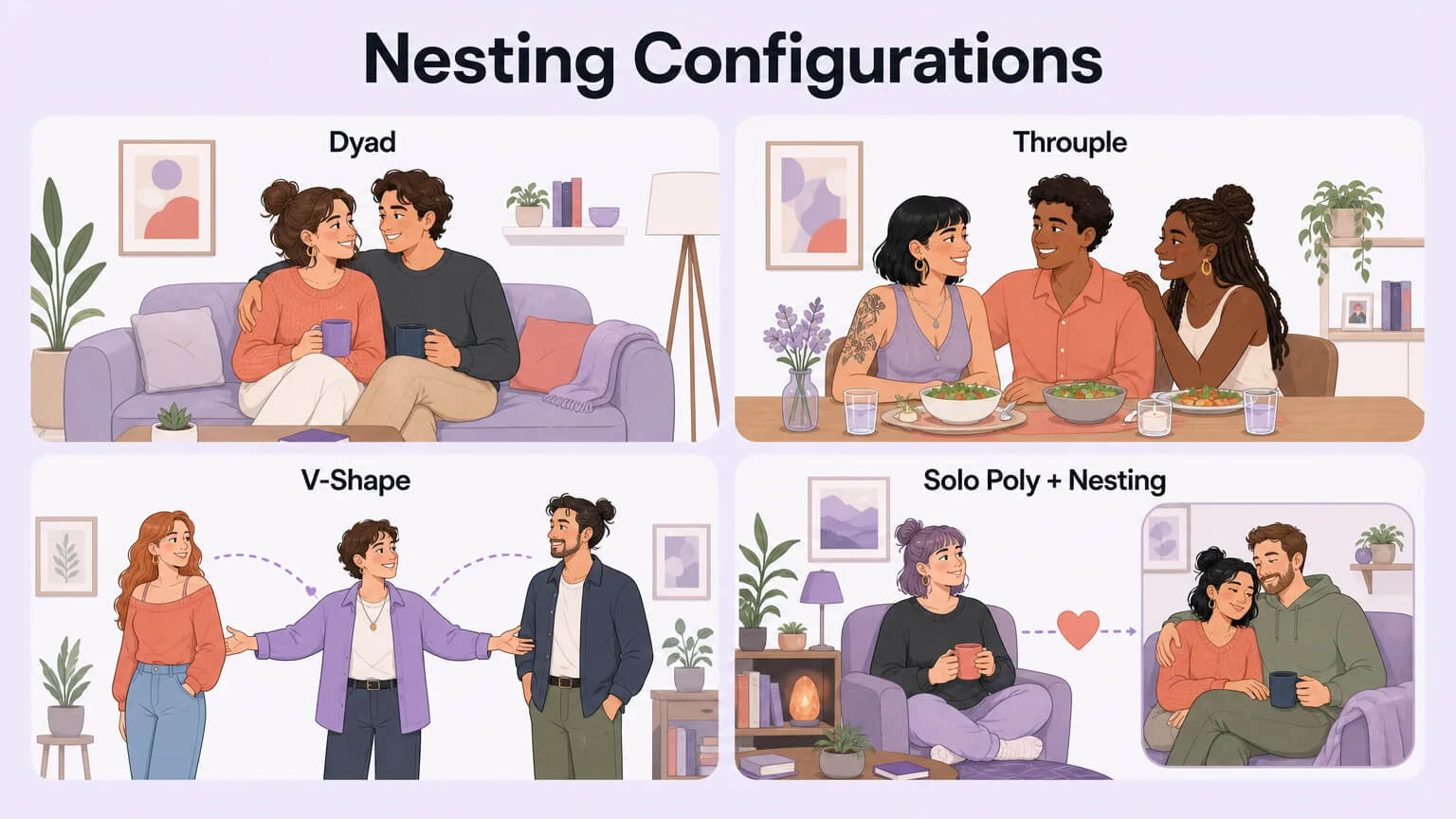
Two nesting partners, a dyad cohabitation, is the most common configuration. Two partners share a home. Other partners visit, stay over, or live nearby, but the domestic core is the dyad. Works well when both people want cohabitation and have compatible domestic styles.
Three or more nesting partners gets complicated fast. A throuple where all three are romantically involved has different dynamics than a V-shaped arrangement where one person lives with two partners who are not romantically involved with each other. Key success factors: everyone has their own physical space, household decisions use a clear process that includes all nesting partners, and kitchen table dynamics are negotiated explicitly rather than assumed.
Kitchen table versus parallel polyamory in a nesting context. Kitchen table polyamory, where metamours are comfortable sharing space, makes multi-partner nesting more practical. But it is not required. Parallel polyamory, where metamours have little to no contact, can coexist with nesting if boundaries are clear: separate entrances, defined guest schedules, agreements about shared versus private spaces. This is not a binary. Most real arrangements fall somewhere on a spectrum.
Solo polyamory and nesting. Solo polyamory emphasizes autonomy and typically rejects cohabitation, shared finances, and relationship escalation. But solo poly people can have nesting partners they do not live with. The term describes a domestic anchor without requiring you to be part of that household. Dr. Liz Powell, a licensed psychologist and ENM educator, notes that some solo poly people negotiate partial nesting: keeping separate residences while maintaining significant domestic time together.
The configuration that works is the one where everyone involved had a voice in designing it. Nesting is a collaborative architecture project, not a default floor plan.
The Real Benefits and Challenges of Nesting Partnerships
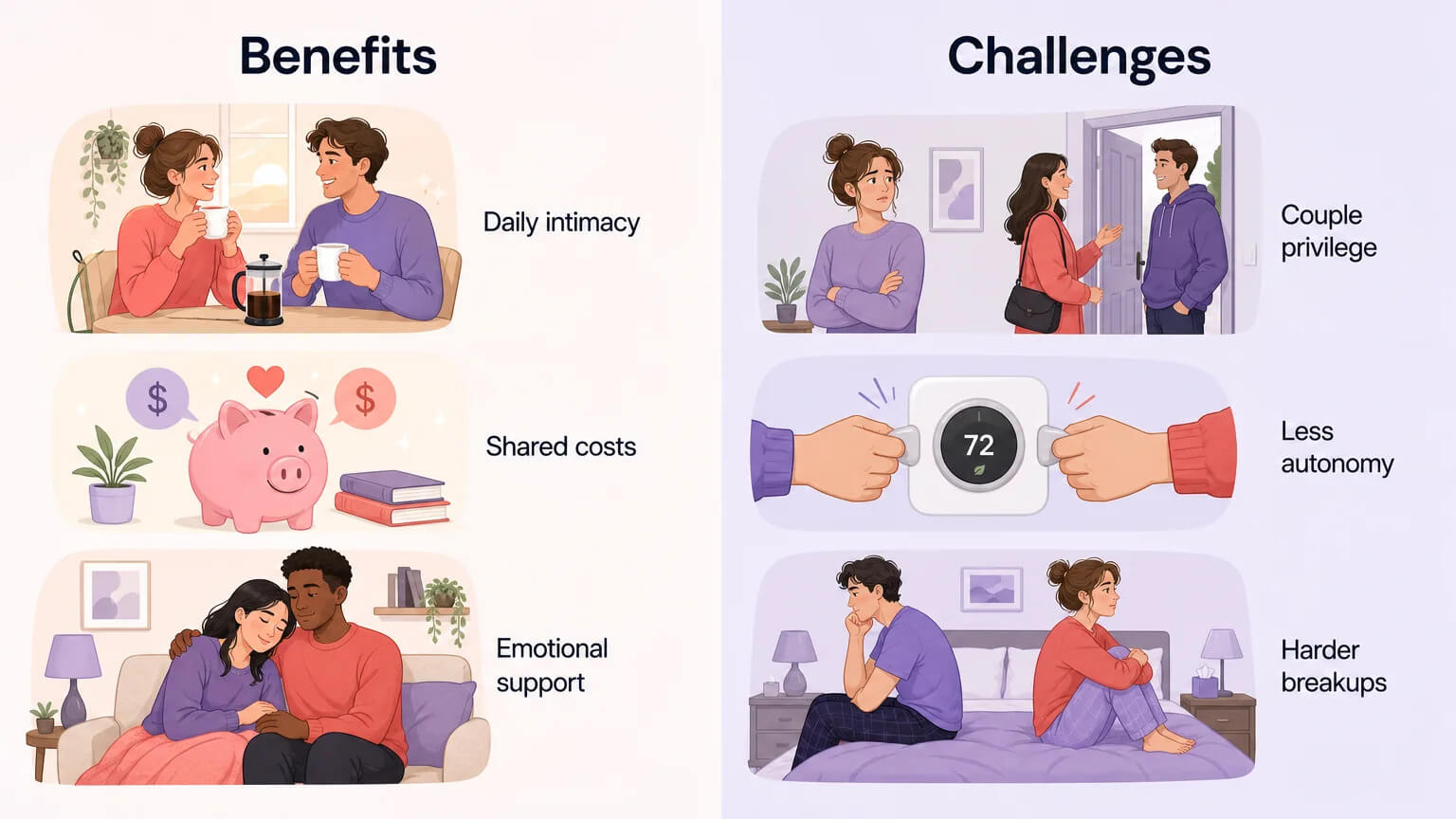
Nesting partnerships are not better or worse than other ENM configurations. They are a specific set of tradeoffs, drawn from research and clinical experience rather than cheerleading.
The benefits.
Daily intimacy without default hierarchy. Sharing a home creates small moments (morning coffee, quiet presence in the next room) that long-distance partnerships cannot replicate. Nesting does not require ranking.
Logistical efficiency. Shared rent, utilities, and coordinated schedules cost less per person than maintaining separate households.
Deepened emotional support. A nesting partner is physically present for illness, grief, and work crises. That everyday proximity builds emotional intimacy in ways scheduled dates cannot.
Custom-built family structures. You design domestic life intentionally rather than inheriting cultural defaults: who cooks, who handles what, how you host other partners.
The challenges.
Couple privilege creep. Cohabitation creates de facto priority even when both partners reject hierarchy. The nesting partner is more available for daily decisions, and non-nesting partners feel that pull even in explicitly non-hierarchical structures (Caitlin Schmidt, PhD). Acknowledging it honestly works better than denying what everyone experiences.
Reduced autonomy. Sharing a home means negotiating everything from thermostat settings to who stays over. The spontaneous overnight guest becomes a conversation. It wears on people who thrive on independence.
Breakup complexity. Ending a nesting partnership means heartbreak plus housing instability plus financial disruption. You cannot take space to process a breakup when you share a front door.
Finding new partners changes. Some potential partners are wary of dating someone with a nesting partner. They worry about being secondary, about never being a priority. Others are relieved: they want connection without domestic obligation, and a partnered person who already has domestic life covered fits the bill.
Is nesting right for you? Nesting fits if you value daily co-presence over maximum autonomy, are willing to negotiate domestic life explicitly, and have the communication skills to manage boundaries under the weight of cohabitation. It may not fit if you thrive on solitude, resent being accountable for your schedule, or are in a structure where hierarchy would feel like a betrayal.
When Nesting Ends: How to De-Nest Without De-Coupling

Nesting partnerships end. Sometimes the relationship ends too. Sometimes it continues but the living arrangement changes. De-nesting without de-coupling is not failure. It is a relationship skill nobody teaches.
De-nesting means you stop sharing a home. De-coupling means you end the romantic partnership. You can do one without the other: de-nest and stay partners, become comet partners, or become something you do not have a word for yet. The end of cohabitation does not have to mean the end of connection.
The de-nesting process.
First, name it early. The moment you wonder whether living together is working, say it out loud. “I have been noticing that our domestic rhythms feel strained lately. Can we talk about that?” The longer you sit on it, the heavier it gets.
Second, separate the relationship conversation from the logistics. One conversation about staying partners. Another about who moves, when, and how finances untangle. Different questions, different emotional weights. Conflating them guarantees neither gets addressed.
Third, make a timeline, not a scramble. Plan a transition window in weeks or months, not days. If you wrote a cohabitation agreement, you already have a framework for unwinding shared property. If you did not, you are negotiating these things for the first time while processing this emotionally.
Fourth, redefine the relationship on purpose. If staying partners while de-nesting, what does that look like? How often do you see each other? Do not let the new shape emerge by accident. Name it. Design it. Check in on it.
Fifth, tell your other partners what is changing. Your de-nesting affects them too. If you are moving, your availability changes. Give them the information they need to adjust.
De-nesting often comes with grief, even when it is the right decision. You are losing a vision of shared life, not just a roommate. The goal, as Dr. Joli Hamilton puts it, is not to avoid grief but to avoid unnecessary damage.
Changing your living arrangement without destroying the relationship is a marker of relational maturity. It means your partnership is held together by choice, not by a lease.
Frequently Asked Questions About Nesting Partners
Is a nesting partner the same as a spouse?
No. A spouse is a legal designation with specific rights. A nesting partner is a descriptive term for someone you cohabit with. You can be both, one without the other, or neither.
Do nesting partners have to be romantically involved?
No. Some people nest platonically: close friends, co-parents, or queerplatonic partners sharing a home without romance. The term describes the living arrangement, not the intimacy.
What if my nesting partner wants monogamy but I do not?
This is a fundamental compatibility question, not a nesting question. Cohabitation makes the tension louder. It does not resolve it. Have the structure conversation before the nesting conversation.
How do I tell my family about my nesting partner?
Lead with what this person means to you, not terminology. “I share my home and my life with [name].” Whether you add details about polyamory depends on your relationship with your family and your partner’s comfort.
Can a nesting partnership be temporary?
Yes. Some people nest for a defined period with an explicit end date. Temporary nesting works best when the end date and transition plan are discussed upfront, not discovered when the lease expires.
Does nesting automatically create hierarchy?
It creates de facto priority. The person you live with has more access to your time and daily decisions. That is not the same as de jure hierarchy, an explicit agreement that this partner outranks others. Honest acknowledgment that cohabitation tilts the scales is more useful than insisting hierarchy does not exist when everyone can feel it.