You are setting up a dating profile. Reading about ethical non-monogamy. Chatting with someone new who mentions their “primary partner.” The phrase stops you cold.
What does it mean? Does wanting one make you bad at polyamory? Is it just a fancy way of saying “my real relationship”?
A primary partner is the person you are building the everyday structure of your life with. Shared logistics. Intertwined futures. The person whose name is on your lease and whose bad day becomes your bad day. This is not about ranking people. It is about describing how you share a life.
This article defines the term, maps the language around it, and walks through the conversations that make primary partnership work, from the first “what are we?” talk through ongoing check-ins. You will get the difference between descriptive and prescriptive hierarchy, how primary partnership looks across swinging, polyamory, and open relationships, and what couple privilege means in practice. Whether you already have a primary partner, are looking for one, or are not sure the label fits: here is the full picture.
Primary Partner, Defined: What the Term Actually Means
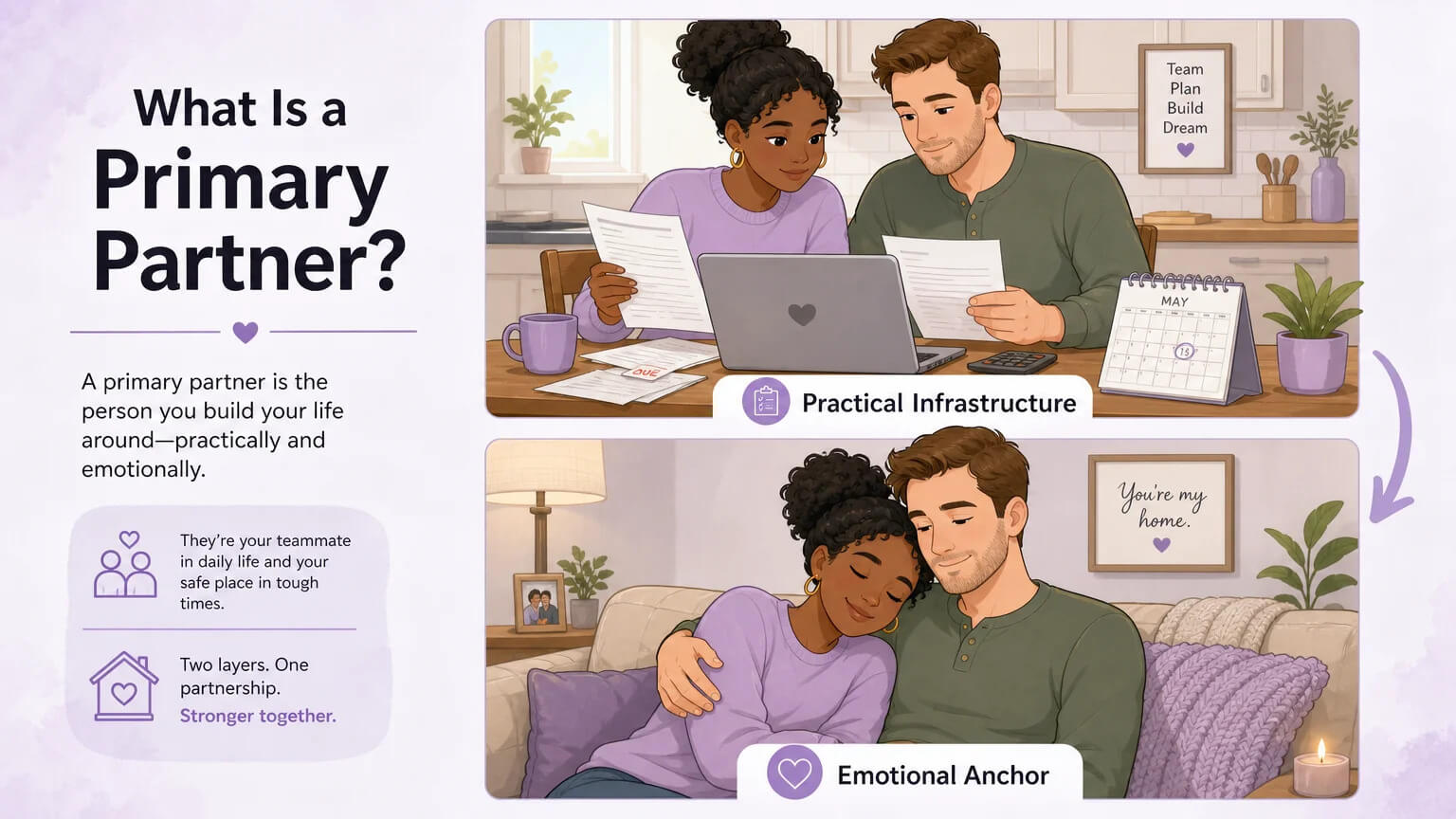
A primary partner is the person, or people, you share the everyday infrastructure of your life with.
That means the practical stuff. Shared living space. Finances that intertwine, from joint accounts to mortgage payments. Long-term planning: where you will be in five years, whether kids or pets are in the picture, whose career move gets priority. The calendar defaults to them. They are your emergency contact, and you are theirs.
A 2025 study published in Sexuality & Culture interviewed 51 adults in consensually non-monogamous relationships and surfaced a pattern. Most people define “primary” through practical entanglement: shared logistics, shared history, shared obligations. Not emotional ranking. Not who you love more. Who you build with.
Then there is the emotional layer. A primary partner is typically the person you turn to first in crisis. The one whose bad day becomes your bad day. The person who knows your family, your medical history, your coffee order, and the exact look you give when you are about to spiral. They have seen you at your worst and did not flinch.
Think of them as the person in the passenger seat. Not because you put them there, but because you both got in the same car and never got out.
The distinction matters: primary partnership describes how you share a life, not how much you love someone. Love is not a finite resource you allocate by percentage. Time, attention, and decision-making power, however, are. A primary partnership names the reality that some relationships involve deeper entanglement. Not deeper feeling. Deeper roots.
The term is shared vocabulary for what already exists between two people. It is a description, not a rulebook. If you check with someone before making weekend plans, if their name is on your lease, if you have said “we” about the future without thinking: you are already inside a primary partnership. Naming it just makes it easier to talk about, negotiate, and invite others in with clarity.
The Terminology Landscape: Primary, Nesting, Anchor — What Is the Difference?
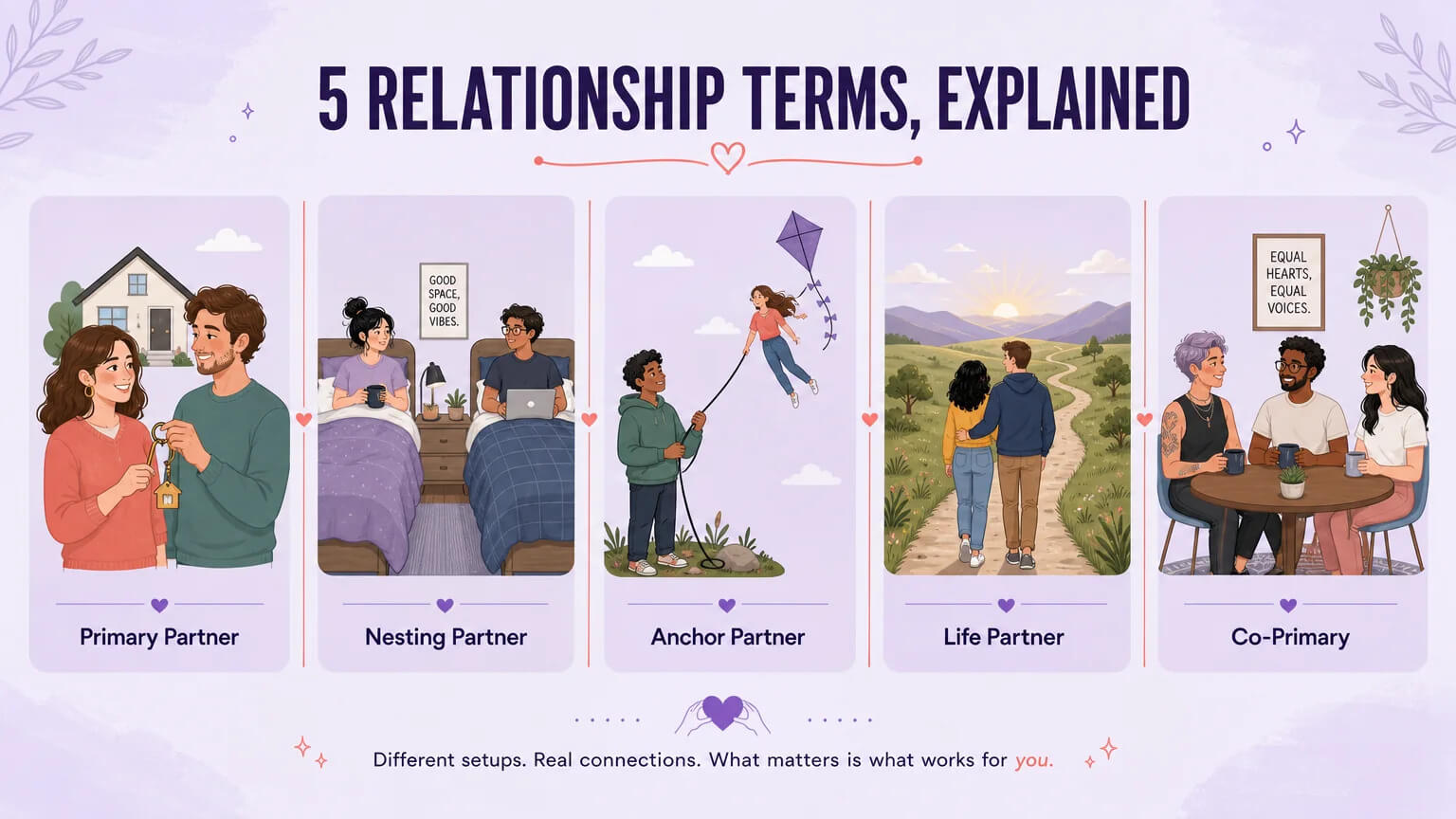
Primary partner. Nesting partner. Anchor partner. Life partner. Co-primary. If you have seen these terms tossed around and wondered whether they all mean the same thing, you are in good company. They overlap, but they are not interchangeable. Getting them straight saves you from describing your relationship wrong on a first date.
A primary partner signals rank and priority. It says: this person comes first in the practical hierarchy of my life. That usually means cohabitation, shared finances, and long-term planning. It does not have to. But it usually does.
A nesting partner is narrower. The term, which comes from the polyamory community, means specifically someone you live with, regardless of hierarchy. You can have a nesting partner who is not your primary. You can have a primary partner you do not nest with. Nesting focuses on the shared-home piece, not the priority piece.
An anchor partner is about emotional gravity. It describes the person who grounds you, the one you return to for stability, whether or not you share an address. Anchor partners may live separately. They may not share finances. But they are the emotional center of your relationship constellation. The term emerged partly as a pushback against rigid hierarchy language.
A life partner is the broadest term. It implies permanent commitment without specifying structure. You can call someone your life partner whether you are monogamous, polyamorous, married, or none of the above.
Co-primary means multiple partners at the same priority level. This shows up in triads, quads, or polycules where two or more people share life infrastructure equally. It is not a loophole for avoiding hard conversations. It requires extraordinary communication and, frankly, a shared Google Calendar.
Here is a quick way to think about it. Shared calendar and lease: that is nesting-primary territory. Emotional gravity with separate homes: anchor partner. Both: primary partner covers it comfortably. The label matters less than the shared understanding behind it. Pick the word that fits, then define what it means to the two of you.
Descriptive vs Prescriptive Hierarchy: The Distinction That Changes Everything
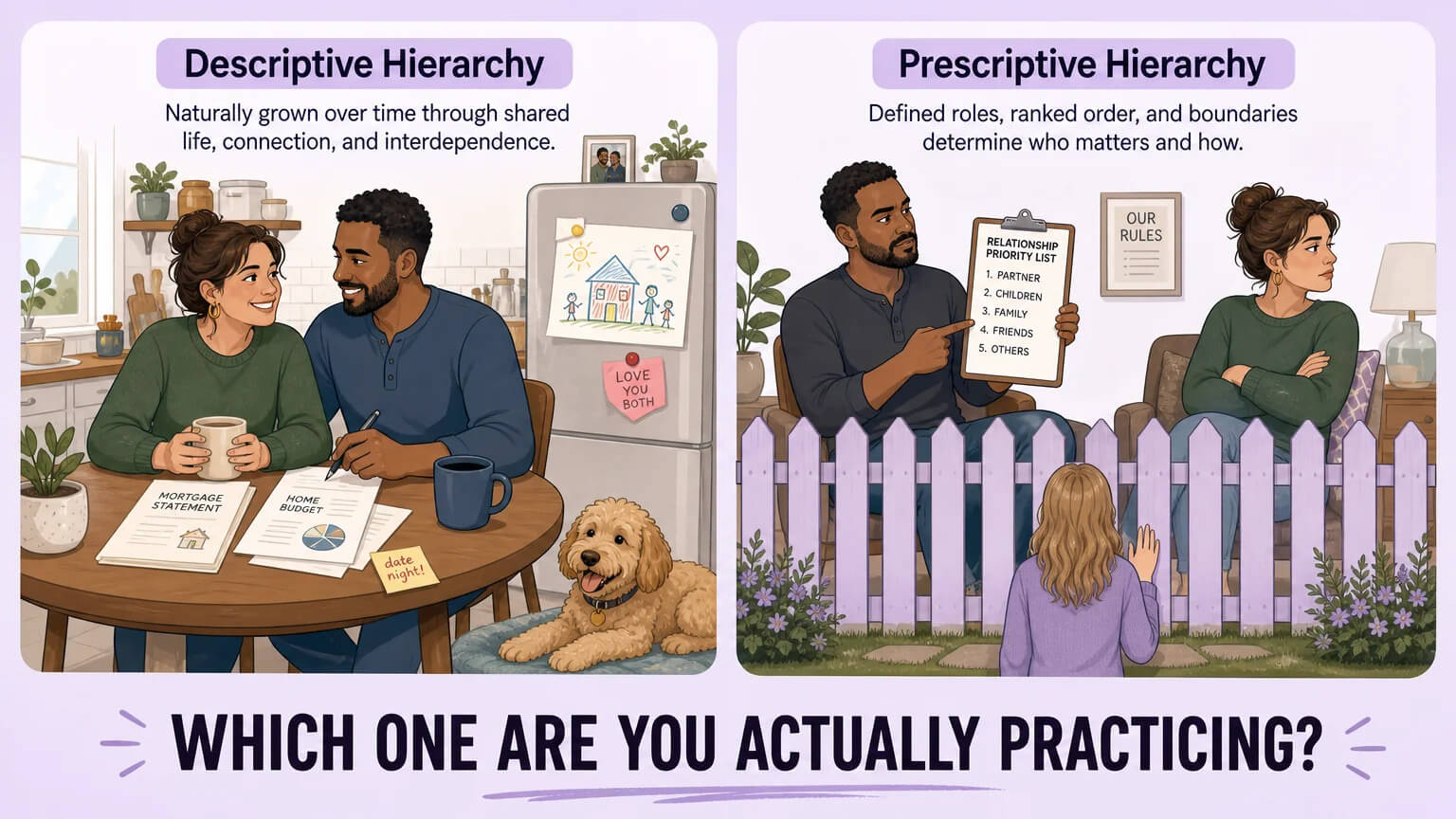
There are two ways hierarchy shows up in relationships. Only one of them causes problems.
Descriptive hierarchy is acknowledging what already exists. You have been married for ten years. You share a mortgage, two kids, and a dog who only listens to one of you. That relationship involves entanglement that newer connections simply do not have yet. Naming that is not creating hierarchy. It is describing reality.
Prescriptive hierarchy means creating rules that prevent other relationships from ever reaching the same depth. You can never spend weekends with anyone else. You can never introduce another partner to your family. You can never love someone as much as you love your primary. These are fences around what is allowed to exist. They are restrictions, not descriptions.
The 2025 Sexuality & Culture study confirmed that how people handle hierarchy matters more than whether they have it. Couples who acknowledge their hierarchy openly tend to navigate non-monogamy with less friction than those who deny it exists.
Polyamory educator Leanne Yau calls the denial version “sneakyarchy.” People loudly claim “we do not do hierarchy” while practicing it unconsciously. They default to their nesting partner for holidays. They cancel dates when their primary has a rough day. They make major life decisions as a couple and inform other partners afterward. The hierarchy is there. They just have not named it.
Sneakyarchy does more damage than honest hierarchy because it gaslights the people on the receiving end. A newer partner senses the priority gap but is told it does not exist. They feel crazy. They are not crazy. They are dating someone who has not done the work of naming their own structure.
Wanting a primary partner is not the problem. Most people want a primary-style relationship at some point. The trouble starts when you pretend the hierarchy does not exist while your actions build one anyway. Name it. Own it. That builds trust with everyone involved.
What a Primary Partner Looks Like Across Different Relationship Styles
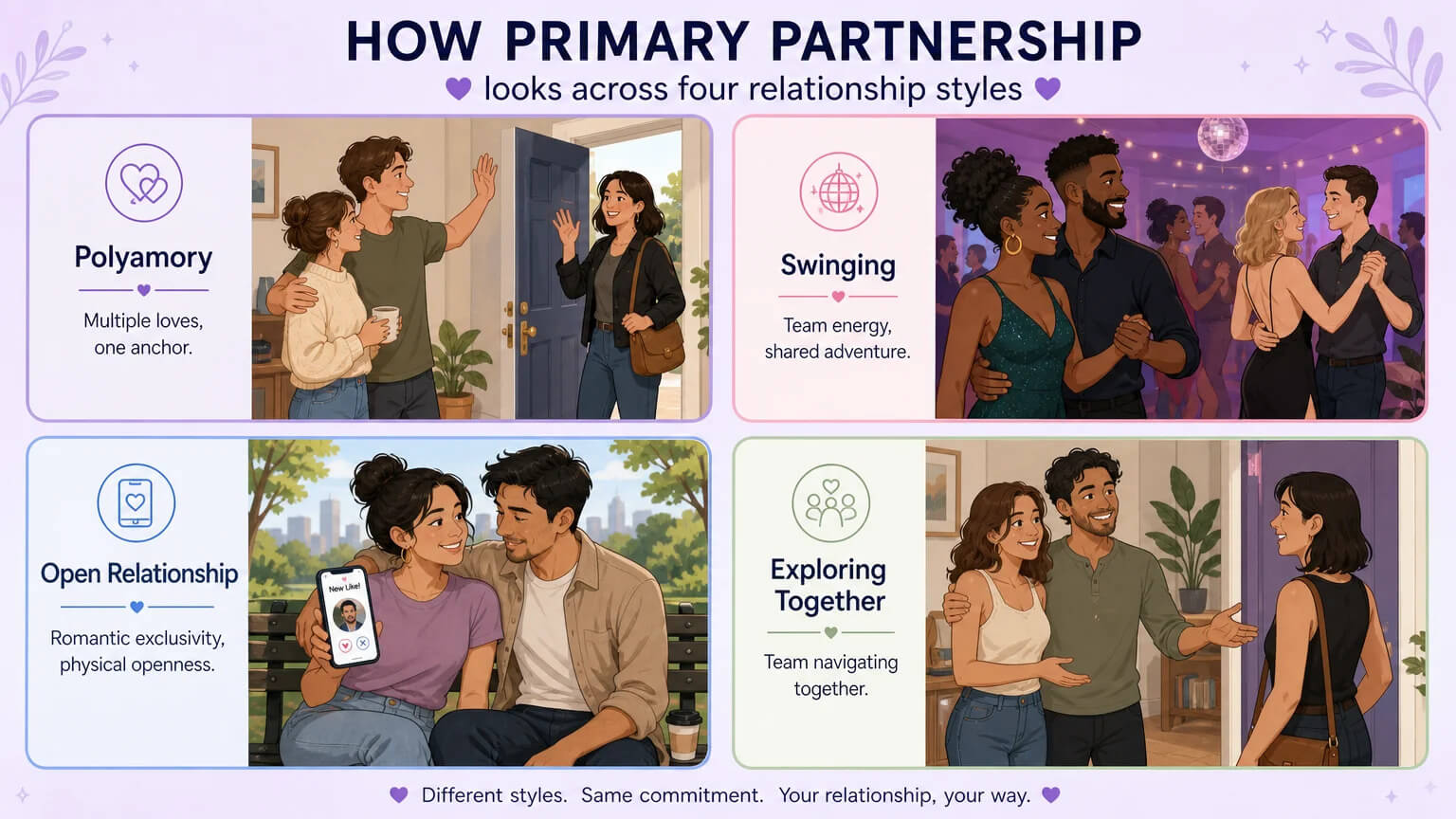
A swinger couple at a club. A polyamorous triad sharing a home. Two people in an open relationship who keep romance exclusive. All three might use the term “primary partner.” They mean three different things.
In polyamory, a primary partner typically means multiple romantic loves with one anchor relationship managing the shared logistics. The primary is the person you come home to. Other partners may be deeply loved and fully integrated into your life. Think of the primary as the hub of a wheel — the central point other spokes connect through.
For swingers, the primary partner is the romantic and emotional home base. Outside play is physical, shared, and often something the couple does together. The primary relationship is the entire emotional container within which outside adventures happen. The couple is the team. The play is the shared hobby.
In open relationships, the primary partner is typically the exclusive romantic connection. Outside connections are physical but not romantic; outside partners are friends, play partners, or casual connections. The primary relationship holds emotional exclusivity.
When couples explore together, they navigate as a team. The third person, whether a recurring guest or a one-time connection, enters a dynamic where the couple’s connection is the foundation. This is why clarity matters so much. A single guest deserves to know what they are walking into.
The 2025 study found that hierarchy operates differently across relationship styles. The same word, “primary,” carries different weight in a swinger context than in a polyamorous one. The useful question is not “is this a primary partnership?” The useful question is “what does primary mean to us?”
Couple Privilege: The Elephant in Every Primary Partnership

Couple privilege is the set of unearned advantages that come from being the “official” couple. This is not about intention. This is about structure.
Automatic scheduling priority. Social and legal recognition as the default unit. Your relationship fits on insurance forms; nobody asks “but what are you, really?” And often, veto power over outside connections: the unspoken understanding that the primary partner can shut things down.
The 2025 Sexuality & Culture study found that how people handle couple privilege matters more than whether they have it. Every married or cohabitating couple has some form of it. The couples who navigate non-monogamy well are not the ones who pretend otherwise. They are the ones who name it.
Your other partner cannot introduce you at a work event without an explanation they did not sign up to give. They cannot put you on their health insurance. During a family emergency, you go home to your primary. Holidays default to your primary’s family. These are structural realities, not moral failings.
The fix is not pretending these dynamics disappear if you ignore them. The fix is discussing them openly and giving other partners agency within them. Franklin Veaux, co-author of More Than Two, articulated the Secondary’s Bill of Rights: secondary partners deserve honesty about what is available, respect for their time and emotions, and a voice in how the relationship affects them.
Name what you can and cannot offer. “I have a primary partner. Here is what that means. Here is what is still available. Are you interested?” That conversation, delivered early and without apology, is the difference between an ethical dynamic and a messy one.
How to Talk About Primary Partnership Without Making It Weird
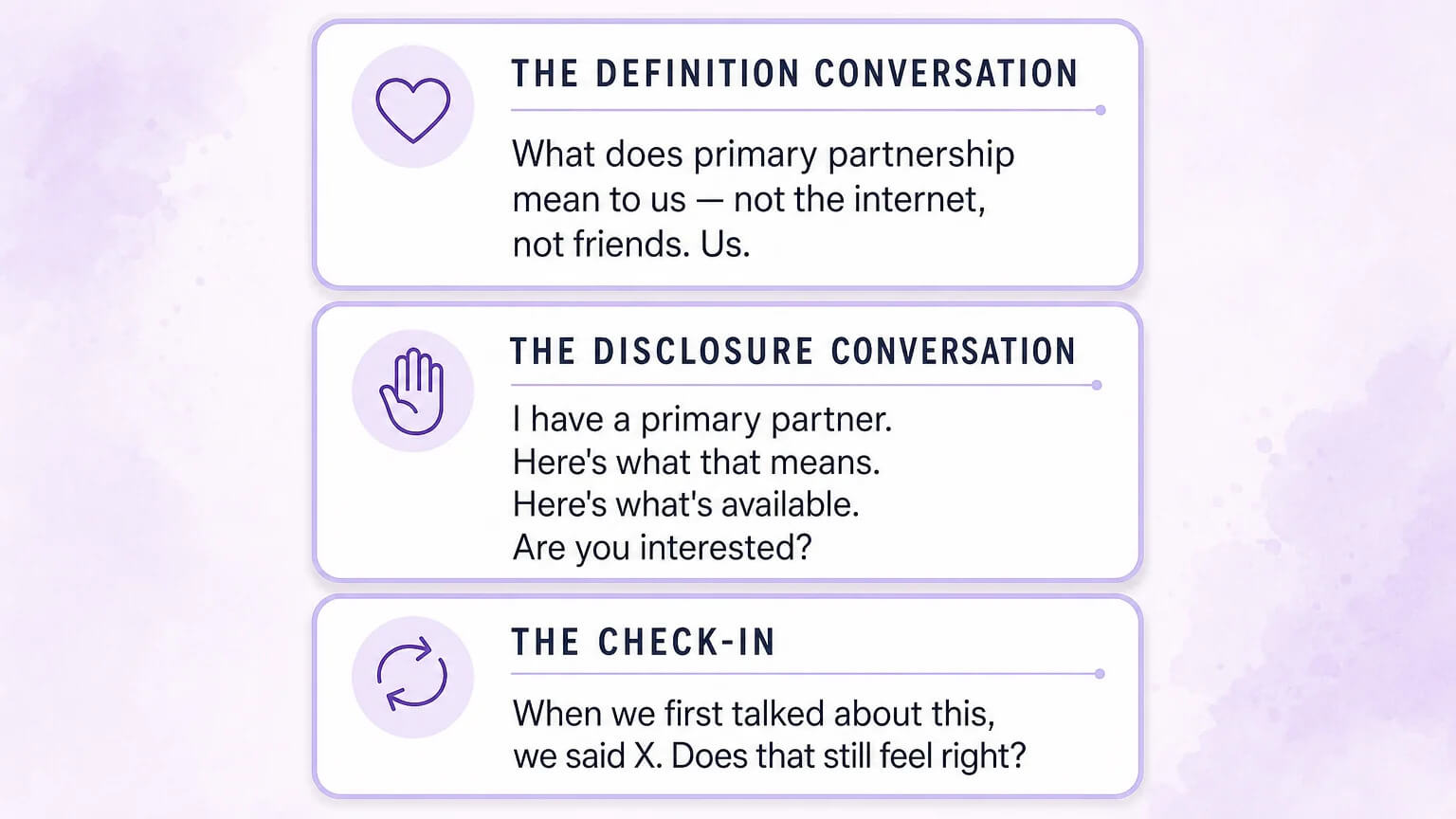
The most important conversation about primary partnership is the one you have with each other first.
Before you can tell anyone else what your structure looks like, you need to agree on what it looks like between the two of you. Here are three starting points.
The definition conversation: for couples clarifying between themselves.
“I want us to talk about what primary partnership means to us. Not what the internet says. Not what our friends do. What we want it to mean. What do we prioritize? What is always available to each other? What might be available to someone else?”
This is not a one-and-done talk. It is the first of many.
The disclosure conversation: for telling a new connection what is available.
“I want to be upfront. I have a primary partner, which means we share a home and make major life decisions together. That does not mean our connection is not real. It means I want you to have accurate information about what is on the table, so you can decide if that works for you.”
The goal is not selling your situation. It is giving someone the data to make their own informed choice.
The check-in: for revisiting definitions as things evolve.
“When we first talked about this, we said X. I am wondering if that still feels right to you. Have your feelings shifted? Have mine?”
Relationships change. Your agreements should change with them.
Think of these as agreements, not rules. Rules are imposed from one side. Agreements are built together, revisited together, and changed together. They require two yeses. The 3Fun Agreement Series puts it this way: an agreement is a living thing. It adapts as you adapt. Treat your primary partnership definition the same way.
Are You Ready? Signs You Are in Primary Partner Territory
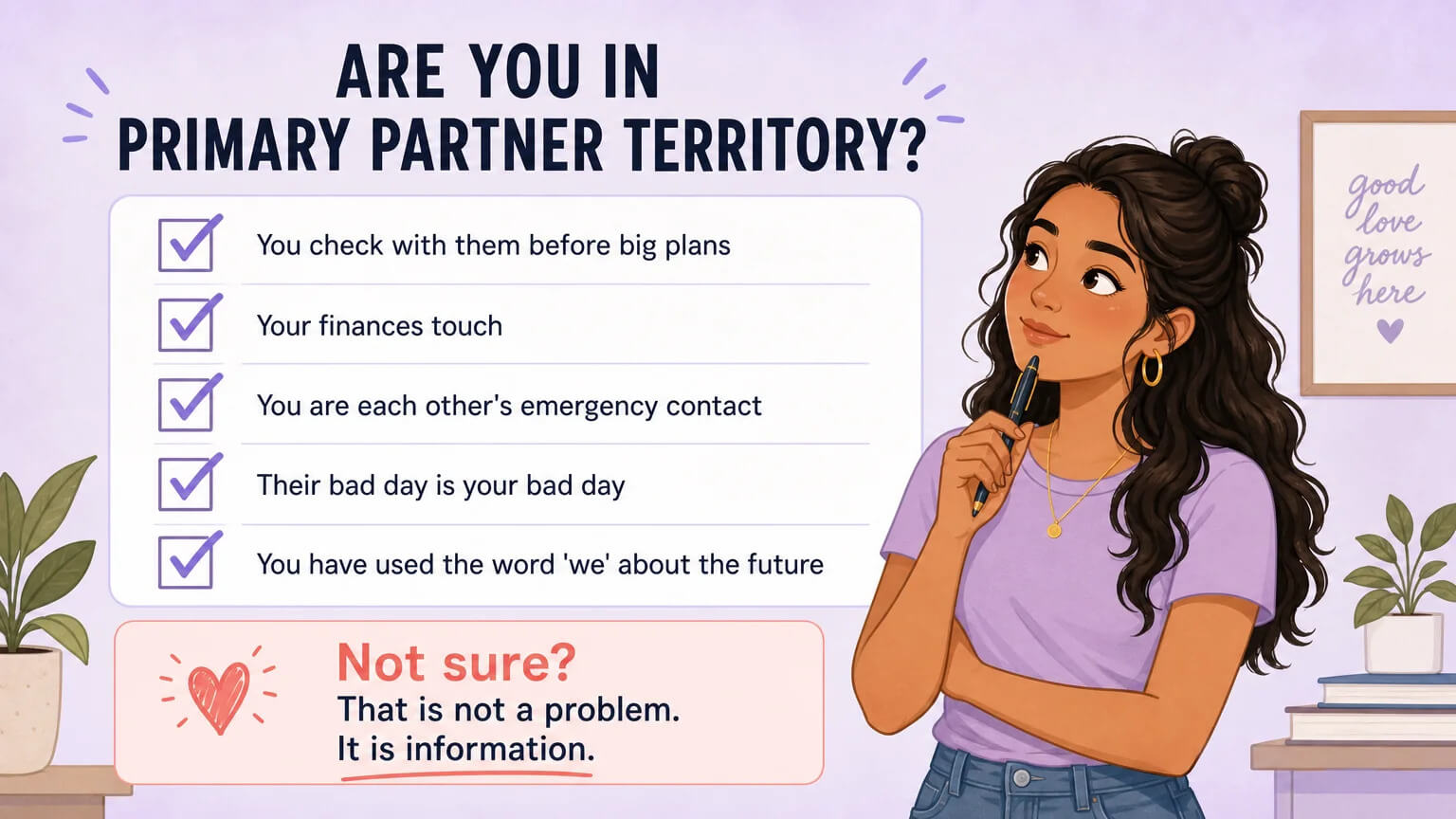
There is no form to fill out. No anniversary that triggers the upgrade. No polyamory council that stamps your primary-partner passport. The label either describes something that already exists, or it is aspirational. Either way, the signs live in the daily texture of your life.
You check with them before making big plans. You know each other’s families as people you have spent holidays with. Your finances touch: a shared account, a lease with both names, a budget built around “we” not “me.” You are each other’s emergency contact. Their bad day is your bad day, and the reverse. You have talked about the future and used the word “we” without thinking about it.
Shared infrastructure. Mutual prioritization. A life that would be logistically difficult to untangle. That is primary-partner territory.
What does not make you primaries: how long you have been together. How intense the sex is. How jealous you feel when they flirt with someone else. Time and intensity are not the measure. Shared infrastructure and mutual prioritization are.
The 2025 study found that primary definitions are fluid. A secondary connection can deepen into a primary one. A primary partnership can loosen into something less entangled as lives diverge. The label serves the relationship, not the other way around.
If you are not sure whether the term fits, you are probably not there yet. That is not a problem. It is information.
When “I’m My Own Primary” Is the Answer

Some people do not want to merge daily infrastructure with a romantic partner. They want love, connection, and intimacy on terms that preserve their autonomy. This is not about avoiding commitment. It is a different kind of commitment.
Solo polyamory is a growing philosophy: people intentionally avoid primary-style entanglements like cohabitation, shared finances, and automatic prioritization. The phrase “I am my own primary partner” has become a declaration of autonomy. It means: I make my own decisions. I hold my own center. I build relationships that add to my life without becoming its infrastructure.
This is a valid and increasingly common choice, not a phase or a failure to find the right person. Solo poly people often maintain deep, long-term, loving relationships spanning years. They keep their romantic connections alongside their daily life structure rather than woven into it, and that distinction is intentional, not incidental.
Whether you have a primary partner, are looking for one, or are your own primary: the goal stays the same. Relationships built on honesty, clarity, and what you actually want. Not someone else’s script.
FAQ
Can you have more than one primary partner?
Yes. Co-primary partnerships exist, often in triads or quads where all partners share life infrastructure equally. It requires extraordinary communication. It is not common, but it works when built intentionally.
Is having a primary partner the same as being married?
Not necessarily. Marriage is a legal status. Primary partnership is a functional one. You can be married to someone who is not your primary, and vice versa. Primary partnership is defined by shared logistics, not a legal document.
Do all polyamorous people have primary partners?
No. Solo poly people, relationship anarchists, and those practicing non-hierarchical polyamory intentionally avoid the primary/secondary framework. They build multiple meaningful relationships without assigning priority rankings. The structure is a choice, not a default.
Can a secondary partner become a primary partner?
Yes. Many primary partnerships started as secondary connections that deepened as lives intertwined. The key is transparent communication when priorities shift. Everyone deserves to know when the map is being redrawn.
What if my partner and I disagree about whether we are primaries?
Pause and have the Definition Conversation from section seven. If you cannot agree on what you are to each other, the gap matters more than the label. Get clear on the substance first. The word can follow.