Cuckold is one of the oldest insults in the English language. It is also one of the most common sexual fantasies men carry around without ever saying out loud.
Justin Lehmiller’s research found roughly 45% of men have fantasized about watching their partner with someone else. That is nearly half. The archetype itself is older than the word by about two thousand years. Helen of Troy’s husband Menelaus shows up in Homer’s Iliad as the original cuckold-husband, abandoned when Helen ran off with Paris. And yet most people have only ever heard the term as a slur, a punchline, or a scrap of medieval trivia.
The gap between how common the desire is and how little anyone talks about it is where the actual story lives.
This article covers what cuckolding means now, where the word came from, the psychology underneath the fantasy, how it differs from hotwifing and the dynamics around it, how the term got weaponized politically, how to bring it up with a partner, what goes wrong, and how technology made the whole thing more accessible than ever. No shame, no jargon.
Where the Word Cuckold Comes From: Cuckoo Birds, Horns, and Green Hats
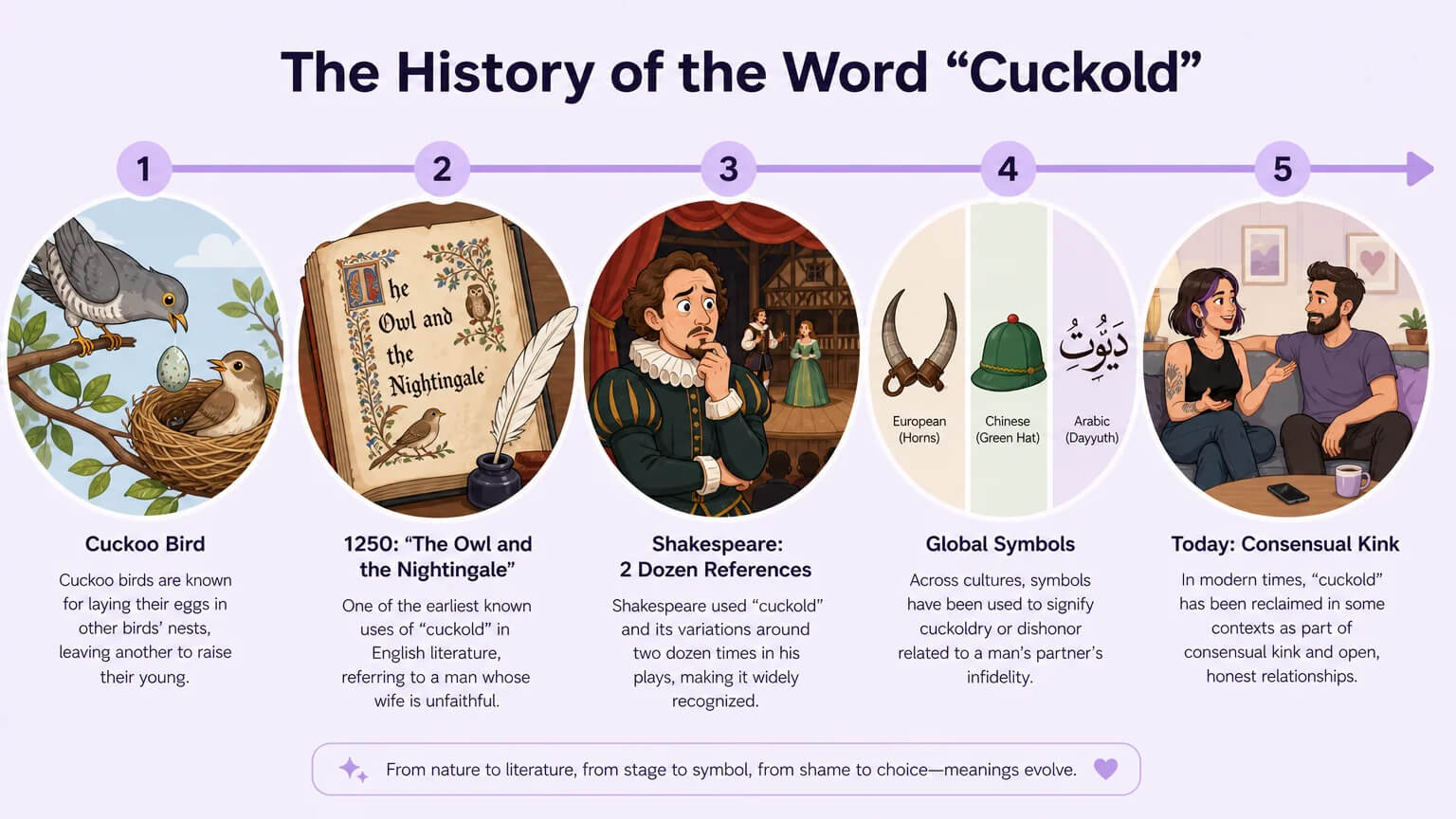
Cuckoo birds do not build nests. They drop their eggs in other birds’ nests and let unsuspecting foster parents do the work of raising their young. That one biological quirk gave English one of its most emotionally freighted words.
“Cuckold” first shows up around 1250, in a medieval poem called “The Owl and the Nightingale.” From a single poem, the idea spiraled. By Shakespeare’s time, cuckoldry was everywhere: he referenced it roughly two dozen times across his plays. Othello’s murderous jealousy. The comedic paranoia running through The Merry Wives of Windsor. The fear of being made a cuckold was not some niche anxiety. It sat at the center of early modern European life. Dr. Esme Louise James, a historian of sexuality, calls it a full-blown “cultural obsession”: men getting mocked across literature, theatre, paintings, and public life, all for the same perceived failing.
Then came the horns. Across Europe, a man whose wife strayed was said to be “wearing the horns,” a nod to stag mating: the defeated male loses his mate to the victor. In Italy people still say “cornuto,” and in the south, throwing the horned hand gesture at someone is a genuine insult. The French have “porter des cornes,” Germans “Horner tragen,” and in Brazil “corno” fuels a whole genre of jokes.
The symbolism does not stop at Europe. In Chinese culture, “wearing a green hat” (dai lǜ mao zi) means being cuckolded. This goes back to the Yuan Dynasty, when Mongol rulers forced the families of prostitutes to wear green scarves in public. In traditional Chinese cosmology, green was an inferior color: a blend of blue and yellow, not one of the five pure noble colors. The phrase is still live on Weibo. Catholic bishops in China swapped their green mitres for violet ones just to dodge the association. Western brands have figured out not to gift green hats to Chinese business partners, for the same reason. In Islamic cultures, the Arabic “dayyuth” packs a similar punch: it describes someone seen as permissive about unchaste behavior in his household, tied to the concept of “ghayrah,” protective honor. And in Catholic tradition, Saint Arnoult is cited as the patron saint of cuckolded husbands. Even sainthood had a seat at the table.
For centuries, being a cuckold was a man’s worst-case scenario: something done to him without his knowledge, without his say. Today, a growing number of men choose it. That reversal is everything.
What Cuckolding Actually Means Today: Consent, Roles, and the Modern Definition
Here is the distinction most quick definitions skip: the historical cuckold was a victim. His wife was unfaithful and he did not know. The modern consensual cuckold is a participant. He has chosen this, discussed it, negotiated it with his partner. She has sex with other people, and he gets off on knowing about it, watching it, hearing about it afterward.
Consent is not the fine print here. It is the whole thing. Without it, you have infidelity. With it, you have cuckolding.
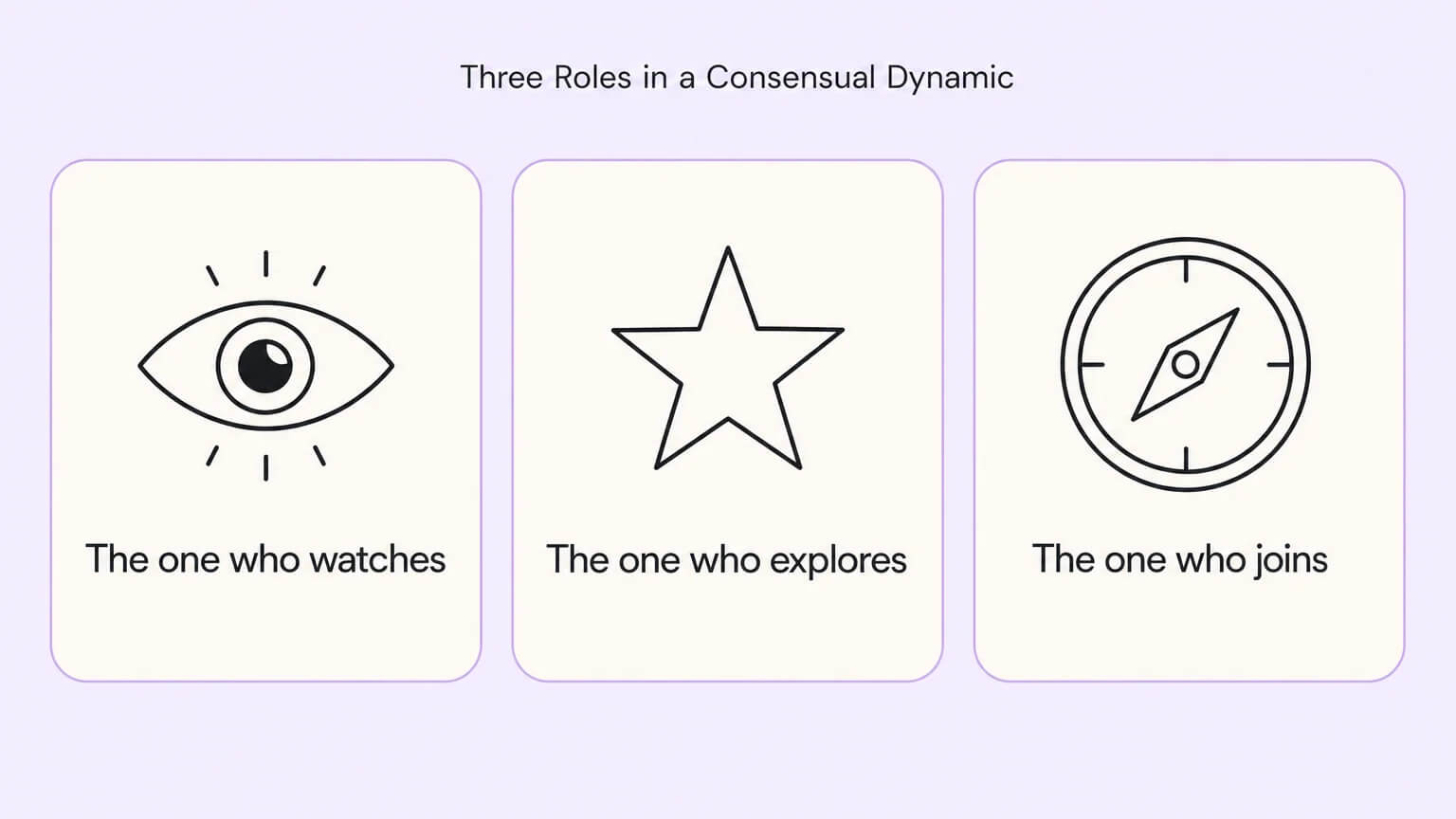
Three roles give the dynamic its shape. The “cuckold” is usually the male partner who finds the scenario arousing, and there is often a thread of submission or eroticized jealousy running through it. The “cuckoldress” or “hotwife” is the female partner who has sex with others: her pleasure and her agency sit at the center, not the periphery. The “bull” is the third party, typically a confident, dominant man. He is also an actual human being who has boundaries and needs of his own. He is not scenery.
The female equivalent has its own backstory. “Cuckquean” first appeared in English in 1562, for a woman who gets off on watching her male partner with another woman. The dynamic runs across genders and orientations. Gay male cuckolding dynamics exist. Lesbian cuckquean relationships exist. They are documented, just rarely discussed. A 2025 Feeld feature profiled a 28-year-old lesbian cuckquean in Montreal who turned the pain of being betrayed at 19 into a consensual dynamic built on compersion: joy taken from a partner’s joy.
English even coined a word for the guy who knew and was fine with it. “Wittol,” from 1520, smashes together “wit” (knowing) and “cuckold.” It described a husband aware of and reconciled to his wife’s infidelity. The line between victim and willing participant was there centuries before modern kink communities drew it in ink. Compersion as a concept might be new. Accepting and even embracing a partner’s sexual autonomy is ancient.
The modern cuckolding community built its own vocabulary, its own educational resources, its own ethical frameworks, precisely because consent and communication are what separate the kink from the insult. Adreena Winters’ Cuckold Academy, sex educators on YouTube, the forums: they all hammer the same point: the fantasy falls apart without enthusiastic participation from every single person in the room. The cuckold is not being humiliated against his will. He set the container. He chose the terms. He asked for the aftercare.
Why Would Anyone Want This: The Psychology Behind Cuckolding Fantasies
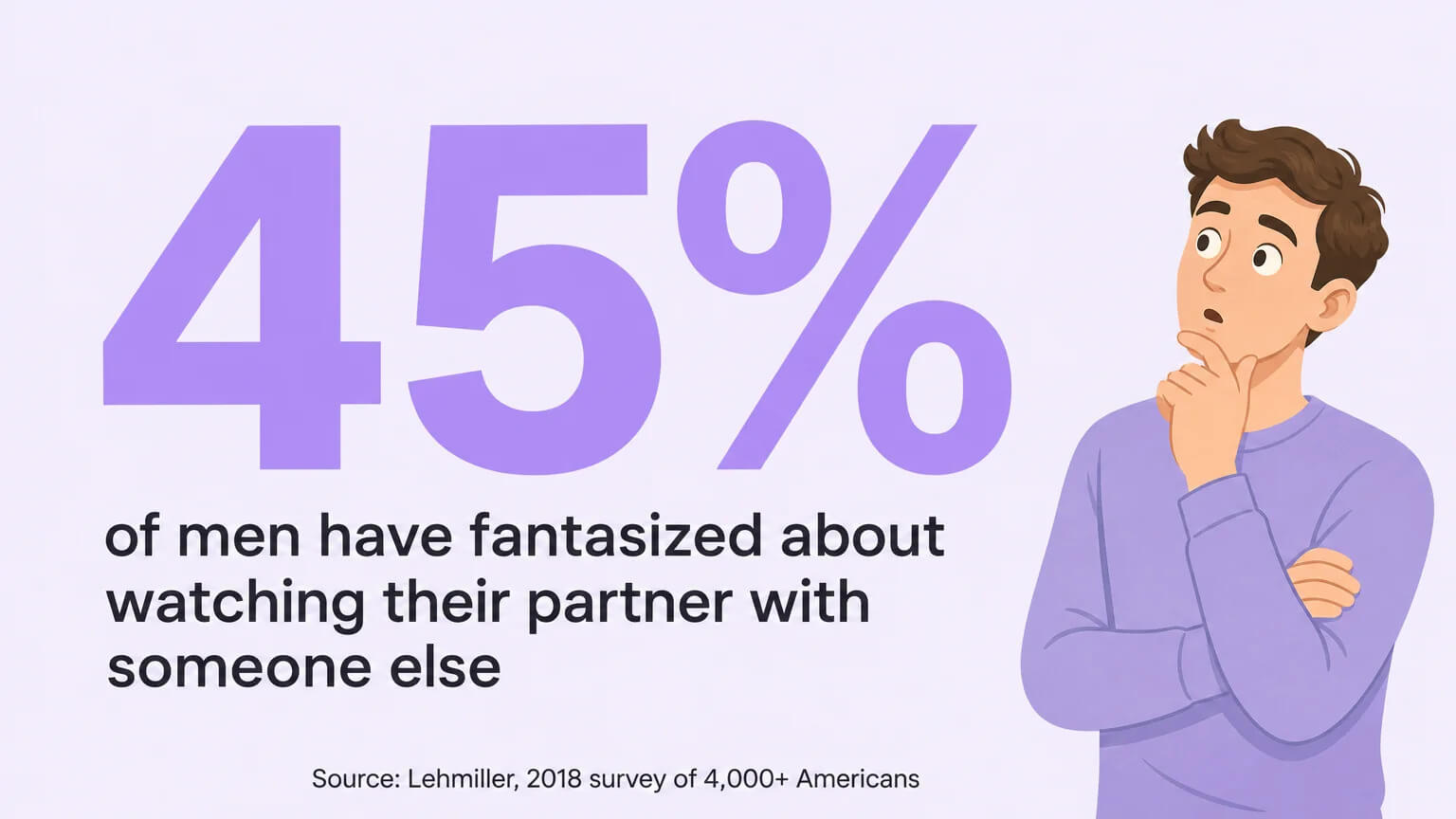
Here is the number that stops most people: Justin Lehmiller’s 2018 survey of over 4,000 Americans found roughly 45% of men have fantasized about watching their partner have sex with another man. This is not some fringe itch. It is nearly half of all men.
No single explanation covers everyone, but researchers and clinicians have mapped several overlapping drivers.
First, compersion. The word comes out of the ethical non-monogamy community and means feeling joy because your partner is feeling joy: vicarious pleasure, the opposite of jealousy. Peer-reviewed work by Flicker et al. (2024, Archives of Sexual Behavior) found compersion is strongest when people feel close to their metamour (their partner’s other partner) and when they have real knowledge about that relationship. Buczel et al. (2024) found consensually non-monogamous people scored higher on compersion and cognitive empathy, and lower on jealousy, than monogamous participants. Compersion indirectly predicted relationship satisfaction by shrinking jealousy. Some brains are wired to feel thrill rather than threat when a partner experiences pleasure elsewhere.
Second, eroticized jealousy. The in.yvex.de (2025) analysis frames this as “an active psychological feat”: jealousy deliberately rerouted from a primitive danger signal into an erotic charge. This is not about having a weak ego. It is about a “highly specific deployment of it”: vicarious ego inflation dressed up as submission. The brain takes a biologically hardwired fear and turns it into arousal, on purpose, in a container the person built.
Third, the surrender of control. Some researchers call this the evolutionary glitch theory. High-status men, the ones under constant pressure to perform and manage and decide, are disproportionately drawn to cuckolding. Handing over power in a safe, agreed-upon space can be a profound relief.
Fourth, Adreena Winters of The Cuckold Academy maps cuckolding as four stages, not a binary switch. Stage one, Shame: the desire shows up, and the person wrestles with it internally. Stage two, Fantasy: exploring through imagination and conversation with a partner. Stage three, Service: the focus shifts toward the partner’s pleasure as an act of devotion. Stage four, Fulfillment: cuckolding becomes an integrated, positive identity. “For many,” she says, “cuckolding is a calling.”
The reality check: Larmuseau’s genetic research shows actual unknowing biological cuckoldry happens in only 1 to 2 percent of births in Western societies. The cultural panic is wildly out of proportion to the biology. Sperm competition theory (the idea that male arousal at competing with another male’s genetic material has evolutionary roots) offers one possible bridge between the fantasy’s prevalence and its genetic rarity.
Secure attachment keeps coming up across expert sources as the prerequisite. People with anxious attachment are likely to feel genuine distress, not eroticized pleasure, in these scenarios. This dynamic is not for everyone. That is not a judgment. It is just how the wiring works. And if you want to dig deeper into the psychological explanation of cuckolding, you can check this complete guide: Cuckold Psychology: The Science Behind the Fantasy and What It Means for Couples.
Cuckolding vs. Hotwifing vs. Stag and Vixen: A Clear Guide to the Differences
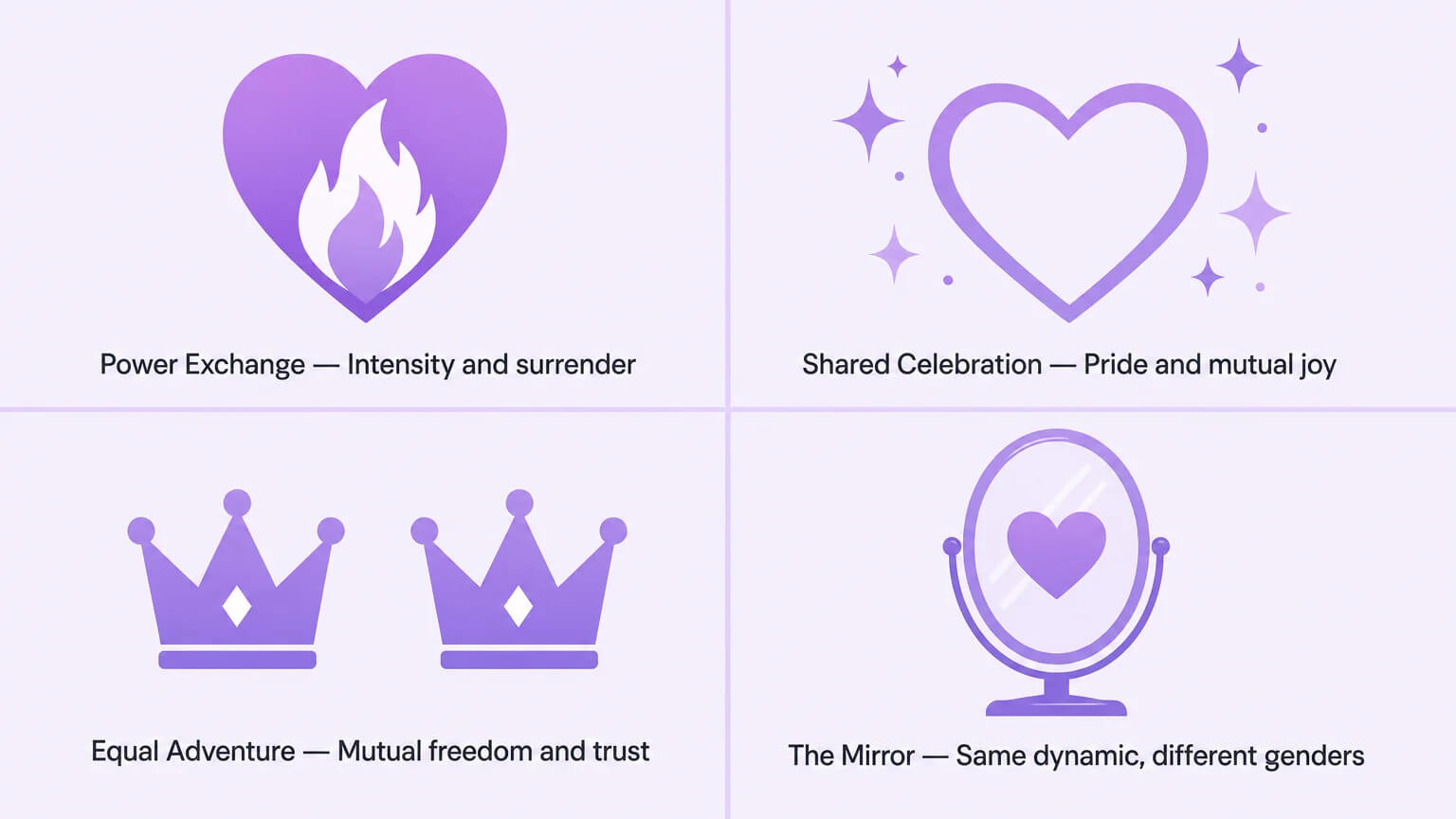
A handful of terms orbit around the same space, and people toss them around like synonyms. They are not. Each dynamic has a different emotional engine. Figuring out which one actually fits you changes how you approach the whole thing.
The simplest dividing line is humiliation.
Cuckolding centers a female-driven power dynamic where eroticized humiliation or shame sits at the core. The cuckold is typically submissive and monogamous by agreement. The third party gets called a “bull”: the word choice is deliberate, all dominance. The emotional fuel is consensual jealousy and power exchange.
Hotwifing is shared arousal with no degradation anywhere in the frame. The husband is enthusiastically into his wife having sex with others, and he takes pride in her being desired. The third party is a “play partner,” not a “bull.” The husband is usually monogamous by arrangement, but the whole emotional register is celebration. Adreena Winters draws the line cleanly: a hotwife operates through sexual freedom and autonomy. A cuckoldress operates through control and intentional power imbalance. Same surface activity, completely different interior.
Stag and Vixen is equal or male-driven, running on pride and compersion. The stag is confident, not submissive, and often gets to play with others too. Zero humiliation. The term was coined specifically to give men in wife-centric dynamics something to call themselves that dodges cuckold’s baggage. The emotional core is mutual conquest, shared celebration.
Cuckquean is the female mirror: a woman aroused by watching her male partner with another woman. Same psychological patterns, far less visibility in the conversation.
Candaulism is a narrower thing: arousal specifically from showing off your partner’s naked body or sexuality to others, usually in a proud, exhibitionist register. It can overlap with any of the dynamics above, but it is more about display than full sharing.
Winters’ Cuckold Academy maps five archetypes on a spectrum, from the Stag (pure pride, zero humiliation) to the Humiliation Cuck (deep psychological intensity, degradation as the point). In between: the Classic Cuck, the Service-Oriented Cuck, the Lifestyle Cuck. Most people land somewhere in the middle. The spectrum matters because it makes clear that submission, pride, service, and psychological intensity are independent sliders: they do not move together. Karen Bigman, a certified sex educator, points out that women drawn to these dynamics tend to share high sexual autonomy, emotional intelligence, and comfort with power. The stereotype says broken relationships. The reality is usually the opposite.
These labels are for understanding yourself and communicating clearly. They are not permanent assignments. Plenty of couples start in one dynamic and drift into another as they figure out what actually works.
How “Cuck” Became a Political Insult: From 4chan to the Mainstream
If you have been anywhere near social media or political YouTube in the last ten years, you have seen “cuck” thrown as an insult. It had zero to do with anyone’s actual sex life. Knowing how it got there matters, because the political slur has polluted the term and made it harder for anyone to have a straight conversation about the consensual kink.
“Cuck” started as mid-2000s BDSM porn shorthand: niche community vocabulary, nothing more. It probably would have stayed there if not for Gamergate in 2014, when 4chan’s /pol/ board began turning it into a weapon. The logic was not subtle: if a cuckold is a man who cannot control his wife, a “cuckservative” is a conservative who cannot control the country.
The portmanteau “cuckservative” landed on /pol/ on September 26, 2014. By July 2015 it was everywhere: over 14,000 Twitter uses in a single month, aimed mostly at Republican presidential candidates deemed insufficiently hardline. By the 2016 election, “cuck” was the alt-right’s go-to insult. Steve Bannon reportedly called Jared Kushner one in 2017. A decade after escaping the BDSM scene, the term is still circulating in online politics.
The racial layer is not hidden and not accidental. The porn the insult borrows from frequently runs on fears of Black men “preying” on white women: an anxiety with a direct line to the Ku Klux Klan and white nationalist mythology about racial purity. When the alt-right calls someone a “cuck,” the word is doing double duty: weakness plus a specific racist fantasy about white men losing hold of “their” women.
None of this has anything to do with the consensual kink that couples actually practice. People in cuckolding relationships are not weak. They are not victims. They are not making a political statement. They are in a negotiated dynamic that runs on trust and communication. But the word is stained, and that has consequences. It is a big part of why so many people in the lifestyle reach for “hotwifing” or “stag/vixen” instead. Not because the dynamics are different, but because “cuckold” now drags behind it a bunch of baggage the bedroom never asked for. A couple building a consensual, loving dynamic should not have to share words with an online hate movement. The term will probably get reclaimed someday. For now, the community just steers around it.
How to Talk to Your Partner About Cuckolding: Scripts, Timing, and What Not to Say

This is where most people freeze. You have done the reading. You understand what this is. You might even know which dynamic fits. And now you have to actually say the words to the one person whose reaction matters more than anyone else’s.
Sex therapist Heather Shannon, LMFT, CST, has a framework. It starts before any words leave your mouth.
Step one: nail down your own “why.” Before bringing your partner anywhere near this, get clear on what specifically pulls you. Is it compersion: getting off on seeing your partner desired? Surrendering control? A specific scene or image? If you do not know your own motivation, you will fumble when the questions start coming.
Step two: pick your moment. Not during sex or right after, when hormones are high and judgment is offline. Not during a fight. A relaxed, private stretch of time (a long drive, a quiet evening, a walk) where nobody is rushed and both of you feel safe.
Step three: lead with vulnerability, not a demand. The Cuckology guide flags the single biggest mistake men make: “treating this as a demand rather than a vulnerable disclosure.” Use “I” statements. Here is a concrete opener, adapted from the Consent Culture playbook:
“Can I share something I have been thinking about that is a little vulnerable for me? I have realized that the idea of watching you experience pleasure, even with someone else, genuinely excites me in a way I did not expect. This is not about replacing anything between us. It is about adding something new. I want to talk about whether this is something we could explore together, even just as a shared fantasy at first.”
Step four: get ahead of the most obvious fear. Your partner’s first question is almost always some version of “Are you not satisfied with just me?” Have an answer ready, and make it good. This is not about what is missing. It is about what might be added.
Step five: frame every next move as exploration starting from fantasy. Heather Shannon emphasizes shared erotic stories, roleplay, hypothetical conversations: all before anything happens in the real world. That gives both of you time to sit with it, no pressure.
Step six: prepare for no, and mean it when you say you will respect it. This only works if both people are genuinely enthusiastic. A soft no is still a no. A “maybe someday but not now” is still a no. The conversation stops there. Pushing, repeating, hinting: all of it eats the trust this entire thing depends on.
The couple behind Anxious FLR built their whole dynamic on three rules. Rule one: no secrets. Total transparency about everything. Rule two: marriage comes first, period. The primary relationship is never up for debate. Rule three: love stays between us. Emotional exclusivity holds even when physical exclusivity does not.
What Can Go Wrong: Common Pitfalls, the Cuck Drop, and How to Protect Your Relationship
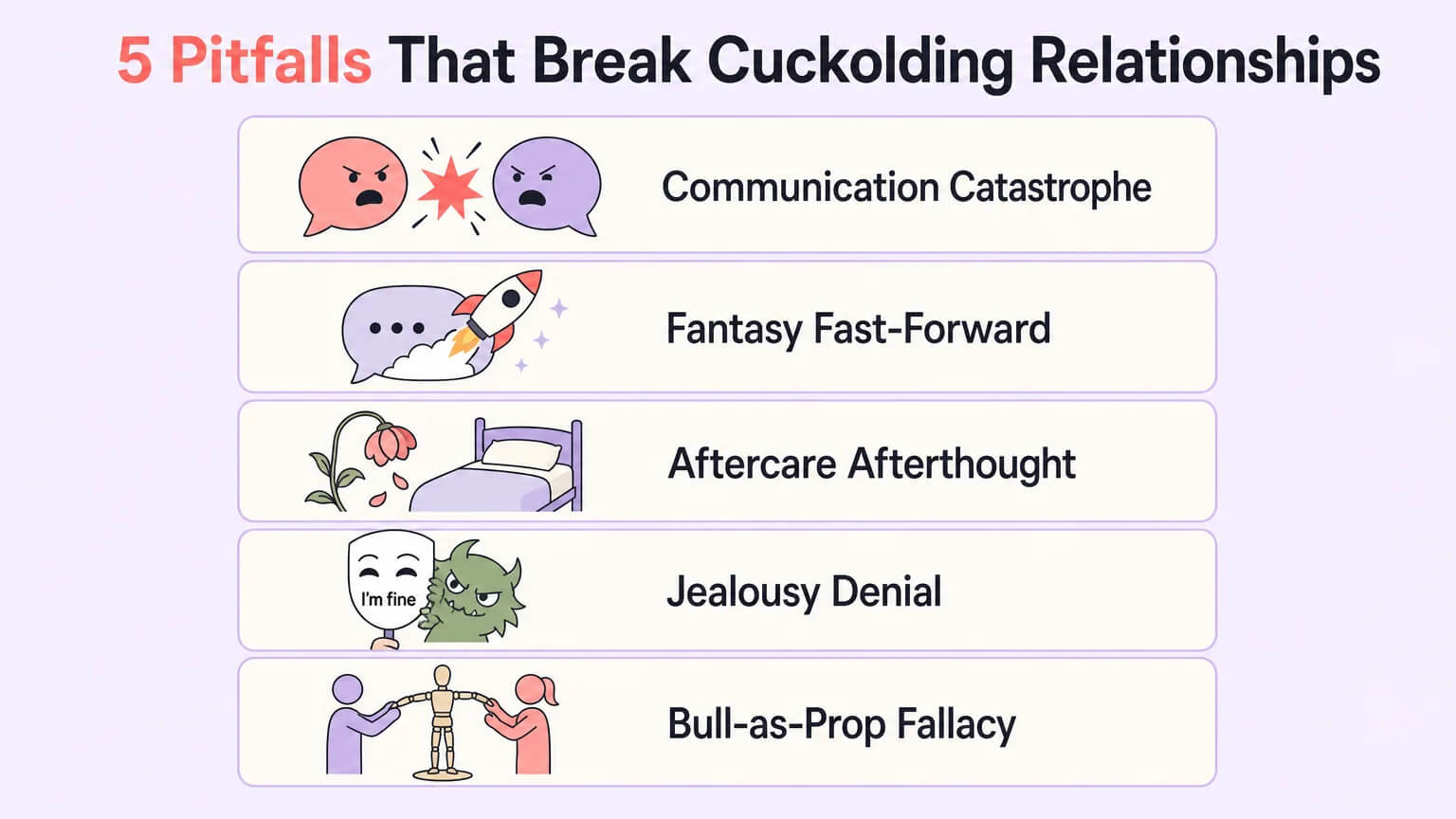
Most couples who try cuckolding prep for the sex. Almost nobody preps for the emotions. That gap is why things fall apart, and it is completely avoidable.
The Consent and Curiosity channel has tracked five blunders that show up across couple after couple.
Blunder one: the Communication Catastrophe. Criticism, contempt, defensiveness, stonewalling: the Four Horsemen, as relationship researcher John Gottman named them: roll in the moment hard feelings surface. The fix: agree ahead of time that feelings are data, not weapons. “I felt jealous when you touched his arm” is information your partner can work with. “You obviously care more about him than me” is an attack. Know which is which before the heat is on.
Blunder two: the Fantasy Fast-Forward. “I have this fantasy” becomes “let us find someone tonight” inside a single conversation. The fix: graduated exposure. Shared fantasy talk first. Roleplay next. Maybe flirting at a bar while your partner watches, somewhere down the line. Each rung gives both of you time to process before the next one. There is genuinely no hurry.
Blunder three: the Aftercare Afterthought. This is the most common way it goes sideways. After a cuckolding encounter, your neurochemistry takes an actual hit. Dopamine and oxytocin spike during the experience, then drop hard. They call it the “Cuck Drop,” and it can bring anxiety, depression, or emotional numbness even when the experience itself was good. The fix: structured aftercare in the 24 hours after. Reconnection. Reassurance. Physical touch. Specific debrief questions: what felt good, what felt hard, what do you need from me right now. The Evolved Relationships channel pushes a formal aftercare protocol. “How was it?” over coffee the next morning is not enough.
Blunder four: Jealousy Denial. Telling yourself jealousy will not show up because you have “done the work.” It will show up. The fix: treat jealousy as information, not catastrophe. The Consent and Curiosity framework splits healthy jealousy: a signal to talk about and work through: from destructive jealousy that is overwhelming, relentless, and chewing at the foundation. Secure attachment is the prerequisite. If jealousy keeps landing as genuine distress instead of something you can process together, this dynamic is not right for your relationship.
Blunder five: the Bull-as-Prop Fallacy. Treating the third person like an accessory instead of a human who has their own needs and boundaries and emotional world. The fix: screen carefully, state expectations upfront, and remember the best thirds are people who respect your relationship: not people treating it as a trophy.
The Evolved Relationships safety framework runs on three guardrails. The 24-hour rule: both partners confirm they are emotionally ready before any encounter, every time. Veto power: either person can stop anything at any moment, no questions asked in the heat of it. Emotional firewalls: explicit agreements that prevent emotional drift and keep New Relationship Energy from becoming a problem. Boundaries are not the thing holding you back. They are the container that lets the fantasy breathe without burning the house down.
How Dating Apps Changed Cuckolding: Finding Partners, Bulls, and Community Online

Twenty years ago, if you wanted to explore this, your options were personal ads that felt humiliating to write, obscure forums, or dumb luck. Today, purpose-built apps have rewired how people find partners, bulls, and community, and 3Fun is built squarely for this world.
Unlike mainstream dating apps that treat non-monogamy as an afterthought, 3Fun was designed from the ground up for couples and singles exploring the lifestyle together. Couple profiles are unified rather than bolted on. Orientation filters let you set exactly what you are looking for without awkward mid-conversation disclosures. Privacy tools give you control over who sees you and when, because getting outed to coworkers or family is a real fear that vanilla apps do not account for.
The reach matters too. While niche kink apps tend to cluster in major coastal cities, 3Fun pulls from a broader base. Suburban couples. Mid-sized cities. People who are curious but not ready to walk into a club or a munch. For plenty of them, the app is where they first dip a toe into non-monogamy in a space where everyone already speaks the language.
Outside the apps, a whole educational layer has grown up around this. The Cuckold Academy runs a free self-assessment quiz, published a book (“Soo, You Want to Be a Cuckold?” on Amazon and Audible), and keeps an active YouTube channel. Creators like Belle and Fynn document their cuckold life openly. Community educators are building actual frameworks for doing this ethically. Don The Dealer, a male escort, has noted the “surprising popularity among affluent couples.”
The digital shift did not just streamline logistics. It normalized the whole conversation. Open an app and you see thousands of people using the same words you are just now learning. That visibility breaks shame faster than any article can.
Use an app built for this, not a generic dating platform. Be direct in your profile. And remember: the person on the other side of the screen is a person, not a shortcut to your fantasy.
FAQ
What does “cuckold” actually mean?
Historically, a husband whose wife was unfaithful without his knowledge: the word comes from the cuckoo bird, which lays eggs in other birds’ nests. In modern consensual usage, it means a man who gets aroused by watching or knowing his partner has sex with someone else, inside a negotiated dynamic. The switch: deception versus consent.
Is cuckolding the same as an open relationship?
No. Cuckolding is a subset of consensual non-monogamy with a female-driven power structure, eroticized humiliation, and asymmetry: the cuckold is typically monogamous, the partner is not. Most open relationships give both partners equal freedom. Different architecture, different feel.
What is the difference between cuckolding, hotwifing, and stag/vixen?
Humiliation is the divider. Cuckolding runs on it. Hotwifing is shared arousal with zero degradation: the husband takes pride in his wife being desired. Stag/vixen is equal or male-driven, fueled by pride and mutual celebration. The third party is a “bull” in cuckolding; everywhere else, they are a play partner.
Why would any man want this?
Compersion (getting joy from your partner’s pleasure), eroticized jealousy, surrender of control, the charge of doing something taboo. Lehmiller found 45% of men have had the fantasy. Wanting it is common. Doing it is less so.
Does cuckolding destroy relationships?
It can, when people skip the groundwork. Common failure points: rocketing from fantasy to reality, blowing off aftercare, pretending jealousy will not happen, treating the third like an accessory. Couples who do the work often report deeper intimacy afterward. The variable is not the act. It is the architecture around it.
How do I tell my partner I want this?
Get clear on your own motivation first. Pick a relaxed, private moment. Lead with vulnerability and “I” statements. Frame it as shared fantasy exploration, not an ultimatum. A direct opener: “I have realized that watching you experience pleasure, even with someone else, genuinely excites me. It is not about replacing anything. It is about adding something.” And then actually respect the answer.
Is there a female version of cuckolding?
Yes. “Cuckquean,” from 1562: a woman aroused by watching her male partner with another woman. The dynamic shows up across gender configurations. A 2025 Feeld piece profiled a lesbian cuckquean who turned past infidelity into a consensual compersion-based dynamic.
What percentage of men have this fantasy?
About 45% of men, from Lehmiller’s 2018 survey of over 4,000 Americans. Related data puts it at 58% of men and 33% of women. Fantasy and practice are not the same number.
Why is “cuck” used as a political insult?
BDSM shorthand from the mid-2000s. Weaponized during Gamergate in 2014 on 4chan’s /pol/ board. Went viral as “cuckservative” in mid-2015. Became the alt-right’s signature insult through the 2016 election. Carries a specific racist subtext. Entirely disconnected from the consensual kink.
Are dating apps making cuckolding more common?
Yes. Apps like 3Fun cut the friction by building spaces where everyone already shares the vocabulary. They make the lifestyle visible and accessible to people who would never walk into a club or a forum. Educational platforms like The Cuckold Academy add structured resources on top.