You have the word. It names the receiving half of the dynamic, not the giving half.
A pleasure sub is the receiving partner in a power exchange where pleasure is the dominant’s instrument of control. Giving it, pacing it, edging it, withholding it, sometimes forcing it. They are not deciding what arrives, when, or how much.
One clause of honesty belongs inside it. There is no settled published definition of the term. This one is assembled from how people use it rather than quoted from a source, and the only person on record identifying as one is a podcast guest who goes by Chained Valkyrie.
This is written for two readers: the one who recognizes themselves and has been calling it something else, or nothing, and the one who met someone using the label and wants to get it right. Then: the meaning, the line against service sub, and the risk inside it.
Naming a thing is not decoration. People who could not name this were describing it to themselves, and concluding the fit was wrong when only the vocabulary was missing.
Pleasure Sub Meaning: What the Label Describes
It sounds soft. The one person on record using the label for herself lists impact, pet play, ABDL and degradation among her kinks. Hold that.
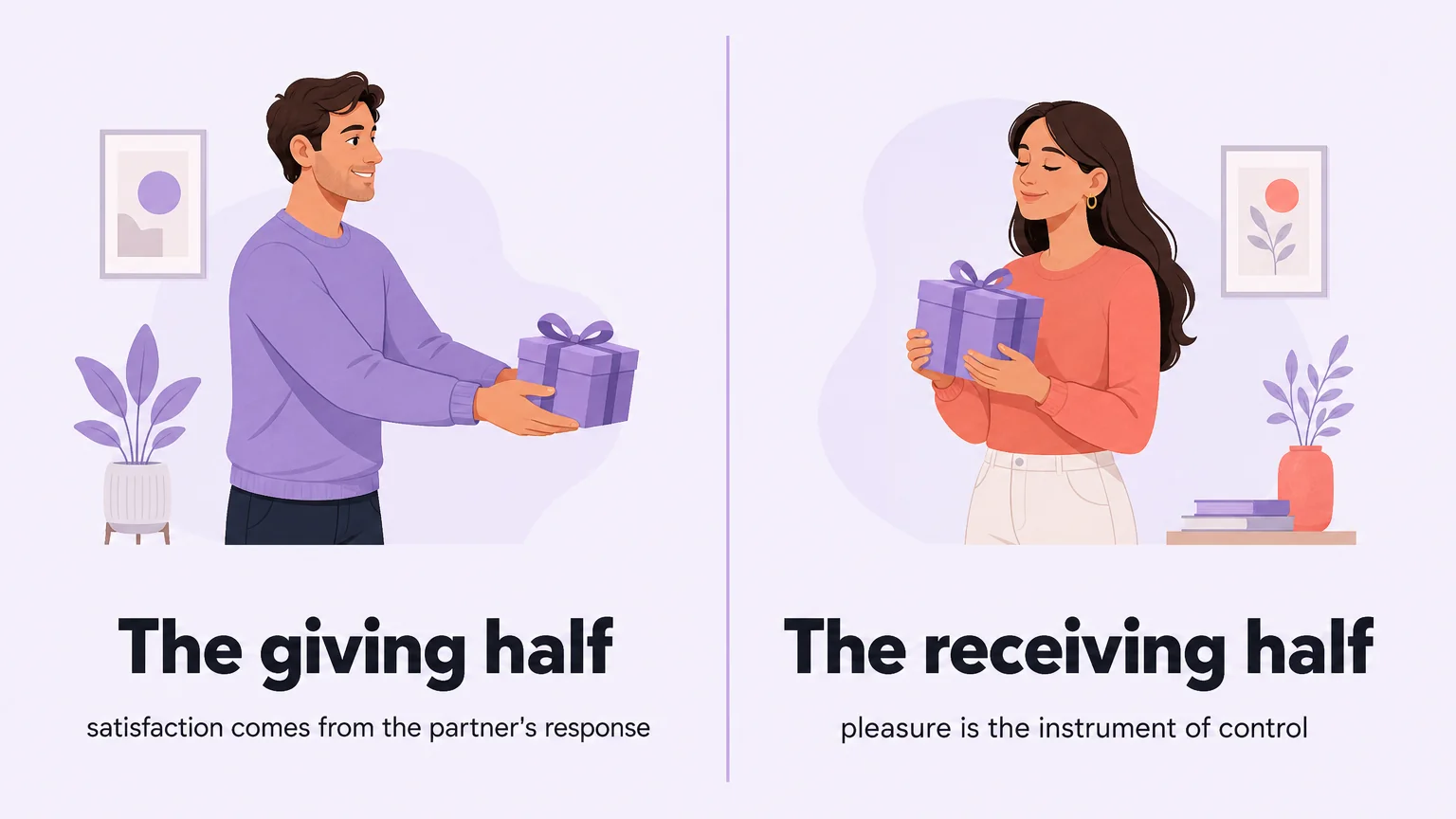
Start with the mirror, because both halves matter. A pleasure dom is the giving side: a dominant whose satisfaction comes from a partner’s response rather than their compliance. The working description is a dominant who prioritizes a partner’s pleasure and satisfaction.
Sara Salazar, a kink therapist with fifteen years on the scene, finds that hollow: every clause describes what any decent dominant should already be doing. That is the first clue to why the receiving half has never been pinned down. If the giving side is this hard, the receiving side is harder.
Define it by mechanism, not mood. What makes someone a pleasure sub is not that the play is gentle. It is that pleasure is the instrument of control. The surrender sits in not controlling what you receive: not knowing when it arrives, not deciding how intense it gets, not being able to pace or stop it.
Then the counterintuitive core, the most useful reframe here: for some people, receiving is harder than obeying. Alessandra, a kink educator, describes a more exposed kind of surrender in being given pleasure, not controlling it, not managing it.
That exposure is where the submission lives for them. Not easier. More.
What makes this a role rather than good partnership is structure. Evie Lupine, a long-running BDSM educator, compares it to a housemate who resents doing all the cleaning. That resentment becomes domestic servitude once it is intentional and negotiated. Caring whether a partner gets off has the same shape: it becomes kink only when it is deliberately structured, and outside that frame it is being a decent partner.
So the question that decides whether you are a pleasure sub is not “do I like being pleased” but “am I handing over authority over my own pleasure on purpose.”
Three corrections, quickly. Not a soft-only label. Not defined by gear either: wands, blindfolds, restraints and rope are the equipment the field associates with this play, but control comes from pacing and permission, not the device.
And not a doormat: a pleasure submissive can prioritize a partner’s satisfaction and still express their own limits.
A practitioner describing what her clients wanted: the craving is not really about the pleasure, it is about what the pleasure means. I see you. I studied you. I know what you need.
Being known that specifically is the most intimate form of dominance available. The clearest illustration: a dominant narrating a partner’s body out loud, describing what they can see happening in real time. The difference is between something happening to you and being witnessed while it happens.
One last thing, said plainly rather than in a footnote. There is no settled published definition of pleasure sub. This one is assembled from usage, not quoted from a source. That is the state of the vocabulary, not a hedge.
It applies to any gender and any pairing: men and women describe this, straight and queer people describe this.
Pleasure Sub vs Service Sub: The Difference That Matters Most
Two people can do the same thing on the same evening and be in completely different roles. The act will never tell you which.
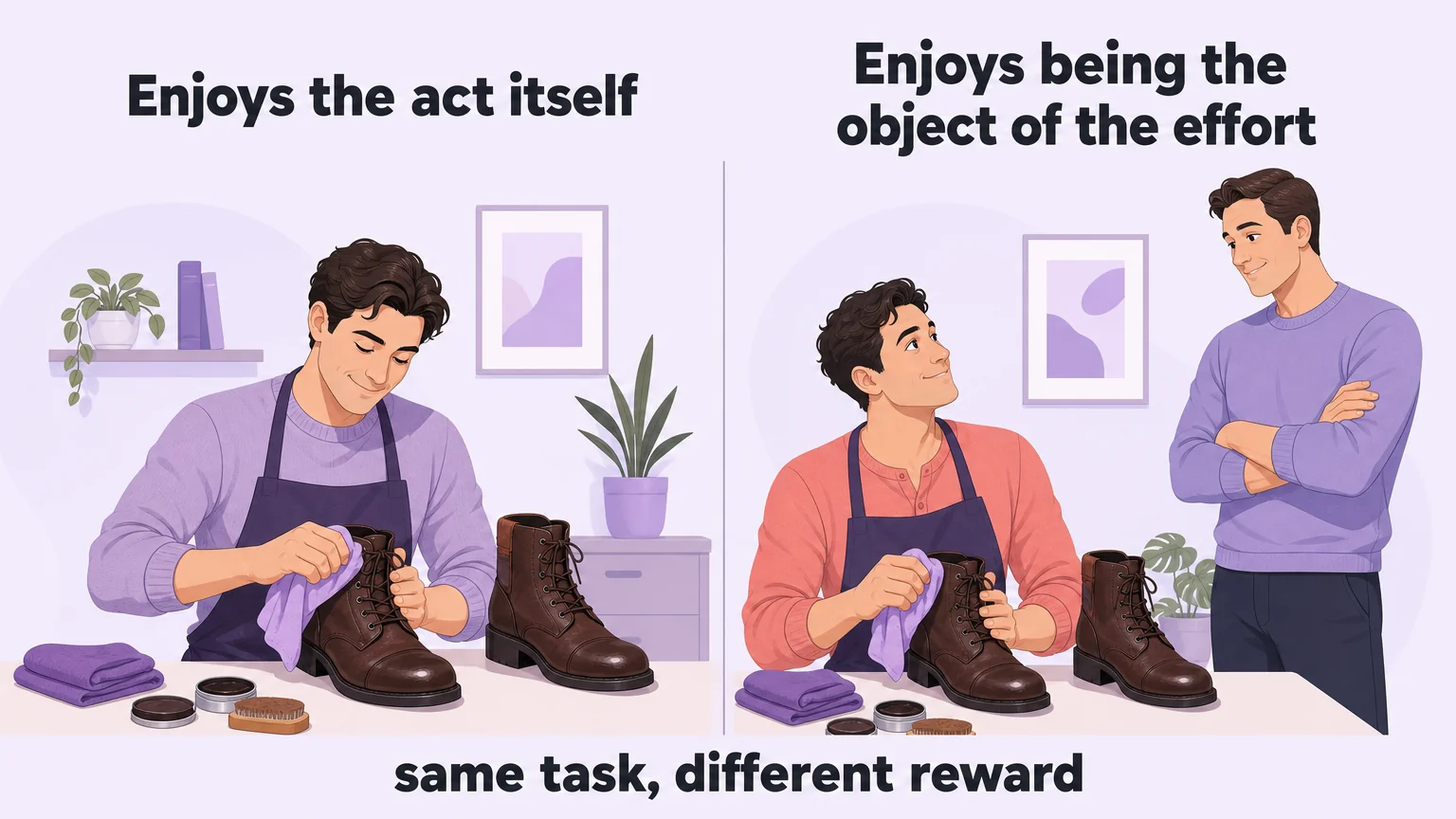
A service sub enjoys the act itself and does it unprompted, because being useful is the reward. A pleasing sub enjoys being the object of a partner’s effort: the pleasure comes from the attention, not the task.
The concrete example: a sub who maintains a partner’s boots unprompted, because being useful is the point, set against a sub who only does it when instructed, because what they wanted was the instruction. Same boots, opposite role. Plenty of submissives run into difficulty when asked to serve, having conflated the two all along.
The disagreement teaches more than a verdict would. Position one: the distinction is real, and it turns on the object of enjoyment. Serving is enjoying the action performed; pleasing is enjoying having obeyed and satisfied the dominant’s need.
Position two: it collapses under inspection, because motivation rather than act is what matters. One dominant’s idea of submission is a sub changing the batteries in the remote while he steps out of the room; another’s is a sub blowing him every morning and every night. The hard version: where there is no pleasure, the action stops.
Position three, from a sub: why can it not be both? If you do not get pleasure from the act, why else would you do it?
She lands on pleasing by serving: I get pleasure from it, but not for my pleasure, for my dominant’s. And if it were only about the pleasure of obedience, one would obey anyone who gave a command.
Unresolved, and worth leaving that way. What separates them is position on the axis: a service sub sits on the giving end of the act, a pleasure sub on the receiving end of attention. That is why the two can look nearly identical from outside and feel nothing alike from inside.
Draw the same line from the giving side. A service top hands the dynamic over to the sub’s gratification; a pleasure-led dominant keeps leading. The collapse is easy to miss: the giver starts tracking whether the sub is enjoying every second, whether the orgasm came fast enough, and slides into serving without noticing. The question that catches it: am I intentionally leading this experience, or emotionally reacting to it?
The self-check that resolves more cases than any definition: when you think about a scene you loved, is the memory the thing you did, or the fact that someone was paying attention?
The distinction is about where the reward sits, not about what gets done.
Why the Pleasure Sub Label Is So New, and Where It Came From
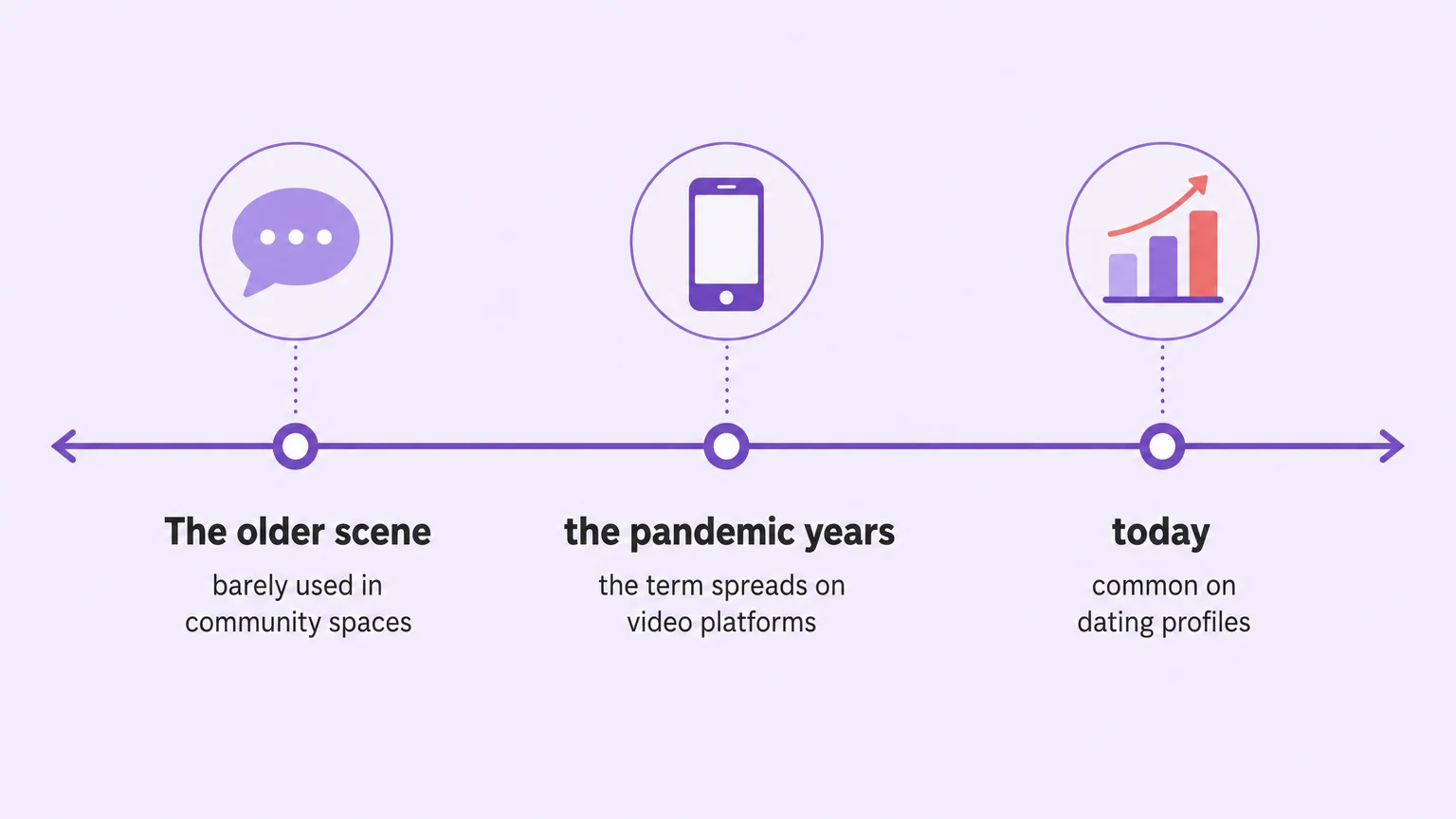
The term turns up on dating profiles constantly and is close to absent from the places kink vocabulary usually lives and gets argued over.
Evie Lupine offers the explanation, as field impression rather than measurement. The label was broadly absent from FetLife, the long-running kink social platform, while being everywhere on TikTok. In the older scene there were only inklings here and there. That explains the confusion: someone with two decades in the community may never have heard the term, while someone who arrived last year sees it daily.
The rest of the taxonomy is new too. Terms like vanilla dom and the split between hard and soft dominance exploded on TikTok during the pandemic, when people were learning kink from one platform and coining terms in isolation. Lupine’s marker: two years earlier she had never heard anyone describe their style preferences that way. Gentle femdom is the exception, long established.
The sharpest idea here is a rename proposal. Lupine argues that pleasure dominance is euphemistic, because not all pleasure is sexual and not all kink is pleasant, and suggests hedonistic dominance instead, since the real mechanism is using enjoyable bodily sensations as a tool for control. It has not caught on.
Why the original sticks anyway: it is legible to a new partner, and it signals that this person’s satisfaction comes from your response rather than your compliance. That is real value even when the term is imprecise, and new is not the same as fake.
If pleasure sub feels both familiar and undefined, that is not a gap in your knowledge. It is the state of the vocabulary.
How a Pleasure Sub Differs From Brat, Rope Bunny and Pillow Princess
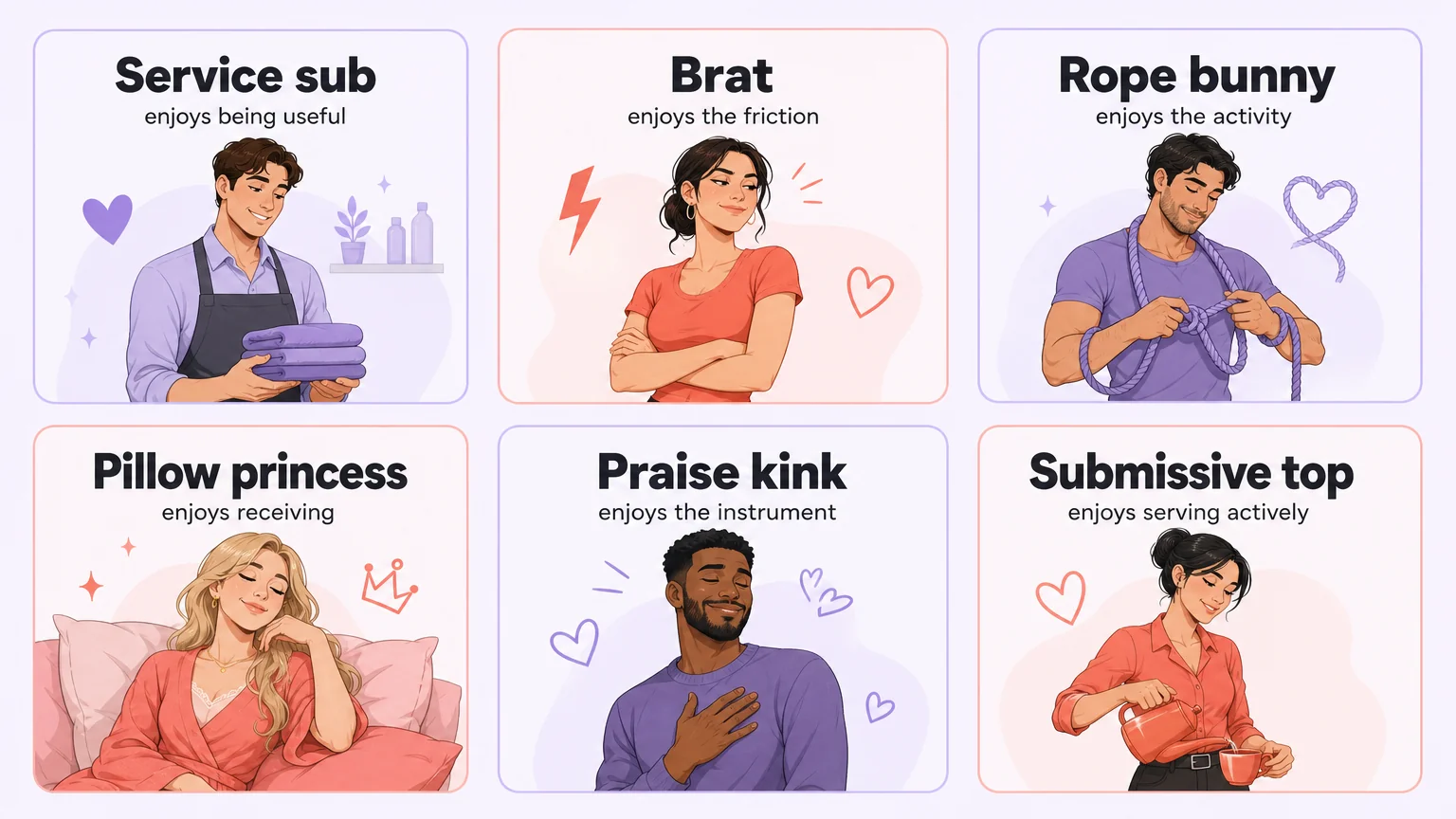
Labels are not ranks. Most people are several at once, and the useful question is not which one you are but what each one names.
Service sub names the reward. The tell: you do it unprompted, and being useful is the point. It pairs with pleasure sub as an opposite, one at the giving end of the act and the other at the receiving end.
Brat names friction as the reward. The tell: the playful pushback is the point rather than a failure of submission, and being handled firmly is the payoff. It pairs with pleasure sub often, because a brat wants the same deliberate attention.
Rope bunny names an activity preference rather than a role. The tell: it describes what you like doing, not where you sit in a dynamic. Someone can be a rope bunny on the days the rope is the instrument.
Pillow princess names a receiving position and overlaps most heavily with pleasure sub. The tell: the receiving is the whole of it. Here the newer term does work the older one cannot. Pillow princess reads as passive, implying nothing is directed, while pleasure sub keeps authority inside the frame.
Praise kink names an instrument, not a role. The tell: praise is the tool rather than the position. Most people are both, since for someone whose pleasure comes from being the object of attention, praise is one of its most direct forms. Aim it at what the person most values rather than at generic compliments, and negotiate it first, because it can surface more than either of you expects.
Submissive top names a role on a different axis: someone who takes the penetrative role as an act of service and obedience. A pleasure sub can be one, because one label describes what you do and the other what you want from being given.
Two questions resolve most cases. What do you want out of the exchange: attention, friction, a task, a sensation, or simply to be directed? And who leads?
Pain deserves a direct answer, since it is the most common misread. Liking pain does not disqualify anyone: the only person on record identifying as a pleasure sub lists impact and degradation among her kinks. For a lot of people who practice kink, being made to feel pain, or causing a partner pain, is an act of love rather than its opposite, and nothing inherent to masochism stops you being sweet and loving.
The doormat worry sits under all of these, and the answer does not change: a pleasure submissive can prioritize a partner’s satisfaction and still express their own limits.
Labels name three different kinds of thing: a position, an activity, or an instrument. Comparing them to each other is what keeps failing.
Pleasure Sub Dynamics: Nurturing Attention or Forced Pleasure
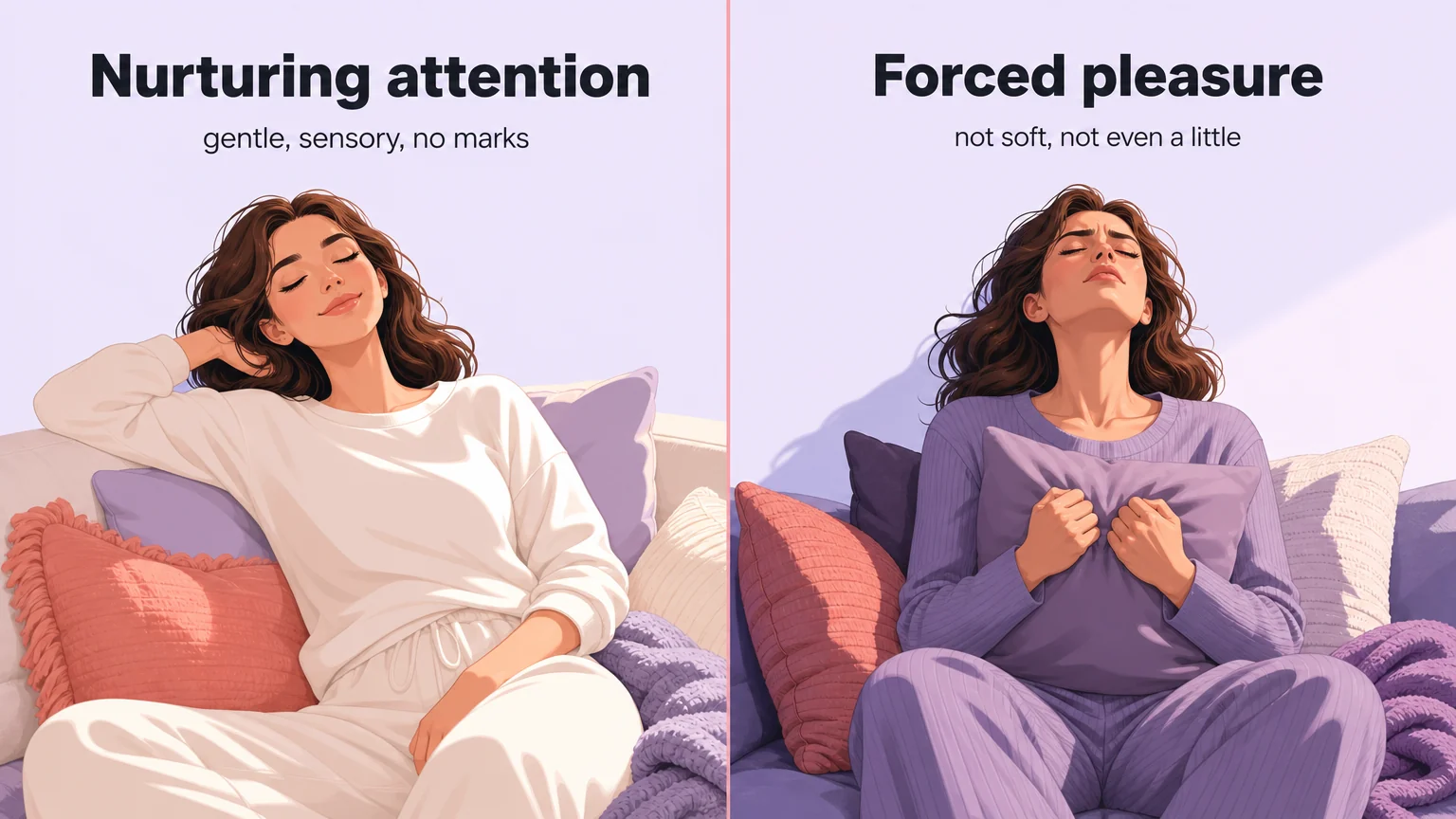
The gentle version is the familiar one. It is not the whole picture: the same practice includes pleasure the sub did not ask for.
Attentive pleasure-led dominance: sensory, emotionally present, intensity without aggression, no marks left behind, a partner who studies what you respond to and orchestrates the experience around it. That version is real.
Then the second, in one practitioner’s own terms. Forced pleasure inside a consensual non-consent container. The dominant gives pleasure the sub did not ask for, the sub is not in control of receiving it, and may be actively trying to resist.
Asked whether this is soft, the same practitioner answers: not even a little. That is the same dynamic turned all the way up, not an edge case.
The instrument is identical in both, which is why the harder version is not a contradiction. Control arrives through what the body is made to feel. Evie Lupine calls orgasm torture the ideal expression of this kind of dominance, since it fuses sadism, control and bodily pleasure. Plainly: someone brought to climax so often, against their will, that it becomes painful.
The container is the point rather than a footnote. In the practitioner’s framing, the negotiation is the foundation: limits established, the conversation already had, both people knowing the agreement. Consent operates at the container level and stays revocable at any second, so blanket consent is out. What separates the hard version from harm is structure: prior explicit agreement, active safety systems, continuous revocability, and mutual investment in both people leaving well, set against pressure, disregarded boundaries and one person’s needs overriding the other’s.
One thing keeps the hard version leadership rather than mere intensity. Authority is easy to hold while saying no, and much harder to hold while being attentive without collapsing into performance anxiety. The gentle version needs the same skill.
And the quiet part, out loud: a partner who resists negotiation, waves away safewords, or springs intensity on you unannounced is showing the opposite of experience, whatever title they use.
Both versions run on trust that the container holds. For a pleasure sub, gentleness is a setting, not the definition.
Orgasm Control and Edging From the Pleasure Sub Side
What gets negotiated here is authority over timing. The acts themselves matter less than who decides when they arrive.
What gets handed over is timing, pacing, permission and intensity. Withholding works as the mechanism rather than a punishment: brought to the edge and pulled back, calmly, knowing the pleasure is available. Without it there is no power, only generosity. A vibrator in a partner’s hand rather than your own is the mechanical version: then you cannot pace what you feel.
The receiving-side texture, as practitioners describe it: an extended state of anticipation, a low hum of waiting where the body has surrendered before anything happened.
The negotiation happens before anything starts and needs four categories of limit, hard and soft in each. Physical: choking, slapping, restraints. Verbal: specific words, degradation, roleplay. Emotional: fear play, humiliation, psychological triggers. Sexual: specific acts, rough oral, orgasm control.
The question people forget is whether orgasms are allowed, controlled or denied, and whether the sub will be asked to pretend they do not want it. One caveat: a checklist only surfaces the categories it contains, so treat it as a conversation opener, not a completed form.
The traffic-light system’s middle gear matters most here: yellow slows things down without ending the scene, which is what staying in surrender needs. But it assumes the sub can speak, and in a fawn or freeze state they may not be able to. Inside a script where no and stop are part of the dialogue, ordinary words lose their signaling power. So choose a safeword outside the scene’s vocabulary, add a matching nonverbal signal, and rehearse both until reaching for them is automatic.
Intermediate safewords, a graduated system between fine and stop, were named by the only person on record identifying as a pleasure sub, which makes them native to this role. No standard scheme is in circulation, so the principle matters more than a ladder. For check-ins that do not break the scene: a whispered question or a double hand squeeze.
Learn your own escalation map, because no partner can supply it: where panic starts in the body, and how that differs from intensity. The dominant is at risk here too, and past trauma responses should be disclosed on both sides.
Set up before the scene: limits, safewords, check-in method, scene duration, escape plan. Reject anything that removes the ability to stop, because that capability is never surrendered.
One hazard named plainly. Orgasm training, conditioning a body to climax only under particular conditions, can outlast the relationship: people have been left unable to get off for weeks or months after a breakup. It varies wildly between people.
The same continuum extends down to something as ordinary as a partner being brought into how you relax.
You are not deciding what happens. You decided the container in advance, and inside it you do not have to decide anything. That is what is being bought.
The Pleasure Sub Trap: When Pleasing Becomes Performing

This is the most generous kind of partner to be with, and the hardest one to tell the truth to.
Name the trap precisely. When a partner’s whole identity is giving you pleasure, your enjoyment becomes their scorecard. Reporting a bad scene stops being a preference conversation and becomes a verdict on their competence. That is structural, not anyone’s failing, which is why it is hard to say.
The giving partner’s side deserves equal space: a shared problem, not an indictment. A dominant can become emotionally dependent on a sub’s pleasure to feel successful, and can destroy the power gap they thought they were deepening by reacting instead of leading. The tell: the pacing stops, the anticipation stops being shaped, and the giver starts checking whether it works.
The sharpest critique: when pleasure is given as ego rather than attention, the sub’s experience becomes a scoreboard for the giver. Evie Lupine compares it to bragging about volunteering at a soup kitchen while ignoring the people you were helping.
The trap fires in reverse too. When a partner’s reward system turns pleasure into something earned, or withholds it as a corrective, the association can outlast the scene. One pleasure sub’s account of a non-negotiated experience: it left them unable to revisit that play without a negative mindset for a long time.
Another community member names the mechanism: conditioning a partner to associate a pleasurable act with a negative consequence can permanently damage their desire for it. The red flag is that something was never discussed.
A nervous-system layer sits under all of this. Fawning is a survival response rather than a choice: agreeing to scenes you do not want, pushing past limits to avoid disappointing someone, pretending obedience while privately feeling fear. That is why “just safeword” is incomplete advice for anyone whose body responds to pressure by complying.
What helps is practical. Build a debrief a day or two after a scene, once both nervous systems have settled, into the dynamic from the start, so reporting becomes routine rather than an accusation. Practice small refusals in low-stakes moments.
On the giving side, read hollow compliance as a signal to stop. Choose partners who want your agency over your obedience.
A partner who cannot hear “that did not work” is denied information they need to do the thing they care about. Telling them is what serves the dynamic.
One last idea turns this into a competence question, not a kindness one: pleasure reveals whether someone knows how to lead.
Pleasure Sub Drop: Aftercare When Nothing Hurt

Nothing hurt, nothing broke the skin, and two days later you cannot work out why you feel like this.
Drop is a neurochemical comedown, not a verdict on the scene. It follows the adrenaline and endorphin spike and not an injury, and any intense sexual activity can produce it. The absence of pain removes the wound care, not the crash. Orgasm control and edging keep arousal elevated longer, which makes the drop more likely.
It is not a sign something went wrong, but a predictable physiological response to an extraordinary experience.
The timing catches people out: it typically arrives 24 to 72 hours later and lasts from hours to a couple of days, which is why people blame work, hormones or the relationship rather than the scene.
The difficulty specific to a pleasure sub: there is no mark, no bruise, no visible cost to point at. A partner looking for damage to fix will not find any, so the ask has to be explicit. That is unfair, and it is still the situation.
What to ask for: water and electrolytes, food for blood sugar, warmth, because core temperature drops after high activation. Then the part most often skipped: explicit, non-sexual validation of who you are rather than how you performed, plus the line people almost never hear. It is okay to feel this way.
What makes it worse: isolating, alcohol, big decisions mid-drop, rushing back to work, replacing intensity with more intensity.
Wanting verbal affirmation can feel needy, and people assume it looks insecure. In a negotiated dynamic there is a frame that makes asking intentional, and it is allowed to be a little needy here.
Treat aftercare as structural, set up before the scene. Include a real debrief a day or two later. The giving partner can drop too, which affects how the sub lands.
No damage is required for the crash to be real.
Being a Pleasure Sub: Telling Your Partner What You Want
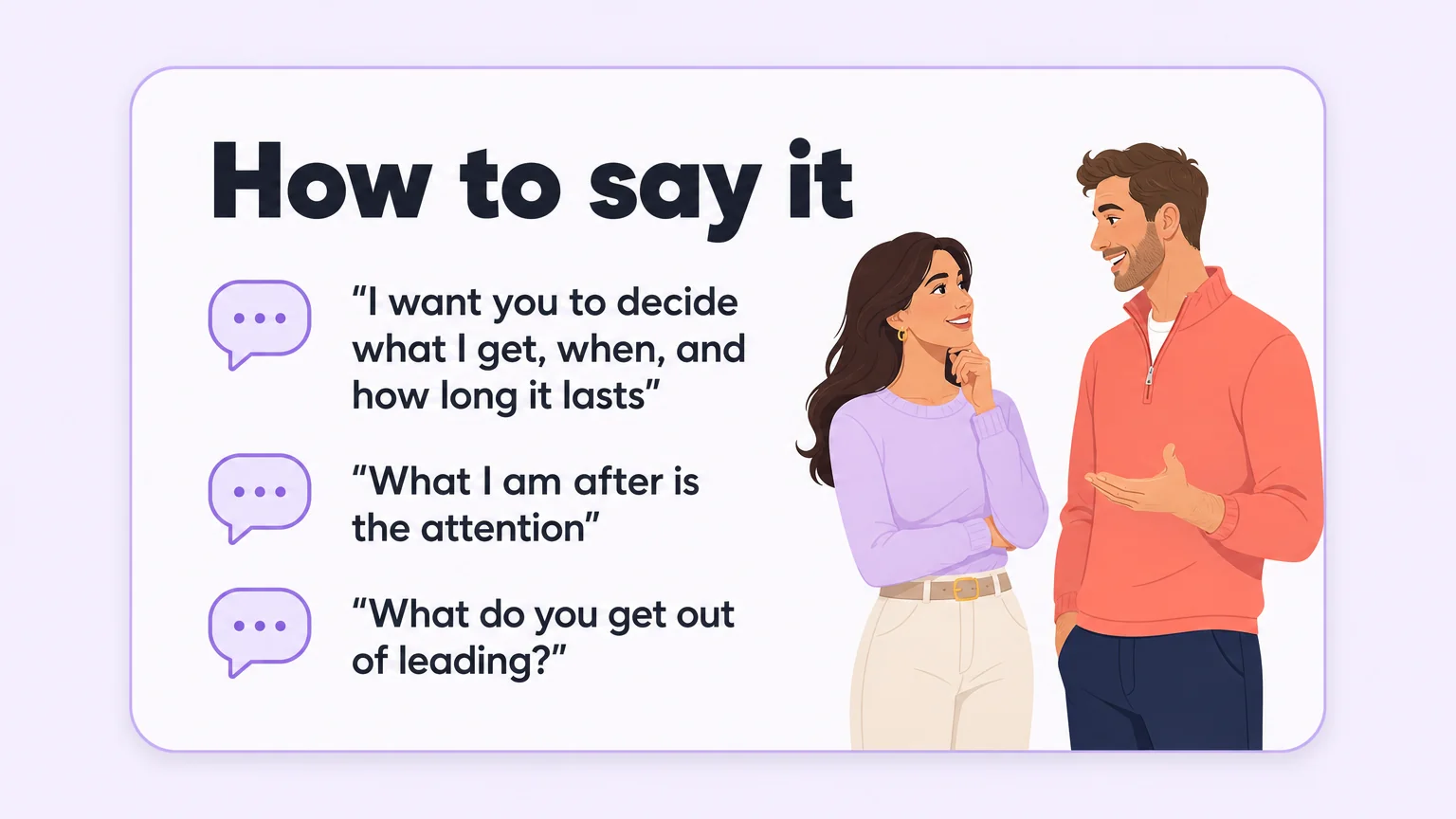
The wanting is rarely the hard part. Saying it out loud is, without it landing as a complaint about what your partner already does.
Start with the frame, not the request. Open with what you have learned about how you want to be handled. “You are not doing this” is a different conversation. The people who could not name this had been describing it to themselves for years, concluding the fit was wrong rather than the vocabulary.
Most readers will not open with a term nobody has heard. Offer the description: I want you to decide what I get, when, and how long it lasts. I want to not be in charge of it. What I am after is not a technique, it is the attention.
Bring four things: what you want to receive, what you want decided for you, what is off the table, what you need after.
Ask the reciprocal question: it keeps this a team conversation, not a brief. What do you get out of leading? If the only thing they can name is your pleasure, that is worth knowing early: it is the signature of a partner adapting to please rather than leading.
Being a pleasure sub is not specific to a gender or orientation. This role is described by men and women, by straight and queer people, and men and same-sex couples have the least vocabulary for it.
Test it in a low-stakes moment rather than a scene, and treat the first attempt as information rather than a verdict. Escalate once you are both used to it, and know that naming it only gives a partner somewhere to read.
Naming it is the first negotiation, and easier than the second.
Pleasure Sub in a Mismatched Pairing or Open Relationship
You can want this and not have a partner who leads this way. Plenty of pairings do not match, and that is not automatically anyone’s fault.
Permission first, technique second. Kink incompatibility is normal, at the start of a relationship and later as people change. A partner who is not a pleasure-led dominant is not a project.
How to raise it: separate the want from the person. The useful sentence is about what you would like more of, not what they are failing to be. Then be honest about whether it is a preference or a requirement.
The structural difficulty is why these conversations stall. A sub who wants to please and a dominant whose identity is about giving reinforce each other into a loop where neither can report a failure.
Open relationships and group scenes, handled honestly. The general practice is sound: talk outside the bedroom, treat agreements and boundaries as different things, take small steps, check in afterwards. The point specific to a pleasure sub is that a dynamic running on being closely known does not transfer to someone who did not build it.
One group format has something behind it: several people taking turns to name what they value about one person. That suits someone whose pleasure comes from focused attention, and it is the only group structure in the material that fits.
Be straight about what is untested: the guidance that exists is general non-monogamy practice, and how a pleasure sub’s dynamic works in a group setting has no account behind it.
A mismatch is information rather than a failure. Most of the work is finding out early and saying so plainly, which is the same skill an open relationship already asks.
Saying so plainly is easier when it is the norm rather than a risk. That is the practical argument for dating where intent sits on the profile instead of being worked up to. It is also what 3Fun’s About us field is for.
Pleasure Sub FAQ: Common Questions Answered
What is a pleasure sub, in one sentence?
The receiving partner in a power exchange where pleasure is the dominant’s chosen instrument of control. One caveat: the term has no settled published definition, so this one is assembled from how people use it, not quoted from a source.
Do you lose your safeword in a forced-pleasure or CNC scene?
No, and this is the most dangerous myth in the area. Most experienced practitioners keep one even in the heaviest roleplay, outside the scene’s vocabulary, with a matching nonverbal signal for when speech fails. You never remove the ability to stop.
Is a pleasure sub always a woman?
No. The role is not attached to a gender or a pairing. YouGov’s 2015 research found women reporting a clear submissive preference over dominant, 21% against 4%, while men reported the opposite skew, 18% against 10%. The same study found 60% agreed a woman can want to be sexually dominated and still be a feminist.
Does the research say dominants are happier than submissives?
Not the way it usually gets summarized. Botta et al. 2019, in The Journal of Sexual Medicine, measured sexual function, satisfaction and distress, not mental health. Dominant and switch participants scored unusually well on satisfaction; submissive participants and the comparison group sat within normal ranges. Dominants function unusually well, not submissives badly.
The 266 Italian participants were recruited by word of mouth, a stated limitation.
How common is this, and is wanting it normal?
Roughly half the adults YouGov surveyed reported some sexual preference for dominance or submission, and the most common single answer was wanting both roles at different times. A smaller group had practiced it, and among under-thirties interest ran markedly higher, with 35% saying they would like to try it.
Isn’t “pleasure dom” just a rebrand of soft dom or sensual dom?
No. A pleasure-led dominant is not necessarily soft; the control arrives through a different channel. The comparison that stings is the service top, which follows the sub’s lead while a pleasure-led dominant still directs everything. The tell is intent: leading through pleasure, or using it to avoid leading.
Is pleasure-led play actually BDSM if nothing hurts?
Practitioners argue yes, because the control is real even when the sensation is not painful. Someone is still deciding pacing, permission, escalation and when it ends. The caveat cuts both ways: caring whether a partner gets off is only a kink once it is deliberate and structured.
Do you still get drop if nothing hurt?
Yes. Drop is a neurochemical comedown rather than a response to injury, so it follows the adrenaline and endorphin spike and not the damage. Any intense sexual activity can produce it, and orgasm control keeps arousal elevated longer, making the crash more likely. It arrives a day or two later and runs for hours to a couple of days.
How does praise kink relate to being a pleasure sub?
They overlap heavily and they are not the same thing. Praise kink is using praise deliberately to produce a specific emotional state, which can be warmth and can equally be embarrassment or humiliation. For someone whose pleasure comes from attention, praise is its most direct form.
How do I know if someone calling themselves a pleasure dom is safe?
Treat the label as carrying no information. Ask what the term means to them, why they identify that way, and what dominance and submission look like to them. Two tells: if the only thing they can name that they get from the dynamic is your pleasure, they are adapting to please rather than leading, and if they resist negotiation or wave away safewords, that is the opposite of experience.