
Someone said it to you, or you finally said it to yourself, and it landed wrong. Submissive top sounds like a contradiction, and for years the people using it were the ones who already felt it and had no better words.
Two readers arrive here. The first has known this shape for years: they like being on top, and they like being told what to do while they are there. One person described the dynamic in a post, a top who is “super submissive,” who enjoys being teased “knowing they want to pin you down but can’t,” and then asked what it was called.
The second met the term on a profile or in a book and does not want to get it wrong. Many met the role in fiction first, as a character who will top if told to, long before it had a name.
By the end you will know what a sub top means, why it is not a paradox, what the vocabulary calls it, and how to say it out loud. No prior reading required.
The phrase sounds impossible only because English uses one word for two different questions.
Top vs Dominant: Why They Are Two Separate Questions
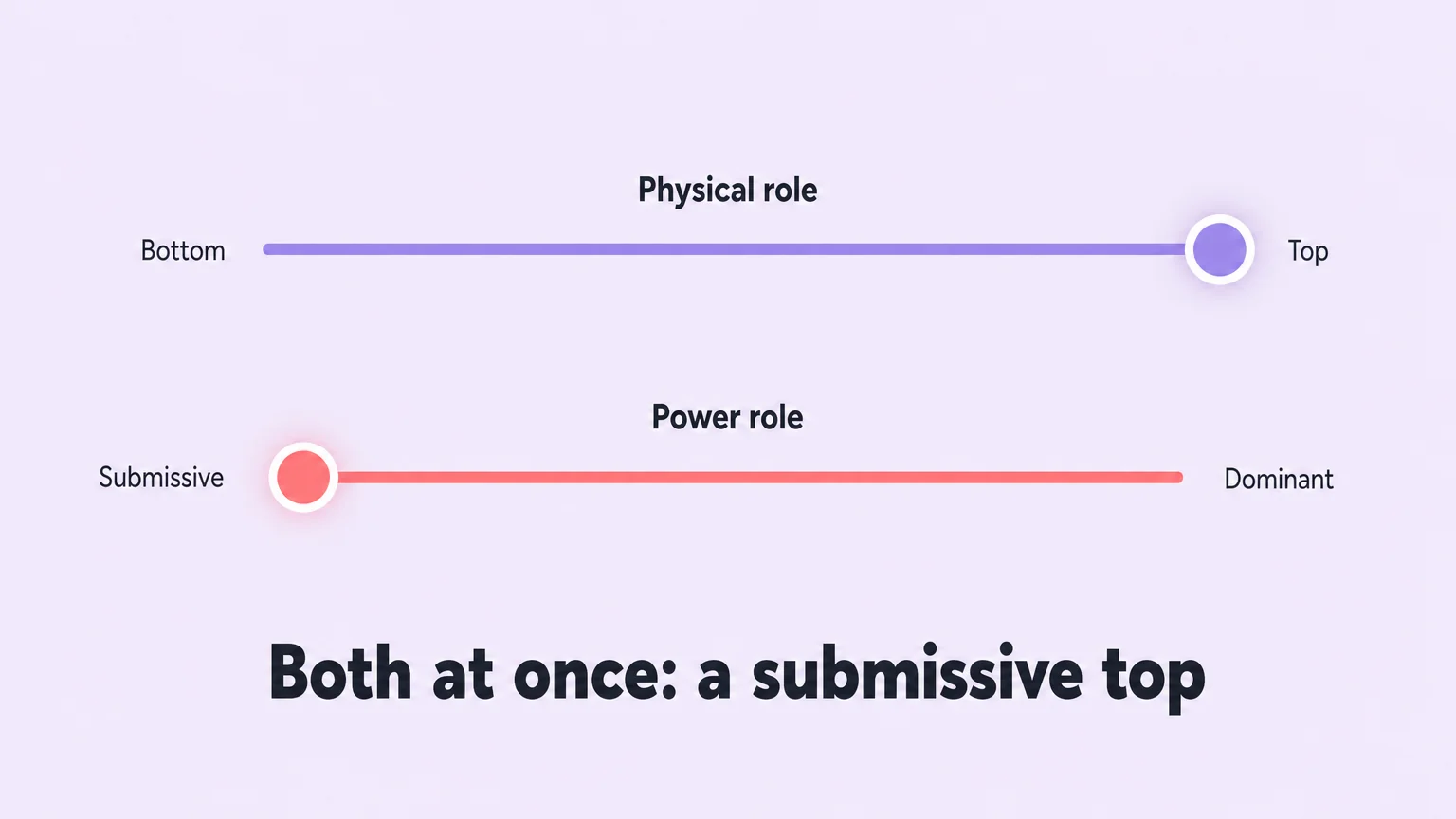
Ask a room who is a top and who is a bottom and you will get answers. Ask who is dominant and half the room will realize they have never been asked. Top versus dominant is the whole article in two words.
“Top” answers a question about what your body does in the room: who penetrates, who runs the technique, who is physically active. “Dominant” answers a completely different question: who directs, who holds psychological authority, who can call a stop. For some people those two answers match. For plenty of people they do not.
That group has a name, and it is not new. BDSM educator and author Midori built a role grid: Top, Switch, Bottom, and Neutral on one axis, Dominant, Switch, Submissive, and Neutral on the other. Sixteen positions.
The Dominant Top is the classical “true dominant” of pre-1995 usage. The Dominant Bottom tops from the bottom by directing how they want to be used, a legitimate role rather than a contradiction. Neutral-Neutral is essentially vanilla sex.
Where someone is physically topping while sitting on the submissive side of the power axis, the role has a name: the Service Top, the person who “revels in the service aspect and the giving.” A submissive top is not an anomaly. It is a named position.
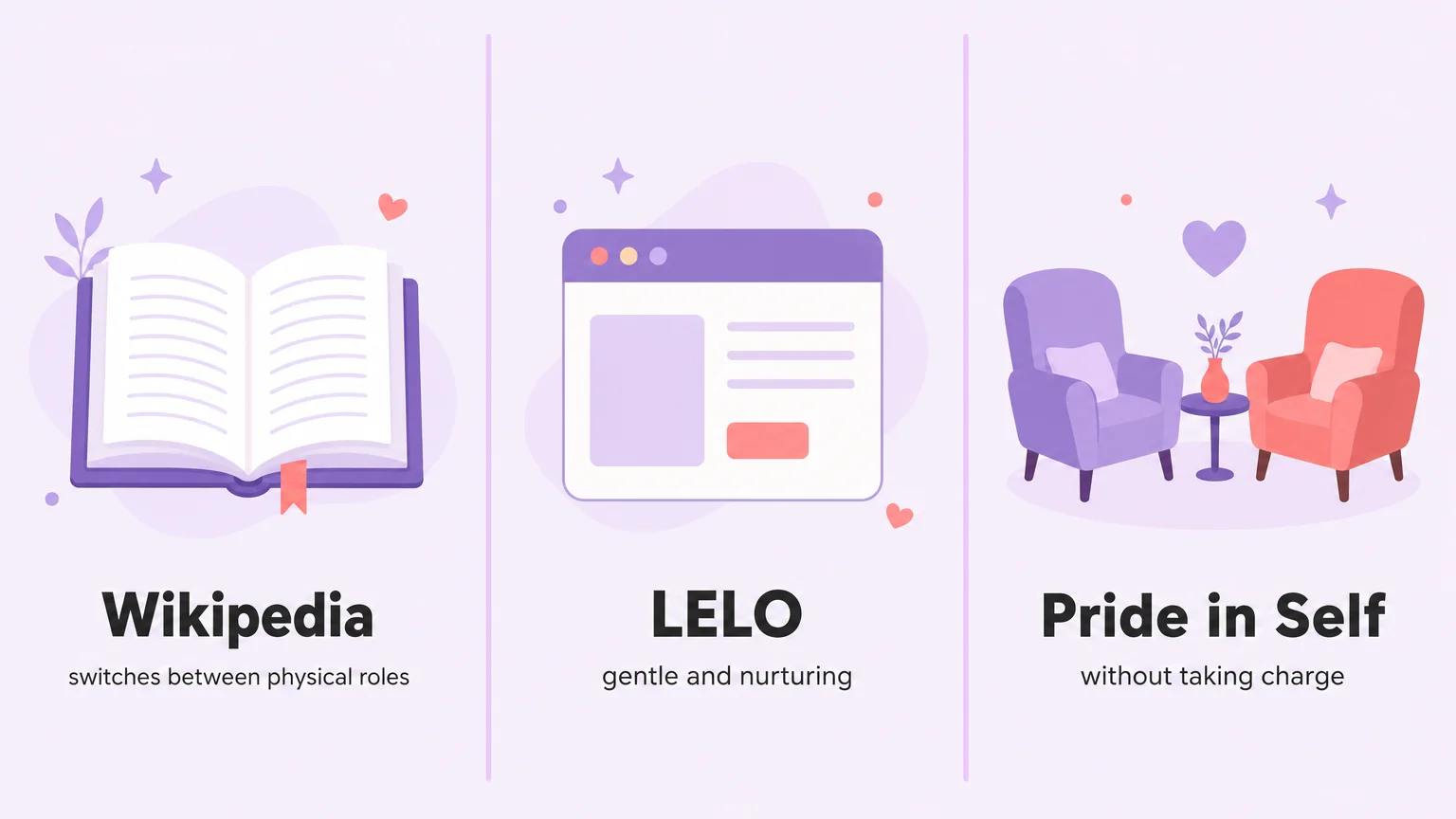
Michael Lefever, a therapist writing for gay men at Pride in Self Counseling, puts the broader point cleanly: sexual position and power dynamics are related for some people but “not automatically the same thing.” A top can be soft, passive, or submissive, and none of that makes the word untrue.
Then there is the clinical version. Healthline’s guide to sexual submission, medically reviewed by Janet Brito, PhD, LCSW, CST-S, states that someone who is submissive can be on top, servicing their partner because they are skilled at something the dominant enjoys. Not community slang, and it describes exactly what you have been trying to say.
So why does the confusion persist? The culture picked up the words before the definitions did. Fandom glosses “Seme” as “the dominant/Top partner,” one word doing the work of two. Outside kink spaces the phrase travels informally too: one poster described a reading phase as being a “submissive pathetic needs-to-be-told what to do top.” The vocabulary escaped before the meaning did.
Two questions, two answers. One of them has had a name all along.
Soft Top, Service Top, Sub Top: Why the Definitions Conflict
Here is a test. Say “soft top” to four people and get four definitions. Say “service top” and the room mostly agrees. Say “sub top” and everyone nods, then quietly checks what the person beside them meant.
Several words circle the same territory and they do not mean the same thing. If you have been handed two as though they were interchangeable, you did not misread. The conflict is documented.
The reference literature calls “soft top” a colloquialism for a versatile top, filing it with people who move between physical roles.
LELO’s editorial on soft tops takes another route: a soft top is someone sexually dominant but otherwise gentle and nurturing. The dominance stays. Only the manner softens.
Bobby Box, the sex educator who wrote the piece, argues the belief that a top must be dominant without compassion is outdated and potentially dangerous to our bodies. That discussion, he says, grows out of an antiquated idea that mannerisms and presentation predict bedroom role.
Pride in Self Counseling lands somewhere else again: topping without strongly identifying with dominance, aggression, or control. The physical role stays. The dominance goes.
Three sources, three answers, nobody acknowledging the others.
The sharpest detail is internal. That same LELO piece notes that some people use “soft top” to mean a submissive top, the inverse of a power bottom. Two readings, one page, unreconciled. Which is a polite way of saying your confusion was earned.
Why have you heard “soft top” at all? It spread faster than the older, more precise terms. The discussion blew up on TikTok, where the #softtop hashtag has drawn roughly 3.2 billion views, after years on message boards. The newer, vaguer word traveled further, so that is the one you inherited.
Keep a short glossary. Submissive top and sub top name the configuration. Service top is the established term and the least ambiguous. Obedient top and soft top overlap in community usage.
Expect the vocabulary to stay local. Community writing notes it “usually only standardizes fully amongst geographically constrained areas,” which means the same word can mean different things in different rooms. Ask what someone means.
What It Feels Like to Be a Submissive Top

A submissive top looks, from the outside, like the person in charge. From the inside, they are following instructions they asked for and being told they are doing well. That gap is the whole experience.
Robert Cohen, a self-identified subtop on the Two Bi Guys podcast, puts numbers on it. Roughly 25 to 30 percent dominant, 70-plus percent submissive, and still a preference for topping.
“I love pleasing a partner. I love to be of service. Those are things that turn me on as well,” he says. Then the line that explains the orientation: “I like when somebody knows what they want and tells me what they want and sometimes tells me what to do. That’s hot for me.”
He is describing a specific pleasure in being the instrument of someone else’s wanting, not passivity.
For Cohen, this version is also the lower-anxiety one. He likes to penetrate, but he does not need to determine what happens. Topping dominantly requires clear boundaries and a clear read on what his partner wants before he feels confident. His harder line: “I hate the idea that I’m dominating as a default with someone who doesn’t want that.”
That is the opposite of settling. Submission is where he can relax.
Taylor Ellwood, who works with submissive men on the Sovereign Submission podcast, adds the other half. Service topping, he says, “brought me a deep joy to give her that service,” while his partner stayed in control throughout. The giving and the submission do not compete. They reinforce.
The identity did not change what either man wanted. It named it. Cohen spent thirty years assuming dominance came bundled with being a straight man before he pulled the two spectrums apart. Not the relief of a new desire, but of a label that fits.
A person described tying a partner up, using increasingly large toys, and between each one holding him and telling him how cute and special he is. Fully top, entirely caretaking.
Now the cost. Cohen: “Sometimes people think that those two things don’t go along together.” His own concession: “We are more rare.” Some communities treat service tops as failing a proper dominant-top, submissive-bottom alignment. That friction is social and external, not evidence of a flaw in you.
Service Topping Is Not Topping From the Bottom
The sentence you are most afraid of hearing: that’s just topping from the bottom. For a submissive top, the two look identical from outside and opposite in intention.
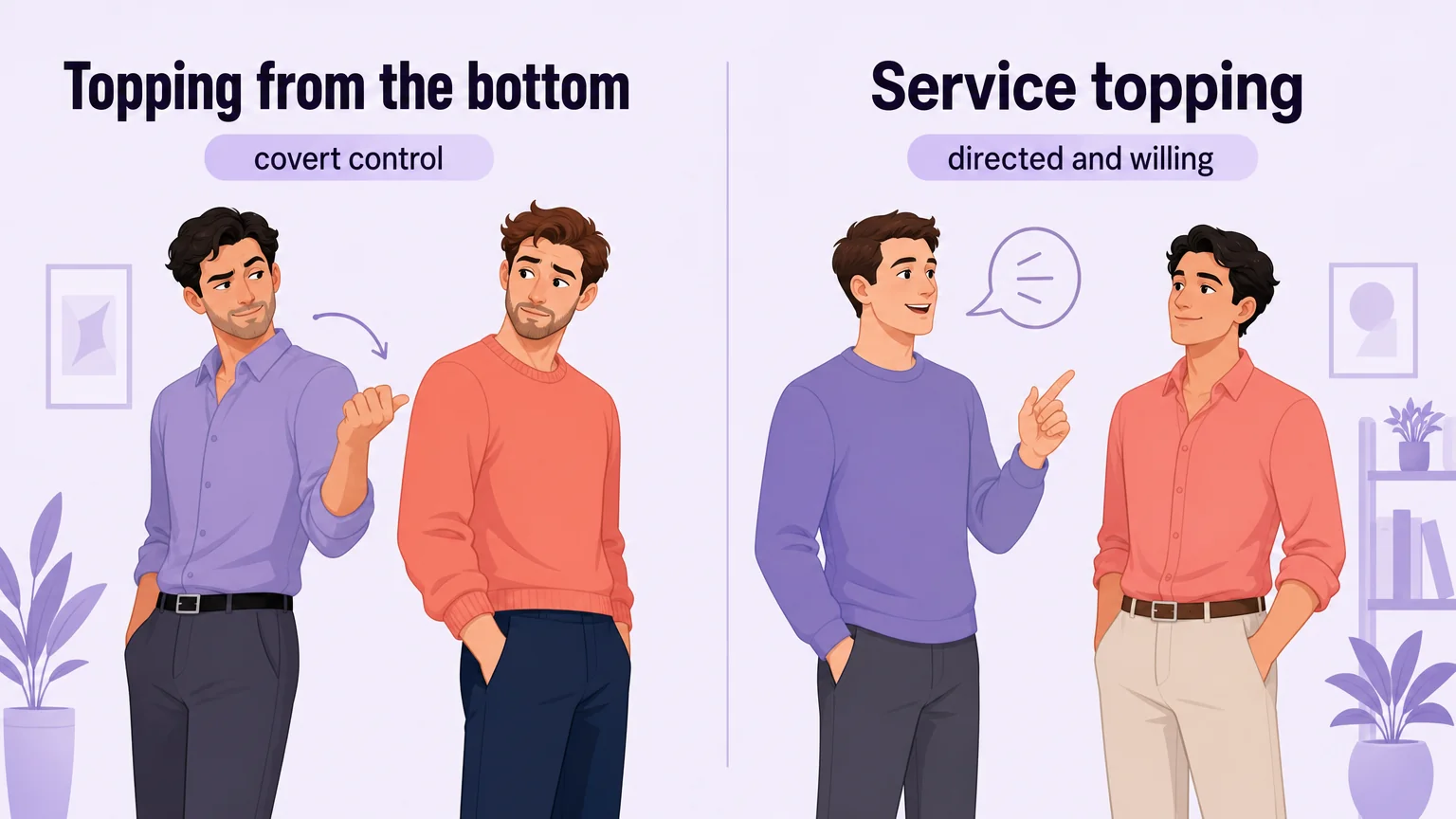
Topping from the bottom is covert control. Taylor Ellwood describes it as telling your partner what to do in a roundabout way, or resisting and dragging your feet until the dynamic is undermined. His illustration: a submissive who says he wants to submit, “and then he would promptly share everything he wanted her to do to him and expect her to do it on the spot.” The consequence: “It causes her to dry up. It causes her to withdraw.”
Service topping is the same physical event with the opposite intention: the submissive performs the active acts because their dominant directed them to, as a form of service. Ellwood’s framing: “I’m still in control, but if somebody were looking at it from the outside, they might think that you were actually in control.”
His clearest example: a scene where they traded physical roles back and forth. It looked like ordinary switching. It was not.
She decided when they switched and could take control back at any point. He might pick the toys. She could stop it.
So the test is not who is active. Onlookers judge activity. What decides it is who chose this and who can stop it.
Submission on the power axis does not mean handing over unlimited authority. A dominant’s control is what one practitioner source calls “seldom absolute,” operating inside defined limits, with safewords governing where it ends. Something with no floor and no exit is not this role but something else wearing its name.
One self-check, not an accusation. If you catch yourself using service topping as cover for managing your partner, Ellwood’s advice is to name it and renegotiate. If someone says the phrase to you, ask which meaning they have in mind.
The Mirror Role: Who a Submissive Top Pairs With
You already understand the mirror image. A power bottom is the receptive partner who takes the more dominant or controlling role, the bossy bottom, the one being penetrated who is nonetheless running the show. Most people find that intuitive within about four seconds.
Now stand the submissive top in the same frame.
Robert Cohen explains the pairing better than anyone: “You’ve heard of a power bottom, the bossy bottom, the bottom who is in charge, even though they’re the one being penetrated. Me as a subtop is on the flip side of that.”
The structure is why it works. One person wants to do the physical work inside a frame someone else sets. The other wants to run the scene from the receiving end. Neither is pretending, and neither is doing the other’s job badly.
If you want the older and more precise name for the submissive-top side of that pairing, it is service top.
A matched pair of labels is not the requirement, though. Cohen again: “We fit very well with power bottoms, but we can fit with other people, too. As long as there’s awareness created and we can talk about this dynamic.”
Compatibility comes from the conversation, not from a checklist. Neither role is a package deal either. Two people can both sit off-center on both axes, and a submissive top does not need a fully dominant receiving partner to have a good night.
Submissive Top Beyond Gay Male Culture: Who Else It Fits
The vocabulary grew largely out of gay male sexual culture, and the writing about this role is still concentrated there. That history is real. Clinical and therapeutic writing also treats the configuration as something a person can be regardless of gender or who they sleep with.
Because a straight man is assumed to be the dominant partner by default, many men in heterosexual relationships never examine their actual position on the dominance-submission axis. Cohen spent his first thirty years assuming the role and never questioning it. “I just thought the man is the dominant one, the woman is the submissive one.”
Cohen’s account of his own straight years names the mechanism. Sexual misalignment among straight couples happens frequently, he says, because the man does not actually want to be totally dominant and the woman does not actually want to be totally submissive, and neither realizes there is another option. Nobody is failing there. Two people were handed a script and never told it was optional.
Community writing calls breaking that script liberating. Justin Sitron, PhD, of Widener University’s Center for Human Sexuality Studies, frames the soft-top conversation as offering a role for men who reject the tropes cisgender heterosexual masculinity encourages.
Second, the data, used carefully. A 2018 study of women active in BDSM found 61.7 percent preferred a submissive role, 25.7 percent identified as switches, and 12.6 percent preferred the dominant role. That quietly retires the idea this vocabulary belongs to men.
The role-fluidity research points the same way. In Martinez and colleagues’ work, people with “other” sexual orientations were 292 to 298 percent more likely to identify or perform as switches, and role fluency tracked sexual orientation more closely than gender. Carry the researchers’ own caveat: self-reported roles may not reflect actual preference, since many people adopt a switch identity strategically to improve partner compatibility. Findings about self-description, not a ranking of identities.
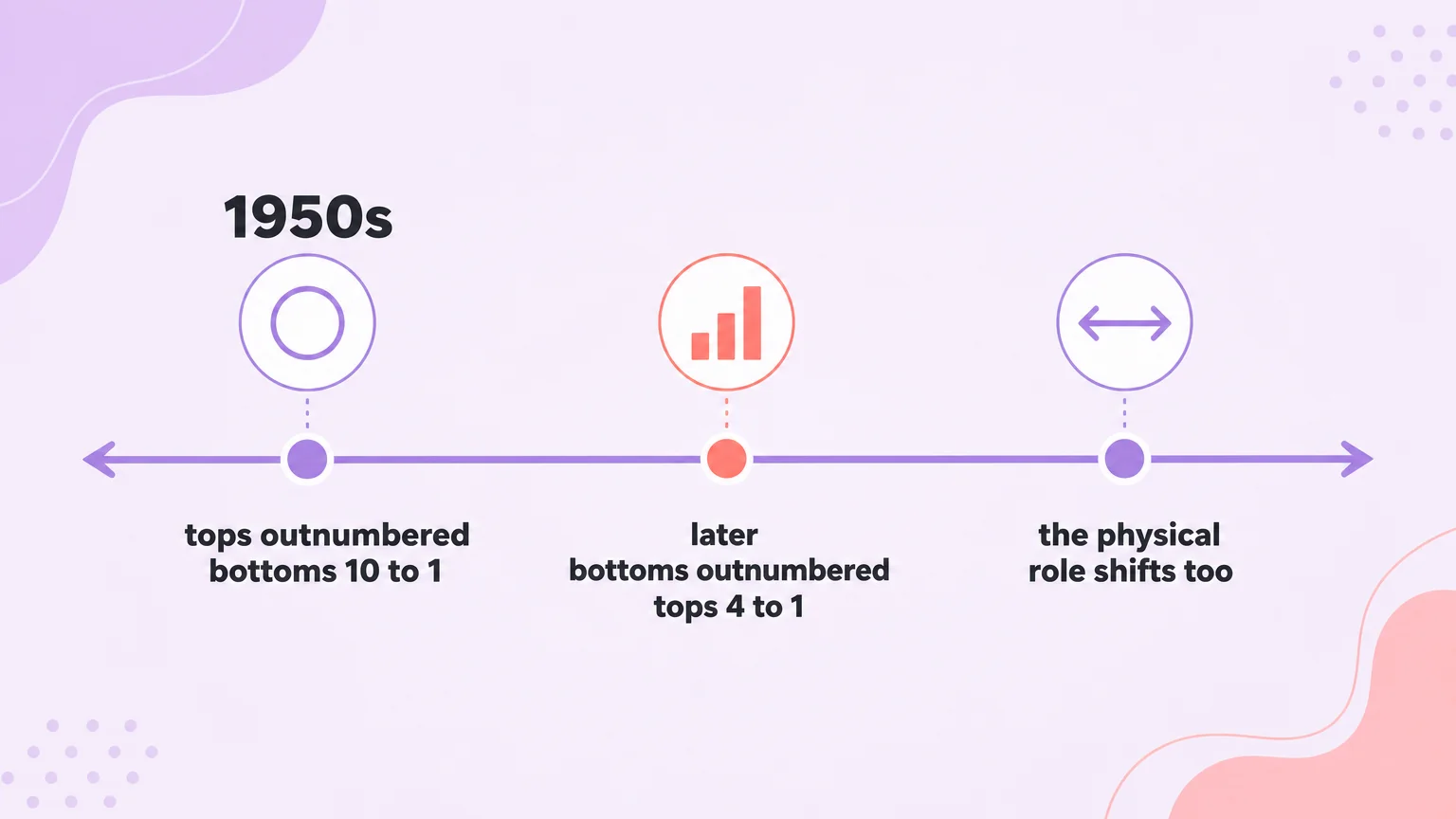
Third, fluidity as a fact. The historian David Stein documented that in the 1950s tops outnumbered bottoms ten to one, and later bottoms outnumbered tops by at least four to one. The numbers are not the point. Even the physical axis bends with culture, so nobody should treat their role as fixed.
Last, the line that matters. One trans femme reader, quoted in LELO’s piece on soft tops, dislikes the “masc association of topping” and argues soft top should apply to “anyone who has bottom energy but enjoys topping.” If that is you, the word is yours. It was never gated.
Submissive Top in a Threesome or an Open Relationship
Picture it. Your partner’s guest is in the room, you are the one on top, and halfway through you can see the third reading your position as authority. You do not correct it in time.
The friction is precise and nobody’s fault. In a threesome or a playdate, everyone reads bodies for status cues, because bodies are the only information available. Topping a third while being submissive to your own partner is a genuine misread risk. Say the structure out loud before anyone is in the room, not mid-scene, when correcting it would break the mood.
Research on non-monogamous power-exchange arrangements backs that up. When a dominant-submissive relationship is also non-monogamous, negotiation increases, because other partners have to be considered, and the top carries heightened responsibility. The research phrase is “with privilege comes responsibility.”
In plain language: the more people involved, the more the structure has to be said out loud. The same research documents the questions that arise, chastity arrangements among them, or a partner not wanting to be seen in “slave mode” in front of others.
If you are the third, this concerns you directly. You are a guest in their playground, not a toy in their toybox, and you deserve to know who is directing whom, with your own role stated plainly instead of inferred from who is on top. That is the green flag separating a good night from a bad story.
If you are the couple, your existing arrangements are part of the negotiation, not an obstacle. What each of you is comfortable witnessing, how each wants to be seen, and how a new person fits in are all answerable in advance.
Monogamous, open, polyamorous, or swinging, the question is identical. Who decides? Answer it before it matters.
Answering it is easier with people who already speak the language. That’s the argument for dating inside a community where intent and limits are normal conversation rather than a confession.
Service Outside the Bedroom: The Everyday Submissive Top
You probably recognized the pattern before the bedroom role. The everyday submissive top handles things, remembers what everyone needs, and takes real pleasure in making someone else’s day run smoothly. Competence offered as intimacy.
It stretches past penetration: a rope submissive ties a dominant, at that person’s direction. A fireplay top brings a specialized skill to curious people at an event. A professional dominatrix is functionally a paid service top: Ashley Paige, who works as one in New York, describes the job as putting the active partner in service of the client.
Then the driving. Taylor Ellwood usually drives because his partner wants him to, attention mostly on the road. Her phrase for it: he needs to be “the riverbank to my river,” flagging what needs her attention. Silent while she is stretched thin, he is not serving her.
Tell her she needs a nap and he has handed her information; what she does with it stays her call. What looks like the opposite of service is often the highest form of it.
Giving without reciprocal care turns attentiveness into depletion; burnout arrives when authority starts to feel like obligation. That writing is mostly about dominants, and it applies here. House Praxis treats service and self-preservation as in tension, not opposition.
Ellwood’s counterintuitive fix: staying silent about your own wants, he says, “is not a form of healthy submission at all,” because you are keeping needed information from the person leading you.
The sex worker Tilly Lawless put it in one line: “after being a submissive, sometimes all I crave is a hug.” Service is a gift, not a debt. It needs a return path.
How to Tell a Partner You’re a Submissive Top: Scripts and Scenes
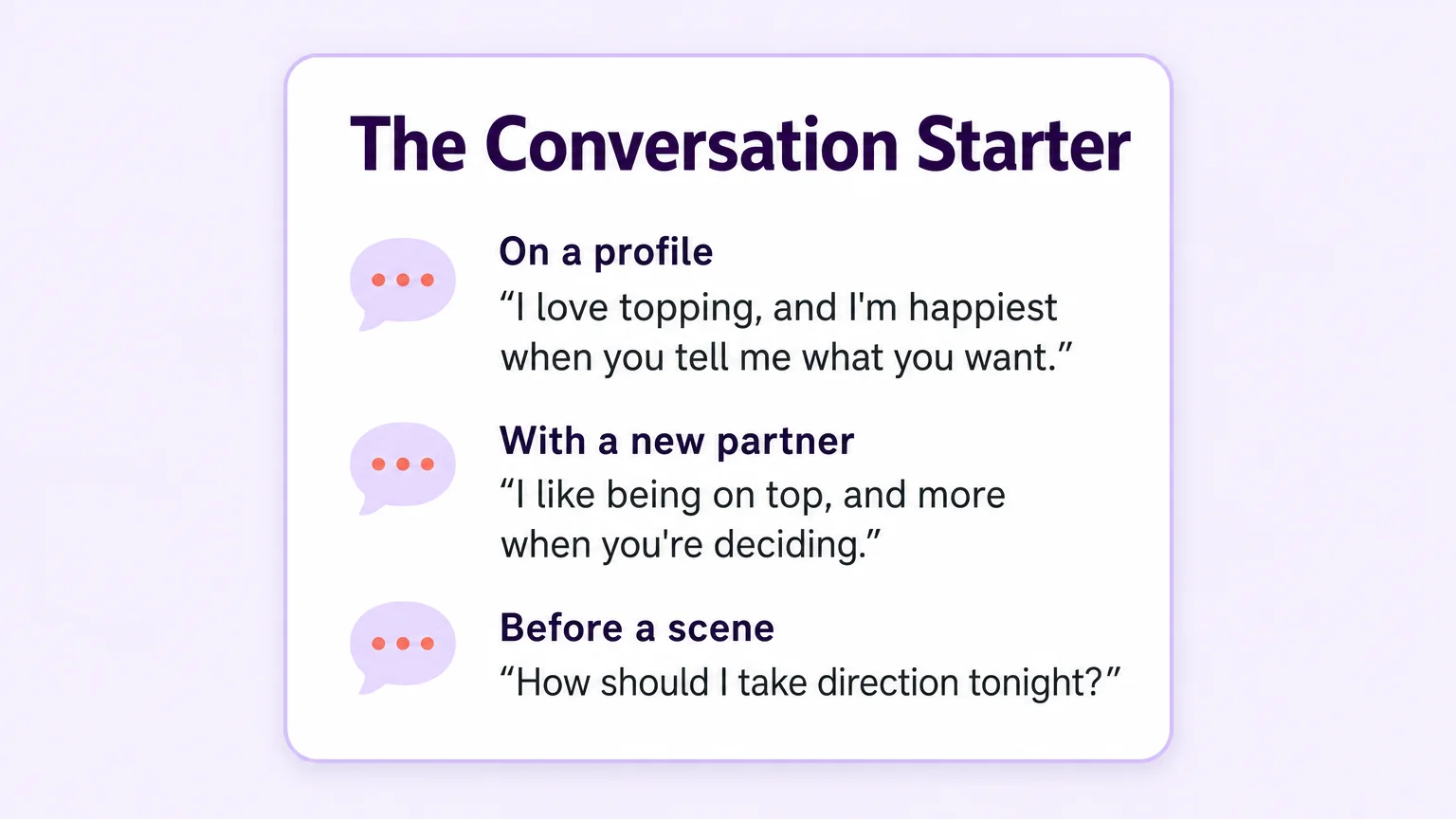
You are about to tell a partner and have no idea how to say it. Take the move first.
Two statements, not one label. State the physical role you want. Then, separately, state that you prefer your partner to lead. In that order it does not sound contradictory, and the order is the trick.
🛠️ The Conversation Starter
On a profile: “I love topping, and I’m happiest when you tell me what you want.”
With a new partner: “Can I ask about the power side of things? I like being on top, and more when you’re deciding.”
Before a scene: “How should I take direction tonight? Say it out loud, set me a target, or signal a change.”
On a profile, lead with what you enjoy rather than with jargon. “I love being told what you want” attracts people who already like the sound of it, so it filters for you. The label appears on profiles, so be ready to define it.
A profile is where that sentence does the most work. On 3Fun, the About us field invites you to state your intent, desires, and limits, so both statements have somewhere to live instead of competing for one bio line.
In a first conversation, ask their preference on the power axis directly. Cohen notes the power-dynamic spectrum is what people most often never discuss, which makes asking the intervention. Meet surprise by saying this is a documented role with a name. If you are non-monogamous, raise it early.
If your partner assumes topping means dominating, correct it with the two questions, not the label. Top or bottom is the physical role; dom or sub is who holds power. Use the power bottom as the mirror, and pre-empt the topping-from-the-bottom objection. If they want a term, offer service top.
Then the scene, where the order matters. Describe what you want to feel rather than naming a role. Set hard limits, soft limits, and a yes list explicitly, or work from a Yes/No/Maybe list.
Disclose health conditions, medications, allergies, and triggers beforehand, not during. Agree whether sex is included, how long the scene runs, and what the wrap-up signal is. Settle safewords in advance: green for all good, yellow to slow down and check in, red to stop. Inspect the equipment, keep safety shears within reach, and never leave anyone alone in bondage.
The step almost nobody negotiates is the whole apparatus. How will direction be given mid-scene? Does your partner give verbal instructions, set a target, or simply signal when to change?
Agree it before you start, because this is where a submissive top’s scene either works or quietly stalls. Yellow exists so a scene can be corrected without ending it.
Negotiation is adjustable and revocable, never settled once. A past yes never obligates a present body. Untamed Ember names the red flags: limits negotiated and then mocked, debriefs that turn into trials. Accountability, in his framing, is erotic.
Aftercare When the Person Topping Is the Submissive One

The scene was good. Then the top is the one crying the next morning, and nobody saw it coming.
In an aligned dynamic the active partner also holds authority, so care flows one direction. Here they are different people, splitting the drop profile.
Drop is not a warning sign. Intense scenes flood the body with adrenaline, dopamine, endorphins, and oxytocin; when the scene ends, those drop and cortisol can spike.
Top drop looks like guilt, self-doubt, low mood. Sub drop brings tearfulness, anxiety, sudden fatigue. Someone physically topping while psychologically surrendered can land in both. No source addresses that combination, so what follows is reasoned guidance built from those two documented profiles, not a cited protocol.
Physical care first: tend wounds, remove bondage, rehydrate, eat to restore blood sugar, add warmth. Do not open with “what do you need?” during drop, when clear thinking is unavailable. Move to touch instead, and take a blindfold off slowly rather than flooding the eyes with light. Offer contact rather than assuming it, since some want to be held and others need space first.
Reassure the top before they ask. “You trusted me, and I kept you safe.” “Everything you gave me was exactly what I wanted.” A submissive top may need to hear the direction they followed was wanted, and they are the last to ask.
Negotiate aftercare before the scene, and stay until your partner is awake and self-caring. Schedule a next-day check-in, since drop can arrive later, and one community report describes a drop lasting up to seven days.
There is no universal checklist. Drop is a body doing body things; the remedy is boring and tender.
Common Questions About Submissive Tops
Isn’t a submissive top a contradiction?
No. It only looks like one if you assume top and bottom describe what dom and sub describe. Top or bottom is the physical role. Dominant or submissive is who holds psychological power. Nobody calls a bossy bottom a contradiction.
Is a submissive top the same as a service top?
Largely yes in current usage, though the histories differ. The reference literature files the concept under service top and never uses the phrase submissive top. Midori’s grid maps the Submissive Top cell onto the Service Top. Overlapping terms include obedient top and soft top.
Can you be submissive if you are the one topping?
Yes. Medically reviewed guidance states that someone submissive can be on top, servicing a partner because they are skilled at something the dominant enjoys. The reviewer is Janet Brito, PhD, LCSW, CST-S, if you want clinical weight over community opinion.
How is that different from topping from the bottom?
The difference is awareness and honesty, not who is physically active. Topping from the bottom is covert control: steering through hints, resistance, or foot-dragging. Service topping is conscious participation in an agreed dynamic. The practitioner framing: the dominant stays in control of the container, even when an observer assumes the active partner is running things.
What is a soft top, and is it the same thing?
Sources disagree, which is worth flagging, not resolving. LELO defines a soft top as sexually dominant but otherwise gentle and nurturing. Pride in Self defines it as topping without strongly identifying with dominance. The reference literature calls it a colloquialism for a versatile top. For the submissive configuration, service top is less ambiguous.
How common is this, and am I unusual?
No source measures the crossed configuration directly, so any figure would be invented. What is known: neither axis is a clean binary, and in one large international sample 78 people held both a left-of-slash and a right-of-slash role without calling themselves switches. One person’s plain admission: “we are more rare.” Uncommon, documented, not anomalous.
Is this a gay thing?
The vocabulary originates largely in gay male sexual culture and still appears most among LGBTQ+ readers, but the configuration is not orientation-specific. Clinical and therapeutic writing discusses it across gay, bisexual, and straight contexts. Much misalignment among straight couples happens because the man defaults into the dominant role and the woman into the submissive one.
How do I put this on a dating profile?
State the physical role you want, then separately that you prefer your partner to lead. In that order it does not read as contradictory. Lead with what you enjoy rather than jargon, and be ready to define your terms. The scripts above are yours to borrow.