A sub is short for submissive: the partner in a consensual power-exchange dynamic who gives a degree of control to a dominant partner. The defining feature is not any one activity. It is negotiated, ongoing consent, freely given and revocable at any point.
The word does other work too. A sub is also a sandwich, a submarine, a substitute teacher, and a piece of audio equipment. None of those are what this page covers.
What it means to be submissive in a relationship is smaller and quieter than the culture around it suggests. It does not require a dungeon, a costume, or a total life overhaul. It starts with a conversation.
Below: what a sub is, how the vocabulary fits together, how consent works in practice, how to work out whether the word describes you, and how to raise it with a partner. The everyday adjective (meek, yielding, compliant) and the religious idea of the submissive wife get covered too, and both are different things from this one.
Sub, Bottom or Switch: Telling the Three Apart
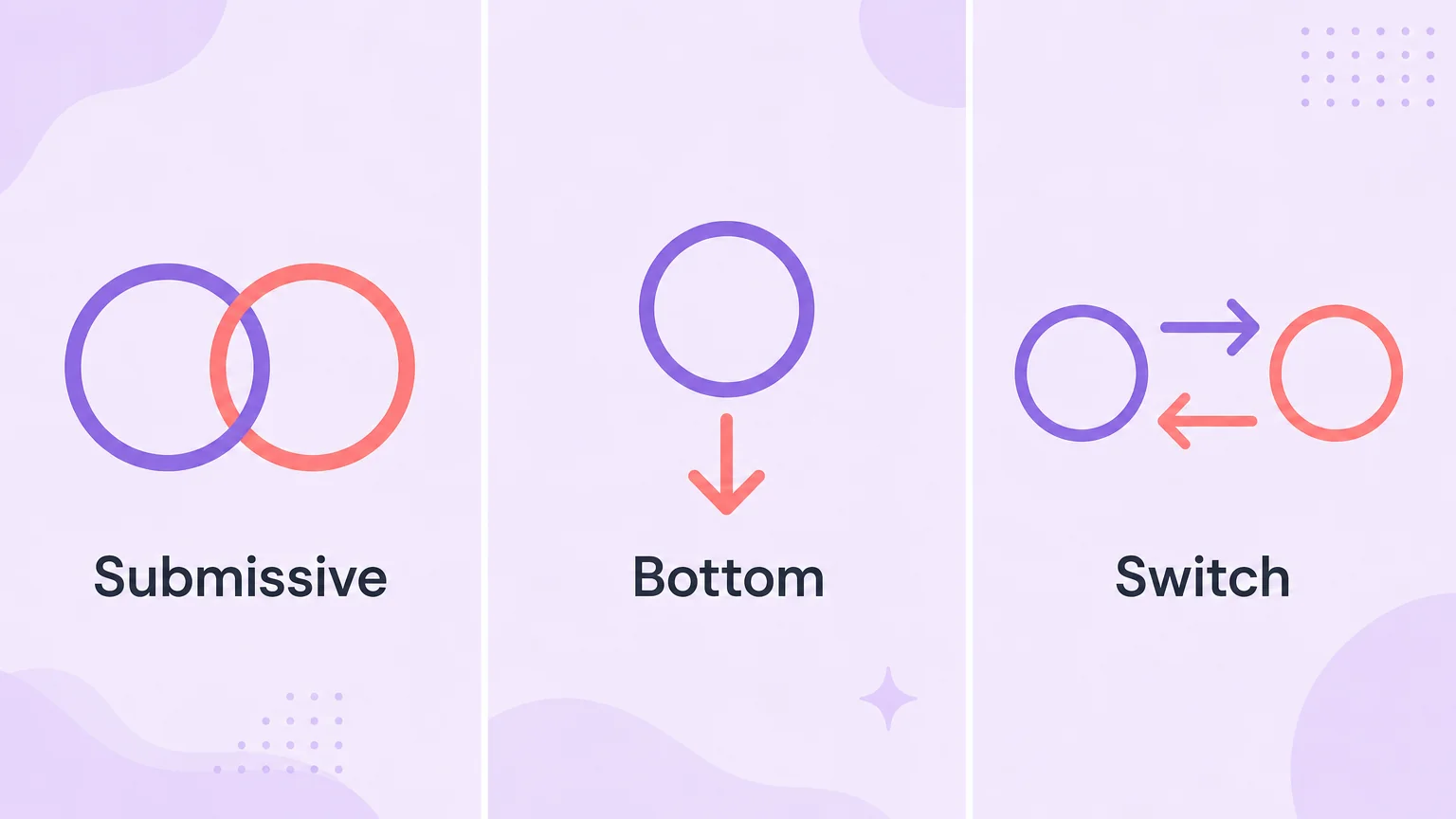
Ask six people to define these four words and you will get six answers. Two separate ideas got bundled under one set of labels.
Top and bottom describe physical position: who does the thing, and who receives it. Dominant and submissive describe psychological control: who holds authority. Those axes can point in opposite directions. A submissive can spend an entire encounter taking orders and receiving nothing physical at all. That crossed version has a name: a submissive top tops physically while submitting in the power exchange, and it is a documented role rather than a contradiction.
A bottom may or may not be submissive, because power exchange does not have to be part of anyone’s play. A switch moves between roles depending on the play, the partner, or the dynamic. Switch also goes by versatile, or vers.
Then there is the ordinary word. Submissive means meek, obedient, yielding, compliant, and it has been applied to children and to patients. That adjective is not a personality diagnosis, and it is not what this article means. It resurfaces in the myth section.
This vocabulary confuses people inside it too, which is why more precise labels like service top and power bottom were invented. Your confusion is not a gap in your intelligence.
Two axes, four words, and no rule that anyone sits neatly on either one.
Am I a Sub? How to Tell, and Why There Is No Test
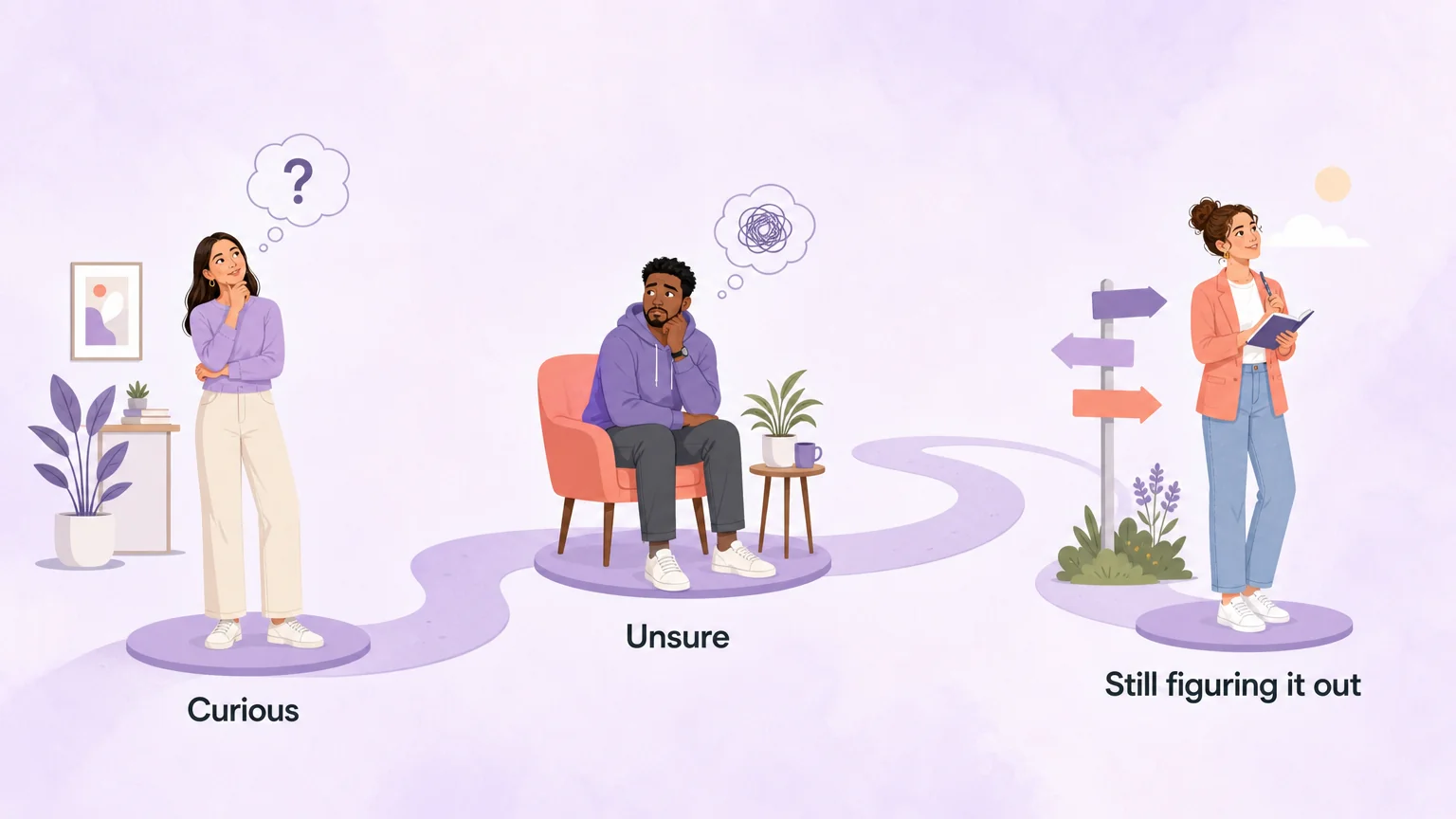
If you are reading this with a knot in your stomach, you are in the majority. The most common thing people bring to this subject is some version of “is this me,” and sitting with that question unanswered is genuinely uncomfortable.
There is no test. No checklist, no score, no moment that settles it. The guidance experienced people give is to understand who you are as a person before taking on any label, and to treat the label as something that moves. How submissive you feel can shift from one day to the next. Wondering is normal. It is not a failure to qualify.
There is also no single submissive personality. One person at a play party takes it quietly and says thank you after every stroke. Another swears at the top through the whole scene and then lies awake wondering whether she was the bad one. Both are legitimate. The brat, a submissive who deliberately pushes buttons to get a reaction, is described as being as in control as their dominant.
Submission behaves more like a skill set than a trait. The five that come up most: communication, emotional intelligence, service and task mastery, obedience, conflict resolution. Nobody starts with them. Being new is not the same as being bad at it.
One false disqualifier does the most damage: the idea that a real sub cannot have limits or a safeword. It is false, and The Doormat Myth below dismantles it.
So the useful question is not whether you are a sub. It is what you want, and how you want to feel while you get it.
Why People Choose Submission: What the Research Says

The people most drawn to submission are often the ones carrying the most authority everywhere else: lawyers, managers, police officers, soldiers. The pairing is counterintuitive until you hear how they describe it.
The most consistent explanation is relief from decision fatigue. Handing over control feels restful to someone who makes decisions all day, and it reads as empowering rather than diminishing, because it means acting on your own desires instead of denying them.
The clinical picture is de-pathologizing. The DSM-5 separates paraphilia from paraphilic disorder, and the disorder label requires non-consent or clinically significant distress. Studies report no difference between practitioners and non-practitioners in psychopathology, distress, sexual satisfaction, or relationship satisfaction.
The specific evidence is small but real. One experiment randomly assigned 14 experienced practitioners to top or bottom roles: BDSM activity tracked with lower stress and negative affect and higher sexual arousal, and for bottoms a transient hypofrontality state and some facets of flow (Ambler et al., 2017). A qualitative study of 19 practitioners reported wellbeing across personal, interpersonal, and sociocultural dimensions (Kim et al., 2025).
The counter-evidence deserves the same space. A study of 266 participants found dominant and switch groups appeared more sexually satisfied and less concerned about sexuality than the submissive group. A separate study of 163 practitioners, measuring relationship quality rather than sexual satisfaction, found no significant difference between dominants and submissives, with both groups scoring in the non-distressed range. A 2025 Bayesian study of 99 practitioners found submissive respondents higher on agreeableness, depression, hypersexuality, and sensation seeking. All three are correlational and small, and none shows that submission causes anything. Practitioners also still face stigma, which produces its own distress.
What the evidence supports is modest: for many people, submission is associated with less stress and more satisfaction, and it is not a marker of disorder. What it does not support is that submission makes anyone happier, healthier, or better off as a rule.
The Doormat Myth: What Submission Is Not
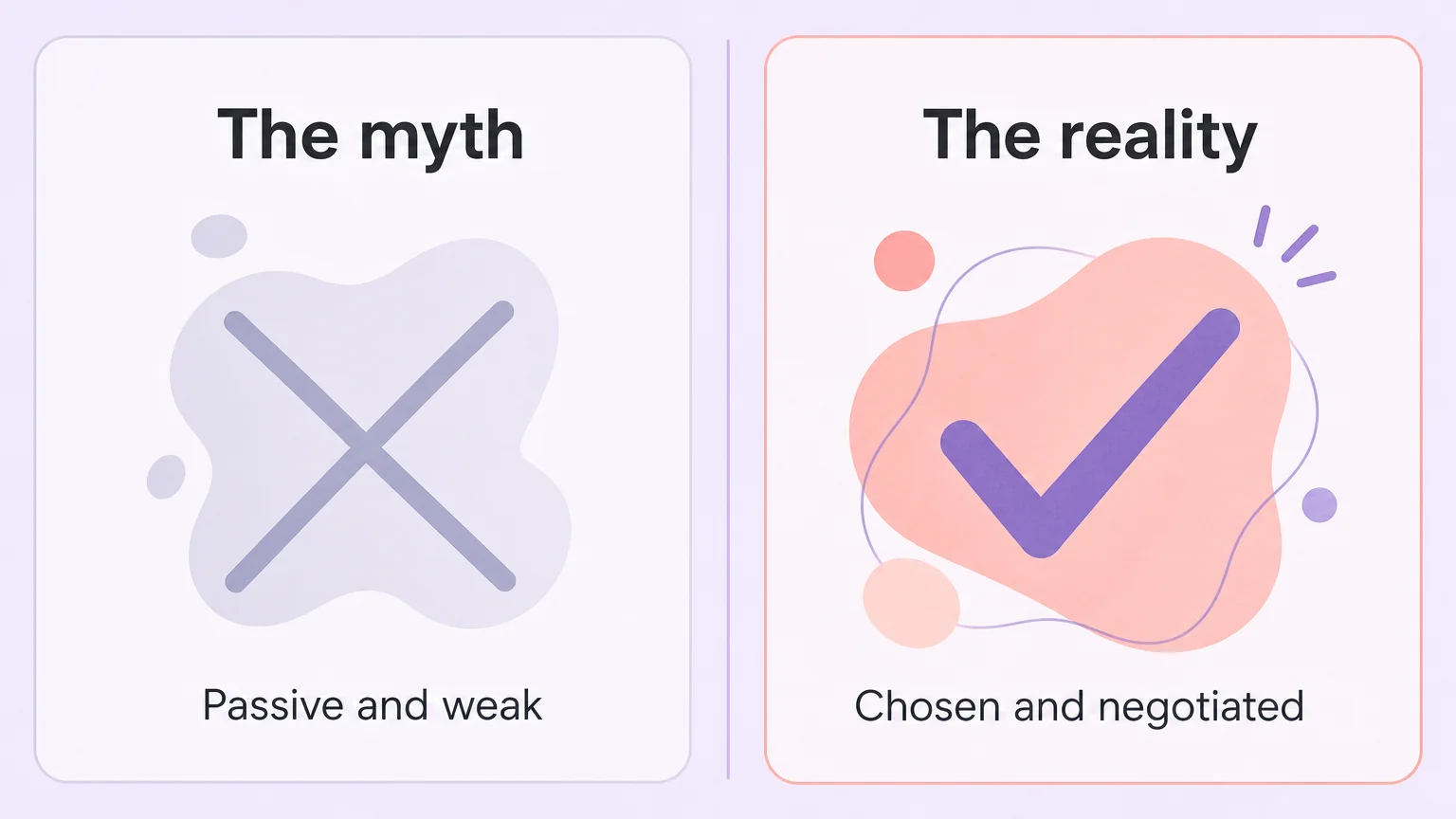
The baggage is in the word itself. In ordinary English, submissive means meek, passive, compliant, and it is currently used as an insult aimed at men. That is where the assumption comes from.
A submissive role is chosen and negotiated, not a personality deficiency. Play happens inside the sub’s limits, which is why one framing says the sub determines the rules of the game.
Does being submissive mean having no say? No. Being submissive does not mean not having free will. The sub sets the boundaries, agrees the limits, and holds the exit. The say is not reduced so much as relocated, from the moment to the negotiation.
Does it mean being passive or lazy? Also no. Both parties are actively participating. The brat is the clean counterexample, a submissive who pushes buttons on purpose and shapes the whole scene. The skills submission runs on are not passive ones.
The myth is dangerous, not just unfair. Believing that a good sub has no hard limits and no safeword produces people who cannot stop something they are not enjoying. A sub who never says no is a sub who does not know themselves yet, which is the practical cost of a story that sounds like romance.
The popular reassurance overshoots too. The line that the submissive is really the one in charge is itself an over-correction. Consent and desire coexist. A submissive does not lose agency by being chosen and pursued, and being chosen is often part of what is wanted.
One test applies to any dynamic you read about, watch, or consider: who set the limits, and can they still change them? If both answers are clear, it is a real dynamic. If either answer is missing, it is not.
Abuse or Kink? How to Tell the Difference
The difference is consent, and consent is not a feeling or a label. It is something specific and observable. If you are reading this section because something in your own situation worries you, it is written for you.
Start with the test. A submissive’s rights are not taken from them, they are given freely during a period of negotiation, and consent can be withdrawn at any point. The inverse is the one to memorize: if someone never agreed, or does not want it, or cannot leave, it is not this, whatever anyone calls it.
Warning signs show up as behaviors, not intensity. Breaking rules that were agreed. Ignoring a safeword. Tracking a partner’s location or messages without agreement. Controlling their money, possessions, or friendships. Each of those is the opposite of a consensual dynamic, not an extreme version of it.
Watch also for the exploitative dominant, someone more interested in wielding power than in a genuine dynamic, and for the pretender who uses the vocabulary without the practice.
The exit settles it. Consent is only genuinely available when leaving is genuinely available. That holds even in the most complete forms of power exchange, including Total Power Exchange, where consent, intimacy, and trust are what separate the relationship from abuse. The most extreme-sounding dynamics are judged by the same standard as the mildest, not exempted from it. A submissive needs the practical ability to leave, protection from harm, and the right to end it.
If you recognize your own situation here, this is not a kink problem. It is a safety problem, and it deserves the same response as any other one. Abuse wearing the vocabulary of submission is still abuse, a safeword being ignored is not a misunderstanding, and professional support exists. Agreeing to something does not hand over responsibility for it.
Bedroom-Only to 24/7: The Range of Submissive Dynamics
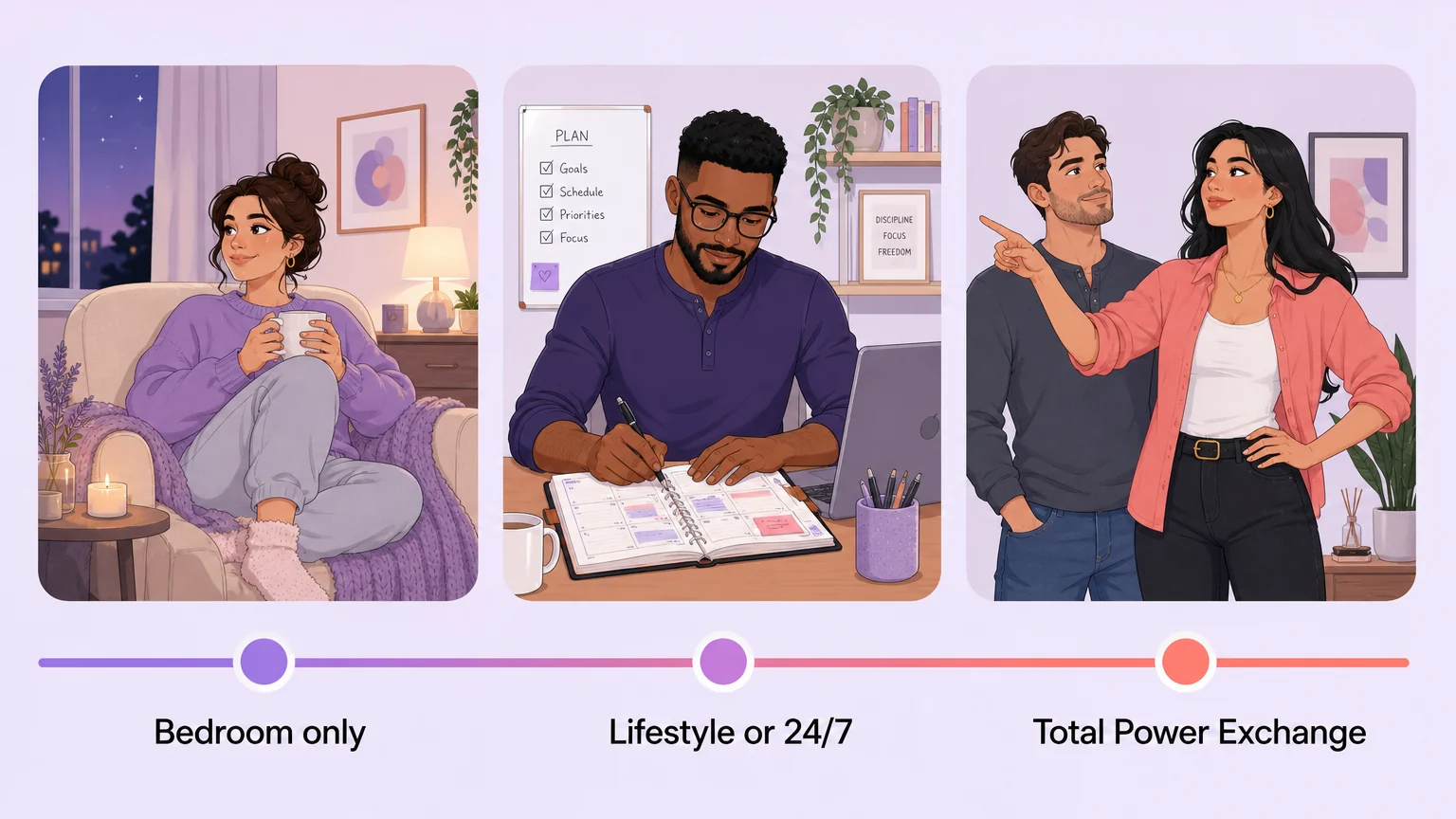
Most people picture one version of this dynamic. There are at least three structures, and none of them is the default.
Scene-based or bedroom-only dynamics keep power exchange inside agreed sessions. Lifestyle or 24/7 dynamics run it continuously. Total Power Exchange is the most complete form, where the sub’s life is submitted rather than a portion of it. Bedroom-only is the usual entry point, and choosing it does not make anyone less of a sub.
The submissive-versus-slave distinction is contested: there is no universal community definition. The clearest framing comes from one long-time practitioner rather than a consensus. A slave has no agency; a submissive enters the relationship consciously and submits with purposes of their own, such as growth. That is one voice on a term argued about rather than fixed.
On contracts: many dynamics use a written agreement documenting negotiated boundaries and limits, and it is explicitly not legally binding. Treat it as a communication tool.
Scope is negotiated too. A dynamic can extend beyond sex into household management, health decisions, finance, or personal appearance. Style varies as well: a pleasure dom runs control through giving, pacing, and withholding rather than through command. The receiving half of that style has a name of its own: a pleasure sub submits by being given to rather than commanded. Dominance has styles, and you are not choosing from a menu of one. Dominance has styles, and you are not choosing from a menu of one.
The variables surprise people: relationships can be monogamous or polyamorous, sexual or chaste, and one dominant may have more than one submissive. None are required, and none disqualify anyone.
It helps to know the shape of a first negotiated session: preparation and negotiation first, then the session itself, then aftercare that does not get skipped. Treat it as a framework, not a script to perform perfectly. Nerves beforehand are the normal starting state.
Which raises the question of what actually keeps all of that safe.
Negotiation, Limits and Safewords: How Consent Works in Practice
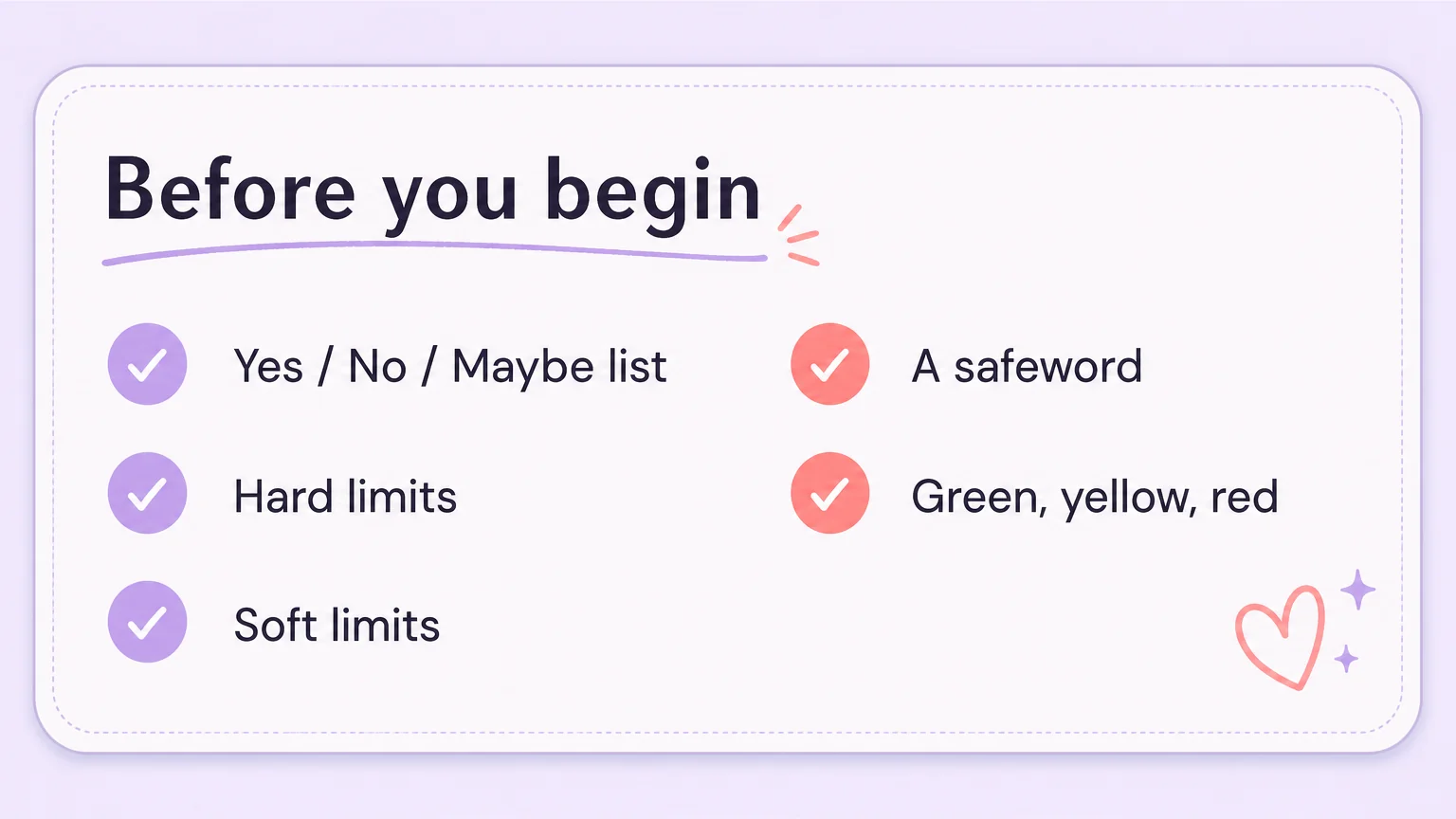
The mechanics take about five minutes to learn. They come down to a set of specific agreements made before anything happens.
Negotiation is a calm, equal conversation held before anything begins. It is the foundation, not the paperwork, and “do whatever you want” is explicitly not a green flag. The low-pressure entry point is the yes, no, maybe list, also called a limit list: each person writes down what they enjoy, what they do not, and what they are unsure about, then the lists are compared. The best negotiations are the simplest ones, and emotional tone matters more than a long catalogue of activities.
Consent is revocable at any time, including mid-scene. Asking to stop is not a breach of the agreement. It is the agreement working.
Limits come in two kinds and both belong in the conversation. Hard limits are non-negotiable and never crossed. Soft limits are negotiable, may be explored depending on context and comfort, and can be revisited: a hard limit is not up for discussion in the moment, a soft limit is a maybe that gets a conversation, not a push. Negotiating matters most with a new partner, but it does not stop mattering in a long one, because limits change.
Safewords exist for a practical reason: people say no and stop playfully during scenes, so those exact words become ambiguous precisely when clarity matters most. Pick a word outside normal play speech, and one the person will actually remember under pressure.
The most common convention is the traffic light system. Green means comfortable, continue or go further. Yellow means slow down or check in, reducing intensity without ending the scene. Red means stop immediately. Yellow is the most valuable: it allows correction without killing the scene, so a person is far more likely to use it than a word that ends everything. Agree what each color means to you specifically, and practice the safeword once before it is needed, so saying it does not feel like a failure.
Safewords work in both directions. Dominants should have one too, because they can also become physically or emotionally overwhelmed. It is not one person with an exit and one without, but two people holding one each.
When speech is not possible, agree a nonverbal signal in advance: dropping keys, tapping a thigh, clicking fingers, a specific hand squeeze. Someone who cannot speak cannot negotiate a new exit on the spot, which is why the signal is agreed beforehand. Any arrangement without an agreed way to stop is not a safe arrangement.
Finally, check in. Consent is an ongoing dialogue rather than a one-time yes, and a check-in can be as simple as a look or a single word. The same mechanic works outside kink, as a pause or reset word in any difficult conversation. These are not exotic rituals, just ordinary communication with better vocabulary.
What holds it together is agreements either person can check, change, or stop at any time, rather than mood or trust alone.
SSC, RACK and PRICK: Decoding the Safety Acronyms
SSC, RACK and PRICK turn up everywhere and are almost never explained.
SSC means Safe, Sane, Consensual, and it came first, from a New York gay S/M activists’ group in 1983. By 1987 it was a rallying cry in marches. Safe means working inside your skill level and minimizing harm. Sane means everyone is of sound mind, not intoxicated or impaired. Consensual means everything was negotiated beforehand and can be withdrawn at any time.
RACK means Risk-Aware Consensual Kink, and it arrived in the late 1990s. It shifted the aim from eliminating risk to managing it, since nothing is perfectly safe. Its originator, Gary Switch: if we want to limit this to what is safe, we cannot do anything more extreme than flogging somebody with a wet noodle.
PRICK means Personal Responsibility, Informed, Consensual Kink, and it added explicit individual accountability: each person owns their own decisions and consequences. It is the least widespread of the three. Critics worry it implies blame; its proponents mean shared rather than shifted responsibility.
The vocabulary is contested and keeps moving. Safe and sane are subjective, and critics note SSC can imply that people with mental illness cannot consent. Other frameworks exist: SSICK, the 4Cs, FRIES, CCC. Many people start with SSC and move to a RACK or PRICK mindset later.
Whatever initials someone uses, what matters is that consent is informed, ongoing, and revocable. Anyone using the acronym as a substitute for that conversation is using it wrong.
Subspace and Sub Drop: What Happens During and After a Scene
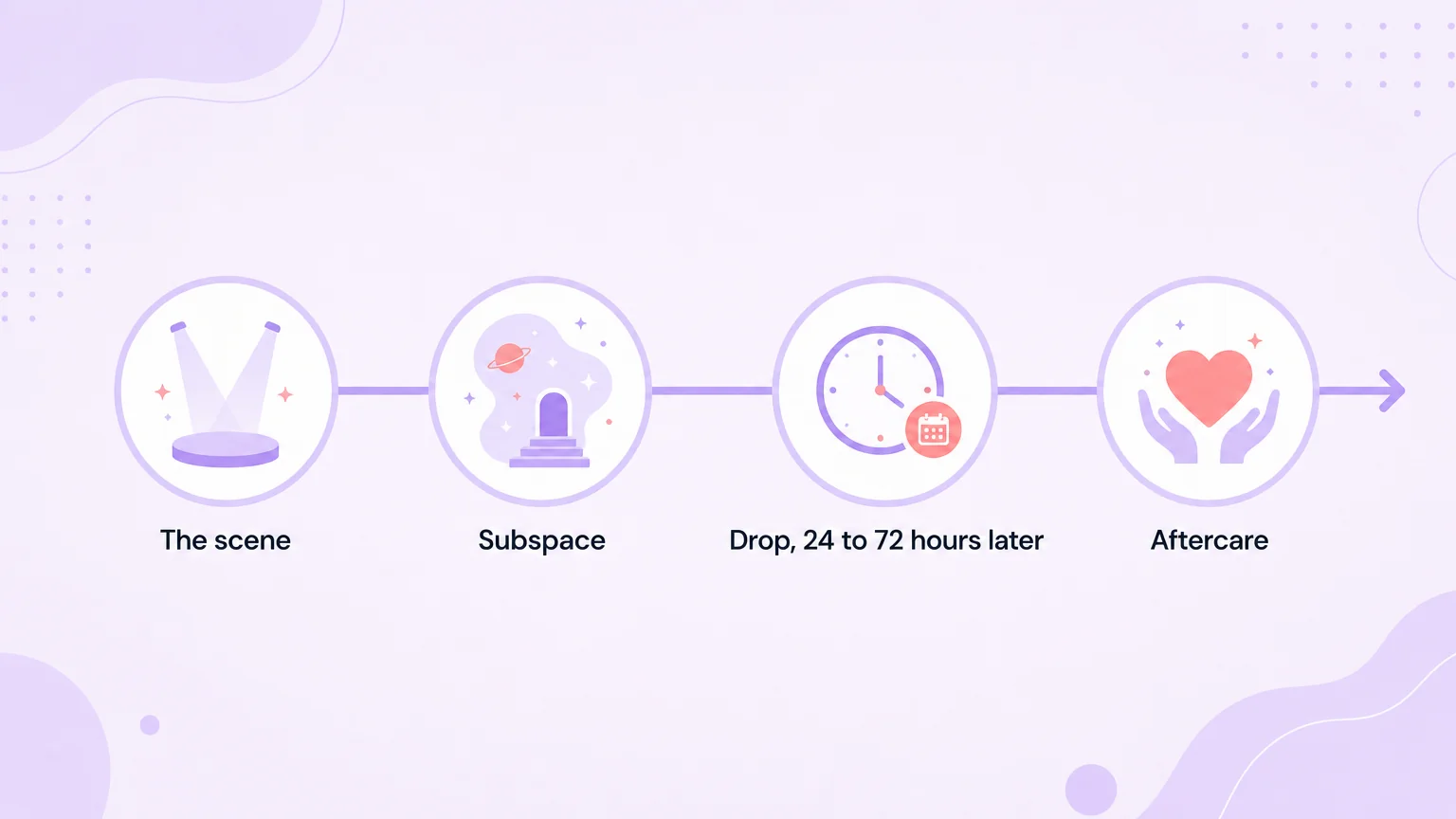
The hardest part of this experience usually arrives a day or two after it ends. That delay is the surprise, and it is chemistry rather than evidence that anything went wrong.
Subspace is a distinct altered state that some people reach through consensual play: euphoric, floaty, light, like being a little drunk without the spins. Thinking in full sentences stops and time distorts. A partner might notice increased pain tolerance, slowed or deep breathing, limp posture, distant eyes, delayed reactions, slurred speech, going nonverbal, or warm flushing.
It comes from a neurochemical cascade: endorphins, dopamine, adrenaline, oxytocin, and cortisol, followed by a parasympathetic rebound. There is no large, repeatable body of research on subspace, only reported experience and adjacent work on pain and stress response: enough to describe it, not enough to be certain.
What if it never happens to you? Subspace does not happen for everyone, and experienced practitioners have deeply fulfilling scenes without entering it. Treating it as the pinnacle sets newcomers up to feel like failures. Stop worrying about it.
One distinction is safety-critical. Subspace is not dissociation. Subspace is consensual, negotiated, and typically blissful, with the body relaxed and trust present. Dissociation is detachment from your whole being, including the ability to feel, and looks like rigidity and a vacant expression rather than blissful limpness. One is a goal; the other is a stop signal.
One rule does not bend: consent is impaired in subspace. You cannot meaningfully consent while in it, any more than you can while high or drunk, because judgment and communication are both affected. Never negotiate a scene while someone is in subspace. Wait until they are back.
Drop is the crash afterwards, caused by adrenaline and endorphin levels spiking and then falling. It usually sets in within 24 to 72 hours, sometimes later. Symptoms resemble depression: fatigue, difficulty concentrating, guilt or worthlessness, hopelessness, sleep and appetite changes, irritability, aches, and persistent sadness.
Drop is a predictable physiological response, not evidence that something went wrong. It varies enormously between people and between scenes, so escaping it once is not proof you always will. It happens to dominants too, which is why many educators say drop rather than sub drop: top drop shows up as guilt, self-doubt, or low mood. If it has not cleared within seven days, seek professional help.
Aftercare is how you manage it, and it is not one fixed script. Water, warmth, food, touch, a check-in, or space. Rehydrating and eating matter because body temperature and blood sugar both drop. During drop an open “what do you need” can be hard to answer, so concrete offers work better than questions. For the partner, the scene is not over until aftercare has happened, and reassurance such as “you were incredible” or “I kept you safe” beats an open question. A gradual build-up, a gradual decline, and generous aftercare make drop far less likely; frequent play without proper care intensifies it.
None of this is a reason to be afraid of drop. It is a reason to plan for it, the same way you plan for the day after a long flight.
Male Subs and the Myth That Submission Is Feminine
Yes, men can be submissive, and submission is not gendered. That sentence should not need qualifying, and the fact that it does is the whole problem this section is about.
Both genders take both roles, and there are many male subs. It is one of the least controversial statements available, which is exactly why the hesitation around saying it plainly is itself the issue.
The double standard deserves a name. Submissive men get treated as a punchline in a way submissive women do not, and the word is used as an insult about men in general, divorced from kink entirely.
The available material has real limits, and naming them is better than smoothing them over. One educator who made a video for cis straight male submissives says she sticks to cis men because she does not feel equipped to generalize about trans men’s or gay men’s experiences. That scarcity is a gap in the material, not a fact about who practices this.
The stereotype has a root: the same misreading the doormat section addresses. Submission gets conflated with weakness, and weakness with femininity, so a submissive man is read as a passive man. He is not. He chose a role in a negotiated dynamic, which is a decision, not a deficiency.
If you are a man reading this and wondering whether any of it applies to you: it does, you are not the exception, and you are not the joke.
Shame, Support and Telling a Partner

For many people the difficulty is not the desire. It is the shame attached to it. Kink-affirming therapists see it constantly: people raised on messages that their interests are unhealthy or shameful, carrying real distress about desires that harm nobody. Locate the problem in the shame, not in the person.
Does submission help with past trauma? For some people, consensual power exchange and role-play offer a structured way to work through difficult material and reclaim a sense of control. Two guardrails: this is not a claim that submission generally stems from trauma, and it is not a substitute for therapy.
Support exists and it is specific. A kink-affirming therapist treats consensual kink as valid rather than symptomatic, helps with guilt, shame, and anxiety about preferences, and builds fluency around consent, negotiation, boundaries, and aftercare. Nothing is guaranteed, but it is worth trying, and peer communities count too.
Then there is the conversation with the person who matters.
Do the groundwork first. Know what you want, and separate service, surrender, and obedience, and something sexual only from something wider. A partner who has to fill the gap will fill it with their fears. Examine your motive too: genuine desire and wanting relief from carrying too much are different things, and a dynamic entered purely for relief creates more problems than it solves.
Choose the moment. A connected, relaxed one, never mid-argument and never when either of you is exhausted. Lead with desire rather than a list of complaints: “I’ve been thinking about something I want to explore with you.” Frame it as play, talk about how you want to feel rather than specific acts, and skip the jargon. Start small.
Leave real space for a no. Guilt turns curiosity into resistance. They may need time to digest it, they may not be into it, and an initial reaction is not a verdict. Keep the conversation going, folding limits, safewords, and aftercare in as it continues rather than as a package.
If you would rather start somewhere lower-stakes, 3Fun is a place where people are already open about this, which makes the first honest sentence easier to say.
Take your time with all of it. There is no deadline on telling the truth about what you want.
Kink Submission vs Religious Submission: Different Things, Same Word
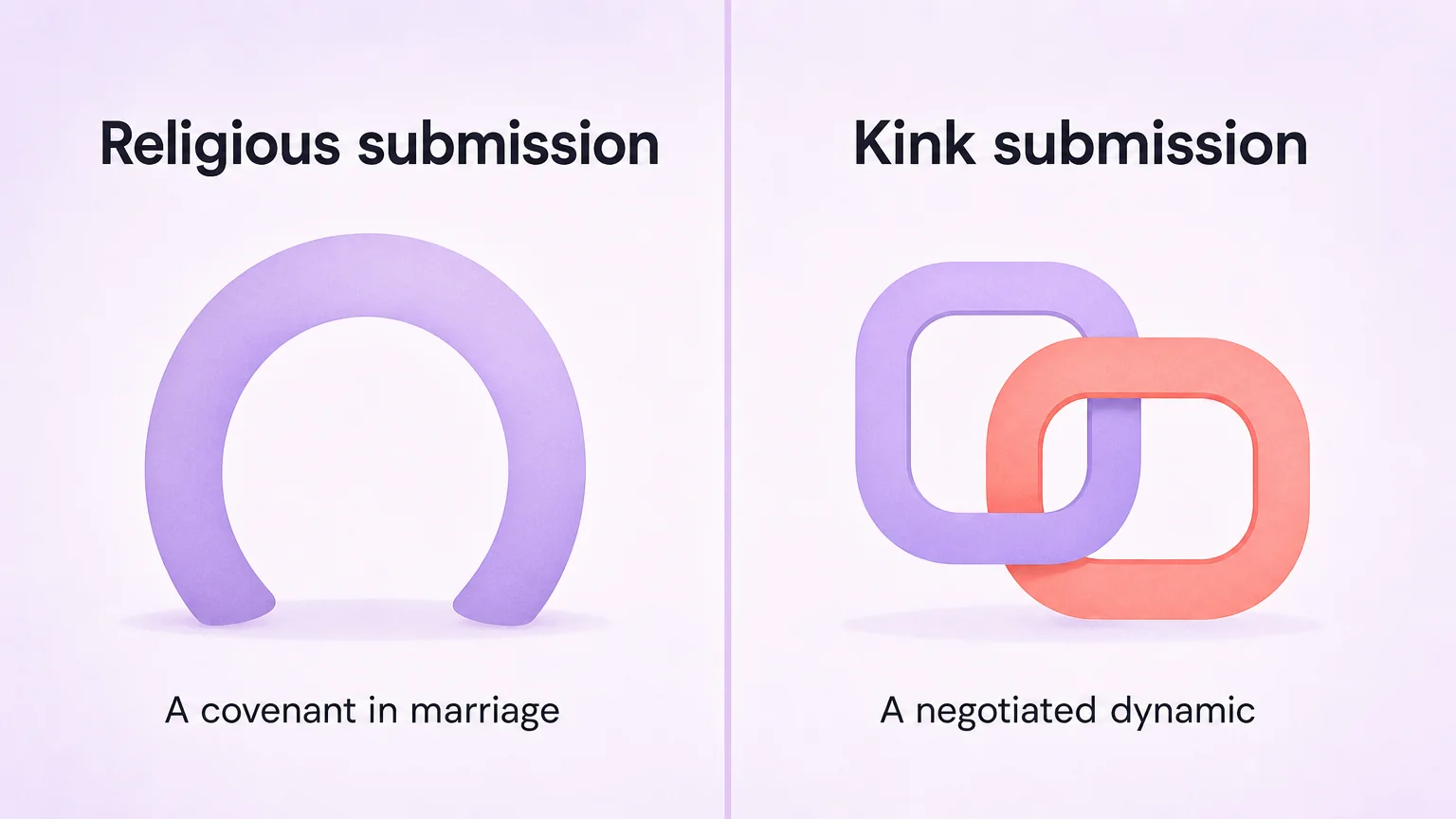
The same word carries a second meaning with nothing to do with kink, and knowing which one someone means saves a lot of confusion.
The traditional religious account frames submission as set inside marriage as a permanent covenant, described by its own teachers as voluntary rather than imposed. One formulation captures it: this kind of submission enlists an all-volunteer force, there is no draft, and husbands are never instructed to make their wives submit. Its teachers distinguish it from abuse explicitly. That is what the tradition holds, reported rather than endorsed.
Consensual kink submission is a negotiated power exchange. It does not require marriage, it can be limited to agreed sessions or run continuously, and it is built around limits, safewords, and aftercare. The cleanest contrast is covenant versus contract: one permanent, one terminable.
Neither grew out of the other, neither is the older or truer meaning, and neither improves on the other. A third usage exists too: the everyday sense of meek and compliant, which describes no one’s identity.
So: religious submission is a covenant inside a marriage. Kink submission is a negotiated, revocable dynamic between consenting adults. Everything else on this page is about the second one.
Frequently Asked Questions About Being a Sub
What does “sub” actually mean?
In kink, a sub is someone who consents to hand over a measure of control to a dominant partner. Consent is the whole definition: agreed in advance, specific, and withdrawable by either person at any moment. No particular activity, outfit, or personality is required.
Why would anyone want to give up control?
The most common answer is rest. People who make decisions all day often find handing that over restorative. Others find it connects to how they show affection, to the taboo itself, or to enjoying the other side of a role. For many, it feels like acting on a desire rather than suppressing one.
Is being submissive the same as being weak?
No. The role is chosen and negotiated, not assigned, and people who hold authority all day are among those most drawn to it. The confusion comes from the everyday English word, which means meek or compliant and has nothing to do with this. Submissives aren’t weak. The word gets used as an insult often enough that people start believing it.
Does being submissive mean I have no say?
No. Free will does not go anywhere. The person submitting sets the limits, agrees what is allowed, and keeps the power to end it, which is why the say is better described as relocated than reduced. It moves from the moment to the negotiation, and it comes back the instant anyone asks.
Do I have to be in a 24/7 dynamic to be a sub?
No, and most people are not. The smallest version confines the exchange to sessions agreed in advance, and that is where most people start. Others prefer it running all the time, and the most complete version is called Total Power Exchange. Choosing the narrowest option does not make you any less of a sub.
Do I have to sign a contract?
No. Nothing about this requires paperwork, and any agreement people do write down carries no legal weight. Some find a written list useful as a memory aid and a conversation starter, which is all it is. Anyone telling you a contract is binding has misunderstood what it is.
Do I need a safeword if I can just say stop?
Yes. People say stop playfully mid-scene, which makes the word unreliable exactly when you need certainty. Pick something that would never come up otherwise, agree it in advance, and say it once out loud before you need it. Dominants need one too, and if speech is impossible, agree a physical signal.
How do I start if I’m brand new?
Slowly, and in small steps. Write down what interests you and what does not, as a yes, no, maybe list. Talk it through with a partner before anything happens, agree a safeword, and decide in advance what you will both need afterwards. Keep the first attempt small and low-stakes.
Is there a “right” way to be submissive?
No. There is no script and no single personality that fits. One person is quiet and grateful throughout; another is loud, profane, and pushing back on purpose. Both are legitimate. The standard experienced people use is authenticity rather than conformity, and how submissive you feel can change from one month to the next.
Is subspace the same as dissociating?
No, and confusing the two is dangerous. Subspace is a negotiated, consensual high: the body goes soft, trust is intact, and the person is still in a good place. Dissociation is a shutdown, marked by stiffness and a blank stare, and it means stop. If you cannot tell which one you are looking at, stop and ask.
Are only women submissive?
No. Men submit in large numbers, and both genders occupy both roles. The impression otherwise comes from who tends to write about it, not who practices it, and that imbalance is a gap in the material rather than a fact about the people. However the desire shows up in you, it is not the problem.