
Ask what a service submissive is and you will get a tidy answer: a submissive who does the housework.
Ask someone who lives it and you will get something else. Someone whose sense of being whole comes from being needed.
Both describe the same person. Only one explains why anyone would want it.
Service-oriented submission is the performance of personal tasks for a dominant partner as part of a submissive role. A dominant holds authority; a submissive yields it.
That definition is the smallest part of this article.
One qualifier matters more than the definition. Service sits on a spectrum of submissive behaviors, and not every submissive is service-oriented. You might put service at the center of everything you do, or treat it as one role inside one dynamic, the ongoing arrangement between you and a partner.
Most people reading this want to know whether something they have felt for a long time has a name.
The rest of this piece answers the four questions a one-line definition cannot. Why a task can produce an entire internal state. How far the role stretches from a single evening to full time. What happens when service goes unacknowledged or the dynamic pauses. And where devotion stops and unpaid labor begins.
Service Submission, Defined Past the Chore List
In a survey of more than 11,000 couples, 84 percent of submissives said yes to service. About one in five said maybe.
Then the detail that undoes the stereotype. Chores drew 59 percent of submissives and 51 percent of dominants. Massage and bodywork drew roughly 85 and 89 percent. Even among the people who practice it, service is not primarily housework. Treat that survey as a signal rather than a census.
Service can be servile or dignified. Formality is a style choice inside the act, not a property of it. A bootblack working leather and a partner who makes coffee a particular way are the same category of thing.
There is a sharper definition, and it moves the emphasis from task to manner. Service is as much how you show up as what you do, and at bottom it is about contributing to your dynamic in a meaningful way. That contribution travels through three channels. Acts of care: running a home, cooking, daily tasks. Rituals and protocol: the repeated behaviors that reinforce structure. Emotional service: comfort, presence, and anticipating a need before it is voiced.
Now what service is not, because most of the confusion lives here.
Not necessarily sexual. Service usually happens outside play, a defined occasion for kink activity rather than everyday life. It can be eroticized without becoming sexual: wearing a collar during a chore, dressing a specific way, or a consequence attached to an unfinished list.
Not chores. The task is the surface. The meaning is the point.
Not a fixed duty list, and not a personality trait you either have or lack. What matters is what the practice does for you.
Service submission is what you do when being needed produces something in you. The only qualification that matters is whether the giving is genuinely yours to give.
Why the Tasks Work: The Core Kink Underneath the Chores
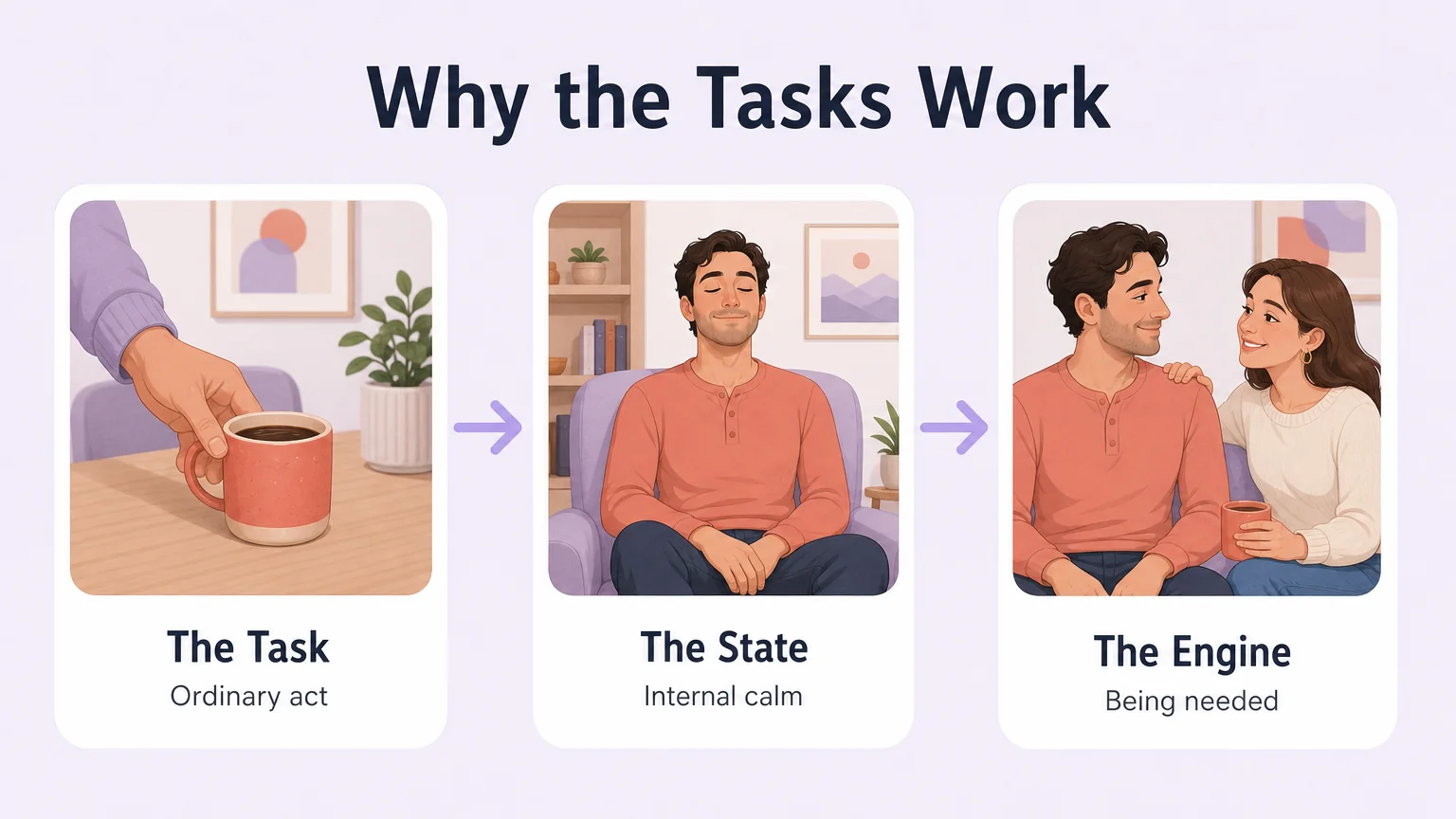
Wiping a counter or making a drink in a particular order should be unremarkable. For some people it produces an entire internal state: calm, focus, a sense of rightness that outlasts the task by hours.
The task is not the point. The state the task produces is.
Your core kink, a concept credited to educator Princess Callie and popularized by Evie Lupine, is the specific feeling you and your partners are seeking to achieve through play. The common core kinks are a set to match yourself against, not a diagnosis: loss of control, feeling small, being cherished, feeling worthless, devotion, feeling powerful, feeling transgressive, self-expression. More than one can be true at once.
Service acts work as a vocabulary. Coffee becomes a statement of anticipatory care. Polished boots become an act of reverence. The behavior stays ordinary and the meaning changes, which is why the state gets described as blissful egolessness or an erotic flow. They are not doing the task to feel something. The task is how they say something.
One thing here protects you. This is not selflessness. Service submissives require an energy exchange to feel fulfilled, and they are not turned on by doing tasks for anyone who asks. That is the difference between a service submissive and free labor, and it is exactly what exploitation depends on you forgetting. Getting nothing back is depletion rather than devotion, and noticing it is not a character flaw.
Finding what you get out of it
Start with raw material: your fantasies, and the moments that felt genuinely good rather than the ones that merely looked good on paper. For each, ask how you felt, what the dynamic was, how you felt about your partner, and what was going on around you. Then look across them for a common thread instead of treating each as a one-off.
Language helps. Use a feelings wheel or a values list and go as granular as you can. If the feeling is afraid, work out whether it is helpless-afraid or frightened-afraid, and keep asking until there is no more.
One worked example. Evie Lupine’s own answer was circlusion, the act of surrounding rather than being acted upon. Specific, a little unglamorous, clearly personal. That is what you are aiming for, not a tidy answer.
Then apply it. Beneath the surface framing of being helpful, what are you getting from serving? Naming it is what lets you ask for what you need instead of merely being acted upon. Doing something solely for another person’s needs is not sustainable unless selfless giving is genuinely part of your core kink.
What Service Actually Looks Like: Nine Categories, and the One That Defines It
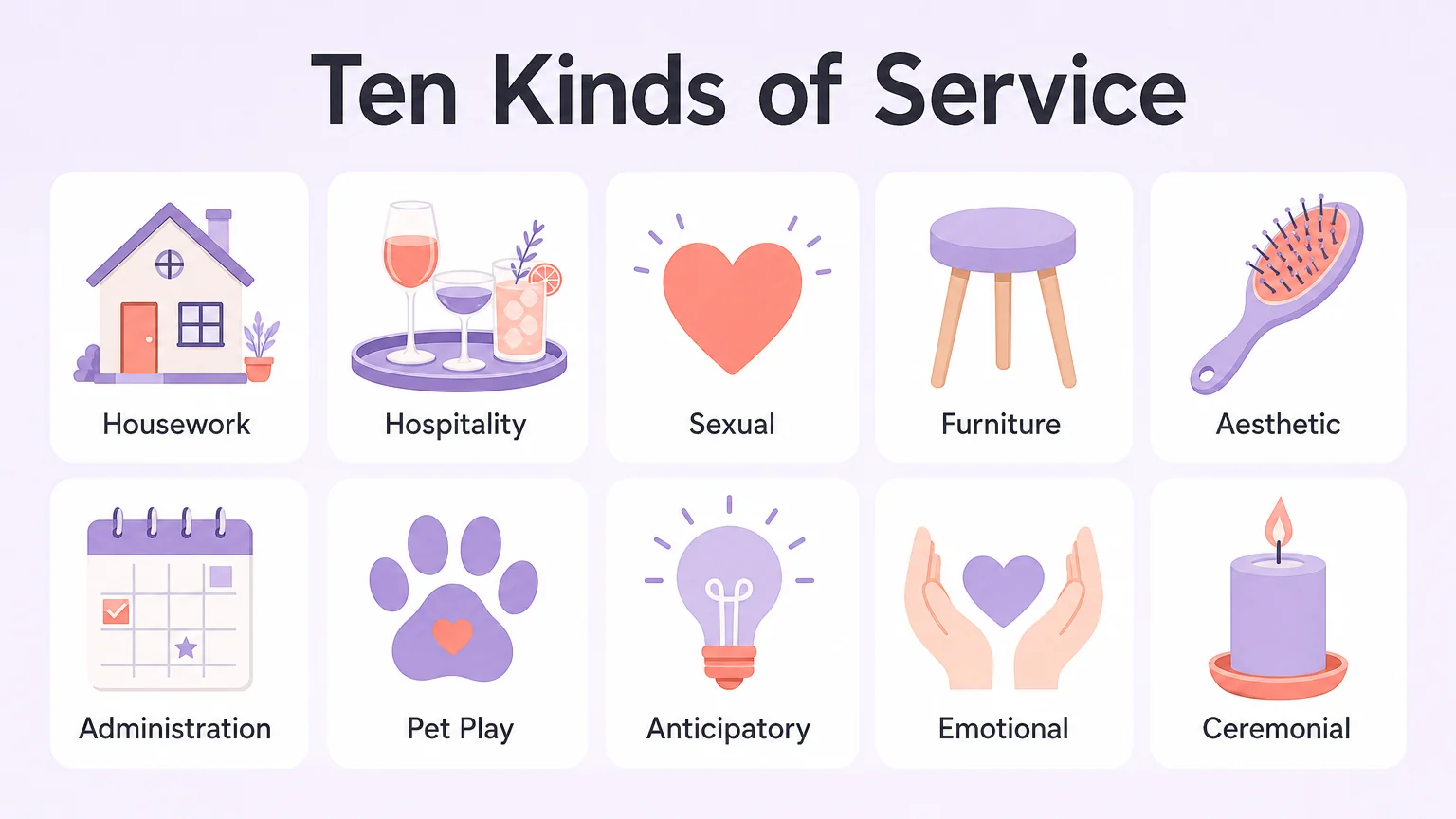
Service is not one thing, and most confusion comes from only ever being shown the domestic version.
The established map has seven entries. Housework and domestic tasks. Hospitality, meaning food and drink. Sexual service. Human furniture, where service is offered through the body rather than a task. Aesthetic and pampering service, such as helping someone dress, drawing a bath, massage or foot rubs. Administration, meaning schedules, correspondence and logistics. And pet play.
Three more belong on the map, and they are the interesting ones. Anticipatory service means noticing a need before it is spoken. Emotional service means holding space, presence and reassurance. Ceremonial service means turning a routine into ritual. Community service by proxy, through teaching or mentoring, counts too, as do the historical roles, above all bootblacking, the care of boots and leather.
Make it concrete. One long-time submissive tracked exactly when her partner drinks coffee: on waking, with lunch, mid-afternoon, sometimes early evening. Those became the moments she offered.
Anticipatory service is what separates an orientation from a to-do list, and it is learned by attention rather than intuition. Which brings the most common misunderstanding. Anticipation is not mind-reading. A partner who expects to be anticipated without ever stating a preference has handed you an impossible job, and being asked to guess is not a more advanced form of service. It is a missing conversation. Documented preferences are the raw material anticipation runs on, so the fix is information rather than effort.
Service shaped around a partner’s practical limits rather than their convenience, as with chronic pain or low mobility, gets chosen because they physically cannot do it, which reframes the dynamic from indulgence to provision.
Two more points. Service can also carry identity exploration, including the mid-century domestic fantasy people are drawn to because the frame lets them hold the role without the baggage, and men and trans people exploring a feminine presentation through it. And protocol can be an accessibility feature rather than a control flourish, because codified rules and scripts prevent assumption and boundary-crossing, which makes structure more workable for anxious and neurodivergent people than ambiguity is.
If you have no partner in this yet, two routes need no dominant. Serve a room rather than a person: topping off water and serving drinks or food at an event is genuine practice with no dynamic attached. Or run it self-directed, as a routine maintained for its own sake. As a couple without a formal framework, add intention to something you already do, one thing at a time. Do not open with a protocol you will not sustain.
Finding someone who already understands this is the real bottleneck, and it is worth being deliberate about. On 3Fun, couples and open-minded singles say what they want up front, which removes most of the guesswork.
Service Sub vs Pleasure Sub, Slave, and Pet: Same Acts, Different Engine
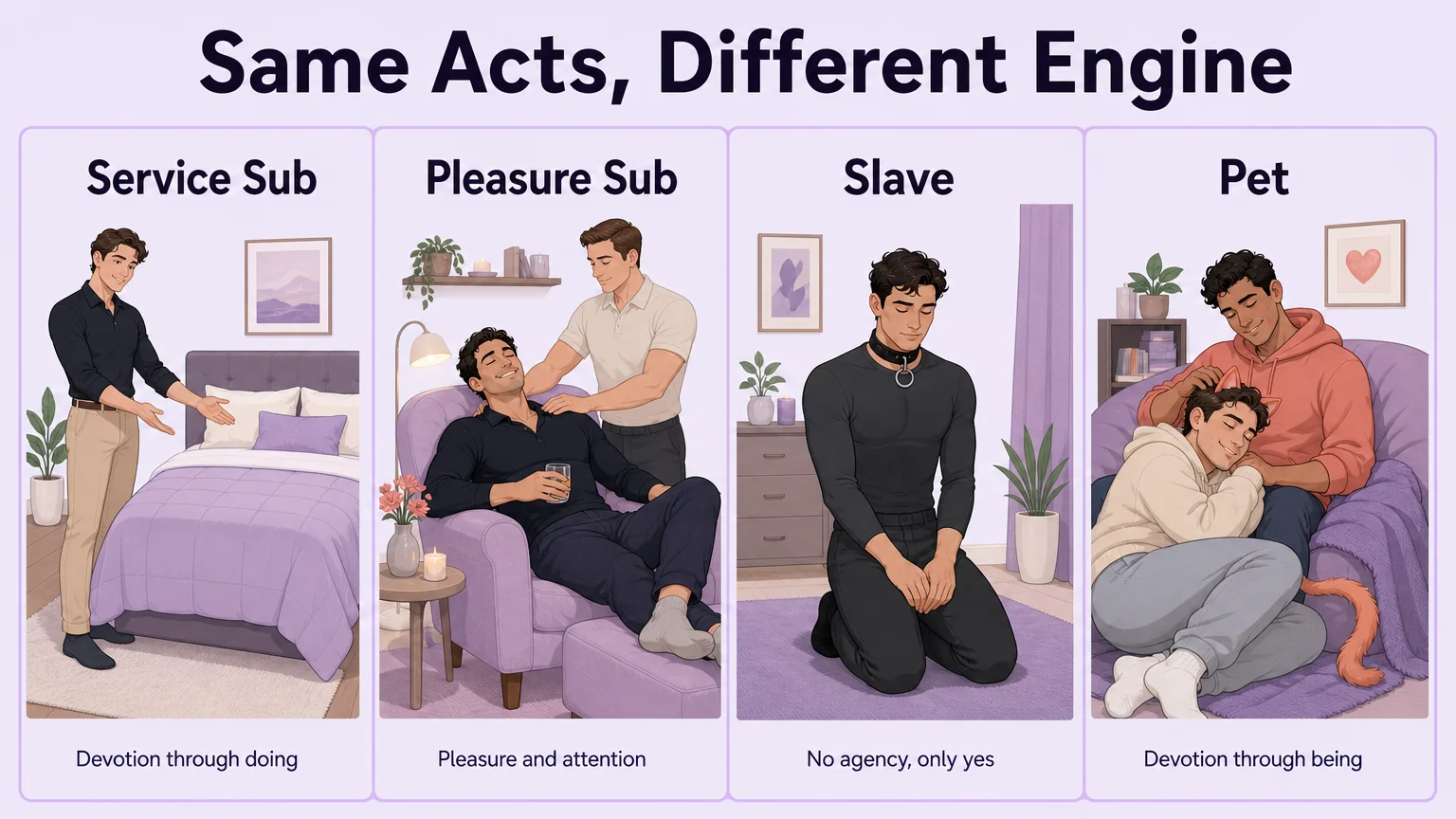
The same act can appear under several names, and the name follows what the person is looking for in the exchange rather than what happens physically. So ask what you are after, not what you do.
These are descriptions, not departments, and nobody checks your membership. The vocabulary earns its place because naming the engine is how you ask for the right thing.
Pleasure sub. Oriented around receiving pleasure and attention, with authority exercised over that pleasure. The acts overlap heavily with service, which is where the confusion starts, but the direction of the payoff is reversed. The diagnostic that settles it: what do you want out of the exchange? Attention, friction, a task, a sensation, or simply to be directed? For a pleasure sub, gentleness or intensity are settings rather than the definition, so tone tells you nothing.
Slave. The line is agency and purpose, not severity. A slave has no agency and simply says yes, whereas a submissive goes into the relationship consciously and submits consciously, for the purpose of growth and well-being and of obtaining goals. The same visible behavior sits on either side of that line depending on whether it is for you or only for them. That is one practitioner’s working definition, not a settled standard.
Pet. Devotion expressed through being rather than doing. A service submissive feels it by producing an outcome; a pet feels it by occupying a role. Same devotion, different verb.
On the dominant side of this, watch for the failure signature that educator Ms. Elle X names: the person who has become emotionally dependent on a partner’s pleasure to feel successful. They stop observing and start performing. They stop pacing and start rushing. They stop leading and start reacting.
The strongest evidence that none of this is about scope came from Piper Blush. When someone argued that round-the-clock obedience and a permanently worn collar make a person a slave by definition, her answer was no. Scope, how much of your life the dynamic occupies, does not determine which archetype you are. A service submissive can operate inside a single evening or across a whole life without changing what they are.
A service top is on the other side of the slash and does not belong in this comparison, though the orientation can appear in the dominant role too.
The Scope Dial: Scene-Only, Part-Time, and 24/7 Total Service
Round-the-clock total service does not arrive as a single grant of authority. Authority deepens over time, through shared routines, repeated decisions and ritual.
The picture most newcomers carry, of a contract signed once and an absolute structure switched on, is largely a fantasy, and the people living it usually say so first. Which is good news. Nobody has to decide the shape of their whole life in advance.
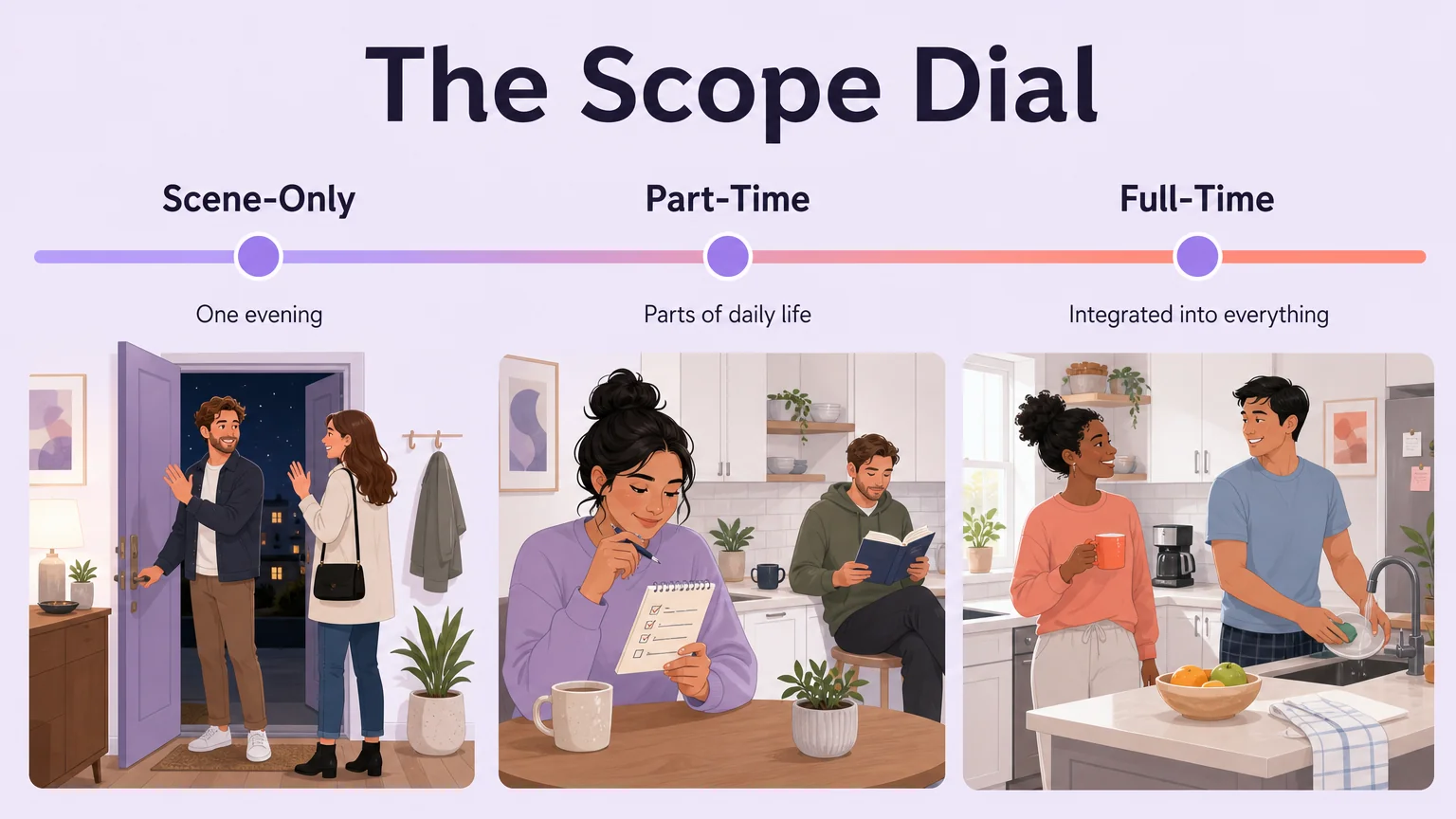
Think of three positions on one line rather than three identities. People move along it, and most do.
Scene-level service is offered inside a defined occasion, called a scene, and then set down. It can be elaborate and still contained: a real version of the thing, not a beginner setting.
Partial or contextual service runs parts of daily life on service while other parts stay outside the arrangement. Formality shifting by context surprises people who assume one consistent register everywhere. A protocol at home and an entirely ordinary relationship in front of family is design, not hypocrisy.
Full-time or total service is integrated into daily life rather than scheduled into it. One submissive in a long-running arrangement describes the point as structural rather than supervised: his dominant built a framework fully integrated into his life that does not need managing minute to minute. The texture is mostly small and domestic: a daily mantra, an instructed meditation he continues until told otherwise, written reflections shared with her, an ongoing feelings journal.
Asked what service looks like in practice, his own example is the least dramatic possible: when she travels for work, he researches restaurants and attractions that might suit her.
Two details keep it credible. The yearning when they are apart is managed by explicit baseline rules rather than willpower, and he admits it is sometimes hard to tell where her desires end and his own began.
Now the far end, so the dial is clearly a dial. A protocol-heavy model: appearance standards framed as a reflection of the dominant’s own standards, clothing treated as a privilege rather than a right, speech and posture trained deliberately, enough repetition that a single word executes an entire routine. The payoff is that service becomes effortless for both people. The cost arrives with it: a person trained this deeply knows the protocol so well that no instruction is needed, which leaves nothing to execute when there is nothing to do.
Certain areas are commonly treated as non-transferable even inside round-the-clock arrangements: health, sleep, finances, work, family, and bodily autonomy. Lanes that stay yours. The reasoning is practical. A dynamic that has absorbed the areas you need to function does not have more authority, it has less capacity, because it breaks the first time life gets hard. It is a convention rather than an enforced rule, and a place where the community disagrees.
One failure pattern the dial exists to prevent: scope creeping upward without anyone renegotiating it. Most people who end up somewhere they did not choose got there through a series of small yeses rather than one large one, and each step felt reasonable at the time. The fix is a scheduled review rather than constant vigilance.
Negotiating Service: The Menu, the Contract, and Rules That Survive a Bad Week
Two artifacts and one habit cover almost every service negotiation that goes wrong.
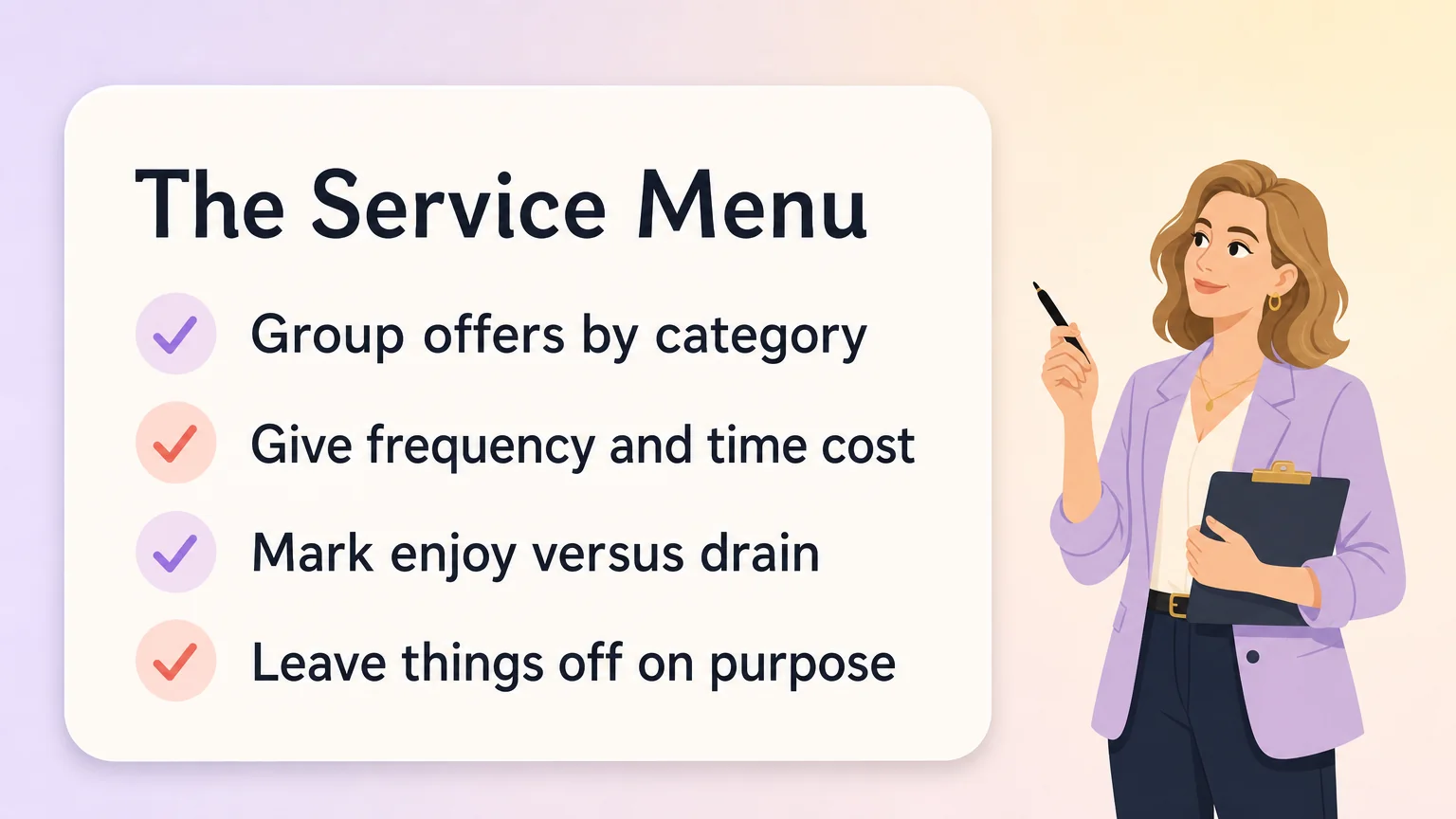
The service menu comes first. It is a written list of services you are offering, from which your dominant selects. The safeguard is structural: you decide what is on the menu, which is the most direct protection against service quietly expanding past what was agreed. It also turns an overwhelming open question, what should I do, into a bounded one.
Nobody hands you build steps, so here is how to build one. Group your offers by category rather than listing tasks at random. Be specific about frequency and time cost rather than vague about willingness. Mark the difference between things you actively enjoy and things you can do but find draining. And leave things off on purpose, because a menu with nothing excluded is not a menu. The excluded items are the point. One warning: a menu that is never revised has quietly become a contract.
The written agreement comes second, and it helps to frame it as a memory aid rather than a legal instrument. That reframing is what lowers the barrier to writing one at all. The canonical structure runs: what you call each other, shared values, rules, consequences if any, protocols and rituals, aftercare (what each person needs afterward) and availability, limits, and what happens to all of it when the dynamic ends.
Put shared values before rules, which is the part people skip. Values are the backstop when a specific rule turns ambiguous, and they make clear which areas are fair game to push back on.
A first version should be small. Titles, shared values, one or two rules, and whether consequences exist is a real agreement rather than a draft. The most common mistake is not writing too little, but becoming attached to the document and resisting a change because I agreed to this. A good agreement should be more flexible than a lease. People are not fixed terms.
Then the shape, so you are not inventing from scratch. Most rules fall into six categories: appearance and presentation; speech and body language; acts of service; health and well-being; physical intimacy; finances and self-development. Acts of service is only one of six. That single fact is what prevents a dynamic collapsing into a chore rota with a relationship attached.
Then the part that decides whether any of it survives. Stress-test every rule against the real week before you adopt it. What happens on a bad week, a different shift, a sick day, a week when one of you is traveling or unwell?
The instructive failure case: a rule that the dominant would approve the submissive’s outfit each morning, in a household where the submissive had to leave for work half an hour before the dominant woke. Not unreasonable, incompatible with a real schedule, and it left her floundering, wondering how to make a bad rule work. The fix preserved the intention and changed the mechanism: choosing the outfit the night before, the dominant offering ideas the night before, or a photograph sent on arriving at the office. Protect the intention, change the mechanism. It generalizes far past outfits.
One warning that flows from it. Rules touching basic bodily functions, or reshaping daily behavior noticeably, tend to outlast the relationship that produced them. One educator had a rule that she was not permitted to open her own doors outside, and after the relationship ended it took her nearly a year to stop waiting for other people to open them. Which is why the agreement needs terms for what happens when the dynamic ends, covering toys, the collar, and the lingering habits.
The conditions matter as much as the content. Do not negotiate in role with a new or inexperienced partner, and do not negotiate while aroused, in subspace (the altered state some submissives enter during play), or in the first flush of enthusiasm. Someone saying if it pleases you may not be conveying a real limit, and the in-role register is very good at hiding that. Coming back a day later is the correct move, not a failure of spontaneity.
If saying it aloud is hard, write it. Letters or email reduce self-consciousness, force clearer thinking about what you want, and give the other person time to compose a response rather than react. Comparing yes lists finds common ground. No requires no justification. If the two of you cannot negotiate this openly, the right answer is not to do it yet.
The habit is a recurring review, monthly being the common recommendation, with a neutral phrase either party can use to ask for the conversation without it reading as a crisis. Reviews are for changing, adding and removing things, not for emergencies, and holding a scheduled one is what makes a small unhappiness easy to raise early. The negotiation overhead for a service dynamic is higher than for a single scene, and the payoff arrives later, as far fewer painful surprises.
When Service Goes Unacknowledged: The Failure Mode Nobody Names

Start with the structural problem rather than the interpersonal one, because that reframing is what stops you feeling unreasonable.
Service usually happens in the background. Scene work is loud and memorable; a maintained home is neither. That means everyone systematically underestimates service, including the person doing it. Visibility is a poor measure of depth. Noticing the gap is not ingratitude. You have spotted a design flaw, and design flaws are fixable.
Now the belief that keeps people quiet. The idea that a real submissive should not need praise is nonsense. What it produces is a person pretending it does not matter while quietly becoming resentful, which is not a more virtuous version of submission but an unsustainable one. It erodes the dynamic from underneath, and by the time it becomes visible it usually arrives as distance rather than as a complaint.
The escalation trap is the most useful diagnostic here. When a dominant only notices elaborate or dramatic service, the submissive learns to escalate output to be seen. That teaches a specific lesson: ordinary consistency does not matter, performance does. It is a trap rather than a strategy, because performance is sustained by fear rather than desire and therefore always breaks down.
Underneath it sits a fear worth naming once. Excessive service is sometimes driven by the belief that being useful enough is what keeps you, and nobody should have to continuously earn their right to exist inside a relationship.
The fix, concretely. Have the maintenance conversation rather than dropping hints, and have it outside a service task or a scene. The middle of a task is the worst moment, because the other person is absorbed in the outcome rather than the exchange. Supply the line almost verbatim: I would like more acknowledgment for the things I do. Directness beats hinting, because hinting asks your partner to guess correctly and then rewards them for it, which is the mind-reading trap in reverse.
If friction has built up around the whole topic rather than one incident, pause the dynamic briefly so the two of you can speak outside the roles, then resume. That is a tool, not an admission of failure. And if you are afraid of the answer, decide how long an unmet need is tolerable rather than staying in indefinite hope.
Then the other side of the slash, because it is half the problem.
Watch which service you praise. If only the dramatic version gets noticed, you are training the behavior you will later be frustrated by. Praise the boring, repeated, invisible work, because that is what the dynamic runs on. The calibration experienced dominants use: consistency is judged over months rather than evenings, and the trait separating people who are serious from people who are not is showing up when it is inconvenient.
And the mirror, so this does not read as one-sided. Consistency from the dominant is what the submissive is measuring too, and withdrawal of connection and communication is a signal to address the arrangement, not a cue for the submissive to try harder.
One practical mechanism. A written record, whether a service journal, a duty roster or an inspection log, gives structure without requiring fresh instructions every time and creates a trail of acknowledgment that would not otherwise exist. Writing it down converts an unremarkable background hum into something both people can see. The caution: a journal can invert into paperwork, which is where devotion starts to feel like a debt rather than an offering.
Suppressing a submissive’s voice does not buy peace. It builds performance, and performance always breaks down eventually.
Drop After Serving: When the Crash Follows Devotion, Not Intensity
For some service submissives, the crash does not follow something difficult. It follows something good, once the serving stops.
If you have felt flat and purposeless after a lovely, connected stretch of service, or after your partner simply went back to work, this section is for you.
One account describes the shape better than a definition can. Her drop comes after spending quality time with her dominant, particularly when she has gone deeper into submission through serving him. While serving, everything is warm and light and she feels whole. When that ends she flounders, and then she falls hard. Then the line that matters most: it is not really something that can be abated by chocolate and a cuddle at the end of a visit. The standard response is calibrated to the wrong cause.
Three other triggers, in case that account is not yours. One submissive drops hard whenever her efforts are not being noticed. Another has the same trigger with a more forgivable cause: a partner away for long stretches for work. A third gets it during long gaps with no contact at all, and describes it as anxiety, low enough that getting out of bed is hard. Name that plainly, because it is where people start to think they are depressed rather than dropping.
The thread running through all four: the trigger is the loss of the connected, needed state, not the intensity of anything.
Contrast it with scene drop directly, because every reader will try to map this onto that. Scene drop follows exertion and it answers to decompression, rest and reassurance. Service drop follows connection and its ending, so it can arrive after a quiet evening when nothing was physically demanding. It is often worst when the partner is absent, which is exactly when the usual remedies are unavailable. That is why so many service submissives conclude the problem is them rather than the situation.
The mechanism, in plain language, is a hormonal crash. The endorphins running during deep submission fall away, producing a withdrawal-like state of sadness, anxiety, crying and guilt. It can last minutes, hours or days, sometimes with flu-like physical symptoms, and shame is a common part of it, which is why people hide the very thing that would help. It can surface hours or even days later, so the window is far wider than the event itself.
The reframe that matters most for this audience: drop is more common in submissives in long-term, committed dynamics than with casual partners, and service submissives are disproportionately in exactly those dynamics. Read it as the predictable cost of the thing being real rather than a sign that the dynamic is too much or that you are fragile, and note that the cost scales with the investment. A successful evening can produce it as easily as a hard one.
There is also a version with no task in it. An idle sub is an anxious sub. When there is nothing to do, the drive does not switch off. It turns inward and starts to look like something else entirely. Redirect the drive to serve into self-care framed as being done for a future partner, which satisfies the impulse instead of starving it.
Antidotes, behavioral first.
Keep doing the submissive acts while your dominant is away. The appearance routine, the chores, the rules. One submissive reports this keeps her in the right mindset and blunts the crash, the opposite of the instinct to let everything lapse until the dynamic resumes. The acts are what produce the state, so stopping them removes the thing holding the state in place.
Something tangible. A shirt that smells like them, or saved messages and videos. Grounding rather than sentimental.
A prepared kit for self-directed aftercare. Blanket, bath salts, music, something to eat, for when your partner is only visiting or already gone. Prepare it in advance, because nobody assembles a comfort kit while crashing.
The unglamorous basics that do most of the work. Water or electrolytes, a proper meal with protein and carbohydrate, rest, a stretch, and a routine so the day does not become shapeless.
Drop does not mean the dynamic failed. It takes the chemistry you already have and amplifies it, which makes it a side effect of depth rather than evidence of damage. Plan for the delayed window instead of being ambushed by it, tell your partner what your window looks like, and treat a bad Tuesday as information about your body rather than a verdict on your relationship.
When Devotion Becomes a Debt: The Abuse Test and the Argument Behind It
It is very hard to judge a dynamic from inside it. Trust-your-instincts fails exactly when you need it, because the instincts have reorganized around keeping the relationship. So use a test that does not depend on how you feel about your partner.
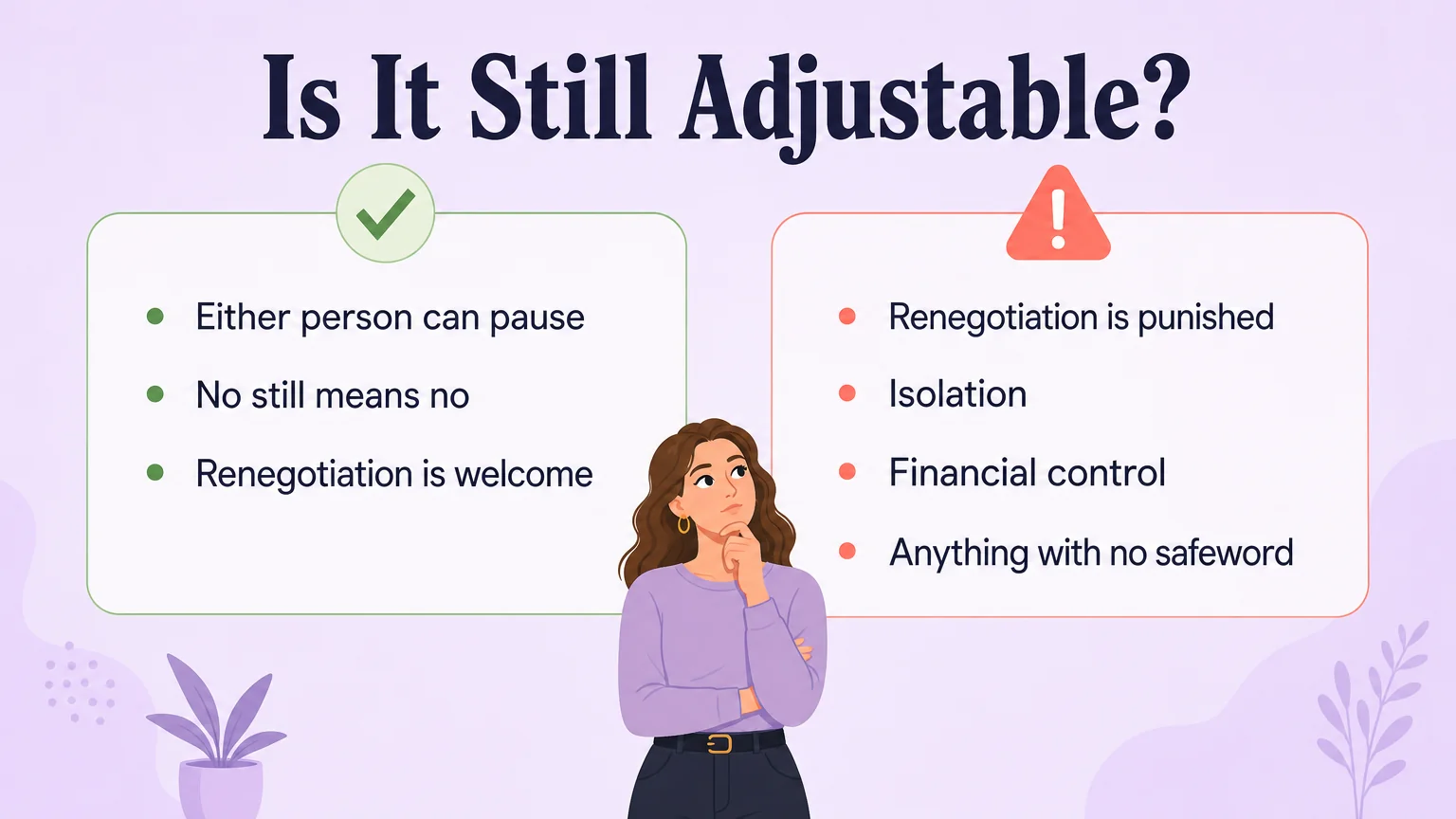
Ethical power exchange is adjustable and revocable. Either person can pause something, reopen a rule, or end the arrangement at any time. A dynamic that stops being adjustable is at risk of becoming abusive. That is the right measure because the line is drawn at adjustability rather than severity: you never have to justify how intense your play is, and unusual consensual play is not treated as a problem by a test that still catches genuine coercion.
The practical version: does the stop signal still work. An abuser does not relinquish control when the word is used, and the failure usually shows the first time it is tested rather than after months. The formal position of advocacy organizations in this space is that consent can be withdrawn at any time, and that withdrawal legitimately leads to release, retraining, a time-out, renegotiation, or the end. Withdrawal is an exercise of the agreement, not a breach of it.
The disagreement here is real. The person who coined the term Total Power Exchange, Steven S. Davis, argued that safewords, contracts, limit negotiation, and anything else that formalizes limits on the dominant’s decision-making are alien to it. That conflicts directly with the advocacy standard and with the consent consensus held across this community. Boundaries are what make power exchange possible rather than a formality layered on top of it. Authority that cannot be questioned is not authority at all; it is an absence of options.
The test has one honest limitation: it is hardest to apply from inside a trauma bond, which is precisely when it is needed. The practical answer is a person outside the dynamic who can hold the question with you.
The anti-pattern. Service inverts when it stops being an offering and becomes a debt you believe you owe. Labor debt rather than devotion. The tell is not the volume of work. It is the direction of obligation.
The case, without commentary. A married couple whose dynamic collapsed when the dominant expected full housework on top of the submissive’s full-time job. Wanting the trappings of devotion without the reciprocal structure is the housekeeping equivalent of a booty call. The principle: substantial service has to be met with structure, whether recognition, reciprocity, or a reconsideration of who carries the rest of the load.
Money deserves its own line. If service displaces paid work, someone is carrying that cost, and the arrangement has to say who. Unpaid service piled on a full-time job is an abuse arrangement rather than a devotion one.
Then the pattern of trials that never resolve: a self-described submissive describes ten months of vetting he calls intense and deliberate, physical, emotional, psychological and financial, for a person whose face he has never seen and whose voice he has never heard, all of it in writing, the next threshold being financial readiness. He describes it positively, as a measure of his commitment.
The warnings, compactly. Renegotiation punished. Coercion that drifts rather than announcing itself. Isolation. Financial control. Anything framed as having no safeword. The energy-exchange principle explains why this population is exposed. Service submissives are not turned on by doing tasks for anyone who asks, so the harm is not being used for labor they enjoy. It is having the reward they need withheld while the labor continues.
When someone stops providing consistent connection, communication and care, that is the signal, not a cue to chase or cling harder. Staying out of fear of being alone, or out of hope, is not the same as choosing to stay. And leaving something that hurts is not failing. It is remembering what you are worth.
Service in Open and Multi-Partner Dynamics: What Actually Changes
For readers in open relationships and polyamorous structures, this part is for you, and the fact that you are here is unremarkable. It covers how service behaves when more than two people are involved.
Start with the finding that resets assumptions. When service structures involve more than two people, there is usually more conflict where one submissive serves two dominants than where one dominant has several submissives. Coordination is the hard part, not capacity. A dominant with several submissives is adding people to a structure they already own, while a submissive with two dominants is being asked to hold two structures that were designed independently.
The rules that follow. Handing one person two complete sets of rules reliably produces conflict, so do not do it. If a submissive is serving more than one dominant, one of them needs to be primary, and that has to be a deliberate decision rather than something that emerges by default. Choosing not to attempt it is a legitimate answer rather than a lack of adventurousness.
Turn the same lens the other way, because it carries an ethical point. When a dominant leads more than one submissive, the coordination burden belongs to the dominant, not to the submissives. The person with more power is responsible for making the arrangement work. And the finding that runs against the usual assumption: more partners means more explicit agreement, not less.
The failure pattern you are most likely to be living in without a word for it is service creep between metamours, meaning your partner’s other partners, where one partner expects another to serve them when that was never negotiated. It looks gradual and is almost never announced. It starts as a small favor that gets repeated until it is treated as an expectation.
It has to be asked for rather than assumed, and the principle is worth repeating in full: being in a relationship with someone who serves your partner does not mean you are owed their service. That is a boundary question, not a generosity question, because it usually gets misfiled as the latter.
Hierarchy, handled without endorsing or condemning it. Hierarchical structures designate certain partnerships primary or anchor, and those designations carry real weight in commitment, shared resources and life decisions. The useful move is to treat hierarchy as negotiated rather than natural, so couple privilege can be named out loud instead of quietly resented. If you are the newer partner, ask what primary actually confers and what it does not. If you are the established partner, state it rather than leaving the other person to infer it from behavior.
Negotiate limits, hierarchies and communication explicitly rather than assuming anything is settled by default. Negotiate the level of openness and the specific kinds of involvement you want. And do not accept a partner taking on additional play partners or submissives if that does not suit you. Not wanting a configuration is not a failure of open-mindedness.
One standard holds across every configuration: consistency when nobody is watching, thoughtfulness without instructions, and loyalty that does not collapse the moment attention moves elsewhere. That is the same thing asked of a service submissive with one partner as with three, which means you already know how to do the hard part.
3Fun is built for exactly these conversations: what you are offering, what you are not, and who is primary.
Frequently Asked Questions About Service Submission
What are examples of a service top?
A service top takes the dominant or penetrating role as an act of service and obedience to their partner’s needs rather than from their own dominance drive. The diagnostic: is the person intentionally leading their partner through the experience, or have they handed the dynamic over to their partner’s gratification and become dependent on it to feel successful? The top and the sub are distinct roles, and this piece covers the sub side.
What are some examples of submissive acts of service?
Domestic tasks and housework. Hospitality, meaning food and drink. Sexual service. Human furniture. Aesthetic and pampering service: helping someone dress, drawing a bath, massage or foot rubs. Administration, meaning schedules and correspondence. Pet play. Then the three that separate an orientation from a chore list: anticipatory service, noticing a need before it is voiced; emotional service, meaning presence and reassurance; and ceremonial service, turning a routine into a ritual.
What are examples of submissive?
Service-oriented submission is one part of a spectrum of submissive behaviors, and not every submissive is service-oriented. Someone may place service at the center of their submission entirely, or treat it as a role inside one specific dynamic. Examples range from formally coded roles such as bootblacking, through everyday acts of care like meals and errands, to emotional service such as holding space for a partner.
What are the duties of a submissive woman?
There is no fixed list of duties, and the answer is the same for every gender. What a submissive does is negotiated between the people involved, which is the only answer that does not turn you into a prop in someone else’s fantasy. The real range includes domestic, emotional, logistical and sexual service, chosen rather than assigned. Devotion does not mean having no boundaries. It is having your own mind and still choosing to use it for someone you respect.
Does service have to be sexual?
No, and it is one of the most common misconceptions. Service-oriented submission is not necessarily sexual and usually happens outside play altogether. It can be eroticized without becoming sexual: being collared during a task, wearing something specific, or consequences for an unfinished list. Someone might rub their partner’s feet because they enjoy the service, because they have a foot fetish, because they enjoy being lower, or some combination.
Can a service submissive belong to more than one dominant?
Yes, and it is the harder configuration rather than the easier one, so it needs more negotiation rather than less. Coordination is the difficulty, not capacity, and it works better when one dominant is primary. Never hand one submissive two complete sets of rules, because that reliably generates conflict. If you are the one with more than one submissive, making the arrangement work is your responsibility rather than theirs.
Is acts of service being my love language a real explanation, or a shortcut?
A useful bridge and a poor explanation, and the answer says both. Practitioners use it credibly, and one dominant names acts of service as her own primary love language. But it is contested inside the community, partly on the grounds that within kink several of the five languages collapse into each other. The sharper contrast is turn-on versus love language. For precision rather than a bridge, reach for the core kink underneath.
How do you explore service if you do not have a dominant yet?
Two routes need no partner. Serve a room rather than a person: at events, service submissives often top off water and serve drinks or food, genuine practice with no dynamic attached. Or run it self-directed, with a routine you maintain for its own sake. As a couple exploring without a formal framework, add intention to something you already do, one thing at a time, starting low-lift, such as a check-in message or making coffee a specific way.