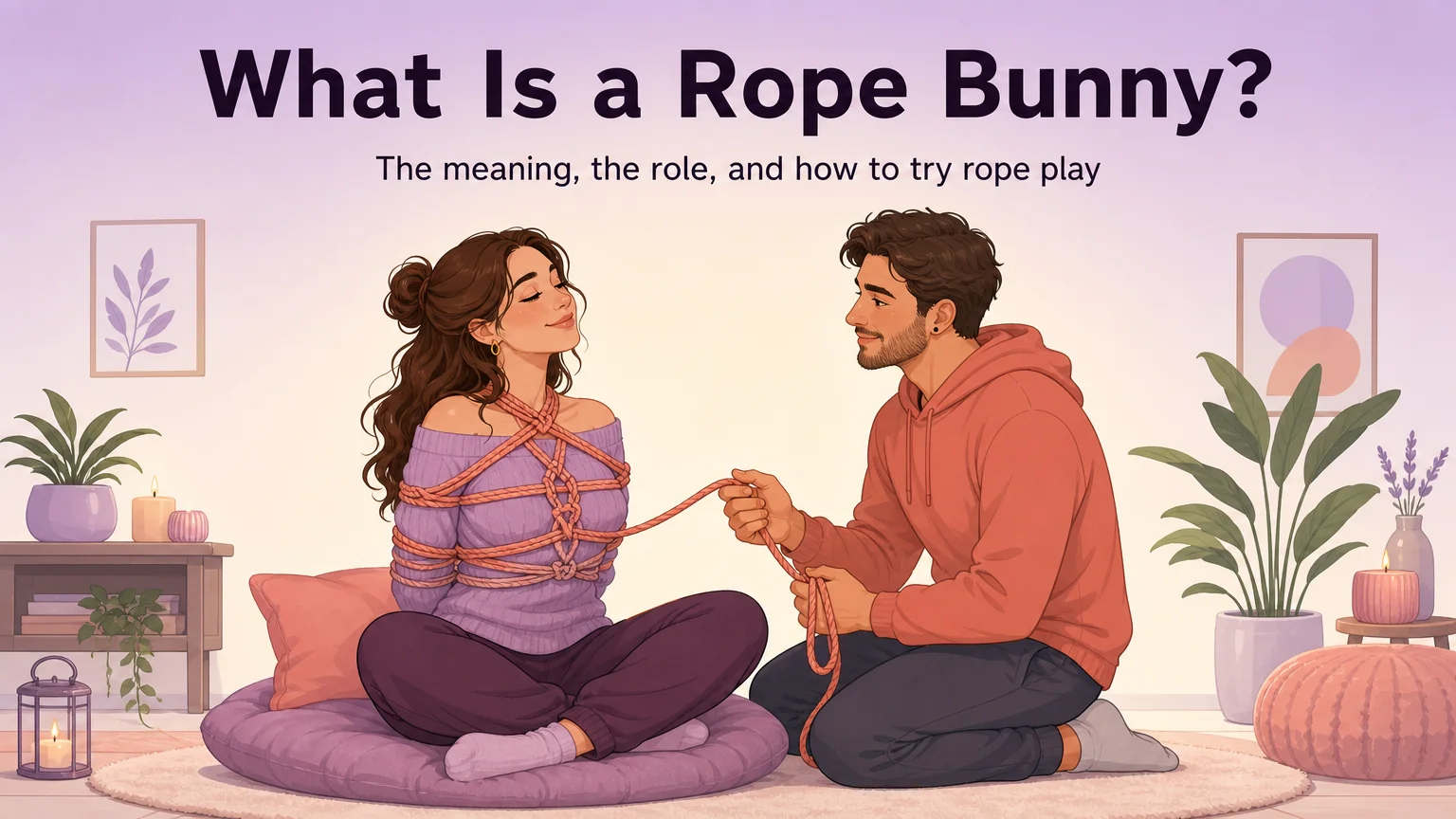
Shibari and rope play have taken over your feed. The photographs are everywhere: elegant knots, soft light, a person wrapped in what looks like calm itself. And underneath all of it, a quiet question most people are too shy to say out loud: what is a rope bunny, actually?
It’s a fair thing to wonder. Some people have called themselves a rope bunny for months and only learned the meaning when someone offered to tie them up and they had no idea what was about to happen.
Rope play is far more common than the word “taboo” suggests, and being curious about it is completely normal. The numbers back that up, and we’ll get to them. This guide answers the question properly: what a rope bunny is, what being tied actually feels like, whether it’s for you, and how to try it safely with a partner, a community, or on your own. No judgment, no lecture. Just the answers and a safe way in.
So What Is a Rope Bunny, Exactly?
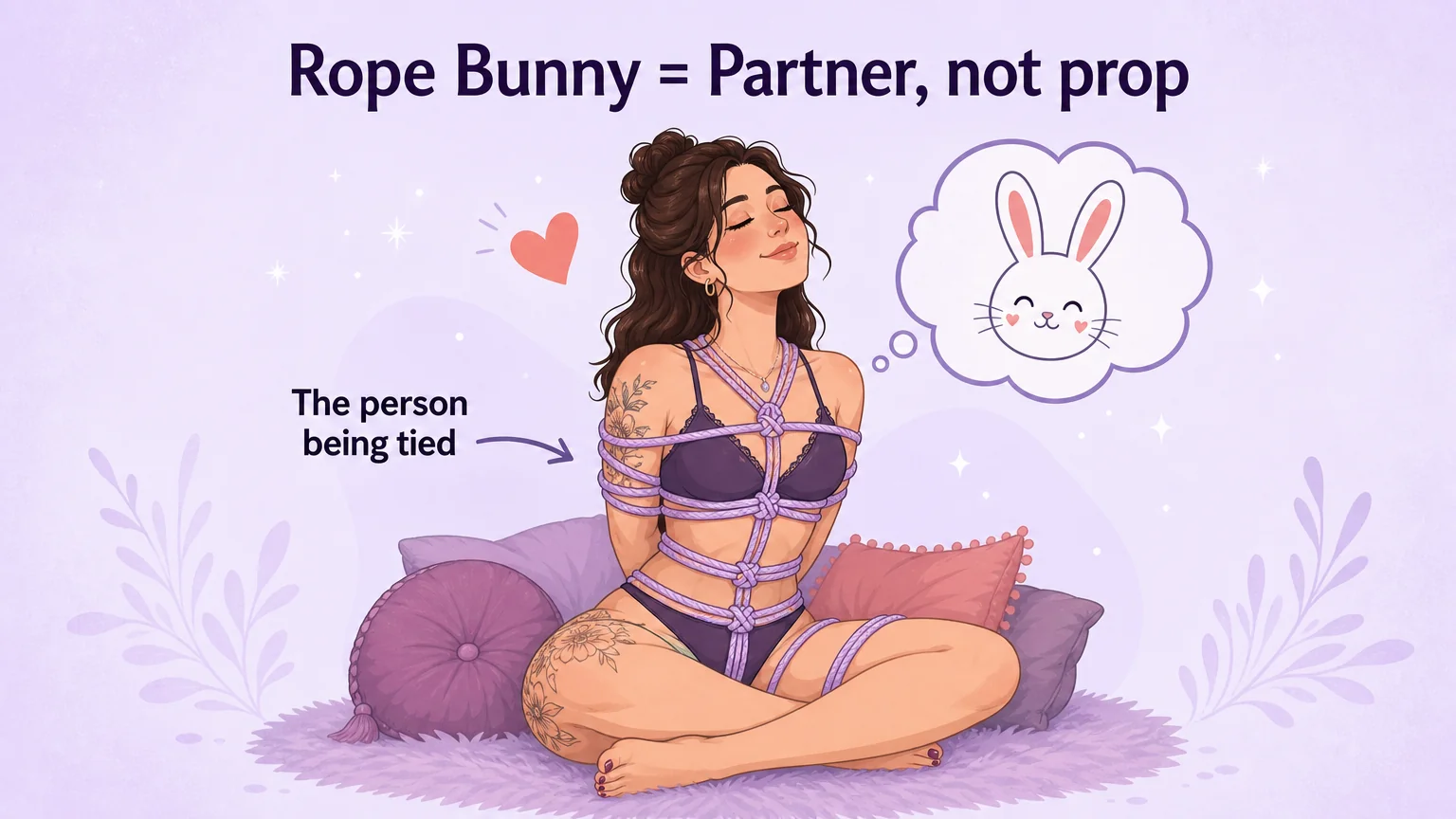
The rope bunny meaning, in one plain sentence: a rope bunny is the person being tied in rope bondage, or shibari, the one who enjoys the sensation, the surrender, and the experience of being wrapped, whether or not the scene is sexual.
That first clause matters, so let’s sit with it. The bunny is the person being tied, not the person being acted upon. Rope educators put it simply: partner, not prop. The person in the rope negotiates the scene before it starts, communicates all the way through it, holds a safeword, and keeps their agency for every minute of the tie. Passive was never part of the job description. The bottom steers the scene through communication, naming what feels good and flagging what doesn’t, in real time. A healthy rope scene is a conversation between two people, one of whom happens to be wrapped in knots.
The second thing people get wrong is assuming rope is automatically sexual. It isn’t. It can be sexual, deeply so. It can also be artistic, meditative, athletic, or simply a way to feel held. Whatever the two of you agree on is the right version for you, period.
So here’s where it gets interesting: the role has its own vocabulary, it doesn’t require submission, and there’s a genuinely safe way for a beginner to try it. That’s what the rest of this guide is for, from the labels you’ll hear to the exact shape of a first session.
Rigger vs Rope Bunny: The Two Roles in Every Rope Scene
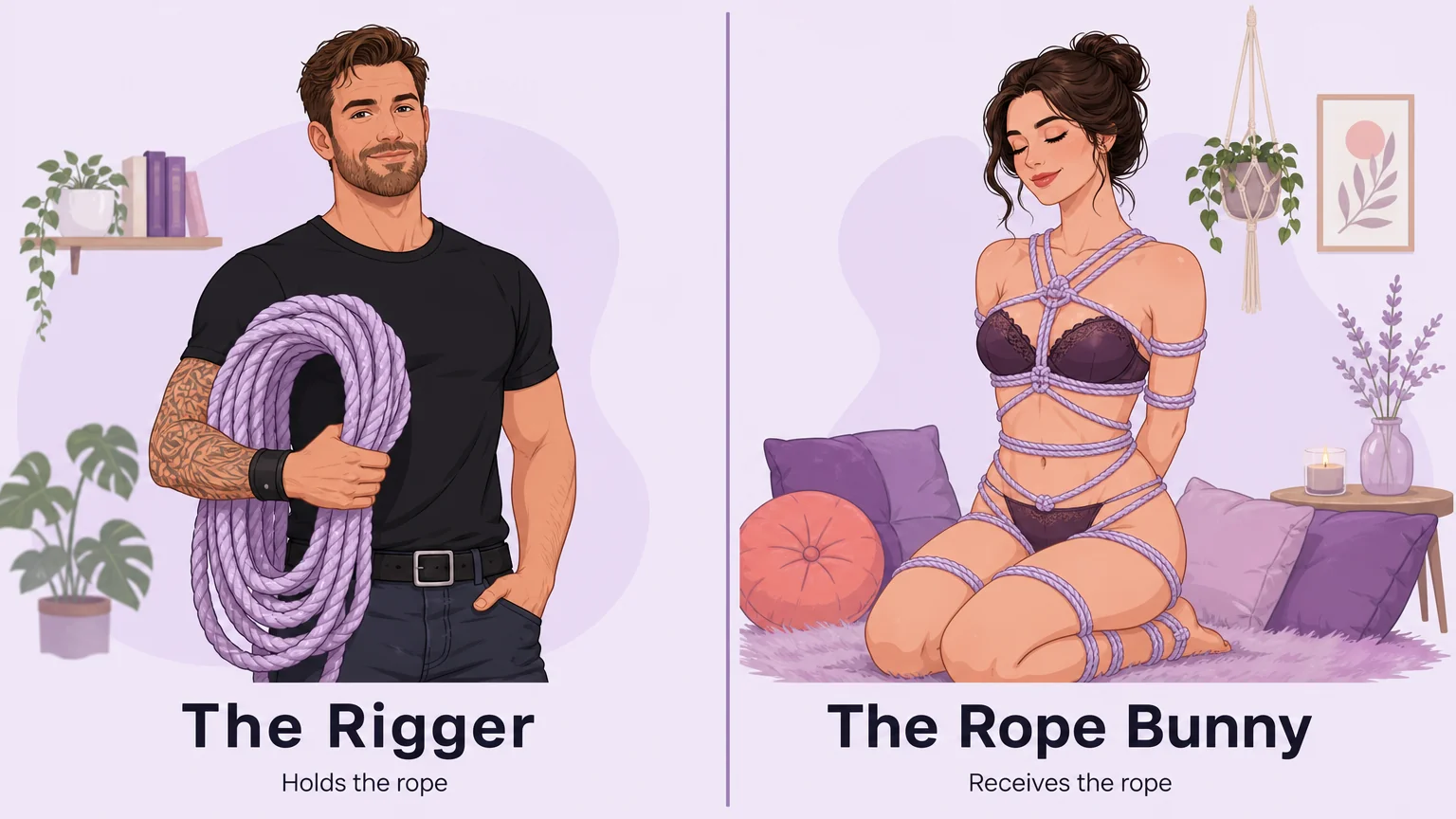
Every rope scene has two roles, and once you see them clearly, the bunny role clicks into place.
The person who ties is the rigger, sometimes called a rope top, or a shibarite in Japanese. The terms nawashi and bakushi are reserved for the professionals, the artists and masters of rope. The person being tied is the rope bottom, the rope model, or the shibariuke, a Japanese word that literally means receiver.
And rope bunny? That’s the English slang layer sitting on top of that older vocabulary. It’s the friendliest, most playful of the terms, the one that sounds like a nickname rather than a job title. It’s also the word you’re most likely to hear from the friendliest corners of the scene, the one that makes a newcomer feel welcome before they know a single knot.
Now, a small controversy, handled without judgment. Some people love bunny, finding it affectionate and warm, a perfect match for the feeling rope gives them. Others find it diminutive, because bunny can sound cute, passive, and interchangeable, and it’s most often applied to women. Both reactions are valid, which is why the respectful move is simple: ask each person which label they prefer. Rope bottom, rope model, shibariuke, or bunny. Each one carries different weight for different people.
Here’s the reassurance: nobody expects a newcomer to have this lexicon down. Getting a term slightly wrong is how everyone starts, and the community is friendlier than the photos suggest. And whichever word you land on, the person in the rope is the same: an active, consenting partner. The label just changes the flavor.
Are You a Rope Bunny? Signs You Might Love Being Tied
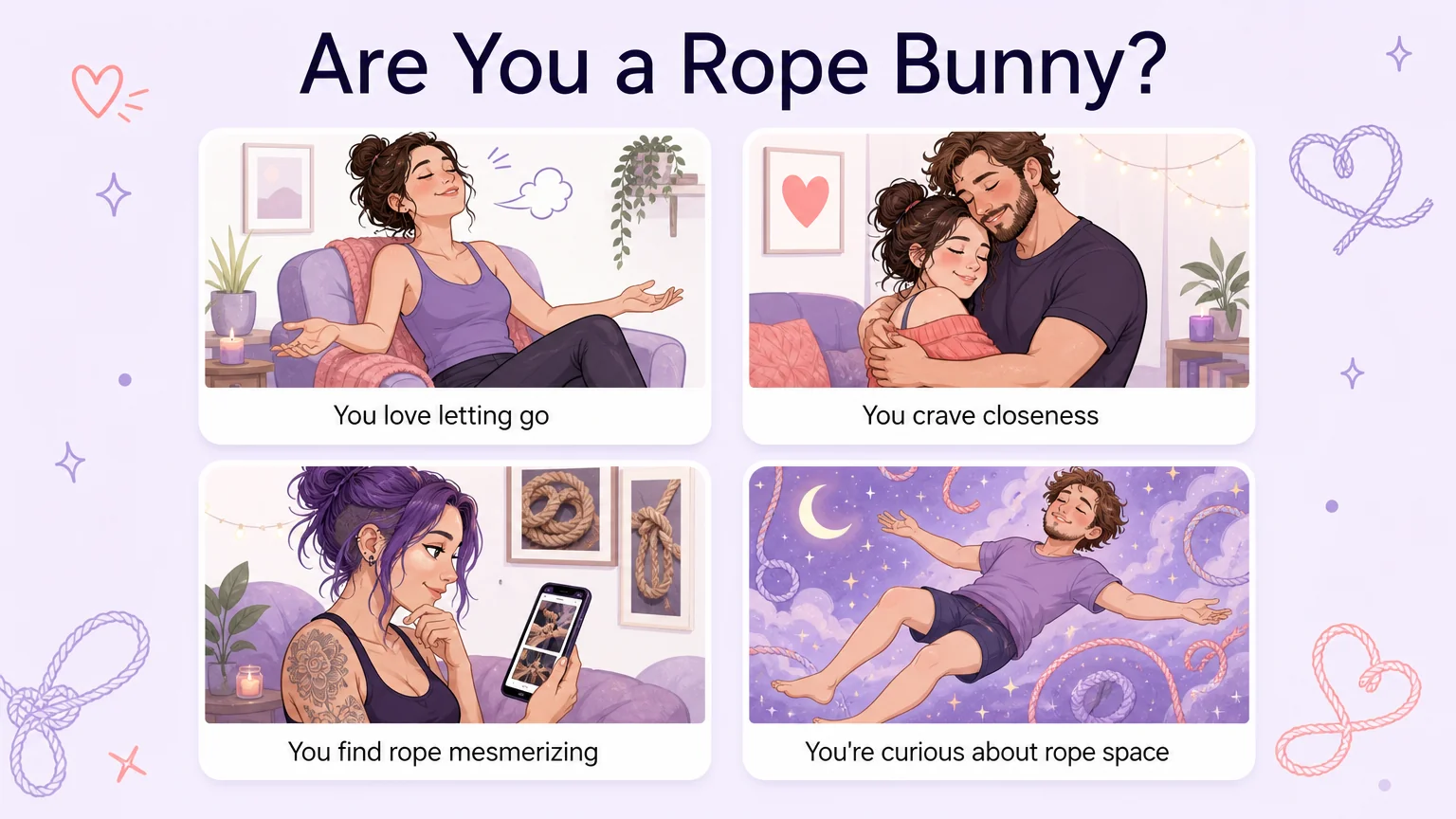
Let’s clear the air first: being a rope bunny is about loving the experience of rope, not about fitting some submission template. Bottoming is a role, not a personality. You don’t audition for it. You recognize yourself in it.
A few friendly signs you might love being tied. You don’t need all of them. One strong yes is plenty.
You’re drawn to the idea of letting go. Not being out of control, letting go, the way a deep breath after a long day lets go. The version where you hand over the steering wheel because you trust the driver, not because you want to be driven. You love sensation and touch. You’re the person who leans into a good massage and isn’t shy about asking for a firmer hand.
You find rope photos mesmerizing, and a small part of you pictures yourself there. The ties, the patience, the stillness. You can imagine being the one held in that frame.
You trust deeply and you crave that kind of closeness. For you, intimacy is the point, and rope is a doorway to it. The negotiation, the care, the way someone holds your limits as carefully as they hold the rope.
You’re curious what the floaty, altered headspace is like. That curiosity is a compass pointing somewhere real, and rope space is a destination worth exploring.
You’re patient, or you’re learning to be. Rope rewards the slow build, the careful layering of wrap after wrap, and patience is half of what makes it work.
And yes, switches count. Plenty of people tie and love being tied, and many are picky about who they let wrap them. Wanting both sides isn’t a contradiction. It’s the whole experience.
Now the fear that keeps the most people from trying: that being a bottom means becoming a victim, or losing control. It doesn’t. In a healthy scene you keep your agency, your voice, and your safety tools the entire time. Anyone who frames it otherwise has missed the point of partner, not prop.
So here’s the bottom line. No submission test, no flexibility exam, no pain threshold to clear. If enthusiasm for the experience is enough, you already qualify. There’s no other entrance exam.
Common Myths About Rope Bunnies, Busted
Misconceptions do a lot of the scaring around here, so let’s bust them one at a time. Every myth has a friendlier reality hiding behind it.
Myth: Bunnies just lie there. Reality: the bottom is the most active participant in the scene. They steer the tie through communication, naming what feels good, flagging what doesn’t, and shaping every moment of the experience. The rope doesn’t move without the bottom’s input, and the best scenes are built on exactly that.
Myth: It has to hurt. Reality: sensation is fully adjustable. Some people love a deep, squeezing pressure. Others want rope light and loose. There’s a whole spectrum between whisper-light and deep pressure, and finding your spot is half the fun. Body awareness and clear communication matter far more than being bombproof, and your comfort level sets the ceiling.
Myth: You need a certain body. Reality: the social-media look is not the real community. The rope world has a saying for this: if you have a body, it is a rope body. A skilled rigger adapts to the specific person in the rope, not the other way around. The Instagram feed is a highlight reel, not a roster.
Myth: Suspension is the pinnacle. Reality: floor-based ties explore connection, sensation, and emotion as fully as anything hanging ever will. Many of the most celebrated ties in the community never leave the floor. You never have to suspend to be an excellent practitioner. Ever.
Myth: It’s only for submissives, or only sexual. Reality: bottoming is not submission, and non-sexual, artistic, meditative rope is everywhere. Rope is what you make it, and whatever the pair agrees on is the right version. Different day, different version, and no one else’s preference is the rule.
In every case, the reality is more welcoming than the myth. So if a myth has been quietly telling you this world isn’t for you, it was wrong all along. The barrier to trying rope was never rope. It was a story about rope.
What Being a Rope Bunny Actually Feels Like: Rope Space, Explained
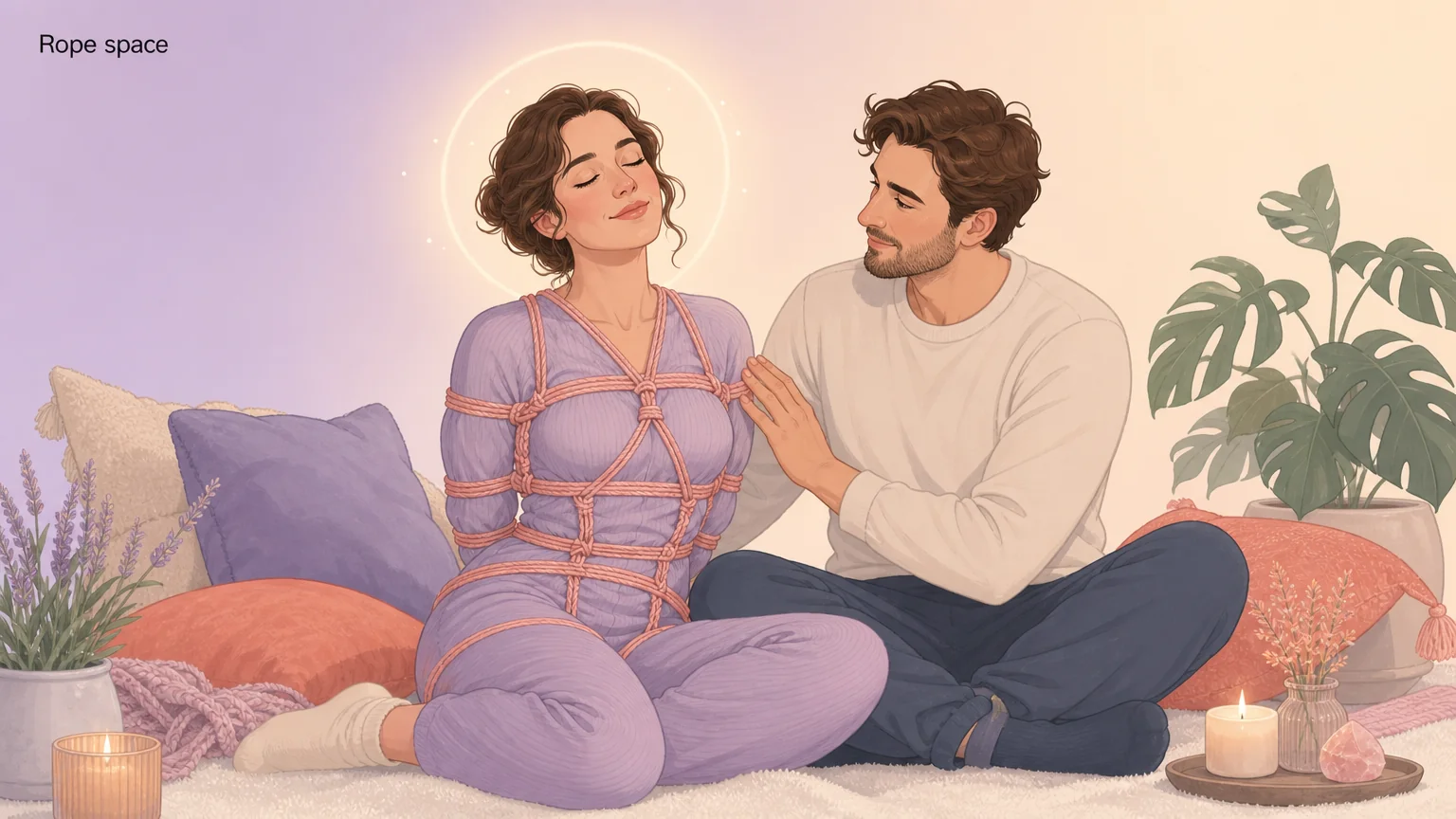
Photos can’t show you the best part, so we’ll do it with words. During a longer tie, bottoms often slip into what the community calls rope space, a floaty, trance-like, meditative headspace, playfully nicknamed rope drunk. It’s the cousin of what people call sub space or top space. Some people describe it as the closest thing to floating they’ve found while still fully awake.
The why is almost embarrassingly simple. Steady pressure. Body warmth. The rhythm of the rope. The quiet of being held by something you can’t slip out of, with nothing asked of you in return. Your nervous system takes that combination and drops you into a relaxation you can’t reach on your own, which is why so many people describe rope as moving meditation.
One caveat worth naming, because it matters: rope space can dull your communication. Everything feels so good that you might not notice a wrap gone slightly wrong. That’s exactly why check-ins and safewords matter even when everything feels wonderful. The floaty state is the gift. The check-ins are what keep it safe.
And the intimacy? That’s the part couples keep coming back to. The negotiation, the trust, the closeness of being fully held by someone who knows your limits. Rope is how a lot of couples describe getting closer. It’s not really about the knots. It’s about who’s holding them.
How Common Is Rope Play, Really? The Numbers Behind the Taboo
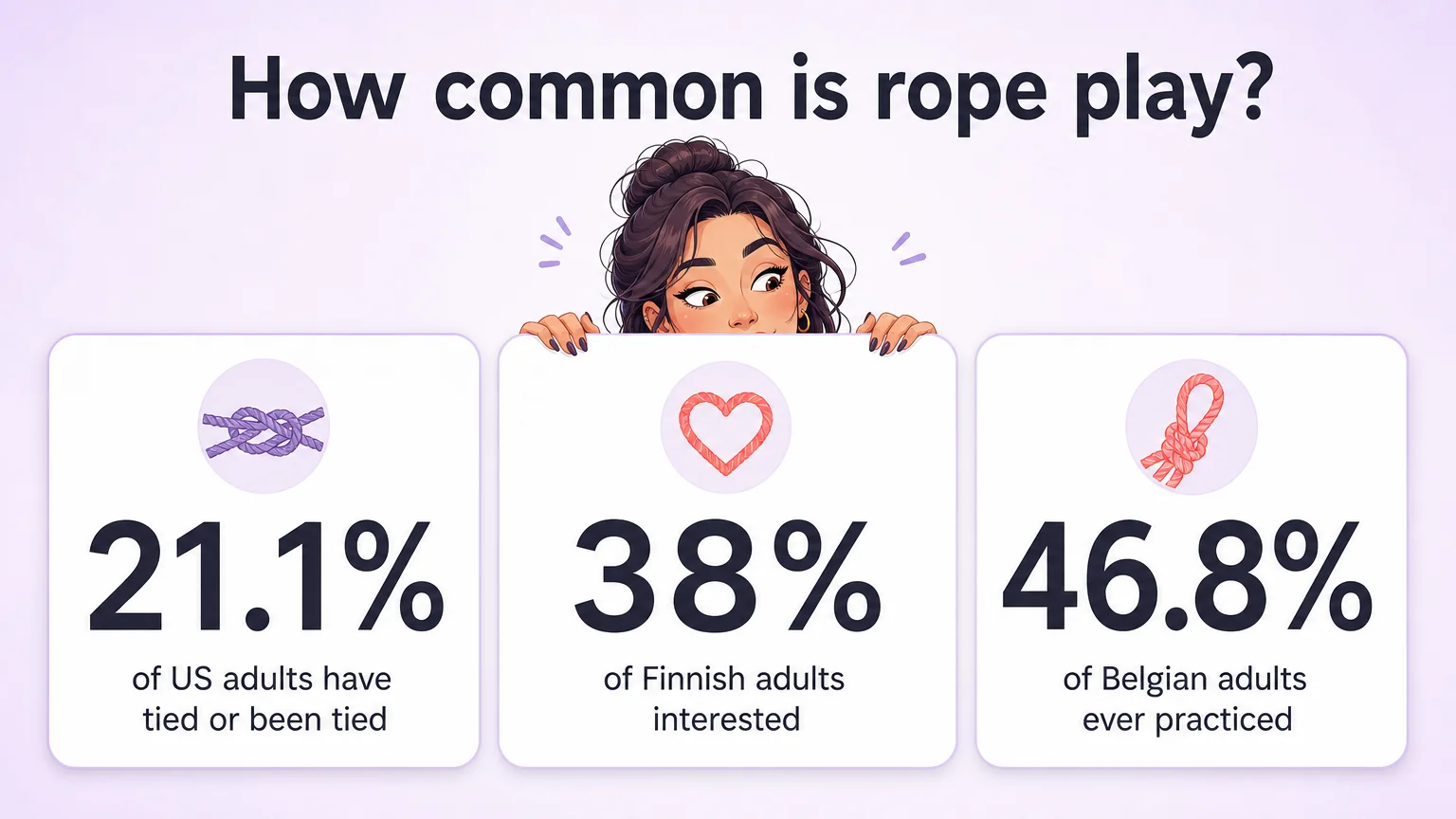
Here’s the number that reframes everything: in a representative US sample, about one in five adults, 21.1%, reported having tied someone up or been tied up in their lifetime. Another 29.3% found the idea appealing. Not a fringe. A normal slice of the people around you, quietly into the same thing you’re wondering about right now.
The data goes deeper. In Finland, 38% of adults aged 18 to 60 reported interest in BDSM-related sex, with notably higher interest among non-heterosexual people. And a Belgian study of the general population found that 46.8% of adults had performed at least one BDSM-related activity. Another 22% had the fantasies without practicing, 7.6% self-identify as practitioners, and 61.4% knew of their interest before age 25.
Sit with that for a second. Rope play, and the desires around it, are common, consensual, and nothing to pathologize. The person next to you at the party has probably wondered about the same thing. If you’ve been quietly curious, you are far from alone. The numbers say so, in study after study.
How to Ask Your Partner About Rope Play (Without It Being Awkward)
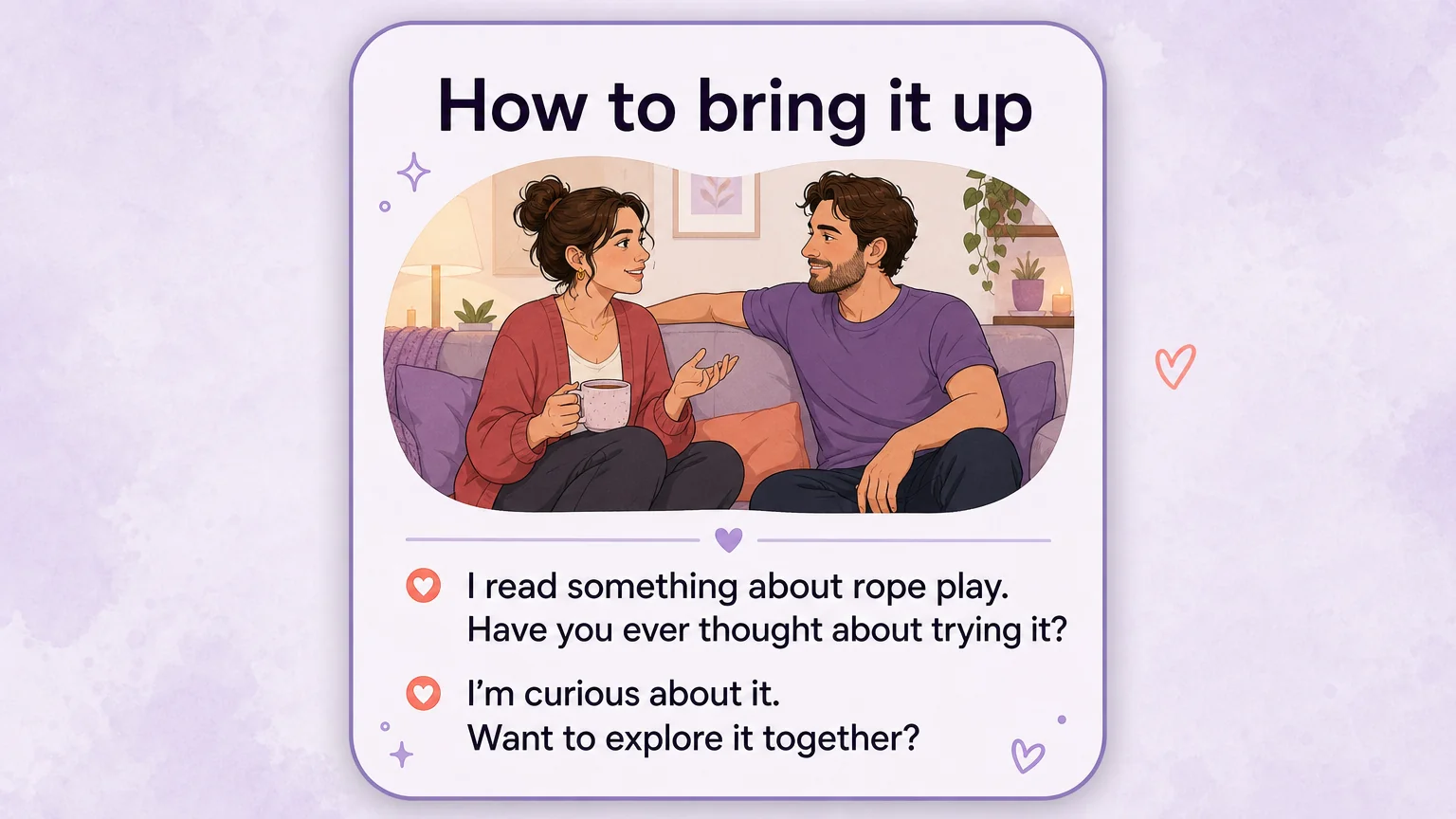
Even the reach-out can feel like the hardest part. Asking a partner about rope, whether you want to be the bunny or the rigger, can set your pulse going, and that nervousness is completely normal. You’re about to share a desire that matters to you. The courage it takes is part of the point.
Here’s the approach that keeps it from being awkward. Bring it up outside of a sexual moment, when you can both relax. Start casual and specific: “I read something recently about bondage. Have you ever thought about trying it?” Or: “I’m interested in learning more about rope play. Is that something you’d want to do with me?” Keep your tone light. You’re not delivering a manifesto; you’re opening a door.
Frame it as intimacy and trust-building, not restraint. Offer to watch an educational video or two together so they can see what you mean, in motion, before deciding anything. Share the feeling you’re after, whether it’s being cherished, controlled, or desired, and name your limits, including whether you’d rather tie or be tied.
Then give them time to think, and don’t expect an answer on the spot. Some of the best conversations happen across a few days, not a few minutes. Let them say no gracefully, and make sure the yes, when it comes, is enthusiastic and revocable. If the answer is no for now, that is the answer. Consent is the whole foundation of rope, and a not yet is information, not rejection.
One more note for readers already exploring ENM or swinging: the skill you’re using right now, raising a desire honestly and letting it be answered, is the exact muscle that community is built on. It’s the same move, in a different arena, and it’s how a lot of couples find their people. We built 3Fun around that kind of honesty. When you raise rope with someone who shares your values, the conversation is already halfway done.
How to Find People to Try Rope With: Community and Dating
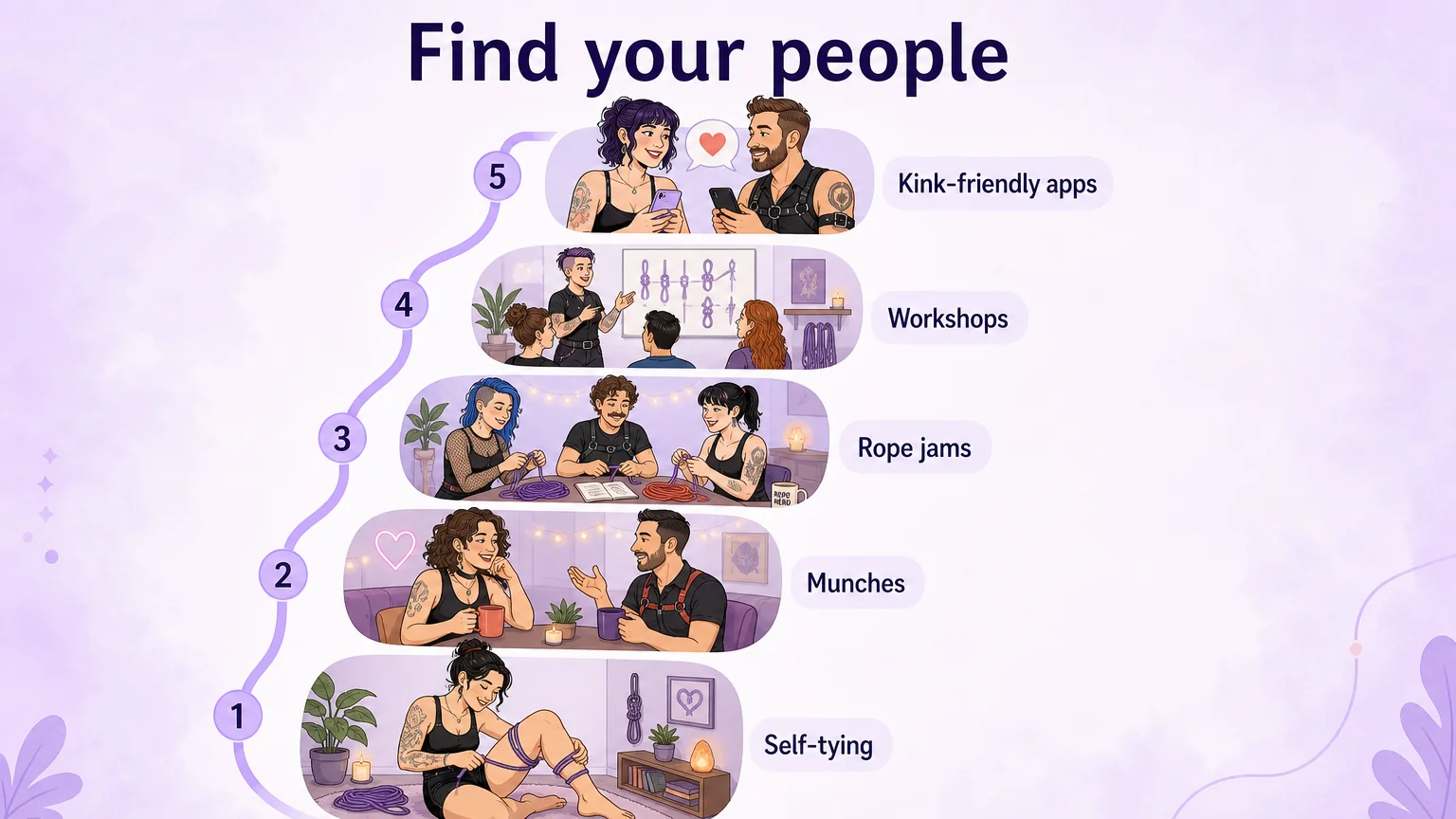
You don’t need an existing rope scene to start, and you don’t even need a partner. Self-tying is a real, common entry point. Practicing a simple harness on your own body teaches you technique and rope feel, and plenty of experienced bottoms started exactly there. You’ll learn how a wrap should feel before anyone else’s hands are on you, which makes you a better bottom and, eventually, a more thoughtful rigger.
If you do have a partner, that’s the fastest path. Use the conversation from the last section, and you’re already practicing.
For everyone else, there’s a community ladder, and each rung is lower-pressure than you’d think. Rope munches are casual socials, just people talking over coffee, no rope required. Rope jams are unstructured practice time with shared knowledge, often with a short class up front. Beginner workshops are platonic, low-pressure, and frequently match you with a practice partner, usually for a small fee. You don’t have to tie or be tied at your first munch. Showing up, listening, and saying hello is a complete success.
You’ll find all three on FetLife Events, plus a search for “your city shibari workshop” to catch anything not listed there. While you’re there, the groups worth joining include Riggers and Rope Sluts, Ask a Rope Bottom, Shibari, and Rope Incident Reports, which doubles as safety education. Spend a little time reading before you dive in. How a group treats newcomers tells you a lot about its culture. If no local scene exists, online learning like Shibari Study carries you through the fundamentals from anywhere.
And for people already in the ENM and swinging world, kink-friendly dating apps are a legitimate way to meet partners open to exploring rope. Because that community centers honest, consent-first communication, the people you meet there are often the easiest to have this conversation with. That’s exactly where 3Fun lives, and it’s a good place to start looking when the local munches are a hundred miles away. Either way, the principle holds: look for people who treat consent like the non-negotiable it is.
One quality filter before you go anywhere: prefer a partner with aligned goals and good communication over the most experienced rigger in the city. And learn the safety basics before you seek partners, not after. Both will thank you.
Your First Rope Session: A Safe, Simple Playbook
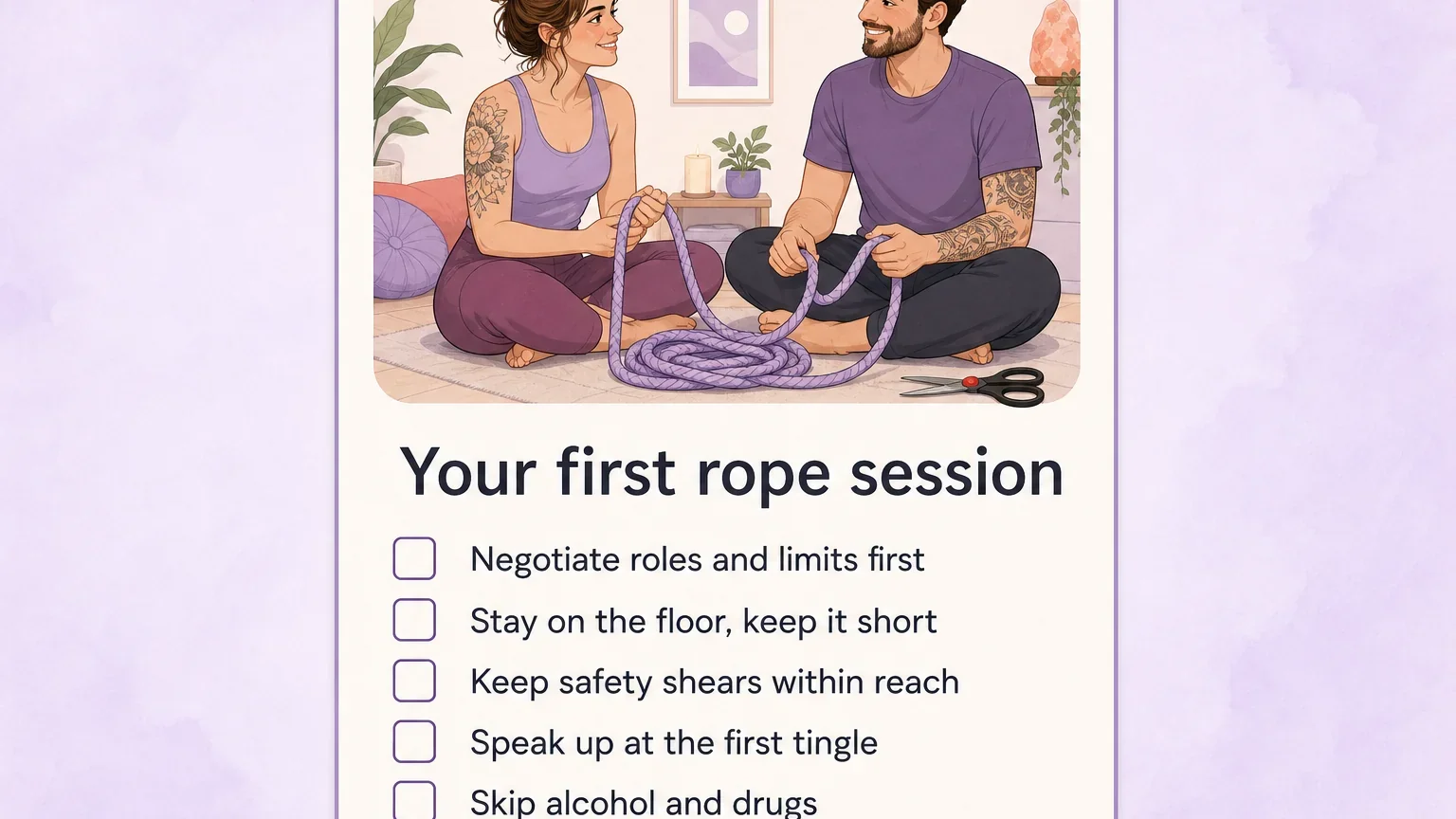
Let’s be honest about the risk so the fear doesn’t get to run the show. Rope play is risk-aware, not zero-risk. The main physical hazard is nerve compression from misplaced or over-tightened wraps, most often at the wrists, arms, and legs. It’s real, and it’s largely preventable with education and a few simple habits. You’re not memorizing a risk manual. You’re learning four or five habits that keep a beautiful practice safe.
Step one: negotiate before the scene. Agree on roles, body parts, limits, a safeword, and a non-verbal cue. Make it explicit that consent can be revoked at any time, even mid-scene, and that the absence of a no is not a yes. If it’s not an enthusiastic yes from everyone in the room, it’s a hard no. Disclose anything relevant: circulation issues, neuropathy, recent injuries. Come to it already knowing what you’d like to try and what’s off the table. The negotiation isn’t a formality. It’s where the trust gets built, and it’s half the fun.
Step two: keep the first session short and grounded. Simple floor ties for about twenty minutes, with regular check-ins built in. Twenty minutes sounds short until you’re in the middle of it. The first time, less is more, and leaving both of you wanting more is a win. Suspensions are higher-risk and belong to in-person instruction, not a first night.
Step three: the safety gear and checks. Keep EMT-style safety shears within reach before the tie even starts, and never use a knife on someone wearing rope. Know where the shears are before you’re tied, not after something goes wrong. The bottom reports any tingling, numbness, coldness, or color change immediately, and can wiggle fingers periodically if the hands are wrapped. Check color and warmth along with sensation; hands and feet are the places to watch. Never leave a tied person alone.
Step four: the conditions. Skip alcohol and drugs before a session. Both of you stay clear-headed. That’s non-negotiable. The best scenes happen between two people who are fully present.
A light gear note: untreated jute can carry jute batching oil, some of which is potentially carcinogenic. Use treated rope or a synthetic beginner rope, nylon or posh, roughly 7.5 to 8 meters and 6 to 8 millimeters thick. If you’d rather start without thinking about fiber at all, synthetic is the low-friction choice, and it cleans up easily after a scene.
Then the part everyone almost forgets: aftercare. Plan it for both of you, not just the person in the rope. Physical comfort, water, food, and an emotional check-in. Some people feel elated and buzzy after a scene. Others feel quiet and tender. Both are normal, and naming your state is how you land gently. The scene ends when aftercare begins, not when the rope comes off.
FAQ: Your Rope Bunny Questions, Answered
Do I have to be submissive to be a rope bunny?
No. Bottoming is a role, not a personality. Many rope bunnies are switches who also tie, and plenty love the sensation and surrender of being wrapped. If you’re drawn to the experience itself, that’s the only qualification that counts here.
Is the term “rope bunny” offensive?
It’s contested. Some people wear it happily as affectionate and playful. Others find it diminutive, because bunny can sound cute, passive, and interchangeable, and it’s most often applied to women. The respectful move: ask each person which term they prefer.
Is rope play sexual?
It’s what you make it. Rope can be deeply sexual, completely non-sexual and artistic, or purely meditative, and it can vary from day to day. What matters is what the two of you agree on before the rope comes out.
Does rope have to hurt?
No. Sensation is fully adjustable, from loose and light to deep and squeezing. Body awareness and clear communication matter far more than pain tolerance. Rope is a conversation, not a test, and nothing is wrong if your preference runs soft.
Is rope play safe?
Risk-aware, not zero-risk. Nerve compression is the main hazard, and the mitigations are well known: education, negotiation, safewords, nerve self-checks, short floor sessions, and shears within reach. Learn the basics before you tie, and the rest is practice.
How do I ask my partner to try rope?
Raise it outside of a sexual moment, casually and specifically. Frame it as intimacy and trust, offer to watch an educational video together, share what you’re after and your limits, then give them time. Make sure a yes is enthusiastic and revocable.
Do I need to suspend to be good at rope?
No. Floor-based ties explore connection, sensation, and emotion fully, and you never have to suspend to be an excellent practitioner. Suspension is higher-risk, optional, and belongs to in-person instruction when you’re ready for it, not to a first session.
How do I find people to practice with?
Start with FetLife events: munches, jams, and beginner workshops, which often match you with a practice partner. Add online learning like Shibari Study if no local scene exists, and kink-friendly apps for open-minded partners. Learn basic safety first.
Curiosity is the only qualification you need. The rope will be waiting.