If you’ve spent any time in polyamory spaces, you’ve probably heard the furniture metaphors. Kitchen table polyamory. Garden party polyamory. These terms get thrown around like everyone already knows what they mean.
But there’s one that rarely gets explained: lap-sitting polyamory.
It sits at the far end of the metamour intimacy spectrum: the point where your partner’s other partner isn’t just someone you’re cordial with, but someone whose life is deeply woven into yours. And understanding it helps you understand every other point on that spectrum.
Whether you’re a couple opening up for the first time, a single navigating connections with couples, or someone who’s been told your dynamic is “too enmeshed” and wants to know if that’s actually a problem, knowing the full map matters.
What Is Lap-Sitting Polyamory?
In 2018, a polyamory blogger named Page received a letter that stuck. A reader had been broken up with, and the reason they discovered through a mutual friend was that they hadn’t been close enough with their metamour. Not just friendly. Not just comfortable. The expectation was deeper: close friendship, maybe more, with everyone in the web.
Page coined a term for it: lap-sitting polyamory. The name captures the image perfectly. You’re not just at the kitchen table with your metamour. You’re on their lap.
Lap-sitting describes the deepest level of metamour entwinement. Metamours may be close friends, romantic partners, sexual partners, co-parents, or cohabitants. They may share finances and make decisions that prioritize group cohesion over individual convenience. The goal is closeness and connection: building a consistent community, not managing separate parallel lives.
But here’s what it’s not: a triad. A triad means three people all in romantic relationships with each other. Lap-sitting is broader. It can include a triad, but it can also mean two metamours who are best friends and roommates with zero romantic involvement. The term describes the degree of closeness, not the specific structure.
It also sits in relationship to kitchen table polyamory, sometimes called “KTP plus more.” All lap-sitting arrangements are kitchen table polyamory. Not all kitchen table arrangements are lap-sitting. The difference is depth.
Mapping the Metamour Intimacy Spectrum
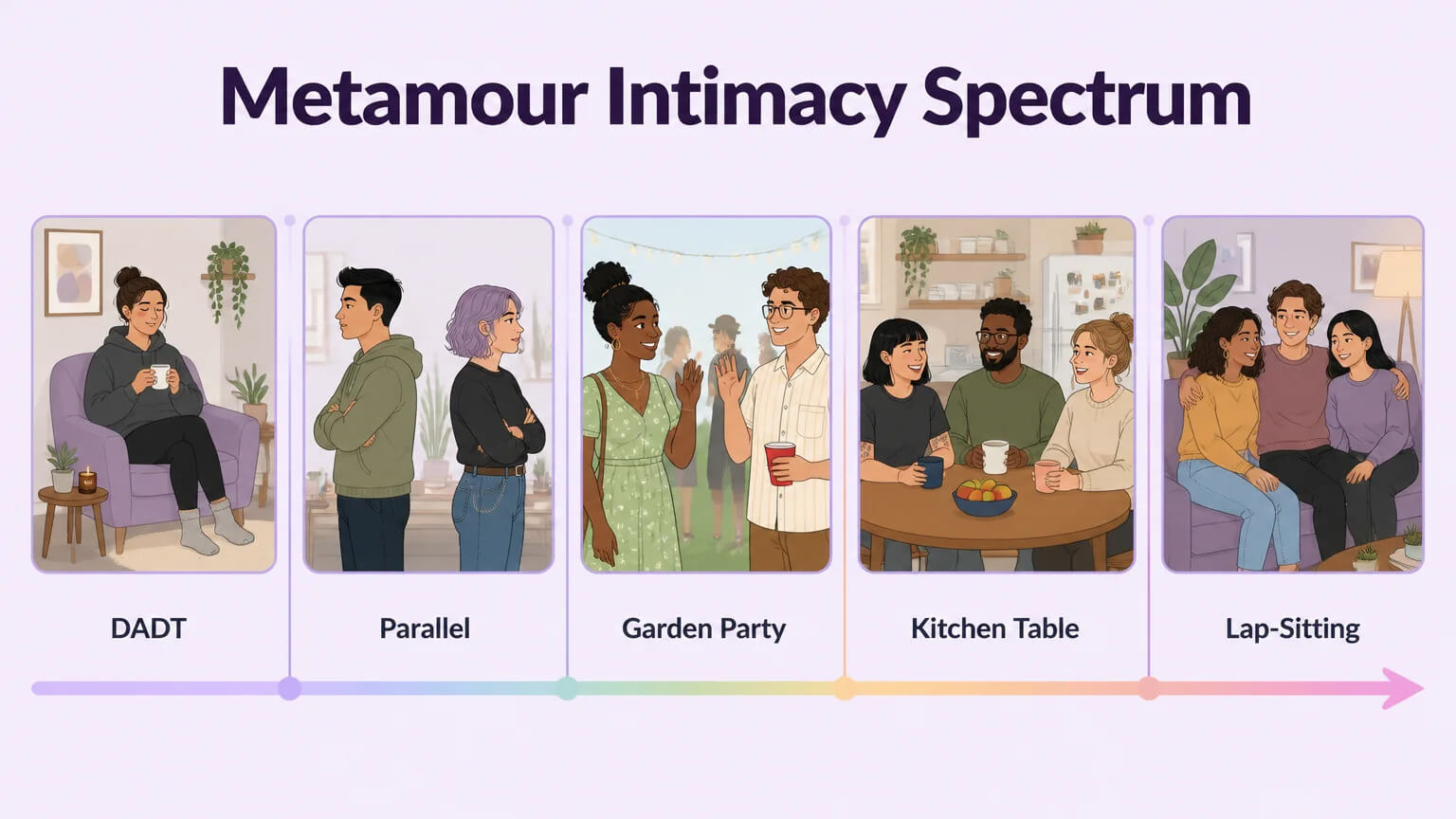
Lap-sitting only makes sense when you see the full range. The metamour intimacy spectrum, popularized by the Multiamory podcast and now widely used across the polyamory community, describes five levels of how much contact and entwinement metamours have with each other.
Don’t Ask, Don’t Tell (DADT). You know your partner has other relationships. You prefer not to hear about them. Metamours have zero interaction. Entwinement: none.
Parallel Polyamory. Relationships run alongside each other without intersecting. Metamours have little to no contact. Information flows only through the hinge (the shared partner). Some choose this to protect emotional space. Others find it suits long-distance dynamics. Entwinement: low.
Garden Party Polyamory. Metamours are friendly when they’re in the same space at a birthday or a holiday gathering, but don’t seek out independent friendship. Think: “I’ll see you at the party, and I’ll be genuinely glad you’re there.” Entwinement: low to medium.
Kitchen Table Polyamory. Metamours are comfortable enough to share meals together. There’s an intentional effort to build friendship or family-like bonds. They may chat independently, coordinate surprises for the hinge, and actively support each other. Think: “Come over for dinner. Bring your other partner.” Entwinement: medium to high.
Lap-Sitting Polyamory. Metamours have a deeply bonded relationship. They may be best friends, romantic or sexual partners, cohabitants, or co-parents. Shared finances, group decision-making, and community cohesion are common. Think: “These people are my family, in every practical sense of the word.” Entwinement: very high.
| Style | Metamour Relationship | Entwinement | Real-World Analogy |
|---|---|---|---|
| DADT | No interaction | None | Separate departments |
| Parallel | Polite awareness, no contact | Low | Neighbors who wave |
| Garden Party | Friendly at events | Low-Medium | Colleagues at the holiday party |
| Kitchen Table | Intentional friendship | Medium-High | Close extended family |
| Lap-Sitting | Deep bond, possibly romantic/sexual | Very High | Immediate family under one roof |
Two things to understand about this spectrum: First, it’s not a hierarchy. No style is “better” or “more evolved” than another. Health is determined by consent and fit, not by how close or distant metamours are. Second, you can practice different styles with different metamours at the same time. Your polycule isn’t one setting applied uniformly. You negotiate each relationship independently.
What Lap-Sitting Actually Looks Like
Definitions are useful. Stories are better.
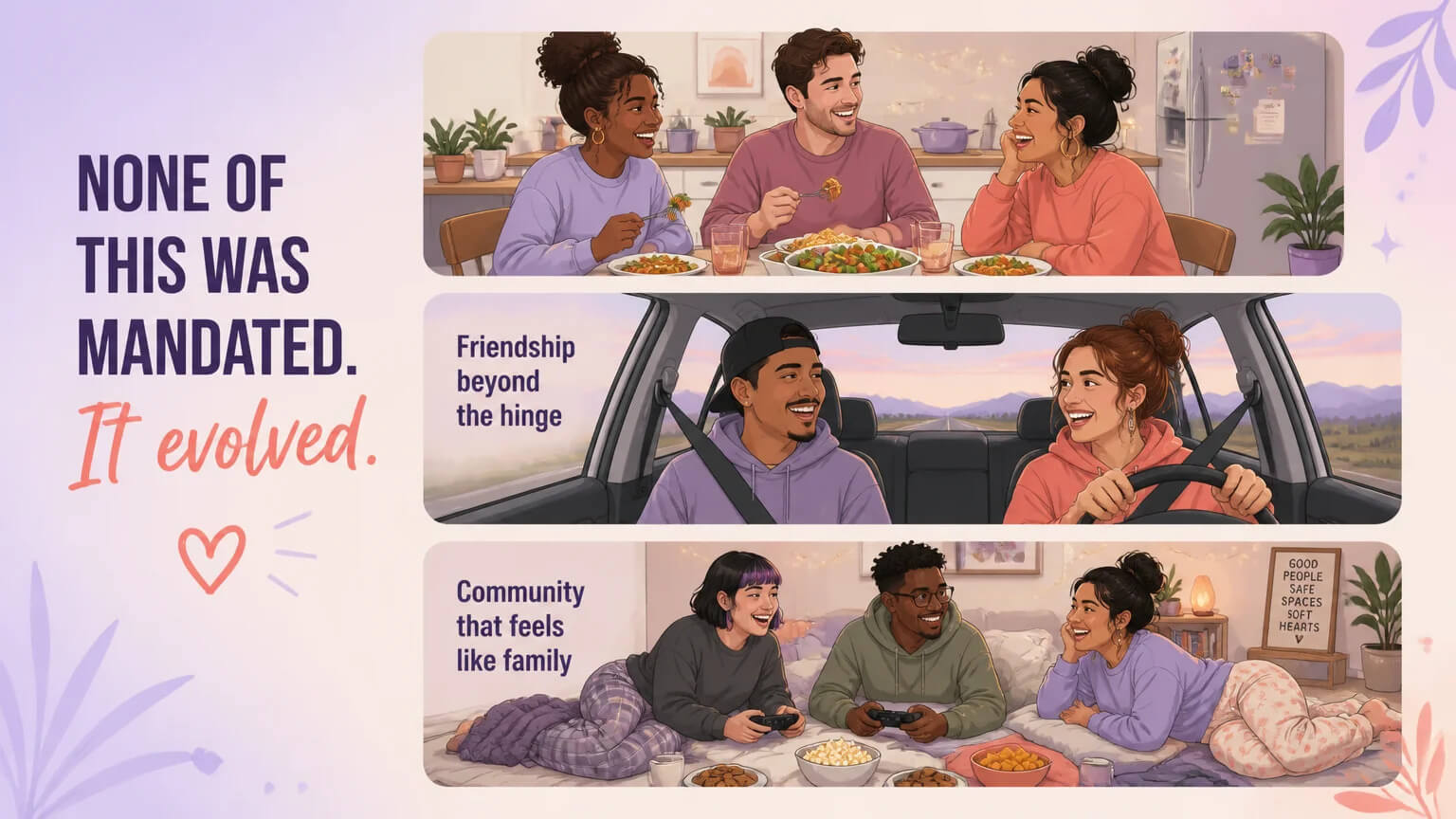
One person in the polyamory community describes a five-year arrangement where they live with their partner and metamour. All three attend each other’s family functions. Bills are split three ways. Group dinners. Group sex. Road trips between metamours without the hinge, just because they enjoy each other’s company. Both metamours have an independent friendship and sexual connection that operates separately from the shared partner. “We’re just kinda doing what feels right for us,” they wrote, “and letting our connection evolve naturally in whatever form that takes.”
Another describes an artists’ collective where people live, train, perform, and party together. Connections arise fast. Metamours meet on day one, share space, share meals, share creative work. “I keep reading about how this type of thing is destined to crash and burn,” one member wrote, “but I’ve been a part of it for five years, it’s been going on for nine, and we’re happier and healthier every season.”
Then there are the friendships that outlast the romances that created them. Minka, the polyamory blogger behind Minka Guides, describes a former metamour who became one of her closest friends. A bond that survived the end of both original relationships with the hinge. “Together, we have developed such a deep level of honesty and communication that we’re very open to exploring our connection as metamours again in the future.”
And sometimes it’s simpler than any of that. During the pandemic, a metamour moved in with their meta. No romance. No sex. Just two people who shared a partner and discovered they also shared enough life to cohabitate. Daily support, logistical ease, genuine friendship. Not every lap-sitting dynamic involves group sex or shared bank accounts.
The common thread: none were mandated. They evolved.
Why People Choose This Level of Closeness
When lap-sitting works, it solves real problems.
Community that functions like family. When your metamour is genuinely your person too, you have a support system wider than a dyad. One person described navigating mental health crises together and maintaining “a solid system of support to keep everyone healthy, including participating in each other’s therapies.” As another put it: “It’s hard not to feel warm and fuzzy when you have that amount of love and security in your life.”
Logistical ease. Cohabitation, shared resources, coordinated schedules. When multiple adults function as a household unit, the friction of managing separate lives drops. Childcare gets covered. Rent gets split. Someone’s always around to feed the cat. The daily benefits compound: one less rent check, one more person in the rotation for school pickups, one more set of hands when life gets heavy.
Relationships that outlast the romance. Deep metamour bonds (friendships, co-parenting arrangements, creative partnerships) can survive the end of the romantic connections that created them. The investment isn’t just in the hinge. It’s in the community.
The through-line is simple: these benefits only materialize when the closeness is freely chosen. Mandated closeness produces none of them. A forced family dinner doesn’t build community. It builds resentment.
The Risks: When Closeness Crosses Into Coercion
The original coiner of the term wasn’t celebrating lap-sitting polyamory. Page described it as falling “in that gray zone between consent and non-consent, with people being coerced to have relationships that they normally wouldn’t have in order to preserve ones that they would.”
That critique deserves honest engagement. Here are the specific risks.
The package deal. You’re dating someone. They want you to also be close, maybe very close, with their other partner. If you decline, the original relationship ends. This isn’t community-building. It’s a condition of access dressed up as polyamory.
The bait-and-switch. A partner presents as wanting kitchen table polyamory. Slowly, “optional” group hangouts become mandatory. “Wouldn’t it be nice if we all…” becomes “I need you to…” As Minka Guides puts it: “If your new partner tells you that they expect you to have a sexual or romantic connection with your metamour, or even strongly hints at it, I personally think you should run a mile.”
Privacy erosion. In deeply enmeshed dynamics, intimate dyadic details flow freely. Your partner processes their other relationship with you in detail. Your meta hears about your arguments. Without explicit agreements about what information stays where, the whole system becomes transparent in ways nobody fully consented to.
Breakup complexity. When relationships within an enmeshed polycule end, housing, finances, friendships, and community ties all get disrupted at once. As one community member put it: “Most people just are poor hinges and can’t manage the emotional dexterity such closeness requires.”
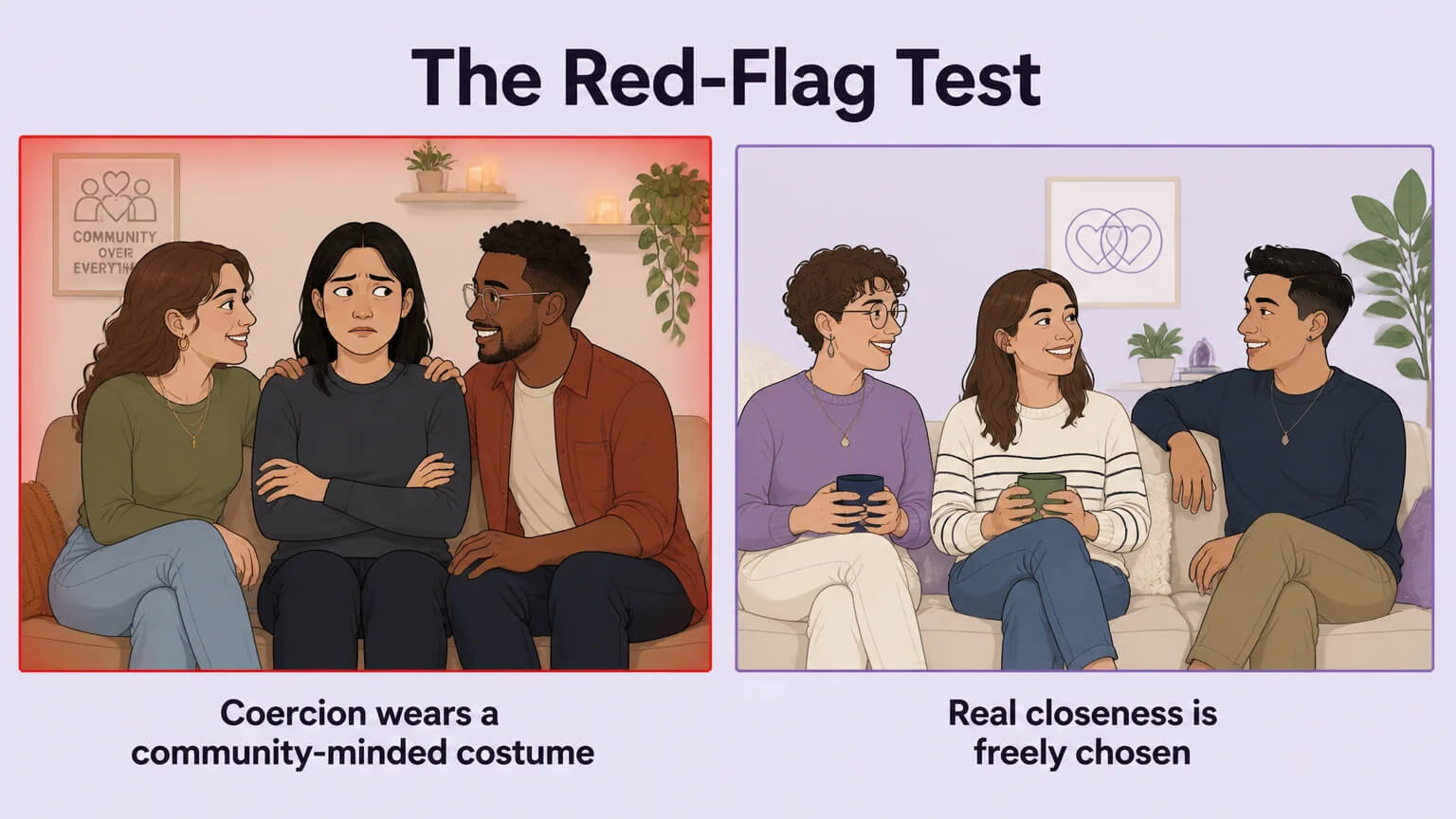
The red-flag test: if you feel like you can’t say no to closeness without losing connection, that’s not lap-sitting. That’s coercion wearing a community-minded costume.
How to Find Your Place on the Spectrum
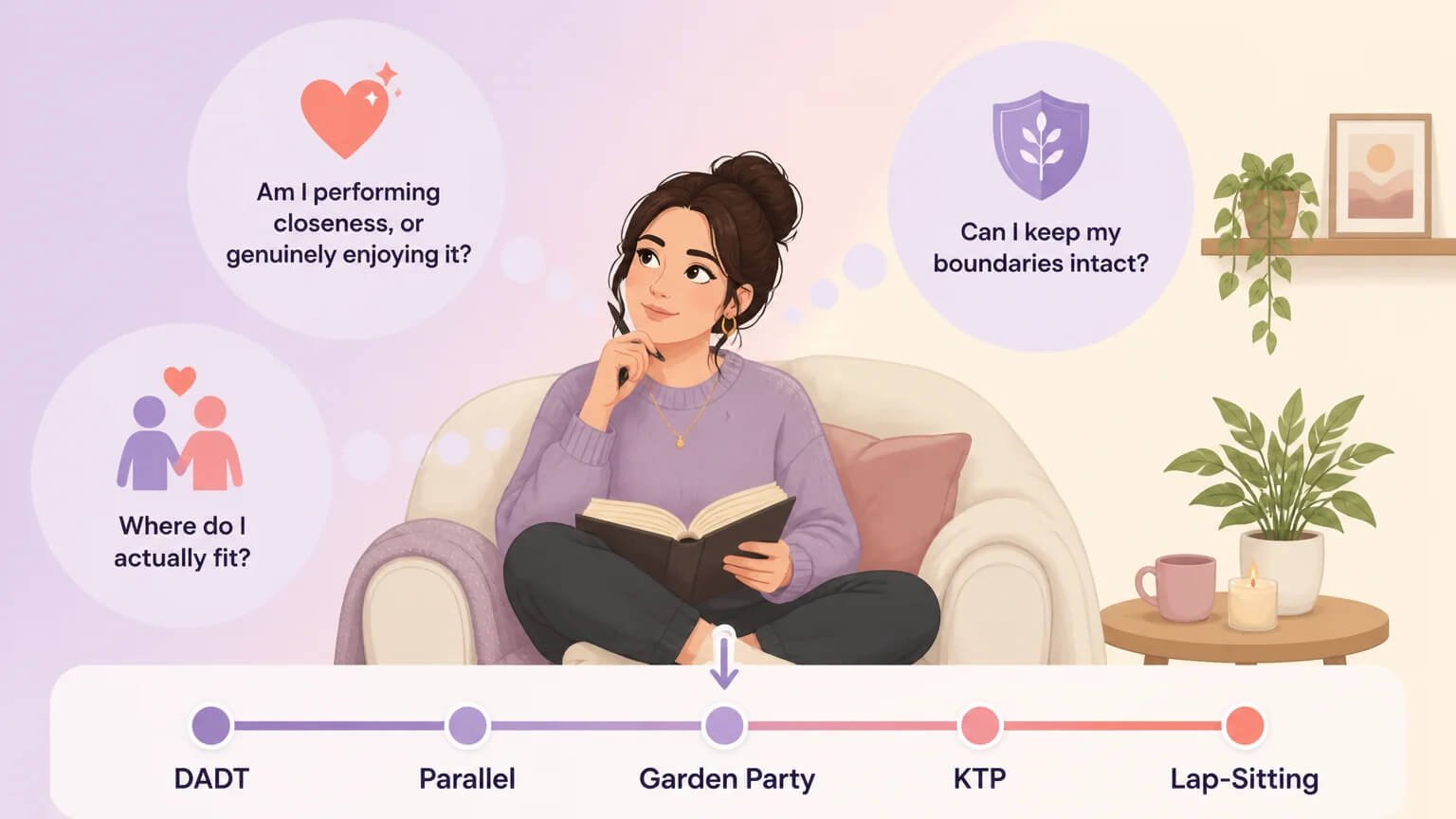
Knowing the spectrum exists is one thing. Applying it to your actual relationships is another. Here are four questions to sit with, ideally with your partner, and ideally before anyone else enters the picture.
Do I genuinely enjoy this metamour’s company, or am I performing closeness to keep my partner happy? If the honest answer is the latter, the arrangement isn’t serving you.
Can I maintain my individual boundaries and identity within this level of enmeshment? Deep closeness shouldn’t mean losing yourself. If you consistently override your own needs to preserve group harmony, the system is extracting more than it’s giving.
If one relationship in this system ends, am I prepared for the complexity? Not as a reason to avoid closeness. As something to have clear agreements about before it happens.
Is the level of closeness I want being reciprocated? Pushing for more than the other person wants is the most common failure mode. Enthusiasm must be mutual.
Once you’ve done the internal work, have the external conversation. Laura Boyle, the polyamory educator behind Ready for Polyamory, offers a script that works whether you’re asking for more closeness or less:
“I think you’re a good person and you and [hinge] seem very happy, but I’d be more comfortable with [more/less] closeness. What that looks like for me is…”
Start with less closeness and walk it up slowly. Pulling back later is much harder than starting conservative. And the metamour arrangement is between you and your metamour. Your hinge partner doesn’t get to dictate it.
The Emotional Toolkit That Makes Deep Closeness Sustainable
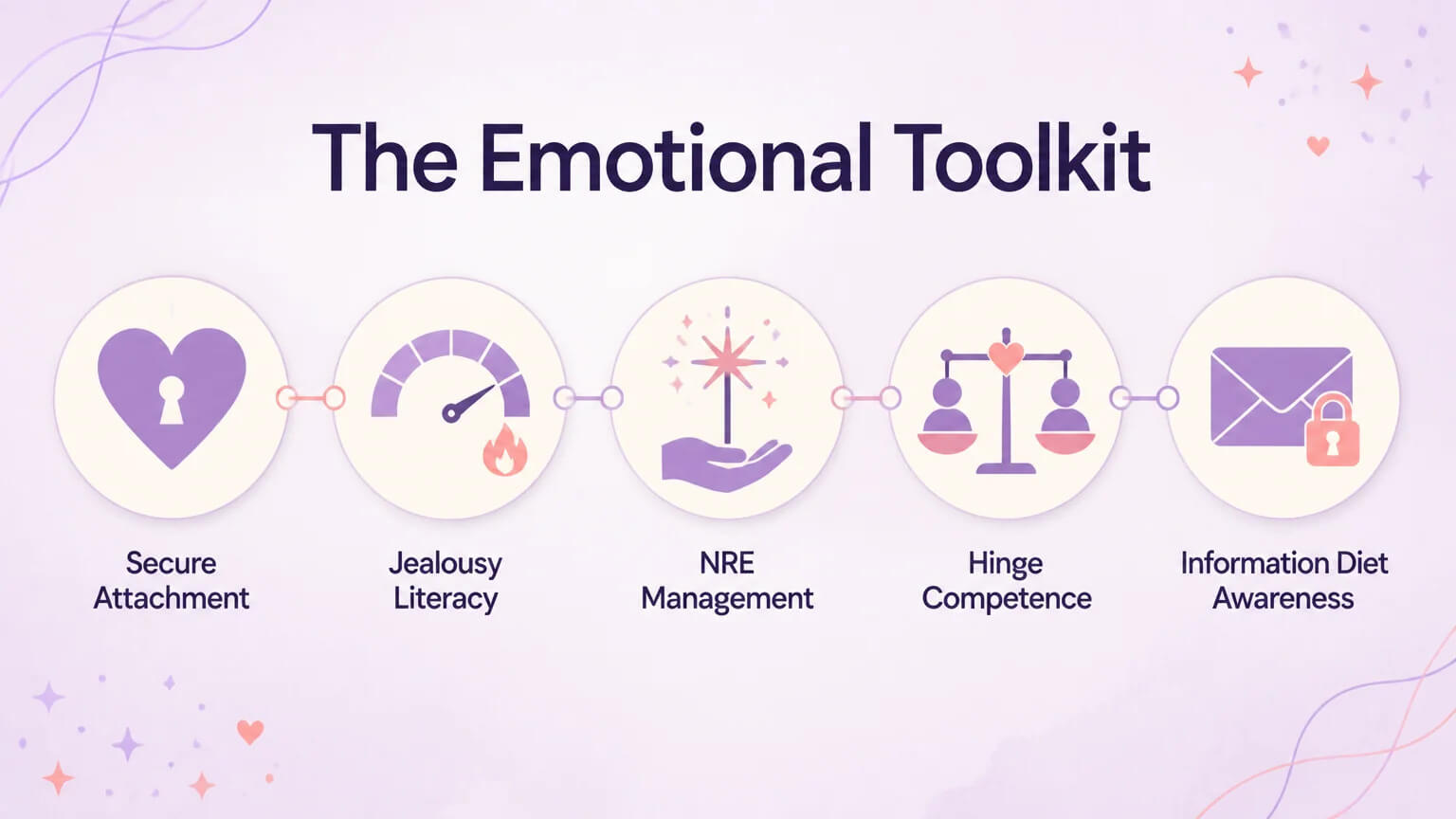
Lap-sitting polyamory isn’t entry-level. It asks more of everyone involved. Here are the skills that make it sustainable rather than combustible.
Secure attachment. Each person must be capable of self-soothing: regulating their own emotions without outsourcing that job to partners. If you need constant reassurance to feel safe, deep enmeshment amplifies every insecurity rather than soothing it.
Jealousy literacy. Jealousy isn’t a stop sign. It’s a dashboard light: information about where your emotional engine needs attention. In lap-sitting dynamics, you’ll encounter it. The skill is processing it without making it everyone else’s emergency.
NRE management. New Relationship Energy is intoxicating. It’s also notorious for making people neglect existing partners and overshare with metas. The rule: your NRE is your responsibility. Process it with the new person or a therapist, not by offloading it onto your existing partner during your scheduled time together.
Hinge competence. The shared partner carries disproportionate responsibility. They must manage multiple relationships without triangulation, without oversharing, and without expecting closeness between metas. A weak hinge is the single most reliable predictor of chaos.
Information diet awareness. Privacy is not secrecy. Transparency is not blanket disclosure. Intimate dyadic details (your arguments, your sex life, your partner’s vulnerabilities) require explicit consent before being shared with a metamour. When in doubt, ask: would this person want me sharing this?
If you and your partners have these skills, any point on the spectrum, including lap-sitting, becomes genuinely available to you. Without them, even parallel polyamory is hard.
FAQ
Is lap-sitting polyamory the same as a triad?
No. A triad means three people all in romantic relationships with each other. Lap-sitting describes the degree of closeness between metamours, which can be platonic, sexual, or romantic. Many lap-sitting arrangements are not triads. You can be deeply entwined with a metamour as a best friend or co-parent without romantic involvement.
Can I practice lap-sitting with one metamour but not another?
Yes. The spectrum applies per relationship, not per polycule. You might have a close, lap-sitting dynamic with one metamour while maintaining a garden-party or parallel arrangement with another. Each metamour relationship is independently negotiated.
What if my partner wants this level of closeness but I don’t?
That’s a compatibility issue, not something you need to fix about yourself. Your metamour relationships belong to you and your metamour. Your hinge partner does not get to dictate them. A partner who presents lap-sitting as a requirement for dating them is showing you a red flag, not a relationship model.
Are couples new to ethical non-monogamy ready for lap-sitting?
Generally, no. Lap-sitting requires advanced emotional skills that most newly opened couples haven’t yet developed: secure attachment, jealousy literacy, NRE management. A more sustainable approach: start with clear agreements and lower entwinement. Let closeness evolve organically. The goal isn’t to arrive at lap-sitting. The goal is to build dynamics that genuinely work for everyone involved, whatever style that turns out to be.
Where’s the line between healthy transparency and oversharing?
Healthy transparency covers logistics, health status relevant to sexual safety, and general emotional well-being. Oversharing means processing intimate relationship details (your arguments, your partner’s vulnerabilities, your sex life) without that person’s consent. The one-question test: would this person want me sharing this? If you’re not sure, ask them.
Is lap-sitting healthier than parallel polyamory?
No. The health of any relationship structure is determined by consent, communication, and whether it meets the authentic needs of everyone involved, not by how close or distant metamours are. A fully consensual parallel arrangement is healthier than a coerced lap-sitting one. An organically evolved lap-sitting dynamic can be wonderfully healthy. The measure isn’t closeness. It’s choice.