You have heard the term. Maybe someone you are dating mentioned it. Maybe you stumbled across it late at night and could not look away. And now you want the actual answer to what is BDSM: not the scandalized news clip, not the porn version, not the whispered joke at a party.
BDSM is a consensual framework for exploring power, sensation, and trust. It is not one activity. It is not one type of person. It is not a pathology, a broken relationship, or a sign that something went wrong in your wiring.
Research suggests over 90% of adults have fantasized about some form of power play or kink. Curiosity does not make you unusual. It makes you human. This article covers what the letters actually stand for, why anyone would enjoy this, how safety works, and whether exploring it means you belong to some secret club. By the end, you will know enough to decide whether and how far you want to explore. You do not need to join anything, buy anything, or become anyone other than who you already are.
What Does BDSM Stand For: Breaking Down the Acronym
When people ask what is BDSM, the six-letter acronym is where most explanations start and end. What gets skipped is where these ideas came from and why they sit under one umbrella.
BD stands for Bondage and Discipline. Bondage involves restraint: ropes, cuffs, silk scarves, or a hand pressed into the mattress. Discipline involves rules, structure, and agreed consequences for breaking them. Think less “punishment” and more “a framework someone willingly steps into because the structure itself feels good.”
DS stands for Dominance and Submission. This is the consensual power exchange at the heart of many BDSM dynamics. One person leads. Another willingly follows. The Dominant holds authority within boundaries both people negotiated. The Submissive experiences release through surrender. Neither role reflects what someone is like outside the dynamic. Many Dominants are quiet and collaborative in daily life. Many Submissives run companies, manage teams, and make decisions all day.
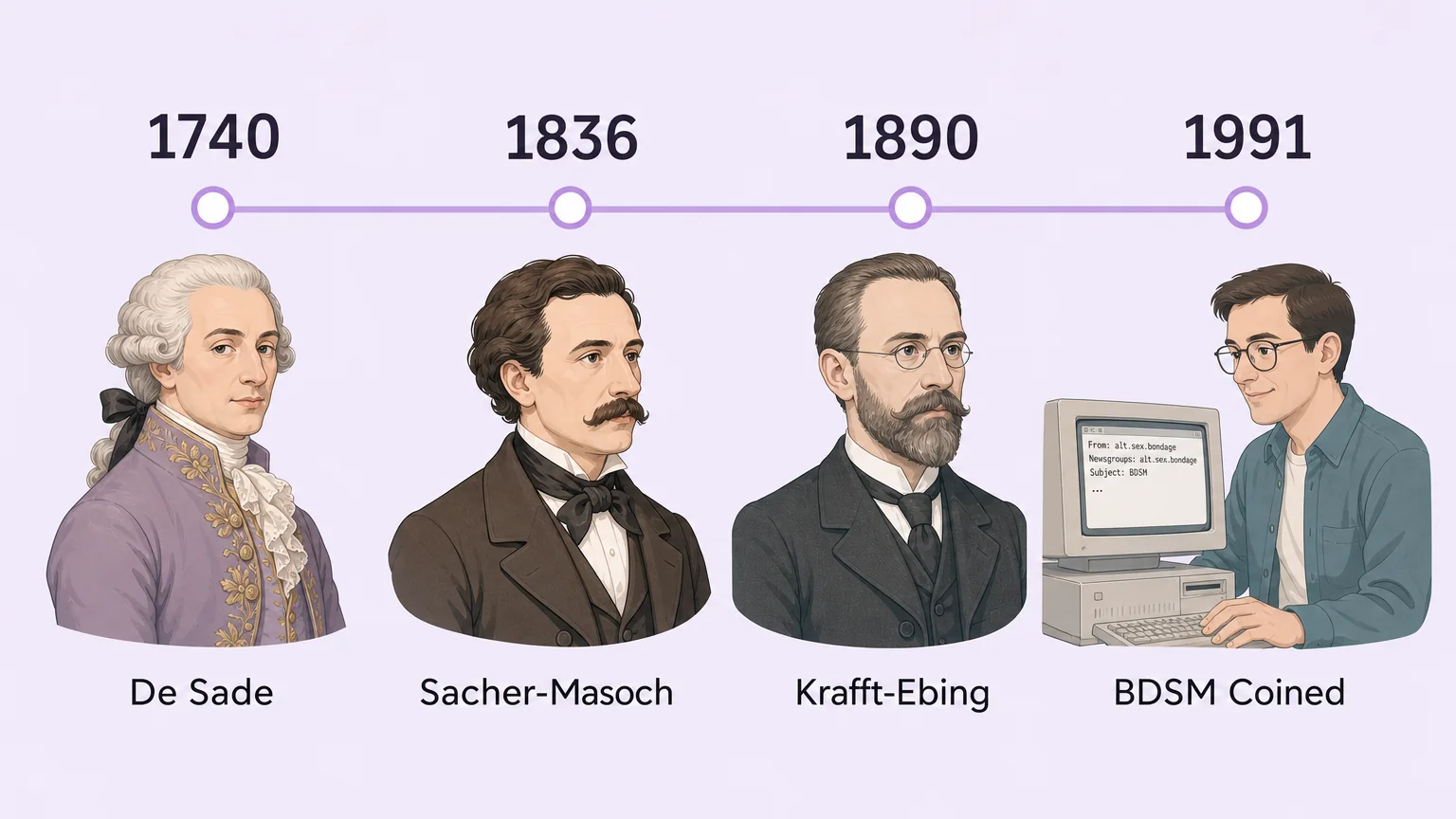
SM stands for Sadism and Masochism. These words come from actual people. The Marquis de Sade, a French aristocrat who lived from 1740 to 1814, wrote extensively about pleasure derived through inflicting sensation. Leopold von Sacher-Masoch, an Austrian author born in 1836, wrote about deriving pleasure from receiving pain. The term “sadomasochism” was coined by psychiatrist Richard von Krafft-Ebing in 1890, well over a century ago.
Here is where it gets interesting: the full acronym BDSM itself is surprisingly modern. Its earliest known use appeared in a 1991 Usenet post. The term is barely older than the World Wide Web. This reframes the entire conversation. BDSM is not some ancient secret society with an unbroken lineage. It is a recent label, stitched together from much older ideas, for desires people have always had.
The six letters cover a vast range of activities and identities. Most people who practice BDSM do not engage with all of them. Someone might love rope bondage and have zero interest in power exchange. Someone else might live in a Dominant/submissive dynamic without ever incorporating physical sensation play. The letters are a menu, not a checklist. If you want that menu spelled out, here is a field guide to the types of BDSM, from beginner-friendly restraint to advanced edge play. And this variety leads directly to the question most beginners are too embarrassed to ask out loud.
The Psychology of BDSM: Why Pain, Power, and Surrender Feel Good
If you have ever wondered why anyone would voluntarily sign up for pain or surrender control, you are asking the right question. The answer is more interesting than “some people are just wired differently,” though that is also true.
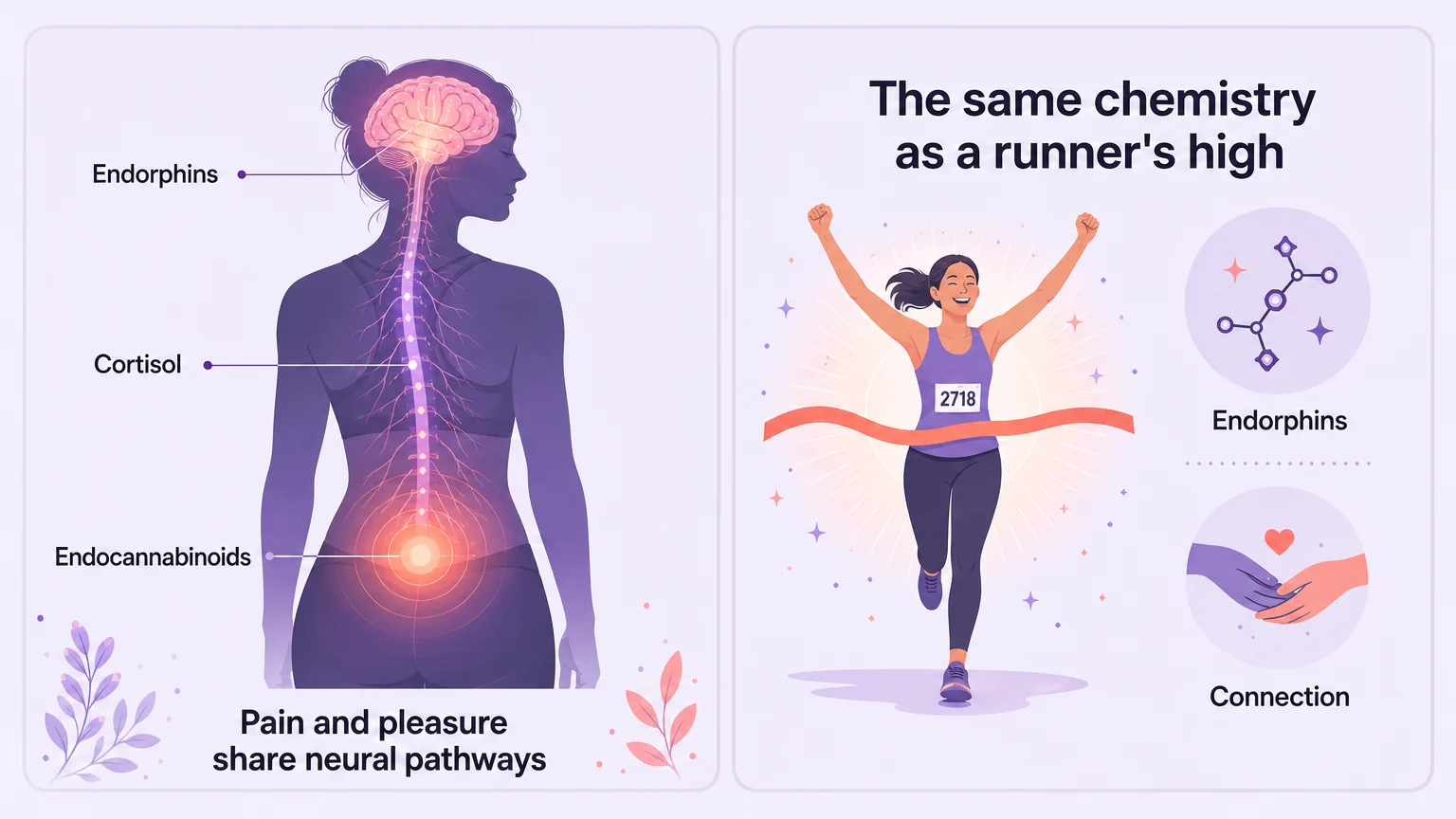
Start with biology. During intense sensation, the body releases a cocktail of endorphins, cortisol, and endocannabinoids. This is the same internal chemistry behind a runner’s high. The brain does not process pain as a single, fixed signal. Context changes everything. Research by Wuyts et al. (2020) studied 35 BDSM couples and found submissives showed significant cortisol increases that correlated positively with pleasure biomarkers. Both dominants and submissives showed elevated levels of 2-AG and anandamide, the same endocannabinoids that produce the euphoria of a runner’s high.
The shared neurology runs even deeper. Pain and sexual pleasure travel through the same spinothalamic tract in the spinal cord. Research on spinal cord injury patients found that when this pathway was severed, people lost both pain sensation and orgasmic ability. Both returned together when sensation was restored. The hardware does not distinguish them as cleanly as our conscious minds do. A slap during sex lands differently in the nervous system than a slap during an argument. Same sensation, completely different meaning.
There is a psychological layer, and for many people it matters more than the biology. Power exchange can create a state of deep mental release. If you spend your days making decisions, managing responsibility, and holding things together, surrendering control for a defined period can feel like taking off a heavy backpack you did not realize you were wearing. If you feel invisible in daily life, being the focus of someone’s intense, deliberate attention can feel like being truly seen for the first time all week.
This is what researchers call eustress: the positive stress that feels exciting rather than threatening. The difference between the thrill before a roller coaster drops and the dread before a difficult conversation. Same physiological arousal, radically different emotional experience. Understanding what is BDSM requires getting this distinction. The body responds to intensity; the brain assigns meaning.
Then there is the healing angle, and it deserves care. BDSM is not therapy. No scene replaces a licensed professional. But practitioners consistently report improved communication skills, deeper self-knowledge, and reduced shame about their bodies and desires. As kink educator Evie Lupine puts it, BDSM is not a substitute for therapy but can be genuinely healing. The DSM-5 has explicitly distinguished consensual BDSM from paraphilic disorders since 2013. Enjoying kink is not a pathology. Fewer than 5% of people who engage in BDSM meet clinical criteria for a paraphilic disorder.
These desires tend to cluster into recognizable patterns. That leads to the next question most beginners ask.
The Core Roles: Dominant, Submissive, Switch, and Beyond
If you are picturing leather-clad archetypes speaking in dramatic monologues, put that image aside. Most people in BDSM look nothing like the movie version. You do not need to pick a costume to explore a role. You may not need a role at all.
Still, the vocabulary helps. Three core roles describe the most common ways people orient themselves within BDSM dynamics.
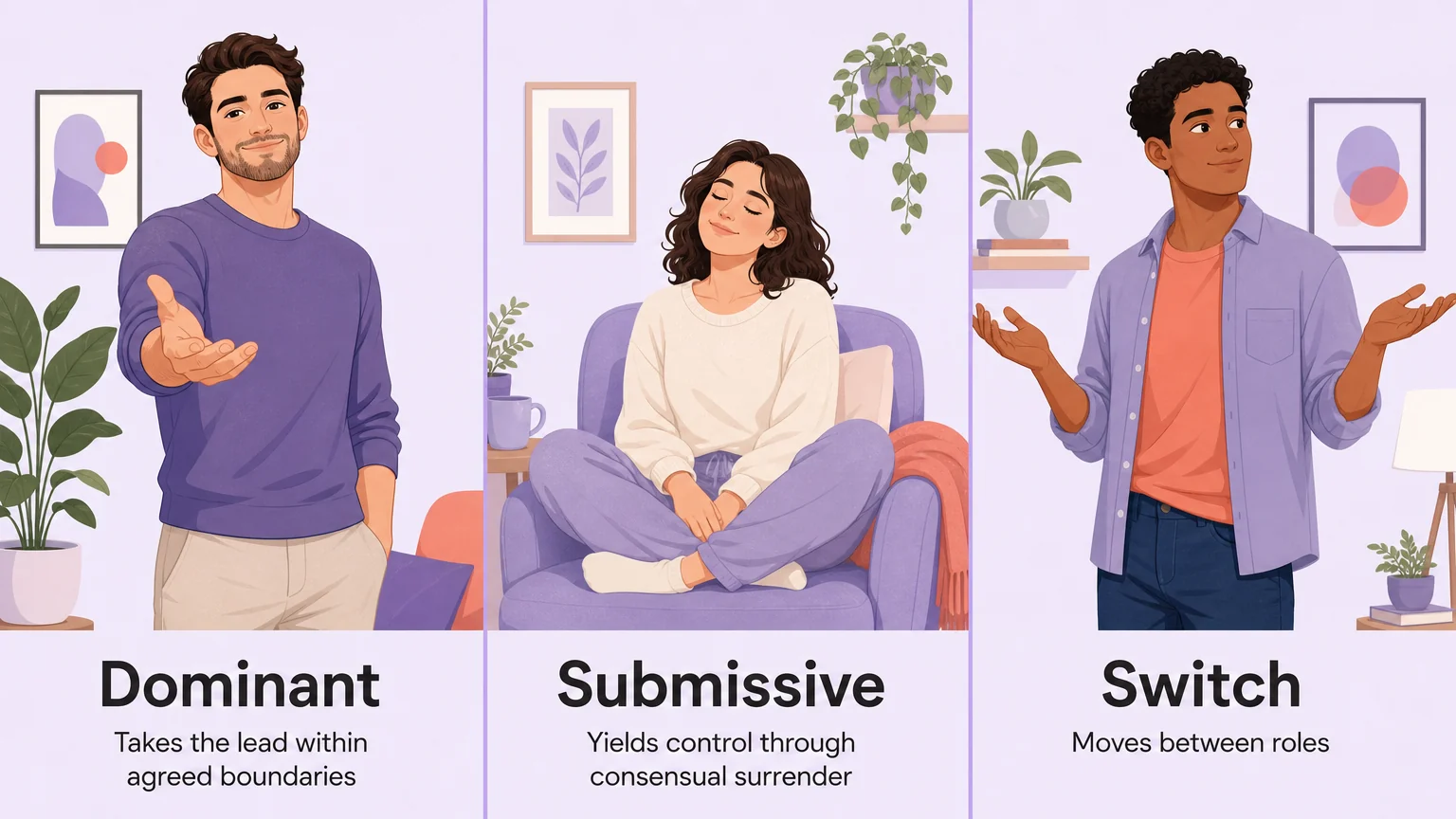
A Dominant takes the lead, directs the scene, and holds authority within agreed boundaries. But a Dominant is not simply bossy or controlling. The satisfaction comes from being trusted with someone’s vulnerability. Someone hands you the keys to their body, their attention, their surrender. That is not power taken. That is power earned, and carrying it well requires self-awareness, restraint, and genuine care for the person who placed it in your hands.
A Submissive yields control, follows direction, and experiences release through surrender. This is not weakness. The Submissive sets the boundaries. The Submissive defines the limits. The Submissive can end everything with a single word. In many ways, the Submissive holds the ultimate power in a scene because nothing happens without their ongoing consent. As Veronica Yanhs of Desires Laid Bare puts it: there is no one true way to be submissive. You get to make your own recipe.
A Switch moves between both roles depending on context, partner, or mood. Some Switches lean Dominant with certain people and Submissive with others. Some shift within the same relationship. Some value variety and adapt to the person in front of them.
These are starting points, not boxes. Some people identify as “tops” or “bottoms” without the power-exchange layer. Some practice kink without any role identification at all. Some discover their orientation changes over time. Kink therapist Maya Attia emphasizes that identity evolves and you should give yourself permission to change. The point is not to find your permanent category. The point is to develop language for what you want, so you can ask for it clearly when the time comes.
You do not need to pick a label today, or ever. Understanding the vocabulary simply helps you describe what you might want to try. The language exists to serve your exploration, not to cage it.
That vocabulary has a visual shorthand too. The triskelion, the three-curved emblem you see on rings and pendants, encodes those same roles, and it is one of the quiet ways the community marks itself. Our guide to BDSM symbols walks through the triskelion, collars, the handkerchief code, and the rest, so you can read the signals people wear and signal your own interests.
BDSM Consent and Safety: Safewords, SSC, and RACK Explained
The thing that lets people safely explore pain, power, and vulnerability is the same thing that looks most boring from the outside: explicit, ongoing, enthusiastic consent. This is what separates BDSM from harm, and it is the infrastructure that makes everything else possible.
BDSM communities did not invent consent. But they have developed some of the most detailed, practical consent frameworks in any subculture. The structure is not a killjoy checklist bolted onto the fun. The structure is what makes the fun possible. Without it, trust evaporates, and without trust, what is BDSM but risk without reward?
Two frameworks dominate the conversation. SSC stands for Safe, Sane, and Consensual. Activities should be reasonably safe. Everyone involved should be of sound mind, meaning not impaired by substances, exhaustion, or emotional crisis. Everything must be agreed to by everyone involved. SSC is clear, intuitive, and widely used.
RACK stands for Risk-Aware Consensual Kink. This framework acknowledges that no activity is perfectly safe and that pretending otherwise can be its own kind of danger. Instead of promising safety, RACK asks everyone to understand and accept the specific risks before participating. Neither framework is superior. RACK is often preferred for activities where objective safety cannot be guaranteed, like edge play or higher-intensity sensation work, because naming the risks directly gives everyone better information than pretending they do not exist.
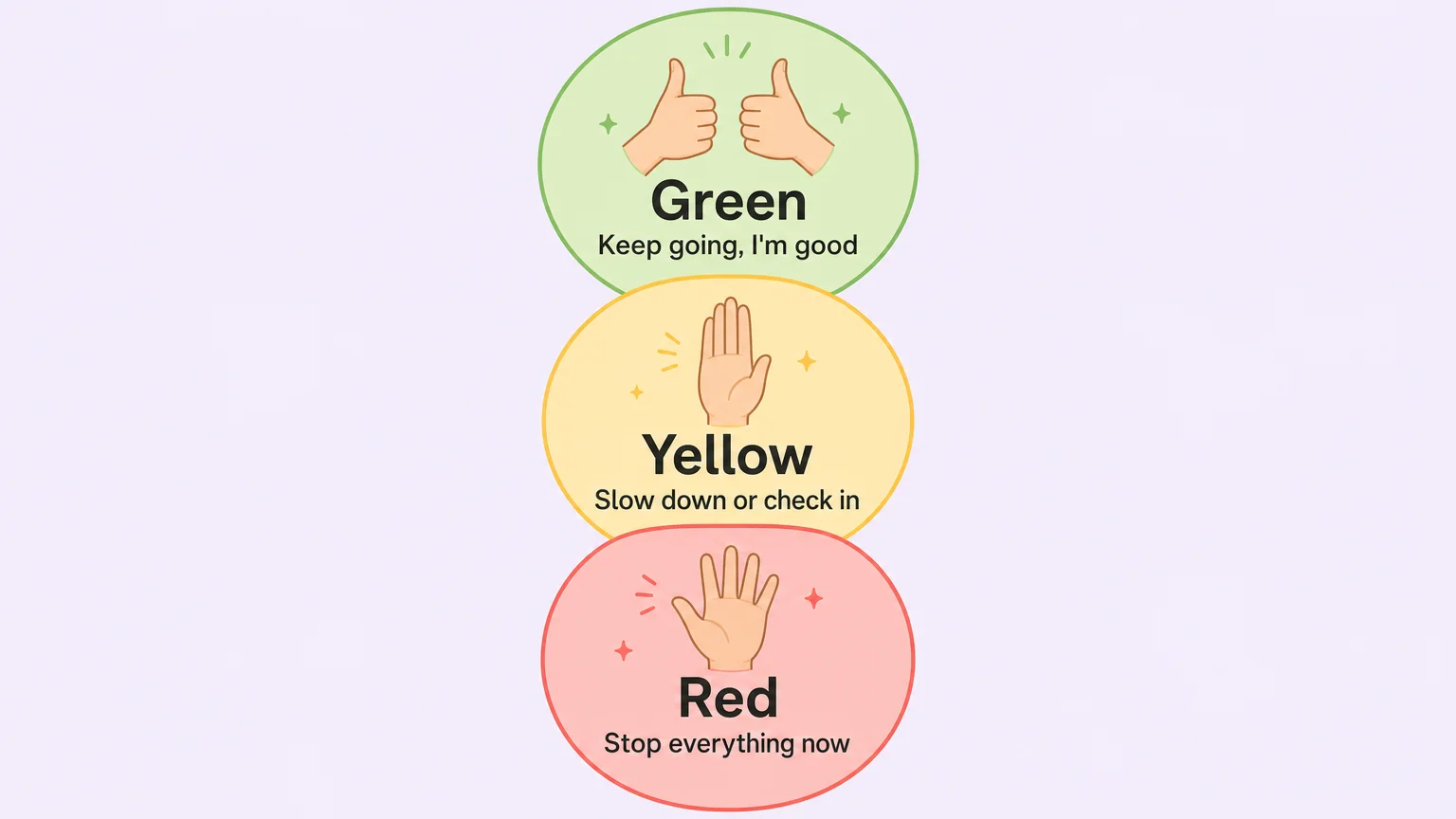
Safewords are the emergency brake that makes trust possible. A safeword is a pre-agreed signal that stops all activity immediately, no questions asked, no guilt attached. The most common system is the traffic light. Green means keep going, I am good. Yellow means slow down, check in, or adjust something. Red means stop everything now, the scene is over.
Non-verbal safewords exist for when speaking is not possible. A hand squeezing twice. A held object dropped to the floor. A specific head shake. These are not optional extras. They are the infrastructure that lets both people relax into the experience, knowing an exit will be honored without hesitation.
Consent is the ethical foundation of BDSM. It is also the legal question: whether BDSM is illegal depends on where you live and what a scene involves, because the law does not always treat consent as a shield. For the straight answer on whether BDSM is illegal, our guide covers what actually gets prosecuted, how the law varies by state and country, and how to keep your play low-risk.
Safewords are not a failure of a scene. They are communication working exactly as designed. A good partner thanks you for using one, because you just gave them information they needed. Consent must be ongoing and can be withdrawn at any moment. Enthusiasm in minute one does not obligate anyone for minute ten.
The BDSM Spectrum: Light Kink to 24/7 Lifestyle
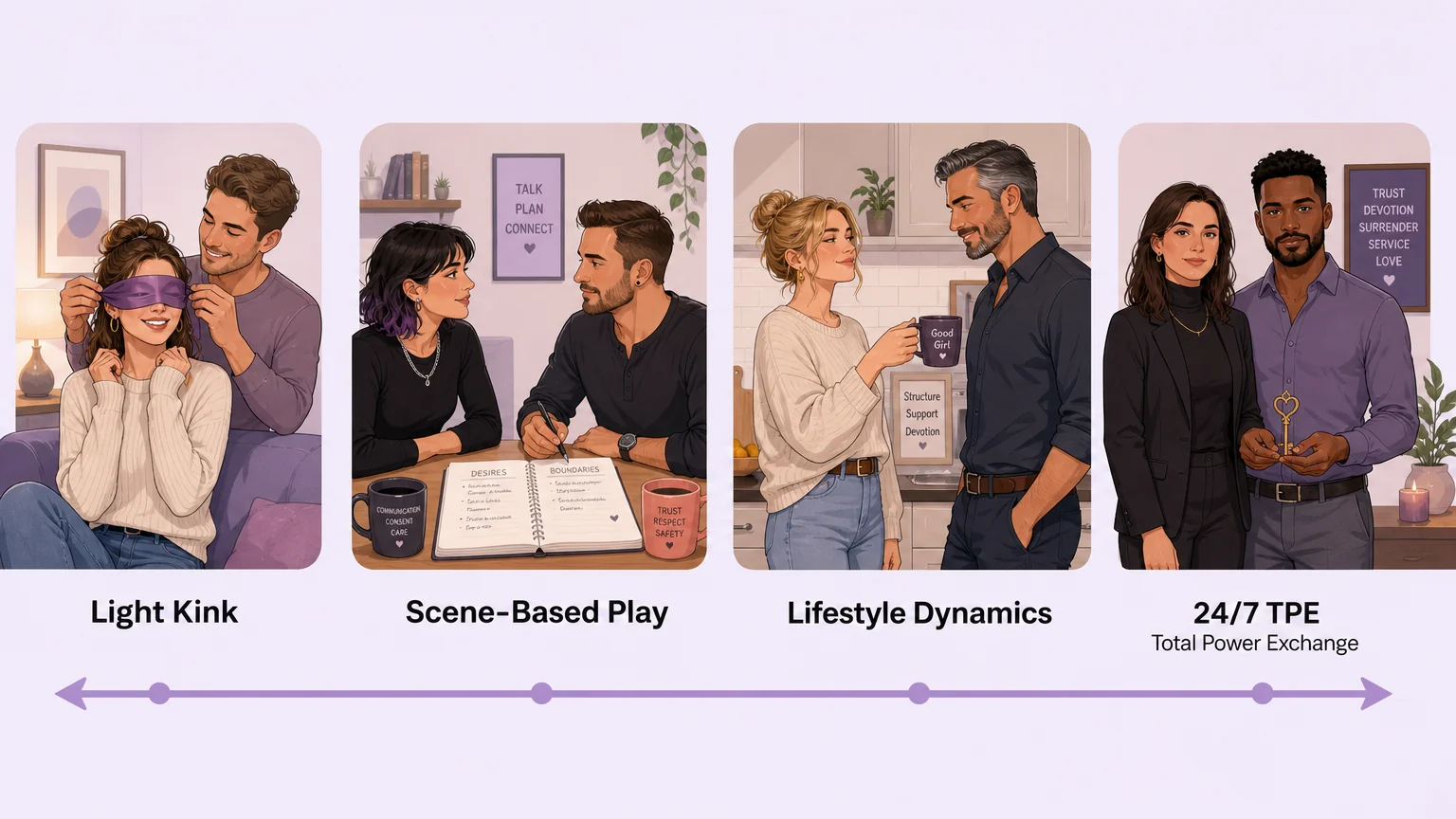
BDSM is not a switch you flip. It is a dial you can turn as far as you want, in whatever direction interests you.
On one end of the spectrum: a couple who occasionally uses a silk scarf as a blindfold during sex. On the other: a pair who have negotiated a 24/7 Total Power Exchange where one partner has agreed authority over specific areas of the other’s daily life. Both are BDSM. Most people live somewhere in the vast middle, and most never move to either extreme.
Light kink lives at the accessible end. Occasional sensory play. Light restraint. Playful power dynamics like one person taking charge for an evening. Many couples already do some version of this without naming it. A blindfold. A firm instruction. A teasing dynamic where one person waits for permission. If it feels a little daring and a little fun, it counts.
Scene-based play is the next zone. Negotiated, time-bound sessions focused on specific activities. A couple sets aside Saturday evening for a planned scene: discuss beforehand, do it, check in afterward, return to normal. Some call this the “weekend kinkster” model. It is probably the most common pattern among people who self-identify as kinky.
Lifestyle dynamics extend power exchange beyond sexual contexts. Rules, rituals, and protocols weave into daily life. A Submissive might have agreed tasks. A Dominant might hold decision-making authority in specific domains. The dynamic colors the relationship without consuming it.
24/7 Total Power Exchange sits at the far end. One partner holds full-time negotiated authority. This is rare, often misunderstood, and not a goal most people aim for. It requires extraordinary communication, deep self-knowledge, and a commitment level most would find unsustainable.
One distinction worth attention: play versus lifestyle. Many people engage in BDSM purely as occasional play without it being part of their identity. Others consider it a core orientation, as central to who they are as their sexuality. Both are legitimate. Neither is more authentic. Crucially, BDSM does not require sex. Non-sexual BDSM is common: impact play scenes, rope bondage as art, service-oriented dynamics. Some people engage purely for the sensations, the headspace, the aesthetic, or the connection, with zero genital contact involved.
You choose your depth. Curiosity does not commit you to the deep end. The dial is in your hand the entire time.
How to Start Exploring BDSM as a Curious Beginner
Before you buy anything, before you download any app, before you have a single conversation with a partner: sit with your own curiosity without judgment. This is the step most people skip, and it determines whether exploration feels expansive or stressful.
Shame and guilt about these desires are common. They are also learned responses, not truths about who you are. Kink therapist Maya Attia puts it plainly: shame is learned, and what is learned can be unlearned.
Start with a simple self-reflection. What specifically piques your curiosity? Is it the sensory side, the way certain textures, temperatures, or sensations sound interesting? Is it the power side, the idea of someone else taking charge or the idea of surrendering control yourself? Is it the aesthetic side, the look and feel of certain materials or scenarios? Is it the emotional side, the promise of deeper connection through shared vulnerability? There are no wrong answers. You are mapping your own mind, not taking a test.
Once you have a rough sense of what draws you, here is the practical roadmap.
Learn first, act later. Read “Kink Curious” by Gigi Engle or “Kink For Dummies” by Jaime M. Grant. Watch educator channels on YouTube. Evie Lupine and Desires Laid Bare produce accessible content that answers questions you might not feel ready to ask anyone directly.
Journal on what draws you and what your hard limits are. Knowing what you do not want matters as much as knowing what you do. You can be curious about rope bondage and uninterested in pain. Your no-list is not prudish. It is clarifying.
If you have a partner, approach the conversation as exploration, not demand. Use “I” statements about your curiosity. “I have been reading about this and wanted to share it with you” lands differently than “I want us to start doing this.” Let them process. They may have their own curiosity they have never voiced. They may not be interested, and that is their right.
Start smaller than you think. One new sensation or one new dynamic element is a successful first step. A blindfold. A single instruction. Ten minutes where one person is fully in charge. If you are looking for specific ideas to try, we put together 19 BDSM ideas for couples, organized from zero equipment to gentle tools. You discover whether the shallow end feels good before swimming deeper.
When you are ready to move from curiosity to action, our step-by-step guide walks you through this BDSM beginner guide and these BDSM tips for beginners from the opening conversation to negotiation, safewords, and aftercare.
If a few ideas spark something and you want to build a more structured dynamic, our BDSM training guide takes you from your first negotiation to exercises that deepen connection — step by step, at your own pace.
Consider a munch: a casual, vanilla-dress social gathering of kinky people at a restaurant or bar. No play happens. People show up in jeans, order appetizers, and talk about normal life. FetLife is the most common platform for finding local events.
When you try something physical, negotiate explicitly beforehand. Use a safeword system, even if you think you will not need it. Knowing you can stop makes it safe to start.
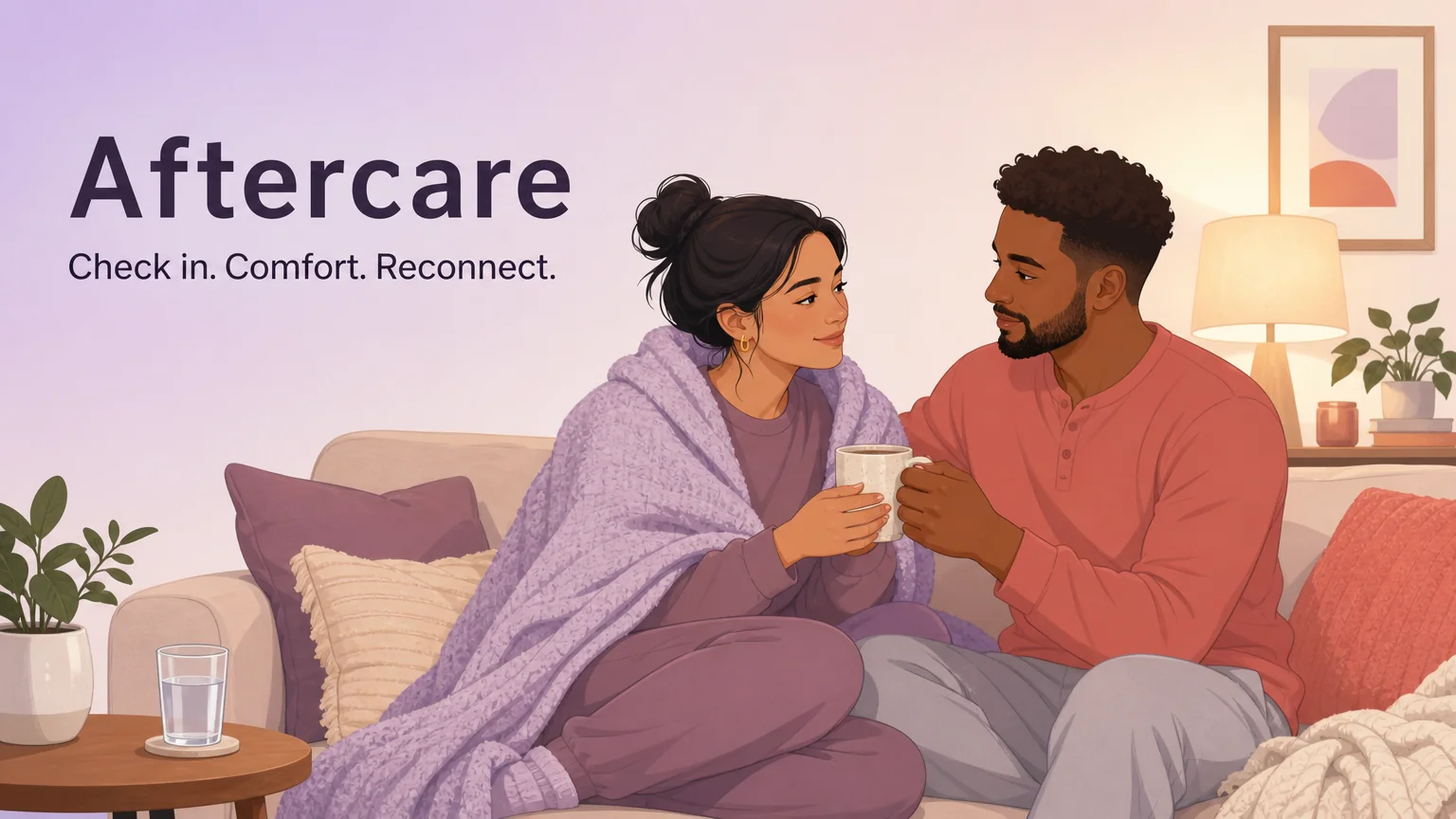
Plan aftercare: the intentional check-in, comfort, and reconnection afterward. Water. A blanket. Quiet conversation. Processing. Aftercare is not an add-on. Skipping it leaves people emotionally raw in ways that can surface hours or days later. If you feel interested in this topic, you can check this guide of ours with more details: BDSM Aftercare: The Complete Guide to Coming Down Together.
Curiosity without action is also valid. You can learn, read, and reflect without ever doing a single scene. Understanding your own mind is a complete outcome. No one is keeping score.
BDSM Red Flags: How to Spot Unhealthy Dynamics vs. Healthy Kink
The same structures that make BDSM safe, like trust, communication, and consent, are exactly what bad actors exploit. Knowing the difference between a healthy dynamic and a harmful one is not about being paranoid. It is about being informed.
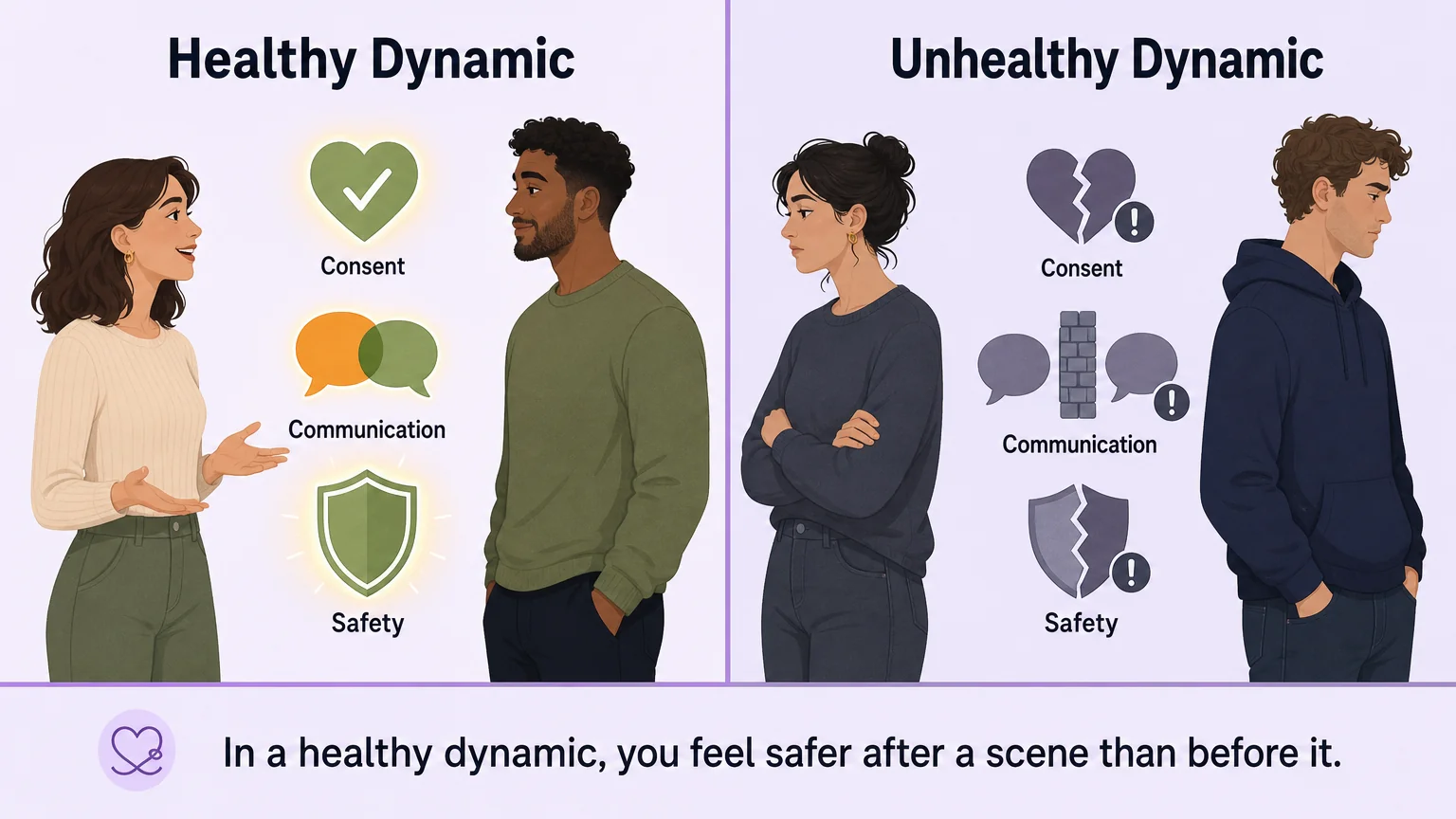
The core distinction is simple. In healthy BDSM, limits are respected, safewords are honored immediately, and negotiation happens before anything else. In unhealthy dynamics, limits become obstacles to overcome, safewords get dismissed or ignored, and negotiation is skipped or one-sided.
Some specific red flags are common enough to deserve their own spotlight.
“A real submissive has no limits.” This shows up in dating site or app, forums, and DMs from strangers. It is a lie. Submission is freely given within negotiated boundaries. Someone who tells you your limits disqualify you is telling you they do not intend to respect you.
“You just have not found the right Dominant yet. Let me show you.” Grooming language dressed as mentorship. A genuine mentor respects your pace, answers questions without an agenda, and never positions themselves as the solution to your inexperience.
“If you safeword, you are letting me down.” This inverts safewords from protection to obligation. A good partner thanks you for using one. Anyone who frames it as failure or disappointing performance is dangerous.
Other flags: refusing to discuss experience or references, isolating you from community, pressuring you to move faster than agreed, dismissing aftercare as unnecessary, treating BDSM as a cover for unprocessed anger.
The American Association of Sexuality Educators, Counselors, and Therapists (AASECT) offers a clear framework: the difference between BDSM and abuse is not the activity. It is the consent, the negotiation, and the ability to say no and have that no actually respected.
A simple litmus test: in a healthy dynamic, you feel safer after a scene than before it. Your partner just proved they will stop when you say stop. They demonstrated that your boundaries matter more than their gratification. That builds trust at a level most relationships never reach.
If something feels wrong, it probably is. Your gut is part of your safety system. Do not override it to seem open-minded. The person worth exploring with thanks you for speaking up, not the one who makes you feel difficult for doing so.
FAQ: Common Questions About BDSM
What does each letter in BDSM stand for?
Bondage and Discipline (BD), Dominance and Submission (DS), Sadism and Masochism (SM). Bondage involves restraint. Discipline involves rules and agreed consequences. Dominance is consensual authority. Submission is consensual surrender. Sadism means deriving pleasure from giving sensation, including pain. Masochism means deriving pleasure from receiving it. The acronym first appeared in a 1991 Usenet post, a modern label for desires that have always existed.
Is BDSM the same as rough sex?
No. BDSM is fundamentally about consensual power exchange, sensation play, and psychological dynamics. Rough sex is about intensity during sex. BDSM can be entirely non-sexual. Some practitioners do rope art, sensation scenes, or service dynamics without sexual contact. The eroticism often lives in the headspace and the dynamic, not just physical stimulation.
How common is BDSM?
More common than most people assume. Roughly 46% of adults have engaged in some form of BDSM behavior, and over 90% have had fantasies involving power dynamics or kink. About 7.6% identify as regular practitioners. You are in much larger company than you probably think.
Do I need to pick a role?
No. Roles are descriptive, not prescriptive. Some people identify strongly as Dominant, submissive, or switch. Others use no labels at all. Some discover their orientation evolves over time. You can explore activities without committing to an identity. The vocabulary helps you describe what you want, not assign you a category.
Is enjoying BDSM a sign of mental illness or trauma?
No. The DSM-5 has explicitly distinguished consensual BDSM from paraphilic disorders since 2013. Fewer than 5% of people who engage in BDSM meet clinical criteria for a paraphilic disorder. Enjoying kink is not a pathology. BDSM is not a substitute for therapy. Some people find kink healing, but it works alongside professional support, not as a replacement.
What is the difference between SSC and RACK?
SSC (Safe, Sane, Consensual) holds that activities should be safe, undertaken with sound judgment, and fully consensual. RACK (Risk-Aware Consensual Kink) acknowledges no activity is perfectly safe and instead emphasizes understanding and accepting specific risks before participating. Neither is superior. RACK is often preferred for higher-risk activities where safety cannot be objectively guaranteed.
How do I tell a partner I am curious about BDSM?
Start with “I” statements about your own curiosity, not demands. Choose a calm, private moment. Be ready for them to need time to process. Share articles or resources rather than asking for an immediate answer. Frame it as exploration, not an ultimatum. Your partner may have their own unspoken curiosity, or they may not be interested. Both responses are valid. Neither is a rejection of you.
What is aftercare and why does it matter?
Aftercare is the intentional check-in, comfort, and reconnection time after a BDSM scene. It can include physical care like water, blankets, and snacks. It often includes emotional processing: talking through what happened, what felt good, what felt complicated. Intense experiences can leave people emotionally vulnerable. Aftercare helps everyone return to baseline safely and reconnect as equals. It is not optional. A partner who dismisses aftercare is a partner to reconsider.