
Wanting punishment in your relationship doesn’t mean something is broken. It means you’re building a structure most couples never learn to build.
The difference between BDSM punishment that corrects and punishment that connects is knowing what you’re actually doing. Not just grabbing a paddle and hoping it lands right. Not guessing whether this is discipline or foreplay. Understanding the architecture underneath.
Below you’ll find 31 specific punishments organized into six categories: psychological and sensory methods that reach inside without leaving a mark, physical impact calibrated to your specific intensity range, denial and restriction for couples who want to start somewhere accessible, task-based discipline that turns correction into output, humiliation that stays on the right side of the bright line, and tech-enabled tools that keep long-distance dynamics accountable across time zones.
This is not a list of “try this” suggestions. It’s a decision system. No guesswork. No hoping the paddle lands right. Just a framework you can calibrate to your specific relationship. You’ll walk away knowing which category matches your dynamic, how to calibrate intensity, what to do before, during, and after every punishment scene, and how to repair when something goes wrong.
But first, before a single punishment idea, you need the one distinction that separates healthy discipline from a dynamic that drifts.
Punishment vs Funishment: The One Distinction That Defines Your Entire Dynamic
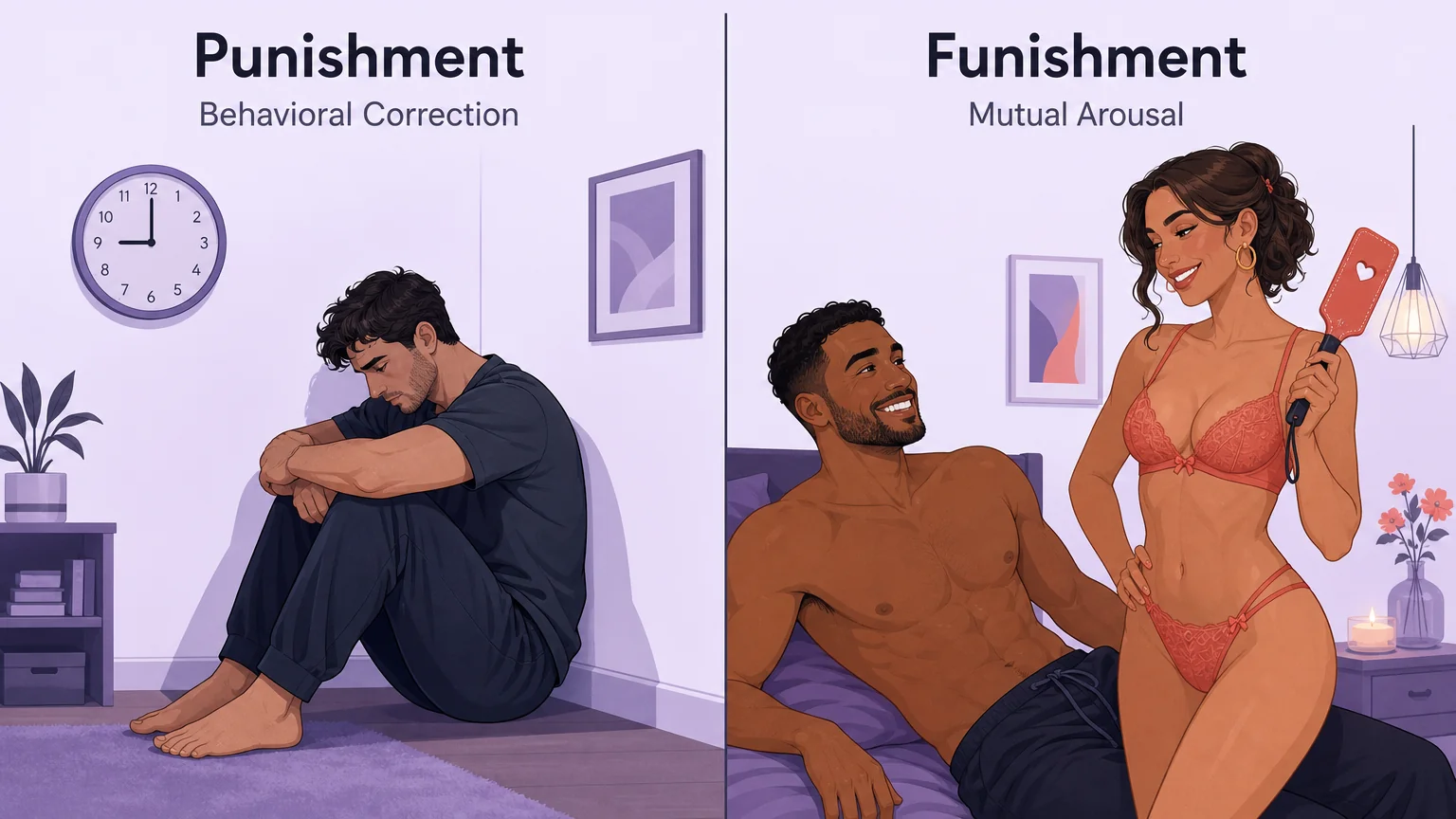
Punishment and funishment live on opposite sides of the same street. Walk into the wrong house and someone gets hurt in a way you didn’t plan.
Here is the concrete split.
The submissive partner violated a phone check-in protocol. Not a game. A real agreement they both take seriously. The Dominant assigns corner time, fifteen minutes, followed by a written reflection letter. The sub does not enjoy this. The purpose is genuine behavioral correction. The sub feels accountable, not aroused. That’s punishment.
Same scenario, different intent. The submissive deliberately “forgot” the check-in, grinning, testing the fence. The Dom “punishes” with a spanking. Both find it deeply arousing. The purpose is mutual enjoyment inside a roleplay frame. The sub feels challenged and desired, not corrected. That’s funishment.
Both are valid. Both can strengthen a dynamic. But mixing them up without realizing it erodes trust faster than anything else in BDSM.
Here is the three-part test to know which mode you’re in:
- Does the sub genuinely want to avoid this consequence? If yes, it’s punishment. If no, you’re in funishment territory.
- Is the purpose behavioral change or mutual arousal? Punishment aims to correct. Funishment aims to connect through play.
- Would this make sense if neither party found it arousing? If the answer is yes, it’s punishment. If the whole thing collapses without arousal, it’s funishment.
Most dynamics live somewhere on a spectrum between these poles. Some couples practice pure punishment, others pure funishment. Most float between depending on the day, the infraction, and the headspace. The key is that both partners know which mode they are in at any given moment. Mixed signals cause damage. A sub who thinks they’re being playfully spanked but is actually being disciplined feels gaslit. A Dom who thinks they’re delivering correction but is actually being sexually teased feels undermined.
Clarify the mode before the scene. Every time. We’ll return to this with the negotiation scripts and protocol framework toward the end, because the mode determines everything that follows.
1. Psychological and Sensory Punishments: Write Lines, Corner Time, Orgasm Control, and More

Psychological punishment only works inside deep trust. You are reaching into someone’s interior world. If you don’t know the shape of that world, stay out.
What makes these methods psychological is the mechanism, not the action. They direct internal attention toward the infraction and its resolution.
Writing lines embeds the rule through repetition. Writing “I will complete my nightly check-in by 10pm” fifty times connects hand to mind in a way reading never does. Tie the count to severity: twenty-five for a first minor slip, one hundred for a repeated pattern. The Dom reads the lines afterward. That step closes the loop.
Corner time or timeout removes external stimulation and creates unstructured reflection space. Five to fifteen minutes for beginners. No phone, no music, no distraction. Just the sub, the wall, and the thing they did. Short enough to avoid dissociation, long enough to feel consequential.
Sensory deprivation at the beginner level means blindfold and silence with no restraint. The removal of input forces internal processing. Ten minutes in a quiet room, blindfold on, nothing else. No bondage. No restraint. The vulnerability is already high enough. The Dom stays present in the room, a quiet witness. If sensory deprivation crosses into panic territory for your sub, this is not their punishment method.
The reflection letter is structured: what happened, why it violated the dynamic, what will change. It’s analysis, not apology, though it may contain apology. The Dom provides the prompt questions. The sub writes the answers. This transforms punishment from something done to the sub into something the sub participates in processing.
Orgasm control as discipline is distinct from orgasm control as play. The tone is instructional, not teasing. “You don’t get to come tonight because you broke your protocol, and I need you to sit with that” lands differently than “Maybe if you’re good I’ll let you.” One is discipline. The other is edging dressed as authority. Know which one you’re delivering.
Aftercare for psychological punishment needs extra attention because psychological methods linger differently than physical sensation. The sub needs explicit verbal reassurance that the punishment is over and they are valued. “We’re done. You took your consequence seriously. I’m proud of you. Come here.” Say it. Don’t assume the sub knows it because you stayed in the room.
2. Physical and Impact Punishments: Spanking, Stress Positions, Cold Exposure, and Finding the Right Intensity

Separate your tools. Keep punishment implements physically apart from play implements. A paddle used for ten funishment scenes carries different energy than one reserved for genuine correction. The sub needs to know which world they’re in the moment the implement appears. This prevents the psychological blur between discipline and arousal.
Hand spanking is the entry point for physical punishment. Most intimate, easiest to calibrate. Your hand reads your partner’s body in real time. You feel the muscle tension, the flinch, the release. A paddle doesn’t give you that. Start here and graduate only when you can read your sub’s physical response with precision.
Implement impact graduates by tool: crop, paddle, belt. A crop stings sharp and localized. A paddle thuds broad and deep. Match implement to message. A protocol slip earns the crop’s precise sting. A pattern of disregard earns the paddle’s broader statement. Always warm up, even for punishment. The discipline is in the correction, not in skipping preparation.
Stress positions hold the body in place for a set duration. Kneeling, arms extended, a specific stance. Physical without impact, which makes this accessible for dynamics where striking is a hard limit. Start with two minutes. Watch for shaking, breathing changes, signs the sub is checking out mentally rather than processing.
Physical exertion turns discipline into output. Wall sits, planks, push-ups. The sub’s body works while their mind works. Useful for service-oriented dynamics where physical capability is a point of pride. Count aloud or set a timer. The Dom’s role is witness, not drill sergeant. The difference is everything.
Cold exposure is brief and intense. A thirty-second cold shower or a splash of cold water. Intense enough to register, brief enough to leave no marks. Advanced. Cold reads differently depending on the sub’s history and constitution. Test outside a punishment context first. Never spring cold exposure on a sub who hasn’t experienced it with you before.
Punishment impact and scene impact live in different emotional registers. In a scene, impact builds toward connection, arousal, release. In punishment, impact delivers consequence. The Dom’s tone stays calm and measured. The sub receives and processes. The warmth comes after, in aftercare. During, the temperature is deliberate and low.
3. Denial and Restriction Punishments: Orgasm Denial, Screen Bans, Furniture Privileges, and When Removal Works Best

Denial is the most accessible entry point for couples new to BDSM punishment. No tools required. No impact. No risk of physical misjudgment. Just the removal of something familiar. That empty space is where reflection happens.
Orgasm denial as punishment ties duration to severity. Two days for a minor slip. A week for something significant. The Dom communicates the timeline clearly at the start. “You broke the rule. You don’t get to come until Friday.” The sub knows exactly what the consequence is and when it ends. Ambiguity is not discipline. It’s negligence.
Furniture and comfort restriction is deeply symbolic for dynamics sharing living space. No couch for the evening. Sitting on the floor beside the Dom instead. Visible, tangible, constant. It reminds without a word being spoken. This works especially well in domestic discipline dynamics where the home itself is the container.
Attention denial is a scheduled silent period. One to two hours where the Dom is physically present but not engaging. The sub exists in the same space without access to the Dom’s attention. This requires strong aftercare and should never be the first punishment a couple tries. The sub must know this is structured discipline, not emotional withdrawal. If your sub has any history of abandonment or neglect, skip this method entirely.
Screen time restriction is concrete and measurable. “No phone after 9pm for three days.” No ambiguity. No interpretation. The sub either complies or does not. It pulls the sub out of the scroll and into their own head. That is exactly where the processing needs to happen.
Favorite activity removal works best when the sub identifies the activity. “What privilege, if you lost it for three days, would make you think about what you did?” The Dom doesn’t guess. The sub names it. Self-selected punishment is harder to resent. The Dom approves, enforces, and closes the loop.
Never restrict basic needs: food, water, bathroom, sleep, medical care, support network contact. Cross that line and it’s abuse. Do not approach it.
4. Productivity and Task-Based Punishments: Extra Chores, Research Assignments, Protocol Drills, and Turning Discipline Into Output
Task-based punishment transforms correction into something visible. For service-oriented submissives especially, the act of doing carries meaning that receiving does not.
Extra chores reassigned transfers the Dom’s tasks to the sub for a defined period. The Dom’s laundry, meal prep, morning coffee routine. Works best when the chore is normally the Dom’s responsibility. The sub steps into service as restitution. Duration is specific: three days, one week. Not “until I feel better about it.” The endpoint must be visible from the starting line.
Research assignments ask the sub to produce a short report on the protocol they violated. What the rule is, why it exists, what happened, and what changes. This forces the sub to understand the rule from the Dom’s perspective. The Dom reads it and acknowledges it. The point is the writing, not the grading.
Service tasks lean into the meditative side of discipline. Polishing boots, organizing a shared space, preparing a meal from scratch. The work is simple and repetitive, freeing the mind to process. Ideal for submissives who process emotion through action. The Dom assigns the task and deadline. The sub completes it. The Dom acknowledges it. The ritual closes.
The apology essay bridges punishment with emotional processing. Unlike the analytical reflection letter, it asks the sub to articulate what they regret and why: what I did, why it was wrong, how it affected you, what I commit to changing. The Dom receives it without interrupting. Read aloud or silently, depending on what the dynamic needs. Either way, received, not dismissed.
Protocol drills build muscle memory. The sub repeats a failed protocol correctly ten to twenty times while the Dom observes as a coach, not a warden. Missed a greeting ritual? Run through it until the correct action is physically embedded.
The frame matters for every method above. You are serving your way back into good standing, not performing free labor. The distinction lives in the Dom’s acknowledgment and the clean close. When the tasks are done, they are done. The slate clears. Moving on is not optional.
5. Humiliation and Degradation Punishments: Verbal Reprimands, Body Writing, Confession Rituals, and Where the Line Is
Here is the bright line. Humiliation plays with embarrassment inside a container of care. Degradation attacks identity or self-worth. If you cannot tell the difference in the moment, you are in degradation territory. Stop.
The verbal reprimand is a structured scolding. The Dom names the infraction in calm, controlled language. No raised voice. No character attacks. “You broke the check-in protocol at 11pm. That rule exists because I need to know you’re safe. When you skip it, you remove my ability to protect you. That is not acceptable.” Scripted, not improvised. The sub hears the correction without the terror.
Body writing uses temporary, non-degrading words on skin. “Accountable.” “Present.” “Mine.” Washes off. Intermediate risk because body writing can trigger unexpected responses. Test with a single neutral word before using it as a punishment tool.
Eating from a bowl on the floor is symbolic and primal. The sub eats from a bowl on the floor while the Dom eats at the table. The distance is the consequence. Advanced risk. Not for beginners. Aftercare must include explicit verbal affirmation that the sub is valued and equals outside the dynamic.
The confession ritual asks the sub to verbally admit the infraction while the Dom listens without interrupting. No defense. Just the facts, spoken to the person who holds authority. Intermediate risk. The confession closes with the Dom’s acknowledgment: “I hear you. We will address this. Thank you for telling me directly.”
A designated punishment outfit creates ritualistic separation. A specific garment worn only during discipline. Putting it on signals the transition from everyday dynamic to disciplinary space. Taking it off signals the return. Beginner-friendly. The outfit becomes a container for the role.
Aftercare is non-negotiable for every method in this category. It must include explicit verbal affirmation. “You are not diminished. You are not less. You took your consequence with dignity. I see you fully.” This is not window dressing. It is the repair sequence that prevents shame from hardening.
If you’re unsure whether something is humiliation or degradation, assume it’s degradation and do not do it. When in doubt, stay out.
6. Long-Distance and Tech-Enabled Punishments: App Tracking, Remote Toys, Video-Call Discipline, and Staying Connected When You’re Apart
Most BDSM resources assume you’re in the same room. For long-distance couples, that assumption is a slow erosion of the dynamic. Punishment across distance requires different tools, but the structural principles remain the same: clarity, calibration, closure.
The Obedience App, with over a million installs, is the standard for habit tracking inside D/s dynamics. The Dom sets rules and assigns point values. The sub self-reports completion. Missed tasks generate automatic notifications. It removes the “did you or didn’t you” ambiguity from long-distance discipline. The data is right there.
Video-call corner time places the sub on camera in a designated spot. The Dom is present but not entertaining. The Dom works, reads, exists on the other side of the screen. The sub feels the Dom’s presence without accessing their attention. Fifteen minutes. The Dom ends it with: “You’re done. Come back to me.” This works because it mirrors the in-person version: presence without engagement, the weight of being observed.
Remote-controlled toy discipline uses devices like Lovense toys that the Dom controls from anywhere. The Dom sets intensity, duration, and mode. The key variable is tone and context, not the toy itself. Punishment mode: controlled and calm. Funishment mode: teasing and escalating.
A shared journal for penance uses Penzu or a shared Google Doc. The sub writes reflections or progress updates. The Dom reads and responds. Over months, both partners can scroll back and see the arc of growth.
Photo and video proof tasks create accountability through documentation. “Send me a photo of your made bed by 9am.” Timestamped. Verifiable. These proof points close the verification gap that distance creates.
Scheduled check-in violations trigger pre-negotiated consequences stored in the Obedience App or a shared document. Missed check-ins execute automatically. No negotiation in the moment. The system runs itself.
The long-distance aftercare rule is non-negotiable: never end a video call immediately after punishment. Stay on. Sit in silence if needed. The sub needs to feel your presence, not your absence. A screen going black after a punishment scene is abandonment. Don’t do it. Five minutes minimum. Talk about something unrelated. Reconnect as people, not roles. Then end the call.
How to Match Punishment to Your Dynamic: A 5-Step Decision Framework
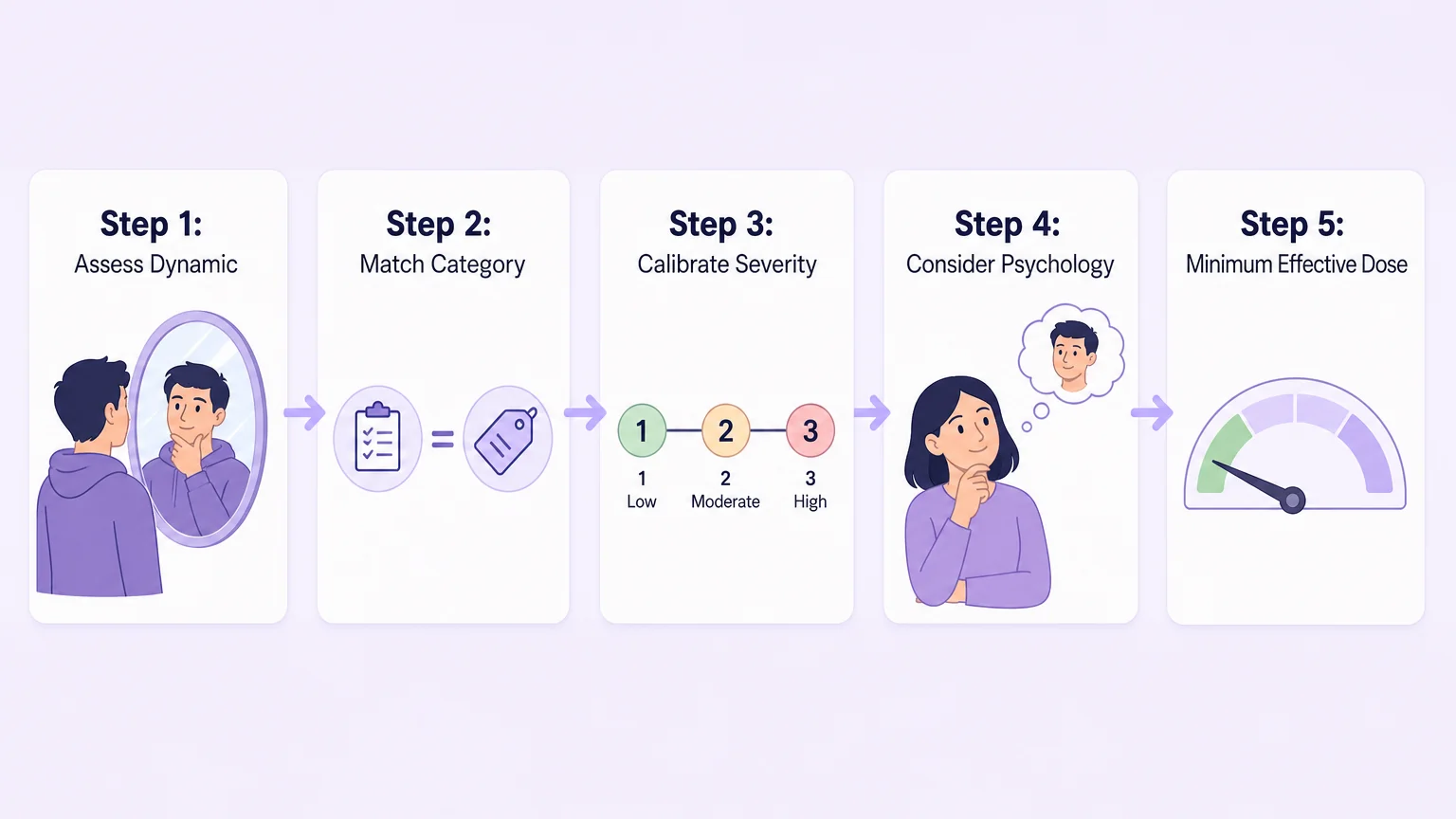
A paddle in the wrong dynamic is just violence. A writing assignment in the wrong dynamic is just homework. The punishment only works when it fits the people, the infraction, and the structure they’ve built together.
Five steps turn guesswork into a decision.
Step 1: Assess your dynamic type. Is this 24/7 D/s or bedroom-only? Service-oriented or brat and tamer? Domestic discipline or scene-based? Each type routes punishment differently. A 24/7 service-oriented dynamic might use task-based punishment naturally. A bedroom-only dynamic might find task-based punishment absurd because the authority doesn’t extend to daily life. Be honest about what your dynamic actually is.
Step 2: Match category to infraction type. Protocol violations, like missed check-ins or forgotten rituals, map to task-based or psychological punishment. Attitude problems, like eye-rolling or dismissiveness, map to psychological or light humiliation methods. Repeated negligence maps to physical or denial. When talking hasn’t worked, the consequence needs more weight.
Step 3: Calibrate severity on a 1-to-3 scale. Level 1 covers minor or first-time offenses: ten minutes of corner time, a single day of orgasm denial. The smallest dose that signals “this matters.” Level 2 addresses repeated infractions with longer duration and more intensity. Level 3 is for significant patterns with extended consequences and a formal debrief. If you jump to maximum every time, the system has no room to escalate.
Step 4: Consider the sub’s psychology. What actually deters this person, and what secretly rewards them? If the sub craves impact play, a spanking may be a reward wearing a punishment costume. Switch categories. Pick something the sub genuinely wants to avoid. Conversely, if corner time triggers abandonment panic, don’t use corner time. The punishment must deter without destabilizing.
Step 5: Apply the minimum effective dose. Start at the lowest intensity that could work. Escalate only if the behavior repeats. Return to baseline after compliance is restored. A sub who hasn’t broken a protocol in six months doesn’t need maximum intensity when they slip once. The system rewards improvement.
A quick reference to carry into negotiation: dynamic type plus infraction category points to suggested punishment category. Service-oriented plus protocol violation points to task-based. Domestic discipline plus attitude problem points to psychological. Brat and tamer plus deliberate boundary testing often points to funishment, not punishment, because the provocation is part of the play. If the framework keeps routing you to funishment, name that. Punishment may not be the tool you need. Knowing which problem you’re solving determines whether punishment is even the right tool.
The Punishment Protocol: What to Do Before, During, and After
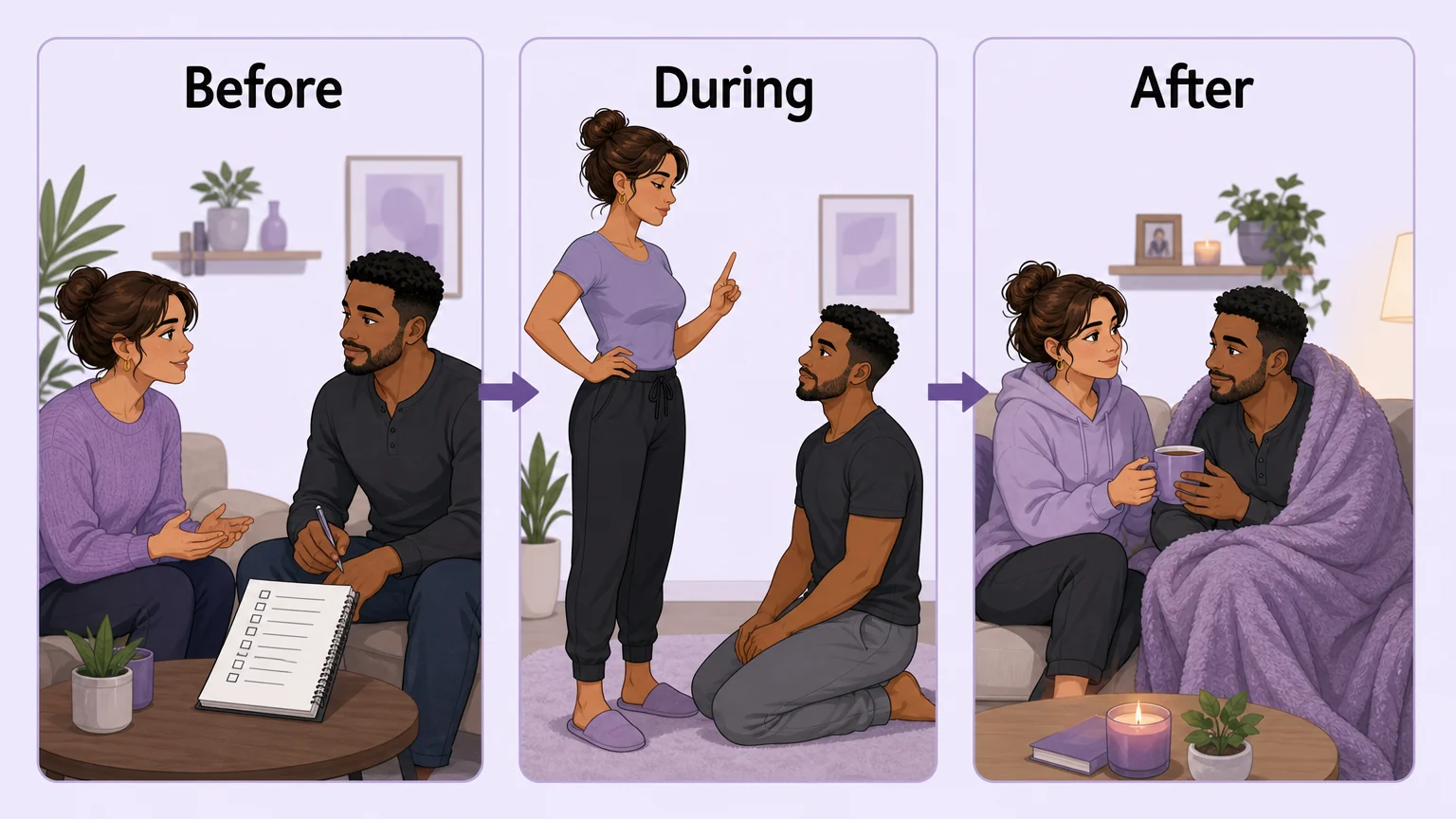
Discipline without a protocol is an argument with props. Structure makes punishment safe, effective, and repeatable. Here is the three-phase framework with scripts you can adapt to your own voice.
Phase 1: Before
Confirm the infraction, the agreed punishment, and headspace. Even if pre-negotiated, reconfirm before you begin. “We agreed missing the nightly check-in means corner time. Is that still what we’re doing tonight? How are you feeling?” If the sub is sick, emotionally raw, or not in a headspace to receive punishment, reschedule. Forcing it is not discipline.
Review the safeword. Confirm it is accessible. Check implements if physical. Assess the state of both partners. If the Dom is angry, tired, or dysregulated, the session does not happen. Punishment delivered from anger is the fastest route to abuse.
Phase 2: During
State the infraction clearly. No guessing games. The sub must know exactly why they face discipline. “You broke the check-in protocol last night. You agreed to message by 10pm. You didn’t. This is the consequence we agreed on.” Clear. Specific. No ambiguity.
Deliver without improvisation. The Dom carries out what both partners agreed to. If anger rises during the session, pause or stop. The Dom’s emotional regulation is the container that makes the sub’s vulnerability safe.
Read the sub throughout. Shaking where there is usually calm is communication. A dissociating sub needs the session to stop, safeword or not. The Dom’s responsibility is to the person, not the protocol.
Phase 3: After
Tailor aftercare to the punishment type. Physical punishment: water, blanket, gentle touch if the sub wants it. Psychological: verbal reassurance. “We’re done. You took it seriously. You’re good.” Humiliation: explicit affirmation. Long-distance: stay on the call.
The debrief uses three questions: “How did that feel? What would you change for next time? Are you back with me?” The first gathers data. The second improves future sessions. The third checks reconnection. Both partners answer. This is mutual, not a Dom-to-sub interrogation.
Reintegration signals the end. “We’re done. The slate is clean. I love you and I’m proud of you for taking this seriously.” The sub needs to hear that their standing is restored. Without this signal, the sub carries the weight into the hours and days that follow, uncertain whether the discipline is still active.
When Punishment Goes Wrong: Safewords, Repair, and Rebuilding Trust

Safewording during punishment is not failure. It is success. It means the system you built together works under pressure. When the safeword fires, everything stops. That’s the agreement. That’s the trust. Honor it instantly and completely.
The R.E.A.D. safeword protocol gives you a sequence when things go sideways. React: stop immediately. Undo restraints. The safeword is an emergency brake, not a suggestion. Evaluate: physical safety first. “Are you hurt?” Then emotional state: “What are you feeling right now?” Address the body before the story. Administer care: water, blanket, grounding, presence. Offer options and let the sub choose what they need. Debrief: wait until both partners are regulated, not five minutes later if someone is still shaking. Then walk through: “What happened? What did we miss? What changes?” This is calibration, not blame.
Brianna Nuckols, a respected kink educator, frames this as rupture and repair. Punishment is a structured rupture. Aftercare begins the repair. But sometimes hours later, the sub may still feel disconnected. That’s when deeper repair is needed. The Dom acknowledges the rupture explicitly: “I misjudged the intensity. I see that it landed harder than either of us expected. What do you need from me right now?” Takes responsibility for miscalibration without self-flagellation. Asks what the sub needs. Rebuilds slowly. Trust doesn’t rush.
The Dom’s aftercare matters too. Guilt after punishing a partner is normal. Fear of having become abusive is normal. But process that with a mentor, therapist, or community peer, not the sub. The sub’s aftercare is not the place for the Dom to seek reassurance. Separate the channels.
Recalibrate after an incident. A session that went wrong is data, not a verdict. Lower the intensity. Add check-in points during the session. Switch to a different punishment category if the original one triggered something unexpected. A single bad session is a tuning opportunity. Repeated bad sessions are a structural problem. If you hit the same wall twice, the system needs redesign, not a third attempt.
Seek professional help when patterns persist: repeated safeword incidents, emotional flashbacks, dread of sessions, inability to discuss what happened. A kink-aware therapist is the right resource. The dynamic may need restructuring before the couple can discipline safely.
A bad session doesn’t define your dynamic. How you handle it does. Repair well and the trust comes back stronger than it was before the break.
FAQ: BDSM Punishment Questions You Didn’t Know to Ask
How do I know if this is punishment or abuse?
Three tests. One: did both partners enthusiastically consent to the dynamic itself, not just the scene? Consent to the system that makes punishment possible. Two: is the safeword honored instantly every single time, no exceptions, no “I thought you didn’t really mean it”? Three: does the punished partner feel more secure afterward, not less? Healthy punishment creates accountability and connection. Abuse creates fear and withdrawal. If the partner feels smaller, frightened, or unsure of their safety, that’s harm, not discipline.
What if my sub actually enjoys the punishment I chose?
You’ve discovered funishment. The sub is being rewarded in a way that masquerades as discipline. Fine if you both name it. But if you intended genuine correction and accidentally delivered arousal, the punishment failed. Recalibrate. Switch categories. If the sub craves impact play, remove impact from your punishment toolkit and use task-based or psychological methods instead. Both punishment and funishment have their place. Confusing them corrodes the dynamic.
Can we use soft limits as punishment?
No. Expert consensus is unanimous. Soft limits exist for exploration in positive contexts, never for discipline. Using a soft limit as punishment hijacks exploration and attaches it to correction. The sub learns that boundaries are tools for discipline rather than respected edges. If the only consequence that seems to fit involves a soft limit, the punishment framework needs recalibration, not the boundary.
How do I stop feeling guilty after punishing my partner?
Guilt means you care. A Dominant who feels nothing after delivering a hard consequence has a bigger problem. Process the guilt separately from the sub’s aftercare: a mentor, therapist, community peer, or journal. Typically it fades as you watch your partner thrive inside the structure you co-created. You see them more present, more accountable, more grounded in the dynamic. That evidence quiets the guilt. Guilt that doesn’t fade over time is signaling that something in the punishment system needs adjustment. Listen to it. It’s data.
We’re beginners and this feels overwhelming. Where do we start?
Pick one category. Try one punishment at the lowest intensity. Debrief. Wait a few days. Adjust. Don’t build a whole system at once. Start with denial or task-based methods: they carry the lowest risk and feel the most familiar. Denial requires no tools, no impact, no risk of physical misjudgment. Task-based methods look like ordinary accountability and are accessible even for couples still getting comfortable with BDSM language. Both let you practice the protocol without the intensity. Avoid humiliation and intense physical punishment until you’ve completed three successful lighter sessions with clean aftercare and an honest debrief. The goal is a system that works reliably, not a system that impresses.
How do I bring up wanting punishment with a partner who might not be into BDSM?
Frame it as wanting to explore something together that could make the relationship feel more connected. Lead with the benefit: structure, clarity, accountability. “I’ve been thinking about ways we could bring more intentional structure into how we handle things when one of us slips on an agreement. I want to share something with you.” Describe one low-intensity example: an agreed consequence for a specific, recurring friction point. Not a dungeon. Not a contract. Just a structure for accountability that both of you opt into. Ask what they think. Listen. This is a conversation, not a proposal. Your partner may say no. Your partner may say yes to parts and no to others. Your partner may need time to process. All three responses are valid. The relationship is more important than the dynamic.